

Educational design and innovative
pedagogies for open and online
teaching and learning
Patrick McAndrew
Institute of Educational Technology
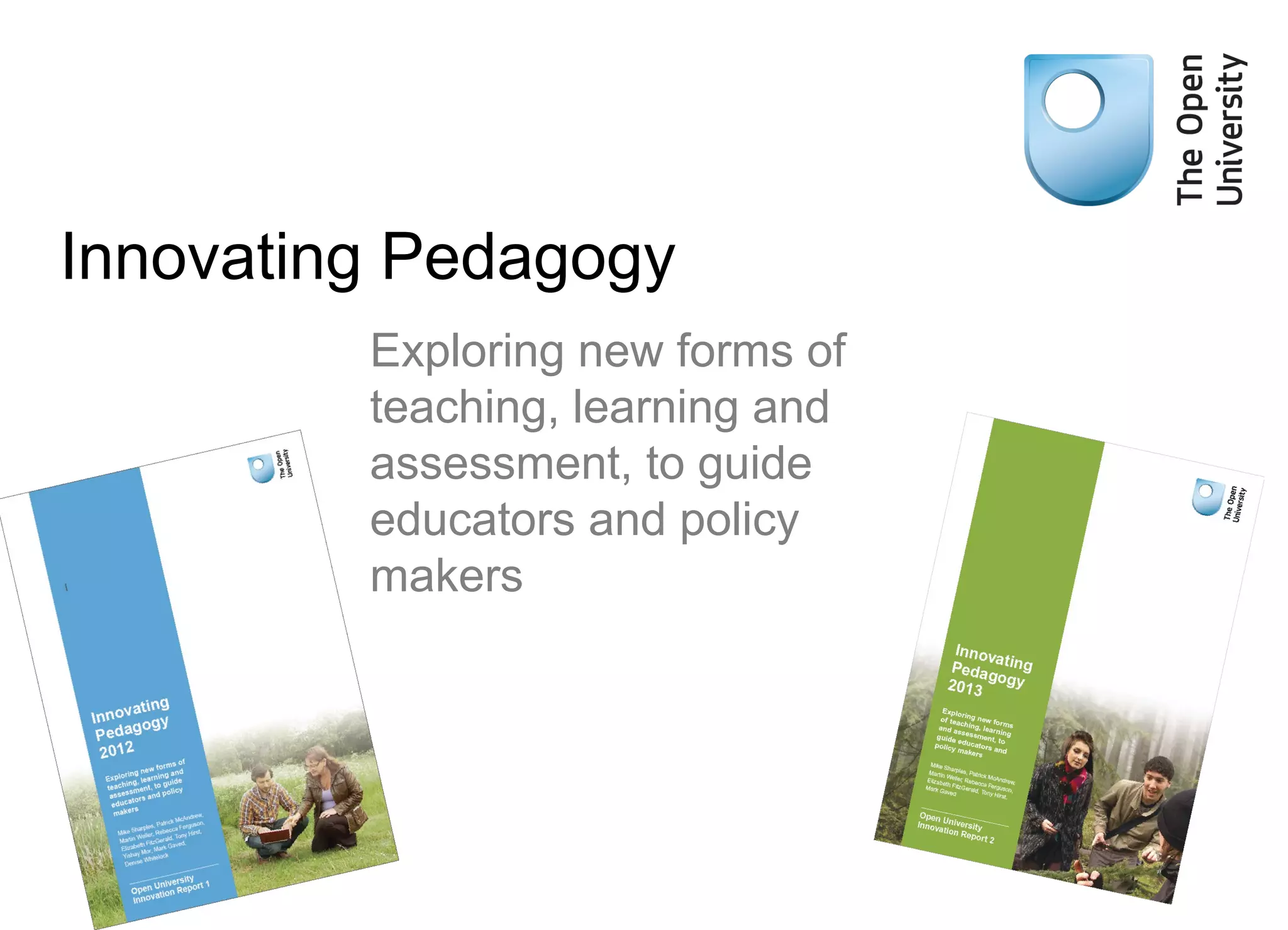
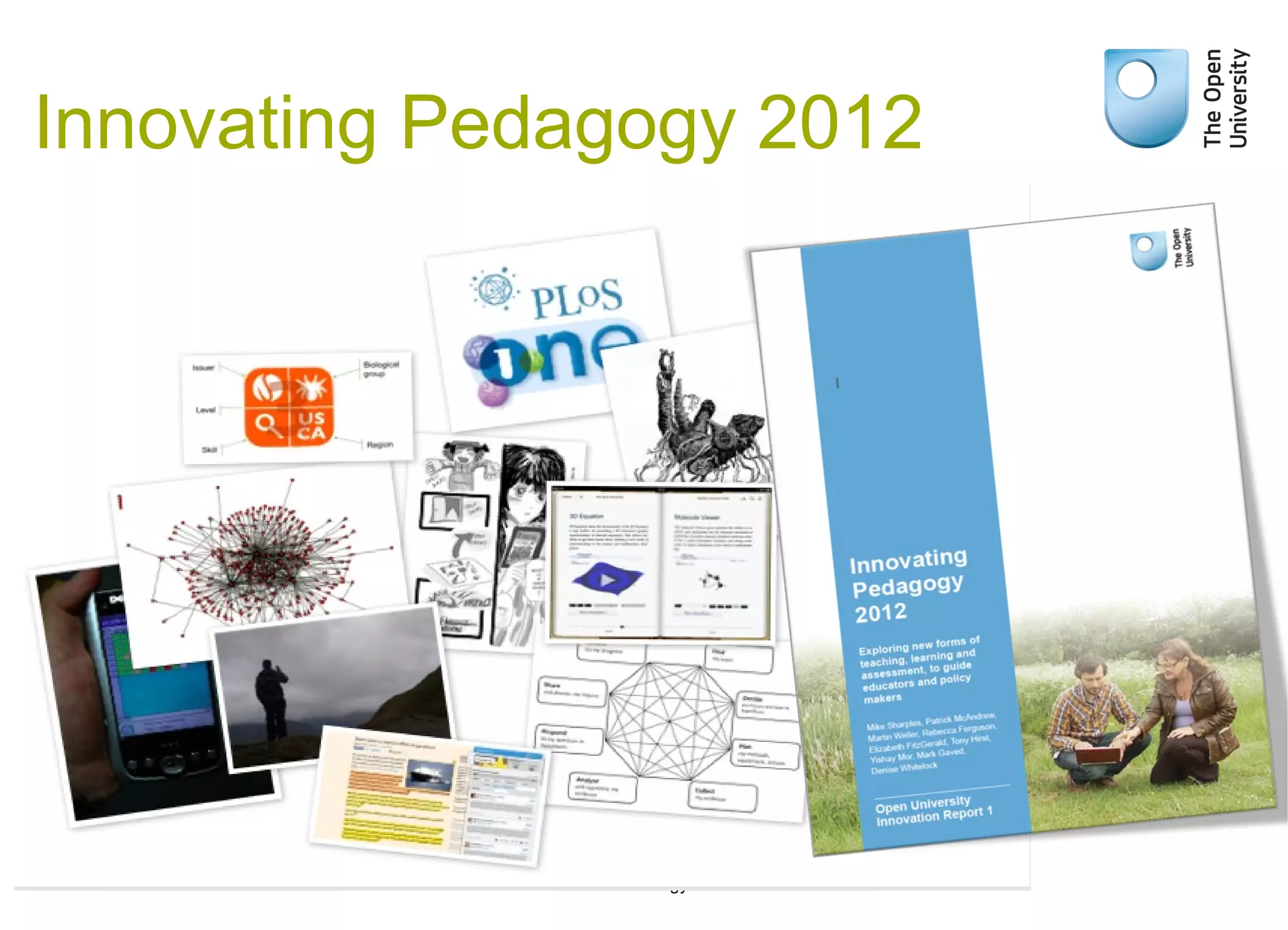
Innovating Pedagogy
Exploring new forms of
teaching, learning and
assessment, to guide
educators and policy
makers
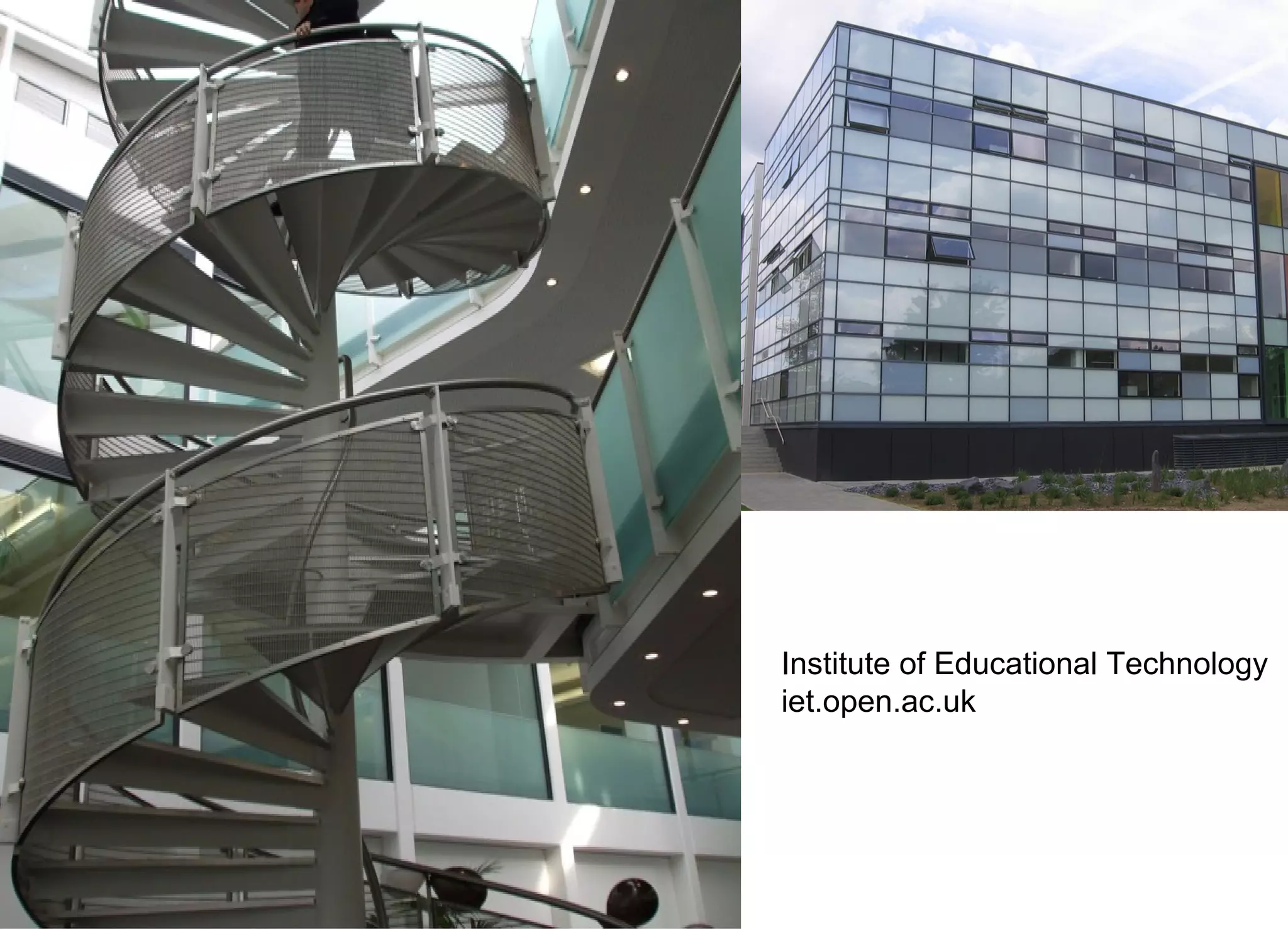
Institute of Educational Technology
iet.open.ac.uk
CC-BY-NC-SA
http://www.flickr.com/photos/57340921@N03/7527822002/
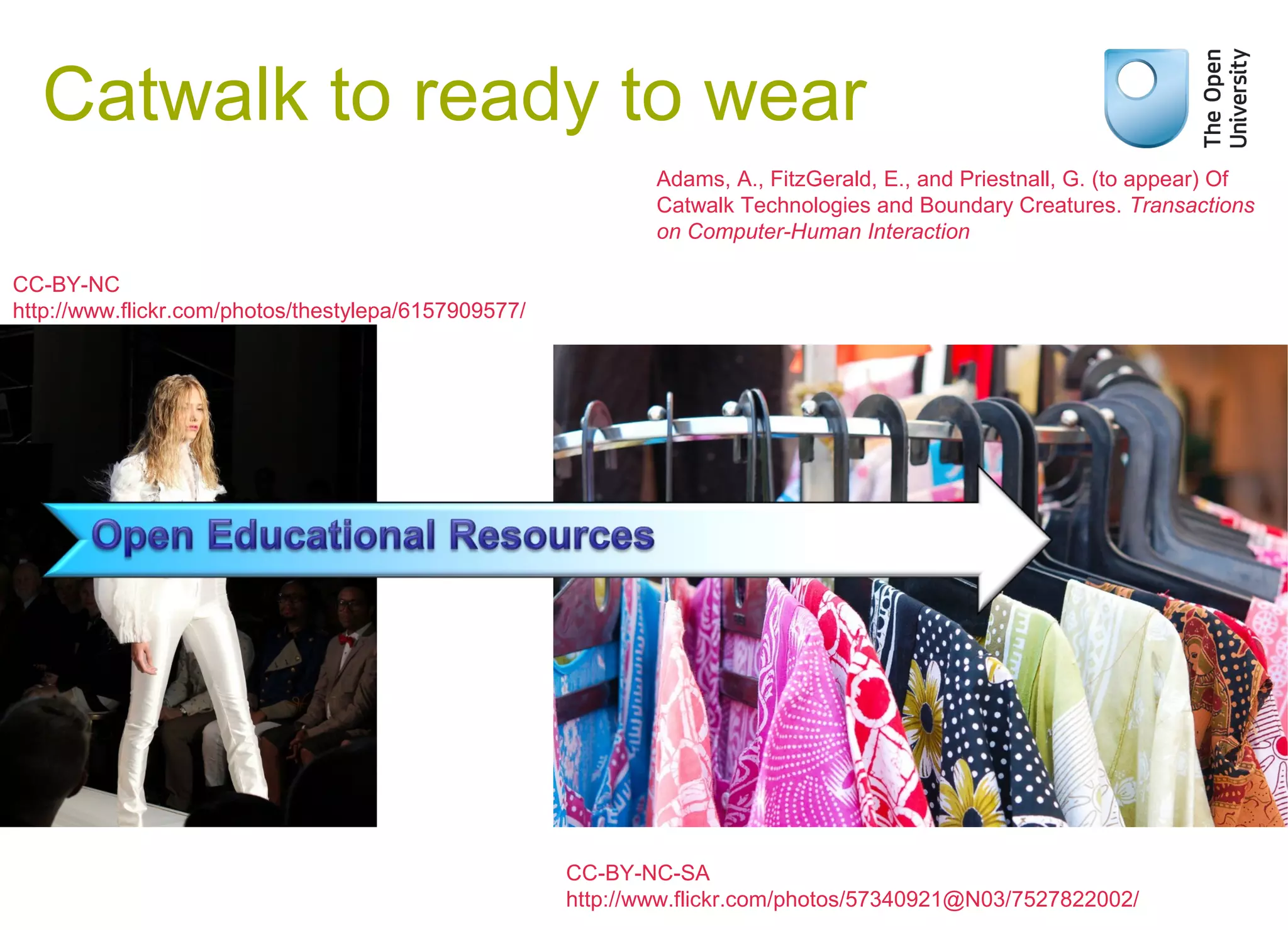
Catwalk to ready to wear
Adams, A., FitzGerald, E., and Priestnall, G. (to appear) Of
Catwalk Technologies and Boundary Creatures. Transactions
on Computer-Human Interaction
CC-BY-NC
http://www.flickr.com/photos/thestylepa/6157909577/
The Open University is open to
people, places, methods and ideas.
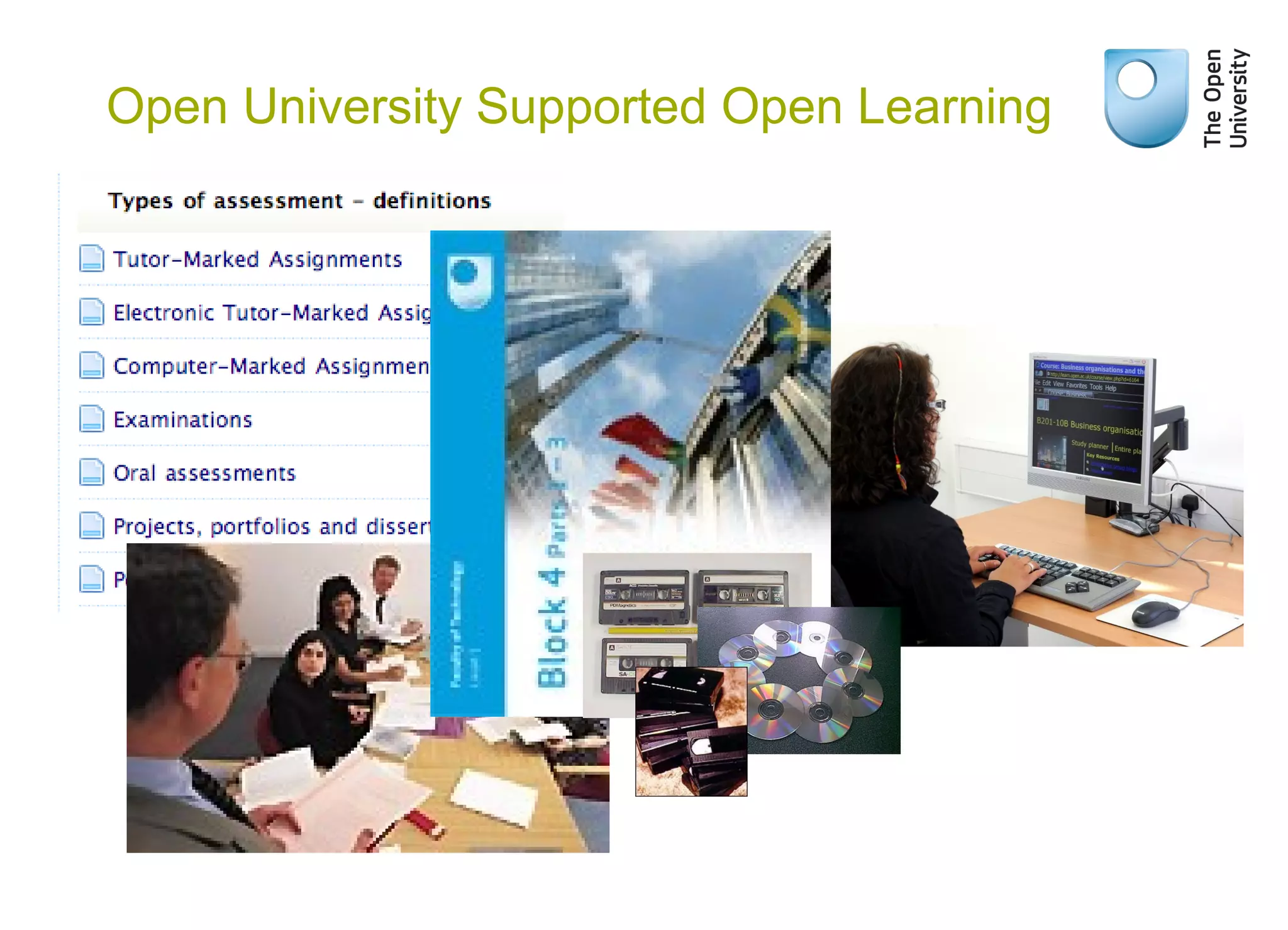
Open University Supported Open Learning
“Walter Perry, told his new staff … to
design the teaching system to suit an
individual working in a lighthouse off
the coast of Scotland.”
Sir John Daniels
Lighthouse keeper
http://creativecommons.org/licenses/by-nc-sa/2.0/
Heidigoseek http://www.flickr.com/photos/75396048@N00/188730566
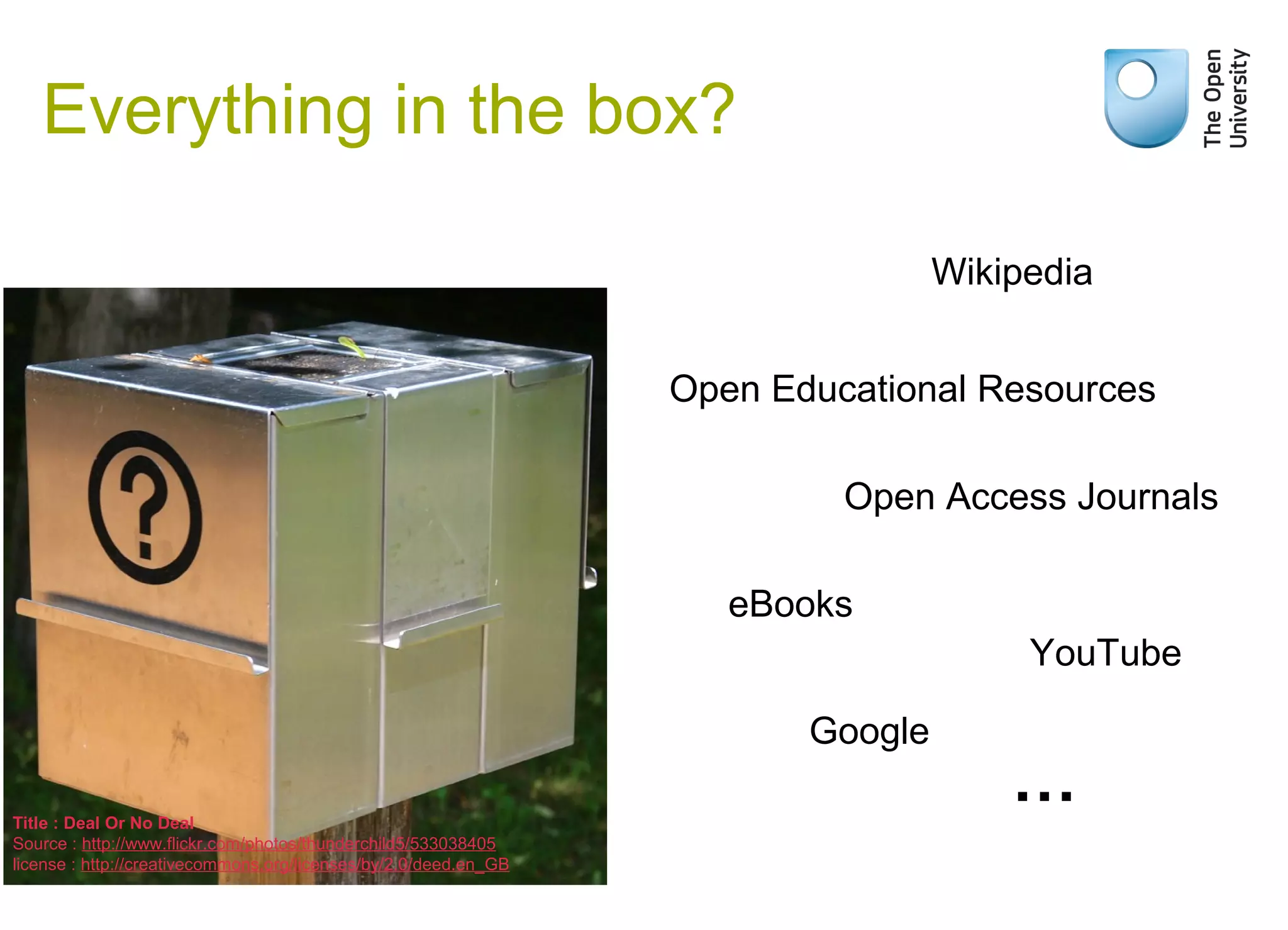
Everything in the box?
Bridge 2 Success
eBooks
Wikipedia
Open Educational Resources
Open Access Journals
Google
YouTube
Title : Deal Or No Deal
Source : http://www.flickr.com/photos/thunderchild5/533038405
license : http://creativecommons.org/licenses/by/2.0/deed.en_GB
…
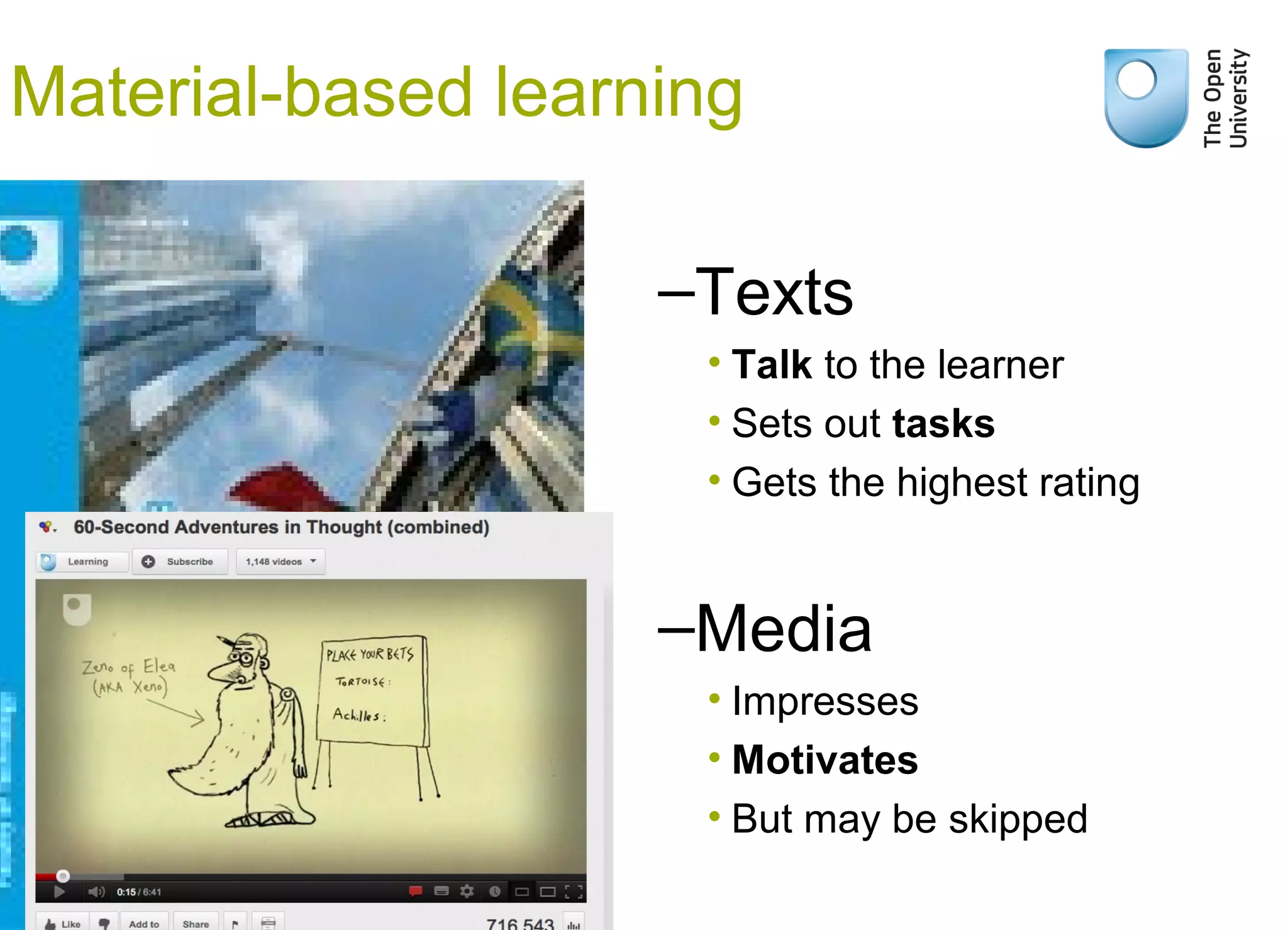
–Media
• Impresses
• Motivates
• But may be skipped
Material-based learning
Bridge 2 Success
–Texts
• Talk to the learner
• Sets out tasks
• Gets the highest rating
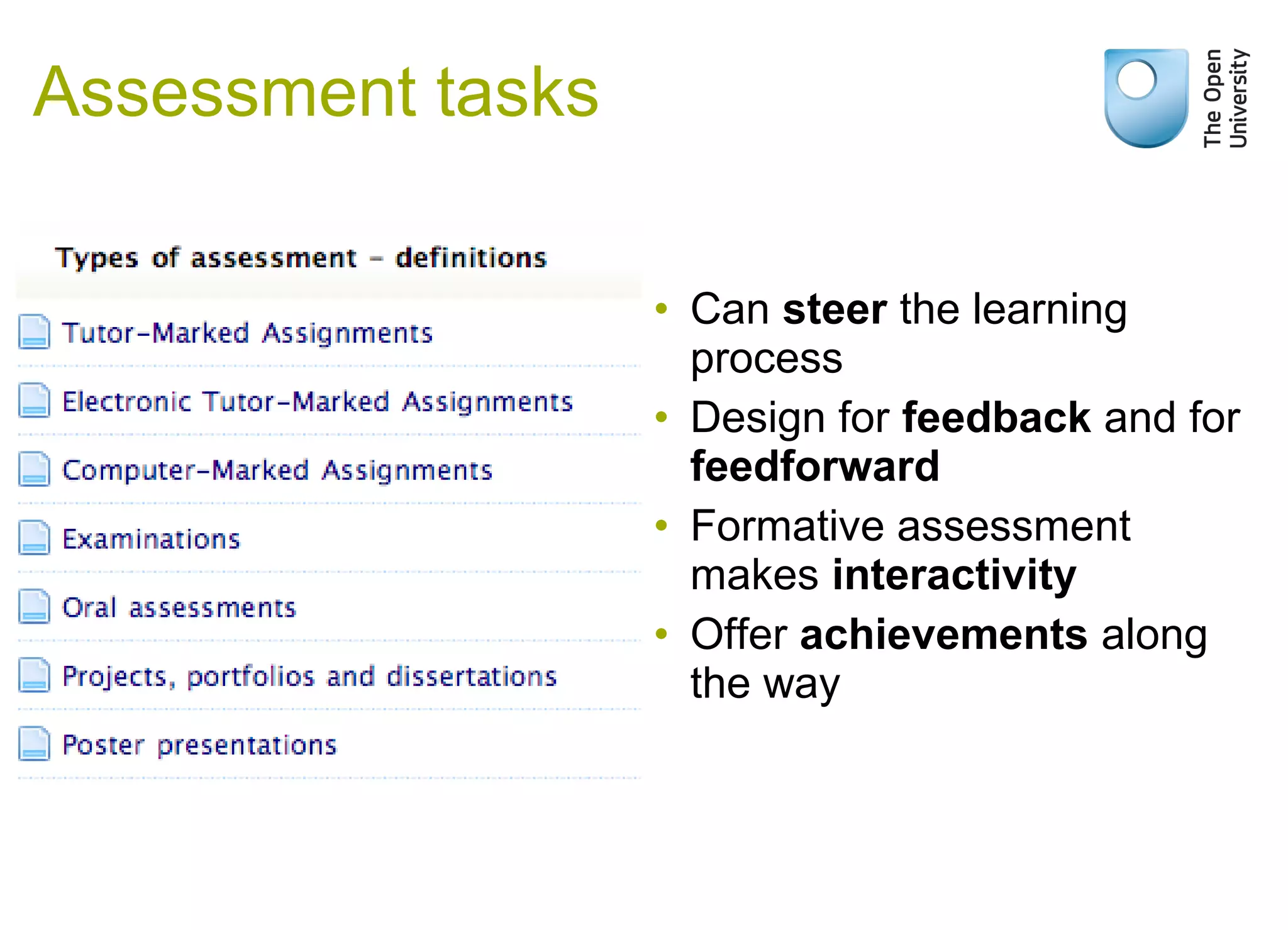
• Can steer the learning
process
• Design for feedback and for
feedforward
• Formative assessment
makes interactivity
• Offer achievements along
the way
Assessment tasks
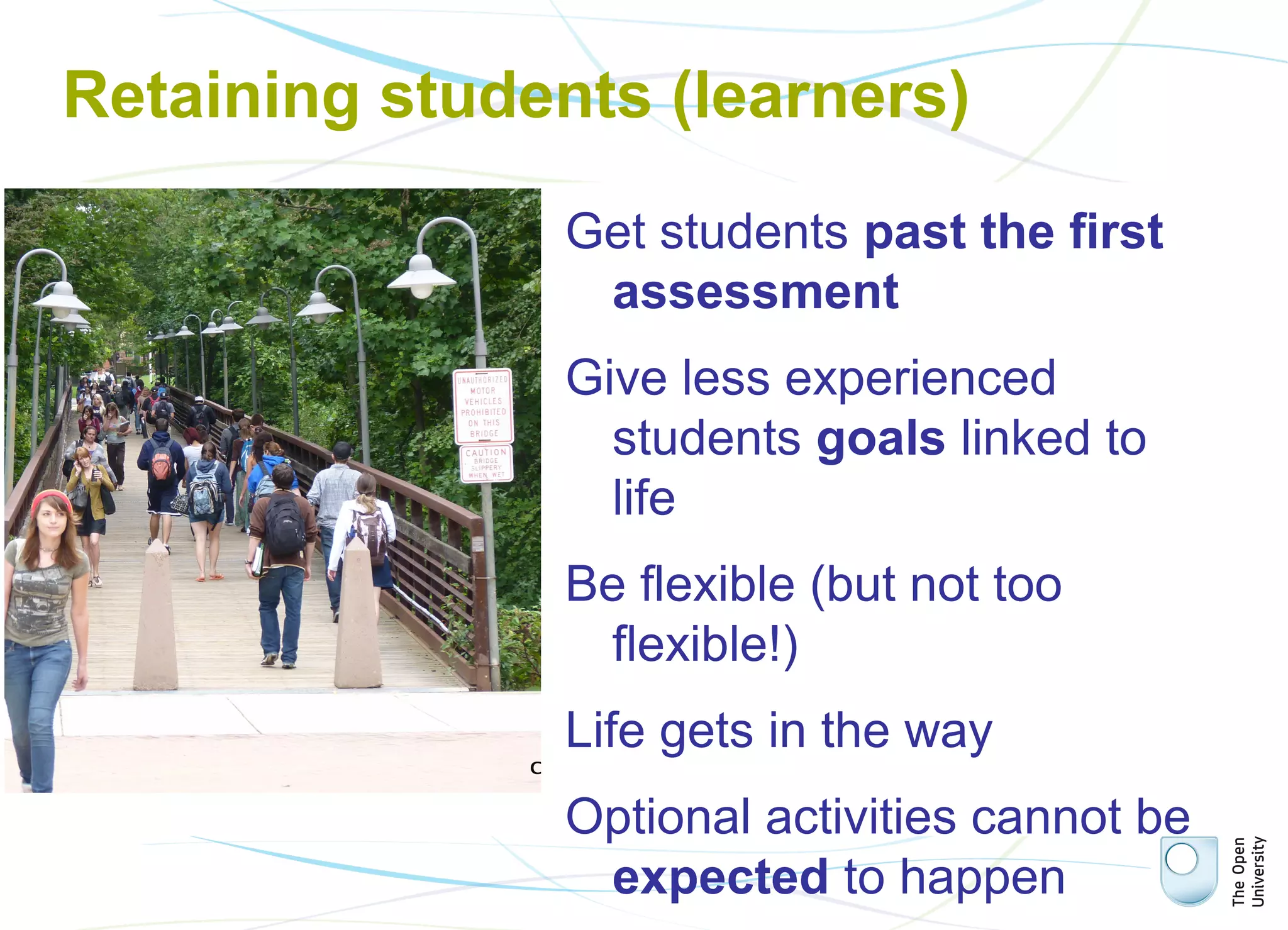
Retaining students (learners)
Get students past the first
assessment
Give less experienced
students goals linked to
life
Be flexible (but not too
flexible!)
Life gets in the way
Optional activities cannot be
expected to happen
Bounce users
Volunteer students
Social learners
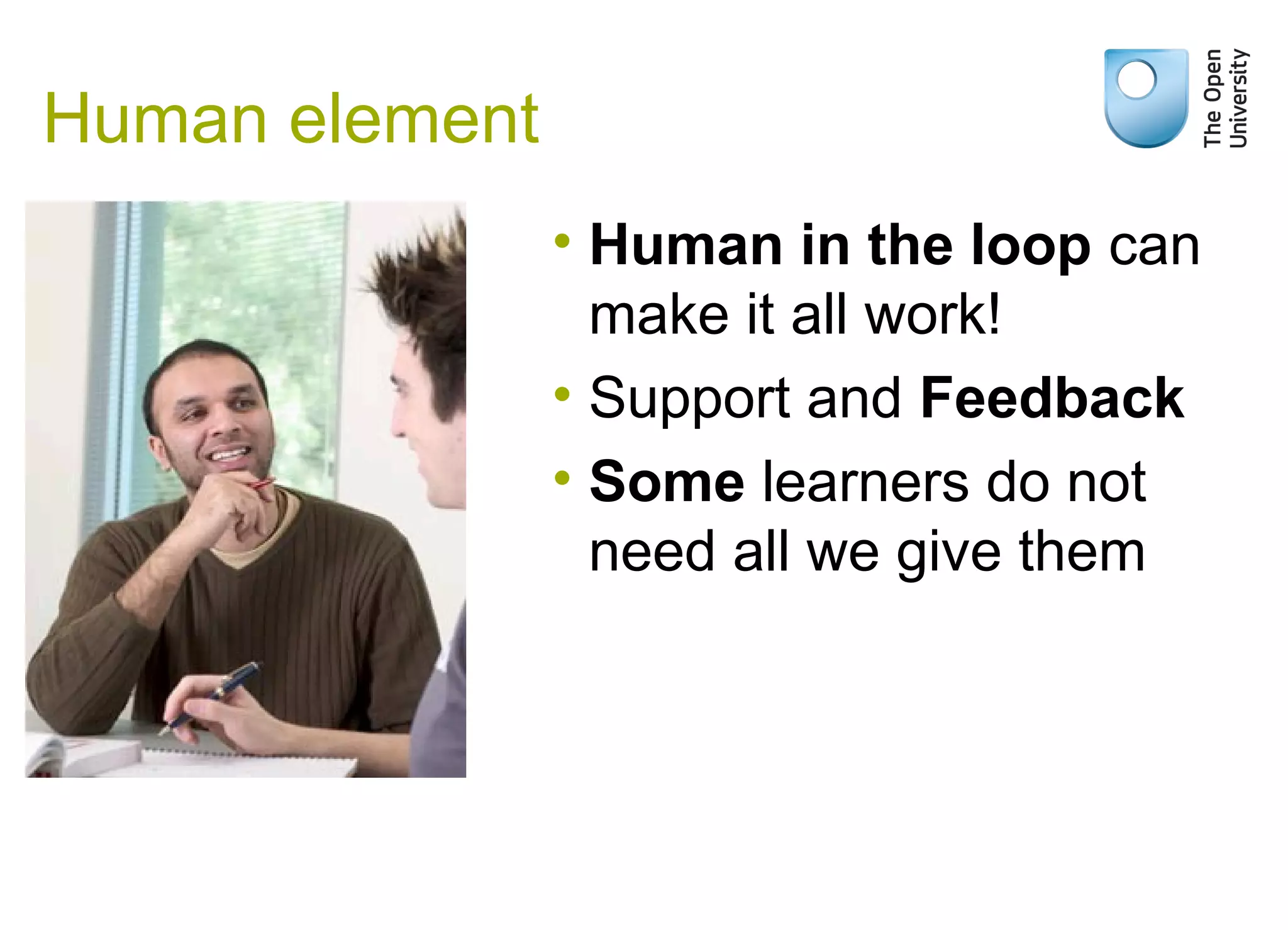
Human element
• Human in the loop can
make it all work!
• Support and Feedback
• Some learners do not
need all we give them
Equivalency Theory
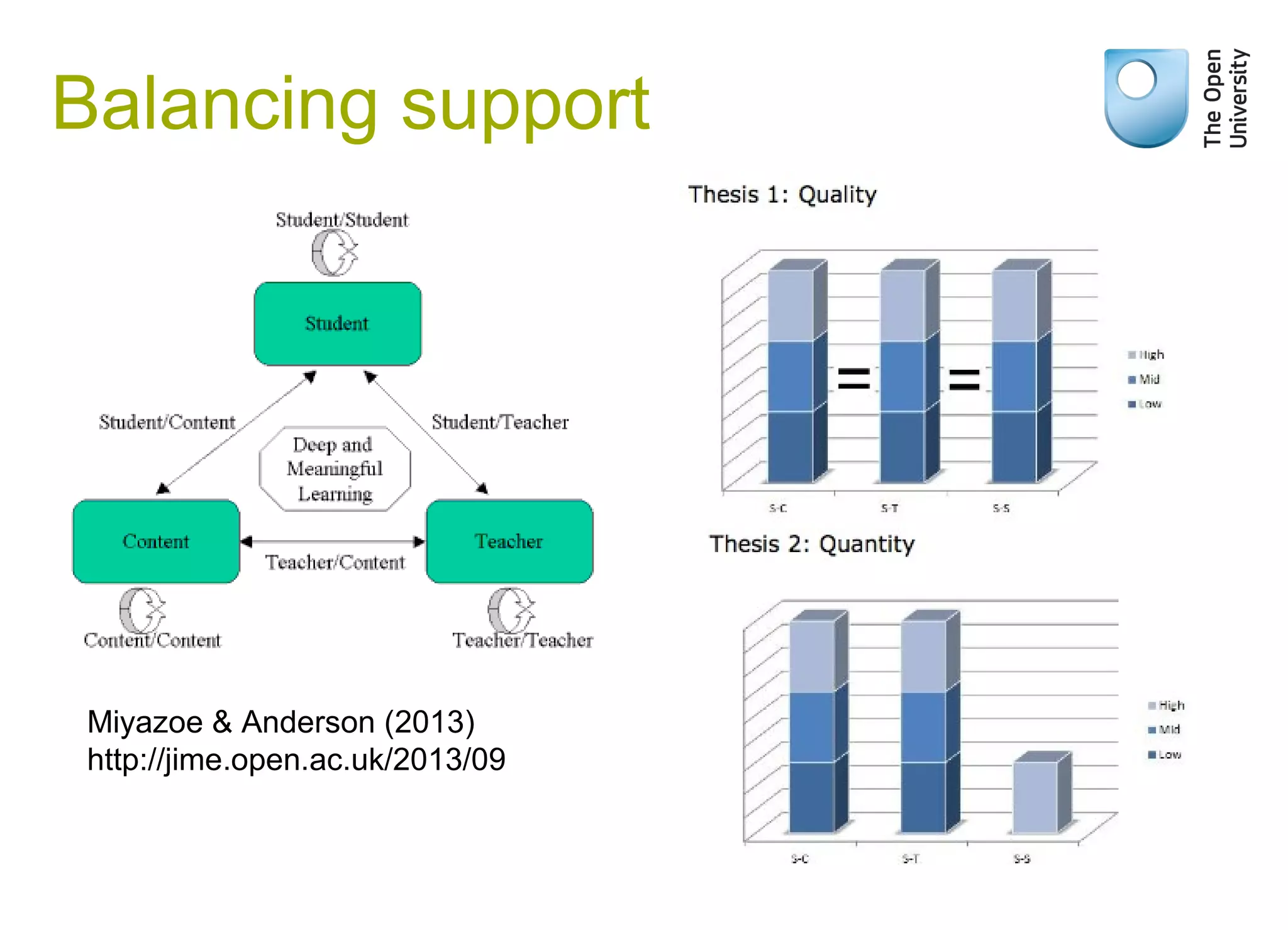
1. “Deep and meaningful formal learning is supported as long as one of the three
forms of interaction (student–teacher; student–student; student–content) is at a
high level. The other two may be offered at minimal levels, or even eliminated,
without degrading the educational experience.
2. “High levels of more than one of these three modes will likely provide a more
satisfying educational experience, although these experiences may not be as
cost- or time effective as less interactive learning sequences.”
Terry Anderson (2003)
http://equivalencytheorem.info
Balancing support
Miyazoe & Anderson (2013)
http://jime.open.ac.uk/2013/09
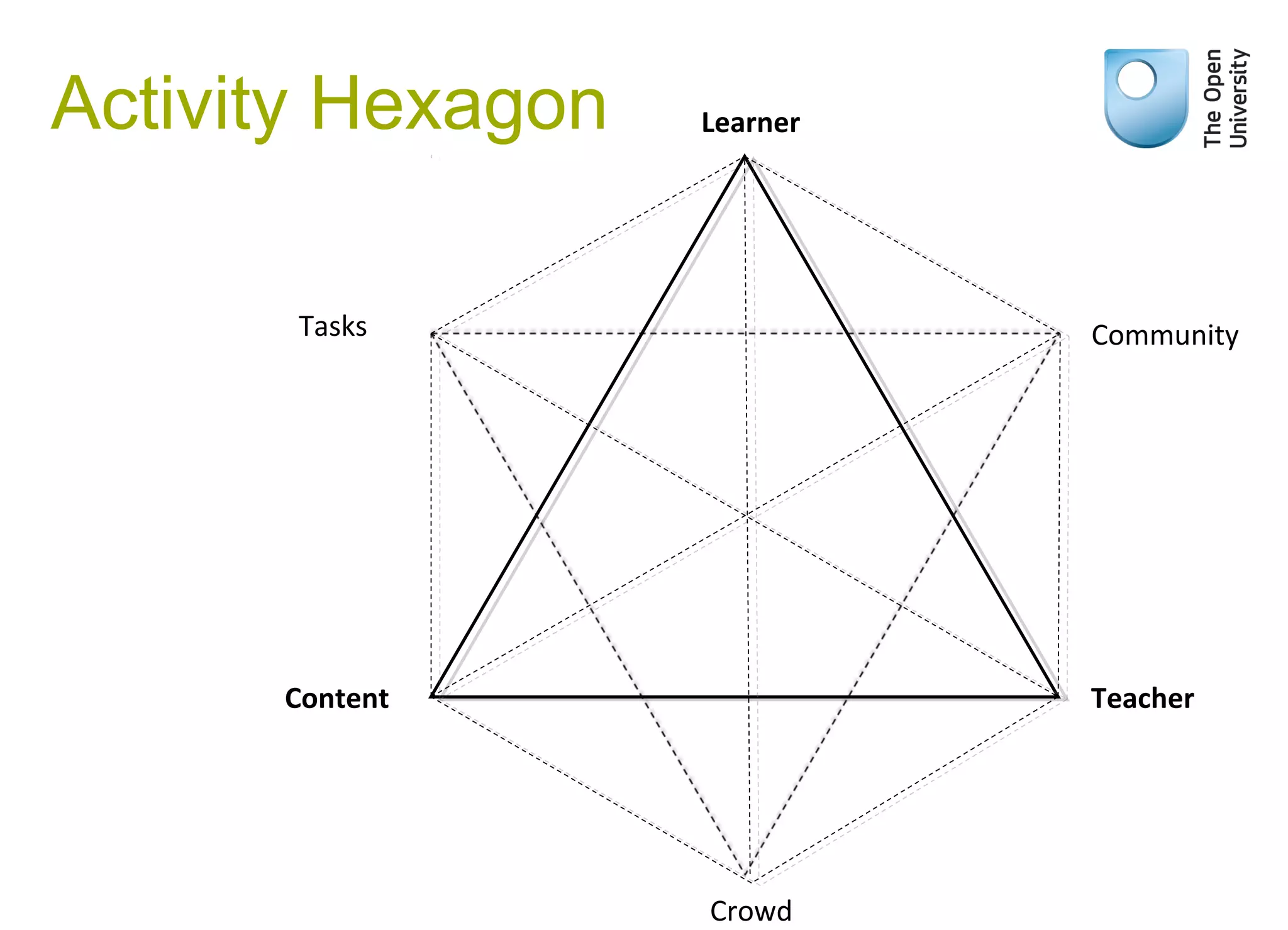
Activity Hexagon
Content
Crowd
Tasks
Teacher
Learner
Community
• Concept
–What will learners do?
–How does assessment work?
–What feedback do they get?
–What are the expected exit points?
• Practical
–How does the social and support side operate?
–Is it Accessible?
–Do you have the right content and media?
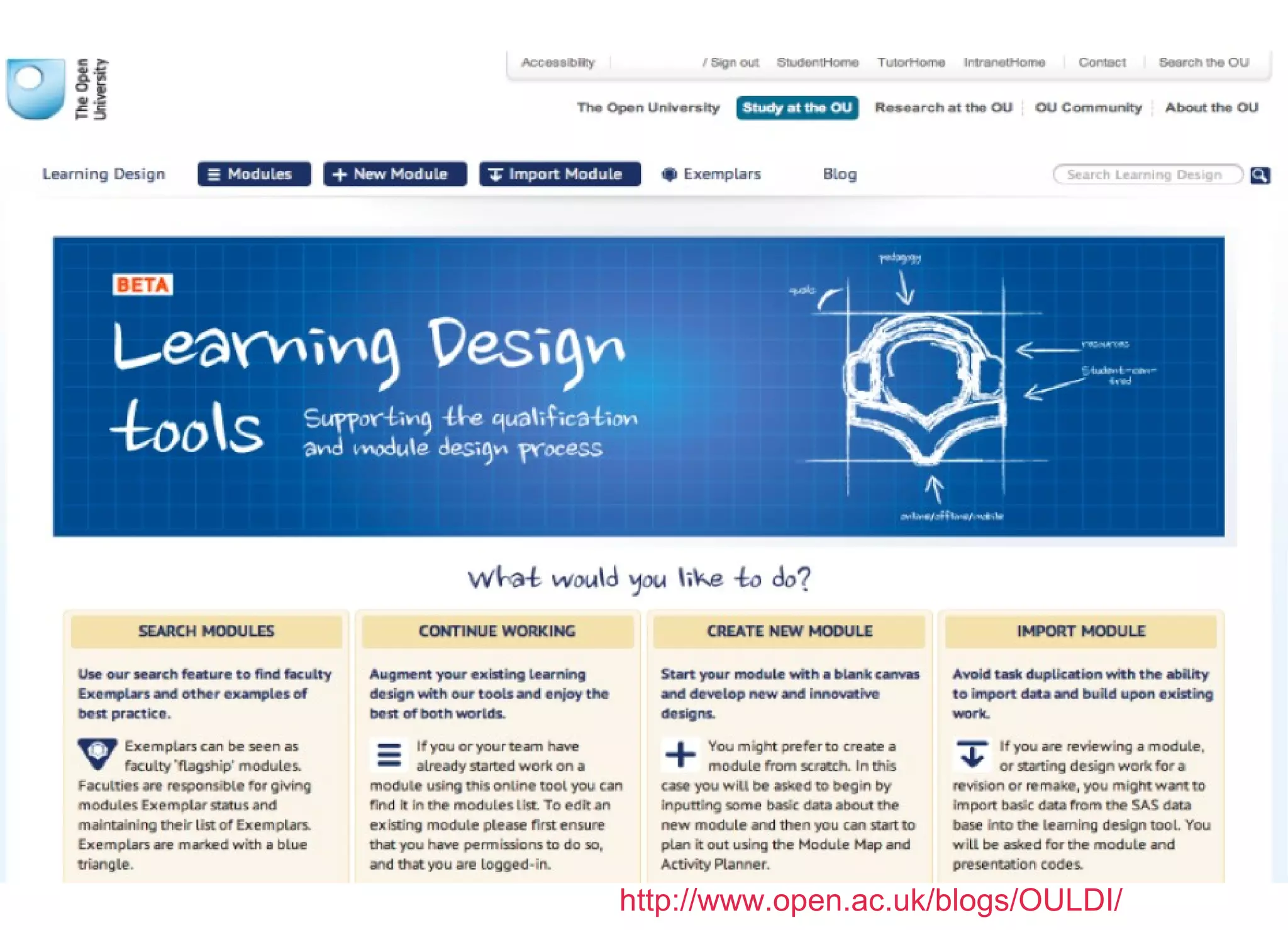
Designing for open
http://www.open.ac.uk/blogs/OULDI/
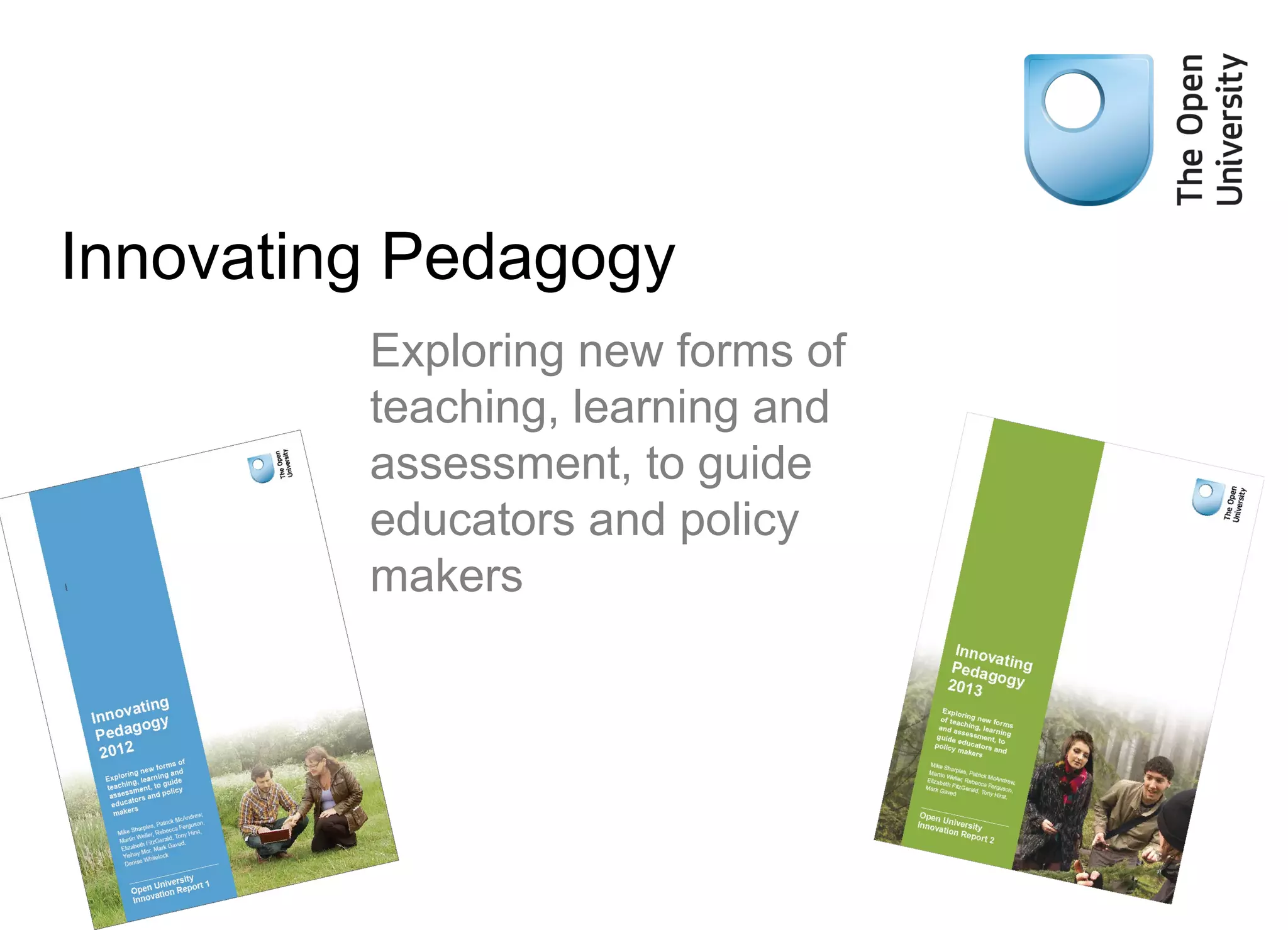
Innovating Pedagogy
Exploring new forms of
teaching, learning and
assessment, to guide
educators and policy
makers
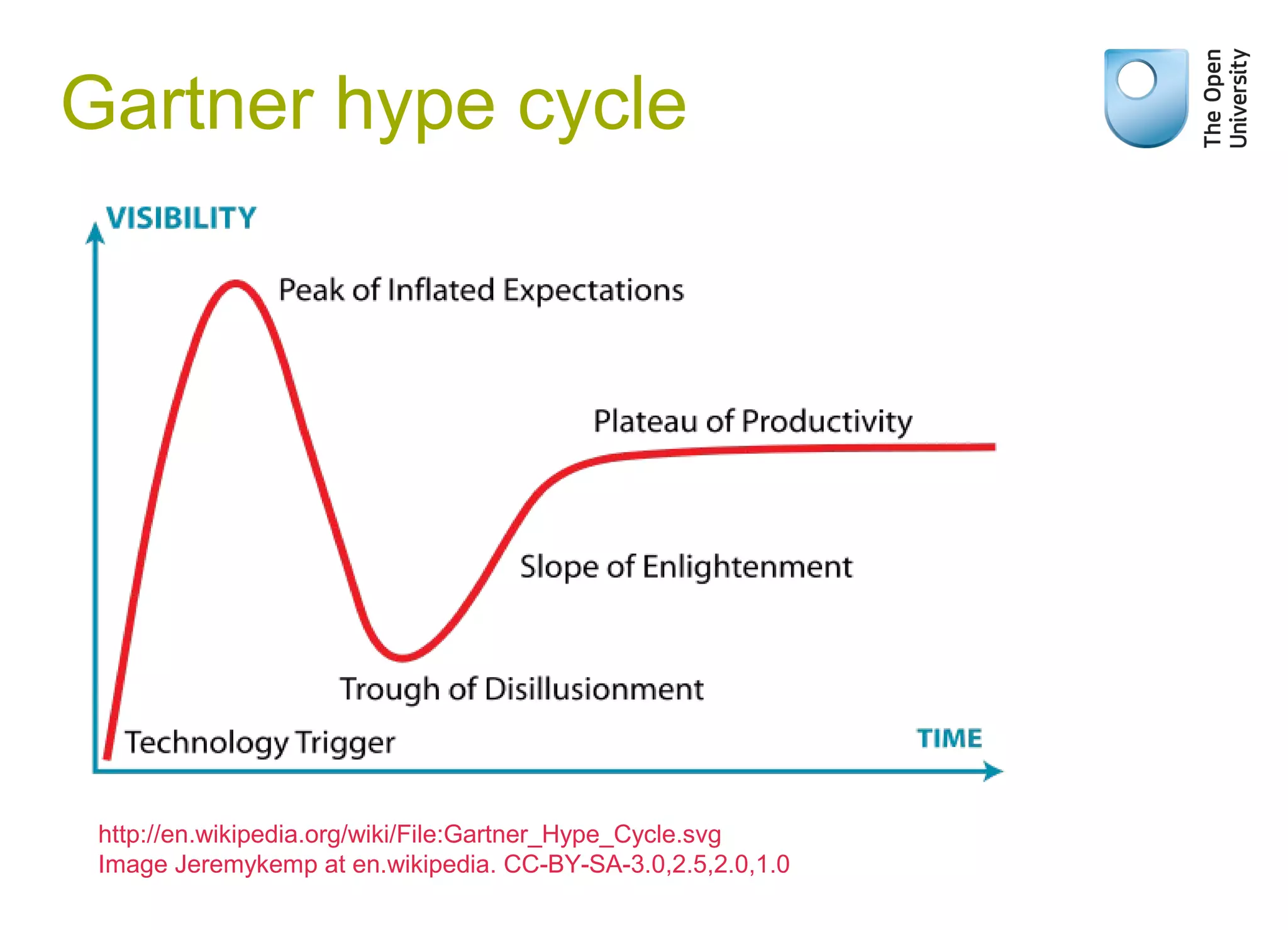
Gartner hype cycle
http://en.wikipedia.org/wiki/File:Gartner_Hype_Cycle.svg
Image Jeremykemp at en.wikipedia. CC-BY-SA-3.0,2.5,2.0,1.0
Distinguish hype from reality
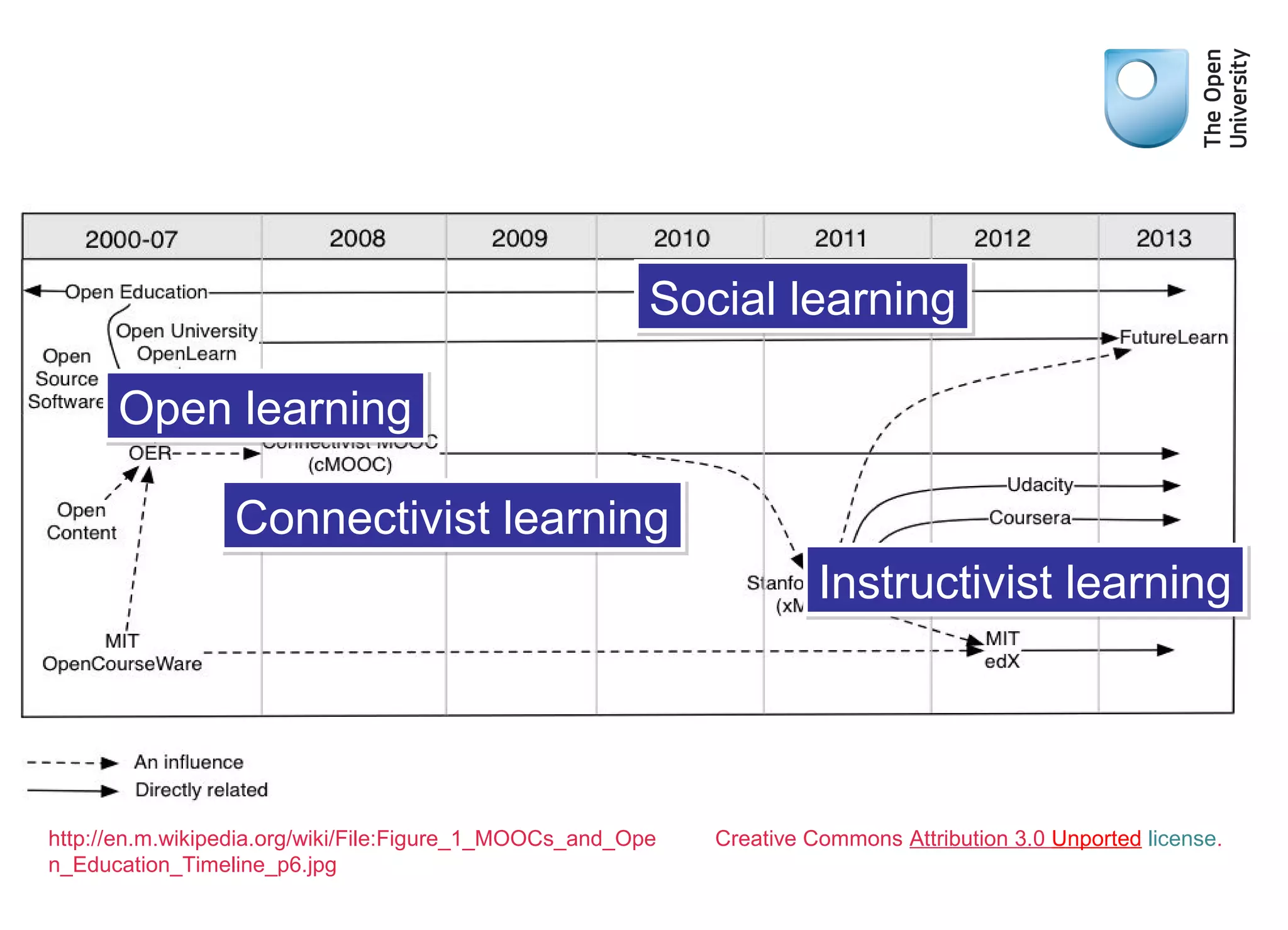
MOOCs
http://en.m.wikipedia.org/wiki/File:Figure_1_MOOCs_and_Ope
n_Education_Timeline_p6.jpg
Creative Commons Attribution 3.0 Unported license.
Distinguish hype from reality
Connectivist learningConnectivist learning
Instructivist learningInstructivist learning
Social learningSocial learning
Open learningOpen learning
The Open University's Institute of Educational
Technology
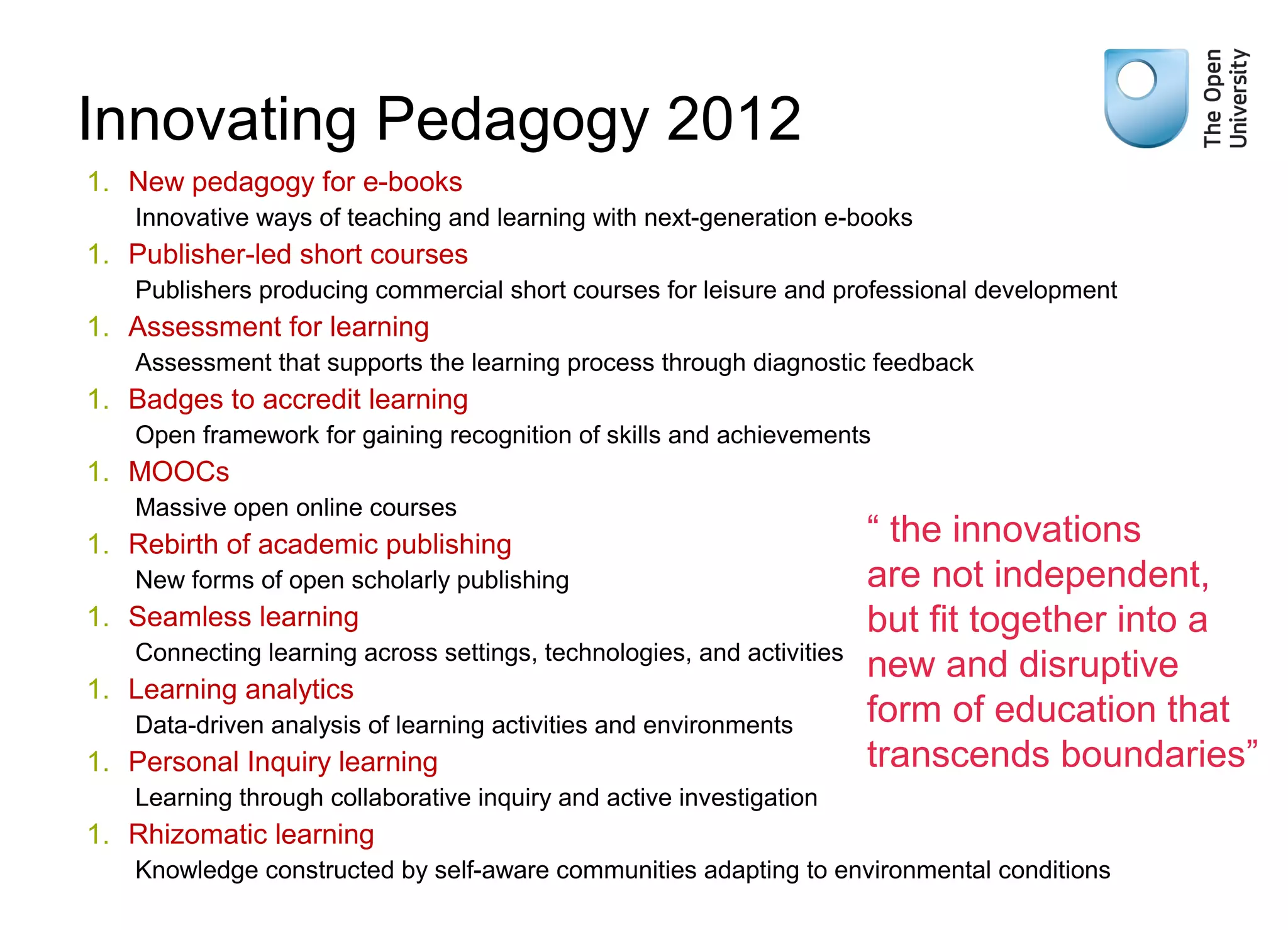
Innovating Pedagogy 2012
1. New pedagogy for e-books
Innovative ways of teaching and learning with next-generation e-books
1. Publisher-led short courses
Publishers producing commercial short courses for leisure and professional development
1. Assessment for learning
Assessment that supports the learning process through diagnostic feedback
1. Badges to accredit learning
Open framework for gaining recognition of skills and achievements
1. MOOCs
Massive open online courses
1. Rebirth of academic publishing
New forms of open scholarly publishing
1. Seamless learning
Connecting learning across settings, technologies, and activities
1. Learning analytics
Data-driven analysis of learning activities and environments
1. Personal Inquiry learning
Learning through collaborative inquiry and active investigation
1. Rhizomatic learning
Knowledge constructed by self-aware communities adapting to environmental conditions
“ the innovations
are not independent,
but fit together into a
new and disruptive
form of education that
transcends boundaries”
Innovating Pedagogy 2012
Weak signals
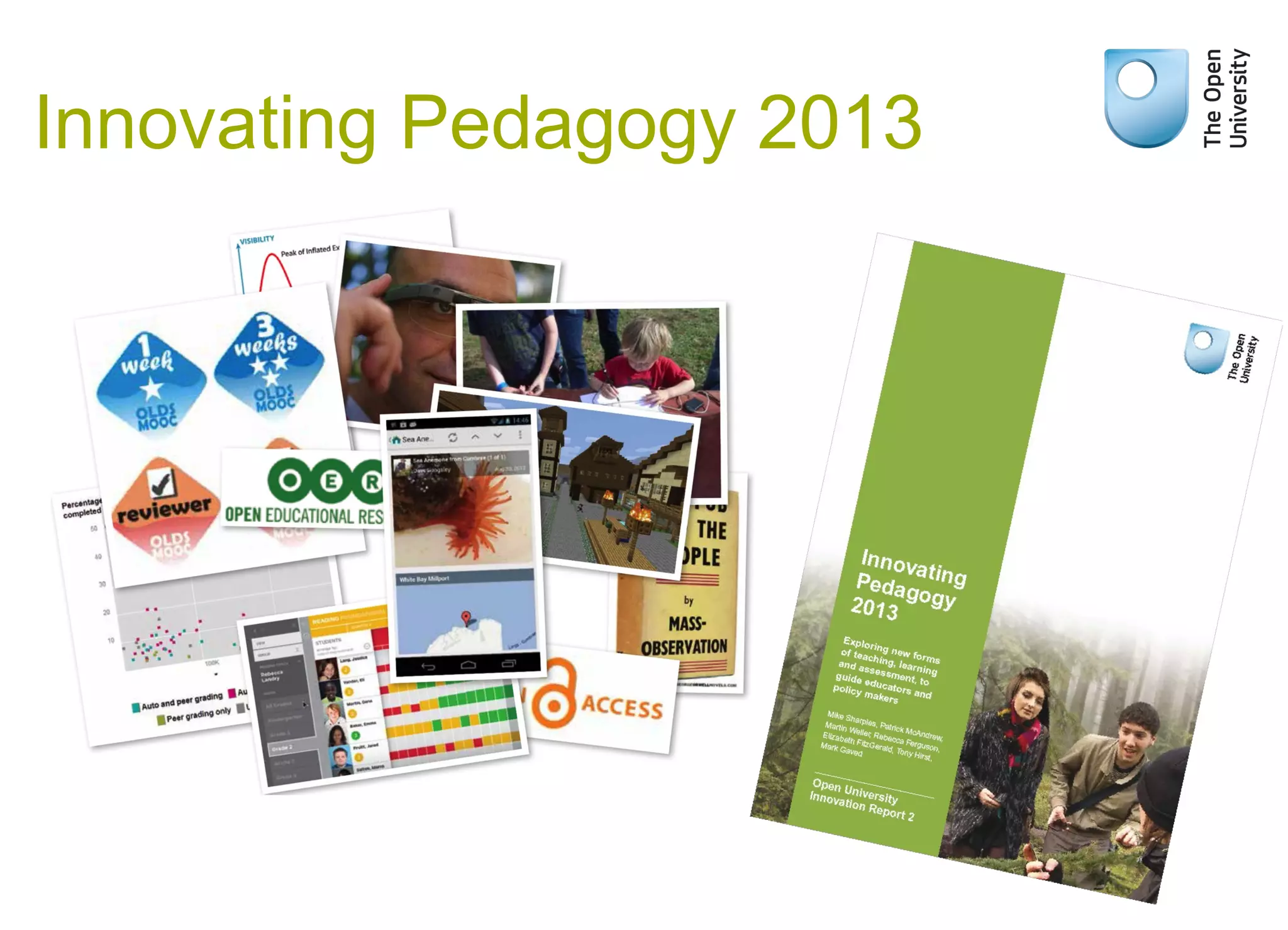
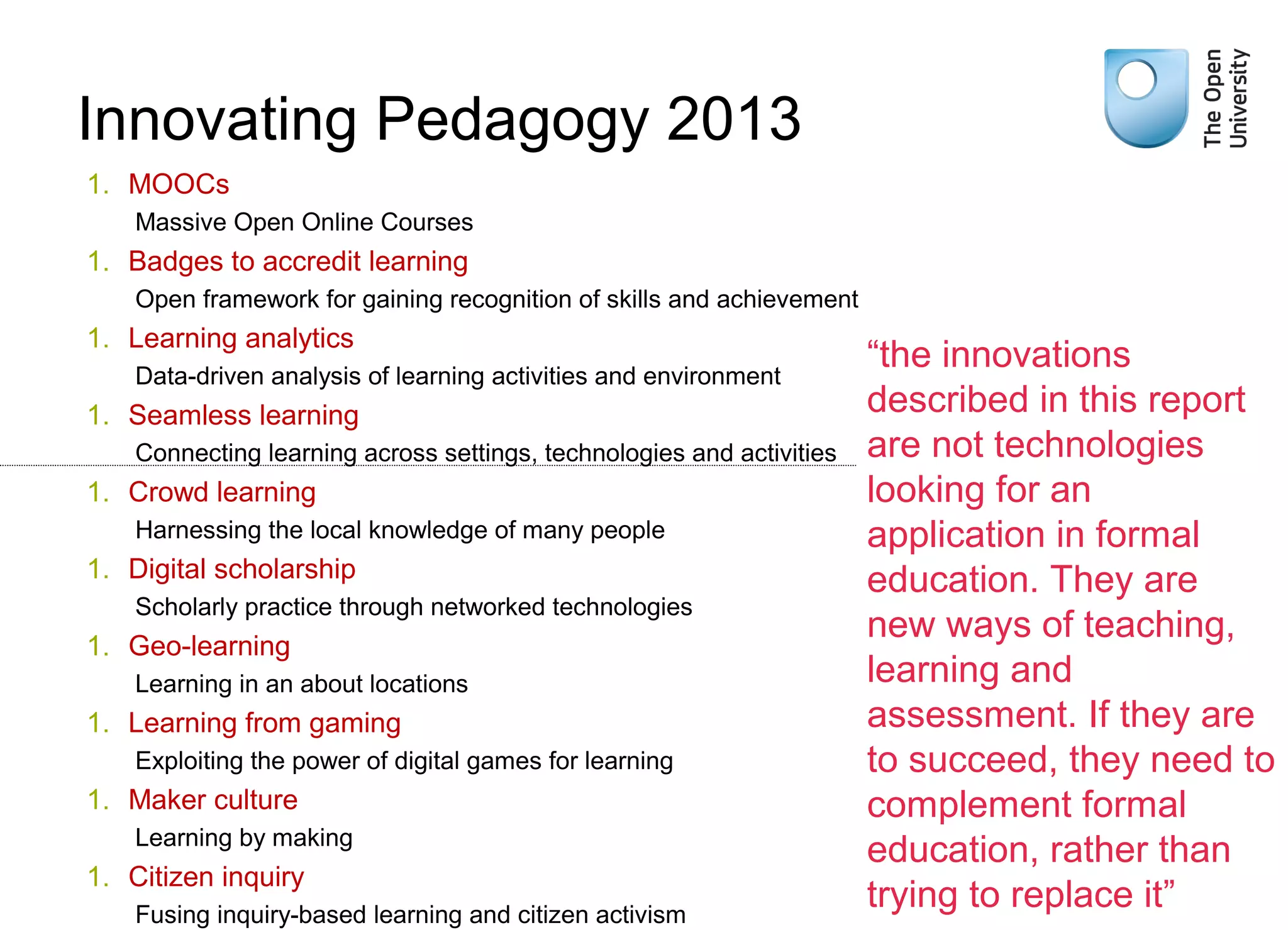
Innovating Pedagogy 2013
1. MOOCs
Massive Open Online Courses
1. Badges to accredit learning
Open framework for gaining recognition of skills and achievement
1. Learning analytics
Data-driven analysis of learning activities and environment
1. Seamless learning
Connecting learning across settings, technologies and activities
1. Crowd learning
Harnessing the local knowledge of many people
1. Digital scholarship
Scholarly practice through networked technologies
1. Geo-learning
Learning in an about locations
1. Learning from gaming
Exploiting the power of digital games for learning
1. Maker culture
Learning by making
1. Citizen inquiry
Fusing inquiry-based learning and citizen activism
“the innovations
described in this report
are not technologies
looking for an
application in formal
education. They are
new ways of teaching,
learning and
assessment. If they are
to succeed, they need to
complement formal
education, rather than
trying to replace it”
Innovating Pedagogy 2013
Weak signals
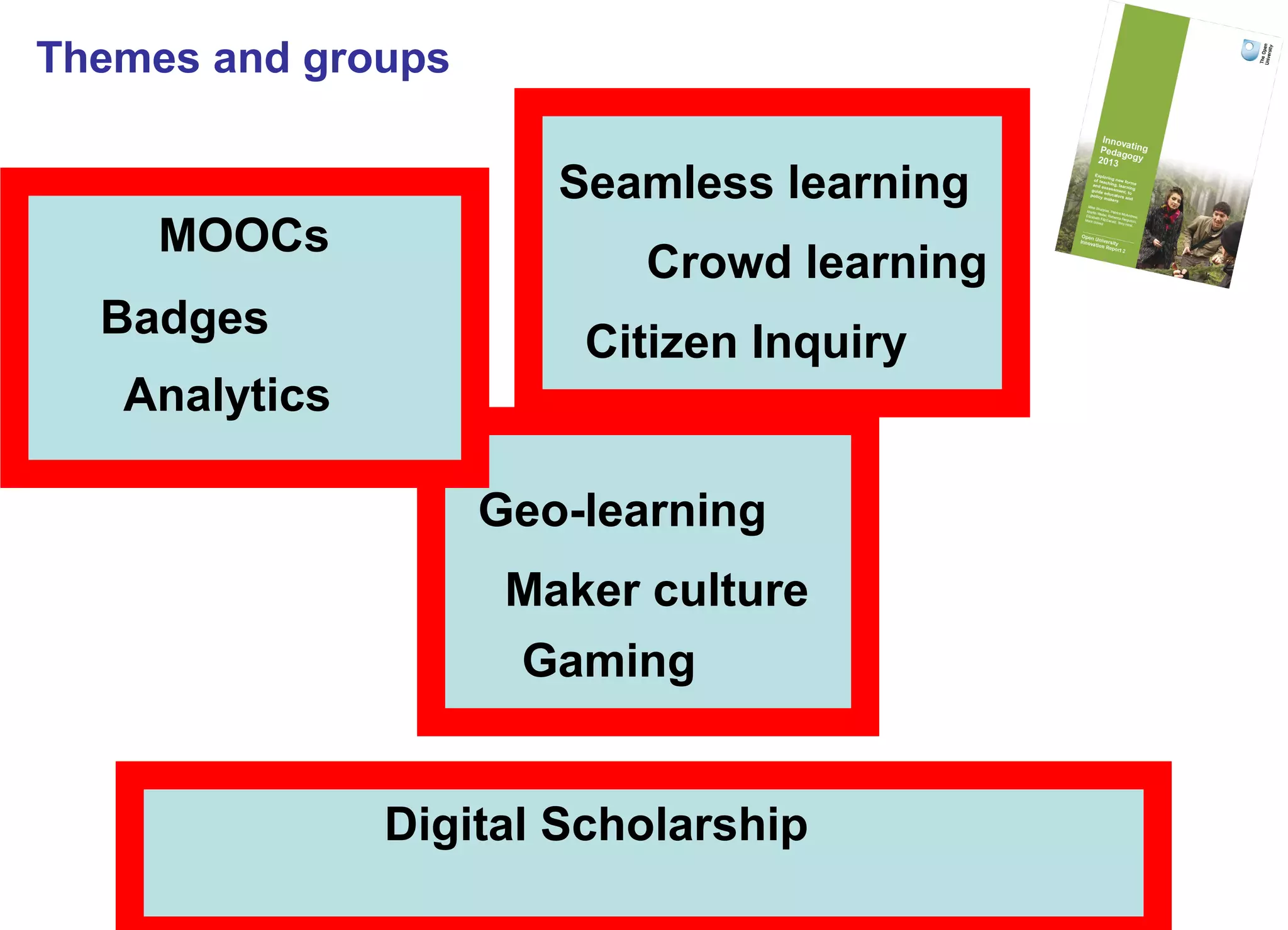
MOOCs
Gaming
Citizen Inquiry
Analytics
Crowd learning
Digital Scholarship
Geo-learning
Badges
Seamless learning
Maker culture
Themes and groups
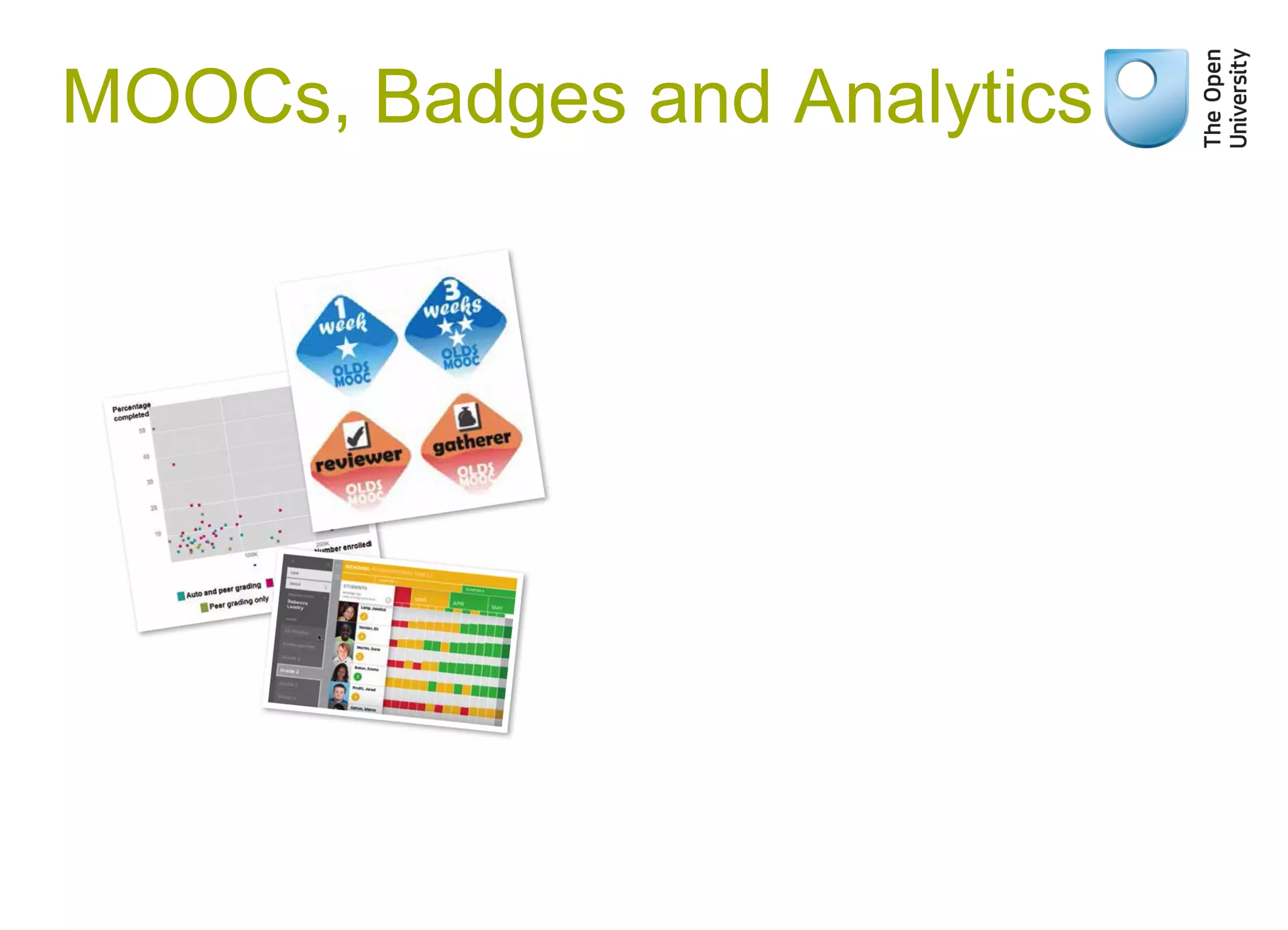
MOOCs, Badges and Analytics
MOOCs
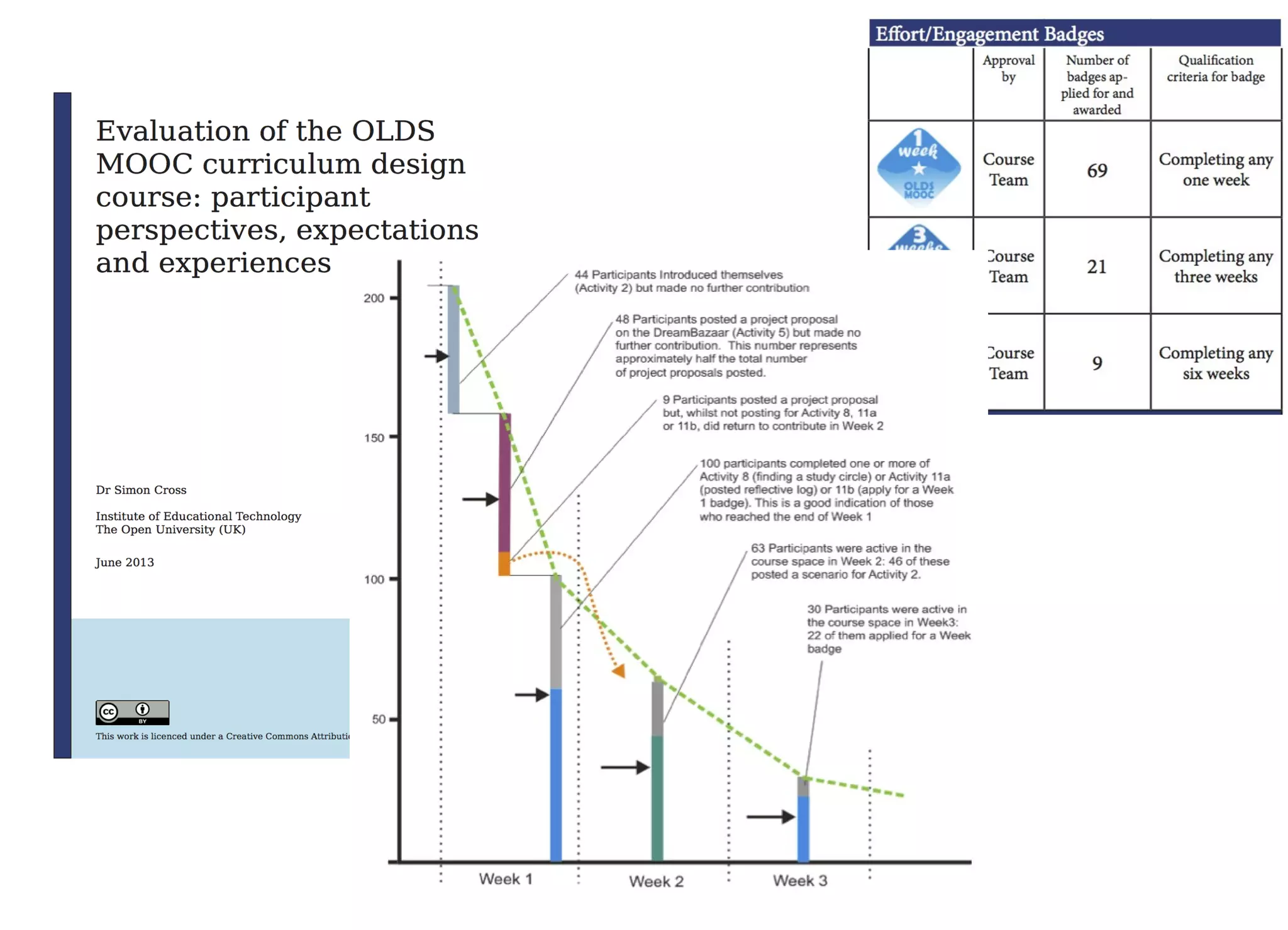
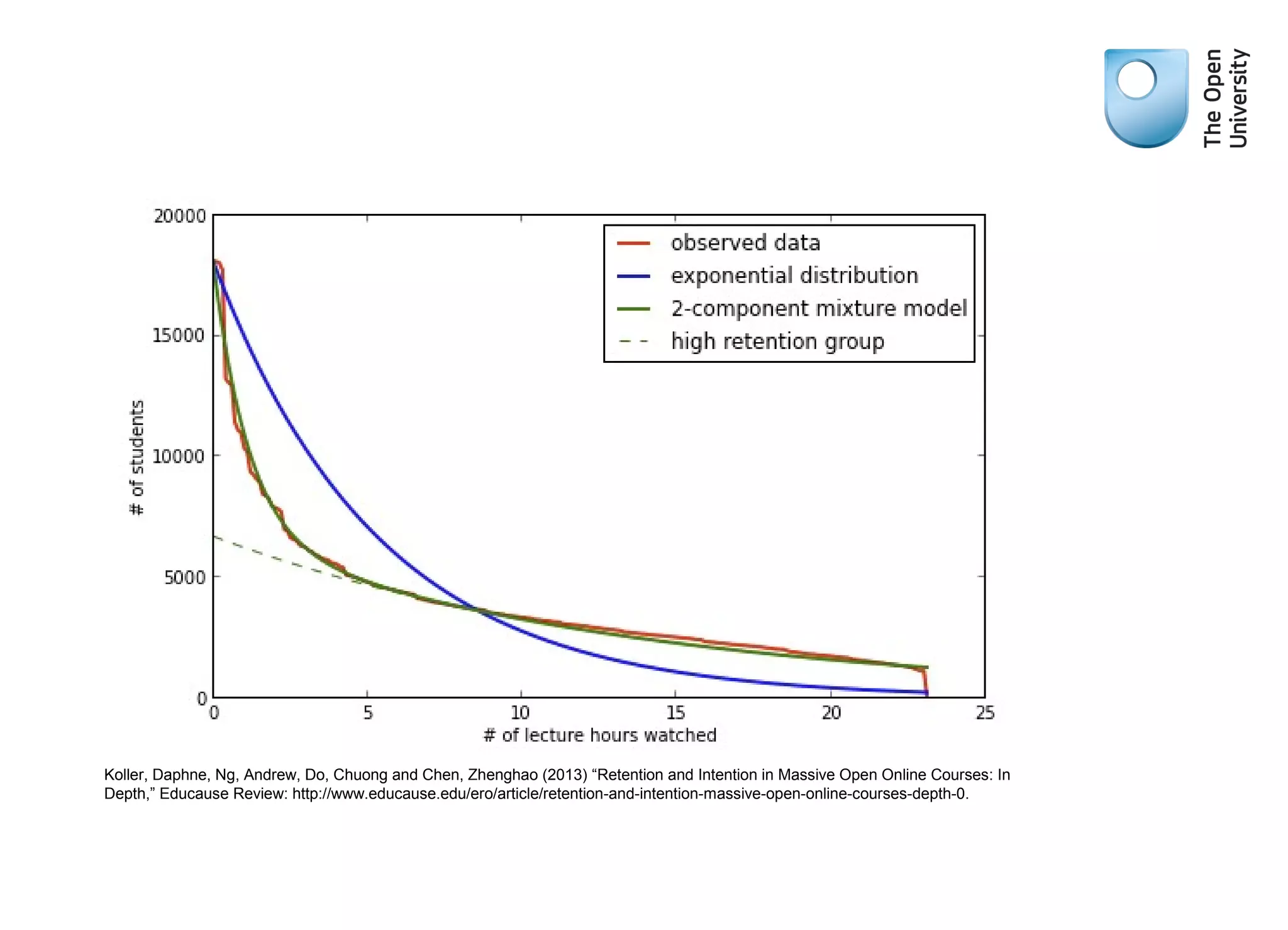
“… ways need to be found to support less experienced
students and those lacking confidence.
Pedagogies that could benefit such learners are missing
from much of the first wave of massive courses. These
pedagogies include materials designed to provide an
integrated learning experience, feedback that is
customised to meet learner needs, and direct mentoring of
learners in difficulties. Some of these are hard to supply in
a cost-free model. Social learning and peer support may
provide alternative ways of generating some of the
feedback that is needed.”
Weak signals
olnet.org
Koller, Daphne, Ng, Andrew, Do, Chuong and Chen, Zhenghao (2013) “Retention and Intention in Massive Open Online Courses: In
Depth,” Educause Review: http://www.educause.edu/ero/article/retention-and-intention-massive-open-online-courses-depth-0.
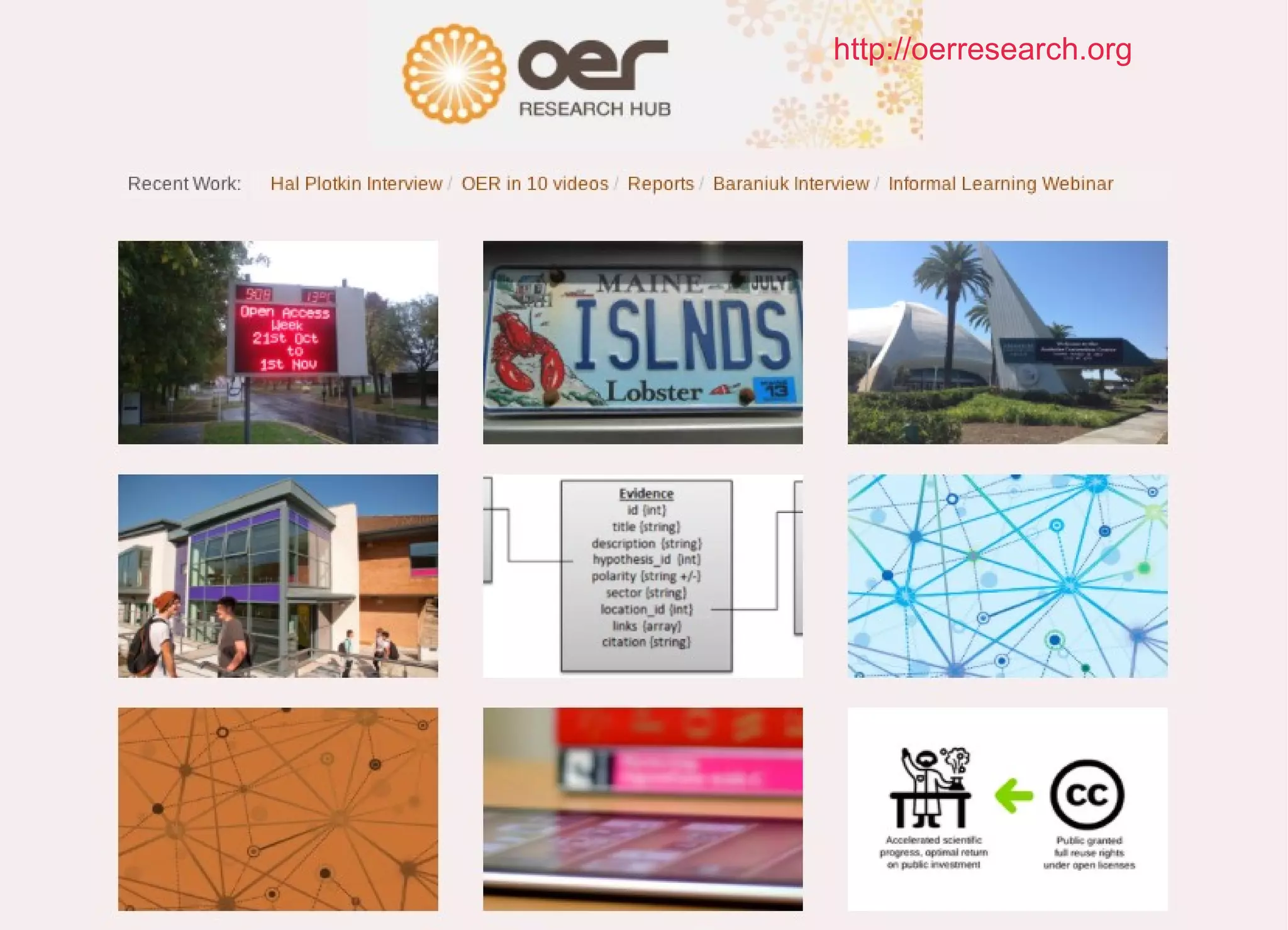
oerresearchub.org
http://oerresearch.org
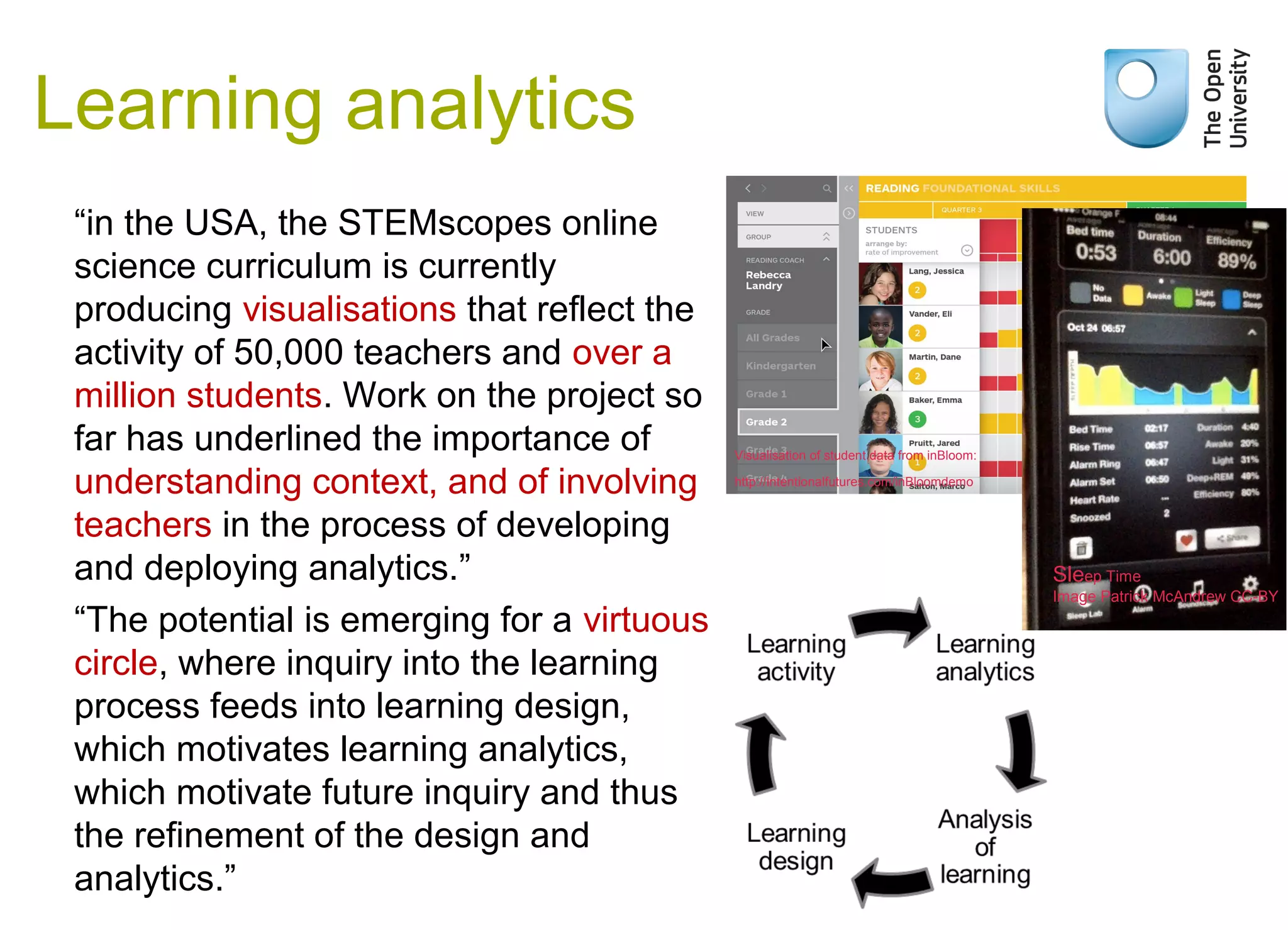
“in the USA, the STEMscopes online
science curriculum is currently
producing visualisations that reflect the
activity of 50,000 teachers and over a
million students. Work on the project so
far has underlined the importance of
understanding context, and of involving
teachers in the process of developing
and deploying analytics.”
“The potential is emerging for a virtuous
circle, where inquiry into the learning
process feeds into learning design,
which motivates learning analytics,
which motivate future inquiry and thus
the refinement of the design and
analytics.”
Learning analytics
Weak signals
Visualisation of student data from inBloom:
http://intentionalfutures.com/inBloomdemo
Sleep Time
Image Patrick McAndrew CC-BY
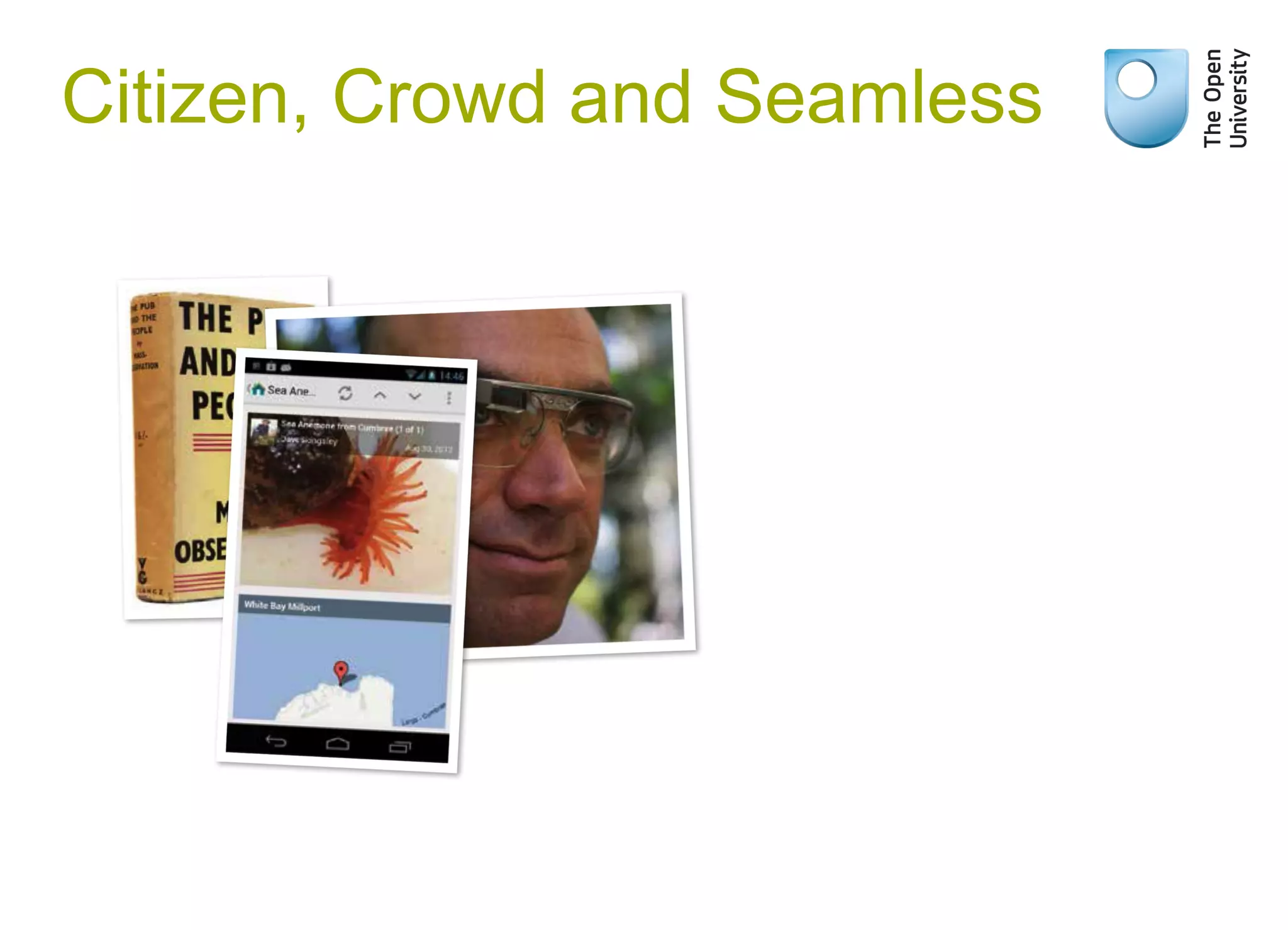
Citizen, Crowd and Seamless
“Seamless learning [is] connecting learning
experiences across locations, times, technologies or
social settings. Mobile technologies are enabling
learning to continue across contexts, so a piece of
work started in the classroom can be continued at
home; and ideas that occur on the move can be
shared with colleagues online, then followed up in
person.”
Seamless learning
Weak signals
“How, then, do we create ‘teachable moments’ from this technology-
supported flow of experience”
“There are ethical and social issues concerning which experiences
should be shared and whether we should move towards a world
where we record the entire flow of experience”
http://en.wikipedia.org/wiki/File:A_Google_Glass_wearer.jpg
Image CC-BY 2.0.
Crowd learning
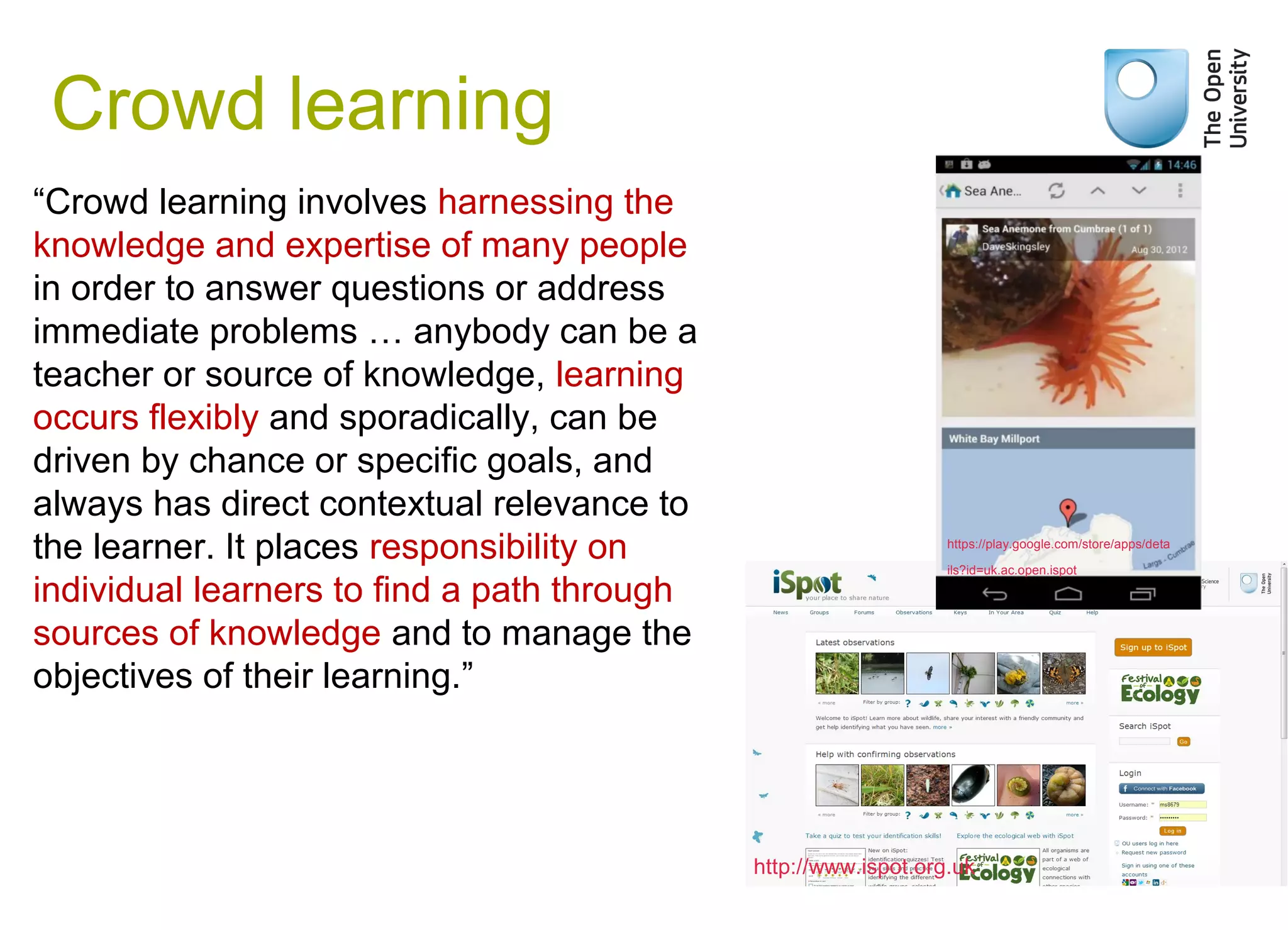
“Crowd learning involves harnessing the
knowledge and expertise of many people
in order to answer questions or address
immediate problems … anybody can be a
teacher or source of knowledge, learning
occurs flexibly and sporadically, can be
driven by chance or specific goals, and
always has direct contextual relevance to
the learner. It places responsibility on
individual learners to find a path through
sources of knowledge and to manage the
objectives of their learning.”
Weak signals
https://play.google.com/store/apps/deta
ils?id=uk.ac.open.ispot
http://www.ispot.org.uk
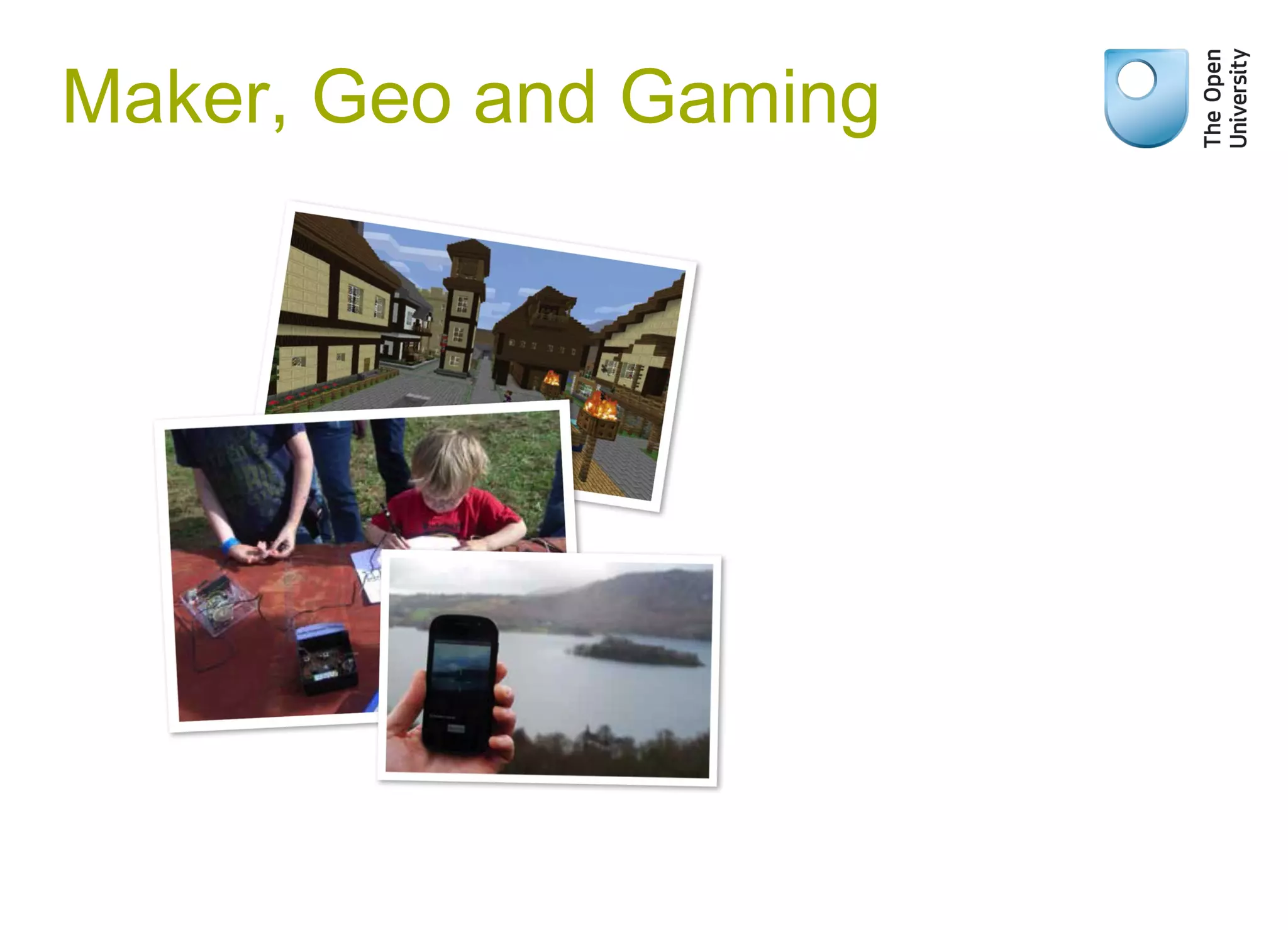
Maker, Geo and Gaming
Geo learning
“Location-based technology… can provide
‘touch points’ that link the physical to the
digital.…
Situated cognition suggests that
knowledge is situated within physical,
social and cultural contexts and cannot be
separated from these. … Learners may
also be overwhelmed by a wealth of digital
information that is not presented
appropriately, resulting in cognitive
overload. Social issues include intruding
on a person’s privacy by knowing their
location or tracking their movements.
… We expect blended spaces to become
more pervasive, especially given current
worldwide investment in ‘smart cities’.”
Weak signals
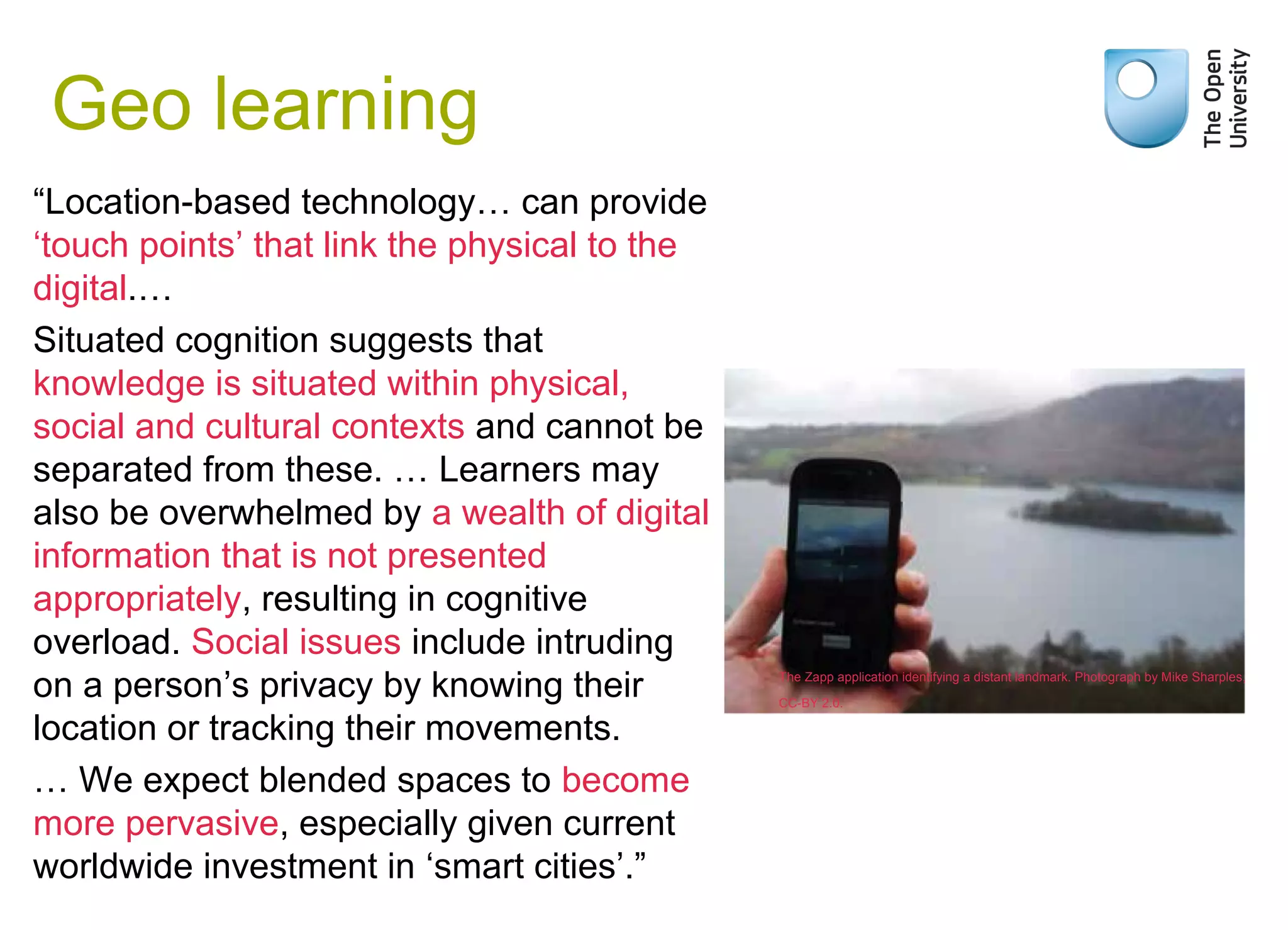
The Zapp application identifying a distant landmark. Photograph by Mike Sharples,
CC-BY 2.0.
Out There In Here
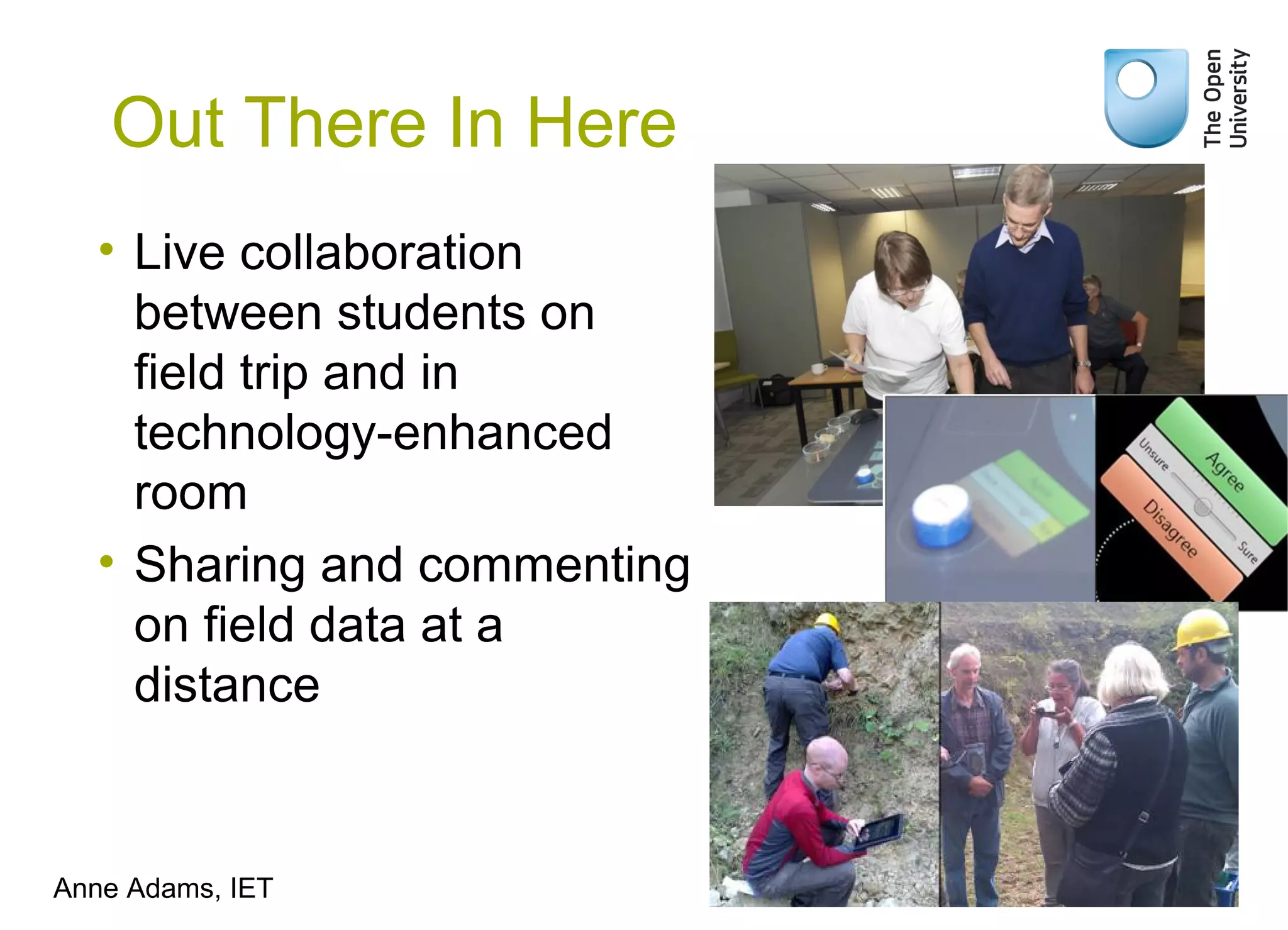
• Live collaboration
between students on
field trip and in
technology-enhanced
room
• Sharing and commenting
on field data at a
distance
Anne Adams, IET
Maker culture
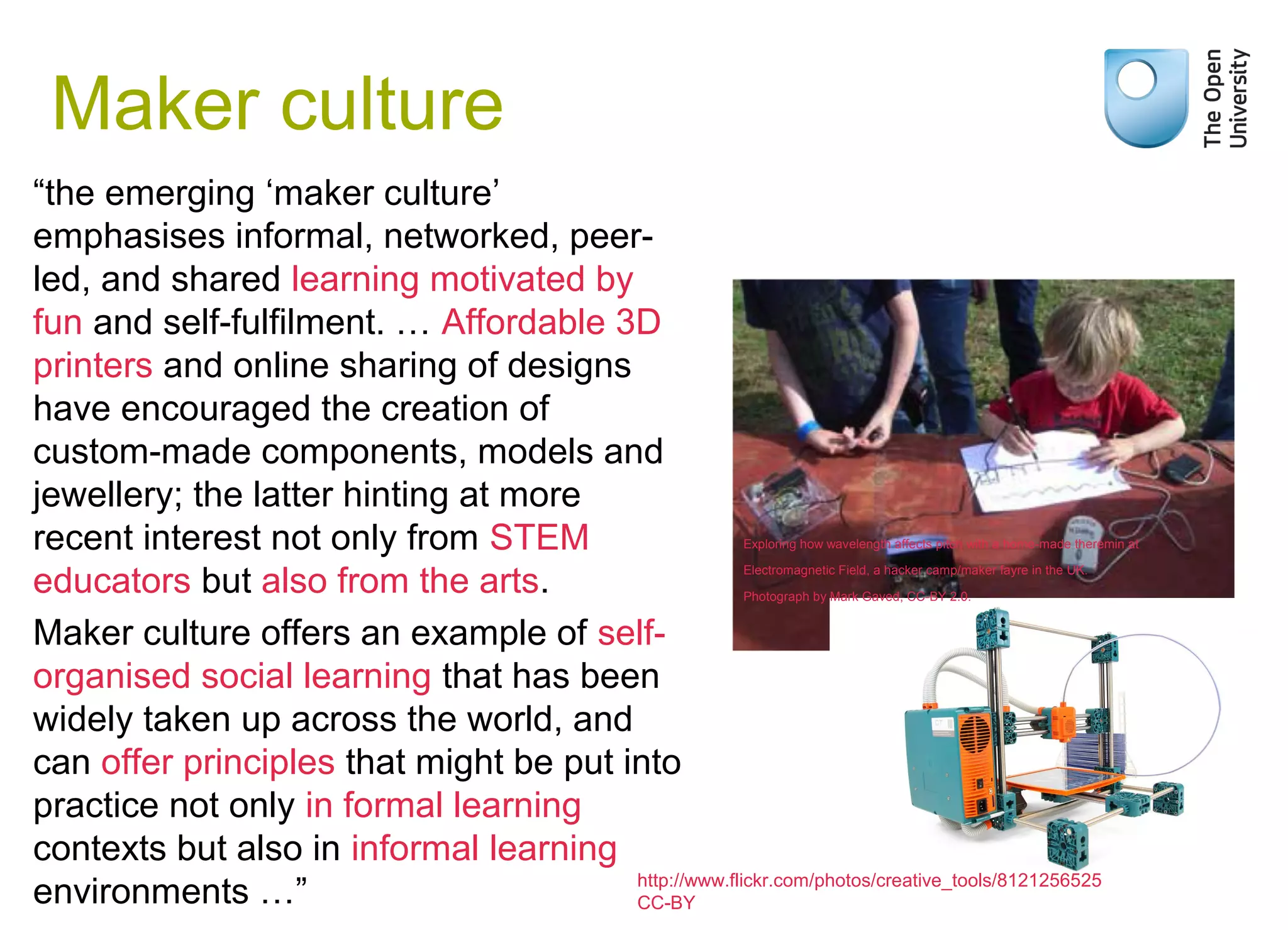
“the emerging ‘maker culture’
emphasises informal, networked, peer-
led, and shared learning motivated by
fun and self-fulfilment. … Affordable 3D
printers and online sharing of designs
have encouraged the creation of
custom-made components, models and
jewellery; the latter hinting at more
recent interest not only from STEM
educators but also from the arts.
Maker culture offers an example of self-
organised social learning that has been
widely taken up across the world, and
can offer principles that might be put into
practice not only in formal learning
contexts but also in informal learning
environments …”
Weak signals
http://www.flickr.com/photos/creative_tools/8121256525
CC-BY
Exploring how wavelength affects pitch with a home-made theremin at
Electromagnetic Field, a hacker camp/maker fayre in the UK.
Photograph by Mark Gaved, CC-BY 2.0.
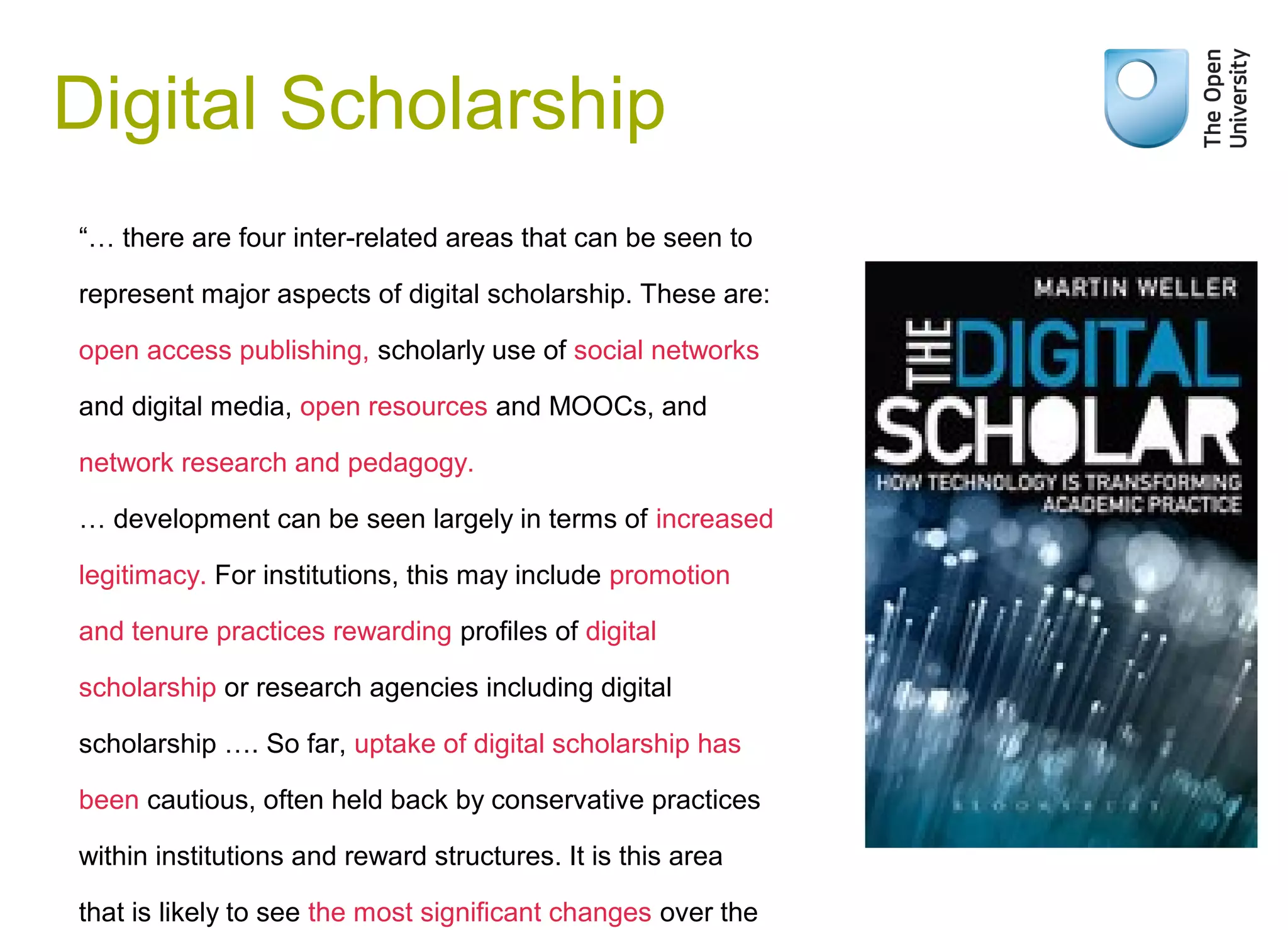
“… there are four inter-related areas that can be seen to
represent major aspects of digital scholarship. These are:
open access publishing, scholarly use of social networks
and digital media, open resources and MOOCs, and
network research and pedagogy.
… development can be seen largely in terms of increased
legitimacy. For institutions, this may include promotion
and tenure practices rewarding profiles of digital
scholarship or research agencies including digital
scholarship …. So far, uptake of digital scholarship has
been cautious, often held back by conservative practices
within institutions and reward structures. It is this area
that is likely to see the most significant changes over the
Digital Scholarship
1. MOOCs
Massive Open Online Courses
1. Badges to accredit learning
Open framework for gaining recognition of skills and achievement
1. Learning analytics
Data-driven analysis of learning activities and environment
1. Seamless learning
Connecting learning across settings, technologies and activities
1. Crowd learning
Harnessing the local knowledge of many people
1. Digital scholarship
Scholarly practice through networked technologies
1. Geo-learning
Learning in an about locations
1. Learning from gaming
Exploiting the power of digital games for learning
1. Maker culture
Learning by making
1. Citizen inquiry
Fusing inquiry-based learning and citizen activism
“the innovations
described in this report
are not technologies
looking for an
application in formal
education. They are
new ways of teaching,
learning and
assessment. If they are
to succeed, they need to
complement formal
education, rather than
trying to replace it”
Innovating Pedagogy 2013
Weak signals
Incubating Innovation
• Harness passion: individual motivation
• Build on what others have done – way to join in but also
…
• Be prepared to create your own approach and system
• Innovate on existing objectives: reach, online,
international experience …
• Be a user of the innovations not just a producer
• Stay in touch – be involved
• Experiment at different scales
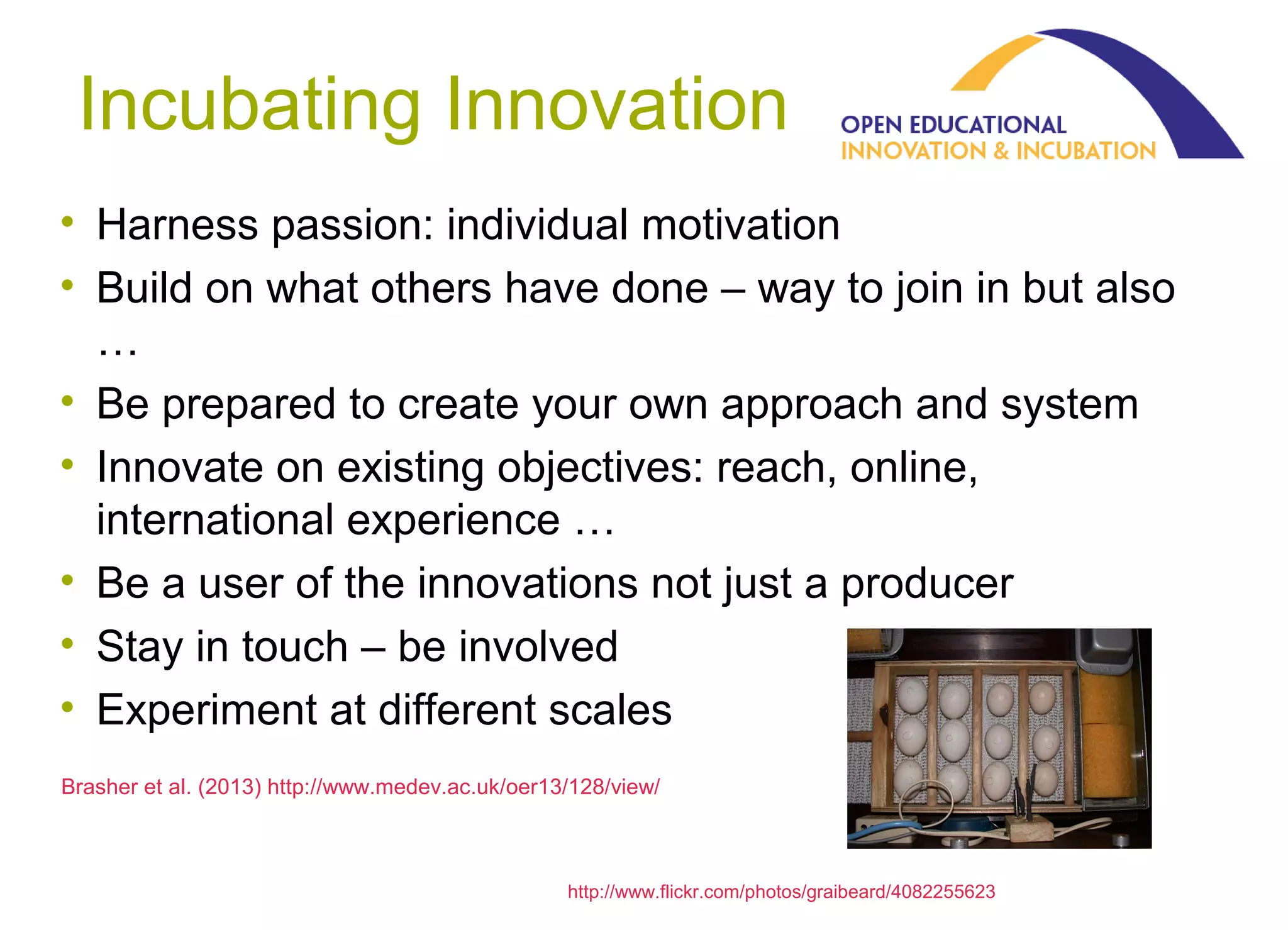
olnet.orghttp://www.flickr.com/photos/graibeard/4082255623
Brasher et al. (2013) http://www.medev.ac.uk/oer13/128/view/
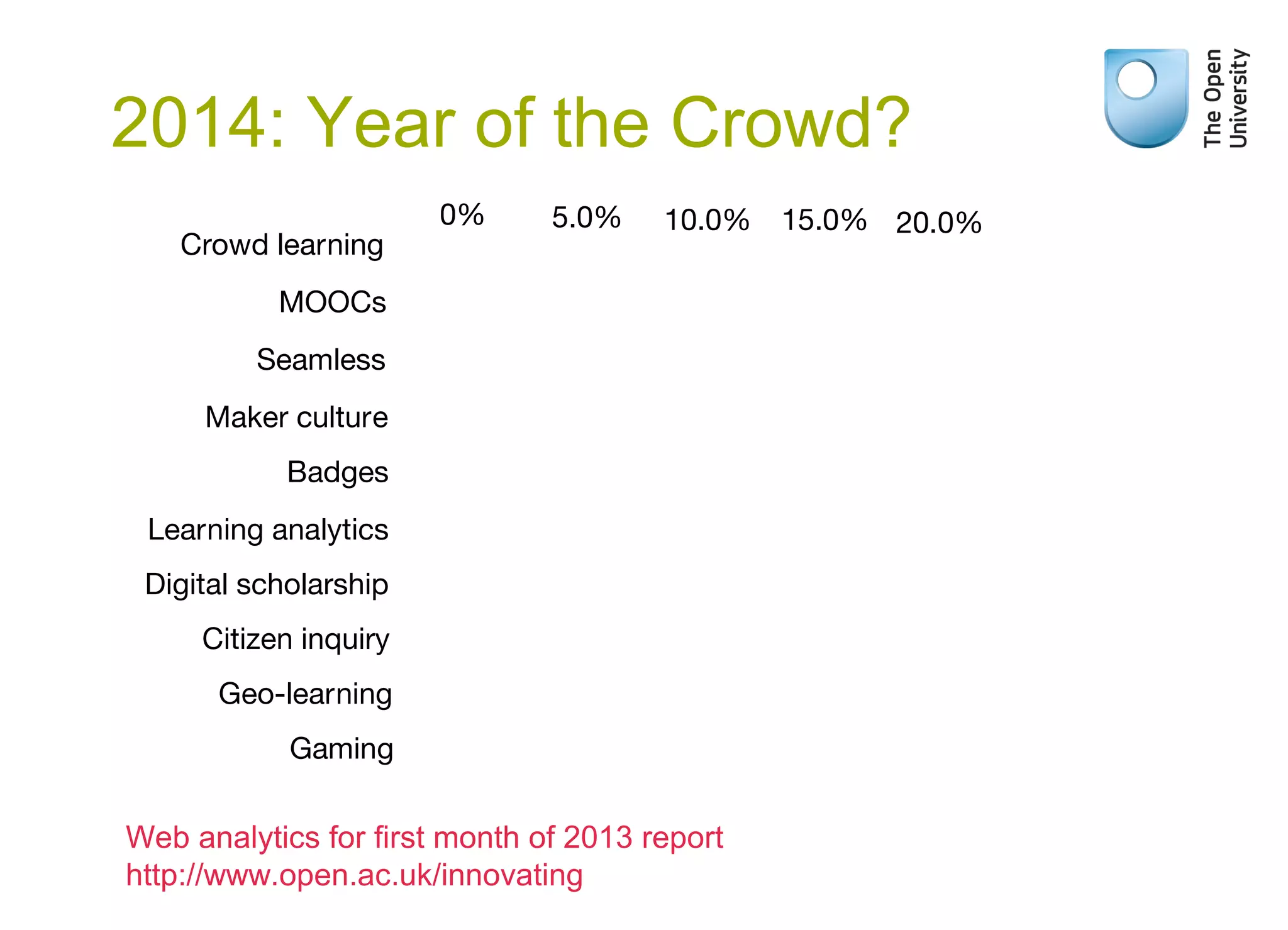
0% 5.0% 10.0% 15.0% 20.0%
Crowd learning
MOOCs
Seamless
Maker culture
Badges
Learning analytics
Digital scholarship
Citizen inquiry
Geo-learning
Gaming
2014: Year of the Crowd?
Web analytics for first month of 2013 report
http://www.open.ac.uk/innovating
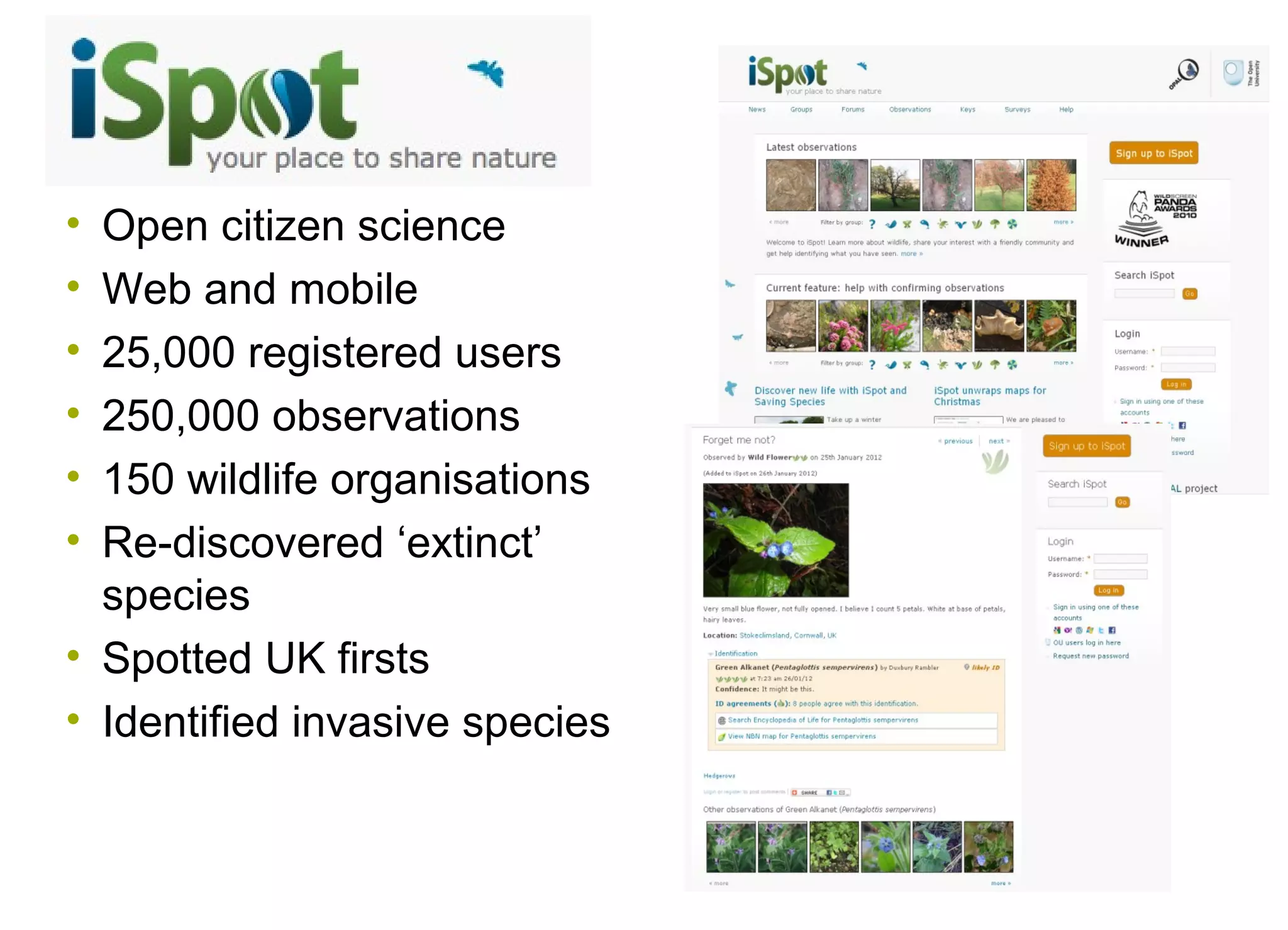
iSpot
• Open citizen science
• Web and mobile
• 25,000 registered users
• 250,000 observations
• 150 wildlife organisations
• Re-discovered ‘extinct’
species
• Spotted UK firsts
• Identified invasive species
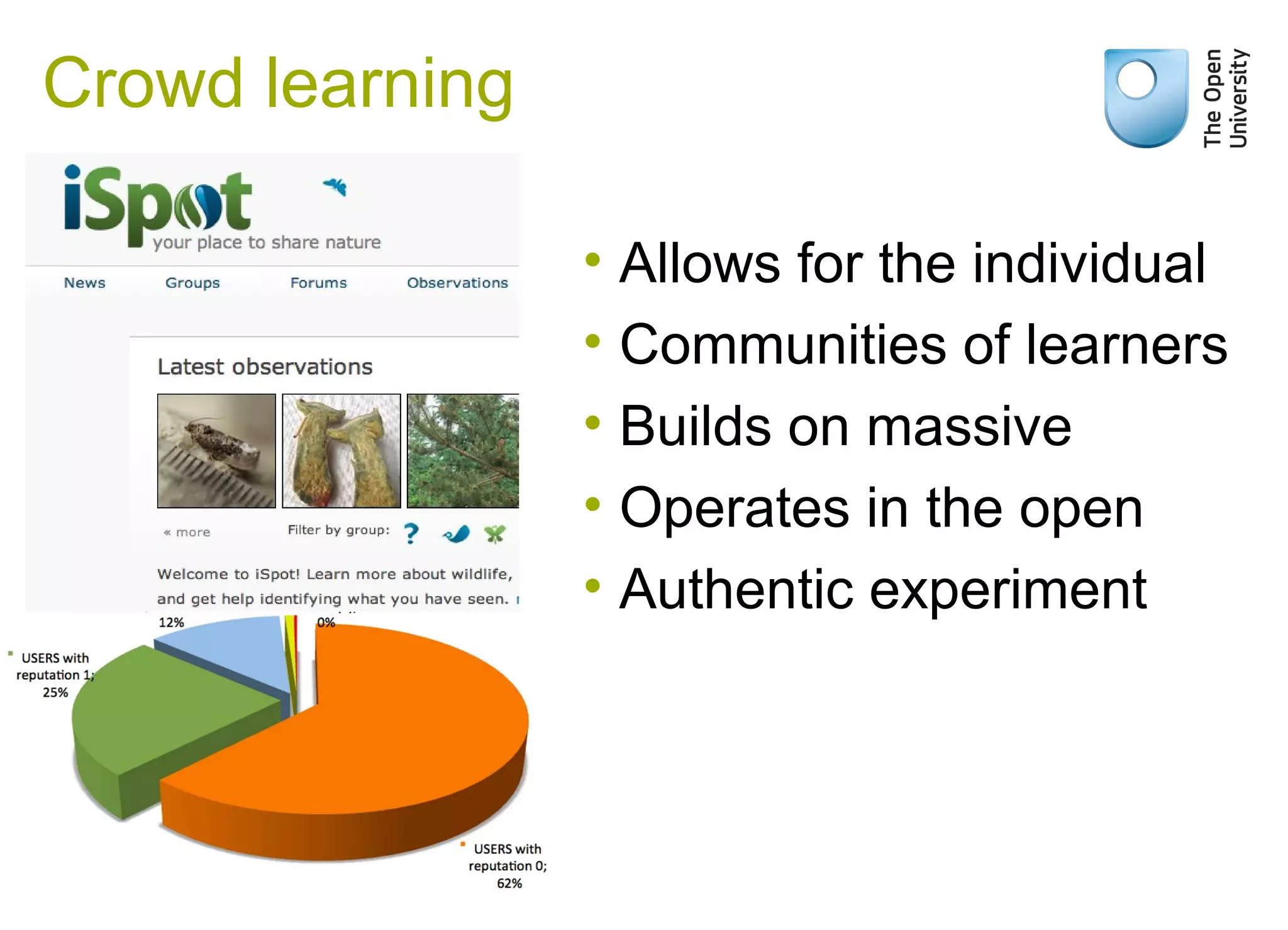
Crowd learning
• Allows for the individual
• Communities of learners
• Builds on massive
• Operates in the open
• Authentic experiment
Institute of Educational Technology
www.open.ac.uk/iet
patrick.mcandrew@open.ac.uk
@openpad
www.open.ac.uk/innovating

Educational design and innovative pedagogies for open and online teaching and learning

  • 1.
    Educational design andinnovative pedagogies for open and online teaching and learning Patrick McAndrew Institute of Educational Technology
  • 2.
    Innovating Pedagogy Exploring newforms of teaching, learning and assessment, to guide educators and policy makers
  • 3.
    Institute of EducationalTechnology iet.open.ac.uk
  • 4.
    CC-BY-NC-SA http://www.flickr.com/photos/57340921@N03/7527822002/ Catwalk to readyto wear Adams, A., FitzGerald, E., and Priestnall, G. (to appear) Of Catwalk Technologies and Boundary Creatures. Transactions on Computer-Human Interaction CC-BY-NC http://www.flickr.com/photos/thestylepa/6157909577/
  • 5.
    The Open Universityis open to people, places, methods and ideas.
  • 6.
  • 7.
    “Walter Perry, toldhis new staff … to design the teaching system to suit an individual working in a lighthouse off the coast of Scotland.” Sir John Daniels
  • 8.
  • 9.
    Everything in thebox? Bridge 2 Success eBooks Wikipedia Open Educational Resources Open Access Journals Google YouTube Title : Deal Or No Deal Source : http://www.flickr.com/photos/thunderchild5/533038405 license : http://creativecommons.org/licenses/by/2.0/deed.en_GB …
  • 10.
    –Media • Impresses • Motivates •But may be skipped Material-based learning Bridge 2 Success –Texts • Talk to the learner • Sets out tasks • Gets the highest rating
  • 11.
    • Can steerthe learning process • Design for feedback and for feedforward • Formative assessment makes interactivity • Offer achievements along the way Assessment tasks
  • 12.
    Retaining students (learners) Getstudents past the first assessment Give less experienced students goals linked to life Be flexible (but not too flexible!) Life gets in the way Optional activities cannot be expected to happen Bounce users Volunteer students Social learners
  • 13.
    Human element • Humanin the loop can make it all work! • Support and Feedback • Some learners do not need all we give them
  • 14.
    Equivalency Theory 1. “Deepand meaningful formal learning is supported as long as one of the three forms of interaction (student–teacher; student–student; student–content) is at a high level. The other two may be offered at minimal levels, or even eliminated, without degrading the educational experience. 2. “High levels of more than one of these three modes will likely provide a more satisfying educational experience, although these experiences may not be as cost- or time effective as less interactive learning sequences.” Terry Anderson (2003) http://equivalencytheorem.info
  • 15.
    Balancing support Miyazoe &Anderson (2013) http://jime.open.ac.uk/2013/09
  • 16.
  • 17.
    • Concept –What willlearners do? –How does assessment work? –What feedback do they get? –What are the expected exit points? • Practical –How does the social and support side operate? –Is it Accessible? –Do you have the right content and media? Designing for open
  • 18.
  • 19.
    Innovating Pedagogy Exploring newforms of teaching, learning and assessment, to guide educators and policy makers
  • 20.
    Gartner hype cycle http://en.wikipedia.org/wiki/File:Gartner_Hype_Cycle.svg ImageJeremykemp at en.wikipedia. CC-BY-SA-3.0,2.5,2.0,1.0 Distinguish hype from reality
  • 21.
    MOOCs http://en.m.wikipedia.org/wiki/File:Figure_1_MOOCs_and_Ope n_Education_Timeline_p6.jpg Creative Commons Attribution3.0 Unported license. Distinguish hype from reality Connectivist learningConnectivist learning Instructivist learningInstructivist learning Social learningSocial learning Open learningOpen learning
  • 22.
    The Open University'sInstitute of Educational Technology Innovating Pedagogy 2012
  • 23.
    1. New pedagogyfor e-books Innovative ways of teaching and learning with next-generation e-books 1. Publisher-led short courses Publishers producing commercial short courses for leisure and professional development 1. Assessment for learning Assessment that supports the learning process through diagnostic feedback 1. Badges to accredit learning Open framework for gaining recognition of skills and achievements 1. MOOCs Massive open online courses 1. Rebirth of academic publishing New forms of open scholarly publishing 1. Seamless learning Connecting learning across settings, technologies, and activities 1. Learning analytics Data-driven analysis of learning activities and environments 1. Personal Inquiry learning Learning through collaborative inquiry and active investigation 1. Rhizomatic learning Knowledge constructed by self-aware communities adapting to environmental conditions “ the innovations are not independent, but fit together into a new and disruptive form of education that transcends boundaries” Innovating Pedagogy 2012 Weak signals
  • 25.
  • 26.
    1. MOOCs Massive OpenOnline Courses 1. Badges to accredit learning Open framework for gaining recognition of skills and achievement 1. Learning analytics Data-driven analysis of learning activities and environment 1. Seamless learning Connecting learning across settings, technologies and activities 1. Crowd learning Harnessing the local knowledge of many people 1. Digital scholarship Scholarly practice through networked technologies 1. Geo-learning Learning in an about locations 1. Learning from gaming Exploiting the power of digital games for learning 1. Maker culture Learning by making 1. Citizen inquiry Fusing inquiry-based learning and citizen activism “the innovations described in this report are not technologies looking for an application in formal education. They are new ways of teaching, learning and assessment. If they are to succeed, they need to complement formal education, rather than trying to replace it” Innovating Pedagogy 2013 Weak signals
  • 28.
    MOOCs Gaming Citizen Inquiry Analytics Crowd learning DigitalScholarship Geo-learning Badges Seamless learning Maker culture Themes and groups
  • 29.
  • 30.
    MOOCs “… ways needto be found to support less experienced students and those lacking confidence. Pedagogies that could benefit such learners are missing from much of the first wave of massive courses. These pedagogies include materials designed to provide an integrated learning experience, feedback that is customised to meet learner needs, and direct mentoring of learners in difficulties. Some of these are hard to supply in a cost-free model. Social learning and peer support may provide alternative ways of generating some of the feedback that is needed.” Weak signals
  • 31.
  • 32.
    Koller, Daphne, Ng,Andrew, Do, Chuong and Chen, Zhenghao (2013) “Retention and Intention in Massive Open Online Courses: In Depth,” Educause Review: http://www.educause.edu/ero/article/retention-and-intention-massive-open-online-courses-depth-0.
  • 33.
  • 34.
    “in the USA,the STEMscopes online science curriculum is currently producing visualisations that reflect the activity of 50,000 teachers and over a million students. Work on the project so far has underlined the importance of understanding context, and of involving teachers in the process of developing and deploying analytics.” “The potential is emerging for a virtuous circle, where inquiry into the learning process feeds into learning design, which motivates learning analytics, which motivate future inquiry and thus the refinement of the design and analytics.” Learning analytics Weak signals Visualisation of student data from inBloom: http://intentionalfutures.com/inBloomdemo Sleep Time Image Patrick McAndrew CC-BY
  • 35.
  • 36.
    “Seamless learning [is]connecting learning experiences across locations, times, technologies or social settings. Mobile technologies are enabling learning to continue across contexts, so a piece of work started in the classroom can be continued at home; and ideas that occur on the move can be shared with colleagues online, then followed up in person.” Seamless learning Weak signals “How, then, do we create ‘teachable moments’ from this technology- supported flow of experience” “There are ethical and social issues concerning which experiences should be shared and whether we should move towards a world where we record the entire flow of experience” http://en.wikipedia.org/wiki/File:A_Google_Glass_wearer.jpg Image CC-BY 2.0.
  • 37.
    Crowd learning “Crowd learninginvolves harnessing the knowledge and expertise of many people in order to answer questions or address immediate problems … anybody can be a teacher or source of knowledge, learning occurs flexibly and sporadically, can be driven by chance or specific goals, and always has direct contextual relevance to the learner. It places responsibility on individual learners to find a path through sources of knowledge and to manage the objectives of their learning.” Weak signals https://play.google.com/store/apps/deta ils?id=uk.ac.open.ispot http://www.ispot.org.uk
  • 38.
  • 39.
    Geo learning “Location-based technology…can provide ‘touch points’ that link the physical to the digital.… Situated cognition suggests that knowledge is situated within physical, social and cultural contexts and cannot be separated from these. … Learners may also be overwhelmed by a wealth of digital information that is not presented appropriately, resulting in cognitive overload. Social issues include intruding on a person’s privacy by knowing their location or tracking their movements. … We expect blended spaces to become more pervasive, especially given current worldwide investment in ‘smart cities’.” Weak signals The Zapp application identifying a distant landmark. Photograph by Mike Sharples, CC-BY 2.0.
  • 40.
    Out There InHere • Live collaboration between students on field trip and in technology-enhanced room • Sharing and commenting on field data at a distance Anne Adams, IET
  • 41.
    Maker culture “the emerging‘maker culture’ emphasises informal, networked, peer- led, and shared learning motivated by fun and self-fulfilment. … Affordable 3D printers and online sharing of designs have encouraged the creation of custom-made components, models and jewellery; the latter hinting at more recent interest not only from STEM educators but also from the arts. Maker culture offers an example of self- organised social learning that has been widely taken up across the world, and can offer principles that might be put into practice not only in formal learning contexts but also in informal learning environments …” Weak signals http://www.flickr.com/photos/creative_tools/8121256525 CC-BY Exploring how wavelength affects pitch with a home-made theremin at Electromagnetic Field, a hacker camp/maker fayre in the UK. Photograph by Mark Gaved, CC-BY 2.0.
  • 42.
    “… there arefour inter-related areas that can be seen to represent major aspects of digital scholarship. These are: open access publishing, scholarly use of social networks and digital media, open resources and MOOCs, and network research and pedagogy. … development can be seen largely in terms of increased legitimacy. For institutions, this may include promotion and tenure practices rewarding profiles of digital scholarship or research agencies including digital scholarship …. So far, uptake of digital scholarship has been cautious, often held back by conservative practices within institutions and reward structures. It is this area that is likely to see the most significant changes over the Digital Scholarship
  • 43.
    1. MOOCs Massive OpenOnline Courses 1. Badges to accredit learning Open framework for gaining recognition of skills and achievement 1. Learning analytics Data-driven analysis of learning activities and environment 1. Seamless learning Connecting learning across settings, technologies and activities 1. Crowd learning Harnessing the local knowledge of many people 1. Digital scholarship Scholarly practice through networked technologies 1. Geo-learning Learning in an about locations 1. Learning from gaming Exploiting the power of digital games for learning 1. Maker culture Learning by making 1. Citizen inquiry Fusing inquiry-based learning and citizen activism “the innovations described in this report are not technologies looking for an application in formal education. They are new ways of teaching, learning and assessment. If they are to succeed, they need to complement formal education, rather than trying to replace it” Innovating Pedagogy 2013 Weak signals
  • 44.
    Incubating Innovation • Harnesspassion: individual motivation • Build on what others have done – way to join in but also … • Be prepared to create your own approach and system • Innovate on existing objectives: reach, online, international experience … • Be a user of the innovations not just a producer • Stay in touch – be involved • Experiment at different scales olnet.orghttp://www.flickr.com/photos/graibeard/4082255623 Brasher et al. (2013) http://www.medev.ac.uk/oer13/128/view/
  • 45.
    0% 5.0% 10.0%15.0% 20.0% Crowd learning MOOCs Seamless Maker culture Badges Learning analytics Digital scholarship Citizen inquiry Geo-learning Gaming 2014: Year of the Crowd? Web analytics for first month of 2013 report http://www.open.ac.uk/innovating
  • 46.
    iSpot • Open citizenscience • Web and mobile • 25,000 registered users • 250,000 observations • 150 wildlife organisations • Re-discovered ‘extinct’ species • Spotted UK firsts • Identified invasive species
  • 47.
    Crowd learning • Allowsfor the individual • Communities of learners • Builds on massive • Operates in the open • Authentic experiment
  • 48.
    Institute of EducationalTechnology www.open.ac.uk/iet patrick.mcandrew@open.ac.uk @openpad www.open.ac.uk/innovating

Editor's Notes

  • #3 Summary of talk: Thanks to Mike Reports Why us pedagogy v technology
  • #4 I work in IET – research and support OU. Courses, labs Proud of it Acting Director
  • #7 Materials Texts Talks to the learner Sets out tasks Gets the highest ratings Resources From everything in the box to power of search Media Motivates Integrates May be skipped
  • #9 http://www.flickr.com/photos/75396048@N00/188730566 Whitefish Point lighthouse keeper
  • #12 Can steer the learning process Sets out the tasks Do not assume read material first Design for feedback/feedforward What comes back is major part of OU teaching Formative assessment makes interactivity Asking the student to do things is key Offer achievements along the way Avoid failures and
  • #19 Share design but avoid custom and practice
  • #20 Summary of talk: Thanks to Mike Reports Why us pedagogy v technology
  • #23 Mentioned in Working document from EU “Analysis and mapping of innovative teaching and learning for all through new Technologies and Open Educational Resources in Europe :
  • #25 Fix to be IP13 data
  • #30 Interactive graphic by Katy Jordan showing completion rates against enrolment rates for MOOCs. http://www.katyjordan.com/MOOCproject.html Visualisation of student data from inBloom: http://intentionalfutures.com/inBloomdemo Badges from the Open Learning Design Studio MOOC: http://www.olds.ac.uk/blog/oldsmoocbadgedesign Image CC-BY-NC-SA 2.0.
  • #36 A developer, Loic Le Meur, selected for Google Glass explorer edition, shows off wearing Google Glass. http://en.wikipedia.org/wiki/File:A_Google_Glass_wearer.jpgImage CC-BY 2.0. Cover of The Pub and the People by Mass Observation.Image at: http://georgeorwellnovels.com/reviews/the-pub-and-the-people-by-mass-observation/ iSpot mobile app. Image from: https://play.google.com/store/apps/details?id=uk.ac.open.ispot
  • #38 Just in time learning Micro learning Self-managed learning Crowd sourced
  • #39 The Zapp application identifying a distant landmark. Photograph by Mike Sharples, CC-BY 2.0. Mediaeval town researched and built by children from three continents learning together informally in the Jokaydia Minecraft community.Image by Rebecca Ferguson and Jacob Weinbren, CC-BY 2.0. Exploring how wavelength affects pitch with a home-made theremin at Electromagnetic Field, a hacker camp/maker fayre in the UK.Photograph by Mark Gaved, CC-BY 2.0.
  • #40 Just in time learning Micro learning Self-managed learning Crowd sourced
  • #42 Fabbster
  • #43 Underpins
  • #48 Divide the learners 1:20 -> 1:200 -> ~5:5000 Build on massive Authentic experiments: personal data, science in the field Social science simulations Operate in the open (iSpot)
  • #49 IET has specialist role in Accessibility. Module H810: Accessible Online Learning. Research – long history. Work on Standards, Personalisation. Practical support to improve accessibility – including specialist testing facilities.