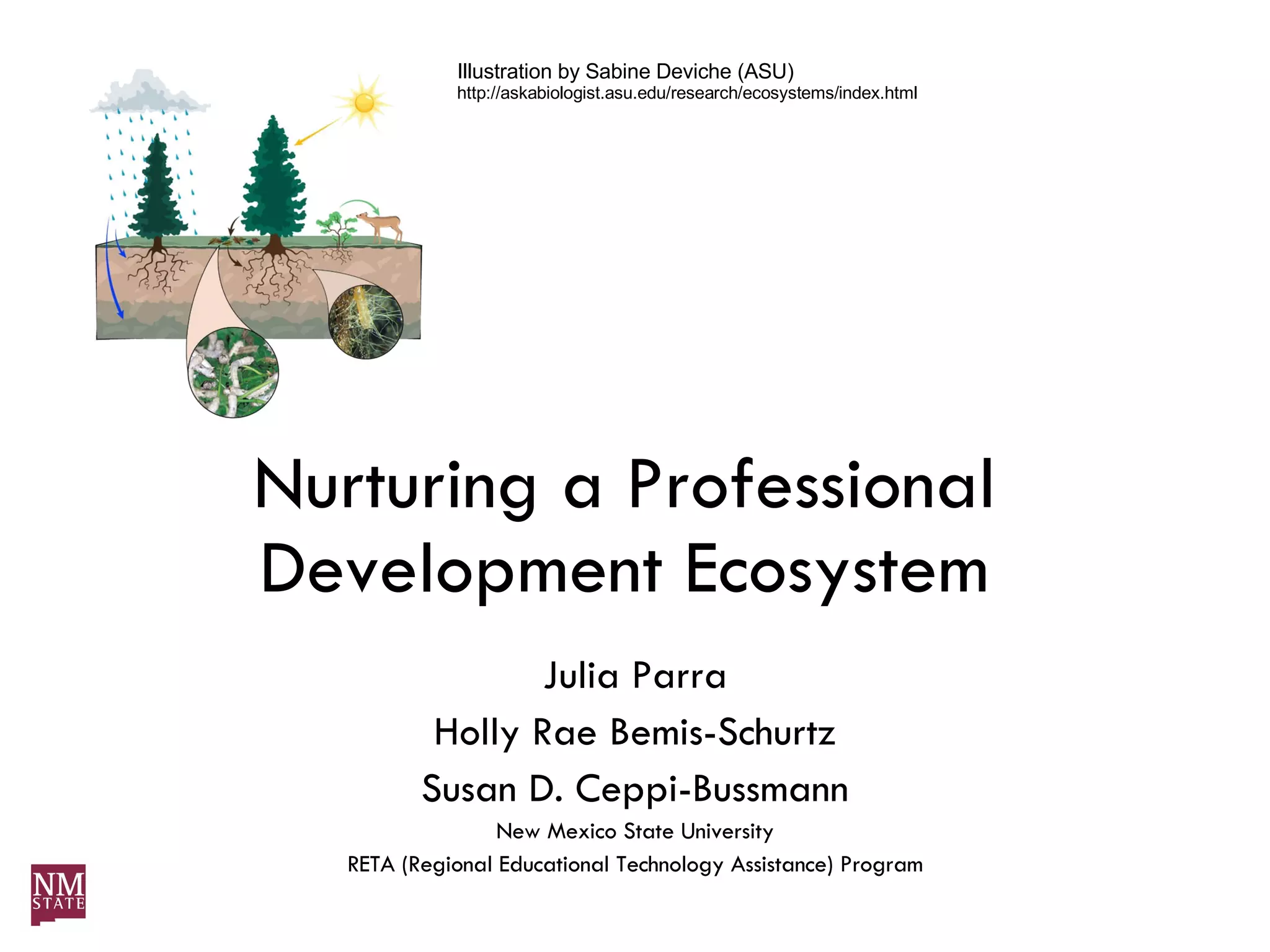
Nurturing a Professional Development Ecosystem Julia Parra Holly Rae Bemis-Schurtz Susan D. Ceppi-Bussmann New Mexico State University RETA (Regional Educational Technology Assistance) Program Illustration by Sabine Deviche (ASU)  http://askabiologist.asu.edu/research/ecosystems/index.html
Agenda  Emerging Web 2.0 Toolset The Ecosystem as Model Nurturing a PD Ecosystem Assessing a PD Ecosystem Q & A
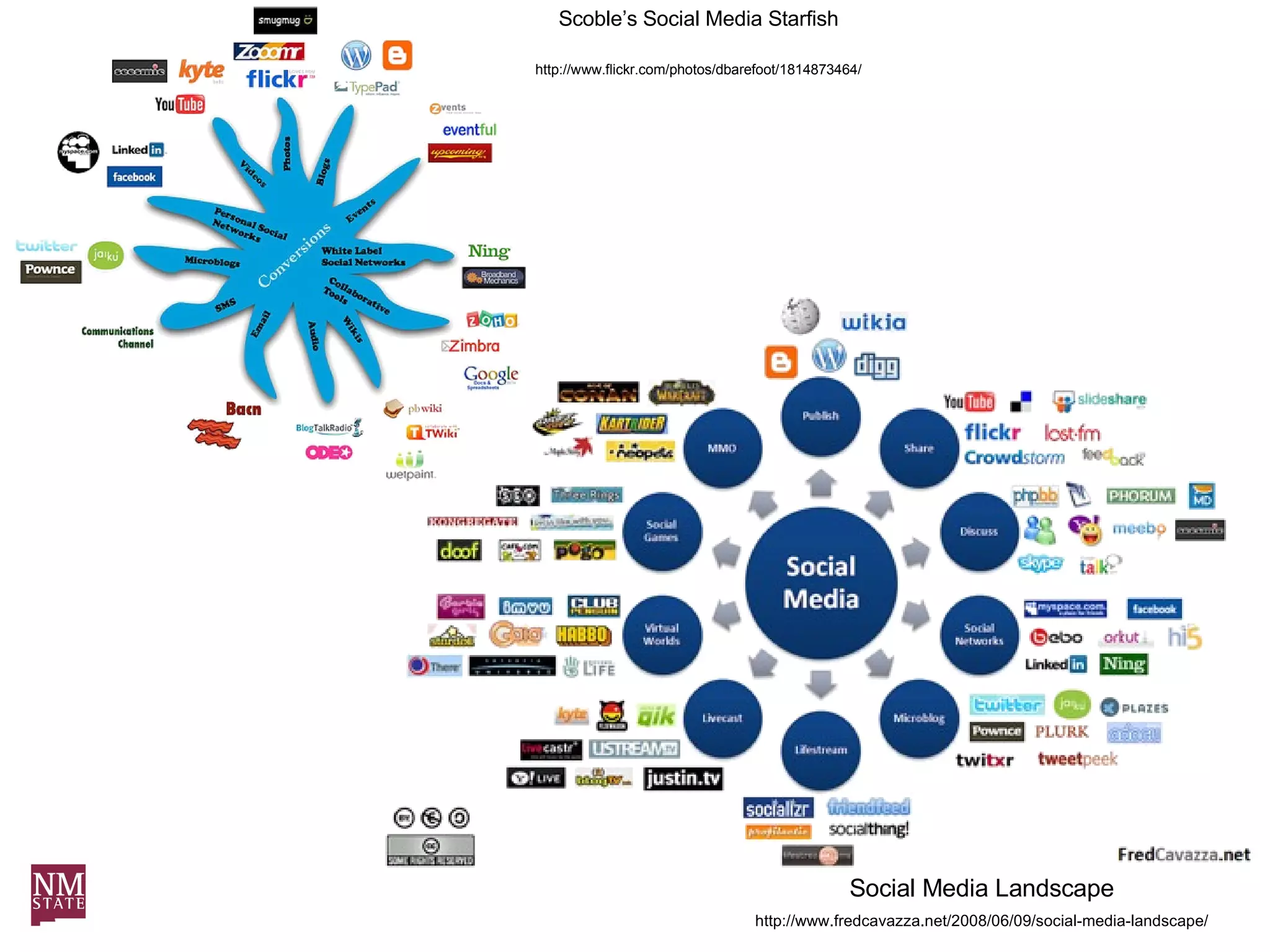
Web 2.0 Tools Scoble’s Social Media Starfish http://www.flickr.com/photos/dbarefoot/1814873464/ Social Media Landscape http://www.fredcavazza.net/2008/06/09/social-media-landscape/ The Conversation Prism http://www.briansolis.com/2008/08/introducing-conversation-prism.html
Can’t see the forest for the trees… Retrieved on October 23, 2008 from http://travel.paintedstork.com/blog/2005/12/hiking-up-brahmagiri.html
Collaboration & Interaction Tools  Content Creation & Dissemination Tools Learning & Content Management Tools Learning/Course Management System Webconferencing System VOIP Instant Messaging Tool Robust Wiki Blogs Micromedia Robust Wikis Voice Discussion Tools Multimedia Creation Tools Social Bookmarking Tools Content Sharing Tools Custom Search Tools Lifestreaming Tools Analytic Tools RSS Feed Aggregators Social Networks eLearning Ecosystem Tools
Current Events & Trends Widgets & RSS Facilitation and Assessment Recomposers Producers Primary Consumers Ambient Consumers The   Internet
Learner Responsibility Learner as Recomposer Learner as Producer Learner as Connector Learner as Lurker Relationship to Requirements
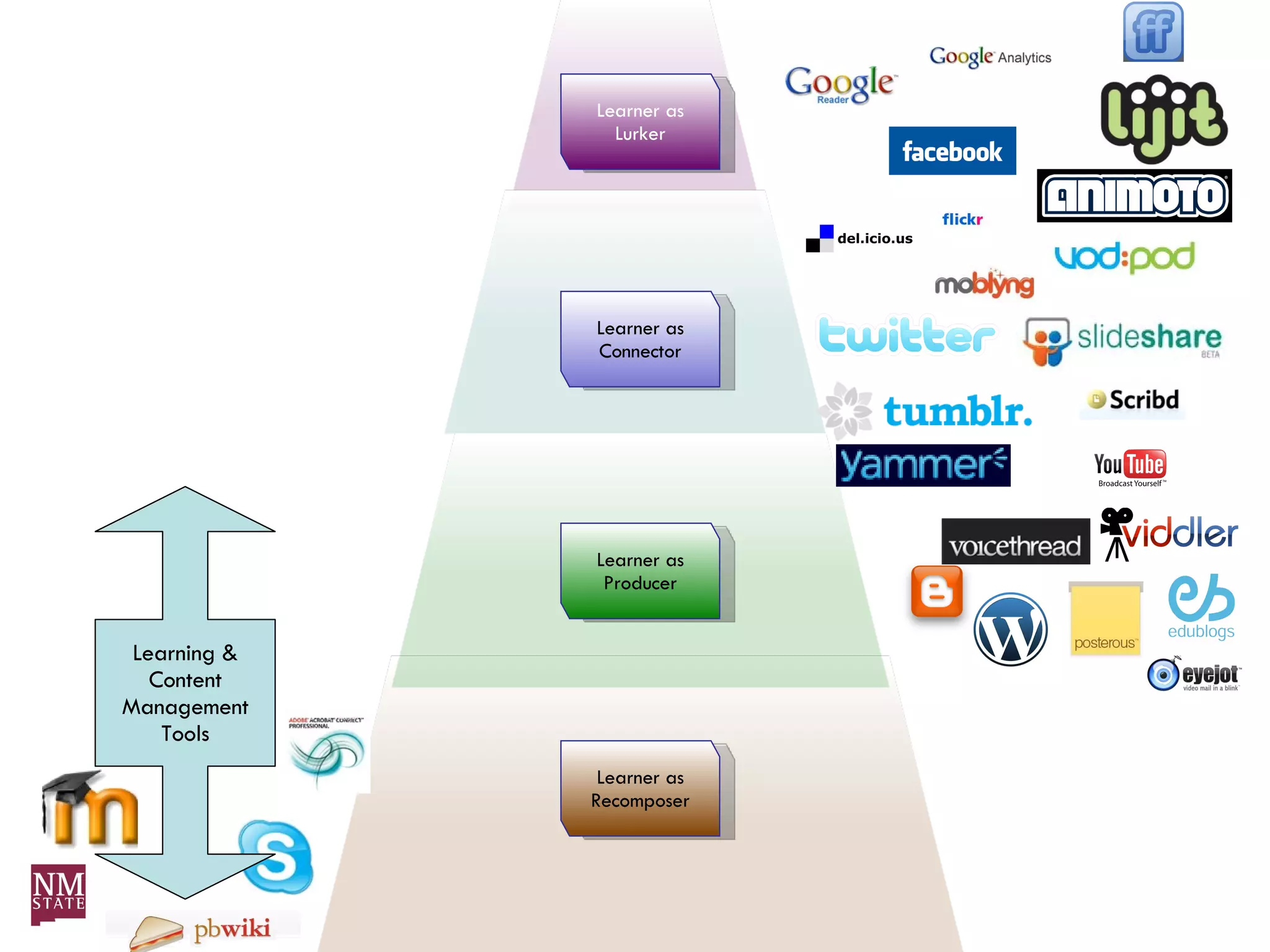
Learner Responsibility Learning & Content Management Tools Learner as Recomposer Learner as Producer Learner as Connector Learner as Lurker
Collaboration and Interaction Tools Learner as Recomposer Learner as Producer Learner as Connector Learner as Lurker
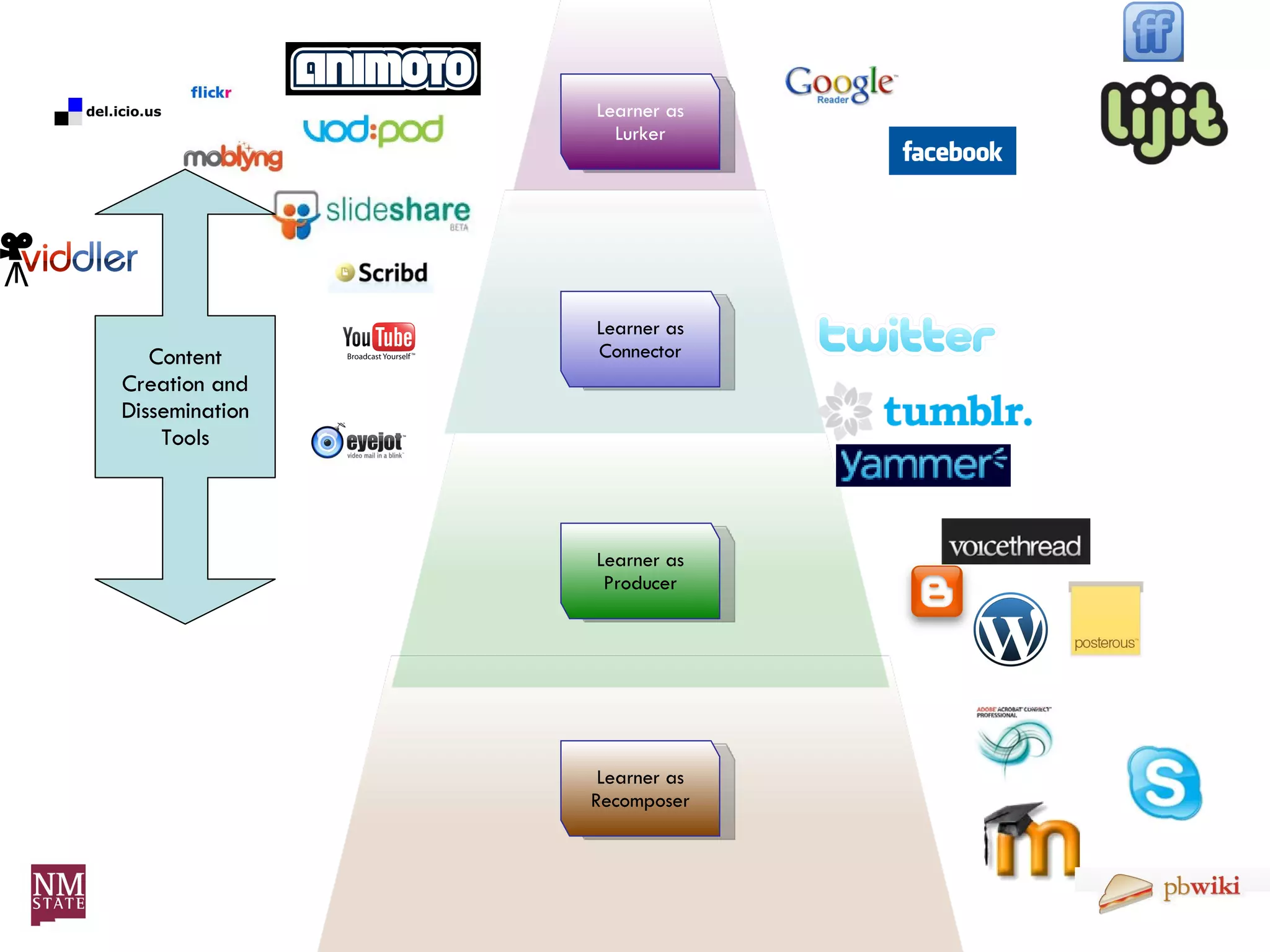
Content Creation and Dissemination Tools Learner as Recomposer Learner as Producer Learner as Connector Learner as Lurker
Learnstreaming Tools Learner as Recomposer Learner as Producer Learner as Connector Learner as Lurker
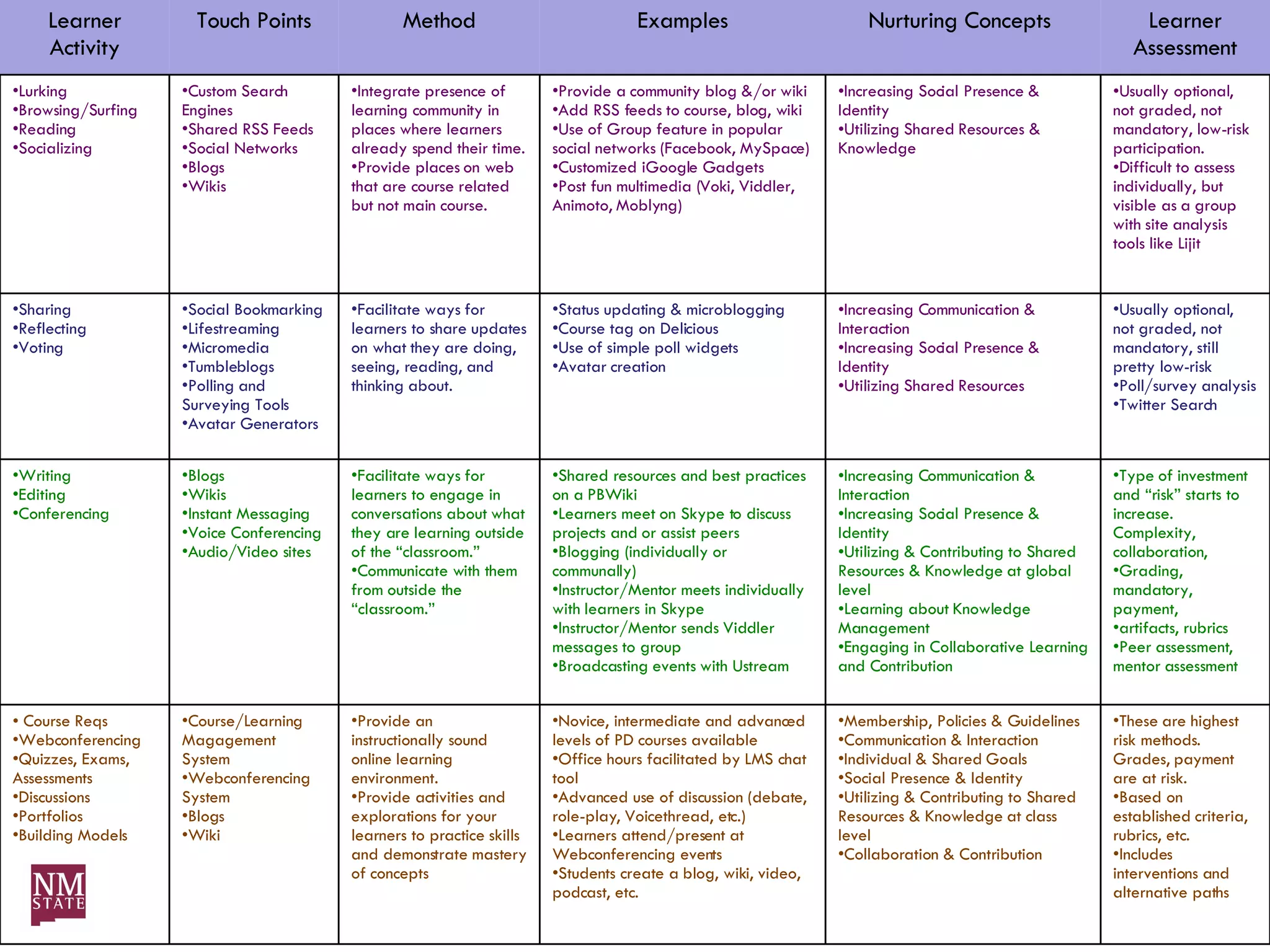
Learner Activity Touch Points Method Examples Nurturing Concepts  Learner Assessment Lurking Browsing/Surfing Reading Socializing Custom Search Engines Shared RSS Feeds Social Networks Blogs Wikis  Integrate presence of  learning community in places where learners already spend their time. Provide places on web that are course related but not main course. Provide a community blog &/or wiki Add RSS feeds to course, blog, wiki Use of Group feature in popular social networks (Facebook, MySpace) Customized iGoogle Gadgets Post fun multimedia (Voki, Viddler, Animoto, Moblyng) Increasing Social Presence & Identity Utilizing Shared Resources & Knowledge Usually optional, not graded, not mandatory, low-risk participation. Difficult to assess individually, but visible as a group with site analysis tools like Lijit Sharing Reflecting Voting Social Bookmarking Lifestreaming Micromedia Tumbleblogs Polling and Surveying Tools Avatar Generators Facilitate ways for learners to share updates on what they are doing, seeing, reading, and thinking about.  Status updating & microblogging Course tag on Delicious Use of simple poll widgets Avatar creation Increasing Communication & Interaction Increasing Social Presence & Identity Utilizing Shared Resources Usually optional, not graded, not mandatory, still pretty low-risk Poll/survey analysis Twitter Search Writing Editing Conferencing Blogs Wikis Instant Messaging Voice Conferencing Audio/Video sites Facilitate ways for learners to engage in conversations about what they are learning outside of the “classroom.”  Communicate with them from outside the “classroom.” Shared resources and best practices on a PBWiki Learners meet on Skype to discuss projects and or assist peers Blogging (individually or communally) Instructor/Mentor meets individually with learners in Skype Instructor/Mentor sends Viddler messages to group Broadcasting events with Ustream Increasing Communication & Interaction Increasing Social Presence & Identity Utilizing & Contributing to Shared Resources & Knowledge at global level Learning about Knowledge Management Engaging in Collaborative Learning and Contribution Type of investment and “risk” starts to increase. Complexity, collaboration,  Grading, mandatory, payment,  artifacts, rubrics Peer assessment, mentor assessment Course Reqs Webconferencing Quizzes, Exams, Assessments Discussions Portfolios Building Models  Course/Learning Magagement System Webconferencing System Blogs Wiki Provide an instructionally sound online learning environment. Provide activities and explorations for your learners to practice skills and demonstrate mastery of concepts Novice, intermediate and advanced levels of PD courses available Office hours facilitated by LMS chat tool Advanced use of discussion (debate, role-play, Voicethread, etc.) Learners attend/present at Webconferencing events Students create a blog, wiki, video, podcast, etc. Membership, Policies & Guidelines Communication & Interaction Individual & Shared Goals Social Presence & Identity Utilizing & Contributing to Shared Resources & Knowledge at class level Collaboration & Contribution These are highest risk methods. Grades, payment are at risk.  Based on established criteria, rubrics, etc. Includes interventions and alternative paths
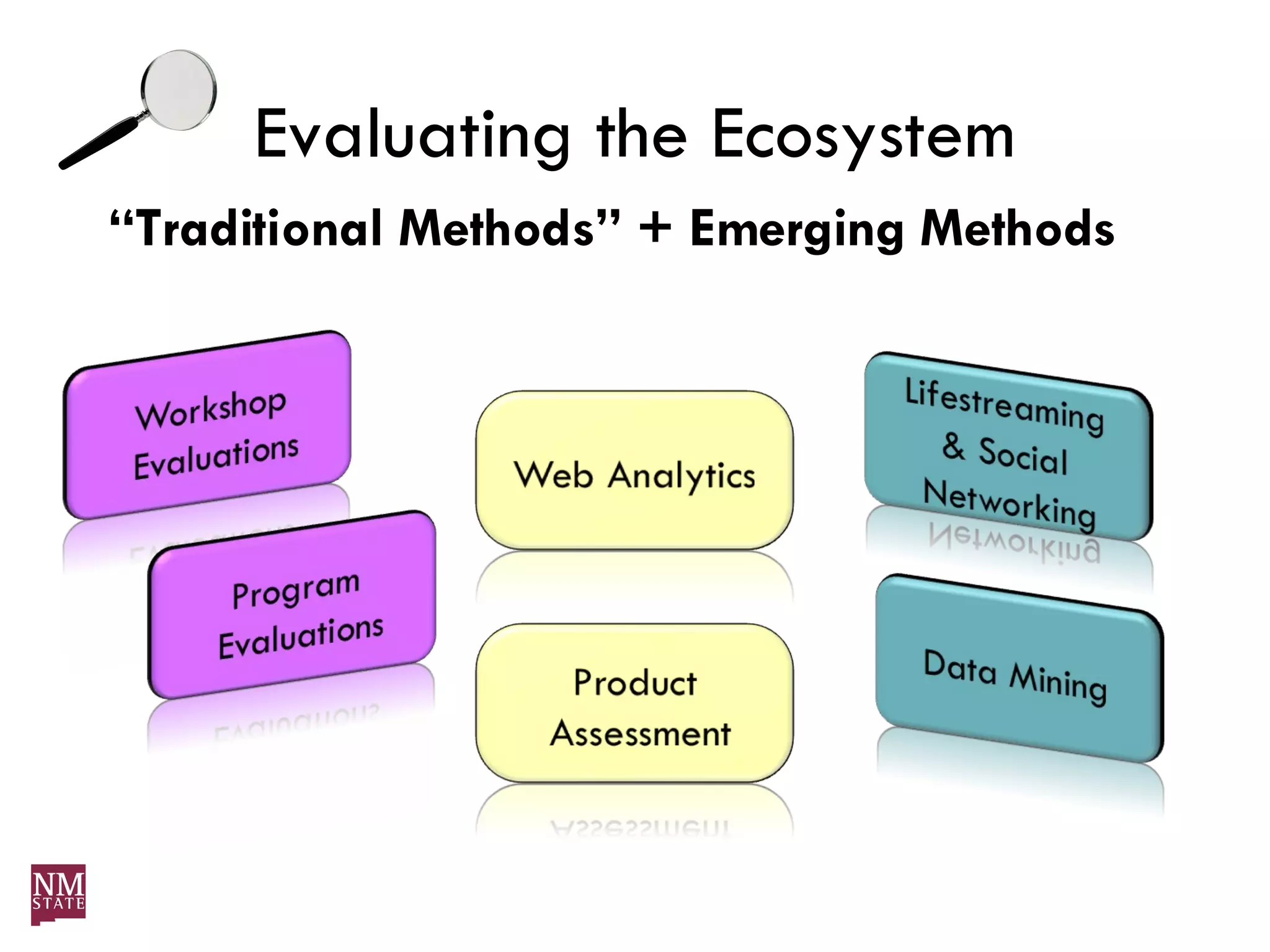
Evaluating the Ecosystem “ Traditional Methods” + Emerging Methods
Evaluating the Ecosystem http://reta.nmsu.edu  and  http://reta-otl.pbwiki.com   *tried and true  **in practice ***completely experimental Method Measuring Example Tool Face to Face Evaluations* Satisfaction Comfort Level Areas for improvement Post Workshop Survey Consensogram Plus / Delta Survey Monkey Moodle Choice Chart Paper Program Evaluation* Change in self assessment on skills based on program goals Relevance of content and activities Accessibility and effectiveness of instructors/mentors Pre and Post Program Surveys Formative and Summative Course Evaluation Informal Course Feedback Survey Monkey Discussion Forum Webconferences Product Assessment** Quality as related to national and/or state standards Demonstration of skills based on program goals Rubrics Peer Reviews Skill Inventories Self Assessment of Practice Webconferences Wiki Survey Monkey Web Analytics** Activity of lurkers in the ecosystem Participation in course activities Number of visits Use of existing content Types of keywords queried Google Analytics Lijit Moodle (LCMS) Tracking Logs Customized Search Tools Lifestreaming & Social Networking*** Health of ‘whole learner’ Connections between learners Activity within the Web-2.0-isphere Awareness of learner stress, overload, burnout Stream of a learner’s updates, Bookmarks, Microblogs, Blogs, etc. Plaxo FriendFeed Linked In Facebook Data Mining*** Occurrences of individualized assistance Types of support offered Project tracking by tag or keyword Organizational email accounts copied on all correspondence from staff Learner or project profiles with a history of all updates related to project Gmail Highrise HQ Yammer
Questions and Answers What are you doing to… Explore learning ecosystems? Explain them to your learners? Model practices involved in teaching and assessing across an ecosystem? Nurture healthy learning ecosystems?
Related Resources http://reta-otl.pbwiki.com http://vss2008.wikispaces.com/nurturing http://reta.nmsu.edu http://webinars.nmsu.edu
Scoble’s Social Media Starfish http://www.flickr.com/photos/dbarefoot/1814873464/ Social Media Landscape http://www.fredcavazza.net/2008/06/09/social-media-landscape/
The Conversation Prism http://www.briansolis.com/2008/08/introducing-conversation-prism.html

Nurturing Professional Development Ecosystems

  • 1.
    Nurturing a ProfessionalDevelopment Ecosystem Julia Parra Holly Rae Bemis-Schurtz Susan D. Ceppi-Bussmann New Mexico State University RETA (Regional Educational Technology Assistance) Program Illustration by Sabine Deviche (ASU) http://askabiologist.asu.edu/research/ecosystems/index.html
  • 2.
    Agenda EmergingWeb 2.0 Toolset The Ecosystem as Model Nurturing a PD Ecosystem Assessing a PD Ecosystem Q & A
  • 3.
    Web 2.0 ToolsScoble’s Social Media Starfish http://www.flickr.com/photos/dbarefoot/1814873464/ Social Media Landscape http://www.fredcavazza.net/2008/06/09/social-media-landscape/ The Conversation Prism http://www.briansolis.com/2008/08/introducing-conversation-prism.html
  • 4.
    Can’t see theforest for the trees… Retrieved on October 23, 2008 from http://travel.paintedstork.com/blog/2005/12/hiking-up-brahmagiri.html
  • 5.
    Collaboration & InteractionTools Content Creation & Dissemination Tools Learning & Content Management Tools Learning/Course Management System Webconferencing System VOIP Instant Messaging Tool Robust Wiki Blogs Micromedia Robust Wikis Voice Discussion Tools Multimedia Creation Tools Social Bookmarking Tools Content Sharing Tools Custom Search Tools Lifestreaming Tools Analytic Tools RSS Feed Aggregators Social Networks eLearning Ecosystem Tools
  • 6.
    Current Events &Trends Widgets & RSS Facilitation and Assessment Recomposers Producers Primary Consumers Ambient Consumers The Internet
  • 7.
    Learner Responsibility Learneras Recomposer Learner as Producer Learner as Connector Learner as Lurker Relationship to Requirements
  • 8.
    Learner Responsibility Learning& Content Management Tools Learner as Recomposer Learner as Producer Learner as Connector Learner as Lurker
  • 9.
    Collaboration and InteractionTools Learner as Recomposer Learner as Producer Learner as Connector Learner as Lurker
  • 10.
    Content Creation andDissemination Tools Learner as Recomposer Learner as Producer Learner as Connector Learner as Lurker
  • 11.
    Learnstreaming Tools Learneras Recomposer Learner as Producer Learner as Connector Learner as Lurker
  • 12.
    Learner Activity TouchPoints Method Examples Nurturing Concepts Learner Assessment Lurking Browsing/Surfing Reading Socializing Custom Search Engines Shared RSS Feeds Social Networks Blogs Wikis Integrate presence of learning community in places where learners already spend their time. Provide places on web that are course related but not main course. Provide a community blog &/or wiki Add RSS feeds to course, blog, wiki Use of Group feature in popular social networks (Facebook, MySpace) Customized iGoogle Gadgets Post fun multimedia (Voki, Viddler, Animoto, Moblyng) Increasing Social Presence & Identity Utilizing Shared Resources & Knowledge Usually optional, not graded, not mandatory, low-risk participation. Difficult to assess individually, but visible as a group with site analysis tools like Lijit Sharing Reflecting Voting Social Bookmarking Lifestreaming Micromedia Tumbleblogs Polling and Surveying Tools Avatar Generators Facilitate ways for learners to share updates on what they are doing, seeing, reading, and thinking about. Status updating & microblogging Course tag on Delicious Use of simple poll widgets Avatar creation Increasing Communication & Interaction Increasing Social Presence & Identity Utilizing Shared Resources Usually optional, not graded, not mandatory, still pretty low-risk Poll/survey analysis Twitter Search Writing Editing Conferencing Blogs Wikis Instant Messaging Voice Conferencing Audio/Video sites Facilitate ways for learners to engage in conversations about what they are learning outside of the “classroom.” Communicate with them from outside the “classroom.” Shared resources and best practices on a PBWiki Learners meet on Skype to discuss projects and or assist peers Blogging (individually or communally) Instructor/Mentor meets individually with learners in Skype Instructor/Mentor sends Viddler messages to group Broadcasting events with Ustream Increasing Communication & Interaction Increasing Social Presence & Identity Utilizing & Contributing to Shared Resources & Knowledge at global level Learning about Knowledge Management Engaging in Collaborative Learning and Contribution Type of investment and “risk” starts to increase. Complexity, collaboration, Grading, mandatory, payment, artifacts, rubrics Peer assessment, mentor assessment Course Reqs Webconferencing Quizzes, Exams, Assessments Discussions Portfolios Building Models Course/Learning Magagement System Webconferencing System Blogs Wiki Provide an instructionally sound online learning environment. Provide activities and explorations for your learners to practice skills and demonstrate mastery of concepts Novice, intermediate and advanced levels of PD courses available Office hours facilitated by LMS chat tool Advanced use of discussion (debate, role-play, Voicethread, etc.) Learners attend/present at Webconferencing events Students create a blog, wiki, video, podcast, etc. Membership, Policies & Guidelines Communication & Interaction Individual & Shared Goals Social Presence & Identity Utilizing & Contributing to Shared Resources & Knowledge at class level Collaboration & Contribution These are highest risk methods. Grades, payment are at risk. Based on established criteria, rubrics, etc. Includes interventions and alternative paths
  • 13.
    Evaluating the Ecosystem“ Traditional Methods” + Emerging Methods
  • 14.
    Evaluating the Ecosystemhttp://reta.nmsu.edu and http://reta-otl.pbwiki.com *tried and true **in practice ***completely experimental Method Measuring Example Tool Face to Face Evaluations* Satisfaction Comfort Level Areas for improvement Post Workshop Survey Consensogram Plus / Delta Survey Monkey Moodle Choice Chart Paper Program Evaluation* Change in self assessment on skills based on program goals Relevance of content and activities Accessibility and effectiveness of instructors/mentors Pre and Post Program Surveys Formative and Summative Course Evaluation Informal Course Feedback Survey Monkey Discussion Forum Webconferences Product Assessment** Quality as related to national and/or state standards Demonstration of skills based on program goals Rubrics Peer Reviews Skill Inventories Self Assessment of Practice Webconferences Wiki Survey Monkey Web Analytics** Activity of lurkers in the ecosystem Participation in course activities Number of visits Use of existing content Types of keywords queried Google Analytics Lijit Moodle (LCMS) Tracking Logs Customized Search Tools Lifestreaming & Social Networking*** Health of ‘whole learner’ Connections between learners Activity within the Web-2.0-isphere Awareness of learner stress, overload, burnout Stream of a learner’s updates, Bookmarks, Microblogs, Blogs, etc. Plaxo FriendFeed Linked In Facebook Data Mining*** Occurrences of individualized assistance Types of support offered Project tracking by tag or keyword Organizational email accounts copied on all correspondence from staff Learner or project profiles with a history of all updates related to project Gmail Highrise HQ Yammer
  • 15.
    Questions and AnswersWhat are you doing to… Explore learning ecosystems? Explain them to your learners? Model practices involved in teaching and assessing across an ecosystem? Nurture healthy learning ecosystems?
  • 16.
    Related Resources http://reta-otl.pbwiki.comhttp://vss2008.wikispaces.com/nurturing http://reta.nmsu.edu http://webinars.nmsu.edu
  • 17.
    Scoble’s Social MediaStarfish http://www.flickr.com/photos/dbarefoot/1814873464/ Social Media Landscape http://www.fredcavazza.net/2008/06/09/social-media-landscape/
  • 18.
    The Conversation Prismhttp://www.briansolis.com/2008/08/introducing-conversation-prism.html