Petrology
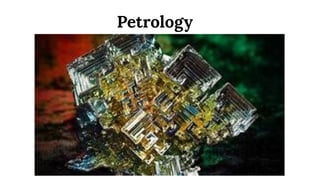
Petrology
1. Igneous rocks
2. Metamorphic rocks
3. Sedimentary rocks
Petrology
Petrology deals with the study of rocks
● Petro = rock , ( litho=rock )
● Logos = study
Petrology comprises the
1. Origin
2. Association
3. Occurrence
4. Mineral composition
5. Texture
6. Structure
7. Physical properties etc.. of rocks
Rocks
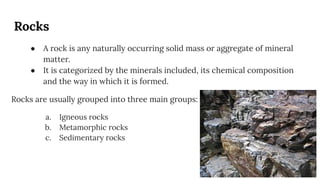
● A rock is any naturally occurring solid mass or aggregate of mineral
matter.
● It is categorized by the minerals included, its chemical composition
and the way in which it is formed.
Rocks are usually grouped into three main groups:
a. Igneous rocks
b. Metamorphic rocks
c. Sedimentary rocks
Primary and secondary minerals
● Structural features that are developed in the body of rock during
its formation are termed s Primary minerals.
a. Igneous rocks - Crystalline structure
b. Metamorphic rocks - Foliation
c. Sedimentary rocks - stratification and lamination
● After the formation if any rearrangement of components of
grains,crystals or mineral composition induced then they are
termed as secondary minerals.
( Folding, faulting and jointing are the results of secondary formation
structure which are seen in almost all types of rocks)
Igneous rocks
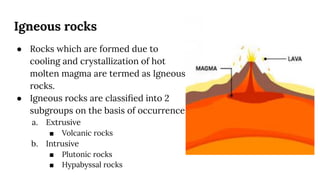
● Rocks which are formed due to
cooling and crystallization of hot
molten magma are termed as Igneous
rocks.
● Igneous rocks are classified into 2
subgroups on the basis of occurrence
a. Extrusive
■ Volcanic rocks
b. Intrusive
■ Plutonic rocks
■ Hypabyssal rocks
Cont.., Igneous rocks
a. Extrusive igneous rocks
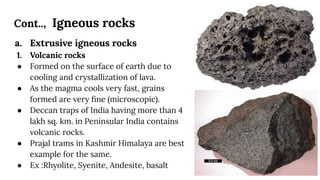
1. Volcanic rocks
● Formed on the surface of earth due to
cooling and crystallization of lava.
● As the magma cools very fast, grains
formed are very fine (microscopic).
● Deccan traps of India having more than 4
lakh sq. km. in Peninsular India contains
volcanic rocks.
● Prajal trams in Kashmir Himalaya are best
example for the same.
● Ex :Rhyolite, Syenite, Andesite, basalt
Cont.., Igneous rocks
b. Intrusive Igneous rocks
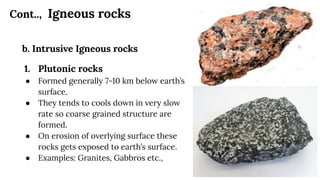
1. Plutonic rocks
● Formed generally 7-10 km below earth’s
surface.
● They tends to cools down in very slow
rate so coarse grained structure are
formed.
● On erosion of overlying surface these
rocks gets exposed to earth’s surface.
● Examples: Granites, Gabbros etc.,
Cont.., Igneous rocks
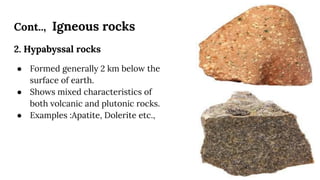
2. Hypabyssal rocks
● Formed generally 2 km below the
surface of earth.
● Shows mixed characteristics of
both volcanic and plutonic rocks.
● Examples :Apatite, Dolerite etc.,
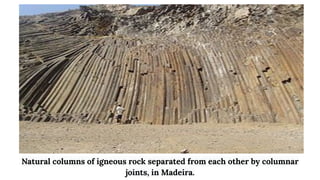
Natural columns of igneous rock separated from each other by columnar
joints, in Madeira.
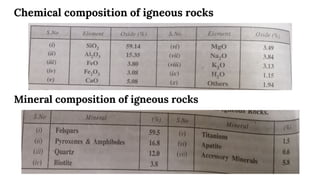
Chemical composition of igneous rocks
Mineral composition of igneous rocks
Cont.., Igneous rocks
Texture of igneous rocks
● It is defined as mutual relationship of different mineralogical constituents
of rocks.
● It is determined based on size, shape and arrangements of the
constituents of rocks.
● Factors influencing texture of igneous rocks
a. Degree of crystallization
b. Granularity
c. Fabric
Texture of igneous rocks
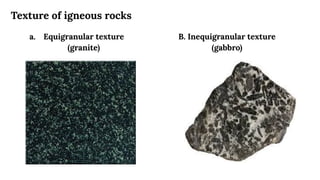
a. Equigranular texture
(granite)
B. Inequigranular texture
(gabbro)
Texture of igneous rocks
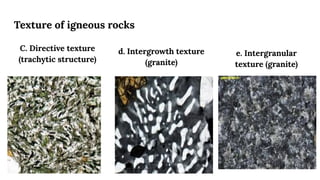
C. Directive texture
(trachytic structure)
d. Intergrowth texture
(granite)
e. Intergranular
texture (granite)
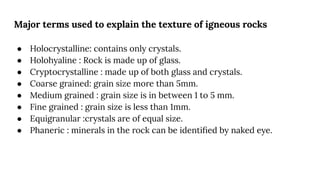
Major terms used to explain the texture of igneous rocks
● Holocrystalline: contains only crystals.
● Holohyaline : Rock is made up of glass.
● Cryptocrystalline : made up of both glass and crystals.
● Coarse grained: grain size more than 5mm.
● Medium grained : grain size is in between 1 to 5 mm.
● Fine grained : grain size is less than 1mm.
● Equigranular :crystals are of equal size.
● Phaneric : minerals in the rock can be identified by naked eye.
Structures of igneous rocks
Structures other features developed on a large scale in the body of an
extrusive and intrusive igneous rocks.
Types of structures in igneous rocks
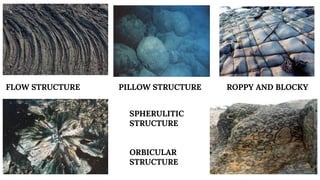
● Structures due to mobility of Lava or magma
a. Flow structure- due to flow larva parallel or nearly parallel layered
structures are formed
b. Pillow structure-development of bulbous, overlapping or pillow like
structures.
c. Ropy and blocky Lava- broken aur fragmented appearance due to highly
viscous or a different mobility of Lava
d. Spherulitic structures- thin minerals arranged in a radial manner about a
common centre
e. Orbicular structures- ball like concentric shell aggregations
FLOW STRUCTURE PILLOW STRUCTURE ROPPY AND BLOCKY
SPHERULITIC
STRUCTURE
ORBICULAR
STRUCTURE
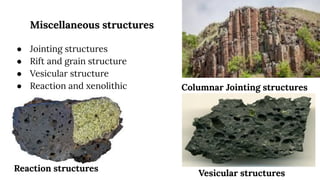
Miscellaneous structures
● Jointing structures
● Rift and grain structure
● Vesicular structure
● Reaction and xenolithic Columnar Jointing structures
Vesicular structures
Reaction structures
Forms of igneous rocks
● Shape of igneous rocks which occur after complete cooling and
crystallisation.
● Factors affecting form of igneous rock
a. Position of the bedrock
b. Viscosity of the magma
c. Composition of the magma
d. Environmental effect
● Based on form of igneous rocks 2 classifications are made.
1. Concordant bodies
2. Discordant bodies
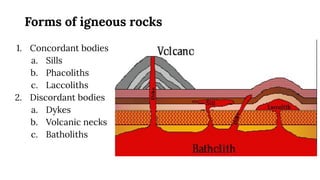
Forms of igneous rocks
1. Concordant bodies
a. Sills
b. Phacoliths
c. Laccoliths
2. Discordant bodies
a. Dykes
b. Volcanic necks
c. Batholiths
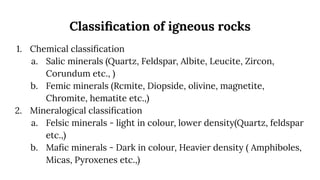
Classification of igneous rocks
1. Chemical classification
a. Salic minerals (Quartz, Feldspar, Albite, Leucite, Zircon,
Corundum etc., )
b. Femic minerals (Rcmite, Diopside, olivine, magnetite,
Chromite, hematite etc.,)
2. Mineralogical classification
a. Felsic minerals - light in colour, lower density(Quartz, feldspar
etc.,)
b. Mafic minerals - Dark in colour, Heavier density ( Amphiboles,
Micas, Pyroxenes etc.,)
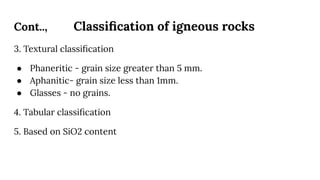
Cont.., Classification of igneous rocks
3. Textural classification
● Phaneritic - grain size greater than 5 mm.
● Aphanitic- grain size less than 1mm.
● Glasses - no grains.
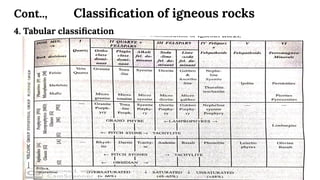
4. Tabular classification
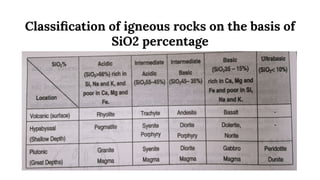
5. Based on SiO2 content
Cont.., Classification of igneous rocks
4. Tabular classification
Classification of igneous rocks on the basis of
SiO2 percentage
Formation of igneous rocks
● More than 90% of the Earth’s crust has been made up of Igneous
rock upto a depth of 10Km from the Earth’s surface.
● So the main question arises while studying formation are
a. What is the source for it ?
b. What is the process involved in it ?
c. What is the basic phenomenon involved ?
Study of commonly occurring igneous rocks
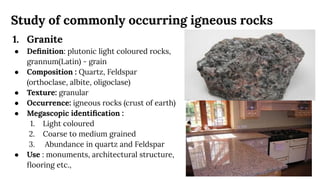
1. Granite
● Definition: plutonic light coloured rocks,
grannum(Latin) - grain
● Composition : Quartz, Feldspar
(orthoclase, albite, oligoclase)
● Texture: granular
● Occurrence: igneous rocks (crust of earth)
● Megascopic identification :
1. Light coloured
2. Coarse to medium grained
3. Abundance in quartz and Feldspar
● Use : monuments, architectural structure,
flooring etc.,
Study of commonly occurring igneous rocks
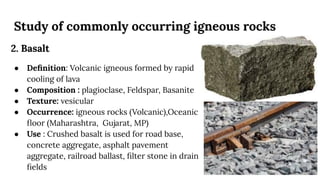
2. Basalt
● Definition: Volcanic igneous formed by rapid
cooling of lava
● Composition : plagioclase, Feldspar, Basanite
● Texture: vesicular
● Occurrence: igneous rocks (Volcanic),Oceanic
floor (Maharashtra, Gujarat, MP)
● Use : Crushed basalt is used for road base,
concrete aggregate, asphalt pavement
aggregate, railroad ballast, filter stone in drain
fields
Study of commonly occurring igneous rocks
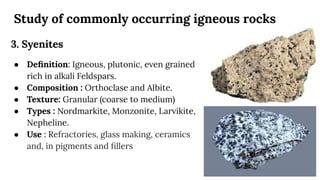
3. Syenites
● Definition: Igneous, plutonic, even grained
rich in alkali Feldspars.
● Composition : Orthoclase and Albite.
● Texture: Granular (coarse to medium)
● Types : Nordmarkite, Monzonite, Larvikite,
Nepheline.
● Use : Refractories, glass making, ceramics
and, in pigments and fillers
Study of commonly occurring igneous rocks
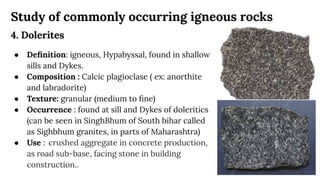
4. Dolerites
● Definition: igneous, Hypabyssal, found in shallow
sills and Dykes.
● Composition : Calcic plagioclase ( ex: anorthite
and labradorite)
● Texture: granular (medium to fine)
● Occurrence : found at sill and Dykes of doleritics
(can be seen in SinghBhum of South bihar called
as Sighbhum granites, in parts of Maharashtra)
● Use : crushed aggregate in concrete production,
as road sub-base, facing stone in building
construction..
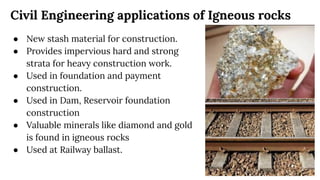
Civil Engineering applications of Igneous rocks
● New stash material for construction.
● Provides impervious hard and strong
strata for heavy construction work.
● Used in foundation and payment
construction.
● Used in Dam, Reservoir foundation
construction
● Valuable minerals like diamond and gold
is found in igneous rocks
● Used at Railway ballast.
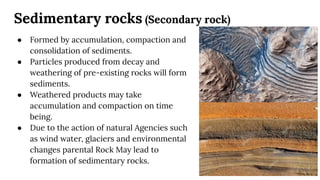
Sedimentary rocks (Secondary rock)
● Formed by accumulation, compaction and
consolidation of sediments.
● Particles produced from decay and
weathering of pre-existing rocks will form
sediments.
● Weathered products may take
accumulation and compaction on time
being.
● Due to the action of natural Agencies such
as wind water, glaciers and environmental
changes parental Rock May lead to
formation of sedimentary rocks.
Formation of sedimentary rocks
● The process of formation of sedimentary rock
is ever prevailing.
● The products which are produced by the
weathering action are being transported
consolidated and then transferred into a
cohesive solid mass which will lead to the
formation of the hard rock core and is termed
as sedimentary rock.
● Right from the beginning of earth the similar
process has been taken continuously and
huge amount of the sedimentary rocks has
been formed by the parental rocks.
Classification of sedimentary rocks based on
mode of formation
● Mechanical formed rocks or clastic rock
● Organically formed rocks
● Chemically formed rocks
1. Mechanically formed or clastic rocks- They can be well defined in 4
different steps
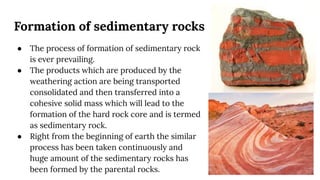
a. Decay and disintegration
b. transport of sediments
c. gradual deposition
d. Diagenesis
Cont.., Classification of sedimentary rocks based on
mode of formation
1. Mechanically formed or clastic rocks
(Cont.,)
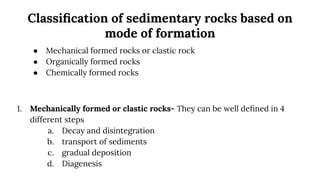
a. Decay and disintegration
● existing parental Rock undergo disintegration by
the action of natural Agencies like atmosphere
water and ice
● these Hard Rocks has been gradually broken
down into smaller fragments and lead to
transportation.
● Disintegrated and loosened material so formed
and accumulated near the service is called
detritus. So the clastic rocks are often called as
detrital rocks.
Cont.., Classification of sedimentary rocks based on
mode of formation
1. Mechanically formed or clastic rocks (Cont..,)
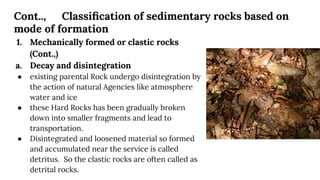
B. Transport of sediments
● Natural Agencies like running water glaciers and wind are the very strong and
common agents for transportation of decayed material.
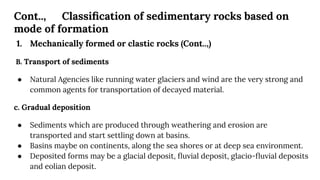
c. Gradual deposition
● Sediments which are produced through weathering and erosion are
transported and start settling down at basins.
● Basins maybe on continents, along the sea shores or at deep sea environment.
● Deposited forms may be a glacial deposit, fluvial deposit, glacio-fluvial deposits
and eolian deposit.
Cont.., Classification of sedimentary rocks based on
mode of formation
1. Mechanically formed or clastic rocks (Cont..,)
● The materials which are being transported are being settled based on
their grain size shape and weight and then lead to the formation of layers
or sediments.
D. Diagenesis
● Sediments deposited in settling basin gradually get converted to cohesive
hard and messing Rock formations by the process of compaction
consolidation and cementation which is termed as Diagenesis.
Cont.., Classification of sedimentary rocks based on
mode of formation
B. Chemically formed rocks
● The water which is flowing from the different water bodies dissolve
many compounds from the parental rocks.
● During this process dissolved salts get crystallized and undergo
evaporation or precipitation.
● Chemically formed rocks may be of two types
○ Precipitates
○ Evaporites
● Ex : Limestone, Rock salt, Gypsum etc..,
Cont.., Classification of sedimentary rocks based on
mode of formation
c. Organically formed rocks
● Variety of plants and animals present in the water bodies lead to organic
reaction of primary or bed rocks.
● The hard parts of many Seas chiefly consists organisms with calcium,
magnesium, carbonate.
● Death and decay of these organisms in the water bodies leads to huge
accumulation of different chemicals.
● On time being they undergo deposition and then get compact and
consolidated and leads to formation of sediments.
● Limestone is one of the best example for such kind of sedimentary rocks.
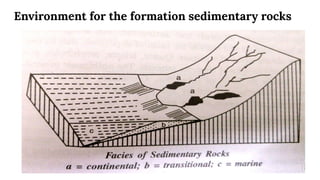
Environment for the formation sedimentary rocks
FACIES :The concept of formation of a sedimentary rock in a particular type of
environment.
The main types of facies recognised during the formation of sedimentary
rocks are as follows,
1. Continental facies
■ Rocks formed on the continents such as lakes rivers streams are
termed as continental facies.
■ Coarse grained rocks like brazier conglomerate and soft sandstone
are the examples.
■ Continental facial are relatively less dense, loosely packed and rarely
cemented.
Cont.., Environment for the formation sedimentary
rocks
2. Transitional faces
● The Rocks which of formed due to accumulation and compaction along
the seashore on the continental Chef V are sometimes submerged under
sea.
● Ex : sandstones, silt stones and clay stones.
3. Marine fishes
● The sedimentary rocks which are formed at the seafloor ocean floor will
come under marine fishes
● It can be further divided as Shallow sea deposits and deeper Marine
deposits.
Environment for the formation sedimentary rocks
Textures of Sedimentary rocks
● Origin of grains : based on chemical or mechanical composition.
● Size of grains : grain size may vary from 0.002 mm to 250mm.
○ Coarse grained rock - > 5mm.
○ Medium grained rock - 5 to 1 mm.
○ Fine grained rock - < 1 mm.
● Shape of grains : Rounded, angular, subrounded and subangular.
● Packing of grains : openly packed or porous in texture or densely packed.
● Fabric of grains.
● Crystallization trend.
Structures of Sedimentary rocks
1. Mechanical structure
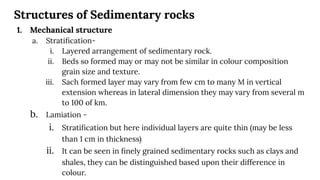
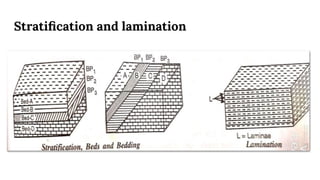
a. Stratification-
i. Layered arrangement of sedimentary rock.
ii. Beds so formed may or may not be similar in colour composition
grain size and texture.
iii. Sach formed layer may vary from few cm to many M in vertical
extension whereas in lateral dimension they may vary from several m
to 100 of km.
b. Lamiation -
i. Stratification but here individual layers are quite thin (may be less
than 1 cm in thickness)
ii. It can be seen in finely grained sedimentary rocks such as clays and
shales, they can be distinguished based upon their difference in
colour.
Stratification and lamination
Cont.., Structures of Sedimentary rocks
1. Mechanical structure
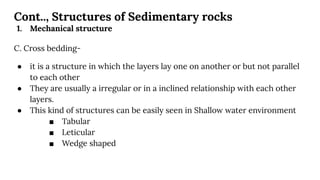
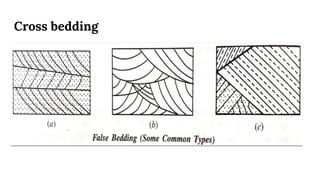
C. Cross bedding-
● it is a structure in which the layers lay one on another or but not parallel
to each other
● They are usually a irregular or in a inclined relationship with each other
layers.
● This kind of structures can be easily seen in Shallow water environment
■ Tabular
■ Leticular
■ Wedge shaped
Cross bedding
Cont.., Structures of Sedimentary rocks
1. Mechanical structure
D. Graded bedding-
● The sediments are arranged based on their grain size.
● based upon the weight of the fragments the particles will settle due to
gravitational forces.
● Finer particles will settle at the top and coarser particle will settle at the
bottom and such formed bedding plane is called graded bedding
structure.
e. Mud cracks- these are polygon oil or irregular shaped tracks which are
spread along the surface of exposure sedimentary rock it will be same as like
the cracks which occur on the drying process of mud in Shallow environment
conditions
Cont.., Structures of Sedimentary rocks
1. Mechanical structure
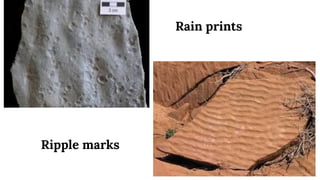
F. Rain prints- These are irregular small crater shaped depressions, seen on
fine grain sediments.
G. Ripple marks- These are symmetrical or asymmetrical wave like
undulations or irregularities which are formed due to wind action or wave
action during the process of deposition.
Mud cracks rain prints and ripple marks when found in sedimentary
formations are taken as confirmatory evidence for the formation which is
being deposited in Shallow water environment
Rain prints
Ripple marks
(Cont..,) Structures of Sedimentary rocks
2. Chemical structure- The structures which are formed due to
evaporation precipitation and crystallization are called as chemical
informed structure
a. Concretionary structure- In this the concretions are of various shapes
and dimensions such as a rounded, Sub-rounded, rough or smooth
texture. When large number of such compositions are compacted
together then the rock shows concretionary structure.
b. Nodular structure- In this type the irregular shaped nodules of chert,
iron oxide, ion carbonates and clayey iron stones are present.
c. Geode structure
Civil engineering importance of sedimentary rocks
● More than 75% edges of the surface area is covered by sedimentary rock
deposits.
● During any civil engineering project construction and engineer has to deal
with the issues which are related to sedimentary deposits
● Under the heavy loading of structures the engineer has to deal with the
load which is being applied on the deposit
● During the construction of tunnels and pavement the engineer has to
understand the capacity of sediment or the capacity of layer for the cut to
be made during the construction.
● Rocks like sandstone and limestone are most important to find the
Reservoir of oil and aquifers.
Study of commonly occurring sedimentary rocks
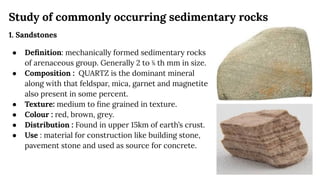
1. Sandstones
● Definition: mechanically formed sedimentary rocks
of arenaceous group. Generally 2 to ⅙ th mm in size.
● Composition : QUARTZ is the dominant mineral
along with that feldspar, mica, garnet and magnetite
also present in some percent.
● Texture: medium to fine grained in texture.
● Colour : red, brown, grey.
● Distribution : Found in upper 15km of earth’s crust.
● Use : material for construction like building stone,
pavement stone and used as source for concrete.
Cont.., Study of commonly occurring sedimentary rocks
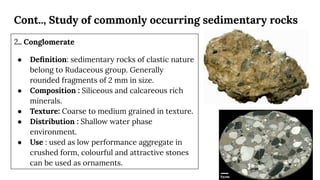
2.. Conglomerate
● Definition: sedimentary rocks of clastic nature
belong to Rudaceous group. Generally
rounded fragments of 2 mm in size.
● Composition : Siliceous and calcareous rich
minerals.
● Texture: Coarse to medium grained in texture.
● Distribution : Shallow water phase
environment.
● Use : used as low performance aggregate in
crushed form, colourful and attractive stones
can be used as ornaments.
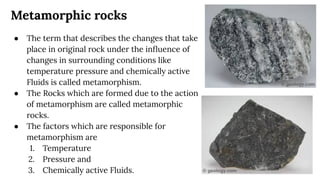
Metamorphic rocks
● The term that describes the changes that take
place in original rock under the influence of
changes in surrounding conditions like
temperature pressure and chemically active
Fluids is called metamorphism.
● The Rocks which are formed due to the action
of metamorphism are called metamorphic
rocks.
● The factors which are responsible for
metamorphism are
1. Temperature
2. Pressure and
3. Chemically active Fluids.
Agents responsible for metamorphism
1. Temperature
● Two common sources of heat generation for Metamorphic activity are the
internal heat and the magnetic heat.
● The rock forming minerals are usually stable at 200° C.
● The temperature of the earth crust goes on increasing as the depth goes on
increasing. The rise of temperature will be approximately 2 to 2.2 per 100 m
depth.
● It is believed that most metamorphic changes induced by heat factor takes
place between 200- 850 ° C.
● Magnetic intrusion like sill and dyke invades country rock from below, host
rock around magnetic intrusion suffer enormous changes in their
temperature.
Cont.., Agents responsible for metamorphism
2. Pressure
● In most of the cases pressure is the most dominating factor for
metamorphism.
● Any rock below some depth from the surface of earth undergo 2 types of
pressure.
1. Due to overburden load- vertical direction load implementation
2. Crustal movements due to tectonic plates- lateral direction load
implementation
Cont.., Agents responsible for metamorphism
3. Chemical environment
● Presence or absence of pore fluids play vital role in metamorphism.
● When the temperature increases below the surface, the fluids expands
and becomes very active in disturbing or breaking of crystal boundaries.
● Some times at elevated temperature fluids come in contact with the
existing mineral s and tends to form new minerals.
● The water and steam are considered most probable fluids.
● Water may be present in the minerals as water of crystallisation or simply
pore fluid or it may be supplied externally y magnetic bodies.
Formation of metamorphic rocks
● Metamorphic rocks are created by the physical or chemical alteration by
heat and pressure of an existing igneous or sedimentary material into a
denser form.
● Due to the action of plate tectonics, compression, stress and shearing
forces over long periods of time, rocks can be essentially warped and
deformed, causing them to be compacted into a smaller volume of space.
● Metamorphic rocks are always more dense than their original material,
and also much less susceptible to erosional breakdown.
● As the Earth's plates move over geologic time, a plate containing igneous
or sedimentary rock may become subducted under another plate. The
sheer weight of the material above it can cause the rock to undergo
metamorphism.
Types of metamorphism
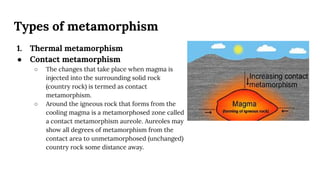
1. Thermal metamorphism
● Contact metamorphism
○ The changes that take place when magma is
injected into the surrounding solid rock
(country rock) is termed as contact
metamorphism.
○ Around the igneous rock that forms from the
cooling magma is a metamorphosed zone called
a contact metamorphism aureole. Aureoles may
show all degrees of metamorphism from the
contact area to unmetamorphosed (unchanged)
country rock some distance away.
Cont.., Types of metamorphism
1. Thermal metamorphism
● Pyrometamorphism
○ it is another type of thermometamorphism.
○ In this type a part of country Rock actually get entrapped within a magnetic body and
metamorphism process will start
○ the effect of such metamorphism results due to Intense localised heating.
○ If rock incidentally fallen in a body of flowing Lava, the block may so much heated up that
original minerals forced to recrystallose and rearrange them in accordance with the
condition imposed by the acute rise in temperature.
Cont.., Types of metamorphism
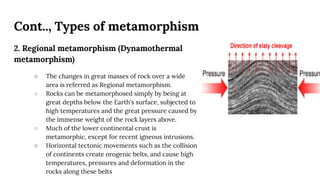
2. Regional metamorphism (Dynamothermal
metamorphism)
○ The changes in great masses of rock over a wide
area is referred as Regional metamorphism.
○ Rocks can be metamorphosed simply by being at
great depths below the Earth's surface, subjected to
high temperatures and the great pressure caused by
the immense weight of the rock layers above.
○ Much of the lower continental crust is
metamorphic, except for recent igneous intrusions.
○ Horizontal tectonic movements such as the collision
of continents create orogenic belts, and cause high
temperatures, pressures and deformation in the
rocks along these belts
Cont.., Types of metamorphism
3. Dynamic metamorphism
● it is also called clastic metamorphism, mechanical metamorphism or
dislocation metamorphism.
● It is brought about by the condition in which pressure factor plays a
dominant role.
● If the pressure is due to load of overlaying rocks then such metamorphism
is called load metamorphism.
● Here there is no or very little formation of new minerals.
● These are Original texture and structure of rocks that are partially or
totally obliterated.
Effects of Metamorphism
Effect of metamorphism is primarily based on two major factors,
1. The type of Rock involved in the process
2. The kind of metamorphic process operating on the rocks.
The effect of metamorphism main involved in the rock will result in,
● Recrystallisation
● Rock Flowage
● Granulation
● Metasomatic Replacement
Textures of Metamorphic rocks
● Crystalloblastic Texture
○ It includes all those texture that have been newly imposed
upon the rock during the process of metamorphism.
● Palimpsest (Relict)
○ These are the textures that were present in the parental rock
and have been retained by the rock despite metamorphic
changes.
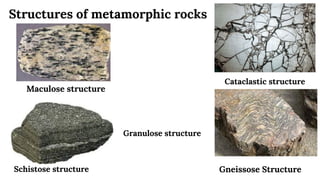
Structures of metamorphic rocks
Granulose structure
Cataclastic structure
Schistose structure Gneissose Structure
Maculose structure
Study of commonly occurring Metamorphic rocks
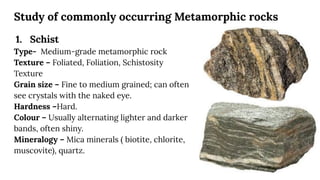
1. Schist
Type- Medium-grade metamorphic rock
Texture – Foliated, Foliation, Schistosity
Texture
Grain size – Fine to medium grained; can often
see crystals with the naked eye.
Hardness –Hard.
Colour – Usually alternating lighter and darker
bands, often shiny.
Mineralogy – Mica minerals ( biotite, chlorite,
muscovite), quartz.
Cont.., Study of commonly occurring Metamorphic rocks
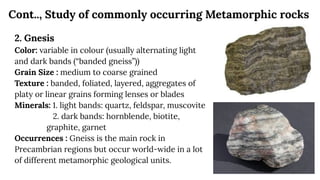
2. Gnesis
Color: variable in colour (usually alternating light
and dark bands (“banded gneiss”))
Grain Size : medium to coarse grained
Texture : banded, foliated, layered, aggregates of
platy or linear grains forming lenses or blades
Minerals: 1. light bands: quartz, feldspar, muscovite
2. dark bands: hornblende, biotite,
graphite, garnet
Occurrences : Gneiss is the main rock in
Precambrian regions but occur world-wide in a lot
of different metamorphic geological units.
Cont.., Study of commonly occurring Metamorphic
rocks
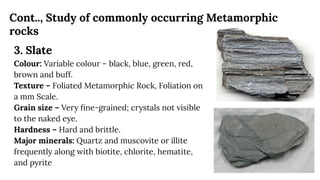
3. Slate
Colour: Variable colour – black, blue, green, red,
brown and buff.
Texture – Foliated Metamorphic Rock, Foliation on
a mm Scale.
Grain size – Very fine-grained; crystals not visible
to the naked eye.
Hardness – Hard and brittle.
Major minerals: Quartz and muscovite or illite
frequently along with biotite, chlorite, hematite,
and pyrite
Thank you

Petrology

  • 1.
  • 2.
    Petrology 1. Igneous rocks 2.Metamorphic rocks 3. Sedimentary rocks
  • 3.
    Petrology Petrology deals withthe study of rocks ● Petro = rock , ( litho=rock ) ● Logos = study Petrology comprises the 1. Origin 2. Association 3. Occurrence 4. Mineral composition 5. Texture 6. Structure 7. Physical properties etc.. of rocks
  • 4.
    Rocks ● A rockis any naturally occurring solid mass or aggregate of mineral matter. ● It is categorized by the minerals included, its chemical composition and the way in which it is formed. Rocks are usually grouped into three main groups: a. Igneous rocks b. Metamorphic rocks c. Sedimentary rocks
  • 5.
    Primary and secondaryminerals ● Structural features that are developed in the body of rock during its formation are termed s Primary minerals. a. Igneous rocks - Crystalline structure b. Metamorphic rocks - Foliation c. Sedimentary rocks - stratification and lamination ● After the formation if any rearrangement of components of grains,crystals or mineral composition induced then they are termed as secondary minerals. ( Folding, faulting and jointing are the results of secondary formation structure which are seen in almost all types of rocks)
  • 6.
    Igneous rocks ● Rockswhich are formed due to cooling and crystallization of hot molten magma are termed as Igneous rocks. ● Igneous rocks are classified into 2 subgroups on the basis of occurrence a. Extrusive ■ Volcanic rocks b. Intrusive ■ Plutonic rocks ■ Hypabyssal rocks
  • 7.
    Cont.., Igneous rocks a.Extrusive igneous rocks 1. Volcanic rocks ● Formed on the surface of earth due to cooling and crystallization of lava. ● As the magma cools very fast, grains formed are very fine (microscopic). ● Deccan traps of India having more than 4 lakh sq. km. in Peninsular India contains volcanic rocks. ● Prajal trams in Kashmir Himalaya are best example for the same. ● Ex :Rhyolite, Syenite, Andesite, basalt
  • 8.
    Cont.., Igneous rocks b.Intrusive Igneous rocks 1. Plutonic rocks ● Formed generally 7-10 km below earth’s surface. ● They tends to cools down in very slow rate so coarse grained structure are formed. ● On erosion of overlying surface these rocks gets exposed to earth’s surface. ● Examples: Granites, Gabbros etc.,
  • 9.
    Cont.., Igneous rocks 2.Hypabyssal rocks ● Formed generally 2 km below the surface of earth. ● Shows mixed characteristics of both volcanic and plutonic rocks. ● Examples :Apatite, Dolerite etc.,
  • 10.
    Natural columns ofigneous rock separated from each other by columnar joints, in Madeira.
  • 11.
    Chemical composition ofigneous rocks Mineral composition of igneous rocks
  • 12.
    Cont.., Igneous rocks Textureof igneous rocks ● It is defined as mutual relationship of different mineralogical constituents of rocks. ● It is determined based on size, shape and arrangements of the constituents of rocks. ● Factors influencing texture of igneous rocks a. Degree of crystallization b. Granularity c. Fabric
  • 13.
    Texture of igneousrocks a. Equigranular texture (granite) B. Inequigranular texture (gabbro)
  • 14.
    Texture of igneousrocks C. Directive texture (trachytic structure) d. Intergrowth texture (granite) e. Intergranular texture (granite)
  • 15.
    Major terms usedto explain the texture of igneous rocks ● Holocrystalline: contains only crystals. ● Holohyaline : Rock is made up of glass. ● Cryptocrystalline : made up of both glass and crystals. ● Coarse grained: grain size more than 5mm. ● Medium grained : grain size is in between 1 to 5 mm. ● Fine grained : grain size is less than 1mm. ● Equigranular :crystals are of equal size. ● Phaneric : minerals in the rock can be identified by naked eye.
  • 16.
    Structures of igneousrocks Structures other features developed on a large scale in the body of an extrusive and intrusive igneous rocks. Types of structures in igneous rocks ● Structures due to mobility of Lava or magma a. Flow structure- due to flow larva parallel or nearly parallel layered structures are formed b. Pillow structure-development of bulbous, overlapping or pillow like structures. c. Ropy and blocky Lava- broken aur fragmented appearance due to highly viscous or a different mobility of Lava d. Spherulitic structures- thin minerals arranged in a radial manner about a common centre e. Orbicular structures- ball like concentric shell aggregations
  • 17.
    FLOW STRUCTURE PILLOWSTRUCTURE ROPPY AND BLOCKY SPHERULITIC STRUCTURE ORBICULAR STRUCTURE
  • 18.
    Miscellaneous structures ● Jointingstructures ● Rift and grain structure ● Vesicular structure ● Reaction and xenolithic Columnar Jointing structures Vesicular structures Reaction structures
  • 19.
    Forms of igneousrocks ● Shape of igneous rocks which occur after complete cooling and crystallisation. ● Factors affecting form of igneous rock a. Position of the bedrock b. Viscosity of the magma c. Composition of the magma d. Environmental effect ● Based on form of igneous rocks 2 classifications are made. 1. Concordant bodies 2. Discordant bodies
  • 20.
    Forms of igneousrocks 1. Concordant bodies a. Sills b. Phacoliths c. Laccoliths 2. Discordant bodies a. Dykes b. Volcanic necks c. Batholiths
  • 21.
    Classification of igneousrocks 1. Chemical classification a. Salic minerals (Quartz, Feldspar, Albite, Leucite, Zircon, Corundum etc., ) b. Femic minerals (Rcmite, Diopside, olivine, magnetite, Chromite, hematite etc.,) 2. Mineralogical classification a. Felsic minerals - light in colour, lower density(Quartz, feldspar etc.,) b. Mafic minerals - Dark in colour, Heavier density ( Amphiboles, Micas, Pyroxenes etc.,)
  • 22.
    Cont.., Classification ofigneous rocks 3. Textural classification ● Phaneritic - grain size greater than 5 mm. ● Aphanitic- grain size less than 1mm. ● Glasses - no grains. 4. Tabular classification 5. Based on SiO2 content
  • 23.
    Cont.., Classification ofigneous rocks 4. Tabular classification
  • 24.
    Classification of igneousrocks on the basis of SiO2 percentage
  • 25.
    Formation of igneousrocks ● More than 90% of the Earth’s crust has been made up of Igneous rock upto a depth of 10Km from the Earth’s surface. ● So the main question arises while studying formation are a. What is the source for it ? b. What is the process involved in it ? c. What is the basic phenomenon involved ?
  • 26.
    Study of commonlyoccurring igneous rocks 1. Granite ● Definition: plutonic light coloured rocks, grannum(Latin) - grain ● Composition : Quartz, Feldspar (orthoclase, albite, oligoclase) ● Texture: granular ● Occurrence: igneous rocks (crust of earth) ● Megascopic identification : 1. Light coloured 2. Coarse to medium grained 3. Abundance in quartz and Feldspar ● Use : monuments, architectural structure, flooring etc.,
  • 27.
    Study of commonlyoccurring igneous rocks 2. Basalt ● Definition: Volcanic igneous formed by rapid cooling of lava ● Composition : plagioclase, Feldspar, Basanite ● Texture: vesicular ● Occurrence: igneous rocks (Volcanic),Oceanic floor (Maharashtra, Gujarat, MP) ● Use : Crushed basalt is used for road base, concrete aggregate, asphalt pavement aggregate, railroad ballast, filter stone in drain fields
  • 28.
    Study of commonlyoccurring igneous rocks 3. Syenites ● Definition: Igneous, plutonic, even grained rich in alkali Feldspars. ● Composition : Orthoclase and Albite. ● Texture: Granular (coarse to medium) ● Types : Nordmarkite, Monzonite, Larvikite, Nepheline. ● Use : Refractories, glass making, ceramics and, in pigments and fillers
  • 29.
    Study of commonlyoccurring igneous rocks 4. Dolerites ● Definition: igneous, Hypabyssal, found in shallow sills and Dykes. ● Composition : Calcic plagioclase ( ex: anorthite and labradorite) ● Texture: granular (medium to fine) ● Occurrence : found at sill and Dykes of doleritics (can be seen in SinghBhum of South bihar called as Sighbhum granites, in parts of Maharashtra) ● Use : crushed aggregate in concrete production, as road sub-base, facing stone in building construction..
  • 30.
    Civil Engineering applicationsof Igneous rocks ● New stash material for construction. ● Provides impervious hard and strong strata for heavy construction work. ● Used in foundation and payment construction. ● Used in Dam, Reservoir foundation construction ● Valuable minerals like diamond and gold is found in igneous rocks ● Used at Railway ballast.
  • 31.
    Sedimentary rocks (Secondaryrock) ● Formed by accumulation, compaction and consolidation of sediments. ● Particles produced from decay and weathering of pre-existing rocks will form sediments. ● Weathered products may take accumulation and compaction on time being. ● Due to the action of natural Agencies such as wind water, glaciers and environmental changes parental Rock May lead to formation of sedimentary rocks.
  • 32.
    Formation of sedimentaryrocks ● The process of formation of sedimentary rock is ever prevailing. ● The products which are produced by the weathering action are being transported consolidated and then transferred into a cohesive solid mass which will lead to the formation of the hard rock core and is termed as sedimentary rock. ● Right from the beginning of earth the similar process has been taken continuously and huge amount of the sedimentary rocks has been formed by the parental rocks.
  • 33.
    Classification of sedimentaryrocks based on mode of formation ● Mechanical formed rocks or clastic rock ● Organically formed rocks ● Chemically formed rocks 1. Mechanically formed or clastic rocks- They can be well defined in 4 different steps a. Decay and disintegration b. transport of sediments c. gradual deposition d. Diagenesis
  • 34.
    Cont.., Classification ofsedimentary rocks based on mode of formation 1. Mechanically formed or clastic rocks (Cont.,) a. Decay and disintegration ● existing parental Rock undergo disintegration by the action of natural Agencies like atmosphere water and ice ● these Hard Rocks has been gradually broken down into smaller fragments and lead to transportation. ● Disintegrated and loosened material so formed and accumulated near the service is called detritus. So the clastic rocks are often called as detrital rocks.
  • 35.
    Cont.., Classification ofsedimentary rocks based on mode of formation 1. Mechanically formed or clastic rocks (Cont..,) B. Transport of sediments ● Natural Agencies like running water glaciers and wind are the very strong and common agents for transportation of decayed material. c. Gradual deposition ● Sediments which are produced through weathering and erosion are transported and start settling down at basins. ● Basins maybe on continents, along the sea shores or at deep sea environment. ● Deposited forms may be a glacial deposit, fluvial deposit, glacio-fluvial deposits and eolian deposit.
  • 36.
    Cont.., Classification ofsedimentary rocks based on mode of formation 1. Mechanically formed or clastic rocks (Cont..,) ● The materials which are being transported are being settled based on their grain size shape and weight and then lead to the formation of layers or sediments. D. Diagenesis ● Sediments deposited in settling basin gradually get converted to cohesive hard and messing Rock formations by the process of compaction consolidation and cementation which is termed as Diagenesis.
  • 37.
    Cont.., Classification ofsedimentary rocks based on mode of formation B. Chemically formed rocks ● The water which is flowing from the different water bodies dissolve many compounds from the parental rocks. ● During this process dissolved salts get crystallized and undergo evaporation or precipitation. ● Chemically formed rocks may be of two types ○ Precipitates ○ Evaporites ● Ex : Limestone, Rock salt, Gypsum etc..,
  • 38.
    Cont.., Classification ofsedimentary rocks based on mode of formation c. Organically formed rocks ● Variety of plants and animals present in the water bodies lead to organic reaction of primary or bed rocks. ● The hard parts of many Seas chiefly consists organisms with calcium, magnesium, carbonate. ● Death and decay of these organisms in the water bodies leads to huge accumulation of different chemicals. ● On time being they undergo deposition and then get compact and consolidated and leads to formation of sediments. ● Limestone is one of the best example for such kind of sedimentary rocks.
  • 39.
    Environment for theformation sedimentary rocks FACIES :The concept of formation of a sedimentary rock in a particular type of environment. The main types of facies recognised during the formation of sedimentary rocks are as follows, 1. Continental facies ■ Rocks formed on the continents such as lakes rivers streams are termed as continental facies. ■ Coarse grained rocks like brazier conglomerate and soft sandstone are the examples. ■ Continental facial are relatively less dense, loosely packed and rarely cemented.
  • 40.
    Cont.., Environment forthe formation sedimentary rocks 2. Transitional faces ● The Rocks which of formed due to accumulation and compaction along the seashore on the continental Chef V are sometimes submerged under sea. ● Ex : sandstones, silt stones and clay stones. 3. Marine fishes ● The sedimentary rocks which are formed at the seafloor ocean floor will come under marine fishes ● It can be further divided as Shallow sea deposits and deeper Marine deposits.
  • 41.
    Environment for theformation sedimentary rocks
  • 42.
    Textures of Sedimentaryrocks ● Origin of grains : based on chemical or mechanical composition. ● Size of grains : grain size may vary from 0.002 mm to 250mm. ○ Coarse grained rock - > 5mm. ○ Medium grained rock - 5 to 1 mm. ○ Fine grained rock - < 1 mm. ● Shape of grains : Rounded, angular, subrounded and subangular. ● Packing of grains : openly packed or porous in texture or densely packed. ● Fabric of grains. ● Crystallization trend.
  • 43.
    Structures of Sedimentaryrocks 1. Mechanical structure a. Stratification- i. Layered arrangement of sedimentary rock. ii. Beds so formed may or may not be similar in colour composition grain size and texture. iii. Sach formed layer may vary from few cm to many M in vertical extension whereas in lateral dimension they may vary from several m to 100 of km. b. Lamiation - i. Stratification but here individual layers are quite thin (may be less than 1 cm in thickness) ii. It can be seen in finely grained sedimentary rocks such as clays and shales, they can be distinguished based upon their difference in colour.
  • 44.
  • 45.
    Cont.., Structures ofSedimentary rocks 1. Mechanical structure C. Cross bedding- ● it is a structure in which the layers lay one on another or but not parallel to each other ● They are usually a irregular or in a inclined relationship with each other layers. ● This kind of structures can be easily seen in Shallow water environment ■ Tabular ■ Leticular ■ Wedge shaped
  • 46.
  • 47.
    Cont.., Structures ofSedimentary rocks 1. Mechanical structure D. Graded bedding- ● The sediments are arranged based on their grain size. ● based upon the weight of the fragments the particles will settle due to gravitational forces. ● Finer particles will settle at the top and coarser particle will settle at the bottom and such formed bedding plane is called graded bedding structure. e. Mud cracks- these are polygon oil or irregular shaped tracks which are spread along the surface of exposure sedimentary rock it will be same as like the cracks which occur on the drying process of mud in Shallow environment conditions
  • 48.
    Cont.., Structures ofSedimentary rocks 1. Mechanical structure F. Rain prints- These are irregular small crater shaped depressions, seen on fine grain sediments. G. Ripple marks- These are symmetrical or asymmetrical wave like undulations or irregularities which are formed due to wind action or wave action during the process of deposition. Mud cracks rain prints and ripple marks when found in sedimentary formations are taken as confirmatory evidence for the formation which is being deposited in Shallow water environment
  • 49.
  • 50.
    (Cont..,) Structures ofSedimentary rocks 2. Chemical structure- The structures which are formed due to evaporation precipitation and crystallization are called as chemical informed structure a. Concretionary structure- In this the concretions are of various shapes and dimensions such as a rounded, Sub-rounded, rough or smooth texture. When large number of such compositions are compacted together then the rock shows concretionary structure. b. Nodular structure- In this type the irregular shaped nodules of chert, iron oxide, ion carbonates and clayey iron stones are present. c. Geode structure
  • 51.
    Civil engineering importanceof sedimentary rocks ● More than 75% edges of the surface area is covered by sedimentary rock deposits. ● During any civil engineering project construction and engineer has to deal with the issues which are related to sedimentary deposits ● Under the heavy loading of structures the engineer has to deal with the load which is being applied on the deposit ● During the construction of tunnels and pavement the engineer has to understand the capacity of sediment or the capacity of layer for the cut to be made during the construction. ● Rocks like sandstone and limestone are most important to find the Reservoir of oil and aquifers.
  • 52.
    Study of commonlyoccurring sedimentary rocks 1. Sandstones ● Definition: mechanically formed sedimentary rocks of arenaceous group. Generally 2 to ⅙ th mm in size. ● Composition : QUARTZ is the dominant mineral along with that feldspar, mica, garnet and magnetite also present in some percent. ● Texture: medium to fine grained in texture. ● Colour : red, brown, grey. ● Distribution : Found in upper 15km of earth’s crust. ● Use : material for construction like building stone, pavement stone and used as source for concrete.
  • 53.
    Cont.., Study ofcommonly occurring sedimentary rocks 2.. Conglomerate ● Definition: sedimentary rocks of clastic nature belong to Rudaceous group. Generally rounded fragments of 2 mm in size. ● Composition : Siliceous and calcareous rich minerals. ● Texture: Coarse to medium grained in texture. ● Distribution : Shallow water phase environment. ● Use : used as low performance aggregate in crushed form, colourful and attractive stones can be used as ornaments.
  • 54.
    Metamorphic rocks ● Theterm that describes the changes that take place in original rock under the influence of changes in surrounding conditions like temperature pressure and chemically active Fluids is called metamorphism. ● The Rocks which are formed due to the action of metamorphism are called metamorphic rocks. ● The factors which are responsible for metamorphism are 1. Temperature 2. Pressure and 3. Chemically active Fluids.
  • 55.
    Agents responsible formetamorphism 1. Temperature ● Two common sources of heat generation for Metamorphic activity are the internal heat and the magnetic heat. ● The rock forming minerals are usually stable at 200° C. ● The temperature of the earth crust goes on increasing as the depth goes on increasing. The rise of temperature will be approximately 2 to 2.2 per 100 m depth. ● It is believed that most metamorphic changes induced by heat factor takes place between 200- 850 ° C. ● Magnetic intrusion like sill and dyke invades country rock from below, host rock around magnetic intrusion suffer enormous changes in their temperature.
  • 56.
    Cont.., Agents responsiblefor metamorphism 2. Pressure ● In most of the cases pressure is the most dominating factor for metamorphism. ● Any rock below some depth from the surface of earth undergo 2 types of pressure. 1. Due to overburden load- vertical direction load implementation 2. Crustal movements due to tectonic plates- lateral direction load implementation
  • 57.
    Cont.., Agents responsiblefor metamorphism 3. Chemical environment ● Presence or absence of pore fluids play vital role in metamorphism. ● When the temperature increases below the surface, the fluids expands and becomes very active in disturbing or breaking of crystal boundaries. ● Some times at elevated temperature fluids come in contact with the existing mineral s and tends to form new minerals. ● The water and steam are considered most probable fluids. ● Water may be present in the minerals as water of crystallisation or simply pore fluid or it may be supplied externally y magnetic bodies.
  • 58.
    Formation of metamorphicrocks ● Metamorphic rocks are created by the physical or chemical alteration by heat and pressure of an existing igneous or sedimentary material into a denser form. ● Due to the action of plate tectonics, compression, stress and shearing forces over long periods of time, rocks can be essentially warped and deformed, causing them to be compacted into a smaller volume of space. ● Metamorphic rocks are always more dense than their original material, and also much less susceptible to erosional breakdown. ● As the Earth's plates move over geologic time, a plate containing igneous or sedimentary rock may become subducted under another plate. The sheer weight of the material above it can cause the rock to undergo metamorphism.
  • 59.
    Types of metamorphism 1.Thermal metamorphism ● Contact metamorphism ○ The changes that take place when magma is injected into the surrounding solid rock (country rock) is termed as contact metamorphism. ○ Around the igneous rock that forms from the cooling magma is a metamorphosed zone called a contact metamorphism aureole. Aureoles may show all degrees of metamorphism from the contact area to unmetamorphosed (unchanged) country rock some distance away.
  • 60.
    Cont.., Types ofmetamorphism 1. Thermal metamorphism ● Pyrometamorphism ○ it is another type of thermometamorphism. ○ In this type a part of country Rock actually get entrapped within a magnetic body and metamorphism process will start ○ the effect of such metamorphism results due to Intense localised heating. ○ If rock incidentally fallen in a body of flowing Lava, the block may so much heated up that original minerals forced to recrystallose and rearrange them in accordance with the condition imposed by the acute rise in temperature.
  • 61.
    Cont.., Types ofmetamorphism 2. Regional metamorphism (Dynamothermal metamorphism) ○ The changes in great masses of rock over a wide area is referred as Regional metamorphism. ○ Rocks can be metamorphosed simply by being at great depths below the Earth's surface, subjected to high temperatures and the great pressure caused by the immense weight of the rock layers above. ○ Much of the lower continental crust is metamorphic, except for recent igneous intrusions. ○ Horizontal tectonic movements such as the collision of continents create orogenic belts, and cause high temperatures, pressures and deformation in the rocks along these belts
  • 62.
    Cont.., Types ofmetamorphism 3. Dynamic metamorphism ● it is also called clastic metamorphism, mechanical metamorphism or dislocation metamorphism. ● It is brought about by the condition in which pressure factor plays a dominant role. ● If the pressure is due to load of overlaying rocks then such metamorphism is called load metamorphism. ● Here there is no or very little formation of new minerals. ● These are Original texture and structure of rocks that are partially or totally obliterated.
  • 63.
    Effects of Metamorphism Effectof metamorphism is primarily based on two major factors, 1. The type of Rock involved in the process 2. The kind of metamorphic process operating on the rocks. The effect of metamorphism main involved in the rock will result in, ● Recrystallisation ● Rock Flowage ● Granulation ● Metasomatic Replacement
  • 64.
    Textures of Metamorphicrocks ● Crystalloblastic Texture ○ It includes all those texture that have been newly imposed upon the rock during the process of metamorphism. ● Palimpsest (Relict) ○ These are the textures that were present in the parental rock and have been retained by the rock despite metamorphic changes.
  • 65.
    Structures of metamorphicrocks Granulose structure Cataclastic structure Schistose structure Gneissose Structure Maculose structure
  • 66.
    Study of commonlyoccurring Metamorphic rocks 1. Schist Type- Medium-grade metamorphic rock Texture – Foliated, Foliation, Schistosity Texture Grain size – Fine to medium grained; can often see crystals with the naked eye. Hardness –Hard. Colour – Usually alternating lighter and darker bands, often shiny. Mineralogy – Mica minerals ( biotite, chlorite, muscovite), quartz.
  • 67.
    Cont.., Study ofcommonly occurring Metamorphic rocks 2. Gnesis Color: variable in colour (usually alternating light and dark bands (“banded gneiss”)) Grain Size : medium to coarse grained Texture : banded, foliated, layered, aggregates of platy or linear grains forming lenses or blades Minerals: 1. light bands: quartz, feldspar, muscovite 2. dark bands: hornblende, biotite, graphite, garnet Occurrences : Gneiss is the main rock in Precambrian regions but occur world-wide in a lot of different metamorphic geological units.
  • 68.
    Cont.., Study ofcommonly occurring Metamorphic rocks 3. Slate Colour: Variable colour – black, blue, green, red, brown and buff. Texture – Foliated Metamorphic Rock, Foliation on a mm Scale. Grain size – Very fine-grained; crystals not visible to the naked eye. Hardness – Hard and brittle. Major minerals: Quartz and muscovite or illite frequently along with biotite, chlorite, hematite, and pyrite
  • 69.