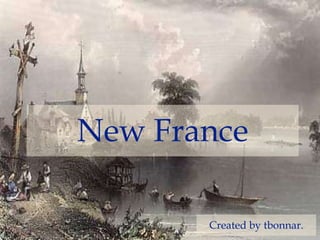

New France
Created by tbonnar.
When and Where?
• In the early 1500s, European countries
(specifically France) began sending explorers to
the “New World”
• They were looking for a route to the Far East
(Asia) to find silks and metals- Jacques Cartier
• They discovered the St. Lawrence area of
Canada and began setting up colonies there
because of the fertile lands and the fur trade
(coureurs de bois- runners of the woods)
John Cabot - Newfoundland
Jacques Cartier
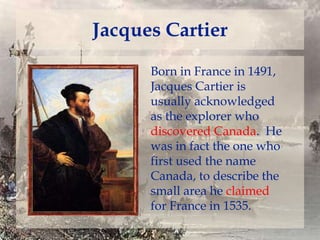
Born in France in 1491,
Jacques Cartier is
usually acknowledged
as the explorer who
discovered Canada. He
was in fact the one who
first used the name
Canada, to describe the
small area he claimed
for France in 1535.
Jacques Cartier
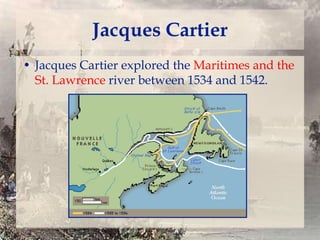
• Jacques Cartier explored the Maritimes and the
St. Lawrence river between 1534 and 1542.
Jacques Cartier - Kanata
Jacques Cartier
• He tried to establish a
colony for France on the St.
Lawrence, but ultimately
failed because:
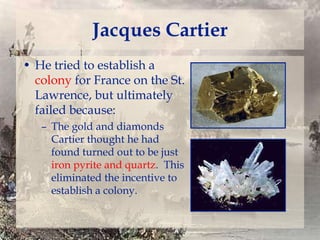
– The gold and diamonds
Cartier thought he had
found turned out to be just
iron pyrite and quartz. This
eliminated the incentive to
establish a colony.
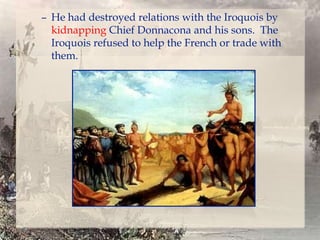
– He had destroyed relations with the Iroquois by
kidnapping Chief Donnacona and his sons. The
Iroquois refused to help the French or trade with
them.
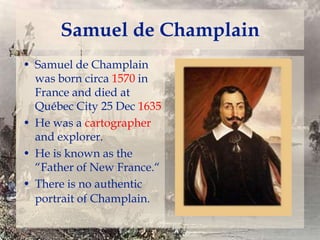
Samuel de Champlain
• Samuel de Champlain
was born circa 1570 in
France and died at
Québec City 25 Dec 1635
• He was a cartographer
and explorer.
• He is known as the
“Father of New France.“
• There is no authentic
portrait of Champlain.
Challenges of New France
• Europeans did not know about our cold winters
• They did not know if their crops would grow
• They did not know how to hunt or protect
themselves against wildlife
• The did not know if the people already living
there would accept them or try to get rid of
them (First Nations peoples)
The Early Years
• The trip over on was difficult and many
got sick
• Those that came were mostly poor people
in search of a better life
• They either farmed or entered the fur
trade (coureurs de bois)
• The populations grew slowly at first due
to the tough life style and lack of women
Failures to Colonize
• Profits continued in both fishing and the
growing fur trade, but other French
attempts at starting a colony also failed
until 1605
• In 1605, Samuel de Champlain started a
colony called Port Royal in what is now
Nova Scotia
• This colony failed by 1607, though some
stayed on as farmers in the area
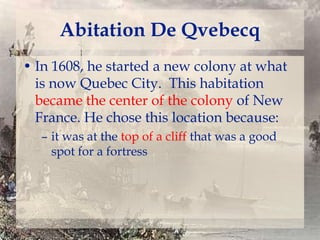
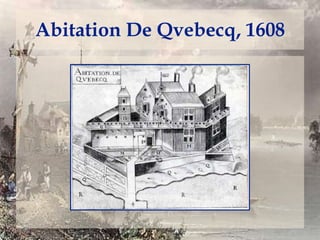
Abitation De Qvebecq
• In 1608, he started a new colony at what
is now Quebec City. This habitation
became the center of the colony of New
France. He chose this location because:
– it was at the top of a cliff that was a good
spot for a fortress
Abitation De Qvebecq, 1608
Abitation De Qvebecq
• He chose this location because:
– From there he was able to trade with the
Algonkians, Montagnais, and Hurons

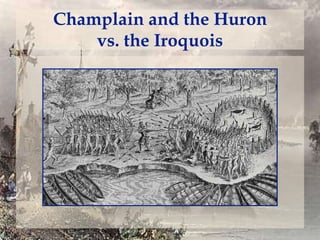
• He allied with these tribes against the
Iroquois, who were working with the
English
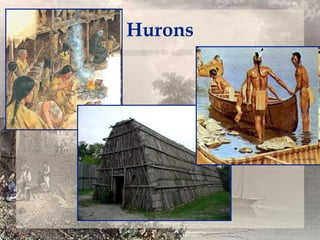
Hurons
Champlain and the Huron
vs. the Iroquois
Double Standard
• He (and France) maintained a strange
double standard:
– They wanted to have a colony so that wealth
could be extracted (in the form of furs),
– But they didn’t want the effort or
responsibility of a larger settlement, so they
tried to stop people from coming to the
colony to work as farmers or anything other
than fur traders.
Jesuit Missionaries
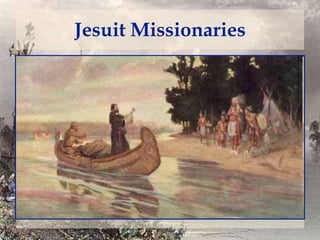
• He did allow Roman Catholic
missionaries to come and to work to
Christianize the Natives. Some did
become Christians, but others become
angry at the French because of the new
religion and the new diseases that the
missionaries brought. Conflict with the
Natives increased because of this.
Jesuit Missionaries
Settlement
• Despite the conflict with Natives and the
efforts to restrict colony growth, the
colony continued to survive. Not long
before Champlain died, The Company of
a Hundred Associates took over the
colony and was forced by France to bring
settlers to Canada. It did so, but still
reluctantly.
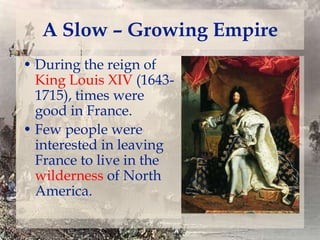
A Slow – Growing Empire
• During the reign of
King Louis XIV (16431715), times were
good in France.
• Few people were
interested in leaving
France to live in the
wilderness of North
America.
Settlement
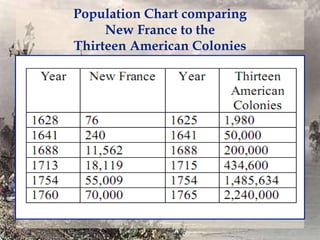
• The reluctance of the leaders of New
France to encourage settlement was one
of the factors that led to a major
population difference with the colonies of
the British that eventually led to the fall
of New France.
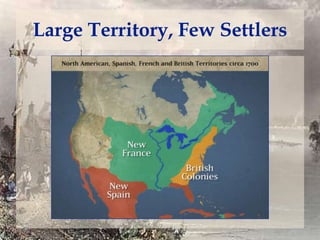
Large Territory, Few Settlers
Population Chart comparing
New France to the
Thirteen American Colonies
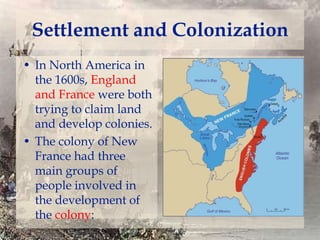
Settlement and Colonization
• In North America in
the 1600s, England
and France were both
trying to claim land
and develop colonies.
• The colony of New
France had three
main groups of
people involved in
the development of
the colony:
Fur Traders
• the Company of 100 Associates controlled
the colony. It was mostly interested in
developing the Fur Trade. It had a
monopoly on the fur trade.
• However, many Frenchmen avoided that
monopoly by becoming Coureurs de Bois
(runners of the woods). They travelled
long distances into the country searching
for people to trade furs with and then
sneaked these furs back into Montreal.
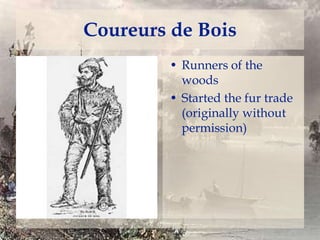
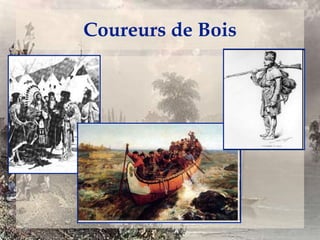
Coureurs de Bois
• Runners of the
woods
• Started the fur trade
(originally without
permission)
Coureurs de Bois
Settlers
• France had told the Company of a
Hundred Associates that it had to bring in
settlers to develop the colony.
• The Company divided the land up into
pieces called seigneuries and gave these
seigneuries to Nobles who would control
them as feudal-style manors. The
Seigneurs then rented out land to peasant
settlers called Habitants.
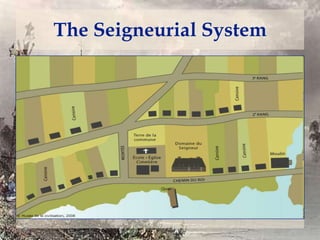
Seigneural system
• The King of France originally owned the land of
New France
• Farms were set up in seigneuries, which were
long, thin strips of land with access to water
• Once the farms were set up, the men would
often leave to enter the military or fur trade to
earn extra money
• Egages (hired hands) and the women and
children ran the farms
The Seigneurial System
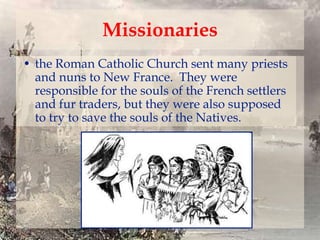
Missionaries
• the Roman Catholic Church sent many priests
and nuns to New France. They were
responsible for the souls of the French settlers
and fur traders, but they were also supposed
to try to save the souls of the Natives.
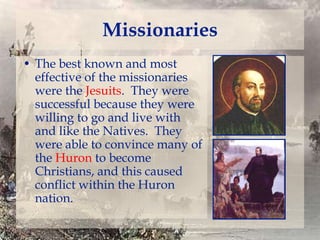
Missionaries
• The best known and most
effective of the missionaries
were the Jesuits. They were
successful because they were
willing to go and live with
and like the Natives. They
were able to convince many of
the Huron to become
Christians, and this caused
conflict within the Huron
nation.
The Royal Province of New France
• By 1661, it was obvious to the King of
France that the current system was not
working. The colony was not growing
the way that the English colonies were
growing. This was a problem to people
who believed in mercantilism.
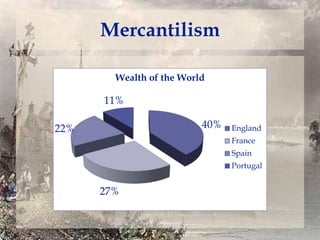
Mercantilism
• The theory that there is a limited amount of
wealth in the world and therefore the way to
become powerful is to control that wealth and
keep it away from others.
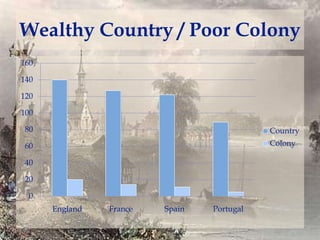
• One way to do this is to obtain raw materials
(natural resources) cheaply from colonies and
use them to make finished products in the home
country that can be sold in both the home
country and the colony. The colony will remain
poor while the home country becomes rich.
Mercantilism
Wealth of the World

11%
40%

22%

England
France
Spain
Portugal

27%
Wealthy Country / Poor Colony
160
140
120
100

80

Country

60

Colony

40
20
0
England

France

Spain

Portugal
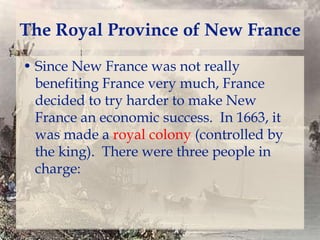
The Royal Province of New France
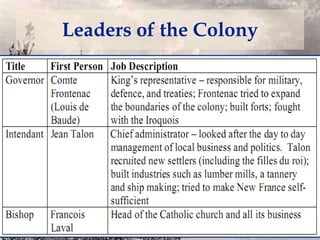
• Since New France was not really
benefiting France very much, France
decided to try harder to make New
France an economic success. In 1663, it
was made a royal colony (controlled by
the king). There were three people in
charge:
Leaders of the Colony
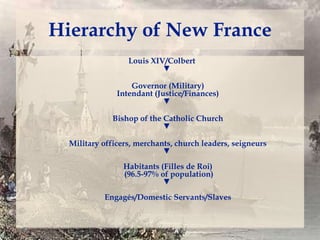
Hierarchy of New France
Louis XIV/Colbert
▼
Governor (Military)
Intendant (Justice/Finances)
▼
Bishop of the Catholic Church
▼
Military officers, merchants, church leaders, seigneurs
▼
Habitants (Filles de Roi)
(96.5-97% of population)
▼
Engagés/Domestic Servants/Slaves
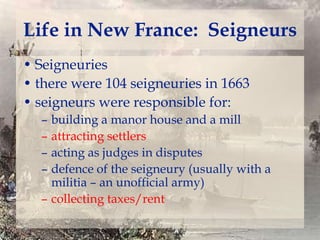
Life in New France: Seigneurs
• Seigneuries
• there were 104 seigneuries in 1663
• seigneurs were responsible for:
–
–
–
–

building a manor house and a mill
attracting settlers
acting as judges in disputes
defence of the seigneury (usually with a
militia – an unofficial army)
– collecting taxes/rent
Habitants
• rented the land from the seigneurs
• were required to:
–
–
–
–

pay rent
provide service
serve in the militia
grind their own grain at the mill

• often had second jobs in the fur trade or
in industry
Habitants
• women also worked on the farms and
had many children
• farmed, harvested sugar
maples, fished, cared for animals
• were not rich, but were considerably
better off than peasants in France because
they had lower rent, tithes and taxes
Towns
• there were several small towns; Quebec
was the biggest, most important and best
fortified
• had schools, hospitals and small
industries (businesses where things are
made)
Women
• many of the first women were Nuns sent to
convert Natives
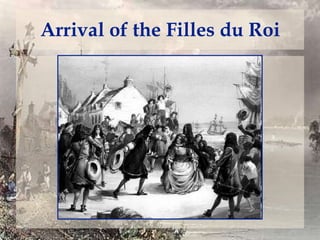
• the filles du roi, or “the king’s daughters” had
been recruited to leave difficult lives in France
to come to New France to be wives to settlers
• women had few official legal rights, but in
practice often worked as almost equal partners
• widows could control land and businesses, and
worked alongside men on the farms
Arrival of the Filles du Roi
The End of New France
• New France had many conflicts
throughout its history - with
Natives, British troops and the American
colonies
• Four major wars took place between
England and France that affected the
colonies
• In each of those wars, Britain (England)
won and took land from New France
Wars with England
• King William’s War (1689-1692) - Acadia was
lost for the first time.
• Queen Anne’s War (1704-1713) - Acadia was
lost permanently and the Acadians were exiled.
• King George’s War (1744-1748) – Louisburg was
lost to the English.
• Seven Years’ War (1756-1763) –
Quebec, Montreal and all of New France was
occupied by the English. They took control of
the colony.

New France

  • 1.
  • 2.
    When and Where? •In the early 1500s, European countries (specifically France) began sending explorers to the “New World” • They were looking for a route to the Far East (Asia) to find silks and metals- Jacques Cartier • They discovered the St. Lawrence area of Canada and began setting up colonies there because of the fertile lands and the fur trade (coureurs de bois- runners of the woods)
  • 3.
    John Cabot -Newfoundland
  • 4.
    Jacques Cartier Born inFrance in 1491, Jacques Cartier is usually acknowledged as the explorer who discovered Canada. He was in fact the one who first used the name Canada, to describe the small area he claimed for France in 1535.
  • 5.
    Jacques Cartier • JacquesCartier explored the Maritimes and the St. Lawrence river between 1534 and 1542.
  • 6.
  • 7.
    Jacques Cartier • Hetried to establish a colony for France on the St. Lawrence, but ultimately failed because: – The gold and diamonds Cartier thought he had found turned out to be just iron pyrite and quartz. This eliminated the incentive to establish a colony.
  • 8.
    – He haddestroyed relations with the Iroquois by kidnapping Chief Donnacona and his sons. The Iroquois refused to help the French or trade with them.
  • 10.
    Samuel de Champlain •Samuel de Champlain was born circa 1570 in France and died at Québec City 25 Dec 1635 • He was a cartographer and explorer. • He is known as the “Father of New France.“ • There is no authentic portrait of Champlain.
  • 11.
    Challenges of NewFrance • Europeans did not know about our cold winters • They did not know if their crops would grow • They did not know how to hunt or protect themselves against wildlife • The did not know if the people already living there would accept them or try to get rid of them (First Nations peoples)
  • 12.
    The Early Years •The trip over on was difficult and many got sick • Those that came were mostly poor people in search of a better life • They either farmed or entered the fur trade (coureurs de bois) • The populations grew slowly at first due to the tough life style and lack of women
  • 13.
    Failures to Colonize •Profits continued in both fishing and the growing fur trade, but other French attempts at starting a colony also failed until 1605 • In 1605, Samuel de Champlain started a colony called Port Royal in what is now Nova Scotia • This colony failed by 1607, though some stayed on as farmers in the area
  • 14.
    Abitation De Qvebecq •In 1608, he started a new colony at what is now Quebec City. This habitation became the center of the colony of New France. He chose this location because: – it was at the top of a cliff that was a good spot for a fortress
  • 15.
  • 16.
    Abitation De Qvebecq •He chose this location because: – From there he was able to trade with the Algonkians, Montagnais, and Hurons • He allied with these tribes against the Iroquois, who were working with the English
  • 17.
  • 18.
    Champlain and theHuron vs. the Iroquois
  • 19.
    Double Standard • He(and France) maintained a strange double standard: – They wanted to have a colony so that wealth could be extracted (in the form of furs), – But they didn’t want the effort or responsibility of a larger settlement, so they tried to stop people from coming to the colony to work as farmers or anything other than fur traders.
  • 20.
    Jesuit Missionaries • Hedid allow Roman Catholic missionaries to come and to work to Christianize the Natives. Some did become Christians, but others become angry at the French because of the new religion and the new diseases that the missionaries brought. Conflict with the Natives increased because of this.
  • 21.
  • 22.
    Settlement • Despite theconflict with Natives and the efforts to restrict colony growth, the colony continued to survive. Not long before Champlain died, The Company of a Hundred Associates took over the colony and was forced by France to bring settlers to Canada. It did so, but still reluctantly.
  • 23.
    A Slow –Growing Empire • During the reign of King Louis XIV (16431715), times were good in France. • Few people were interested in leaving France to live in the wilderness of North America.
  • 24.
    Settlement • The reluctanceof the leaders of New France to encourage settlement was one of the factors that led to a major population difference with the colonies of the British that eventually led to the fall of New France.
  • 25.
  • 26.
    Population Chart comparing NewFrance to the Thirteen American Colonies
  • 27.
    Settlement and Colonization •In North America in the 1600s, England and France were both trying to claim land and develop colonies. • The colony of New France had three main groups of people involved in the development of the colony:
  • 28.
    Fur Traders • theCompany of 100 Associates controlled the colony. It was mostly interested in developing the Fur Trade. It had a monopoly on the fur trade. • However, many Frenchmen avoided that monopoly by becoming Coureurs de Bois (runners of the woods). They travelled long distances into the country searching for people to trade furs with and then sneaked these furs back into Montreal.
  • 29.
    Coureurs de Bois •Runners of the woods • Started the fur trade (originally without permission)
  • 30.
  • 31.
    Settlers • France hadtold the Company of a Hundred Associates that it had to bring in settlers to develop the colony. • The Company divided the land up into pieces called seigneuries and gave these seigneuries to Nobles who would control them as feudal-style manors. The Seigneurs then rented out land to peasant settlers called Habitants.
  • 32.
    Seigneural system • TheKing of France originally owned the land of New France • Farms were set up in seigneuries, which were long, thin strips of land with access to water • Once the farms were set up, the men would often leave to enter the military or fur trade to earn extra money • Egages (hired hands) and the women and children ran the farms
  • 33.
  • 34.
    Missionaries • the RomanCatholic Church sent many priests and nuns to New France. They were responsible for the souls of the French settlers and fur traders, but they were also supposed to try to save the souls of the Natives.
  • 35.
    Missionaries • The bestknown and most effective of the missionaries were the Jesuits. They were successful because they were willing to go and live with and like the Natives. They were able to convince many of the Huron to become Christians, and this caused conflict within the Huron nation.
  • 36.
    The Royal Provinceof New France • By 1661, it was obvious to the King of France that the current system was not working. The colony was not growing the way that the English colonies were growing. This was a problem to people who believed in mercantilism.
  • 37.
    Mercantilism • The theorythat there is a limited amount of wealth in the world and therefore the way to become powerful is to control that wealth and keep it away from others. • One way to do this is to obtain raw materials (natural resources) cheaply from colonies and use them to make finished products in the home country that can be sold in both the home country and the colony. The colony will remain poor while the home country becomes rich.
  • 38.
    Mercantilism Wealth of theWorld 11% 40% 22% England France Spain Portugal 27%
  • 39.
    Wealthy Country /Poor Colony 160 140 120 100 80 Country 60 Colony 40 20 0 England France Spain Portugal
  • 42.
    The Royal Provinceof New France • Since New France was not really benefiting France very much, France decided to try harder to make New France an economic success. In 1663, it was made a royal colony (controlled by the king). There were three people in charge:
  • 43.
  • 44.
    Hierarchy of NewFrance Louis XIV/Colbert ▼ Governor (Military) Intendant (Justice/Finances) ▼ Bishop of the Catholic Church ▼ Military officers, merchants, church leaders, seigneurs ▼ Habitants (Filles de Roi) (96.5-97% of population) ▼ Engagés/Domestic Servants/Slaves
  • 45.
    Life in NewFrance: Seigneurs • Seigneuries • there were 104 seigneuries in 1663 • seigneurs were responsible for: – – – – building a manor house and a mill attracting settlers acting as judges in disputes defence of the seigneury (usually with a militia – an unofficial army) – collecting taxes/rent
  • 46.
    Habitants • rented theland from the seigneurs • were required to: – – – – pay rent provide service serve in the militia grind their own grain at the mill • often had second jobs in the fur trade or in industry
  • 47.
    Habitants • women alsoworked on the farms and had many children • farmed, harvested sugar maples, fished, cared for animals • were not rich, but were considerably better off than peasants in France because they had lower rent, tithes and taxes
  • 48.
    Towns • there wereseveral small towns; Quebec was the biggest, most important and best fortified • had schools, hospitals and small industries (businesses where things are made)
  • 49.
    Women • many ofthe first women were Nuns sent to convert Natives • the filles du roi, or “the king’s daughters” had been recruited to leave difficult lives in France to come to New France to be wives to settlers • women had few official legal rights, but in practice often worked as almost equal partners • widows could control land and businesses, and worked alongside men on the farms
  • 50.
    Arrival of theFilles du Roi
  • 51.
    The End ofNew France • New France had many conflicts throughout its history - with Natives, British troops and the American colonies • Four major wars took place between England and France that affected the colonies • In each of those wars, Britain (England) won and took land from New France
  • 52.
    Wars with England •King William’s War (1689-1692) - Acadia was lost for the first time. • Queen Anne’s War (1704-1713) - Acadia was lost permanently and the Acadians were exiled. • King George’s War (1744-1748) – Louisburg was lost to the English. • Seven Years’ War (1756-1763) – Quebec, Montreal and all of New France was occupied by the English. They took control of the colony.