Aegean Civilizations:  Neolithic to Hellenistic Age
PRODUCED BY Multimedia Learning, LLC  http://www.multimedialearning.org   WRITTEN BY  BRETT WYATT DANA BAGDASARIAN HERSCHEL SARNOFF COPYRIGHT 2006 CONTACT INFORMATION: [email_address] [email_address] VERSION 1.0
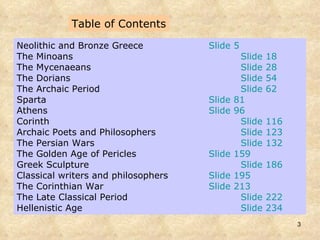
Table of Contents Neolithic and Bronze Greece Slide 5 The Minoans Slide 18 The Mycenaeans Slide 28 The Dorians Slide 54 The Archaic Period Slide 62 Sparta Slide 81 Athens Slide 96 Corinth Slide 116 Archaic Poets and Philosophers Slide 123 The Persian Wars Slide 132 The Golden Age of Pericles Slide 159 Greek Sculpture Slide 186 Classical writers and philosophers Slide 195 The Corinthian War Slide 213 The Late Classical Period Slide 222 Hellenistic Age Slide 234
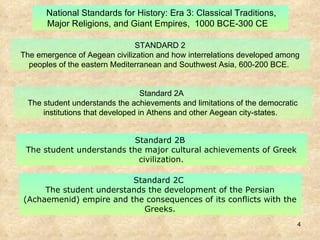
Standard 2B  The student understands the major cultural achievements of Greek civilization. STANDARD 2 The emergence of Aegean civilization and how interrelations developed among peoples of the eastern Mediterranean and Southwest Asia, 600-200 BCE.  National Standards for History: Era 3: Classical Traditions, Major Religions, and Giant Empires,  1000 BCE-300 CE   Standard 2C  The student understands the development of the Persian (Achaemenid) empire and the consequences of its conflicts with the Greeks. Standard 2A  The student understands the achievements and limitations of the democratic institutions that developed in Athens and other Aegean city-states.  
Neolithic and Bronze Age Greece Map of Greece Neolithic defined Neolithic villages Bronze Age  Bronze Age economy Bronze Age trading Bronze Age invaders
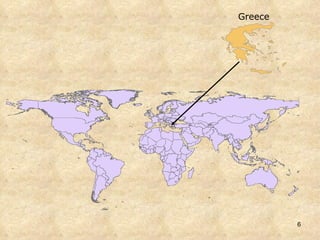
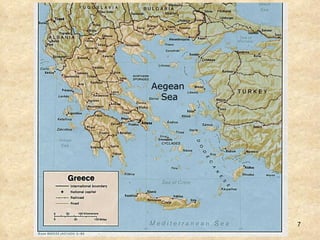
Greece
Aegean  Sea
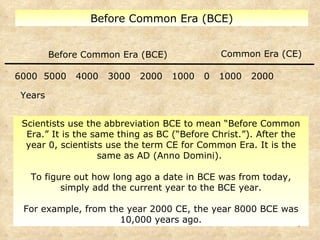
Scientists use the abbreviation BCE to mean “Before Common Era.” It is the same thing as BC (“Before Christ.”). After the year 0, scientists use the term CE for Common Era. It is the same as AD (Anno Domini).  To figure out how long ago a date in BCE was from today, simply add the current year to the BCE year. For example, from the year 2000 CE, the year 8000 BCE was 10,000 years ago. Before Common Era (BCE) Years 6000  5000  4000  3000  2000  1000  0  1000  2000  Before Common Era (BCE) Common Era (CE)
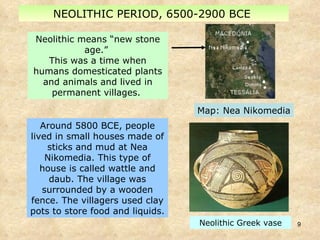
NEOLITHIC PERIOD, 6500-2900 BCE  Around 5800 BCE, people lived in small houses made of sticks and mud at Nea Nikomedia. This type of house is called wattle and daub. The village was surrounded by a wooden fence. The villagers used clay pots to store food and liquids.  Neolithic means “new stone age.”  This was a time when humans domesticated plants and animals and lived in permanent villages.  Map: Nea Nikomedia Neolithic Greek vase
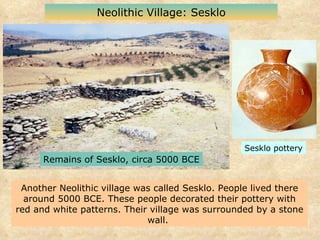
Another Neolithic village was called Sesklo. People lived there around 5000 BCE. These people decorated their pottery with red and white patterns. Their village was surrounded by a stone wall.  Neolithic Village: Sesklo Sesklo pottery Remains of Sesklo, circa 5000 BCE
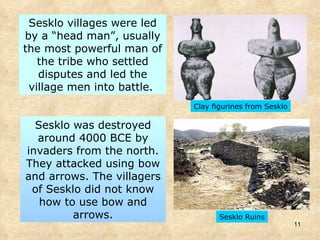
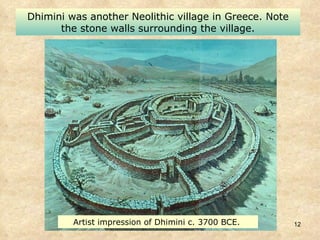
Sesklo villages were led by a “head man”, usually the most powerful man of the tribe who settled disputes and led the village men into battle.  Clay figurines from Sesklo Sesklo was destroyed around 4000 BCE by invaders from the north. They attacked using bow and arrows. The villagers of Sesklo did not know how to use bow and arrows. Sesklo Ruins
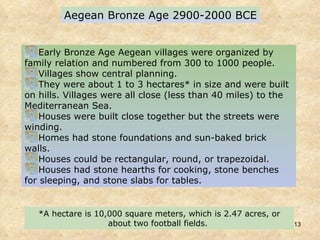
Dhimini was another Neolithic village in Greece. Note the stone walls surrounding the village. Artist impression of Dhimini c. 3700 BCE.
Aegean Bronze Age 2900-2000 BCE Early Bronze Age Aegean villages were organized by family relation and numbered from 300 to 1000 people.  Villages show central planning.  They were about 1 to 3 hectares* in size and were built on hills. Villages were all close (less than 40 miles) to the Mediterranean Sea.  Houses were built close together but the streets were winding.  Homes had stone foundations and sun-baked brick walls.  Houses could be rectangular, round, or trapezoidal.  Houses had stone hearths for cooking, stone benches for sleeping, and stone slabs for tables.  *A hectare is 10,000 square meters, which is 2.47 acres, or about two football fields.
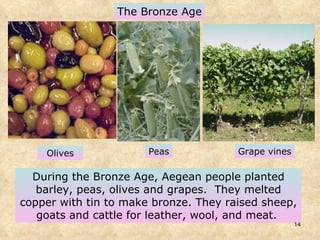
During the Bronze Age, Aegean people planted barley, peas, olives and grapes.  They melted copper with tin to make bronze. They raised sheep, goats and cattle for leather, wool, and meat.  Olives Grape vines Peas The Bronze Age
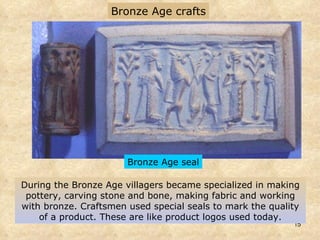
During the Bronze Age villagers became specialized in making pottery, carving stone and bone, making fabric and working with bronze. Craftsmen used special seals to mark the quality of a product. These are like product logos used today. Bronze Age crafts Bronze Age seal
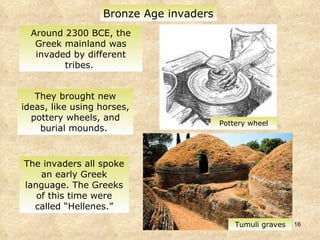
Around 2300 BCE, the Greek mainland was invaded by different tribes.  Bronze Age invaders Tumuli graves Pottery wheel They brought new ideas, like using horses, pottery wheels, and burial mounds.  The invaders all spoke an early Greek language. The Greeks of this time were called “Hellenes.”
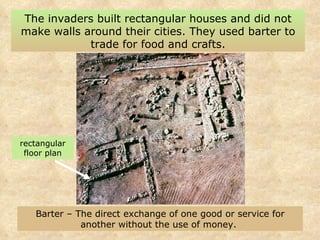
The invaders built rectangular houses and did not make walls around their cities. They used barter to trade for food and crafts. Barter – The direct exchange of one good or service for another without the use of money.   rectangular floor plan
The Minoans Map of Crete Minoan civilization The Minotaur Minoan archaeology Minoan trade
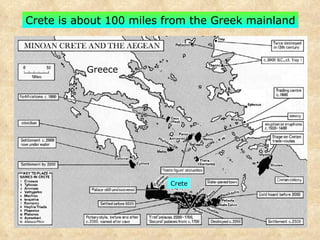
Crete is about 100 miles from the Greek mainland Greece Crete
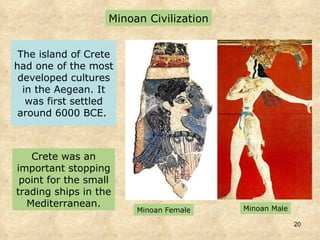
Minoan Civilization The island of Crete had one of the most developed cultures in the Aegean. It was first settled around 6000 BCE.  Crete was an important stopping point for the small trading ships in the Mediterranean. Minoan Male Minoan Female
King Minos In Greek mythology, Minos was a mythical king of Crete, son of Zeus and Europa.  After his death, Minos became a judge of the dead in Hades. The Minoan civilization has been named after him.  Minos and his brothers were raised by King Asterion of Crete. When Asterion died, Minos claimed his throne and banished his brothers. It is not clear if “Minos” is a name, or if it was a title, the Cretan word for "king." Scholars have noted the interesting similarity between Minos and the names of other ancient founder-kings, such as Menes of Egypt, Mannus of Germany, Manu of India, and so on.
Reconciling Minos Difficult to reconcile two conflicting views of Minos: 1.  The “good” King Minos, who received the laws of the land from Zeus and ruled justly 2.  The “evil” King Minos, who was a tyrant and fed small boys to the Minotaur Later mythology solves the problem by claiming there were two:  Minos I (good) and Minos II (bad).
The Legend of Minos Minos appears to be a legendary figure, although there is a Palace of Minos in Crete.  May have some historical basis. Literary sources say Minos reigned over Crete and the islands of the Aegean Sea three generations before the Trojan War. He lived at Knossos for periods of nine years, where he received instruction from Zeus in the legislation which he gave to the island.  He was the author of the Cretan constitution and the founder of its naval supremacy.
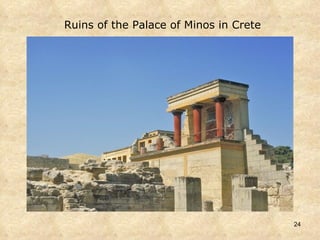
Ruins of the Palace of Minos in Crete
The Legend of King Minos Minos was the son of Zeus and Europa, adopted by the King of Crete.  Ascended the throne and struggled against his brothers to maintain his rule. Appealed to the sea god Poseiden for help, and was sent a snow-white bull as a sign of approval.  He was supposed to sacrifice the bull, but kept it for its beauty. Poseiden was angry, and in punishment caused Mino’s wife to fall in love with the bull.  She built a hollow wooden cow, hid inside of it, and had sex with the bull.  The offspring became the Minotaur.
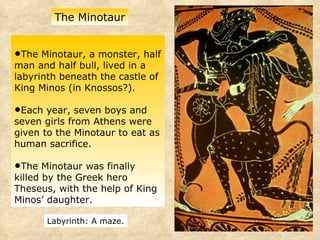
The Minotaur, a monster, half man and half bull, lived in a labyrinth beneath the castle of King Minos (in Knossos?). Each year, seven boys and seven girls from Athens were given to the Minotaur to eat as human sacrifice.  The Minotaur was finally killed by the Greek hero Theseus, with the help of King Minos’ daughter. The Minotaur Labyrinth: A maze.
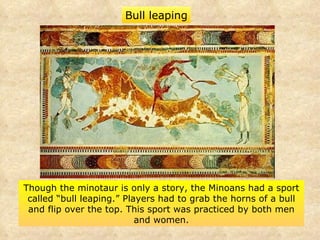
Though the minotaur is only a story, the Minoans had a sport called “bull leaping.” Players had to grab the horns of a bull and flip over the top. This sport was practiced by both men and women. Bull leaping
More on Minos… Ironically, Mino's son was killed in a bullfight.  Outraged, Minos went to Athens to revenge his son, and on the way he camped at Megara.  The king of Megara is, like Sampson of the Old Testiment, said to have received his strength through is long hair.  Megara's daughter, Scylla, fell in love with Minos and  cut her father's purple hair so Minos could conquer the city.  After his triumph, Minos punished Scylla for her treachery against her father by tying her to a boat and dragging her until she drowned.
More on Minos… Minos continued his warfare against parts of Greece.  On arriving in Attica, he asked Zeus to punish the city, and the god struck it with plague and hunger.  In Athens, an oracle told the Athenians to meet any of Minos' demands if they wanted to escape the revenge.  Minos then asked Athens to send seven boys and seven girls to Crete ever nine years to be sacrificed to the Minotaur.
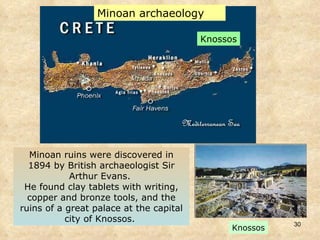
Minoan ruins were discovered in 1894 by British archaeologist Sir Arthur Evans.  He found clay tablets with writing, copper and bronze tools, and the ruins of a great palace at the capital city of Knossos.  Knossos Minoan archaeology Knossos
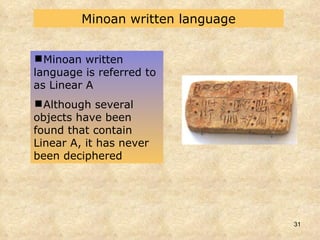
Minoan written language Minoan written language is referred to as Linear A Although several objects have been found that contain Linear A, it has never been deciphered
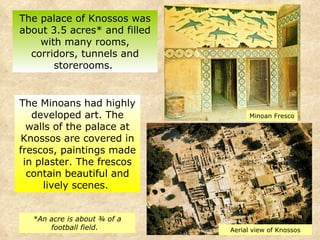
The palace of Knossos was about 3.5 acres* and filled with many rooms, corridors, tunnels and storerooms.  *An acre is about ¾ of a football field.  The Minoans had highly developed art. The walls of the palace at Knossos are covered in frescos, paintings made in plaster. The frescos contain beautiful and lively scenes.  Minoan Fresco Aerial view of Knossos
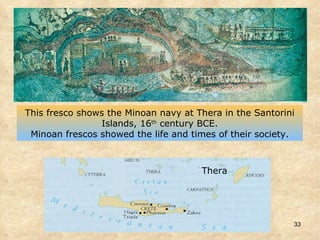
This fresco shows the Minoan navy at Thera in the Santorini Islands, 16 th  century BCE. Minoan frescos showed the life and times of their society. Thera
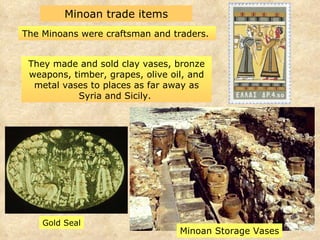
Minoan trade items The Minoans were craftsman and traders.  Gold Seal Minoan Storage Vases They made and sold clay vases, bronze weapons, timber, grapes, olive oil, and metal vases to places as far away as Syria and Sicily.
The Mycenaeans Map Arrival in mainland Greece Citadels  Political system Culture and language Society  Art  Burial  Troy The Oracle of Delphi
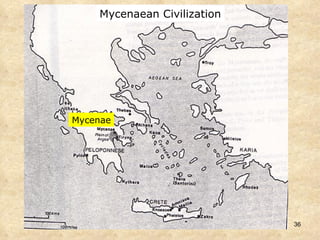
Mycenaean Civilization Mycenae
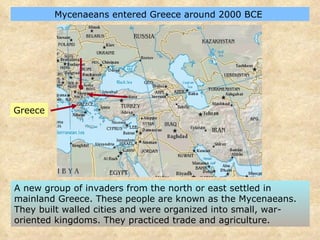
Mycenaeans entered Greece around 2000 BCE  A new group of invaders from the north or east settled in mainland Greece. These people are known as the Mycenaeans. They built walled cities and were organized into small, war-oriented kingdoms. They practiced trade and agriculture.  Greece
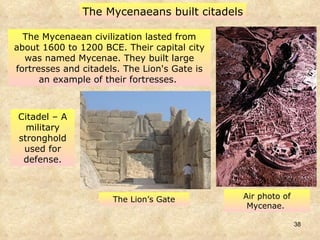
The Mycenaean civilization lasted from about 1600 to 1200 BCE. Their capital city was named Mycenae. They built large fortresses and citadels. The Lion's Gate is an example of their fortresses.  The Mycenaeans built citadels Citadel – A military stronghold used for defense. The Lion’s Gate Air photo of Mycenae.
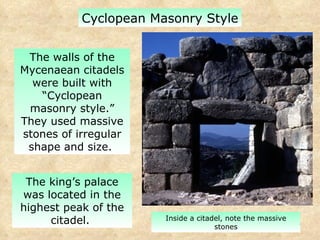
The walls of the Mycenaean citadels were built with “Cyclopean masonry style.” They used massive stones of irregular shape and size.  Cyclopean Masonry Style The king’s palace was located in the highest peak of the citadel.  Inside a citadel, note the massive stones
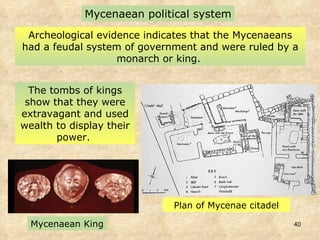
Archeological evidence indicates that the Mycenaeans had a feudal system of government and were ruled by a monarch or  king.  Mycenaean political system The tombs of kings show that they were extravagant and used wealth to display their power.  Plan of Mycenae citadel Mycenaean King
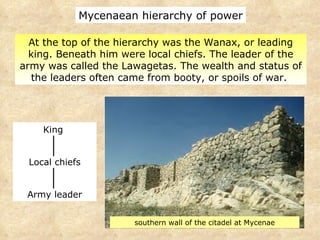
At the top of the hierarchy was the Wanax, or leading king. Beneath him were local chiefs. The leader of the army was called the Lawagetas. The wealth and status of the leaders often came from booty, or spoils of war.  Mycenaean hierarchy of power southern wall of the citadel at Mycenae King  Local chiefs Army leader
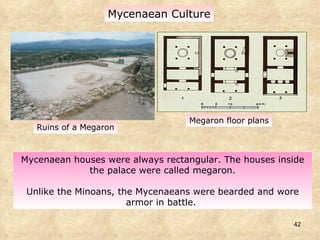
Mycenaean houses were always rectangular. The houses inside the palace were called megaron. Unlike the Minoans, the Mycenaeans were bearded and wore armor in battle.  Mycenaean Culture Megaron floor plans Ruins of a Megaron
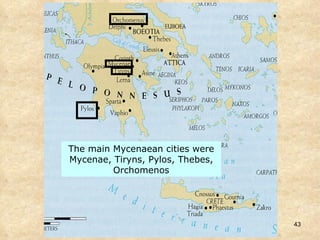
The main Mycenaean cities were Mycenae, Tiryns, Pylos, Thebes, Orchomenos
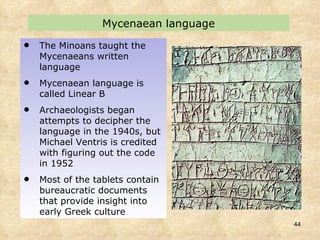
Mycenaean language The Minoans taught the Mycenaeans written language Mycenaean language is called Linear B Archaeologists began attempts to decipher the language in the 1940s, but Michael Ventris is credited with figuring out the code in 1952  Most of the tablets contain bureaucratic documents that provide insight into early Greek culture
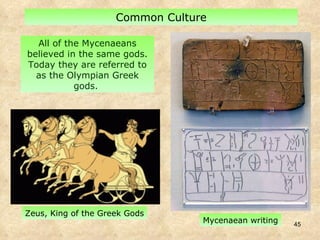
All of the Mycenaeans believed in the same gods. Today they are referred to as the Olympian Greek gods.  Common Culture Mycenaean writing Zeus, King of the Greek Gods
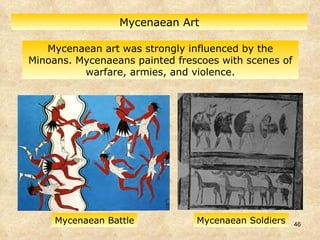
Mycenaean art was strongly influenced by the Minoans. Mycenaeans painted frescoes with scenes of warfare, armies, and violence. Mycenaean Art Mycenaean Battle Mycenaean Soldiers
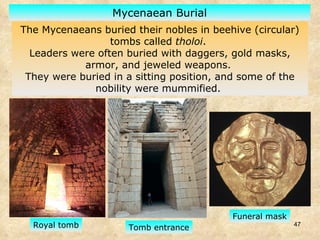
The Mycenaeans buried their nobles in beehive (circular) tombs called  tholoi .  Leaders were often buried with daggers, gold masks, armor, and jeweled weapons.  They were buried in a sitting position, and some of the nobility were mummified.  Mycenaean Burial Funeral mask Tomb entrance Royal tomb
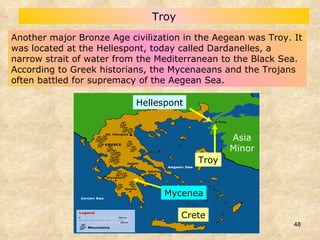
Another major Bronze Age civilization in the Aegean was Troy. It was located at the Hellespont, today called Dardanelles, a narrow strait of water from the Mediterranean to the Black Sea. According to Greek historians, the Mycenaeans and the Trojans often battled for supremacy of the Aegean Sea. Troy Crete Asia Minor Troy Hellespont Mycenea
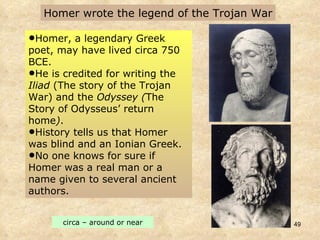
Homer wrote the legend of the Trojan War Homer, a legendary Greek poet, may have lived circa 750 BCE.  He is credited for writing the  Iliad  (The story of the Trojan War)   and the  Odyssey ( The Story of Odysseus’ return home ) . History tells us that Homer was blind and an Ionian Greek.  No one knows for sure if Homer was a real man or a name given to several ancient authors.  circa – around or near
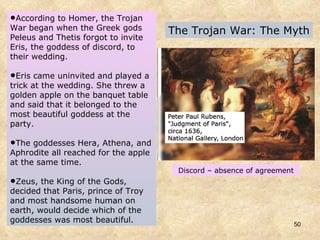
The Trojan War: The Myth According to Homer, the Trojan War began when the Greek gods Peleus and Thetis forgot to invite Eris, the goddess of discord, to their wedding.  Eris came uninvited and played a trick at the wedding. She threw a golden apple on the banquet table and said that it belonged to the most beautiful goddess at the party.  The goddesses Hera, Athena, and Aphrodite all reached for the apple at the same time. Zeus, the King of the Gods, decided that Paris, prince of Troy and most handsome human on earth, would decide which of the goddesses was most beautiful. Discord – absence of agreement
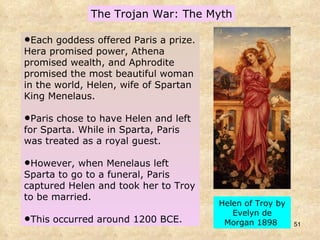
The Trojan War: The Myth Each goddess offered Paris a prize. Hera promised power, Athena promised wealth, and Aphrodite promised the most beautiful woman in the world, Helen, wife of Spartan King Menelaus.  Paris chose to have Helen and left for Sparta. While in Sparta, Paris was treated as a royal guest.  However, when Menelaus left Sparta to go to a funeral, Paris captured Helen and took her to Troy to be married.  This occurred around 1200 BCE. Helen of Troy by Evelyn de Morgan 1898
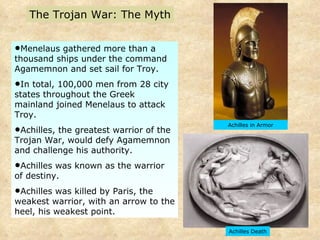
Menelaus gathered more than a thousand ships under the command Agamemnon and set sail for Troy.  In total, 100,000 men from 28 city states throughout the Greek mainland joined Menelaus to attack Troy.  Achilles, the greatest warrior of the Trojan War, would defy Agamemnon and challenge his authority.  Achilles was known as the warrior of destiny.  Achilles was killed by Paris, the weakest warrior, with an arrow to the heel, his weakest point.  Achilles Death The Trojan War: The Myth Achilles in Armor
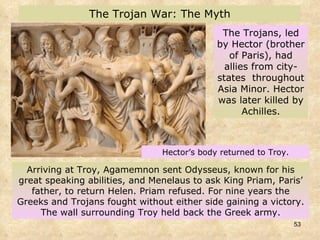
Arriving at Troy, Agamemnon sent Odysseus, known for his great speaking abilities, and Menelaus to ask King Priam, Paris’ father, to return Helen. Priam refused. For nine years the Greeks and Trojans fought without either side gaining a victory. The wall surrounding Troy held back the Greek army. The Trojans, led by Hector (brother of Paris), had allies from city-states  throughout Asia Minor. Hector was later killed by Achilles. The Trojan War: The Myth Hector’s body returned to Troy.
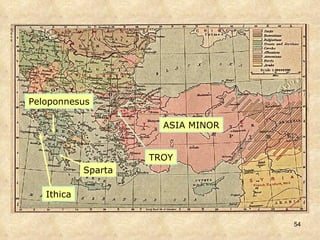
ASIA MINOR TROY Sparta Peloponnesus Ithica
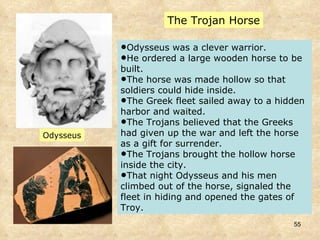
The Trojan Horse Odysseus was a clever warrior. He ordered a large wooden horse to be built.  The horse was made hollow so that soldiers could hide inside.  The Greek fleet sailed away to a hidden harbor and waited.  The Trojans believed that the Greeks had given up the war and left the horse as a gift for surrender.  The Trojans brought the hollow horse inside the city.  That night Odysseus and his men climbed out of the horse, signaled the fleet in hiding and opened the gates of Troy.  Odysseus
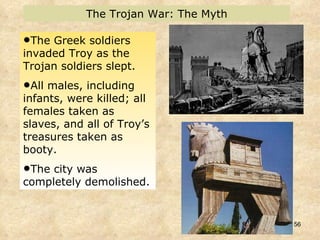
The Greek soldiers invaded Troy as the Trojan soldiers slept.  All males, including infants, were killed; all females taken as slaves, and all of Troy’s treasures taken as booty.  The city was completely demolished.  The Trojan War: The Myth
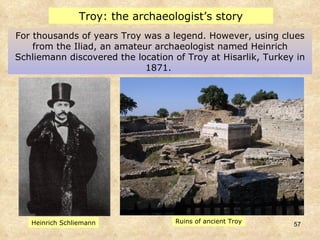
For thousands of years Troy was a legend. However, using clues from the Iliad, an amateur archaeologist named Heinrich Schliemann discovered the location of Troy at Hisarlik, Turkey in 1871.  Troy: the archaeologist’s story Ruins of ancient Troy Heinrich Schliemann
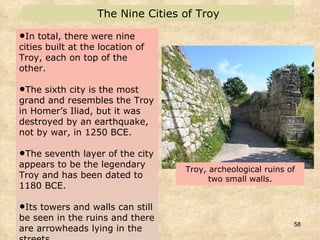
In total, there were nine cities built at the location of Troy, each on top of the other. The sixth city is the most grand and resembles the Troy in Homer’s Iliad, but it was destroyed by an earthquake, not by war, in 1250 BCE.  The seventh layer of the city appears to be the legendary Troy and has been dated to 1180 BCE.  Its towers and walls can still be seen in the ruins and there are arrowheads lying in the streets.  The Nine Cities of Troy Troy, archeological ruins of two small walls.
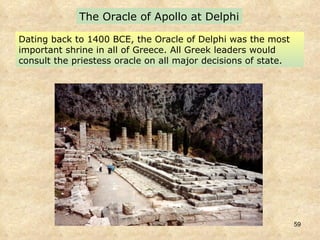
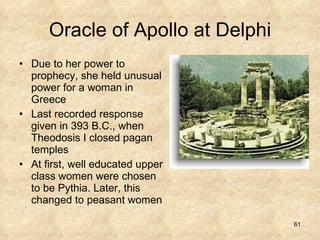
Dating back to 1400 BCE, the Oracle of Delphi was the most important shrine in all of Greece. All Greek leaders would consult the priestess oracle on all major decisions of state. The Oracle of Apollo at Delphi
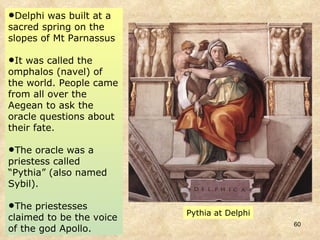
Delphi was built at a sacred spring on the slopes of Mt Parnassus It was called the omphalos (navel) of the world. People came from all over the Aegean to ask the oracle questions about their fate.  The oracle was a priestess called “Pythia” (also named Sybil).  The priestesses claimed to be the voice of the god Apollo. Pythia at Delphi
Oracle of Apollo at Delphi Due to her power to prophecy, she held unusual power for a woman in Greece Last recorded response given in 393 B.C., when Theodosis I closed pagan temples At first, well educated upper class women were chosen to be Pythia. Later, this changed to peasant women
Oracle of Apollo at Delphi Pythias appeared to have a shortened life span, which Greeks attributed to service to the God.  Some modern scholars have attributed this to the lifestyle, and possibly a volcanic vent which may have put sulfer and ethylene
The Dorians Map  Southwestern Macedonia The Greek Dark Age  Dorian invasions Dorian music The Doric Order of Architecture
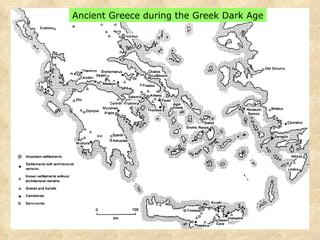
Ancient Greece during the Greek Dark Age
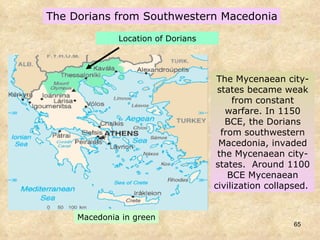
The Mycenaean city-states became weak from constant warfare. In 1150 BCE, the Dorians from southwestern Macedonia, invaded the Mycenaean city-states.  Around 1100 BCE Mycenaean civilization collapsed.  The Dorians from Southwestern Macedonia Macedonia in green Location of Dorians
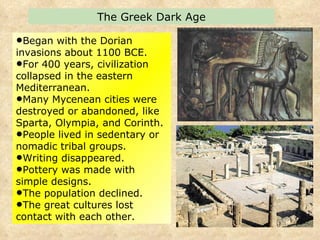
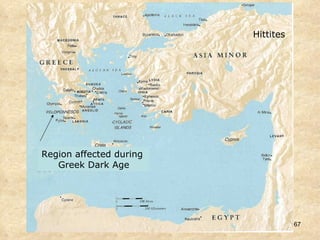
Began with the Dorian invasions about 1100 BCE.  For 400 years, civilization collapsed in the eastern Mediterranean.  Many Mycenean cities were destroyed or abandoned, like Sparta, Olympia, and Corinth. People lived in sedentary or nomadic tribal groups.  Writing disappeared. Pottery was made with simple designs.  The population declined. The great cultures lost contact with each other. The Greek Dark Age
Hittites Region affected during  Greek Dark Age
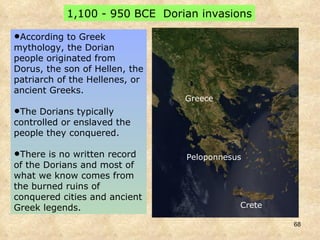
According to Greek mythology, the Dorian people originated from Dorus, the son of Hellen, the patriarch of the Hellenes, or ancient Greeks.  The Dorians typically controlled or enslaved the people they conquered.  There is no written record of the Dorians and most of what we know comes from the burned ruins of conquered cities and ancient Greek legends.  1,100 - 950 BCE  Dorian invasions Crete Greece Peloponnesus
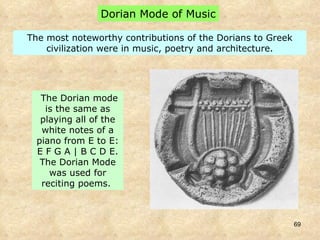
The Dorian mode is the same as playing all of the white notes of a piano from E to E: E F G A | B C D E. The Dorian Mode was used for reciting poems.  The most noteworthy contributions of the Dorians to Greek civilization were in music, poetry and architecture. Dorian Mode of Music
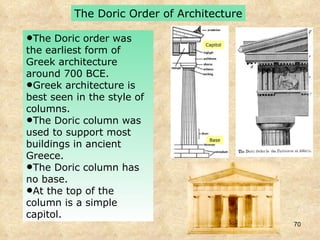
The Doric order was the earliest form of Greek architecture around 700 BCE.  Greek architecture is best seen in the style of columns.  The Doric column was used to support most buildings in ancient Greece.  The Doric column has no base.  At the top of the column is a simple capitol. The Doric Order of Architecture Capitol Base
The Archaic Period Emergence of city-states Greek alphabet Greek gods The Olympics City-state government Oligarchies and democracies Greek colonies Ionic Order architecture
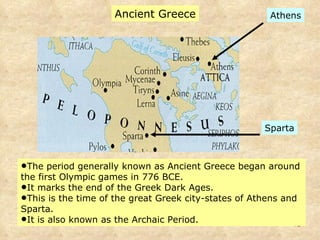
Ancient Greece The period generally known as Ancient Greece began around the first Olympic games in 776 BCE.  It marks the end of the Greek Dark Ages.  This is the time of the great Greek city-states of Athens and Sparta.  It is also known as the Archaic Period.  Athens Sparta
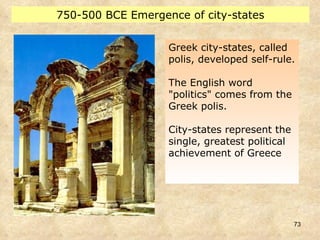
750-500 BCE Emergence of city-states Greek city-states, called polis, developed self-rule. The English word "politics" comes from the Greek polis.  City-states represent the single, greatest political achievement of Greece
The Greek City State The tribal or clan units of the dark ages slowly grew into larger political units at the end of Archaic period Beginning around 800 BC, trade began to dramatically accelerate between the peoples of Greece.  Marketplaces grew up in Greek villages Communities began to gather together into large defensive units, building fortifications to use in common.  On this foundation, the Greek-speaking people who lived on the Greek peninsula, the mainland, and the coast of Asia Minor, developed political units that were centrally based  on a single city .
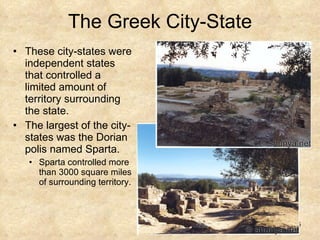
The Greek City-State These city-states were independent states that controlled a limited amount of territory surrounding the state.  The largest of the city-states was the Dorian polis named Sparta. Sparta controlled more than 3000 square miles of surrounding territory.
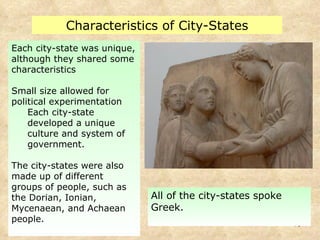
Each city-state was unique, although they shared some characteristics Small size allowed for political experimentation Each city-state developed a unique culture and system of government. The city-states were also made up of different groups of people, such as the Dorian, Ionian, Mycenaean, and Achaean people. Characteristics of City-States All of the city-states spoke Greek.
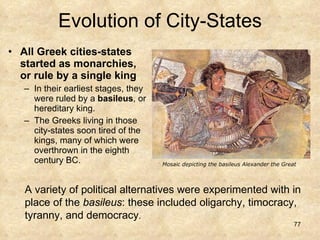
Evolution of City-States All Greek cities-states started as monarchies, or rule by a single king In their earliest stages, they were ruled by a  basileus , or hereditary king.  The Greeks living in those city-states soon tired of the kings, many of which were overthrown in the eighth century BC.  A variety of political alternatives were experimented with in place of the  basileus : these included oligarchy, timocracy, tyranny, and democracy . Mosaic depicting the basileus Alexander the Great
Evolution of the City-States The most common form of government in the Greek city-states was  oligarchy , or "rule by a few."  Oligarchs were almost always drawn from the noble classes or from the wealthiest citizens of the state ("rule by the wealthy" is called a  timocracy ),  Depending on the city-state, oligarchs could be chosen by lot, elected, or rotated power among members of a certain class. Oligarchs most often ruled absolutely; they had many of the powers granted to a king.  In some places like Sparta and Athens, oligarchies ruled in conjunction with other political structures such as a council, and/or a democratic assembly.
Evolution of the City-State The Greek tyrants were often swept into power by dissatisfaction or crisis; they were usually popular leaders when they assumed power. They often assumed absolute control in the name of reforming the government;  Once in power, they ruled as a king would rule, and many attempted, and some succeeded, to make the tyrrany hereditary—in essence, a form of monarchy.  They maintained power only by their hold on military force and often fear.  The tyranies were by nature highly unstable, and they fell apart rapidly. By the 6 th  century B.C., political alternatives were considered
Evolution of the City-State Tyranny of oligarchies never died out, but several were replaced by a second alternative that originated sometime in the 6th century:  democracy .  The word means, "rule by the  demos  (people),"  Greek democracies looked nothing like modern democracies.  Greek democracies were not representative governments, they were governments run by the free, male citizens of the city-state.  All the members of a city-state  were not  involved in the government: slaves, foreigners, and women were all disbarred from the democracy.  In reality, the democratic city-states more closely resembled oligarchies for a minority ruled the state
Greek Citizenship in the Polis The Greek city-states determined citizenship by descent. Greeks still had a fundamental and working sense of kinship relationships and tribal organization.  Most cities demanded that its citizens be able to demonstrate descent from one parent (sometimes both in Athens) who was a citizen; Every once in a while, the administration of a  polis  would admit people into the citizenship who could not demonstrate descent from a citizen, that is, the  polis  allowed for  naturalization .  Naturalization  was a brand new concept in the ancient world, and contributed to the Greek sense during the Hellenistic Age that Greek culture was or could be a universal culture.
Athens & Sparta
Athens & Sparta Sparta and Athens were two of the most prominent city-states in Ancient Greece.  Athens was renowned as a center of wisdom and learning. The people of Athens were interested in arts, music, and intellectual pursuits.  Sparta was recognized for its military strength. A Spartan's life was centered on the state, because he lived and died to serve the state.  Although the competing city states of Sparta and Athens were different in many ways, they both managed to become dominating powers in Ancient Greece.
Rise of Athens The area around Athens has been inhabited since Neolithic times By 1400 BC the settlement had become an important center of the Mycenaean civilization.  Unlike other Mycenaean centers, Athens was not sacked and abandoned at the time of the Doric invasion of about 1200 BC, and the Athenians always maintained that they were "pure" Ionians with no Doric element.  However, Athens lost most of its power and probably dwindled to a small hill fortress once again.
Rise of Athens By the 9th century BC Athens had re-emerged.  Athens’ central location in the Greek world, its secure stronghold on the Acropolis and its access to the sea, gave it a natural advantage over potential rivals such as Thebes and Sparta.  From early in the 1st millennium, Athens was a sovereign city-state, ruled at first by kings.
Rise of Athens During this period Athens succeeded in bringing the other towns around it.  This process created the largest and wealthiest state on the Greek mainland, but it also created a larger class of people excluded from political life by the nobility.  By the 7th century BC social unrest had become widespread, and the Athenian court of justice appointed a leader named  Draco  to draft a strict new lawcode (hence "draconian").  When this failed, they appointed  Solon , with a mandate to create a new constitution.
Solon’s Reforms in Athens In 594 B.C., seven years before the Babylonians destroyed Solomon's Temple and took the Israelites into captivity, Athens became a democracy under the rule of Solon In addition to eliminating serfdom, Solon altered the stringent laws of Draco, making murder the only crime punishable by death.  Under the democracy, Athens entered its golden age, becoming a center of wisdom and learning.
Population of Athens By 431 BC, Athens had become the most populous city-state in Hellas. Some historians estimate the population to be as high as 300,000* at that time. 30,000 male citizens 46,000 non-citizen hired laborers 115,000 slaves 110,000 women and children In 471 BC, scholars believe the approximate population within the actual walls of Athens was 140,000; Approximately 40,000 men were citizens;  Approximately 40,000 were slaves.  The rest were women, children and slaves ‘ *The Population of Ancient Athens - A.W.Gomme - 1933 for the year 431 B.C.
Athenian Democracy Athens was a limited democracy, ruled by all of its male citizens.  Women did not participate in politics at all. Athens had  elected officials  including 10  generals  (strategos),  magistrates  (archons), and others. A  Council of 500  had both executive and administrative control.  Members of this Council were chosen by lot every year, 10 from each of the 50 tribes Any male citizen over the age of thirty was eligible to be chosen.  An  Assembly , made up of all male citizens, had veto power over the Council. In addition, the Assembly was the only branch of the government which could declare war.
Athenian Military A soldier's rank was decided by his social or economic status before he entered the army.  Instituted by Solon in the 6th century B.C., four classes made up the Athenian social ladder. Defined by income, each class had a certain measure of political responsibility:  The wealthiest class, called the " five-hundred-bushel men ", supplied the army with leaders.  Called the  hippeis or "horsemen",  the second class made up the Athenian cavalry.  The third class, called the  zeugitai , made up the foot soldier, or hoplite section of the army.  the poorest class, called the  thetes , served either as oarsmen for the Athenian fleet, or as archers on land.
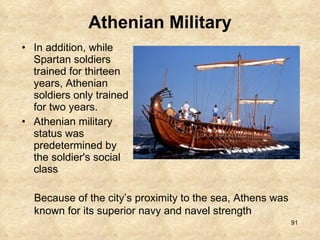
Athenian Military In addition, while Spartan soldiers trained for thirteen years, Athenian soldiers only trained for two years. Athenian military status was predetermined by the soldier's social class Because of the city’s proximity to the sea, Athens was known for its superior navy and navel strength
Athenian Social Structure Freemen  were all male citizens: divided into numerous classes:  at the top  were  aristocrats  who had large estates and made up the cavalry or captained triremes;  middle  ranks were  small farmers ;  lowest  class was the  thetes  (urban craftsmen and trireme rowers). Metics  - those who came from outside the city; they were not allowed to own land, but could run industries and businesses. Slaves  were lowest class, but less harshly treated than in most other Greek cities. Slaves had no rights, and an owner could kill a slave. Slaves varied in status: some were given important roles in Athens, like policemen. Women  were rarely seen outside the home and had no rights in the Athenian democracy.
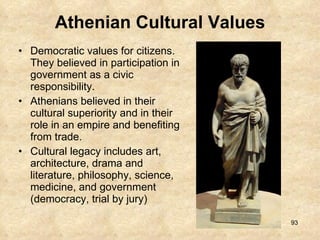
Athenian Cultural Values Democratic values for citizens. They believed in participation in government as a civic responsibility. Athenians believed in their cultural superiority and in their role in an empire and benefiting from trade.  Cultural legacy includes art, architecture, drama and literature, philosophy, science, medicine, and government (democracy, trial by jury)
Athenian Education Boys:  Schools taught reading, writing and mathematics, music, poetry, sport and gymnastics.  Based upon their birth and the wealth of their parents, the length of education was from the age of 5 to 14, for the wealthier 5 - 18 and sometimes into a student's mid-twenties in an academy where they would also study philosophy, ethics, and rhetoric (the skill of persuasive public speaking).  Finally, the citizen boys entered a military training camp for two years, until the age of twenty.  Foreign metics and slaves were not expected to attain anything but a basic education in Greece, but were not excluded from it either.
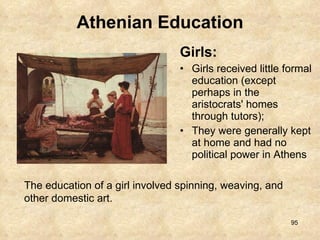
Athenian Education Girls:  Girls received little formal education (except perhaps in the aristocrats' homes through tutors);  They were generally kept at home and had no political power in Athens The education of a girl involved spinning, weaving, and other domestic art.
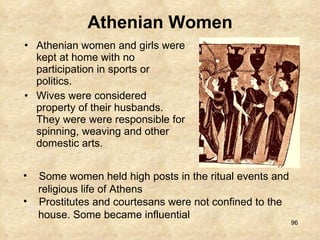
Athenian Women Athenian women and girls were kept at home with no participation in sports or politics.  Wives were considered property of their husbands. They were were responsible for spinning, weaving and other domestic arts. Some women held high posts in the ritual events and religious life of Athens Prostitutes and courtesans were not confined to the house. Some became influential
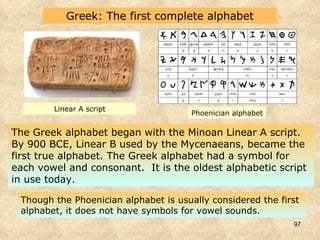
The Greek alphabet began with the Minoan Linear A script.  By 900 BCE, Linear B used by the Mycenaeans, became the first true alphabet. The Greek alphabet had a symbol for each vowel and consonant.  It is the oldest alphabetic script in use today.  Greek: The first complete alphabet Linear A script Phoenician alphabet Though the Phoenician alphabet is usually considered the first alphabet, it does not have symbols for vowel sounds.
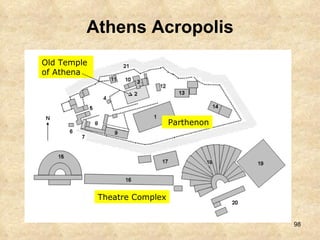
Athens Acropolis Parthenon Old Temple  of Athena Theatre Complex
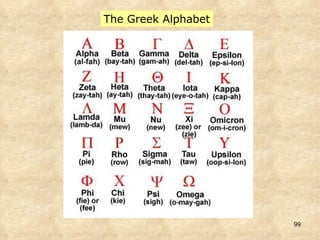
The Greek Alphabet
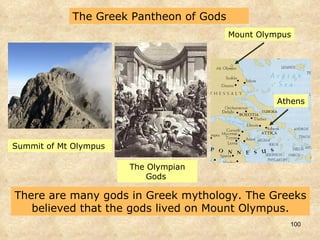
There are many gods in Greek mythology. The Greeks believed that the gods lived on Mount Olympus. The Greek Pantheon of Gods Summit of Mt Olympus  The Olympian Gods  Mount Olympus Athens