A Primary Source Journey through Mexico, New Mexico, Arizona,
Texas, and Kansas
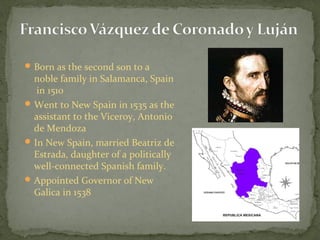
Born as the second son to a
noble family in Salamanca, Spain
in 1510
Went to New Spain in 1535 as the
assistant to the Viceroy, Antonio
de Mendoza
In New Spain, married Beatriz de
Estrada, daughter of a politically
well-connected Spanish family.
Appointed Governor of New
Galica in 1538
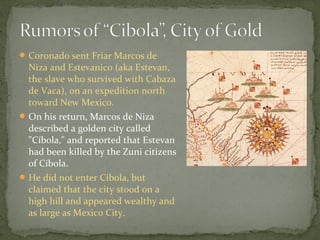
Coronado sent Friar Marcos de
Niza and Estevanico (aka Estevan,
the slave who survived with Cabaza
de Vaca), on an expedition north
toward New Mexico.
On his return, Marcos de Niza
described a golden city called
"Cíbola," and reported that Estevan
had been killed by the Zuni citizens
of Cíbola.
He did not enter Cíbola, but
claimed that the city stood on a
high hill and appeared wealthy and
as large as Mexico City.
Coronado and Mendoza financed a second
exploratory expedition, with Coronado as the leader.
They invested must of their own finances
Coronado mortgaged his own estate, raising nearly
70,000 pesos for the expedition
Two groups were prepared for the exploration:
1. A ship which would travel up the Guadalupe River
with their supplies under Hernando Alarcon.
2. A land expedition headed by Coronado
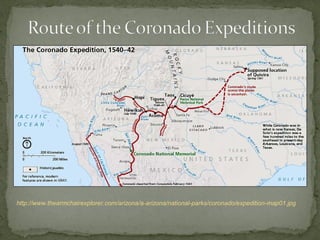
http://www.thearmchairexplorer.com/arizona/a-arizona/national-parks/coronado/expedition-map01.jpg
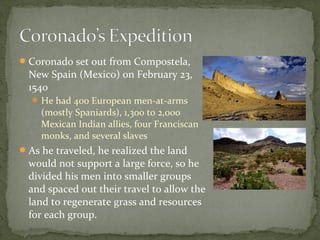
Coronado set out from Compostela,
New Spain (Mexico) on February 23,
1540
 He had 400 European men-at-arms
(mostly Spaniards), 1,300 to 2,000
Mexican Indian allies, four Franciscan
monks, and several slaves
As he traveled, he realized the land
would not support a large force, so he
divided his men into smaller groups
and spaced out their travel to allow the
land to regenerate grass and resources
for each group.
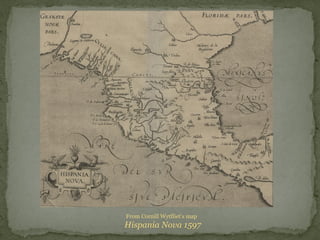
From Cornill Wytfliet’s map
Hispania Nova 1597
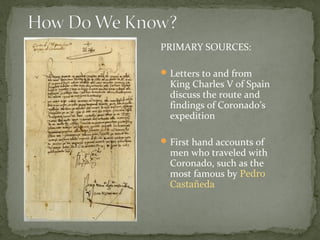
PRIMARY SOURCES:
Letters to and from
King Charles V of Spain
discuss the route and
findings of Coronado’s
expedition
First hand accounts of
men who traveled with
Coronado, such as the
most famous by Pedro
Castañeda
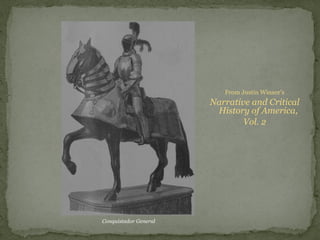
From Justin Winsor’s
Narrative and Critical
History of America,
Vol. 2
Conquistador General
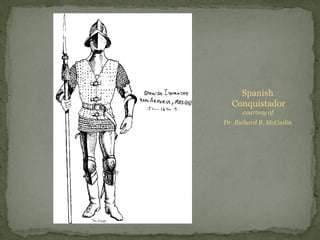
Spanish
Conquistador
courtesy of
Dr. Richard B. McCaslin
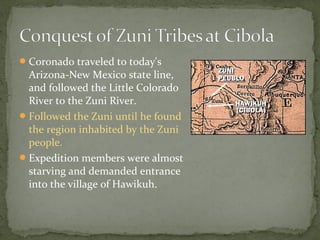
Coronado traveled to today's
Arizona-New Mexico state line,
and followed the Little Colorado
River to the Zuni River.
Followed the Zuni until he found
the region inhabited by the Zuni
people.
Expedition members were almost
starving and demanded entrance
into the village of Hawikuh.
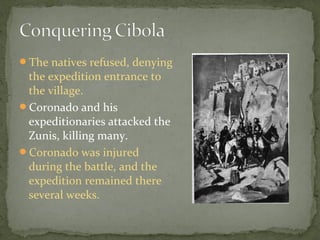
The natives refused, denying
the expedition entrance to
the village.
Coronado and his
expeditionaries attacked the
Zunis, killing many.
Coronado was injured
during the battle, and the
expedition remained there
several weeks.
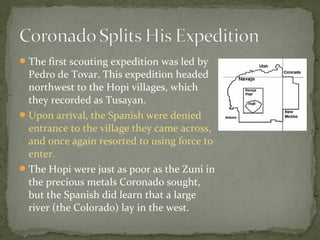
The first scouting expedition was led by
Pedro de Tovar. This expedition headed
northwest to the Hopi villages, which
they recorded as Tusayan.
Upon arrival, the Spanish were denied
entrance to the village they came across,
and once again resorted to using force to
enter.
The Hopi were just as poor as the Zuni in
the precious metals Coronado sought,
but the Spanish did learn that a large
river (the Colorado) lay in the west.
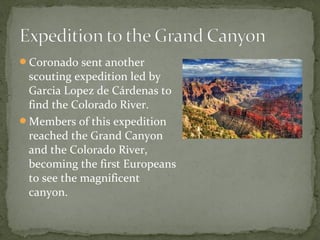
Coronado sent another
scouting expedition led by
Garcia Lopez de Cárdenas to
find the Colorado River.
Members of this expedition
reached the Grand Canyon
and the Colorado River,
becoming the first Europeans
to see the magnificent
canyon.
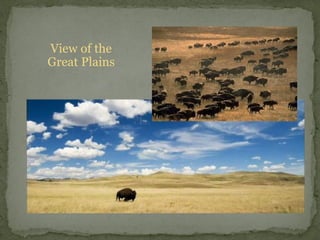
View of the
Great Plains
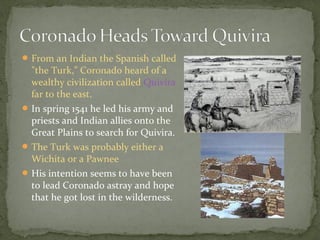
From an Indian the Spanish called
"the Turk," Coronado heard of a
wealthy civilization called Quivira
far to the east.
In spring 1541 he led his army and
priests and Indian allies onto the
Great Plains to search for Quivira.
The Turk was probably either a
Wichita or a Pawnee
His intention seems to have been
to lead Coronado astray and hope
that he got lost in the wilderness.
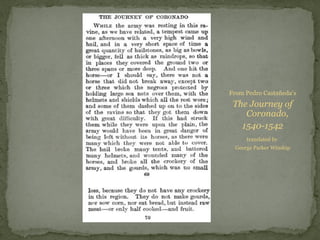
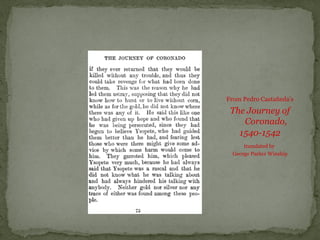
From Pedro Castañeda’s
The Journey of
Coronado,
1540-1542
translated by
George Parker Winship
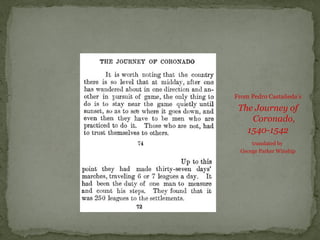
From Pedro Castañeda’s
The Journey of
Coronado,
1540-1542
translated by
George Parker Winship
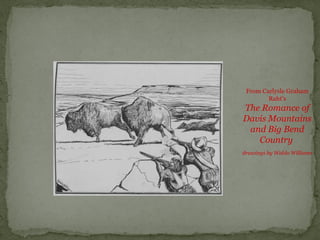
From Carlysle Graham
Raht’s
The Romance of
Davis Mountains
and Big Bend
Country
drawings by Waldo Williams
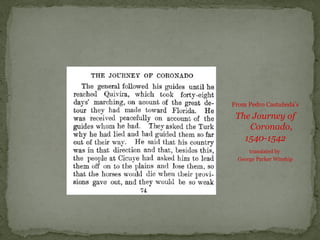
From Pedro Castañeda’s
The Journey of
Coronado,
1540-1542
translated by
George Parker Winship
From Pedro Castañeda’s
The Journey of
Coronado,
1540-1542
translated by
George Parker Winship

Coronado presentation

  • 1.
    A Primary SourceJourney through Mexico, New Mexico, Arizona, Texas, and Kansas
  • 2.
    Born as thesecond son to a noble family in Salamanca, Spain in 1510 Went to New Spain in 1535 as the assistant to the Viceroy, Antonio de Mendoza In New Spain, married Beatriz de Estrada, daughter of a politically well-connected Spanish family. Appointed Governor of New Galica in 1538
  • 3.
    Coronado sent FriarMarcos de Niza and Estevanico (aka Estevan, the slave who survived with Cabaza de Vaca), on an expedition north toward New Mexico. On his return, Marcos de Niza described a golden city called "Cíbola," and reported that Estevan had been killed by the Zuni citizens of Cíbola. He did not enter Cíbola, but claimed that the city stood on a high hill and appeared wealthy and as large as Mexico City.
  • 4.
    Coronado and Mendozafinanced a second exploratory expedition, with Coronado as the leader. They invested must of their own finances Coronado mortgaged his own estate, raising nearly 70,000 pesos for the expedition Two groups were prepared for the exploration: 1. A ship which would travel up the Guadalupe River with their supplies under Hernando Alarcon. 2. A land expedition headed by Coronado
  • 5.
  • 6.
    Coronado set outfrom Compostela, New Spain (Mexico) on February 23, 1540  He had 400 European men-at-arms (mostly Spaniards), 1,300 to 2,000 Mexican Indian allies, four Franciscan monks, and several slaves As he traveled, he realized the land would not support a large force, so he divided his men into smaller groups and spaced out their travel to allow the land to regenerate grass and resources for each group.
  • 7.
    From Cornill Wytfliet’smap Hispania Nova 1597
  • 8.
    PRIMARY SOURCES: Letters toand from King Charles V of Spain discuss the route and findings of Coronado’s expedition First hand accounts of men who traveled with Coronado, such as the most famous by Pedro Castañeda
  • 9.
    From Justin Winsor’s Narrativeand Critical History of America, Vol. 2 Conquistador General
  • 10.
  • 11.
    Coronado traveled totoday's Arizona-New Mexico state line, and followed the Little Colorado River to the Zuni River. Followed the Zuni until he found the region inhabited by the Zuni people. Expedition members were almost starving and demanded entrance into the village of Hawikuh.
  • 12.
    The natives refused,denying the expedition entrance to the village. Coronado and his expeditionaries attacked the Zunis, killing many. Coronado was injured during the battle, and the expedition remained there several weeks.
  • 13.
    The first scoutingexpedition was led by Pedro de Tovar. This expedition headed northwest to the Hopi villages, which they recorded as Tusayan. Upon arrival, the Spanish were denied entrance to the village they came across, and once again resorted to using force to enter. The Hopi were just as poor as the Zuni in the precious metals Coronado sought, but the Spanish did learn that a large river (the Colorado) lay in the west.
  • 14.
    Coronado sent another scoutingexpedition led by Garcia Lopez de Cárdenas to find the Colorado River. Members of this expedition reached the Grand Canyon and the Colorado River, becoming the first Europeans to see the magnificent canyon.
  • 15.
  • 16.
    From an Indianthe Spanish called "the Turk," Coronado heard of a wealthy civilization called Quivira far to the east. In spring 1541 he led his army and priests and Indian allies onto the Great Plains to search for Quivira. The Turk was probably either a Wichita or a Pawnee His intention seems to have been to lead Coronado astray and hope that he got lost in the wilderness.
  • 17.
    From Pedro Castañeda’s TheJourney of Coronado, 1540-1542 translated by George Parker Winship
  • 18.
    From Pedro Castañeda’s TheJourney of Coronado, 1540-1542 translated by George Parker Winship
  • 19.
    From Carlysle Graham Raht’s TheRomance of Davis Mountains and Big Bend Country drawings by Waldo Williams
  • 20.
    From Pedro Castañeda’s TheJourney of Coronado, 1540-1542 translated by George Parker Winship
  • 21.
    From Pedro Castañeda’s TheJourney of Coronado, 1540-1542 translated by George Parker Winship