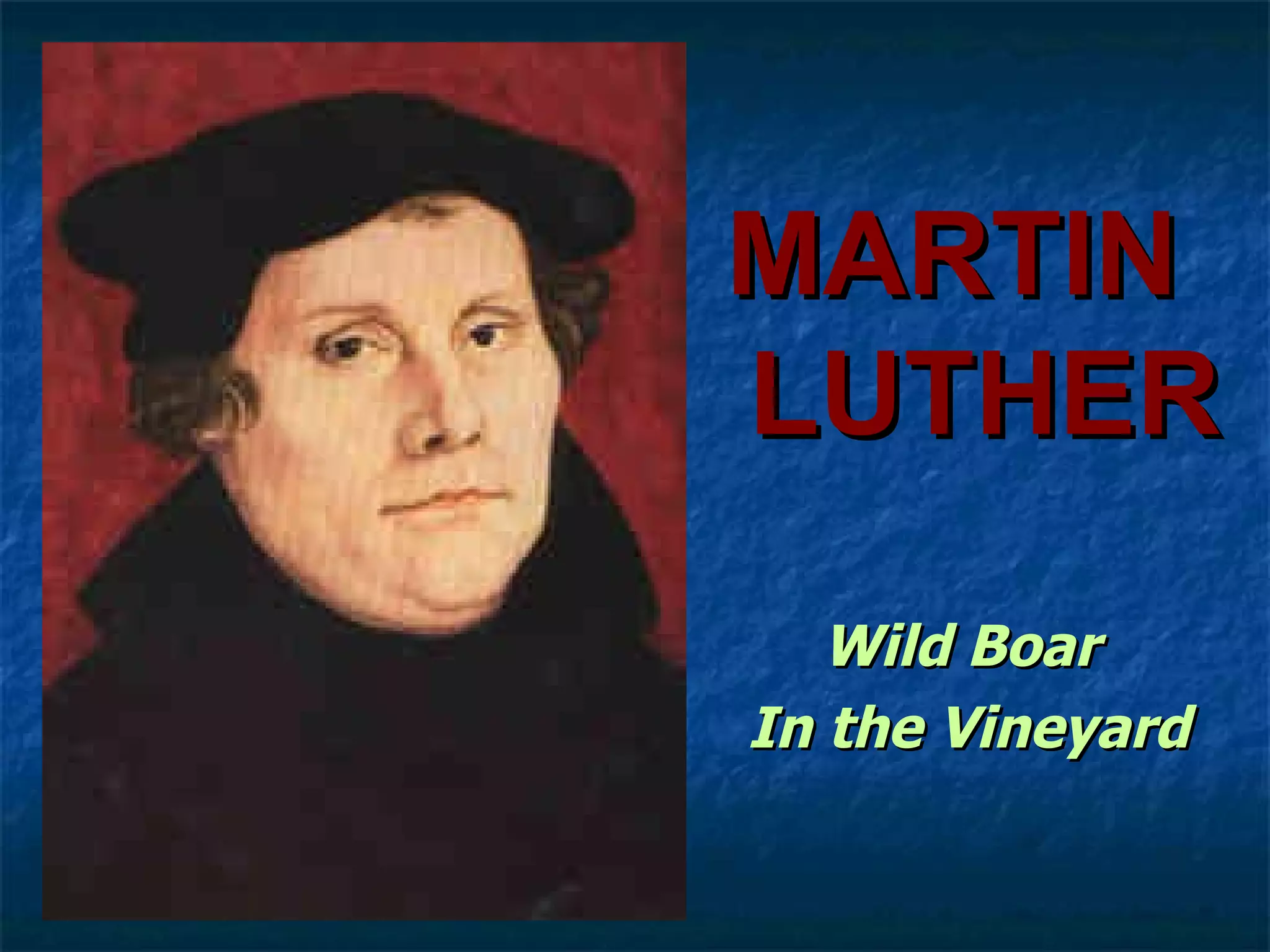
MARTIN
LUTHER
   Wild Boar
In the Vineyard
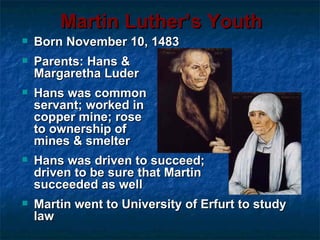
Martin Luther’s Youth
   Born November 10, 1483
   Parents: Hans &
    Margaretha Luder
   Hans was common
    servant; worked in
    copper mine; rose
    to ownership of
    mines & smelter
   Hans was driven to succeed;
    driven to be sure that Martin
    succeeded as well
   Martin went to University of Erfurt to study
    law
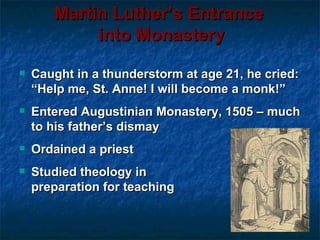
Martin Luther’s Entrance
            into Monastery
   Caught in a thunderstorm at age 21, he cried:
    “Help me, St. Anne! I will become a monk!”
   Entered Augustinian Monastery, 1505 – much
    to his father’s dismay
   Ordained a priest
   Studied theology in
    preparation for teaching
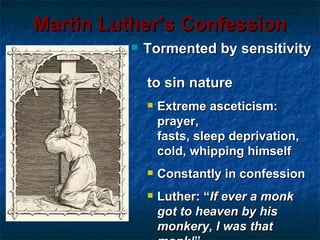
Martin Luther’s Confession
             Tormented by sensitivity

              to sin nature
                 Extreme asceticism:
                  prayer,
                  fasts, sleep deprivation,
                  cold, whipping himself
                 Constantly in confession
                 Luther: “If ever a monk
                  got to heaven by his
                  monkery, I was that
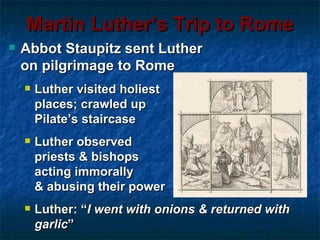
Martin Luther’s Trip to Rome
   Abbot Staupitz sent Luther
    on pilgrimage to Rome
       Luther visited holiest
        places; crawled up
        Pilate’s staircase
       Luther observed
        priests & bishops
        acting immorally
        & abusing their power
       Luther: “I went with onions & returned with
        garlic”
Martin Luther’s Discovery
   Next Staupitz sent Luther to Wittenberg as
    theology professor
   1515, great discovery: Rom. 1:17
       Gospel is revelation of justice of God
       To Luther, justice of God was unbearable; yet,
        Gospel linked to God’s justice
       Justice does not refer to punishment of sinners;
        righteousness is given to those who live by faith
       Justification is the free gift of God
        to sinners: righteousness is imputed by God who
        justifies humans by their faith in Jesus Christ
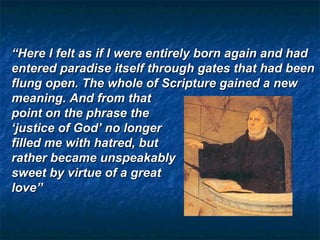
“Here I felt as if I were entirely born again and had
entered paradise itself through gates that had been
flung open. The whole of Scripture gained a new
meaning. And from that
point on the phrase the
‘justice of God’ no longer
filled me with hatred, but
rather became unspeakably
sweet by virtue of a great
love”
Controversy over Indulgences
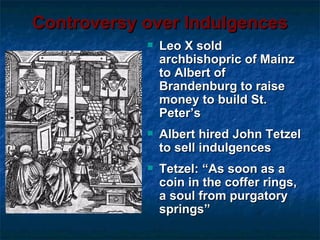
               Leo X sold
                archbishopric of Mainz
                to Albert of
                Brandenburg to raise
                money to build St.
                Peter’s
               Albert hired John Tetzel
                to sell indulgences
               Tetzel: “As soon as a
                coin in the coffer rings,
                a soul from purgatory
                springs”
95 Theses
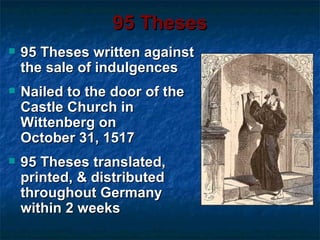
   95 Theses written against
    the sale of indulgences
   Nailed to the door of the
    Castle Church in
    Wittenberg on
    October 31, 1517
   95 Theses translated,
    printed, & distributed
    throughout Germany
    within 2 weeks
Selections from 95 Theses
   32. Those who suppose that on account of their
    letters of indulgence they are sure of salvation
    will be eternally damned along with their teachers.
   36. Every Christian who truly repents has plenary
    (full) forgiveness both of punishment and guilt
    bestowed upon him, even without letters of
    indulgence.
   37. Every true Christian, whether living or dead,
    has a share in all the benefits of Christ and the
    Church, for God has granted him these, even
    without letters of indulgence.
Selections from 95 Theses
   81. This shameless preaching of pardons makes it
    hard even for learned men to defend the pope’s
    honor against calumny or to answer the
    indubitably shrewd questions of the laity.
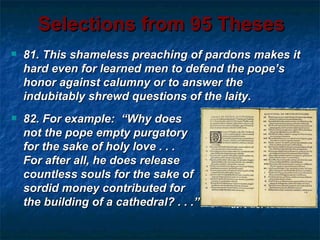
   82. For example: “Why does
    not the pope empty purgatory
    for the sake of holy love . . .
    For after all, he does release
    countless souls for the sake of
    sordid money contributed for
    the building of a cathedral? . . .”
4 Attempts to Silence Luther
   Heidelberg Disputation (May 1518)
       Luther was put on trial before Augustinian General
        Council
       Introduced “Theology of the Cross”:
            Centrality of Cross
            Only Jesus can forgive sins
            Be willing to become nothing for God’s glory
       Attacked scholastic theology, which he called
        “Theology of Glory” – those who hate the cross &
        love works in order to obtain earthly glory
       Martin Bucer attended & was persuaded
4 Attempts to Silence Luther
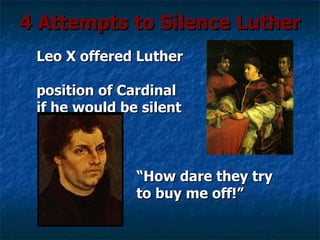
 Leo X offered Luther

 position of Cardinal
 if he would be silent


               “How dare they try
               to buy me off!”
4 Attempts to Silence Luther
   Cardinal Cajetan, Dominican papal legate,
    was sent to stifle Luther
   Luther presented written arguments
       Pope was not infallible
       Authority of council was superior to pope
       Sacraments apart from faith cannot save
       Justification by faith was scriptural
       Appealed to Bible as supreme authority
   Cajetan published order for Luther’s arrest
4 Attempts to Silence Luther
   Leipzig Disputation (July 1519)
       John Maier of Eck vs. Luther
       Luther bested Eck through citation of Scripture by
        memory to prove that Christ, not pope, is head of
        church
       Eck accused Luther of being “Saxon Huss”
       At first Luther denied charge; during intermission,
        he researched Huss; came back to say: “We are all
        Hussites if we believe the Bible to be true”
       Luther’s affirmation of Huss, convicted heretic,
        was dangerous admission
4 Attempts to Silence Luther
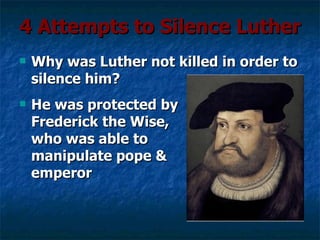
   Why was Luther not killed in order to
    silence him?
   He was protected by
    Frederick the Wise,
    who was able to
    manipulate pope &
    emperor
Three Treatises of 1520
   An Address to the Christian Nobility of
    the German Nation
       Attacked Three Walls pope erected around
        Scripture
         Spiritual power of pope is above temporal
          powers of magistrates (preventing magistrates
          from instituting reform)
         Interpretation of Scripture belongs only to pope

         Only pope can call council

       Insisted on “priesthood of believer”
Three Treatises of 1520
   The Babylonian Captivity of the Church
       Attacked sacramental system
       Affirmed 3 sacraments: baptism, Eucharist
        & penance (later affirmed only first 2)
           Denied transubstantiation but affirmed real
            presence (consubstantiation)
           Mass was not sacrifice but testament
           Faith is real element that gives value to
            sacraments
Three Treatises of 1520
   The Freedom of a Christian
       Exposition of relationship between faith &
        works
       Devotional work that shows that new
        person in Christ lives not to himself/
        herself, but in Christ & for neighbor
       Emphasized priesthood of believer
Papal Bull of Excommunication
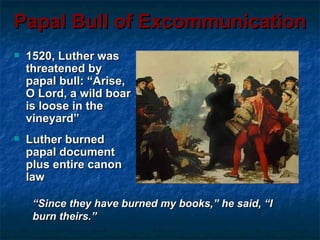
   1520, Luther was
    threatened by
    papal bull: “Arise,
    O Lord, a wild boar
    is loose in the
    vineyard”
   Luther burned
    papal document
    plus entire canon
    law

     “Since they have burned my books,” he said, “I
     burn theirs.”
Diet of Worms (April 17-18, 1521)
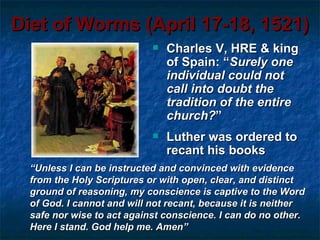
                               Charles V, HRE & king
                                of Spain: “Surely one
                                individual could not
                                call into doubt the
                                tradition of the entire
                                church?”
                               Luther was ordered to
                                recant his books
  “Unless I can be instructed and convinced with evidence
  from the Holy Scriptures or with open, clear, and distinct
  ground of reasoning, my conscience is captive to the Word
  of God. I cannot and will not recant, because it is neither
  safe nor wise to act against conscience. I can do no other.
  Here I stand. God help me. Amen”
Wartburg Castle
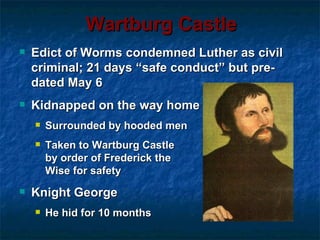
   Edict of Worms condemned Luther as civil
    criminal; 21 days “safe conduct” but pre-
    dated May 6
   Kidnapped on the way home
       Surrounded by hooded men
       Taken to Wartburg Castle
        by order of Frederick the
        Wise for safety
   Knight George
       He hid for 10 months
German Bible
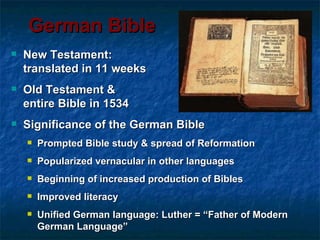
   New Testament:
    translated in 11 weeks
   Old Testament &
    entire Bible in 1534
   Significance of the German Bible
       Prompted Bible study & spread of Reformation
       Popularized vernacular in other languages
       Beginning of increased production of Bibles
       Improved literacy
       Unified German language: Luther = “Father of Modern
        German Language”
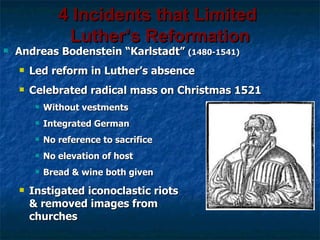
4 Incidents that Limited
                 Luther’s Reformation
   Andreas Bodenstein “Karlstadt” (1480-1541)
       Led reform in Luther’s absence
       Celebrated radical mass on Christmas 1521
            Without vestments
            Integrated German
            No reference to sacrifice
            No elevation of host
            Bread & wine both given
       Instigated iconoclastic riots
        & removed images from
        churches
4 Incidents that Limited
             Luther’s Reformation

   Andreas Bodenstein “Karlstadt” (1480-1541)
       People were nerve-shattered by radical
        mass & iconoclastic riots
       Luther returned to Wittenberg
       Karlstadt was expelled from Saxony
4 Incidents that Limited
              Luther’s Reformation
   Zwickau Prophets
       Lay movement of men studying Scripture in
        Zwickau, Saxony
       Tenets:
          Questioned infant baptism
          Emphasized immediate inspiration over biblical
           revelation (Spiritualistic Reformation)
          Influenced by Taborites (militant Bohemian Hussites)
           with revolutionary eschatology
       Arrived in Wittenberg just after Christmas 1521
          Supported by Karlstadt
          Luther discerned their spirit to be “of the devil” &
           expelled them
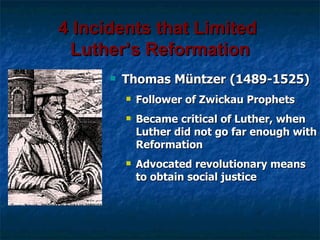
4 Incidents that Limited
 Luther’s Reformation
         Thomas Müntzer (1489-1525)
             Follower of Zwickau Prophets
             Became critical of Luther, when
              Luther did not go far enough with
              Reformation
             Advocated revolutionary means
              to obtain social justice
4 Incidents that Limited
              Luther’s Reformation
   Peasants’ Revolt
       Peasants discontent over economic
        suppression
       Luther’s Freedom of a Christian taught
        priesthood of believer, interpreted as egalitarian
        society
       Müntzer incited peasants against authorities &
        asked Wittenberg for help; Luther refused
       1525, Catholic & Lutheran forces defeated
        peasants, beheaded Müntzer
4 Incidents that Limited
               Luther’s Reformation
   Peasants’ Revolt
       Luther’s Reaction:
           First, pled for princes to deal mercifully with
            peasants
           Then, wrote Against the Robbing & Marauding
            Hordes of Peasants: “Smite, stab, slay the
            peasants!”
           Divorced himself from peasants in order not to
            impugn Reformation
           But lost faith in common people & weakened his
            base of support from them
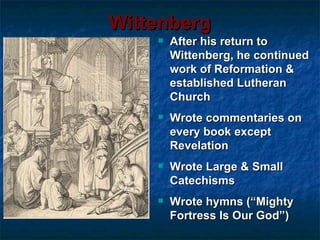
Wittenberg
       After his return to
        Wittenberg, he continued
        work of Reformation &
        established Lutheran
        Church
       Wrote commentaries on
        every book except
        Revelation
       Wrote Large & Small
        Catechisms
       Wrote hymns (“Mighty
        Fortress Is Our God”)
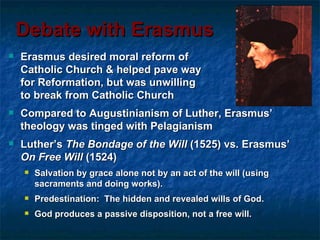
Debate with Erasmus
   Erasmus desired moral reform of
    Catholic Church & helped pave way
    for Reformation, but was unwilling
    to break from Catholic Church
   Compared to Augustinianism of Luther, Erasmus’
    theology was tinged with Pelagianism
   Luther’s The Bondage of the Will (1525) vs. Erasmus’
    On Free Will (1524)
       Salvation by grace alone not by an act of the will (using
        sacraments and doing works).
       Predestination: The hidden and revealed wills of God.
       God produces a passive disposition, not a free will.
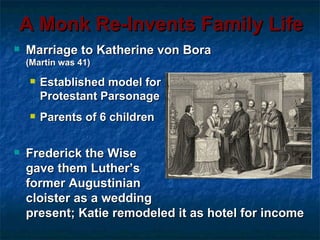
A Monk Re-Invents Family Life
   Marriage to Katherine von Bora
    (Martin was 41)

       Established model for
        Protestant Parsonage
       Parents of 6 children

   Frederick the Wise
    gave them Luther’s
    former Augustinian
    cloister as a wedding
    present; Katie remodeled it as hotel for income
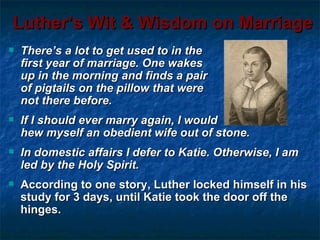
Luther’s Wit & Wisdom on Marriage
   There’s a lot to get used to in the
    first year of marriage. One wakes
    up in the morning and finds a pair
    of pigtails on the pillow that were
    not there before.
   If I should ever marry again, I would
    hew myself an obedient wife out of stone.
   In domestic affairs I defer to Katie. Otherwise, I am
    led by the Holy Spirit.
   According to one story, Luther locked himself in his
    study for 3 days, until Katie took the door off the
    hinges.
Protestants vs. Catholics
   First Diet of Speyer (1526)
       New policy: Cujus regio, eius religio (“whose region,
        his religion”); ruler’s personal religion dictates his
        subjects’ religion
       Within 3 years, most of N. Germany became
        Lutheran: state church
   Second Diet of Speyer (1529)
       Roman Catholics free in Lutheran territories;
        Lutherans not free in Roman Catholic territories
       Lutheran princes wrote Protestations; hence,
        “Protestant Reformation”
Protestants vs. Catholics
   Marbourg Colloquy (1529)
       Philip of Hesse wanted to unify all
        Protestants
       Arranged meeting between Luther & Zwingli
        to unite German & Swiss Protestants
       Major doctrinal difference was over Lord’s
        Supper
            Luther – real presence; Zwingli – memorial
            Luther wrote Hoc est meum corpum on table &
             would not budge
       Agreement & alliance could not be achieved
Protestants vs. Catholics
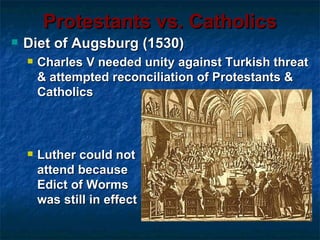
   Diet of Augsburg (1530)
       Charles V needed unity against Turkish threat
        & attempted reconciliation of Protestants &
        Catholics


       Luther could not
        attend because
        Edict of Worms
        was still in effect
Protestants vs. Catholics
   Diet of Augsburg (1530)
       Melanchthon & Luther composed Augsburg
        Confession
           Justification by faith
           Faith not just mental assent
           New life in Christ produces good works by God’s
            grace, not good deeds of merit for salvation
       German princes signed; RCC gave one year to
        recant
       But war with Turks occupied HRE for 16 yrs.
Martin Luther’s Death
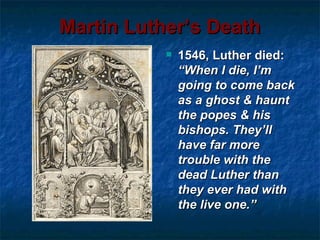
              1546, Luther died:
               “When I die, I’m
               going to come back
               as a ghost & haunt
               the popes & his
               bishops. They’ll
               have far more
               trouble with the
               dead Luther than
               they ever had with
               the live one.”
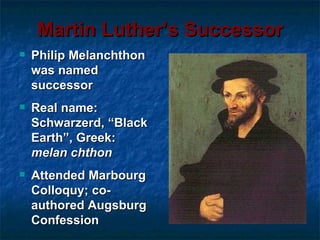
Martin Luther’s Successor
   Philip Melanchthon
    was named
    successor
   Real name:
    Schwarzerd, “Black
    Earth”, Greek:
    melan chthon
   Attended Marbourg
    Colloquy; co-
    authored Augsburg
    Confession
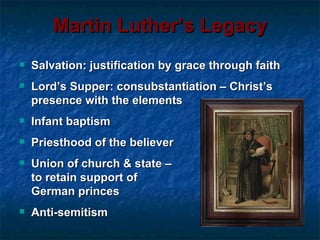
Martin Luther’s Legacy
   Salvation: justification by grace through faith
   Lord’s Supper: consubstantiation – Christ’s
    presence with the elements
   Infant baptism
   Priesthood of the believer
   Union of church & state –
    to retain support of
    German princes
   Anti-semitism
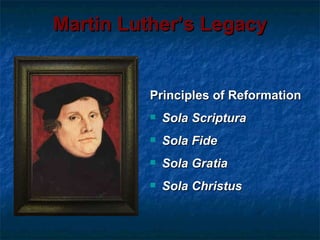
Martin Luther’s Legacy


         Principles of Reformation
            Sola Scriptura
            Sola Fide
            Sola Gratia
            Sola Christus

Martin Luther

  • 1.
    MARTIN LUTHER Wild Boar In the Vineyard
  • 2.
    Martin Luther’s Youth  Born November 10, 1483  Parents: Hans & Margaretha Luder  Hans was common servant; worked in copper mine; rose to ownership of mines & smelter  Hans was driven to succeed; driven to be sure that Martin succeeded as well  Martin went to University of Erfurt to study law
  • 3.
    Martin Luther’s Entrance into Monastery  Caught in a thunderstorm at age 21, he cried: “Help me, St. Anne! I will become a monk!”  Entered Augustinian Monastery, 1505 – much to his father’s dismay  Ordained a priest  Studied theology in preparation for teaching
  • 4.
    Martin Luther’s Confession  Tormented by sensitivity to sin nature  Extreme asceticism: prayer, fasts, sleep deprivation, cold, whipping himself  Constantly in confession  Luther: “If ever a monk got to heaven by his monkery, I was that
  • 5.
    Martin Luther’s Tripto Rome  Abbot Staupitz sent Luther on pilgrimage to Rome  Luther visited holiest places; crawled up Pilate’s staircase  Luther observed priests & bishops acting immorally & abusing their power  Luther: “I went with onions & returned with garlic”
  • 6.
    Martin Luther’s Discovery  Next Staupitz sent Luther to Wittenberg as theology professor  1515, great discovery: Rom. 1:17  Gospel is revelation of justice of God  To Luther, justice of God was unbearable; yet, Gospel linked to God’s justice  Justice does not refer to punishment of sinners; righteousness is given to those who live by faith  Justification is the free gift of God to sinners: righteousness is imputed by God who justifies humans by their faith in Jesus Christ
  • 7.
    “Here I feltas if I were entirely born again and had entered paradise itself through gates that had been flung open. The whole of Scripture gained a new meaning. And from that point on the phrase the ‘justice of God’ no longer filled me with hatred, but rather became unspeakably sweet by virtue of a great love”
  • 8.
    Controversy over Indulgences  Leo X sold archbishopric of Mainz to Albert of Brandenburg to raise money to build St. Peter’s  Albert hired John Tetzel to sell indulgences  Tetzel: “As soon as a coin in the coffer rings, a soul from purgatory springs”
  • 9.
    95 Theses  95 Theses written against the sale of indulgences  Nailed to the door of the Castle Church in Wittenberg on October 31, 1517  95 Theses translated, printed, & distributed throughout Germany within 2 weeks
  • 10.
    Selections from 95Theses  32. Those who suppose that on account of their letters of indulgence they are sure of salvation will be eternally damned along with their teachers.  36. Every Christian who truly repents has plenary (full) forgiveness both of punishment and guilt bestowed upon him, even without letters of indulgence.  37. Every true Christian, whether living or dead, has a share in all the benefits of Christ and the Church, for God has granted him these, even without letters of indulgence.
  • 11.
    Selections from 95Theses  81. This shameless preaching of pardons makes it hard even for learned men to defend the pope’s honor against calumny or to answer the indubitably shrewd questions of the laity.  82. For example: “Why does not the pope empty purgatory for the sake of holy love . . . For after all, he does release countless souls for the sake of sordid money contributed for the building of a cathedral? . . .”
  • 12.
    4 Attempts toSilence Luther  Heidelberg Disputation (May 1518)  Luther was put on trial before Augustinian General Council  Introduced “Theology of the Cross”:  Centrality of Cross  Only Jesus can forgive sins  Be willing to become nothing for God’s glory  Attacked scholastic theology, which he called “Theology of Glory” – those who hate the cross & love works in order to obtain earthly glory  Martin Bucer attended & was persuaded
  • 13.
    4 Attempts toSilence Luther Leo X offered Luther position of Cardinal if he would be silent “How dare they try to buy me off!”
  • 14.
    4 Attempts toSilence Luther  Cardinal Cajetan, Dominican papal legate, was sent to stifle Luther  Luther presented written arguments  Pope was not infallible  Authority of council was superior to pope  Sacraments apart from faith cannot save  Justification by faith was scriptural  Appealed to Bible as supreme authority  Cajetan published order for Luther’s arrest
  • 15.
    4 Attempts toSilence Luther  Leipzig Disputation (July 1519)  John Maier of Eck vs. Luther  Luther bested Eck through citation of Scripture by memory to prove that Christ, not pope, is head of church  Eck accused Luther of being “Saxon Huss”  At first Luther denied charge; during intermission, he researched Huss; came back to say: “We are all Hussites if we believe the Bible to be true”  Luther’s affirmation of Huss, convicted heretic, was dangerous admission
  • 16.
    4 Attempts toSilence Luther  Why was Luther not killed in order to silence him?  He was protected by Frederick the Wise, who was able to manipulate pope & emperor
  • 17.
    Three Treatises of1520  An Address to the Christian Nobility of the German Nation  Attacked Three Walls pope erected around Scripture  Spiritual power of pope is above temporal powers of magistrates (preventing magistrates from instituting reform)  Interpretation of Scripture belongs only to pope  Only pope can call council  Insisted on “priesthood of believer”
  • 18.
    Three Treatises of1520  The Babylonian Captivity of the Church  Attacked sacramental system  Affirmed 3 sacraments: baptism, Eucharist & penance (later affirmed only first 2)  Denied transubstantiation but affirmed real presence (consubstantiation)  Mass was not sacrifice but testament  Faith is real element that gives value to sacraments
  • 19.
    Three Treatises of1520  The Freedom of a Christian  Exposition of relationship between faith & works  Devotional work that shows that new person in Christ lives not to himself/ herself, but in Christ & for neighbor  Emphasized priesthood of believer
  • 20.
    Papal Bull ofExcommunication  1520, Luther was threatened by papal bull: “Arise, O Lord, a wild boar is loose in the vineyard”  Luther burned papal document plus entire canon law “Since they have burned my books,” he said, “I burn theirs.”
  • 21.
    Diet of Worms(April 17-18, 1521)  Charles V, HRE & king of Spain: “Surely one individual could not call into doubt the tradition of the entire church?”  Luther was ordered to recant his books “Unless I can be instructed and convinced with evidence from the Holy Scriptures or with open, clear, and distinct ground of reasoning, my conscience is captive to the Word of God. I cannot and will not recant, because it is neither safe nor wise to act against conscience. I can do no other. Here I stand. God help me. Amen”
  • 22.
    Wartburg Castle  Edict of Worms condemned Luther as civil criminal; 21 days “safe conduct” but pre- dated May 6  Kidnapped on the way home  Surrounded by hooded men  Taken to Wartburg Castle by order of Frederick the Wise for safety  Knight George  He hid for 10 months
  • 23.
    German Bible  New Testament: translated in 11 weeks  Old Testament & entire Bible in 1534  Significance of the German Bible  Prompted Bible study & spread of Reformation  Popularized vernacular in other languages  Beginning of increased production of Bibles  Improved literacy  Unified German language: Luther = “Father of Modern German Language”
  • 24.
    4 Incidents thatLimited Luther’s Reformation  Andreas Bodenstein “Karlstadt” (1480-1541)  Led reform in Luther’s absence  Celebrated radical mass on Christmas 1521  Without vestments  Integrated German  No reference to sacrifice  No elevation of host  Bread & wine both given  Instigated iconoclastic riots & removed images from churches
  • 25.
    4 Incidents thatLimited Luther’s Reformation  Andreas Bodenstein “Karlstadt” (1480-1541)  People were nerve-shattered by radical mass & iconoclastic riots  Luther returned to Wittenberg  Karlstadt was expelled from Saxony
  • 26.
    4 Incidents thatLimited Luther’s Reformation  Zwickau Prophets  Lay movement of men studying Scripture in Zwickau, Saxony  Tenets:  Questioned infant baptism  Emphasized immediate inspiration over biblical revelation (Spiritualistic Reformation)  Influenced by Taborites (militant Bohemian Hussites) with revolutionary eschatology  Arrived in Wittenberg just after Christmas 1521  Supported by Karlstadt  Luther discerned their spirit to be “of the devil” & expelled them
  • 27.
    4 Incidents thatLimited Luther’s Reformation  Thomas Müntzer (1489-1525)  Follower of Zwickau Prophets  Became critical of Luther, when Luther did not go far enough with Reformation  Advocated revolutionary means to obtain social justice
  • 28.
    4 Incidents thatLimited Luther’s Reformation  Peasants’ Revolt  Peasants discontent over economic suppression  Luther’s Freedom of a Christian taught priesthood of believer, interpreted as egalitarian society  Müntzer incited peasants against authorities & asked Wittenberg for help; Luther refused  1525, Catholic & Lutheran forces defeated peasants, beheaded Müntzer
  • 29.
    4 Incidents thatLimited Luther’s Reformation  Peasants’ Revolt  Luther’s Reaction:  First, pled for princes to deal mercifully with peasants  Then, wrote Against the Robbing & Marauding Hordes of Peasants: “Smite, stab, slay the peasants!”  Divorced himself from peasants in order not to impugn Reformation  But lost faith in common people & weakened his base of support from them
  • 30.
    Wittenberg  After his return to Wittenberg, he continued work of Reformation & established Lutheran Church  Wrote commentaries on every book except Revelation  Wrote Large & Small Catechisms  Wrote hymns (“Mighty Fortress Is Our God”)
  • 31.
    Debate with Erasmus  Erasmus desired moral reform of Catholic Church & helped pave way for Reformation, but was unwilling to break from Catholic Church  Compared to Augustinianism of Luther, Erasmus’ theology was tinged with Pelagianism  Luther’s The Bondage of the Will (1525) vs. Erasmus’ On Free Will (1524)  Salvation by grace alone not by an act of the will (using sacraments and doing works).  Predestination: The hidden and revealed wills of God.  God produces a passive disposition, not a free will.
  • 32.
    A Monk Re-InventsFamily Life  Marriage to Katherine von Bora (Martin was 41)  Established model for Protestant Parsonage  Parents of 6 children  Frederick the Wise gave them Luther’s former Augustinian cloister as a wedding present; Katie remodeled it as hotel for income
  • 33.
    Luther’s Wit &Wisdom on Marriage  There’s a lot to get used to in the first year of marriage. One wakes up in the morning and finds a pair of pigtails on the pillow that were not there before.  If I should ever marry again, I would hew myself an obedient wife out of stone.  In domestic affairs I defer to Katie. Otherwise, I am led by the Holy Spirit.  According to one story, Luther locked himself in his study for 3 days, until Katie took the door off the hinges.
  • 34.
    Protestants vs. Catholics  First Diet of Speyer (1526)  New policy: Cujus regio, eius religio (“whose region, his religion”); ruler’s personal religion dictates his subjects’ religion  Within 3 years, most of N. Germany became Lutheran: state church  Second Diet of Speyer (1529)  Roman Catholics free in Lutheran territories; Lutherans not free in Roman Catholic territories  Lutheran princes wrote Protestations; hence, “Protestant Reformation”
  • 35.
    Protestants vs. Catholics  Marbourg Colloquy (1529)  Philip of Hesse wanted to unify all Protestants  Arranged meeting between Luther & Zwingli to unite German & Swiss Protestants  Major doctrinal difference was over Lord’s Supper  Luther – real presence; Zwingli – memorial  Luther wrote Hoc est meum corpum on table & would not budge  Agreement & alliance could not be achieved
  • 36.
    Protestants vs. Catholics  Diet of Augsburg (1530)  Charles V needed unity against Turkish threat & attempted reconciliation of Protestants & Catholics  Luther could not attend because Edict of Worms was still in effect
  • 37.
    Protestants vs. Catholics  Diet of Augsburg (1530)  Melanchthon & Luther composed Augsburg Confession  Justification by faith  Faith not just mental assent  New life in Christ produces good works by God’s grace, not good deeds of merit for salvation  German princes signed; RCC gave one year to recant  But war with Turks occupied HRE for 16 yrs.
  • 38.
    Martin Luther’s Death  1546, Luther died: “When I die, I’m going to come back as a ghost & haunt the popes & his bishops. They’ll have far more trouble with the dead Luther than they ever had with the live one.”
  • 39.
    Martin Luther’s Successor  Philip Melanchthon was named successor  Real name: Schwarzerd, “Black Earth”, Greek: melan chthon  Attended Marbourg Colloquy; co- authored Augsburg Confession
  • 40.
    Martin Luther’s Legacy  Salvation: justification by grace through faith  Lord’s Supper: consubstantiation – Christ’s presence with the elements  Infant baptism  Priesthood of the believer  Union of church & state – to retain support of German princes  Anti-semitism
  • 41.
    Martin Luther’s Legacy Principles of Reformation  Sola Scriptura  Sola Fide  Sola Gratia  Sola Christus