Canada and Iroquoia
• Explorers from England, France, and other Europeon
countries sailed across the Atlantic Ocean to find
economic prosperity.
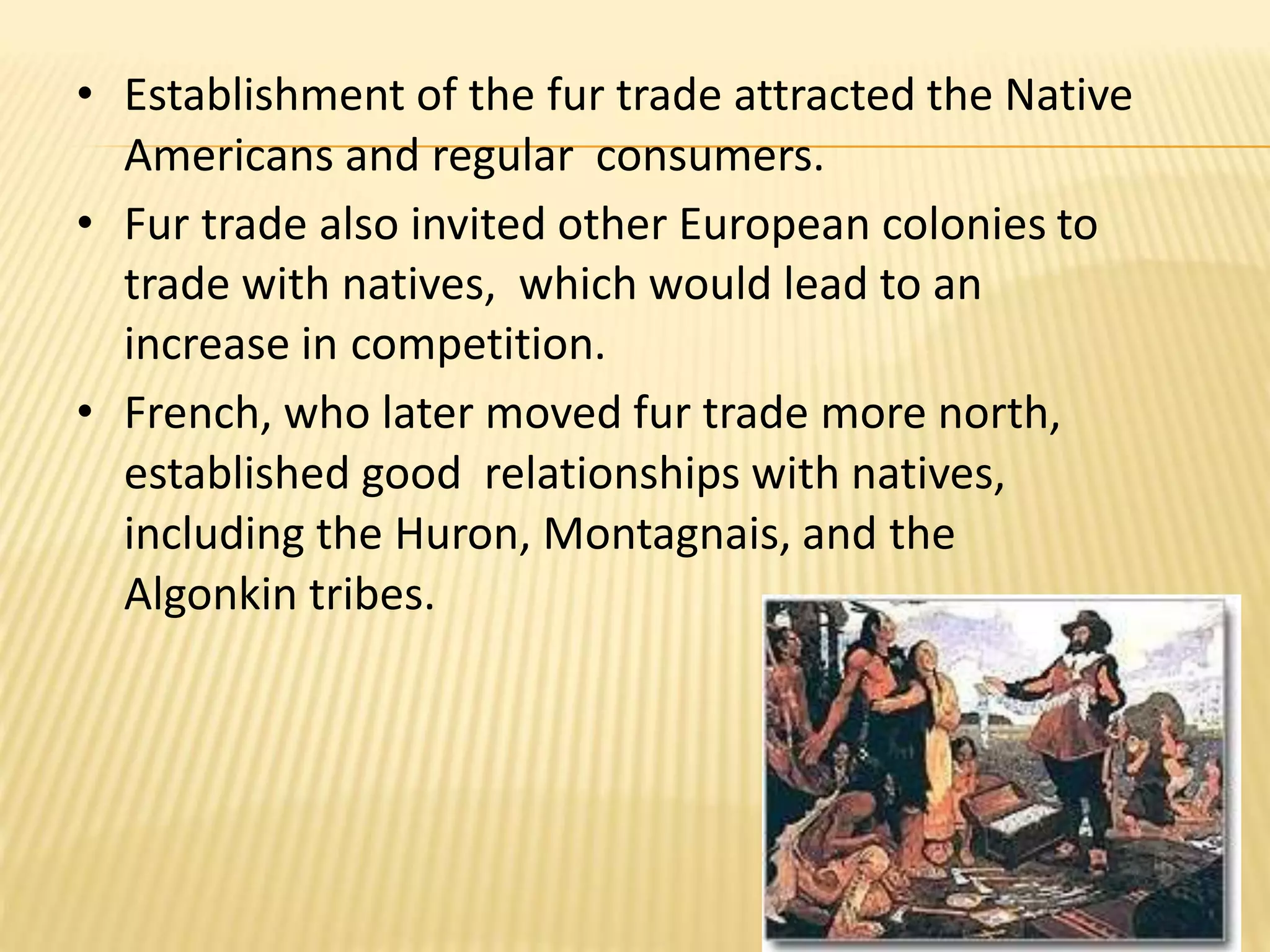
• Trade with Native Iroquois, a tribe that survived as
Hunter-Gatherers; Natives became more dependent on
European goods.
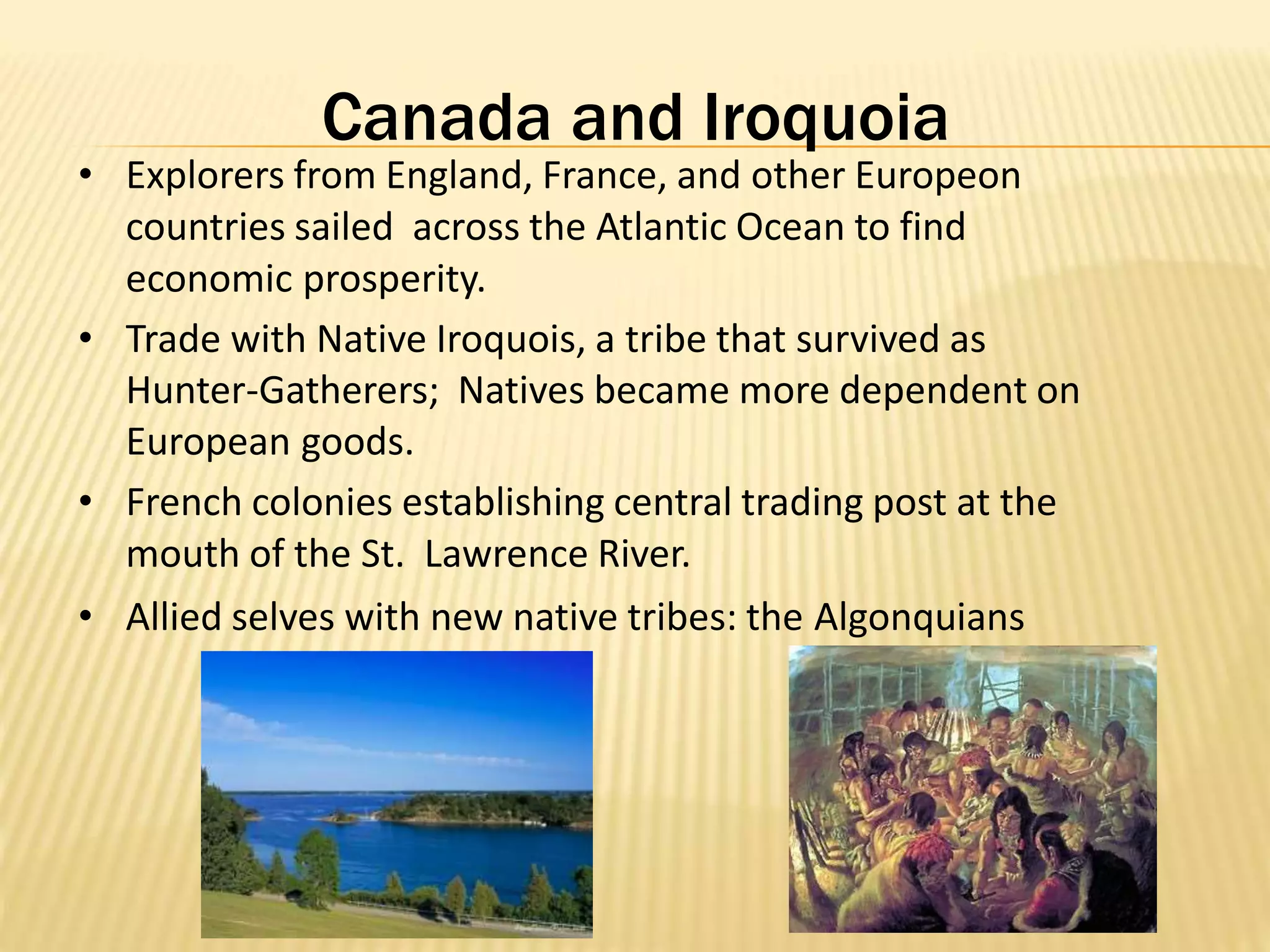
• French colonies establishing central trading post at the
mouth of the St. Lawrence River.
• Allied selves with new native tribes: the Algonquians
• Establishment of the fur trade attracted the Native
Americans and regular consumers.
• Fur trade also invited other European colonies to
trade with natives, which would lead to an
increase in competition.
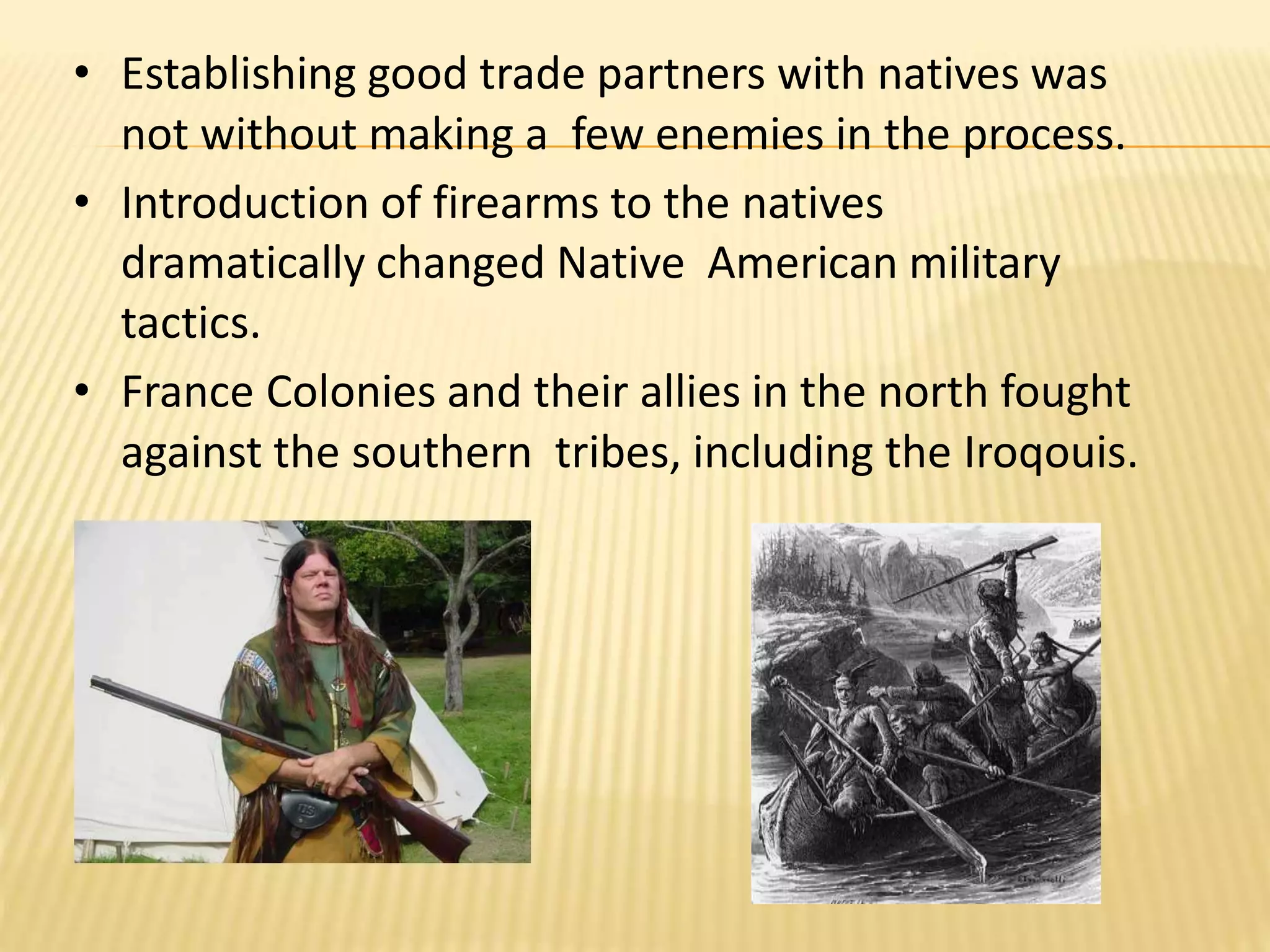
• French, who later moved fur trade more north,
established good relationships with natives,
including the Huron, Montagnais, and the
Algonkin tribes.
• Establishing good trade partners with natives was
not without making a few enemies in the process.
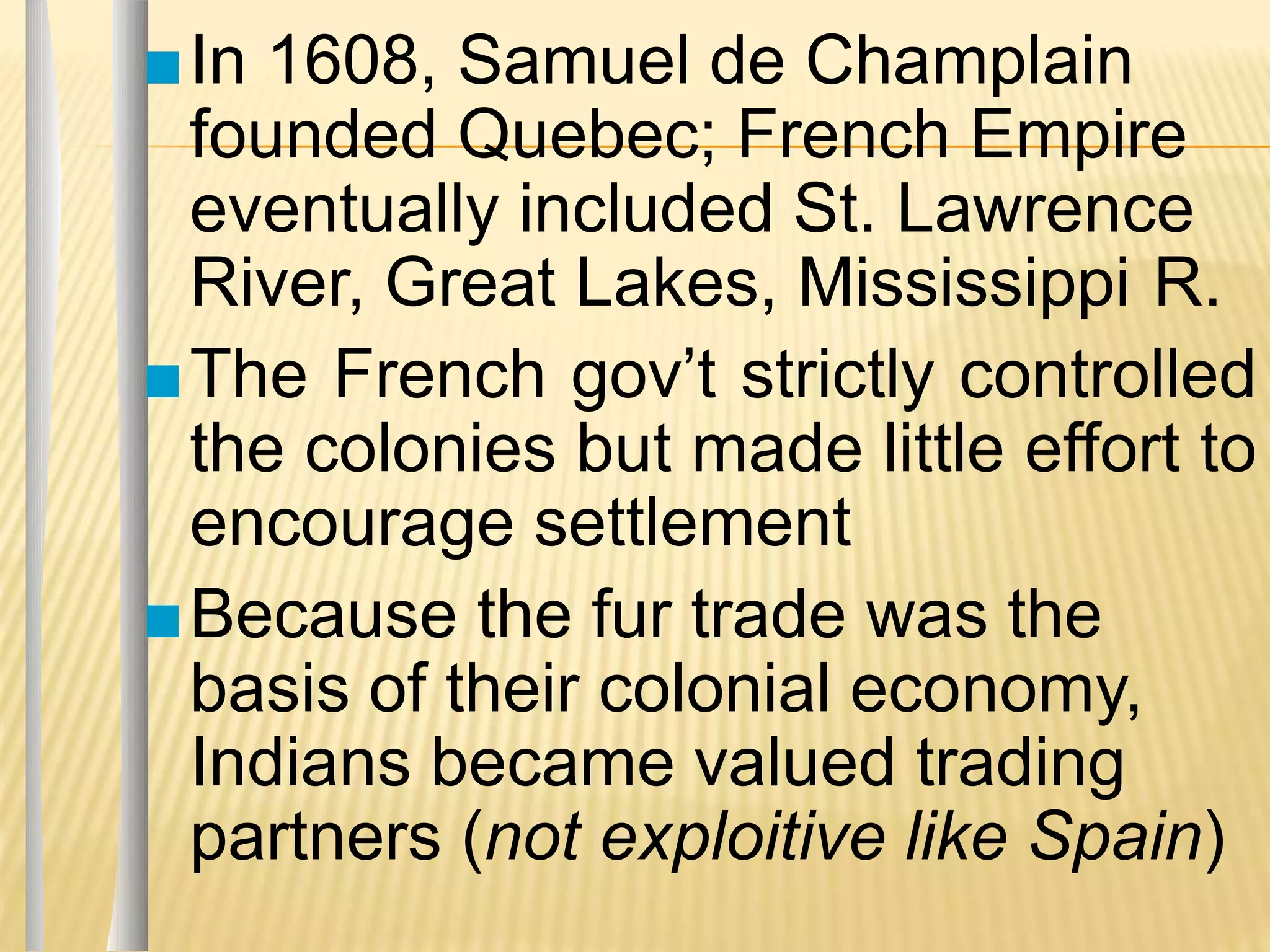
• Introduction of firearms to the natives
dramatically changed Native American military
tactics.
• France Colonies and their allies in the north fought
against the southern tribes, including the Iroqouis.
• In addition to economic purposes, the
French also saw colonization in North
America as an opportunity to spread the
Christian faith.
• These people were known as the Jesuits.
• Some of the French Colonists made Native
American conversion their solitary
mission.
• By the 17th century, the French
colonies, and trade was
endangered by intensifying
warfare from the Iroquois
French America
• The French monarchy sent emigrants to North
America.
• French people seek to emigrate from the poor rural
life, but new French policies would limit people
from settling in North America.
• Emigrants who did come to America from France
were given jobs as soldiers, merchants,
or people to help spread religion.
• French colonizes established in the United States as
south as Louisiana.
• 80 percent of the French Colonists were farmers.
• On these farms, the male and female roles
intertwined as both assumed equally demanding
work.
• Different policies from British colonies in terms of
marriage, childbearing, and welfare.
• Significant French colony set up in the Louisiana
territory.
• Original control of the France Louisiana
belonged to French General- turned emperor,
Napoleon Bonaparte.
• To pay expenses for his wars, Napoleon decided to
sell the territory, which would eventually end up
as part of a large purchase by the United States.
• Tribes along the Gulf Cost and Mississippi of
Louisiana consisted of small tribes.
• Tribes included the Ouacha, Mongoulacha,
Tohome, Atakapa, and many more.
• Native Americans were more critical to
France and English colonies than originally
thought.
Locations of Major Indian Groups and
Culture Areas in the 1600s
■ French settle
Quebec (1608) &
Montreal (1642)
and what would
become Canada
– Control St.
Lawrence River
& access to
interior of North
America
– Develop a fur
trade
■In 1608, Samuel de Champlain
founded Quebec; French Empire
eventually included St. Lawrence
River, Great Lakes, Mississippi R.
■The French gov’t strictly controlled
the colonies but made little effort to
encourage settlement
■Because the fur trade was the
basis of their colonial economy,
Indians became valued trading
partners (not exploitive like Spain)
What was the relationship between the
French and Native Americans living in
North America?
■Business partners
■Friendly
■Huron (in Canada) were close
allies
■Enemies with Iroquois (on East
coast with British colonies)
■Diseases killed many
Like Spain, the French gov’t
encouraged converting Native
Americans & establishing missions
What was life like in French America?
■Difficult
■Swamp area with disease
carrying mosquitoes
■Laziness from settlers
■Frenches took over during the
starving time
■Native Americans refuse to trade
during this time
The Stuart Monarchs
Types of Colonial
Settlements
Three types of colonial settlements
Trading Post
Colony
Plantation Settler colony
Colony
Used to trade items
For example, French
fur traders
Grow and sell
cash crops, such
as rice, indigo,
tobacco,
Settlers establish new towns
and settlements, but linked to
their mother country by trade
and government.
Did not require
a lot of money.
Required more
money to
maintain and
build.
Required more money to
build the towns and
settlements.
More difficult to
protect.
Easier to
protect
Easy to protect
Set up along a
water trade route.
Set up on
large areas
of land.
Set up along the
water for irrigation
use and trade.
European colonization in North America
Spain France England
Plantation colonies in
the Caribbean, Florida,
and Mexico.
Spanish missions
converted Indians to
Christianity by force,
and governed the
colonial settlements.
Georgia’s coastal
barrier islands
served as sites of
Spanish missions.
Trading post colonies
in St. Lawrence,
Great Lakes, and
Mississippi regions.
Port of New
Orleans controlled
trade in the Gulf of
Mexico,
threatening
Spanish shipping
in the area.
Fur traders
expanded networks
throughout all of
the Southeastern
tribes.
Plantation colonies in
Southern English
colonies.
Settler colonies
Jamestown based at
first on trading, then
later became known as
a religious settlement.
Fort King George at
Darien, GA was
southern-most
outpost to protect
Charlestown, South
Carolina from
Spanish attacks.
Colonies in North America
Spanish Colonies French colonies English colonies
Mexico, present day
Florida, South western
part of South America
Inland part of North
America and the St.
Lawrence river.
They set up a variety of
colonies in Canada and along
the coast of the Atlantic
Ocean.
Controlled their
colonies with
viceroys.
Controlled their colonies
loosely. Few settlers moved
to New France, because it
was so rocky, and the
temperature was so cold.
Built for profit and others built
them for religious freedom.
England sent governors to rule
over their colonies.
Use of Native American
labor to work on the
large farms.
French got along better with
the Native Americans than
any other European
country.
English settlers pushed Native
Americans off their land.
Treated the Native
American harshly. Fur traders
England and Spain were the
two main powers in the
Americas.
Harsh treatment of the
Native Americans,
Europeans diseases
claimed their lives
Live among the Native
Americans and
respected their culture.
Did not want to convert the
Native Americans, they just
wanted their land.
Use of African slaves. Focused on Christianity. Touted religious freedom
French Colonies of  North America

French Colonies of North America

  • 2.
    Canada and Iroquoia •Explorers from England, France, and other Europeon countries sailed across the Atlantic Ocean to find economic prosperity. • Trade with Native Iroquois, a tribe that survived as Hunter-Gatherers; Natives became more dependent on European goods. • French colonies establishing central trading post at the mouth of the St. Lawrence River. • Allied selves with new native tribes: the Algonquians
  • 3.
    • Establishment ofthe fur trade attracted the Native Americans and regular consumers. • Fur trade also invited other European colonies to trade with natives, which would lead to an increase in competition. • French, who later moved fur trade more north, established good relationships with natives, including the Huron, Montagnais, and the Algonkin tribes.
  • 4.
    • Establishing goodtrade partners with natives was not without making a few enemies in the process. • Introduction of firearms to the natives dramatically changed Native American military tactics. • France Colonies and their allies in the north fought against the southern tribes, including the Iroqouis.
  • 5.
    • In additionto economic purposes, the French also saw colonization in North America as an opportunity to spread the Christian faith. • These people were known as the Jesuits. • Some of the French Colonists made Native American conversion their solitary mission. • By the 17th century, the French colonies, and trade was endangered by intensifying warfare from the Iroquois
  • 6.
    French America • TheFrench monarchy sent emigrants to North America. • French people seek to emigrate from the poor rural life, but new French policies would limit people from settling in North America. • Emigrants who did come to America from France were given jobs as soldiers, merchants, or people to help spread religion.
  • 7.
    • French colonizesestablished in the United States as south as Louisiana. • 80 percent of the French Colonists were farmers. • On these farms, the male and female roles intertwined as both assumed equally demanding work. • Different policies from British colonies in terms of marriage, childbearing, and welfare.
  • 8.
    • Significant Frenchcolony set up in the Louisiana territory. • Original control of the France Louisiana belonged to French General- turned emperor, Napoleon Bonaparte. • To pay expenses for his wars, Napoleon decided to sell the territory, which would eventually end up as part of a large purchase by the United States.
  • 9.
    • Tribes alongthe Gulf Cost and Mississippi of Louisiana consisted of small tribes. • Tribes included the Ouacha, Mongoulacha, Tohome, Atakapa, and many more. • Native Americans were more critical to France and English colonies than originally thought.
  • 11.
    Locations of MajorIndian Groups and Culture Areas in the 1600s
  • 12.
    ■ French settle Quebec(1608) & Montreal (1642) and what would become Canada – Control St. Lawrence River & access to interior of North America – Develop a fur trade
  • 13.
    ■In 1608, Samuelde Champlain founded Quebec; French Empire eventually included St. Lawrence River, Great Lakes, Mississippi R. ■The French gov’t strictly controlled the colonies but made little effort to encourage settlement ■Because the fur trade was the basis of their colonial economy, Indians became valued trading partners (not exploitive like Spain)
  • 14.
    What was therelationship between the French and Native Americans living in North America? ■Business partners ■Friendly ■Huron (in Canada) were close allies ■Enemies with Iroquois (on East coast with British colonies) ■Diseases killed many
  • 15.
    Like Spain, theFrench gov’t encouraged converting Native Americans & establishing missions
  • 17.
    What was lifelike in French America? ■Difficult ■Swamp area with disease carrying mosquitoes ■Laziness from settlers ■Frenches took over during the starving time ■Native Americans refuse to trade during this time
  • 18.
  • 19.
  • 20.
    Three types ofcolonial settlements Trading Post Colony Plantation Settler colony Colony Used to trade items For example, French fur traders Grow and sell cash crops, such as rice, indigo, tobacco, Settlers establish new towns and settlements, but linked to their mother country by trade and government. Did not require a lot of money. Required more money to maintain and build. Required more money to build the towns and settlements. More difficult to protect. Easier to protect Easy to protect Set up along a water trade route. Set up on large areas of land. Set up along the water for irrigation use and trade.
  • 21.
    European colonization inNorth America Spain France England Plantation colonies in the Caribbean, Florida, and Mexico. Spanish missions converted Indians to Christianity by force, and governed the colonial settlements. Georgia’s coastal barrier islands served as sites of Spanish missions. Trading post colonies in St. Lawrence, Great Lakes, and Mississippi regions. Port of New Orleans controlled trade in the Gulf of Mexico, threatening Spanish shipping in the area. Fur traders expanded networks throughout all of the Southeastern tribes. Plantation colonies in Southern English colonies. Settler colonies Jamestown based at first on trading, then later became known as a religious settlement. Fort King George at Darien, GA was southern-most outpost to protect Charlestown, South Carolina from Spanish attacks.
  • 22.
    Colonies in NorthAmerica Spanish Colonies French colonies English colonies Mexico, present day Florida, South western part of South America Inland part of North America and the St. Lawrence river. They set up a variety of colonies in Canada and along the coast of the Atlantic Ocean. Controlled their colonies with viceroys. Controlled their colonies loosely. Few settlers moved to New France, because it was so rocky, and the temperature was so cold. Built for profit and others built them for religious freedom. England sent governors to rule over their colonies. Use of Native American labor to work on the large farms. French got along better with the Native Americans than any other European country. English settlers pushed Native Americans off their land. Treated the Native American harshly. Fur traders England and Spain were the two main powers in the Americas. Harsh treatment of the Native Americans, Europeans diseases claimed their lives Live among the Native Americans and respected their culture. Did not want to convert the Native Americans, they just wanted their land. Use of African slaves. Focused on Christianity. Touted religious freedom