Southern ColoniesChapter 4Section 3
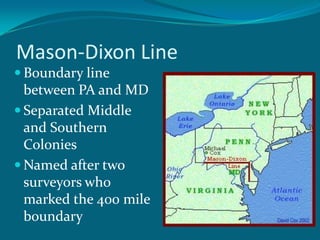
Mason-Dixon LineBoundary line between PA and MDSeparated Middle and Southern ColoniesNamed after two surveyors who marked the 400 mile boundary
MarylandFounded by Lord Baltimore, the son of Sir George Calvert, a Roman Catholic who lived in Protestant England.
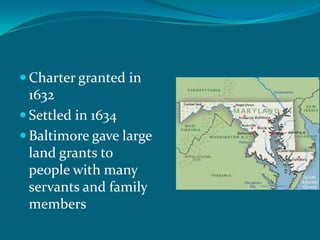
Charter granted in 1632Settled in 1634Baltimore gave large land grants to people with many servants and family members
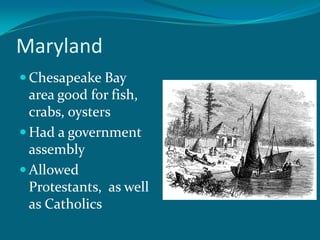
MarylandChesapeake Bay area good for fish, crabs, oystersHad a government assemblyAllowed Protestants,  as well as Catholics
ACT OF TOLERATION-1649 allowed freedom of religion only for all Christians
VirginiaBegan with Jamestown 1607Tobacco was major cropWestward movement was causing problems with Natives along the frontierColonists asked for help, but got noneBacon’s Rebellion followed
BACON’S REBELLION-1676 Nathaniel Bacon, a planter, led  raids against Indians, regardless of whether they were friendly or notled followers to burn Jamestown, the capitalBacon died; rebellion fell apart23 of his followers hangedEnglish settlers would continue to move onto frontier
Carolinas1663-   8 English nobles received a grant from King Charles I1712 North Carolina formed-mostly poor farmers drifting down from VA1719 South Carolina formed- mostly wealthy planters 	Charlestown(Charleston) became major city- Settlers from Barbados; later were Germans, Swiss. French Protestants, and Spanish JewsRice and Indigo major cropsEnslaved Indians, then AfricansAfrican slaves outnumbered white settlers by early 1700’s
Georgia James Oglethorpe founded in 1732 as a place where debtors could start over.Started with smaller farms and no slaveryAfter plantations and slavery allowed, colony grew quickly.
Tidewater v. Backcountry Life	TidewaterLarge plantations developed along the coast and the rivers and creeks of the coastal plain.Major crops were tobacco and rice.Slave labor was used (20-100 on average). Africans brought farming skills and the ability to make things out of gourds and palmetto leaves.Shipping ports developed into large cities like Charleston and Savannah.
BackcountryThis was west of the Tidewater area.The Great Wagon Road took settlers to the base of the Appalachians.People treated each other equallyThere were small farms, not plantations.They were self-sufficient farms, with very few slaves, growing food crops and hunting,.Life was harder, simpler, and more closely knit.

Southern colonies

  • 1.
  • 2.
    Mason-Dixon LineBoundary linebetween PA and MDSeparated Middle and Southern ColoniesNamed after two surveyors who marked the 400 mile boundary
  • 3.
    MarylandFounded by LordBaltimore, the son of Sir George Calvert, a Roman Catholic who lived in Protestant England.
  • 4.
    Charter granted in1632Settled in 1634Baltimore gave large land grants to people with many servants and family members
  • 5.
    MarylandChesapeake Bay areagood for fish, crabs, oystersHad a government assemblyAllowed Protestants, as well as Catholics
  • 6.
    ACT OF TOLERATION-1649allowed freedom of religion only for all Christians
  • 7.
    VirginiaBegan with Jamestown1607Tobacco was major cropWestward movement was causing problems with Natives along the frontierColonists asked for help, but got noneBacon’s Rebellion followed
  • 8.
    BACON’S REBELLION-1676 NathanielBacon, a planter, led raids against Indians, regardless of whether they were friendly or notled followers to burn Jamestown, the capitalBacon died; rebellion fell apart23 of his followers hangedEnglish settlers would continue to move onto frontier
  • 9.
    Carolinas1663- 8 English nobles received a grant from King Charles I1712 North Carolina formed-mostly poor farmers drifting down from VA1719 South Carolina formed- mostly wealthy planters Charlestown(Charleston) became major city- Settlers from Barbados; later were Germans, Swiss. French Protestants, and Spanish JewsRice and Indigo major cropsEnslaved Indians, then AfricansAfrican slaves outnumbered white settlers by early 1700’s
  • 10.
    Georgia James Oglethorpefounded in 1732 as a place where debtors could start over.Started with smaller farms and no slaveryAfter plantations and slavery allowed, colony grew quickly.
  • 11.
    Tidewater v. BackcountryLife TidewaterLarge plantations developed along the coast and the rivers and creeks of the coastal plain.Major crops were tobacco and rice.Slave labor was used (20-100 on average). Africans brought farming skills and the ability to make things out of gourds and palmetto leaves.Shipping ports developed into large cities like Charleston and Savannah.
  • 12.
    BackcountryThis was westof the Tidewater area.The Great Wagon Road took settlers to the base of the Appalachians.People treated each other equallyThere were small farms, not plantations.They were self-sufficient farms, with very few slaves, growing food crops and hunting,.Life was harder, simpler, and more closely knit.