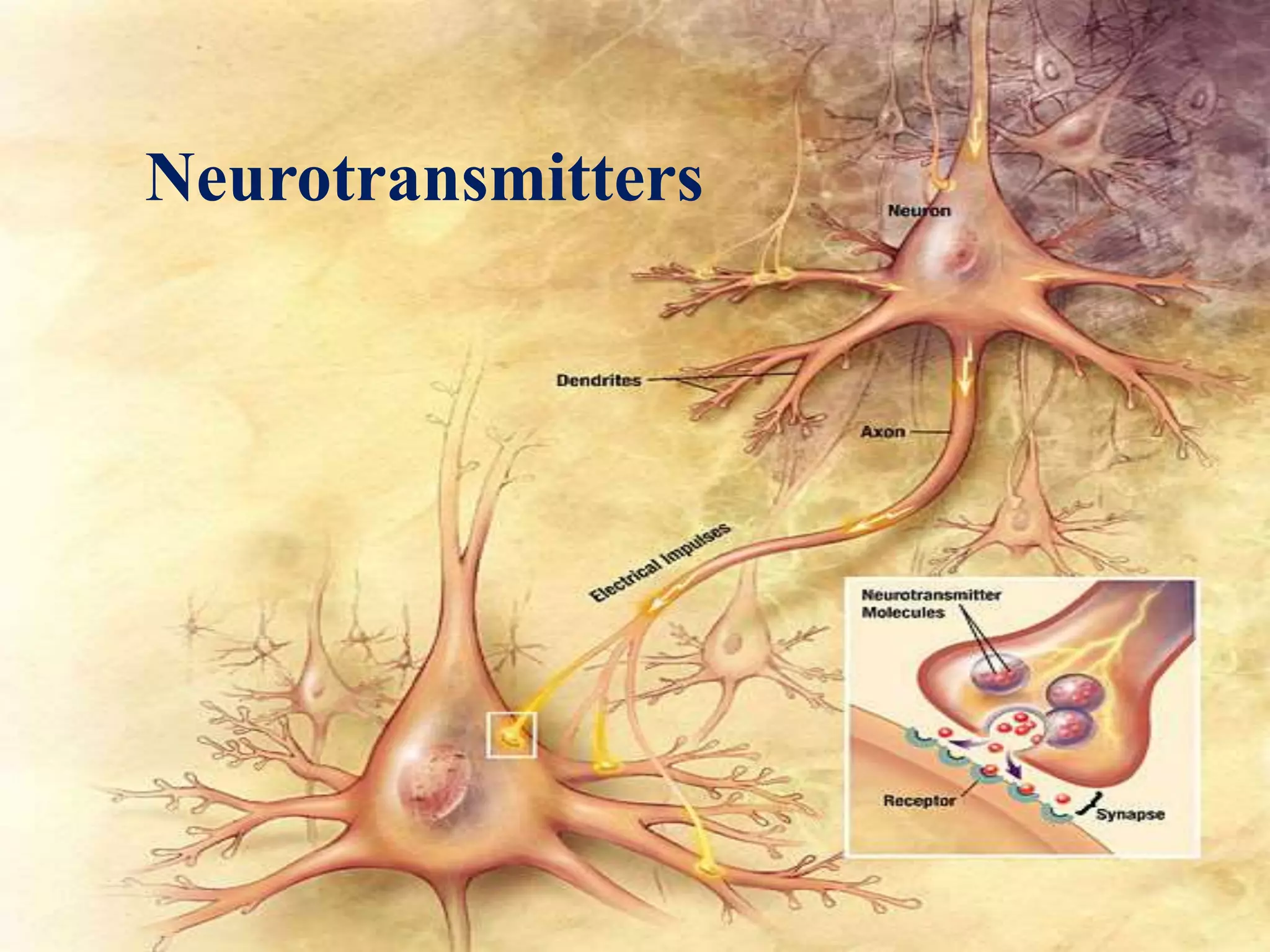
Neurotransmitters
Neurotransmitters
• More than 100 neurotransmitters are now recognized, and more will surely be
discovered.
• Acetylcholine is important and one of the first ones discovered because its
involvement in muscle movement.
• Dopamine and serotonin hugely important for many behaviors.
• The workhorses of the brain are glutamate, glycine, and γ-aminobutyric acid
(GABA).
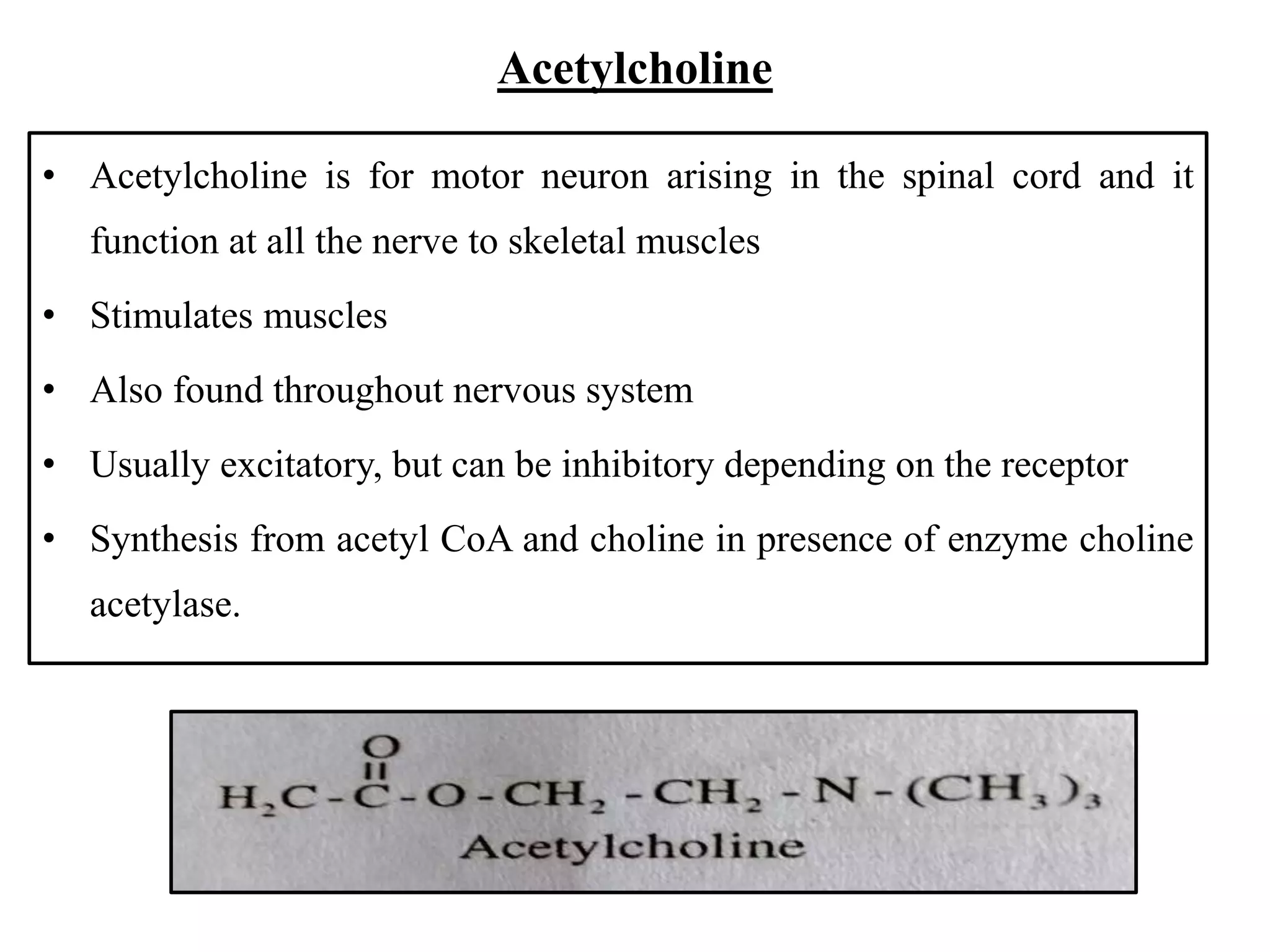
Acetylcholine
• Acetylcholine is for motor neuron arising in the spinal cord and it
function at all the nerve to skeletal muscles
• Stimulates muscles
• Also found throughout nervous system
• Usually excitatory, but can be inhibitory depending on the receptor
• Synthesis from acetyl CoA and choline in presence of enzyme choline
acetylase.
Acetylcholine
Dopamine
 Excitatory (but sometimes inhibitory) depending on the location in the nervous
system
 It is immediate precursor of norepineprine and plays motor function in CNS
 Requires a transport protein to inactivate
Serotonin
 Excitatory or inhibitory depending on area of CNS
 Involved in sleep, appetite, mood
 Drugs like prozac (SSRIs – selective serotonin reuptake inhibitor)
slows down transport protein
 Transporter also binds cocaine and amphetamines.
Dopamine
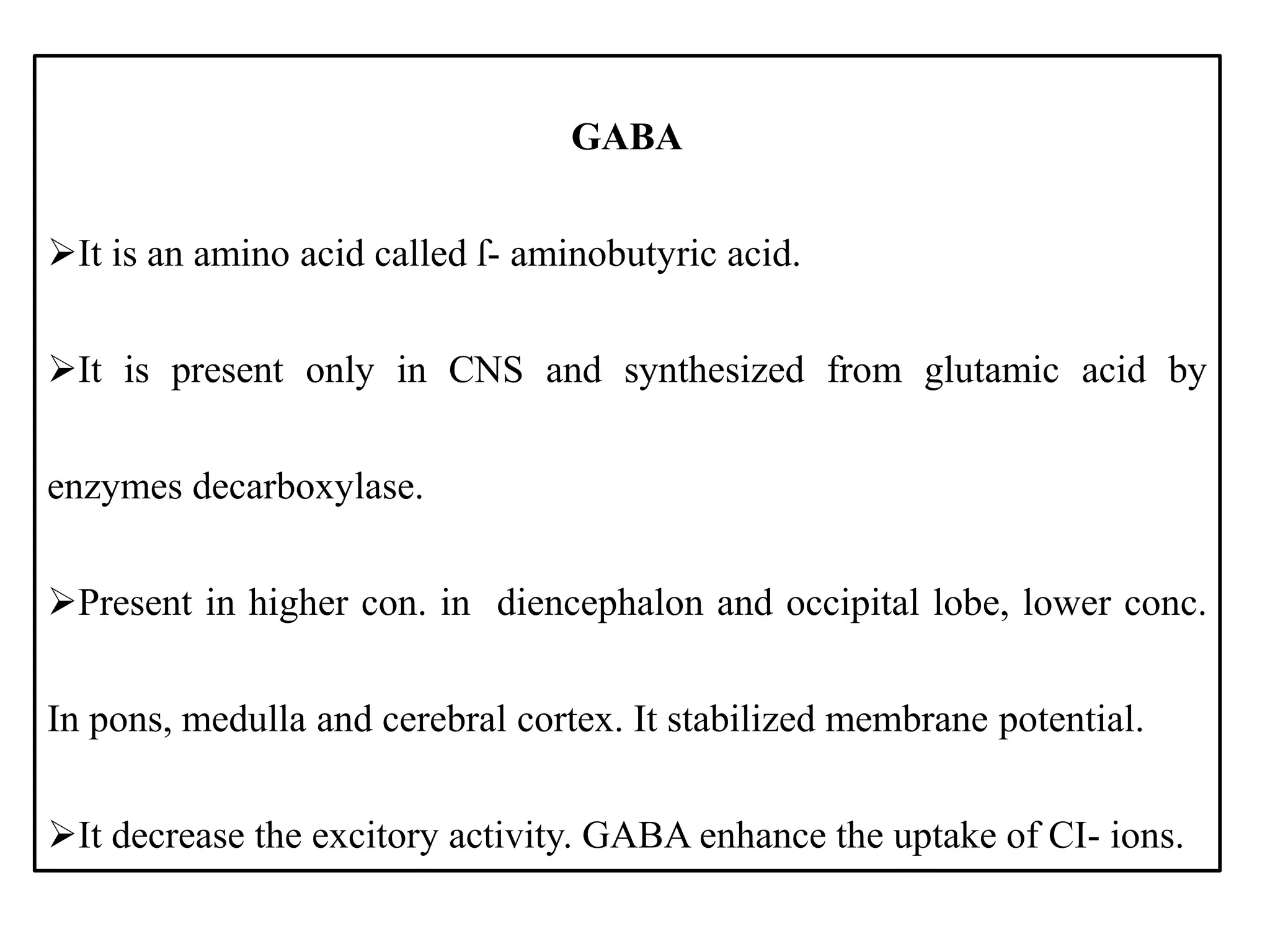
GABA
It is an amino acid called ſ- aminobutyric acid.
It is present only in CNS and synthesized from glutamic acid by
enzymes decarboxylase.
Present in higher con. in diencephalon and occipital lobe, lower conc.
In pons, medulla and cerebral cortex. It stabilized membrane potential.
It decrease the excitory activity. GABA enhance the uptake of CI- ions.
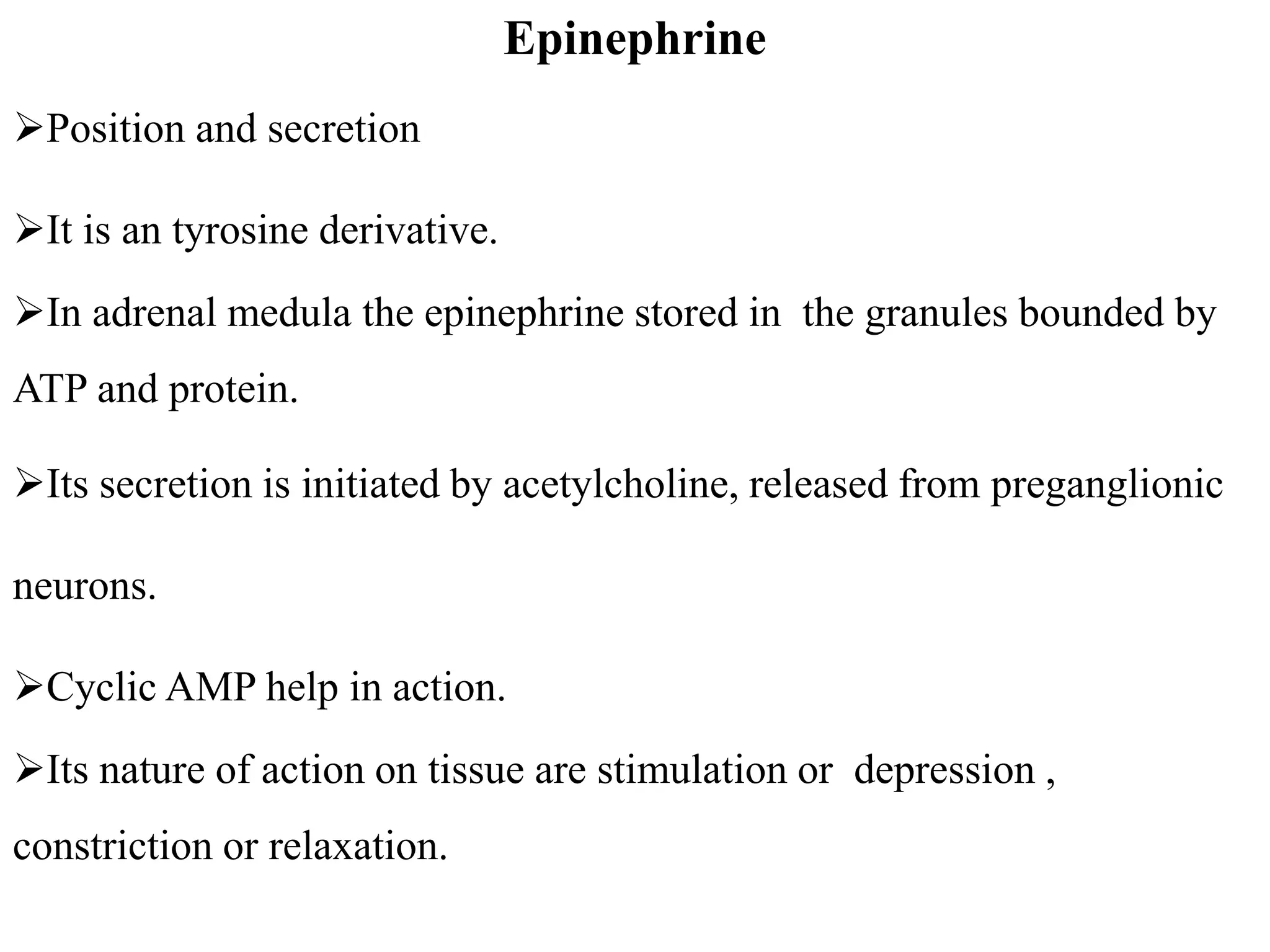
Epinephrine
Position and secretion
It is an tyrosine derivative.
In adrenal medula the epinephrine stored in the granules bounded by
ATP and protein.
Its secretion is initiated by acetylcholine, released from preganglionic
neurons.
Cyclic AMP help in action.
Its nature of action on tissue are stimulation or depression ,
constriction or relaxation.
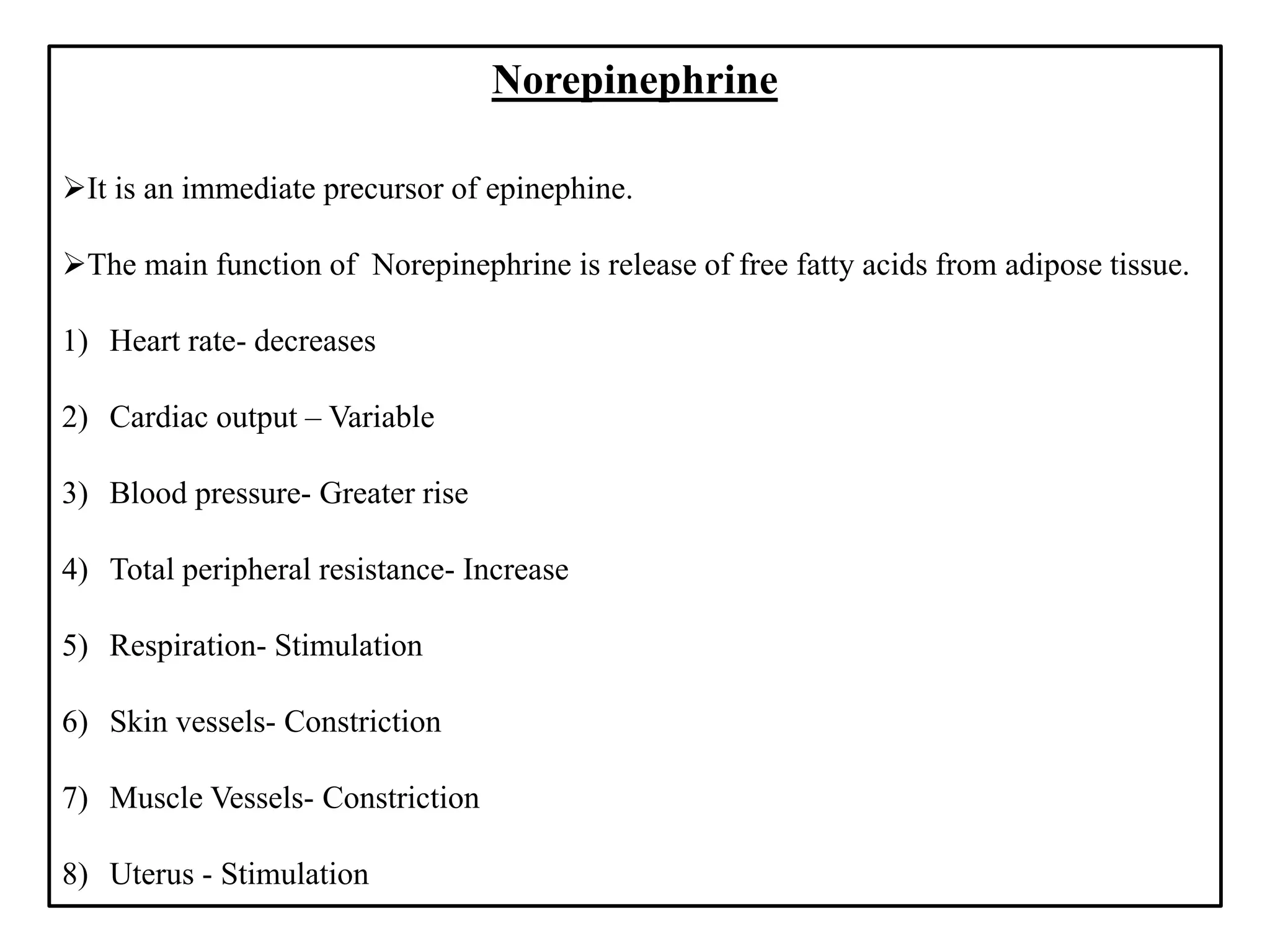
Norepinephrine
It is an immediate precursor of epinephine.
The main function of Norepinephrine is release of free fatty acids from adipose tissue.
1) Heart rate- decreases
2) Cardiac output – Variable
3) Blood pressure- Greater rise
4) Total peripheral resistance- Increase
5) Respiration- Stimulation
6) Skin vessels- Constriction
7) Muscle Vessels- Constriction
8) Uterus - Stimulation
Neurotranmitter

Neurotranmitter

  • 1.
  • 2.
    Neurotransmitters • More than100 neurotransmitters are now recognized, and more will surely be discovered. • Acetylcholine is important and one of the first ones discovered because its involvement in muscle movement. • Dopamine and serotonin hugely important for many behaviors. • The workhorses of the brain are glutamate, glycine, and γ-aminobutyric acid (GABA).
  • 3.
    Acetylcholine • Acetylcholine isfor motor neuron arising in the spinal cord and it function at all the nerve to skeletal muscles • Stimulates muscles • Also found throughout nervous system • Usually excitatory, but can be inhibitory depending on the receptor • Synthesis from acetyl CoA and choline in presence of enzyme choline acetylase.
  • 5.
  • 6.
    Dopamine  Excitatory (butsometimes inhibitory) depending on the location in the nervous system  It is immediate precursor of norepineprine and plays motor function in CNS  Requires a transport protein to inactivate
  • 7.
    Serotonin  Excitatory orinhibitory depending on area of CNS  Involved in sleep, appetite, mood  Drugs like prozac (SSRIs – selective serotonin reuptake inhibitor) slows down transport protein  Transporter also binds cocaine and amphetamines.
  • 9.
  • 10.
    GABA It is anamino acid called ſ- aminobutyric acid. It is present only in CNS and synthesized from glutamic acid by enzymes decarboxylase. Present in higher con. in diencephalon and occipital lobe, lower conc. In pons, medulla and cerebral cortex. It stabilized membrane potential. It decrease the excitory activity. GABA enhance the uptake of CI- ions.
  • 11.
    Epinephrine Position and secretion Itis an tyrosine derivative. In adrenal medula the epinephrine stored in the granules bounded by ATP and protein. Its secretion is initiated by acetylcholine, released from preganglionic neurons. Cyclic AMP help in action. Its nature of action on tissue are stimulation or depression , constriction or relaxation.
  • 13.
    Norepinephrine It is animmediate precursor of epinephine. The main function of Norepinephrine is release of free fatty acids from adipose tissue. 1) Heart rate- decreases 2) Cardiac output – Variable 3) Blood pressure- Greater rise 4) Total peripheral resistance- Increase 5) Respiration- Stimulation 6) Skin vessels- Constriction 7) Muscle Vessels- Constriction 8) Uterus - Stimulation