Acetylcholine
BY- SANCHIT DHANKHAR
M.PHARMACY
1
Content
 Introduction
 Definition of Ach
 Synthesis and release of Ach
 Mechanism of action of Ach
 Sites and function of Ach
 Pharmacology
 Summary
2
3
Acetylcholine (ACh):- is an organic chemical that functions in the brain and body of
humans, as a neurotransmitter—a chemical released by nerve cells to send signals to
other cells.
Its name is derived from its chemical structure: it is an ester of acetic acid and choline.
Parts in the body that use or are affected by acetylcholine are referred to as
cholinergic.
Acetylcholine is the neurotransmitter used at the neuromuscular junction
(A neuromuscular junction is a chemical synapse between a motor neuron and
a muscle fiber) in other words, it is the chemical that motor neurons of the nervous
system release in order to activate muscles.
Acetylcholine is also used as a neurotransmitter in the autonomic nervous system, both
as an internal transmitter for the sympathetic nervous system and as the final product
released by the parasympathetic nervous system.
4
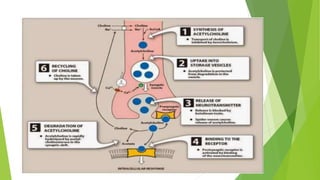
Acetylcholine is synthesized in certain neurons by the enzyme choline acetyltransferase
from the compounds choline and acetyl-CoA. Cholinergic neurons are capable of
producing Ach. At least half of the choline used in ACh synthesis is thought to come
directly from recycling of released ACh, hydrolyzed to choline by cholinesterase.
Presumably, uptake of this metabolically derived choline occurs rapidly, before the
choline diffuses away from the synaptic cleft.
Another source of choline is the breakdown of phosphatidylcholine, which may be
stimulated by locally released ACh. Choline derived from these two sources becomes
available in the extracellular space and is then subject to high-affinity uptake into the
nerve ending.
5
6
Like many other biologically active substances, acetylcholine exerts its effects by
binding to and activating receptors located on the surface of cells. There are two
main classes of acetylcholine receptor, nicotinic and muscarinic.
1-Nicotinic acetylcholine receptors:- are ligand-gated ion channels permeable to
sodium, potassium, and calcium ions. In other words, they are ion channels embedded in
cell membranes, capable of switching from a closed to open state when acetylcholine
binds to them; in the open state they allow ions to pass through. Nicotinic receptors
come in two main types, known as muscle-type and neuronal-type.The main location of
muscle,type receptors is on muscle cells.
Neuronal-type receptors are located in autonomic ganglia (both
sympathetic and parasympathetic), and in the central nervous
System.
7
2-Muscarinic acetylcholine receptors:- have a more complex mechanism, and
affect target cells over a longer time frame. In mammals, five subtypes of
muscarinic receptors have been identified, labeled M1 through M5. All of them
function as G protein coupled receptors, meaning that they exert their effects via a
second Acetylcholine 5 messenger system.
The M1, M3, and M5 subtypes are Gq-coupled; they increase intracellular levels of
IP3 (inositol triphosphate receptor) and calcium by activating phospholipase C. Their
effect on target cells is usually excitatory. The M2 and M4 subtypes are Gi/Go-
coupled; they decrease intracellular levels of cAMP (cyclic adenosine
monophosphate) by inhibiting adenylate cyclase. Their effect on target cells is
usually inhibitory. Muscarinic acetylcholine receptors are found in both the central
nervous system and the peripheral nervous system of the heart, lungs, upper
gastrointestinal tract, and sweat Glands.
8
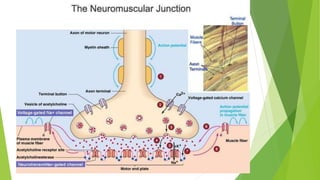
1-Neuromuscular junction : Muscles contract when they receive signals from motor
neurons. The neuromuscular junction is the site of the signal exchange. The steps of
this process in vertebrates occur as follows:
(1) The action potential
reaches the axon terminal.
(2) Calcium ions flow into the axon terminal.
(3) Acetylcholine is released into the synaptic cleft.
(4) Acetylcholine binds to postsynaptic receptors.
(5) This binding causes ion channels to open and allows sodium ions to flow into the
muscle cell.
(6) The flow of sodium ions across the membrane into the
muscle cell generates an action potential which induces
muscle contraction.
9
Acetylcholine is the substance the nervous system uses to activate skeletal
muscles. These are the muscles used for all types of voluntary movement, in
contrast to smooth muscle tissue, which is involved in a range of involuntary
activities such as movement of food through the gastrointestinal tract and
constriction of blood vessels. Skeletal muscles are directly controlled by motor
neurons located in the spinal cord or in a few cases, the brainstem. These motor
neurons send their axons through motor nerves, from which they emerge to connect
to muscle fibers at a special type of synapse called the neuromuscular junction.
When a motor neuron generates an action potential, it travels rapidly along the
nerve until it reaches the neuromuscular junction, where it initiates an
electrochemical process that causes acetylcholine to be released into the space
between the presynaptic terminal and the muscle fiber. The acetylcholine
molecules then bind to nicotinic ion channel receptors on the muscle cell
membrane, causing the ion channels to open. Calcium ions then flow into the
muscle cell, initiating a sequence of steps that finally produce muscle
contraction.
10
11
2- Autonomic nervous system
The autonomic nervous system controls a wide range of involuntary and unconscious
body functions. Its main branches are the sympathetic nervous system and
parasympathetic nervous system. Broadly speaking, the function of the sympathetic
nervous system is
to mobilize the body for action: the slogan often used for it is fight or-flight. The
function of the parasympathetic nervous system is to put the body in a state conducive
to rest, regeneration, digestion , and reproduction: it is sometimes described using the
slogans "rest and digest" or "feed and breed". Both branches use acetylcholine,
but in different ways. At a schematic level, the sympathetic and parasympathetic
nervous systems are both organized in essentially the same way: preganglionic neurons in
the central nervous system send projections to neurons located in autonomic ganglia;
these neurons then send output projections to virtually every tissue of the body. In both
branches the internal connections the projections from the central
nervous system to the autonomic ganglia—use acetylcholine as neurotransmitter, and the
receptors it activates are of the nicotinic type. In the parasympathetic nervous system
the output connections—the projections from ganglion neurons to tissues that don't
belong to the nervous system—also release acetylcholine, acting on muscarinic receptors.
In the sympathetic nervous system the output connections mainly release noradrenaline,
although acetylcholine is released at a few points, such as the sudomotor
innervation of the sweat glands.
12
3- Direct Vascular Effects
Acetylcholine in the serum exerts a direct effect on vascular tone by binding to muscarinic
receptors present on vascular endothelium. These cells respond by increasing production of
nitric oxide, which signals the surrounding smooth muscle to relax, leading to vasodilation.
Blocking, hindering or mimicking the action of acetylcholine has many uses in medicine.
Drugs acting on the acetylcholine system are either agonists to the receptors, stimulating
the system, or antagonists, inhibiting it. Acetylcholine receptor agonists and antagonists
can either have an effect directly on the receptors or exert their effects indirectly, e.g., by
affecting the enzyme acetylcholinesterase, which degrades the receptor ligand. Agonists
increase the level of receptor activation, antagonists reduce it.
13
Examples of drugs
Agonists
1-Direct acting agonist: acting directly on cholinoceptors.
pilocarpine*
Pilocarpine is a cholinergic drug, that is, a drug that mimics the effects of the chemical,
acetylcholine which is produced by nerve cells. Pilocarpine eye drops have been used for
many years to treat glaucoma, a condition in which pressure within the fluid of the eye
is abnormally elevated and ultimately damages the eye and impares vision. In 1994, an
oral formulation of pilocarpine was approved by the FDA for the treatment of dry mouth
caused by radiation therapy for head and neck cancer, a treatment that damages the
salivary glands and reduces their production of saliva.
Side effects:- dizziness, vomiting, diarrhea.
14
2-indirect acting agonist : acting indirectly by inhibiting the activity of enzymes
responsible for degredation of Ach
Neostigmine
Competitive inhibitor of cholinesterase resulting in decreased hydrolysis of
acetylcholine by cholinesterase; by reducing the breakdown of acetylcholine,
neostigmine increases acetylcholine in the synaptic cleft which competes for the
same binding site as non depolarizing neuromuscular blocking agents, and reverses
the neuromuscular blockade , mainly it is used for symptomatic treatment of
myasthenia gravis.
(Myasthenia gravis (MG) is a neuromuscular disorder that causes weakness in the
skeletal muscles, which are the muscles your body uses for movement. It occurs
when communication between nerve cells and muscles becomes impaired. This
impairment prevents crucial muscle contractions from occurring, resulting in
muscle weakness).
Side effects:- vomiting, diarrhea, abdominal cramps, increased
saliva/mucus, decreased pupil size, increased urination, or increased
sweating may occur.
15
Antagonist
*atropine
A class of medications known as anticholinergics or antimuscarinics. Atropine occurs
naturally and is extracted from the belladonna alkaloid plant. Atropine works by
blocking the actions of a chemical called acetylcholine. Atropine has numerous uses in
clinical medicine and is available in several dosage forms including oral tablet,
solution for injection, ophthalmic solution, and ophthalmic ointment.
Side effects:- may cause drowsiness, blurred vision.
16
Ach is a neurotransmitter that transmit signals from one neuron to
another or from neuron to muscle to produce action potential .
Ach was the first neurotransmitter to be identified and its old name
was "vagusstoff".
The type of receptors that Ach act on is cholinoceptors (muscarinic,
nicotinic)
Ach is synthesized at axon terminal by Ach transferase and
hydrolyzed by choline esterase and both are present in neuron
terminal.
Ach is the substance of nervous system that activate skeletal muscle
Blocking or mimicking the action of Ach have many uses in medicine , drug that
acting on Ach receptor either "agonist" or "antagonist".
17

Acetylcholine - A neurotransmitter

  • 1.
  • 2.
    Content  Introduction  Definitionof Ach  Synthesis and release of Ach  Mechanism of action of Ach  Sites and function of Ach  Pharmacology  Summary 2
  • 3.
    3 Acetylcholine (ACh):- isan organic chemical that functions in the brain and body of humans, as a neurotransmitter—a chemical released by nerve cells to send signals to other cells. Its name is derived from its chemical structure: it is an ester of acetic acid and choline. Parts in the body that use or are affected by acetylcholine are referred to as cholinergic. Acetylcholine is the neurotransmitter used at the neuromuscular junction (A neuromuscular junction is a chemical synapse between a motor neuron and a muscle fiber) in other words, it is the chemical that motor neurons of the nervous system release in order to activate muscles. Acetylcholine is also used as a neurotransmitter in the autonomic nervous system, both as an internal transmitter for the sympathetic nervous system and as the final product released by the parasympathetic nervous system.
  • 4.
    4 Acetylcholine is synthesizedin certain neurons by the enzyme choline acetyltransferase from the compounds choline and acetyl-CoA. Cholinergic neurons are capable of producing Ach. At least half of the choline used in ACh synthesis is thought to come directly from recycling of released ACh, hydrolyzed to choline by cholinesterase. Presumably, uptake of this metabolically derived choline occurs rapidly, before the choline diffuses away from the synaptic cleft. Another source of choline is the breakdown of phosphatidylcholine, which may be stimulated by locally released ACh. Choline derived from these two sources becomes available in the extracellular space and is then subject to high-affinity uptake into the nerve ending.
  • 5.
  • 6.
    6 Like many otherbiologically active substances, acetylcholine exerts its effects by binding to and activating receptors located on the surface of cells. There are two main classes of acetylcholine receptor, nicotinic and muscarinic. 1-Nicotinic acetylcholine receptors:- are ligand-gated ion channels permeable to sodium, potassium, and calcium ions. In other words, they are ion channels embedded in cell membranes, capable of switching from a closed to open state when acetylcholine binds to them; in the open state they allow ions to pass through. Nicotinic receptors come in two main types, known as muscle-type and neuronal-type.The main location of muscle,type receptors is on muscle cells. Neuronal-type receptors are located in autonomic ganglia (both sympathetic and parasympathetic), and in the central nervous System.
  • 7.
    7 2-Muscarinic acetylcholine receptors:-have a more complex mechanism, and affect target cells over a longer time frame. In mammals, five subtypes of muscarinic receptors have been identified, labeled M1 through M5. All of them function as G protein coupled receptors, meaning that they exert their effects via a second Acetylcholine 5 messenger system. The M1, M3, and M5 subtypes are Gq-coupled; they increase intracellular levels of IP3 (inositol triphosphate receptor) and calcium by activating phospholipase C. Their effect on target cells is usually excitatory. The M2 and M4 subtypes are Gi/Go- coupled; they decrease intracellular levels of cAMP (cyclic adenosine monophosphate) by inhibiting adenylate cyclase. Their effect on target cells is usually inhibitory. Muscarinic acetylcholine receptors are found in both the central nervous system and the peripheral nervous system of the heart, lungs, upper gastrointestinal tract, and sweat Glands.
  • 8.
    8 1-Neuromuscular junction :Muscles contract when they receive signals from motor neurons. The neuromuscular junction is the site of the signal exchange. The steps of this process in vertebrates occur as follows: (1) The action potential reaches the axon terminal. (2) Calcium ions flow into the axon terminal. (3) Acetylcholine is released into the synaptic cleft. (4) Acetylcholine binds to postsynaptic receptors. (5) This binding causes ion channels to open and allows sodium ions to flow into the muscle cell. (6) The flow of sodium ions across the membrane into the muscle cell generates an action potential which induces muscle contraction.
  • 9.
    9 Acetylcholine is thesubstance the nervous system uses to activate skeletal muscles. These are the muscles used for all types of voluntary movement, in contrast to smooth muscle tissue, which is involved in a range of involuntary activities such as movement of food through the gastrointestinal tract and constriction of blood vessels. Skeletal muscles are directly controlled by motor neurons located in the spinal cord or in a few cases, the brainstem. These motor neurons send their axons through motor nerves, from which they emerge to connect to muscle fibers at a special type of synapse called the neuromuscular junction. When a motor neuron generates an action potential, it travels rapidly along the nerve until it reaches the neuromuscular junction, where it initiates an electrochemical process that causes acetylcholine to be released into the space between the presynaptic terminal and the muscle fiber. The acetylcholine molecules then bind to nicotinic ion channel receptors on the muscle cell membrane, causing the ion channels to open. Calcium ions then flow into the muscle cell, initiating a sequence of steps that finally produce muscle contraction.
  • 10.
  • 11.
    11 2- Autonomic nervoussystem The autonomic nervous system controls a wide range of involuntary and unconscious body functions. Its main branches are the sympathetic nervous system and parasympathetic nervous system. Broadly speaking, the function of the sympathetic nervous system is to mobilize the body for action: the slogan often used for it is fight or-flight. The function of the parasympathetic nervous system is to put the body in a state conducive to rest, regeneration, digestion , and reproduction: it is sometimes described using the slogans "rest and digest" or "feed and breed". Both branches use acetylcholine, but in different ways. At a schematic level, the sympathetic and parasympathetic nervous systems are both organized in essentially the same way: preganglionic neurons in the central nervous system send projections to neurons located in autonomic ganglia; these neurons then send output projections to virtually every tissue of the body. In both branches the internal connections the projections from the central nervous system to the autonomic ganglia—use acetylcholine as neurotransmitter, and the receptors it activates are of the nicotinic type. In the parasympathetic nervous system the output connections—the projections from ganglion neurons to tissues that don't belong to the nervous system—also release acetylcholine, acting on muscarinic receptors. In the sympathetic nervous system the output connections mainly release noradrenaline, although acetylcholine is released at a few points, such as the sudomotor innervation of the sweat glands.
  • 12.
    12 3- Direct VascularEffects Acetylcholine in the serum exerts a direct effect on vascular tone by binding to muscarinic receptors present on vascular endothelium. These cells respond by increasing production of nitric oxide, which signals the surrounding smooth muscle to relax, leading to vasodilation. Blocking, hindering or mimicking the action of acetylcholine has many uses in medicine. Drugs acting on the acetylcholine system are either agonists to the receptors, stimulating the system, or antagonists, inhibiting it. Acetylcholine receptor agonists and antagonists can either have an effect directly on the receptors or exert their effects indirectly, e.g., by affecting the enzyme acetylcholinesterase, which degrades the receptor ligand. Agonists increase the level of receptor activation, antagonists reduce it.
  • 13.
    13 Examples of drugs Agonists 1-Directacting agonist: acting directly on cholinoceptors. pilocarpine* Pilocarpine is a cholinergic drug, that is, a drug that mimics the effects of the chemical, acetylcholine which is produced by nerve cells. Pilocarpine eye drops have been used for many years to treat glaucoma, a condition in which pressure within the fluid of the eye is abnormally elevated and ultimately damages the eye and impares vision. In 1994, an oral formulation of pilocarpine was approved by the FDA for the treatment of dry mouth caused by radiation therapy for head and neck cancer, a treatment that damages the salivary glands and reduces their production of saliva. Side effects:- dizziness, vomiting, diarrhea.
  • 14.
    14 2-indirect acting agonist: acting indirectly by inhibiting the activity of enzymes responsible for degredation of Ach Neostigmine Competitive inhibitor of cholinesterase resulting in decreased hydrolysis of acetylcholine by cholinesterase; by reducing the breakdown of acetylcholine, neostigmine increases acetylcholine in the synaptic cleft which competes for the same binding site as non depolarizing neuromuscular blocking agents, and reverses the neuromuscular blockade , mainly it is used for symptomatic treatment of myasthenia gravis. (Myasthenia gravis (MG) is a neuromuscular disorder that causes weakness in the skeletal muscles, which are the muscles your body uses for movement. It occurs when communication between nerve cells and muscles becomes impaired. This impairment prevents crucial muscle contractions from occurring, resulting in muscle weakness). Side effects:- vomiting, diarrhea, abdominal cramps, increased saliva/mucus, decreased pupil size, increased urination, or increased sweating may occur.
  • 15.
    15 Antagonist *atropine A class ofmedications known as anticholinergics or antimuscarinics. Atropine occurs naturally and is extracted from the belladonna alkaloid plant. Atropine works by blocking the actions of a chemical called acetylcholine. Atropine has numerous uses in clinical medicine and is available in several dosage forms including oral tablet, solution for injection, ophthalmic solution, and ophthalmic ointment. Side effects:- may cause drowsiness, blurred vision.
  • 16.
    16 Ach is aneurotransmitter that transmit signals from one neuron to another or from neuron to muscle to produce action potential . Ach was the first neurotransmitter to be identified and its old name was "vagusstoff". The type of receptors that Ach act on is cholinoceptors (muscarinic, nicotinic) Ach is synthesized at axon terminal by Ach transferase and hydrolyzed by choline esterase and both are present in neuron terminal. Ach is the substance of nervous system that activate skeletal muscle Blocking or mimicking the action of Ach have many uses in medicine , drug that acting on Ach receptor either "agonist" or "antagonist".
  • 17.