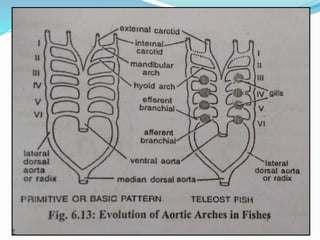
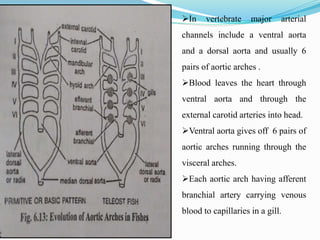
In vertebrate major arterial
channels include a ventral aorta
and a dorsal aorta and usually 6
pairs of aortic arches .
Blood leaves the heart through
ventral aorta and through the
external carotid arteries into head.
Ventral aorta gives off 6 pairs of
aortic arches running through the
visceral arches.
Each aortic arch having afferent
branchial artery carrying venous
blood to capillaries in a gill.
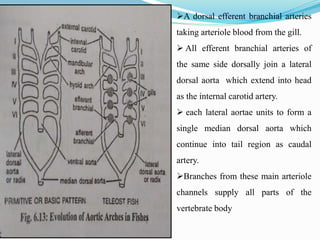
A dorsal efferent branchial arteries
taking arteriole blood from the gill.
 All efferent branchial arteries of
the same side dorsally join a lateral
dorsal aorta which extend into head
as the internal carotid artery.
 each lateral aortae units to form a
single median dorsal aorta which
continue into tail region as caudal
artery.
Branches from these main arteriole
channels supply all parts of the
vertebrate body
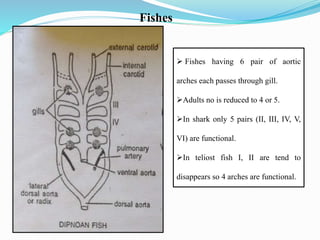
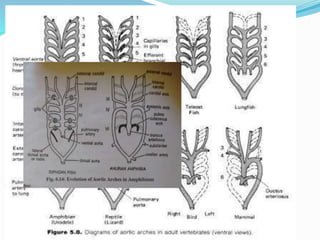
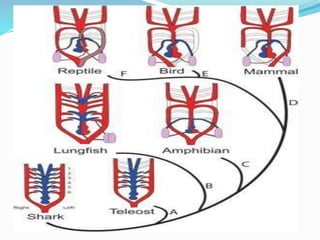
 Fishes having 6 pair of aortic
arches each passes through gill.
Adults no is reduced to 4 or 5.
In shark only 5 pairs (II, III, IV, V,
VI) are functional.
In teliost fish I, II are tend to
disappears so 4 arches are functional.
Fishes
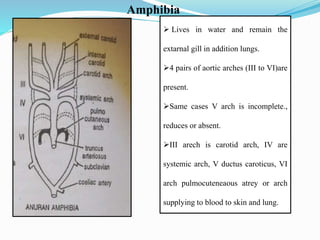
 Lives in water and remain the
extarnal gill in addition lungs.
4 pairs of aortic arches (III to VI)are
present.
Same cases V arch is incomplete.,
reduces or absent.
III arech is carotid arch, IV are
systemic arch, V ductus caroticus, VI
arch pulmocuteneaous atrey or arch
supplying to blood to skin and lung.
Amphibia
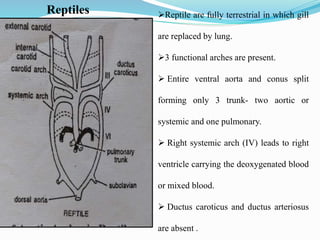
Reptiles Reptile are fully terrestrial in which gill
are replaced by lung.
3 functional arches are present.
 Entire ventral aorta and conus split
forming only 3 trunk- two aortic or
systemic and one pulmonary.
 Right systemic arch (IV) leads to right
ventricle carrying the deoxygenated blood
or mixed blood.
 Ductus caroticus and ductus arteriosus
are absent .
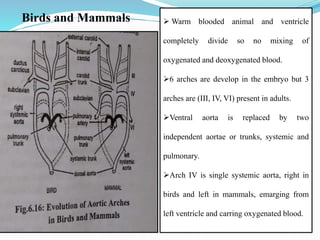
 Warm blooded animal and ventricle
completely divide so no mixing of
oxygenated and deoxygenated blood.
6 arches are develop in the embryo but 3
arches are (III, IV, VI) present in adults.
Ventral aorta is replaced by two
independent aortae or trunks, systemic and
pulmonary.
Arch IV is single systemic aorta, right in
birds and left in mammals, emarging from
left ventricle and carring oxygenated blood.
Birds and Mammals
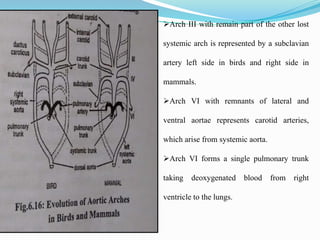
Arch III with remain part of the other lost
systemic arch is represented by a subclavian
artery left side in birds and right side in
mammals.
Arch VI with remnants of lateral and
ventral aortae represents carotid arteries,
which arise from systemic aorta.
Arch VI forms a single pulmonary trunk
taking deoxygenated blood from right
ventricle to the lungs.
Aortic arches in vertebrates

Aortic arches in vertebrates

  • 3.
    In vertebrate majorarterial channels include a ventral aorta and a dorsal aorta and usually 6 pairs of aortic arches . Blood leaves the heart through ventral aorta and through the external carotid arteries into head. Ventral aorta gives off 6 pairs of aortic arches running through the visceral arches. Each aortic arch having afferent branchial artery carrying venous blood to capillaries in a gill.
  • 4.
    A dorsal efferentbranchial arteries taking arteriole blood from the gill.  All efferent branchial arteries of the same side dorsally join a lateral dorsal aorta which extend into head as the internal carotid artery.  each lateral aortae units to form a single median dorsal aorta which continue into tail region as caudal artery. Branches from these main arteriole channels supply all parts of the vertebrate body
  • 5.
     Fishes having6 pair of aortic arches each passes through gill. Adults no is reduced to 4 or 5. In shark only 5 pairs (II, III, IV, V, VI) are functional. In teliost fish I, II are tend to disappears so 4 arches are functional. Fishes
  • 6.
     Lives inwater and remain the extarnal gill in addition lungs. 4 pairs of aortic arches (III to VI)are present. Same cases V arch is incomplete., reduces or absent. III arech is carotid arch, IV are systemic arch, V ductus caroticus, VI arch pulmocuteneaous atrey or arch supplying to blood to skin and lung. Amphibia
  • 7.
    Reptiles Reptile arefully terrestrial in which gill are replaced by lung. 3 functional arches are present.  Entire ventral aorta and conus split forming only 3 trunk- two aortic or systemic and one pulmonary.  Right systemic arch (IV) leads to right ventricle carrying the deoxygenated blood or mixed blood.  Ductus caroticus and ductus arteriosus are absent .
  • 8.
     Warm bloodedanimal and ventricle completely divide so no mixing of oxygenated and deoxygenated blood. 6 arches are develop in the embryo but 3 arches are (III, IV, VI) present in adults. Ventral aorta is replaced by two independent aortae or trunks, systemic and pulmonary. Arch IV is single systemic aorta, right in birds and left in mammals, emarging from left ventricle and carring oxygenated blood. Birds and Mammals
  • 9.
    Arch III withremain part of the other lost systemic arch is represented by a subclavian artery left side in birds and right side in mammals. Arch VI with remnants of lateral and ventral aortae represents carotid arteries, which arise from systemic aorta. Arch VI forms a single pulmonary trunk taking deoxygenated blood from right ventricle to the lungs.