Lecture on
Antigen
Deliverd by
Dr. Dinesh Dabhadkar
Department of Zoology, GSG, College, Umarkhed
Antigens
 Most are proteins or large polysaccharides from a foreign organism.
 Microbes: Capsules, cell walls, toxins, viral capsids, flagella, etc.
 Nonmicrobes: Pollen, egg white , red blood cell surface molecules, serum
proteins, and surface molecules from transplanted tissue.
 Lipids and nucleic acids are only antigenic when combined with proteins or
polysaccharides.
 Molecular weight of 10,000 or higher.
 Hapten: Small foreign molecule that is not antigenic. Must be coupled to a
carrier molecule to be antigenic. Once antibodies are formed they will
recognize hapten.
Properties of Antigen:
1) Chemical Composition & Heterogenicity
2) Molecular Weight
3) Foreignness
4) Ability Antigen Processing
5) Complexity
Types of Antigen:
1) Exogeneous
2) Endogenous
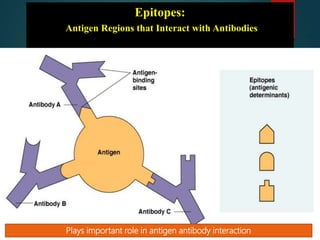
Epitopes:
Antigen Regions that Interact with Antibodies
Plays important role in antigen antibody interaction
Antigens
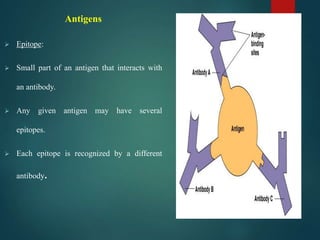
 Epitope:
 Small part of an antigen that interacts with
an antibody.
 Any given antigen may have several
epitopes.
 Each epitope is recognized by a different
antibody.

Antigen

  • 1.
    Lecture on Antigen Deliverd by Dr.Dinesh Dabhadkar Department of Zoology, GSG, College, Umarkhed
  • 2.
    Antigens  Most areproteins or large polysaccharides from a foreign organism.  Microbes: Capsules, cell walls, toxins, viral capsids, flagella, etc.  Nonmicrobes: Pollen, egg white , red blood cell surface molecules, serum proteins, and surface molecules from transplanted tissue.  Lipids and nucleic acids are only antigenic when combined with proteins or polysaccharides.  Molecular weight of 10,000 or higher.  Hapten: Small foreign molecule that is not antigenic. Must be coupled to a carrier molecule to be antigenic. Once antibodies are formed they will recognize hapten.
  • 3.
    Properties of Antigen: 1)Chemical Composition & Heterogenicity 2) Molecular Weight 3) Foreignness 4) Ability Antigen Processing 5) Complexity
  • 4.
    Types of Antigen: 1)Exogeneous 2) Endogenous
  • 5.
    Epitopes: Antigen Regions thatInteract with Antibodies Plays important role in antigen antibody interaction
  • 6.
    Antigens  Epitope:  Smallpart of an antigen that interacts with an antibody.  Any given antigen may have several epitopes.  Each epitope is recognized by a different antibody.