Dr PRASHEETAV PRAVIRAJ
FINALYEAR
DEPARTMENTOF PHARMACOLOGY
1
 Introduction
 Chemistry of NO
 Synthesis of NO
 NOS enzymes
 Pharmacokinetics of NO
 Mechanism of action
 Role of NO on various organ systems
 NO therapeutics
 Conclusion
 References
2
 Fig 1 : Polygraph reading ( tension under isometric
contraction)- rabbit aorta strip precontracted with
noradrenaline ( Courtesy : Rang & Dale)
3
 Until 1980 : NO as an air pollutant.
 1980: EDRF
 1992 :Molecule of the year
 1998 : Nobel prize in Physiology/Medicine
Robert F Furchgott
Louis J Ignarro
Ferid Murad
4
 Small diatomic molecule
 It has unpaired electron in its valence shell
 Highly reactive – looses the extra e- or gaining the
missing e-.
 Paracrine mediator : able to rapidly (lipid soluble)
and easily penetrate across cell membrane.
 Biological t1/2 = 1-100nmin
5
Other sources of nitrates :
1. Dietary nitrates : beetroot juice , dark chocolate,
pepper .
2. Nitric oxide donors
6
Fig 1 : Biosynthesis of NO
 Dimeric flavoproteins ~ CYP 450
 3 distinct domains :
- Reductase domain
- Calmodulin binding domain
- Oxygenase domain
 3 isoforms of NOS
- eNOS (endothelial)
- nNOS (neuronal)
- iNOS (inducible)
7
constitutional
Characteristics eNOS nNOS iNOS
Distribution Cardiac myocytes ,
platelets , osteoblasts ,
osteoclasts , renal
mesangial cells
,endothelial cells
Peripheral and
central neurons
Macrophages ,
fibroblasts , smooth
muscles , endothelial
cells and other
inflammatory cells
Activation Ca2+ -calmodulin
binding dependent
Same as eNOS Ca2+ -calmodulin
binding independent
Duration of
release
Short lasting Short lasting Long lasting
Concentration Picomoles Picomoles Nanomoles
Location Membrane bound Cytosolic Cytosolic
Stimuli Shear mechanical strain
, Histamine,
Acetylcholine ,5HT
Bradykinin ,ATP
Substance P
Same as eNOS Pathological stimuli
-Microorganisms,
endotoxins
- Cytokines
Inhibitors L-NAME
7-nitroindazole
Same as eNOS Glucocorticoids
TGF-β
8
 Absorbed : systemically after inhalation
 Distribution : low
 Metabolism : inactivated by haem , oxidation ,
superoxide dismutase
 Elimination : as nitrates in urine
: small amount is exhaled via lungs
 No known storage mechanism - nitrites
9
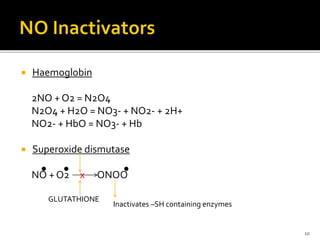
 Haemoglobin
2NO + O2 = N2O4
N2O4 + H2O = NO3- + NO2- + 2H+
NO2- + HbO = NO3- + Hb
 Superoxide dismutase
NO + O2 x ONOO
GLUTATHIONE
Inactivates –SH containing enzymes
10
11
Fig 2 : activation of guanylyl cyclase enzyme ( major mechanism)
Target Mechanism Effect
Heme protein Nitrosoheme Activates soluble GC
Metheme Inhibits hemoglobin and myoglobin
- SH proteins Nitrosothioproteins Activates t-PA : plasma nitroso albumin
Inhibit dehydrogenases
Fe-S protein Nitroso-iron sulfur
proteins
•Inhibit NADH : Ubiquinone
oxidoreductase
•NADH : succinate oxidoreductase
•Cis – aconitase
•Ferritin
•Ribonucleotide reductase
Fe 2+ & free thiols Dinitrosyl Fe(II)
complexes
Depletion of iron in cells
Acts as a transport form of NO
Free amine Nitrosamine Tumorigen
DNA Deamination of DNA
DNA binding protein
Mutagen
Induction/Suppression of expression
(Carcinogen)
12
NAD dehydrogenase Auto ADP ribosylation Inhibits glyceraldehyde – 3-
phosphate dehydrogenase
O2 Nitrites , nitrates Inactivation of NO
O2
- Peroxynitrite ,hydroxyl Toxifications of NO
13
Fig 3 : Alternative pathway for vasodilatation (courtesy :
Golan )
 Cardiovascular system
 Inflammation &
Immunity
 Nervous system
 Respiratory system
 Gastrointestinal
system
 Musculoskeletal
system
 Reproductive system
 Mutagenesis
14
 Vasodilatation
 Antithrombotic
 Antiproliferative
 Anti-inflammatory
 Embryonic fetal heart development
 Gaseous exchange between Hb & tissue
 Pregnancy : generalised vasodilatation
Vascular integrity
Anti –
atherosclerotic
15
16
 Decreased levels of glutathione = increased levels of
peroxynitrite ions(ONOO)
 Pre-eclampsia
 Hypertension : mutant mice lacking NOS3
 Diabetes mellitus (endocrine disorder)
 Atherosclerosis
 Cardiovascular complications secondary to other
 CAD : Coronary artery diseases
 Sickle cell disorders : heme scavanges NO .
17
Pro-inflammatory cytokines Endotoxins
Increased inducible NOS expression
1000 fold increase in the NO levels
(monocytes , macrophages, neutrophils
& granulocytes)
NO diffuses into ECF Destroys the microbes without
prior phagocytosis
18
“Double edged sword”
 Physiological levels : anti-inflammatory
- kills invading pathogens ( antibacterial , antiviral , tumoricidal
,antifungal , antiprotozoal , apoptosis , antiparasitic )
- non specific immunity
 Pathological levels: pro-inflammatory
-bacterial sepsis
-transplant rejection
-inflammation
-autoimmune disorders
19
 Neurotransmitter/neuromodulator
-- it enhances the release of other neurotransmitters by
activating soluble guanylyl cyclase .
-- learning and memory (inc glutamate release - NMDA)
* NO as NT vs other NTs
-- not regulated by storage , release , degradation of NO
-- doesnot require receptors
-- Ca2+ requires for NO synthesis
-- synthesized on demand
* PNS : NANC neurotransmitter
20
 Increases cerebral blood flow
 Nociception : decreases the pain threshold by sensitizing the
neurons
-- chronic pain : increased NO levels
 Over production of NO during inflammation
Activation of glial cells in brain Cytokines , fatty acid
metabolites , free
radicals
Neurodegeneration Excitotoxicity
21
 Retrograde messenger
- acting via mGlu receptors
it blocks caspase 3 – PCD inhibited
 Recently hypothesis ,
- receptors for NO is present
intracellularly in presynaptic
neuron .
 Stroke
 AIDS dementia
 Huntington disease
 Parkinsons disease
22
Fig 4 : Retrograde messenger
Courtesy:textbook on glutamate
receptors (Pelkey & Mcbain) Pg 182
 NOS2 is present in alveolar epithelial cells and smooth
muscles
 Vasodilatation of bronchial vessels
 Bronchodilatation
 Lung inflammatory disorders : increased NO dependent
oxidative stress indices
 Asthmatic patients : NO levels high in expired breath
 IND : NO containing steroid moeity
23
 Pulmonary vasodilatation
-- useful in pulmonary hypertension
-- children & adult respiratory distress syndrome
-- current modality Noenatal ARDS : ECMO
-- when inhaled it has minimal systemic effects.
 Clinical trial
-- Cystic fibrosis and NO donor drugs
24
 ENS : NO is NANC (Non adrenergic Non cholinergic )
neurotransmitter
 NOS 1 enzyme concentrated in pyloric region of stomach
--Hastens gastric emptying
--Infants with hypertrophic pyloric stenosis lack NOS1 in the
stomach.
 Effect on GI secretion
-- NO increases mucus and epithelial cell fluid
--thus improves host defences against microbes, toxins and
irritants
25
 Effect on Mucosal blood flow
-- NO potent vasodilator
-- buffering of acid
-- dilution of toxins
-- stimulates angiogenesis
 Inflammatory bowel diseases
--Crohn’s disease
--Ulcerative colitis
-- Rx : cortocosteroids has shown decreased urinary nitrates
Protective influence over
gastric mucosa
26
 Physiological levels :
-- inhibit bone resorption by osteoclasts
-- acute protective effect in cartilage breakdown
 Pathological amounts
--increase bone resorption
-- bone proliferation decreased
-- induces chondrocyte apoptosis
 Location of NOS : synoviocytes , osteoblasts, chondrocytes,
synovial membrane , fibroblasts
27
 Rheumatoid arthritis , osteoarthritis , ankylosing spondylitis
 Increased serum concentration of nitrates
 Increased urinary concentration of nitrates , cGMP.
 Index of NO-dependent oxidative damage : Nitrotyrosine
 ---- peroxynitrite of tyrosine
28
 Vasodilatation of blood vessels in corpus cavernosum
 Helps in development and maintainence of penile erection.
29
Fig 5 : Action of PDE 5 inhibitors ( Courtesy : Furchgott.at. al
1984)
 Mutagen , tumorigen , carcinogen
 The nitric oxide binds to the free amines ,DNA , DNA binding
proteins
 Thus they induce or suppress the expression of a particular
gene
 Procarcinogen = carcinogen
 Inactivation of tumor suppressor gene (p53)
30
 Nitric oxide gas
 Nitric oxide donors
 Nitric oxide inhibitors
 Nitric oxide potentiators
31
 Persistent pulmonary hypertension (newborns)
 Adult & Neonatal respiratory distress
-- dilates the blood vessels in ventilated alveoli
-- should not be associated with sepsis
-- injected into the inspiratory circuit of ventilator
-- NO is stored in aluminium / stainless cylinder in N2
(100/1000/2000ppm)
-- 5-300ppm : safe in humans
-- monitoring : chemiluminescence
electrochemical analyser
-- high conc. : acute pulmonary edema and methaemoglobinaemia
32
Anti-anginal drugs : amyl nitrite , glyceryl nitrate ,isosorbide
dinitrate , isosorbide mononitrate , erythrityl tetranitrate ,
pentaerythritol tetranitrate.
 Lauder Brunton – 1867
 Nitrates are converted into NO by an enzymatic reaction
involving tissue –SH groups.
 Subsequently NO activates soluble guanylyl cyclase.
33
 Nitrovasodilators
- Sodium nitroprusside , Nicorandil ,hydralazine
 β adrenergic blockers
- Nebivolol , Celiprolol
 Experimental tools
- SNAP : S-nitro-acetylpenillcillamine
-SNOG : S - nitrosoglutathione
- NOC-18 : long acting
34
 COX inhibitory NO donors
 Addition of an NO releasing moiety
 +/= analgesic & anti-inflammatory
 Protective effect on gastric mucosa (NO)
 NO-Aspirin (NCX4016)
 Its more potent in inhibiting platelet activation induced by
thrombin
 + antiproliferative , antiapoptic action
 Cancer treatment trials – colon cancer
 NO-Statins
NO Pravastatin ,NO fluvastatin
 NO- ACE inhibitors
35
 PhosphodiesteraseV inhibitors
-Sildenafil ,Tadalfil , vardenafil
- pulmonary hypertension , erectile dysfunction.
 Antioxidants
 Statins – restore endothelial function (pleotropic effect)
36
 NMMA : N-Mono Methyl Arginine
 ADMA : Asymetric DiMethyl l- Arginine
 L-NAME : N-Nitro-L-Arginine Methyl Ester
 Arginine analogues compete with arginine for NOS
 Experimental tools
 ADMA : endogenously present in plasma
--hypercholestrolaemia , haemodialysis patients ; increased
levels
-- plasma conc α vascular mortality
 Other inhibitors : trials have failed to produce favourable
results
37
 Nonspecific NO inhibitors
 Glucocorticoids : inhibit the expression of inducible NOS
 Cyclosporin : same as above – decreases IL1 production
 Salicylates : scavengers of NO
38
 Psychiatric diseases and NOS1
Psychiatric disorder related to implusive behaviour and
impaired prefrontal brain functioning .
Jail inmates and nitric oxide study
No drugs so far .
39
 Nitric oxide was promoted from the status of an air
pollutant to “molecule of the year” .
 NO was followed by discovery CO ,H2S as a signaling
molecules in CVS and CNS.
 NO as a central neurotransmitter is not yet targeted
even though its role is quite well understood.
 Emergence of new branch “gasotransmitters”(2002)
40
 https://www.nobelprize.org/nobel_prizes/medicine/laurea
tes/1998(1)
 Schmidt, Harald H. H.W. Et al,The nitric oxide and cGMP
signal transduction system: regulation and mechanism of
action , Biochimica et Biophysica Acta (BBA) - Molecular
Cell Research , vol 1178, 153-175.
 Rang H.P et al , Nitric oxide and related mediators, Rang &
Dales Pharmacology;8th edition; Chapter20; Pg 237-244
 David.E.Golan; Nitric oxide; Principles of Pharmacology ;
edition 4;chapter 21;pg356-357
41
 Samie R Jaffrey ; Nitric oxide ;; Basic & Clinical Pharmacology
(13th edition) ; chapter 19 ;Pg 329-334
 Sharma J.N.et.al. ; Role of nitric oxide in infl ---ammatory
diseases; Inflammopharmacology 15 (2007) 252–259
42
43

Nitric oxide

  • 1.
  • 2.
     Introduction  Chemistryof NO  Synthesis of NO  NOS enzymes  Pharmacokinetics of NO  Mechanism of action  Role of NO on various organ systems  NO therapeutics  Conclusion  References 2
  • 3.
     Fig 1: Polygraph reading ( tension under isometric contraction)- rabbit aorta strip precontracted with noradrenaline ( Courtesy : Rang & Dale) 3
  • 4.
     Until 1980: NO as an air pollutant.  1980: EDRF  1992 :Molecule of the year  1998 : Nobel prize in Physiology/Medicine Robert F Furchgott Louis J Ignarro Ferid Murad 4
  • 5.
     Small diatomicmolecule  It has unpaired electron in its valence shell  Highly reactive – looses the extra e- or gaining the missing e-.  Paracrine mediator : able to rapidly (lipid soluble) and easily penetrate across cell membrane.  Biological t1/2 = 1-100nmin 5
  • 6.
    Other sources ofnitrates : 1. Dietary nitrates : beetroot juice , dark chocolate, pepper . 2. Nitric oxide donors 6 Fig 1 : Biosynthesis of NO
  • 7.
     Dimeric flavoproteins~ CYP 450  3 distinct domains : - Reductase domain - Calmodulin binding domain - Oxygenase domain  3 isoforms of NOS - eNOS (endothelial) - nNOS (neuronal) - iNOS (inducible) 7 constitutional
  • 8.
    Characteristics eNOS nNOSiNOS Distribution Cardiac myocytes , platelets , osteoblasts , osteoclasts , renal mesangial cells ,endothelial cells Peripheral and central neurons Macrophages , fibroblasts , smooth muscles , endothelial cells and other inflammatory cells Activation Ca2+ -calmodulin binding dependent Same as eNOS Ca2+ -calmodulin binding independent Duration of release Short lasting Short lasting Long lasting Concentration Picomoles Picomoles Nanomoles Location Membrane bound Cytosolic Cytosolic Stimuli Shear mechanical strain , Histamine, Acetylcholine ,5HT Bradykinin ,ATP Substance P Same as eNOS Pathological stimuli -Microorganisms, endotoxins - Cytokines Inhibitors L-NAME 7-nitroindazole Same as eNOS Glucocorticoids TGF-β 8
  • 9.
     Absorbed :systemically after inhalation  Distribution : low  Metabolism : inactivated by haem , oxidation , superoxide dismutase  Elimination : as nitrates in urine : small amount is exhaled via lungs  No known storage mechanism - nitrites 9
  • 10.
     Haemoglobin 2NO +O2 = N2O4 N2O4 + H2O = NO3- + NO2- + 2H+ NO2- + HbO = NO3- + Hb  Superoxide dismutase NO + O2 x ONOO GLUTATHIONE Inactivates –SH containing enzymes 10
  • 11.
    11 Fig 2 :activation of guanylyl cyclase enzyme ( major mechanism)
  • 12.
    Target Mechanism Effect Hemeprotein Nitrosoheme Activates soluble GC Metheme Inhibits hemoglobin and myoglobin - SH proteins Nitrosothioproteins Activates t-PA : plasma nitroso albumin Inhibit dehydrogenases Fe-S protein Nitroso-iron sulfur proteins •Inhibit NADH : Ubiquinone oxidoreductase •NADH : succinate oxidoreductase •Cis – aconitase •Ferritin •Ribonucleotide reductase Fe 2+ & free thiols Dinitrosyl Fe(II) complexes Depletion of iron in cells Acts as a transport form of NO Free amine Nitrosamine Tumorigen DNA Deamination of DNA DNA binding protein Mutagen Induction/Suppression of expression (Carcinogen) 12
  • 13.
    NAD dehydrogenase AutoADP ribosylation Inhibits glyceraldehyde – 3- phosphate dehydrogenase O2 Nitrites , nitrates Inactivation of NO O2 - Peroxynitrite ,hydroxyl Toxifications of NO 13 Fig 3 : Alternative pathway for vasodilatation (courtesy : Golan )
  • 14.
     Cardiovascular system Inflammation & Immunity  Nervous system  Respiratory system  Gastrointestinal system  Musculoskeletal system  Reproductive system  Mutagenesis 14
  • 15.
     Vasodilatation  Antithrombotic Antiproliferative  Anti-inflammatory  Embryonic fetal heart development  Gaseous exchange between Hb & tissue  Pregnancy : generalised vasodilatation Vascular integrity Anti – atherosclerotic 15
  • 16.
  • 17.
     Decreased levelsof glutathione = increased levels of peroxynitrite ions(ONOO)  Pre-eclampsia  Hypertension : mutant mice lacking NOS3  Diabetes mellitus (endocrine disorder)  Atherosclerosis  Cardiovascular complications secondary to other  CAD : Coronary artery diseases  Sickle cell disorders : heme scavanges NO . 17
  • 18.
    Pro-inflammatory cytokines Endotoxins Increasedinducible NOS expression 1000 fold increase in the NO levels (monocytes , macrophages, neutrophils & granulocytes) NO diffuses into ECF Destroys the microbes without prior phagocytosis 18
  • 19.
    “Double edged sword” Physiological levels : anti-inflammatory - kills invading pathogens ( antibacterial , antiviral , tumoricidal ,antifungal , antiprotozoal , apoptosis , antiparasitic ) - non specific immunity  Pathological levels: pro-inflammatory -bacterial sepsis -transplant rejection -inflammation -autoimmune disorders 19
  • 20.
     Neurotransmitter/neuromodulator -- itenhances the release of other neurotransmitters by activating soluble guanylyl cyclase . -- learning and memory (inc glutamate release - NMDA) * NO as NT vs other NTs -- not regulated by storage , release , degradation of NO -- doesnot require receptors -- Ca2+ requires for NO synthesis -- synthesized on demand * PNS : NANC neurotransmitter 20
  • 21.
     Increases cerebralblood flow  Nociception : decreases the pain threshold by sensitizing the neurons -- chronic pain : increased NO levels  Over production of NO during inflammation Activation of glial cells in brain Cytokines , fatty acid metabolites , free radicals Neurodegeneration Excitotoxicity 21
  • 22.
     Retrograde messenger -acting via mGlu receptors it blocks caspase 3 – PCD inhibited  Recently hypothesis , - receptors for NO is present intracellularly in presynaptic neuron .  Stroke  AIDS dementia  Huntington disease  Parkinsons disease 22 Fig 4 : Retrograde messenger Courtesy:textbook on glutamate receptors (Pelkey & Mcbain) Pg 182
  • 23.
     NOS2 ispresent in alveolar epithelial cells and smooth muscles  Vasodilatation of bronchial vessels  Bronchodilatation  Lung inflammatory disorders : increased NO dependent oxidative stress indices  Asthmatic patients : NO levels high in expired breath  IND : NO containing steroid moeity 23
  • 24.
     Pulmonary vasodilatation --useful in pulmonary hypertension -- children & adult respiratory distress syndrome -- current modality Noenatal ARDS : ECMO -- when inhaled it has minimal systemic effects.  Clinical trial -- Cystic fibrosis and NO donor drugs 24
  • 25.
     ENS :NO is NANC (Non adrenergic Non cholinergic ) neurotransmitter  NOS 1 enzyme concentrated in pyloric region of stomach --Hastens gastric emptying --Infants with hypertrophic pyloric stenosis lack NOS1 in the stomach.  Effect on GI secretion -- NO increases mucus and epithelial cell fluid --thus improves host defences against microbes, toxins and irritants 25
  • 26.
     Effect onMucosal blood flow -- NO potent vasodilator -- buffering of acid -- dilution of toxins -- stimulates angiogenesis  Inflammatory bowel diseases --Crohn’s disease --Ulcerative colitis -- Rx : cortocosteroids has shown decreased urinary nitrates Protective influence over gastric mucosa 26
  • 27.
     Physiological levels: -- inhibit bone resorption by osteoclasts -- acute protective effect in cartilage breakdown  Pathological amounts --increase bone resorption -- bone proliferation decreased -- induces chondrocyte apoptosis  Location of NOS : synoviocytes , osteoblasts, chondrocytes, synovial membrane , fibroblasts 27
  • 28.
     Rheumatoid arthritis, osteoarthritis , ankylosing spondylitis  Increased serum concentration of nitrates  Increased urinary concentration of nitrates , cGMP.  Index of NO-dependent oxidative damage : Nitrotyrosine  ---- peroxynitrite of tyrosine 28
  • 29.
     Vasodilatation ofblood vessels in corpus cavernosum  Helps in development and maintainence of penile erection. 29 Fig 5 : Action of PDE 5 inhibitors ( Courtesy : Furchgott.at. al 1984)
  • 30.
     Mutagen ,tumorigen , carcinogen  The nitric oxide binds to the free amines ,DNA , DNA binding proteins  Thus they induce or suppress the expression of a particular gene  Procarcinogen = carcinogen  Inactivation of tumor suppressor gene (p53) 30
  • 31.
     Nitric oxidegas  Nitric oxide donors  Nitric oxide inhibitors  Nitric oxide potentiators 31
  • 32.
     Persistent pulmonaryhypertension (newborns)  Adult & Neonatal respiratory distress -- dilates the blood vessels in ventilated alveoli -- should not be associated with sepsis -- injected into the inspiratory circuit of ventilator -- NO is stored in aluminium / stainless cylinder in N2 (100/1000/2000ppm) -- 5-300ppm : safe in humans -- monitoring : chemiluminescence electrochemical analyser -- high conc. : acute pulmonary edema and methaemoglobinaemia 32
  • 33.
    Anti-anginal drugs :amyl nitrite , glyceryl nitrate ,isosorbide dinitrate , isosorbide mononitrate , erythrityl tetranitrate , pentaerythritol tetranitrate.  Lauder Brunton – 1867  Nitrates are converted into NO by an enzymatic reaction involving tissue –SH groups.  Subsequently NO activates soluble guanylyl cyclase. 33
  • 34.
     Nitrovasodilators - Sodiumnitroprusside , Nicorandil ,hydralazine  β adrenergic blockers - Nebivolol , Celiprolol  Experimental tools - SNAP : S-nitro-acetylpenillcillamine -SNOG : S - nitrosoglutathione - NOC-18 : long acting 34
  • 35.
     COX inhibitoryNO donors  Addition of an NO releasing moiety  +/= analgesic & anti-inflammatory  Protective effect on gastric mucosa (NO)  NO-Aspirin (NCX4016)  Its more potent in inhibiting platelet activation induced by thrombin  + antiproliferative , antiapoptic action  Cancer treatment trials – colon cancer  NO-Statins NO Pravastatin ,NO fluvastatin  NO- ACE inhibitors 35
  • 36.
     PhosphodiesteraseV inhibitors -Sildenafil,Tadalfil , vardenafil - pulmonary hypertension , erectile dysfunction.  Antioxidants  Statins – restore endothelial function (pleotropic effect) 36
  • 37.
     NMMA :N-Mono Methyl Arginine  ADMA : Asymetric DiMethyl l- Arginine  L-NAME : N-Nitro-L-Arginine Methyl Ester  Arginine analogues compete with arginine for NOS  Experimental tools  ADMA : endogenously present in plasma --hypercholestrolaemia , haemodialysis patients ; increased levels -- plasma conc α vascular mortality  Other inhibitors : trials have failed to produce favourable results 37
  • 38.
     Nonspecific NOinhibitors  Glucocorticoids : inhibit the expression of inducible NOS  Cyclosporin : same as above – decreases IL1 production  Salicylates : scavengers of NO 38
  • 39.
     Psychiatric diseasesand NOS1 Psychiatric disorder related to implusive behaviour and impaired prefrontal brain functioning . Jail inmates and nitric oxide study No drugs so far . 39
  • 40.
     Nitric oxidewas promoted from the status of an air pollutant to “molecule of the year” .  NO was followed by discovery CO ,H2S as a signaling molecules in CVS and CNS.  NO as a central neurotransmitter is not yet targeted even though its role is quite well understood.  Emergence of new branch “gasotransmitters”(2002) 40
  • 41.
     https://www.nobelprize.org/nobel_prizes/medicine/laurea tes/1998(1)  Schmidt,Harald H. H.W. Et al,The nitric oxide and cGMP signal transduction system: regulation and mechanism of action , Biochimica et Biophysica Acta (BBA) - Molecular Cell Research , vol 1178, 153-175.  Rang H.P et al , Nitric oxide and related mediators, Rang & Dales Pharmacology;8th edition; Chapter20; Pg 237-244  David.E.Golan; Nitric oxide; Principles of Pharmacology ; edition 4;chapter 21;pg356-357 41
  • 42.
     Samie RJaffrey ; Nitric oxide ;; Basic & Clinical Pharmacology (13th edition) ; chapter 19 ;Pg 329-334  Sharma J.N.et.al. ; Role of nitric oxide in infl ---ammatory diseases; Inflammopharmacology 15 (2007) 252–259 42
  • 43.