NEUROLOGICAL
         EXAMINATION

                   BY,
    MR. RAMPRASAD.S        M.SC NURSING
              ASST.PROFESSOR
           DEPT.MEDICAL SURGICAL
           NEUROSCIENCES NURSING
GOPALA GOWDA SHANTHAVERI MEMORIAL COLLEGE OF
              NURSING, MYSORE.
A MECHANIC DOES NOT NEED TO USE
EVERY TOOL ON EVERY PROJECT
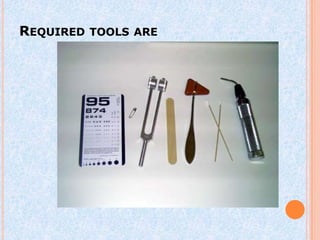
REQUIRED TOOLS ARE
STEPS

1.   A COMPREHENSIVE HISTORY

2.   A NEUROLOGICAL PHYSICAL

     EXAMINATION

3.   GENERAL AND SPECIFIC

     NEUROLOGICAL STUDIES
A PROPER NEUROLOGIC
EXAMINATION BEGINS WITH A
 CAREFUL CLINICAL HISTORY
http://www.cbu.edu/~mcondren/IRM/Stop-Look-Listen-sign-IRM-7-7-07.jpg
A COMPREHENSIVE HISTORY


1. DEMOGRAPHICAL DATA
2. CURRENT HEALTH
     1. Chief complaints
     2. Symptom analysis
3. PAST HISTORY
     1.Childhood infectious diseases,
       immunization
     2. Major illness
     3. Growth and development
4.   FAMILY HEALTH HISTORY

5. PSYCHO SOCIAL HISTROY

6. REVIEW OF SYSTEMS
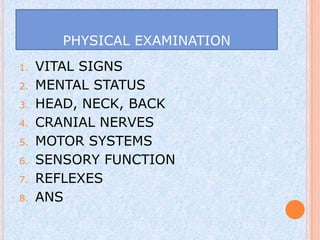
PHYSICAL EXAMINATION
1.   VITAL SIGNS
2.   MENTAL STATUS
3.   HEAD, NECK, BACK
4.   CRANIAL NERVES
5.   MOTOR SYSTEMS
6.   SENSORY FUNCTION
7.   REFLEXES
8.   ANS
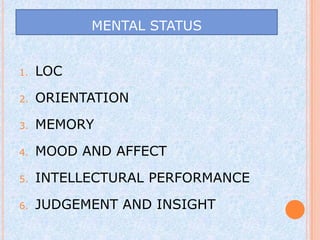
MENTAL STATUS


1.   LOC

2.   ORIENTATION

3.   MEMORY

4.   MOOD AND AFFECT

5.   INTELLECTURAL PERFORMANCE

6.   JUDGEMENT AND INSIGHT
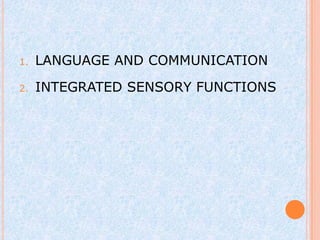
1.   LANGUAGE AND COMMUNICATION

2.   INTEGRATED SENSORY FUNCTIONS
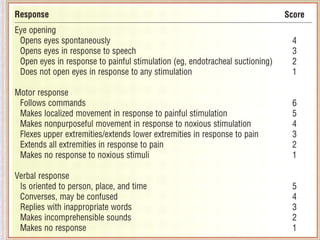
GLASGOW COMA SCALE
HEAD NECK AND BACK

1.   INSPECTION

2.   PALPATION

3.   PERCUSSION

4.   AUSCULTATION
CRANIAL NERVES FUNCTION TEST
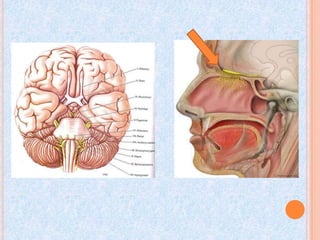
1. OLFACTION

  Test   by    asking   if patients   can
  smell,coffee,vanilla, or cinnamon in
  each nostril. Avoid noxious odors
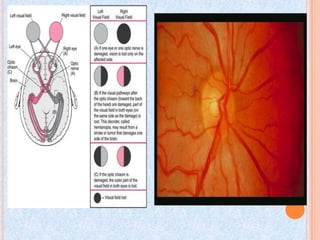
2. OPTIC

Visual   Acuity (test with hand card)

Visual   Fields (can be tested at the bedside by
counting fingers in each quadrant)
OCULOMOTOR NERVE

The size and shape of the pupil should be
recorded        at      rest.     Under   normal
conditions,      the      pupil    constricts   in
response to light. by having the patient
follow an object moved across their full
range      of        horizontal    and    vertical
eyemovements.
TRIGEMINAL NERVE

1. Cotton    fore head,cheeks,jaw
   Check for tactile sensation
2. Sharp and blunt edge of the tongue
   blade check for pain sensations
3. Hot and cold water test tubes check
   for temperature.
4. Eyes looks up cotton against
   temporal surface of the cornea
    blinking
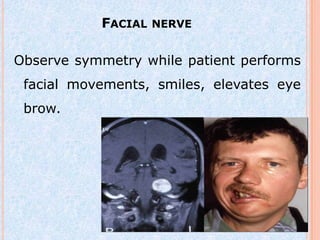
FACIAL NERVE

Observe symmetry while patient performs
 facial movements, smiles, elevates eye
 brow.
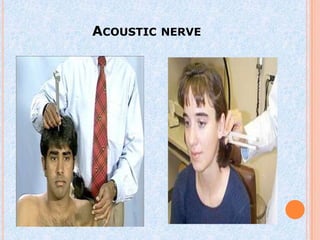
ACOUSTIC NERVE
GLASSO PHARYNGEAL NERVE

Ability to swallow and discriminate
between sugar and salt on posterior
third of the tongue.
VAGUS NERVE


Depress    the   tongue     blade   n
posterior tongue and stimulate the
posterior pharynx to elicit gag reflex
see hoarseness of the voice.
SPINAL ACCESSORY NERVE

Ask   the   patient   to   shrug   their
shoulders, turn their head in both
directions, and raise their head from
the bed, flexing forward against the
force of your hands.
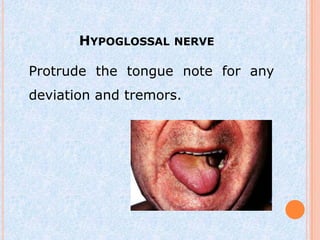
HYPOGLOSSAL NERVE

Protrude the tongue note for any
deviation and tremors.
EXAMINING THE MOTOR SYSTEM

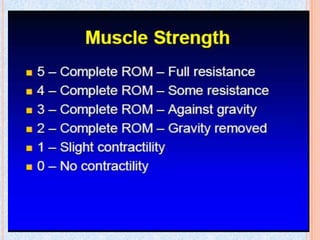
1. MUSCLE STRENGTH

2. BALANCE AND CO-ORDINATION

  A. POINT TO POINT TEST

  B. ROMBERG TEST

3. GAIT

4. ARM BOUNCE
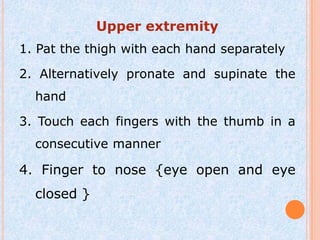
Upper extremity
1. Pat the thigh with each hand separately

2. Alternatively pronate and supinate the
  hand

3. Touch each fingers with the thumb in a
  consecutive manner

4. Finger to nose {eye open and eye
  closed }
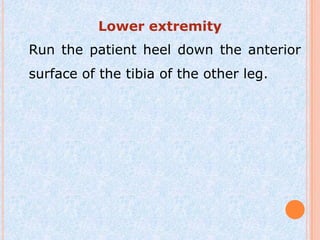
Lower extremity
Run the patient heel down the anterior
surface of the tibia of the other leg.
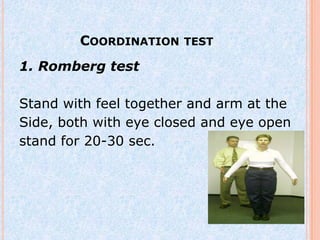
COORDINATION TEST
1. Romberg test

Stand with feel together and arm at the
Side, both with eye closed and eye open
stand for 20-30 sec.
EXAMING THE REFLEXES

1.   BICEPS REFLEX

2.   TRICEPS REFLEX

3.   BRACHIO RADIALIS REFLEX

4.   PATELLAR REFLEX

5.   ANKLE REFLEX

6.   CLONOUS

7.   SUPERFICIAL REFLEX
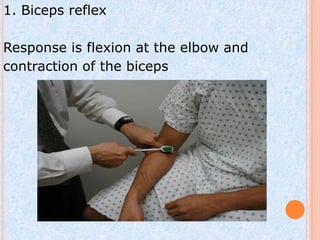
1. Biceps reflex

Response is flexion at the elbow and
contraction of the biceps
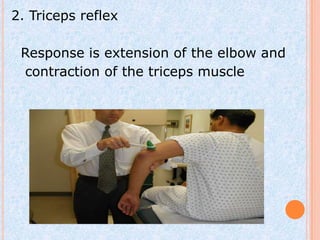
2. Triceps reflex

 Response is extension of the elbow and
 contraction of the triceps muscle
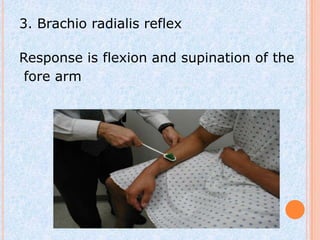
3. Brachio radialis reflex

Response is flexion and supination of the
 fore arm
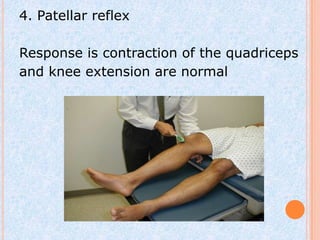
4. Patellar reflex

Response is contraction of the quadriceps
and knee extension are normal
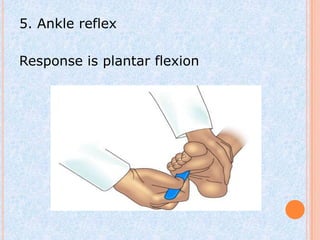
5. Ankle reflex

Response is plantar flexion
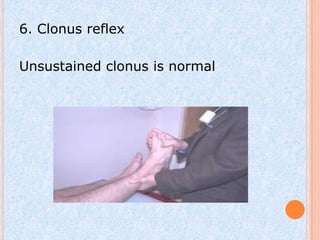
6. Clonus reflex

Unsustained clonus is normal
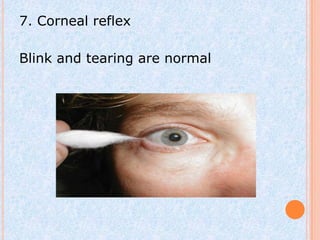
7. Corneal reflex

Blink and tearing are normal
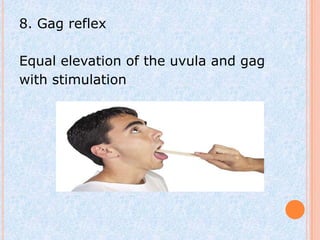
8. Gag reflex

Equal elevation of the uvula and gag
with stimulation
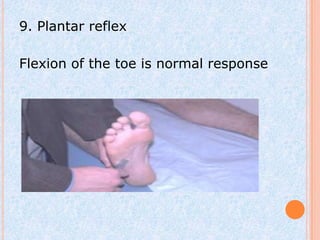
9. Plantar reflex

Flexion of the toe is normal response
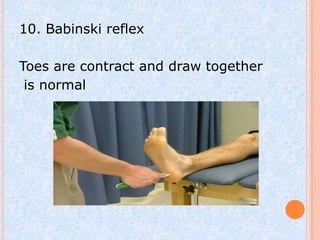
10. Babinski reflex

Toes are contract and draw together
 is normal
1. Tactile sensation
2. Pain sensation

3. Proprioception
Neurological examination

Neurological examination