Medical Surgical Nursing A Care of the Patient  With a Neurological Disorder
Anatomy and Physiology Central nervous system  (CNS) Brain Spinal cord Peripheral nervous system Somatic (voluntary) Autonomic (involuntary)
Anatomy and Physiology Neurons Transmitter cells Carry messages to and from brain and spinal cord Glial cells Support and protect neurons Produce cerebral spinal fluid
Anatomy and Physiology CNS: brain Cerebrum – lobe functions Diencephalon – thalamus, hypothalamus Cerebellum – balance, coordination Brain stem – midbrain, pons, medulla oblongata
Anatomy and Physiology PNS: Somatic (voluntary) 31 pairs of spinal nerves  12 pair of cranial nerves
Anatomy and Physiology PNS: Autonomic (involuntary) Controls: Smooth Muscles Cardiac Muscles Glands Check and balance system: Sympathetic nervous system Parasympathetic nervous system
Neurological Assessment History Headaches Loss of function Visual acuity Seizures Numbness Pain Personality change Mood swing Fatigue
Neuro Assessment Mental Status Orientation Mood and behavior General knowledge Short term memory Long term memory
Neuro Assessment Level of consciousness Glasgow Coma Scale  Eye opening Verbal response Motor response
Neuro Assessment Language and Speech Aphasia Sensory Expressive Global
Cranial Nerves I.  Olfactory II.  Optic III. Oculomotor IV. Trochlear V.  Trigeminal VI. Abducens  VII.  Facial VIII. Acoustic IX.  Glossopharyngeal X.  Vagus XI.  Spinal Accessory XII.  Hypoglossal
Neuro Assessment Motor Function Paralysis Paresis Flaccid Spastic
Neuro Assessment Sensory and Perceptual Status Pain Touch Temperature Proprioception Unilateral neglect Hemianopia
Neuro Assessment Blood and urine ABG Lumbar puncture Imaging EEG EMG Carotid Duplex
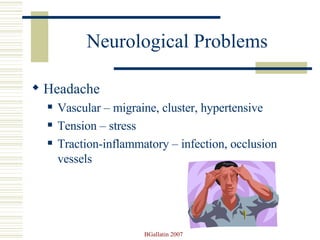
Neurological Problems Headache Vascular – migraine, cluster, hypertensive Tension – stress  Traction-inflammatory – infection, occlusion vessels
Neurological Problems Increased Intracranial Pressure (IIP) Occurs slowly or rapidly May lead to brain stem herniation and death
Assessment of IIP Subjective Diplopia Personality change Thought processes change Headache Nausea
Assessment of IIP Objective Decreasing LOC Hyperthermia Weakness Vomiting Seizures Papilledema Posturing Wide pulse pressure Bradycardia Altered respirations Pupils fixed & dilated
Assessment of IIP Diagnostic tests: CT scan, MRI Close observation Craig’s screw
Medical Management of IIP Craniotomy Craniectomy Tumor removal Drainage of ventricles Drainage of hematoma Intubation
Medical Management of IIP Medications Osmotic diuretics  - Mannitol Corticosteroids  - Decadron Anticonvulsants  - Dilantin Internal monitoring
Nursing Care of the Patient With IIP Elevate HOB  Neck in neutral position Avoid flexion hips, waist and neck Avoid  isometric activity or Valsalva Restrict fluids Foley Suctioning O2 Hypothermia blanket
Neurological Disorders- Seizures Seizures  Disorderly neuron discharges in brain Transitory Different types affect body differently Involuntary movement usually
Seizures Generalized: Tonic-clonic –  grand mal Absence - Petit mal Myoclonic Atonic or akinetic Localized: (Focal) Partial (Jacksonian) Psychomotor
Seizures Causes: Hypoglycemia Infection Electrolyte imbalance Trauma IIP Toxins
Seizure Medications Dilantin (Phenytoin) Phenobarbital Mysoline Tridione Valium (Diazepam) Depakene  Clonopin Mesantoin Neurontin Lamictal Felbatol Cerebyx
Seizure Medications Nursing: Medications Continue meds  Medic alert ID Avoid alcohol, avoid driving, get adequate rest If on Dilantin, instruct on oral hygiene
Seizures: Nursing Care Protect  Lower to the floor; pad side rails; pillow under head; don’t restrain No bite block or padded tongue blade Allow for post-ictal rest Prevent aspiration (airway) Turn side; loosen clothing around neck Document everything
Degenerative Neuro Diseases Multiple Sclerosis Parkinson’s Disease Alzheimer’s Disease Myasthenia Gravis Amyotrophic Lateral Sclerosis (ALS) Huntington’s Disease (chorea)
Multiple Sclerosis Common degenerative neurological disease. Myelin sheath is destroyed. Symptoms vary.  Relapsing/remitting.  Usually ages 20-40.
Multiple Sclerosis - Symptoms Subjective: Shakiness, difficulty walking Fatigue, muscle weakness Numbness, tingling Tinnitus Visual problems Difficulty chewing and speaking Incontinent; impotent
Multiple Sclerosis - Symptoms Objective: Ataxia Changes in behavior & emotions Nystagmus Spasticity, tremors, dysphagia, facial palsy, speech impaired, fatigue Incontinence Impaired judgment
Multiple Sclerosis - Tests CSF CT scan MRI
Multiple Sclerosis-Treatment Meds: Anti inflammatory ACTH, Solu Medrol, Prednisone Immuno Modifiers  Avonex, Betaseron, Capoxone Muscle Relaxants Valium
Multiple Sclerosis-Nursing Interventions Nutrition Skin Care Activity Control of environment Emotional support Patient teaching
Parkinson’s Disease Unknown cause Lack of dopamine. Parkinsonism:  encephalitis, toxic chemicals, meds, drugs
Parkinson’s Symptoms include: Muscular tremors and rigidity Emotional instability Judgment defects Heat intolerance Mask-like facial appearance Dysphagia and drooling
Parkinson’s Testing No specific test to diagnose Parkinson’s Diagnosis based on symptoms
Parkinson’s – Medical Treatment Medications  Sinemet, Symmetrol, Levodopa or Cogentin Less effective over time Surgery Experimental
Parkinson’s – Nursing Care Prevent injury (fall or aspiration) Prevent urinary retention and constipation Patient teaching about medication Patient and family support
Alzheimer’s Unknown cause, but genetic link Very common; risk increases with age Brain changes: plaques tangled neurons blood vessel degeneration chemical changes
Alzheimer’s - Symptoms 1st– memory lapses, difficult word finding,  decreased attention span 2nd – increased memory problems,    disoriented to time, loses things,    confabulates 3rd – total disorientation, apraxia, wanders 4th – severe impairment
Alzheimer’s - Testing No definitive test Family history  Diagnosis: autopsy
Alzheimer’s – Medical Management Medication to treat symptoms Memory:Cognex, Aricept Agitation: Mellaril, Haldol  Supplements Folic Acid & Vitamin B12 Low fat diet NSAIDS
Alzheimer’s – Nursing Care 2 key points for all care: Prevent overstimulation Provide structured, orderly environment Other concerns Communication Family support and education
Myasthenia Gravis Autoimmune disorder Myoneural junction problem Symptoms: ptosis, diplopia,  weakness, dysarthria, dysphagia, difficulty sitting up, respiratory distress
Myasthenia Gravis - Treatment Medication to improve impulse transmission (Mestinon) to suppress immune system (steroids, Cytoxan) Plasmapheresis Respiratory support Safety
Amyotrophic Lateral Sclerosis ALS – Lou Gehrig’s disease Motor neurons in brain stem and spinal cord degenerate Brain’s messages don’t reach the muscles Symptoms – weakness, dysarthria, dysphagia No loss of cognitive function No cure, death occurs in 2-6 years
Huntington’s Disease Chorea Genetic Onset at age 35-45  Excessive involuntary movements Death in 10-20 years No cure
Huntington’s Disease Nursing interventions are palliative Give meds Provide for safety Provide adequate diet Emotional support Genetic counseling
Cerebrovascular Accident (CVA) Ischemia of brain tissue Hemorrhage Thrombus  Embolus 3 rd  leading cause of death in the US All ages, but usually elderly
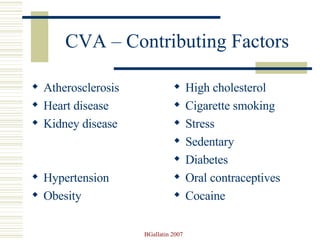
CVA – Contributing Factors Atherosclerosis Heart disease Kidney disease Hypertension Obesity High cholesterol Cigarette smoking Stress Sedentary Diabetes Oral contraceptives Cocaine
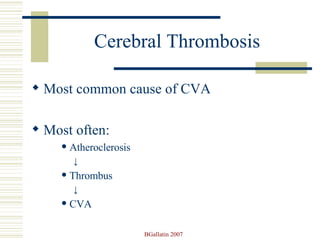
Cerebral Thrombosis Most common cause of CVA Most often: Atheroclerosis ↓ Thrombus  ↓ CVA
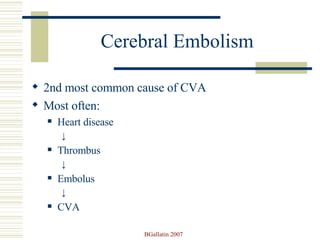
Cerebral Embolism 2nd most common cause of CVA Most often: Heart disease ↓ Thrombus ↓ Embolus ↓ CVA
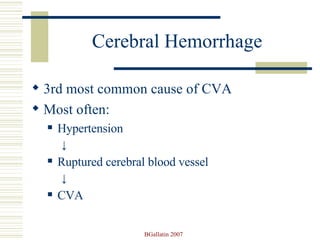
Cerebral Hemorrhage 3rd most common cause of CVA Most often: Hypertension ↓ Ruptured cerebral blood vessel ↓ CVA
Transient Ischemic Attack Cerebrovascular insufficiency Causes – same as CVA Warning sign of impending CVA
CVA - Assessment Motor changes Opposite side Balance, coordination, gait, proprioception Glasgow Coma Scale
CVA Assessment Sensory Changes Aphasia =can’t speak or write Agnosia =can’t recognize familiar objects/people Apraxia =can’t perform purposeful acts or use objects properly Neglect Syndrome Visual problems, including hemianopsia
CVA Assessment Cognitive changes denial impaired memory, judgment can’t concentrate disoriented slow and cautious  versus  impulsive depressed, anxious  versus  euphoric angers quickly  versus  constantly smiling
CVA - Testing CT or MRI Cerebral angiogram CBC, PT, PTT, electrolytes
CVA – Medical Management Thrombolytic (“clot buster”) Anticoagulants Antiplatelet drugs Aneurysm repair Carotid endarterectomy
CVA-Nursing Care Assess LOC IV, NG, Foley, Vent.  Nutrition Encourage perform ADLs Bladder and bowel training ROM Teaching and emotional support
Trigeminal Neuralgia Tic Douloureux Trigeminal nerve – degeneration, pressure Facial pain Medication, surgery Avoid triggers
Bell’s Palsy Facial nerve inflammation  Unilateral weakness of facial muscles Steroids, Zovirax, warm moist cloth, massage, facial exercises
Infection and Inflammation Meningitis Encephalitis Brain abscess Guillain-Barré Neurosyphilis Poliomyelitis Herpes zoster AIDS
Guillain-Barré - Polyneuritis Peripheral nerve disease Prior infection; autoimmune response Weakness and paralysis, begins in  extremities and works up Respiratory failure may occur
Meningitis Acute infection of the meninges Viral or bacterial Severe headache, irritable, fever, delirium, N/V, neck stiffness Kernig’s sign Brudzinski’s sign
Meningitis-Medical Management Diagnosed by LP Medications  Respiratory isolation Cool, dark quiet room Maintain hydration Prevent injury
Acquired Immunodeficiency Syndrome - AIDS AIDS dementia complex Infection of CNS Dementia  Treatment depends on infection  Treat symptoms, maintain safety
Spinal Cord Trauma Complete cord injury – all voluntary movement below level of trauma is lost Autonomic hyperreflexia  stimulus sympathetic nervous system response

Med Surg A Neuro Ppt

  • 1.
    Medical Surgical NursingA Care of the Patient With a Neurological Disorder
  • 2.
    Anatomy and PhysiologyCentral nervous system (CNS) Brain Spinal cord Peripheral nervous system Somatic (voluntary) Autonomic (involuntary)
  • 3.
    Anatomy and PhysiologyNeurons Transmitter cells Carry messages to and from brain and spinal cord Glial cells Support and protect neurons Produce cerebral spinal fluid
  • 4.
    Anatomy and PhysiologyCNS: brain Cerebrum – lobe functions Diencephalon – thalamus, hypothalamus Cerebellum – balance, coordination Brain stem – midbrain, pons, medulla oblongata
  • 5.
    Anatomy and PhysiologyPNS: Somatic (voluntary) 31 pairs of spinal nerves 12 pair of cranial nerves
  • 6.
    Anatomy and PhysiologyPNS: Autonomic (involuntary) Controls: Smooth Muscles Cardiac Muscles Glands Check and balance system: Sympathetic nervous system Parasympathetic nervous system
  • 7.
    Neurological Assessment HistoryHeadaches Loss of function Visual acuity Seizures Numbness Pain Personality change Mood swing Fatigue
  • 8.
    Neuro Assessment MentalStatus Orientation Mood and behavior General knowledge Short term memory Long term memory
  • 9.
    Neuro Assessment Levelof consciousness Glasgow Coma Scale Eye opening Verbal response Motor response
  • 10.
    Neuro Assessment Languageand Speech Aphasia Sensory Expressive Global
  • 11.
    Cranial Nerves I. Olfactory II. Optic III. Oculomotor IV. Trochlear V. Trigeminal VI. Abducens VII. Facial VIII. Acoustic IX. Glossopharyngeal X. Vagus XI. Spinal Accessory XII. Hypoglossal
  • 12.
    Neuro Assessment MotorFunction Paralysis Paresis Flaccid Spastic
  • 13.
    Neuro Assessment Sensoryand Perceptual Status Pain Touch Temperature Proprioception Unilateral neglect Hemianopia
  • 14.
    Neuro Assessment Bloodand urine ABG Lumbar puncture Imaging EEG EMG Carotid Duplex
  • 15.
    Neurological Problems HeadacheVascular – migraine, cluster, hypertensive Tension – stress Traction-inflammatory – infection, occlusion vessels
  • 16.
    Neurological Problems IncreasedIntracranial Pressure (IIP) Occurs slowly or rapidly May lead to brain stem herniation and death
  • 17.
    Assessment of IIPSubjective Diplopia Personality change Thought processes change Headache Nausea
  • 18.
    Assessment of IIPObjective Decreasing LOC Hyperthermia Weakness Vomiting Seizures Papilledema Posturing Wide pulse pressure Bradycardia Altered respirations Pupils fixed & dilated
  • 19.
    Assessment of IIPDiagnostic tests: CT scan, MRI Close observation Craig’s screw
  • 20.
    Medical Management ofIIP Craniotomy Craniectomy Tumor removal Drainage of ventricles Drainage of hematoma Intubation
  • 21.
    Medical Management ofIIP Medications Osmotic diuretics - Mannitol Corticosteroids - Decadron Anticonvulsants - Dilantin Internal monitoring
  • 22.
    Nursing Care ofthe Patient With IIP Elevate HOB Neck in neutral position Avoid flexion hips, waist and neck Avoid isometric activity or Valsalva Restrict fluids Foley Suctioning O2 Hypothermia blanket
  • 23.
    Neurological Disorders- SeizuresSeizures Disorderly neuron discharges in brain Transitory Different types affect body differently Involuntary movement usually
  • 24.
    Seizures Generalized: Tonic-clonic– grand mal Absence - Petit mal Myoclonic Atonic or akinetic Localized: (Focal) Partial (Jacksonian) Psychomotor
  • 25.
    Seizures Causes: HypoglycemiaInfection Electrolyte imbalance Trauma IIP Toxins
  • 26.
    Seizure Medications Dilantin(Phenytoin) Phenobarbital Mysoline Tridione Valium (Diazepam) Depakene Clonopin Mesantoin Neurontin Lamictal Felbatol Cerebyx
  • 27.
    Seizure Medications Nursing:Medications Continue meds Medic alert ID Avoid alcohol, avoid driving, get adequate rest If on Dilantin, instruct on oral hygiene
  • 28.
    Seizures: Nursing CareProtect Lower to the floor; pad side rails; pillow under head; don’t restrain No bite block or padded tongue blade Allow for post-ictal rest Prevent aspiration (airway) Turn side; loosen clothing around neck Document everything
  • 29.
    Degenerative Neuro DiseasesMultiple Sclerosis Parkinson’s Disease Alzheimer’s Disease Myasthenia Gravis Amyotrophic Lateral Sclerosis (ALS) Huntington’s Disease (chorea)
  • 30.
    Multiple Sclerosis Commondegenerative neurological disease. Myelin sheath is destroyed. Symptoms vary. Relapsing/remitting. Usually ages 20-40.
  • 31.
    Multiple Sclerosis -Symptoms Subjective: Shakiness, difficulty walking Fatigue, muscle weakness Numbness, tingling Tinnitus Visual problems Difficulty chewing and speaking Incontinent; impotent
  • 32.
    Multiple Sclerosis -Symptoms Objective: Ataxia Changes in behavior & emotions Nystagmus Spasticity, tremors, dysphagia, facial palsy, speech impaired, fatigue Incontinence Impaired judgment
  • 33.
    Multiple Sclerosis -Tests CSF CT scan MRI
  • 34.
    Multiple Sclerosis-Treatment Meds:Anti inflammatory ACTH, Solu Medrol, Prednisone Immuno Modifiers Avonex, Betaseron, Capoxone Muscle Relaxants Valium
  • 35.
    Multiple Sclerosis-Nursing InterventionsNutrition Skin Care Activity Control of environment Emotional support Patient teaching
  • 36.
    Parkinson’s Disease Unknowncause Lack of dopamine. Parkinsonism: encephalitis, toxic chemicals, meds, drugs
  • 37.
    Parkinson’s Symptoms include:Muscular tremors and rigidity Emotional instability Judgment defects Heat intolerance Mask-like facial appearance Dysphagia and drooling
  • 38.
    Parkinson’s Testing Nospecific test to diagnose Parkinson’s Diagnosis based on symptoms
  • 39.
    Parkinson’s – MedicalTreatment Medications Sinemet, Symmetrol, Levodopa or Cogentin Less effective over time Surgery Experimental
  • 40.
    Parkinson’s – NursingCare Prevent injury (fall or aspiration) Prevent urinary retention and constipation Patient teaching about medication Patient and family support
  • 41.
    Alzheimer’s Unknown cause,but genetic link Very common; risk increases with age Brain changes: plaques tangled neurons blood vessel degeneration chemical changes
  • 42.
    Alzheimer’s - Symptoms1st– memory lapses, difficult word finding, decreased attention span 2nd – increased memory problems, disoriented to time, loses things, confabulates 3rd – total disorientation, apraxia, wanders 4th – severe impairment
  • 43.
    Alzheimer’s - TestingNo definitive test Family history Diagnosis: autopsy
  • 44.
    Alzheimer’s – MedicalManagement Medication to treat symptoms Memory:Cognex, Aricept Agitation: Mellaril, Haldol Supplements Folic Acid & Vitamin B12 Low fat diet NSAIDS
  • 45.
    Alzheimer’s – NursingCare 2 key points for all care: Prevent overstimulation Provide structured, orderly environment Other concerns Communication Family support and education
  • 46.
    Myasthenia Gravis Autoimmunedisorder Myoneural junction problem Symptoms: ptosis, diplopia, weakness, dysarthria, dysphagia, difficulty sitting up, respiratory distress
  • 47.
    Myasthenia Gravis -Treatment Medication to improve impulse transmission (Mestinon) to suppress immune system (steroids, Cytoxan) Plasmapheresis Respiratory support Safety
  • 48.
    Amyotrophic Lateral SclerosisALS – Lou Gehrig’s disease Motor neurons in brain stem and spinal cord degenerate Brain’s messages don’t reach the muscles Symptoms – weakness, dysarthria, dysphagia No loss of cognitive function No cure, death occurs in 2-6 years
  • 49.
    Huntington’s Disease ChoreaGenetic Onset at age 35-45 Excessive involuntary movements Death in 10-20 years No cure
  • 50.
    Huntington’s Disease Nursinginterventions are palliative Give meds Provide for safety Provide adequate diet Emotional support Genetic counseling
  • 51.
    Cerebrovascular Accident (CVA)Ischemia of brain tissue Hemorrhage Thrombus Embolus 3 rd leading cause of death in the US All ages, but usually elderly
  • 52.
    CVA – ContributingFactors Atherosclerosis Heart disease Kidney disease Hypertension Obesity High cholesterol Cigarette smoking Stress Sedentary Diabetes Oral contraceptives Cocaine
  • 53.
    Cerebral Thrombosis Mostcommon cause of CVA Most often: Atheroclerosis ↓ Thrombus ↓ CVA
  • 54.
    Cerebral Embolism 2ndmost common cause of CVA Most often: Heart disease ↓ Thrombus ↓ Embolus ↓ CVA
  • 55.
    Cerebral Hemorrhage 3rdmost common cause of CVA Most often: Hypertension ↓ Ruptured cerebral blood vessel ↓ CVA
  • 56.
    Transient Ischemic AttackCerebrovascular insufficiency Causes – same as CVA Warning sign of impending CVA
  • 57.
    CVA - AssessmentMotor changes Opposite side Balance, coordination, gait, proprioception Glasgow Coma Scale
  • 58.
    CVA Assessment SensoryChanges Aphasia =can’t speak or write Agnosia =can’t recognize familiar objects/people Apraxia =can’t perform purposeful acts or use objects properly Neglect Syndrome Visual problems, including hemianopsia
  • 59.
    CVA Assessment Cognitivechanges denial impaired memory, judgment can’t concentrate disoriented slow and cautious versus impulsive depressed, anxious versus euphoric angers quickly versus constantly smiling
  • 60.
    CVA - TestingCT or MRI Cerebral angiogram CBC, PT, PTT, electrolytes
  • 61.
    CVA – MedicalManagement Thrombolytic (“clot buster”) Anticoagulants Antiplatelet drugs Aneurysm repair Carotid endarterectomy
  • 62.
    CVA-Nursing Care AssessLOC IV, NG, Foley, Vent. Nutrition Encourage perform ADLs Bladder and bowel training ROM Teaching and emotional support
  • 63.
    Trigeminal Neuralgia TicDouloureux Trigeminal nerve – degeneration, pressure Facial pain Medication, surgery Avoid triggers
  • 64.
    Bell’s Palsy Facialnerve inflammation Unilateral weakness of facial muscles Steroids, Zovirax, warm moist cloth, massage, facial exercises
  • 65.
    Infection and InflammationMeningitis Encephalitis Brain abscess Guillain-Barré Neurosyphilis Poliomyelitis Herpes zoster AIDS
  • 66.
    Guillain-Barré - PolyneuritisPeripheral nerve disease Prior infection; autoimmune response Weakness and paralysis, begins in extremities and works up Respiratory failure may occur
  • 67.
    Meningitis Acute infectionof the meninges Viral or bacterial Severe headache, irritable, fever, delirium, N/V, neck stiffness Kernig’s sign Brudzinski’s sign
  • 68.
    Meningitis-Medical Management Diagnosedby LP Medications Respiratory isolation Cool, dark quiet room Maintain hydration Prevent injury
  • 69.
    Acquired Immunodeficiency Syndrome- AIDS AIDS dementia complex Infection of CNS Dementia Treatment depends on infection Treat symptoms, maintain safety
  • 70.
    Spinal Cord TraumaComplete cord injury – all voluntary movement below level of trauma is lost Autonomic hyperreflexia stimulus sympathetic nervous system response