PRESENTED BY:
BANASHREE HAWAIBAM
FINAL YEAR M.SC NURSING
MEDICAL SURGICAL NURSING
B.V.C.O.N.PUNE-43
SPINAL CORD INJURY
Anatomy :
Spinal cord:
 Extends from medulla oblongata – L1
 Lower part tapered to form conus medullaris
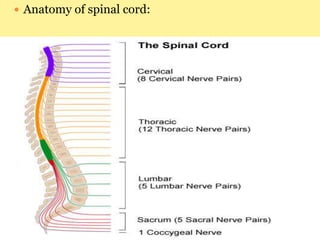
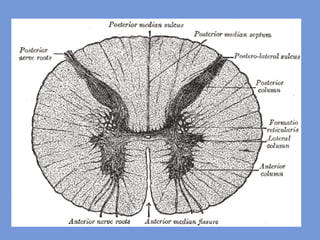
 Anatomy of spinal cord:
Anatomy :
On the surface :
 Deep anterior median fissure.
 Shallower posterior median sulcus.
Spinal cord segment :
 Section of the cord from which a pair of spinal
nerves are given off.
Anatomy :
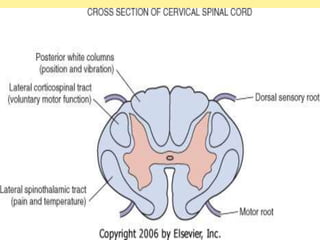
 Dorsal root – sensory fibres
 Ventral root – motor fibres
 Dorsal and ventral roots join at intervertebral
foramen to form the spinal nerve
Physiology and function
 Grey matter - sensory and motor nerve cells
 White matter - ascending and descending
tracts
 Divided into - dorsal
- lateral
- ventral
Dermatomes
 Area of skin innervated by sensory axons within a
particular segmental nerve root
 Knowledge is essential in determining level of injury
 Useful in assessing improvement or deterioration
Myotomes :
 Segmental nerve root innervating a muscle
 Again important in determining level of injury
 Upper limbs:
C5 - Deltoid
C 6 - Wrist extensors
C 7 - Elbow extensors
C 8 - Long finger flexors
T 1 - Small hand muscles
Myotomes contd.
 Lower Limbs :
L2 - Hip flexors
L3,4 - Knee extensors
L4,5 – S1 - Knee flexion
L5 - Ankle dorsiflexion
S1 - Ankle plantar flexion
SPINAL CORD INJURY
 DEFINITION:
 Spinal cord injury is damage to the spinal cord that
results in a loss of function such as mobility or
feeling.
 The cervical and lumbar vertebrae are the most
common sites of injury.
ETIOLOGY
1. Vehicular accidents (35%)
2.Violence (24%)
3.Falls (22%)
4.Sports injury (8%)
5.Gunshots.
RISK FACTORS
 Male sex
 Age between 18 to 25 years.
Classification
Complete
 absence of sensory & motor function in lowest
sacral segment after resolution of spinal shock
Incomplete
 presence of sensory & motor function in lowest
sacral segment (indicates preserved function below
the defined neurological level)
Types of incomplete injuries
i) Anterior Cord Syndrome
ii) Central Cord Syndrome
iii) Brown – Sequard Syndrome
iv) Herniated disc Syndrome
Classification
Incomplete SCI syndromes
 Herniated disc Syndrome:
 Displacement of the disc with the escape of cartilage.
Classification
Incomplete SCI syndromes
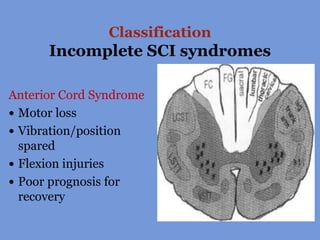
Anterior Cord Syndrome
 Motor loss
 Vibration/position
spared
 Flexion injuries
 Poor prognosis for
recovery
Classification
Incomplete SCI syndromes
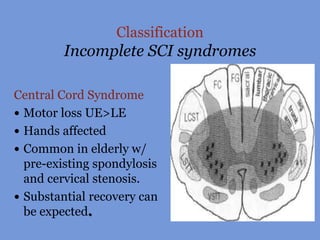
Central Cord Syndrome
 Motor loss UE>LE
 Hands affected
 Common in elderly w/
pre-existing spondylosis
and cervical stenosis.
 Substantial recovery can
be expected.
Classification
Incomplete SCI syndromes
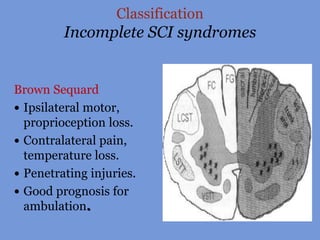
Brown Sequard
 Ipsilateral motor,
proprioception loss.
 Contralateral pain,
temperature loss.
 Penetrating injuries.
 Good prognosis for
ambulation.
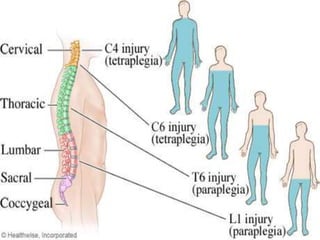
Types of Spinal Cord Paralysis
1.Monoplegia:paralysis of one limb
2.Diplegia:paralysis of both upper or lower limbs
3.Paraplegia:paralysis of both lower extremities
4.Hemiplegia:paralysis of upper limb,torso and
lower leg on one side of the body.
5.Quadriplegia:paralysis of all four limbs.
SIGNS AND SYMPTOMS:
1.Impaired breathing.
2.Extreme back pain or pressure in the neck,head or
back.
3.Weakness,incordination.
4.Numbness,tingling or loss of sensation.
5.Loss of bladder or bladder control.
6.Difficulty with balance and walking.
7.Sexual impairment.
8.Muscle spasm.
DIAGNOSTIC TESTS:
1.X-ray films
2.Spinal tap or myelography.
3.CT Scan
4.MRI
MANAGEMENT:
MEDICAL MANAGEMENT:
1.Adrenal corticosteriods.
2.Cervical collar,the head is immobilised.
3.Back is immobilised with back support.
4.Traction with weighs and pulleys.
SURGICAL MANAGEMENT
1. Surgical decompression.
2.Fixation or stabilization with a steel rod.
3.External immobilization with a brace or cast.
NURSING DIAGNOSIS
1.Ineffective airway clearence related to paralysis of
respiratory,chest and abdominal muscle.
2.Ineffective breathing pattern related to paralysis of
respiratory,chest and abdominal muscle.
3.Acute pain related to irritated nerve root and soft
tissue injury.
4.Impaired physical mobility related to loss of motor
function.
5.Disturbed sensory perception related to motor and
sensory impairment.
NURSING DIAGNOSIS
6.Impaired urinary elimination related to inability to
void spontaneously.
7.Constipation related to presence of atonic bowel as a
result of autonomic disruption.
8.Risk of impaired skin integrity related to immobility
and sensory loss.
9.Anxiety related to prognosis of neurological deficits.
COMPLICATIONS
IMMEDIATE COMPLICATION:
1.Respiratory arrest.
2.Spinal shock.
LONG TERM COMPLICATIONS:
1.Autonomic dysreflexia.
2.Pressure ulcers.
3.Contractures
4.Respiratory tract infection.
COMPLICATIONS CONTD.
5.Urinary tract infection.
6.Calcium loss from the bones.
7.Renal calculi formation.
BIBLIOGRAPHY:
 Barbara k, Nancy E. Introductory Medical-Surgical
Nursing.9th ed . USA. Lippincott Williams and
Wilkins.2007.p.731-5.
 Suzanne C,Brenda G,Janice L,Kerry H.Textbook of
Medical-Surgical Nursing.11st ed. New Delhi.Wolters
Kluwer.2008.p.2250-2257.
 Barbara C, Wilma J, Virginia L. Medical-Surgical
Nursing , A Nursing Process Approach. 3rded.USA.Alison
Miller.1993.p.1276-81.
 Gail A , Judith R. Medical Surgical Nursing .9th ed.
USA . Nancy L.Coon.1996.p.932.
Lois w ,Gena D . Medical-Surgical
Nursing.USA.Dalmar.1997.p.708-13.
Marcia A ,Doris W ,Patrica A . Medical-Surgical
Nursing . USA . Springhouse
corporation.1998.p.321-3.
Ray A. Medical-Surgical Nursing .3rd ed. USA.
Lippincott and Wilkins.2001.p.356-9
http://en.wikipedia.org/wiki/Spinal_cord
http://www.nlm.nih.gov/medlineplus/spinalcordinj
uries.html
http://stemcellstm.alphamedpress.org/content/earl
y/2015/02/15/sctm.2014-0107.short
 Sudhakar Vadivelu, Todd J. Stewart, Kevin Horn, Qun Li et al . Stem
Cells Translational Medicine.NG2+ Progenitors Derived From
Embryonic Stem Cells Penetrate Glial Scar and Promote Axonal
Outgrowth Into White Matter After Spinal Cord Injury.March 2015
4(3).
 Jeannette Spalding. Journal Nature. Peptide Shows Great Promise for
Treating Spinal Cord Injury .December 3, 2014
THANK YOU

Spinal cord injury

  • 1.
    PRESENTED BY: BANASHREE HAWAIBAM FINALYEAR M.SC NURSING MEDICAL SURGICAL NURSING B.V.C.O.N.PUNE-43 SPINAL CORD INJURY
  • 2.
    Anatomy : Spinal cord: Extends from medulla oblongata – L1  Lower part tapered to form conus medullaris
  • 3.
     Anatomy ofspinal cord:
  • 4.
    Anatomy : On thesurface :  Deep anterior median fissure.  Shallower posterior median sulcus. Spinal cord segment :  Section of the cord from which a pair of spinal nerves are given off.
  • 6.
    Anatomy :  Dorsalroot – sensory fibres  Ventral root – motor fibres  Dorsal and ventral roots join at intervertebral foramen to form the spinal nerve
  • 8.
    Physiology and function Grey matter - sensory and motor nerve cells  White matter - ascending and descending tracts  Divided into - dorsal - lateral - ventral
  • 9.
    Dermatomes  Area ofskin innervated by sensory axons within a particular segmental nerve root  Knowledge is essential in determining level of injury  Useful in assessing improvement or deterioration
  • 10.
    Myotomes :  Segmentalnerve root innervating a muscle  Again important in determining level of injury  Upper limbs: C5 - Deltoid C 6 - Wrist extensors C 7 - Elbow extensors C 8 - Long finger flexors T 1 - Small hand muscles
  • 11.
    Myotomes contd.  LowerLimbs : L2 - Hip flexors L3,4 - Knee extensors L4,5 – S1 - Knee flexion L5 - Ankle dorsiflexion S1 - Ankle plantar flexion
  • 12.
    SPINAL CORD INJURY DEFINITION:  Spinal cord injury is damage to the spinal cord that results in a loss of function such as mobility or feeling.  The cervical and lumbar vertebrae are the most common sites of injury.
  • 13.
    ETIOLOGY 1. Vehicular accidents(35%) 2.Violence (24%) 3.Falls (22%) 4.Sports injury (8%) 5.Gunshots.
  • 14.
    RISK FACTORS  Malesex  Age between 18 to 25 years.
  • 15.
    Classification Complete  absence ofsensory & motor function in lowest sacral segment after resolution of spinal shock Incomplete  presence of sensory & motor function in lowest sacral segment (indicates preserved function below the defined neurological level)
  • 16.
    Types of incompleteinjuries i) Anterior Cord Syndrome ii) Central Cord Syndrome iii) Brown – Sequard Syndrome iv) Herniated disc Syndrome
  • 17.
    Classification Incomplete SCI syndromes Herniated disc Syndrome:  Displacement of the disc with the escape of cartilage.
  • 18.
    Classification Incomplete SCI syndromes AnteriorCord Syndrome  Motor loss  Vibration/position spared  Flexion injuries  Poor prognosis for recovery
  • 19.
    Classification Incomplete SCI syndromes CentralCord Syndrome  Motor loss UE>LE  Hands affected  Common in elderly w/ pre-existing spondylosis and cervical stenosis.  Substantial recovery can be expected.
  • 20.
    Classification Incomplete SCI syndromes BrownSequard  Ipsilateral motor, proprioception loss.  Contralateral pain, temperature loss.  Penetrating injuries.  Good prognosis for ambulation.
  • 21.
    Types of SpinalCord Paralysis 1.Monoplegia:paralysis of one limb 2.Diplegia:paralysis of both upper or lower limbs 3.Paraplegia:paralysis of both lower extremities 4.Hemiplegia:paralysis of upper limb,torso and lower leg on one side of the body. 5.Quadriplegia:paralysis of all four limbs.
  • 23.
    SIGNS AND SYMPTOMS: 1.Impairedbreathing. 2.Extreme back pain or pressure in the neck,head or back. 3.Weakness,incordination. 4.Numbness,tingling or loss of sensation. 5.Loss of bladder or bladder control. 6.Difficulty with balance and walking. 7.Sexual impairment. 8.Muscle spasm.
  • 24.
    DIAGNOSTIC TESTS: 1.X-ray films 2.Spinaltap or myelography. 3.CT Scan 4.MRI
  • 25.
    MANAGEMENT: MEDICAL MANAGEMENT: 1.Adrenal corticosteriods. 2.Cervicalcollar,the head is immobilised. 3.Back is immobilised with back support. 4.Traction with weighs and pulleys.
  • 26.
    SURGICAL MANAGEMENT 1. Surgicaldecompression. 2.Fixation or stabilization with a steel rod. 3.External immobilization with a brace or cast.
  • 27.
    NURSING DIAGNOSIS 1.Ineffective airwayclearence related to paralysis of respiratory,chest and abdominal muscle. 2.Ineffective breathing pattern related to paralysis of respiratory,chest and abdominal muscle. 3.Acute pain related to irritated nerve root and soft tissue injury. 4.Impaired physical mobility related to loss of motor function. 5.Disturbed sensory perception related to motor and sensory impairment.
  • 28.
    NURSING DIAGNOSIS 6.Impaired urinaryelimination related to inability to void spontaneously. 7.Constipation related to presence of atonic bowel as a result of autonomic disruption. 8.Risk of impaired skin integrity related to immobility and sensory loss. 9.Anxiety related to prognosis of neurological deficits.
  • 29.
    COMPLICATIONS IMMEDIATE COMPLICATION: 1.Respiratory arrest. 2.Spinalshock. LONG TERM COMPLICATIONS: 1.Autonomic dysreflexia. 2.Pressure ulcers. 3.Contractures 4.Respiratory tract infection.
  • 30.
    COMPLICATIONS CONTD. 5.Urinary tractinfection. 6.Calcium loss from the bones. 7.Renal calculi formation.
  • 31.
    BIBLIOGRAPHY:  Barbara k,Nancy E. Introductory Medical-Surgical Nursing.9th ed . USA. Lippincott Williams and Wilkins.2007.p.731-5.  Suzanne C,Brenda G,Janice L,Kerry H.Textbook of Medical-Surgical Nursing.11st ed. New Delhi.Wolters Kluwer.2008.p.2250-2257.  Barbara C, Wilma J, Virginia L. Medical-Surgical Nursing , A Nursing Process Approach. 3rded.USA.Alison Miller.1993.p.1276-81.  Gail A , Judith R. Medical Surgical Nursing .9th ed. USA . Nancy L.Coon.1996.p.932.
  • 32.
    Lois w ,GenaD . Medical-Surgical Nursing.USA.Dalmar.1997.p.708-13. Marcia A ,Doris W ,Patrica A . Medical-Surgical Nursing . USA . Springhouse corporation.1998.p.321-3. Ray A. Medical-Surgical Nursing .3rd ed. USA. Lippincott and Wilkins.2001.p.356-9 http://en.wikipedia.org/wiki/Spinal_cord http://www.nlm.nih.gov/medlineplus/spinalcordinj uries.html http://stemcellstm.alphamedpress.org/content/earl y/2015/02/15/sctm.2014-0107.short
  • 33.
     Sudhakar Vadivelu,Todd J. Stewart, Kevin Horn, Qun Li et al . Stem Cells Translational Medicine.NG2+ Progenitors Derived From Embryonic Stem Cells Penetrate Glial Scar and Promote Axonal Outgrowth Into White Matter After Spinal Cord Injury.March 2015 4(3).  Jeannette Spalding. Journal Nature. Peptide Shows Great Promise for Treating Spinal Cord Injury .December 3, 2014
  • 34.