TINGKAH LAKU BILAZIM
(CPE3100)
NEUROCOGNITIVE DISORDER (NCD)
(DSM5: PAGE 591-643)
PENSYARAH: DR. YUSNI MOHAMAD YUSOP
NAMA: NUR ZATUL AYUNI BINTI JAMAL (188318)
2
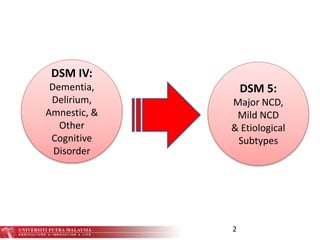
DSM IV:
Dementia,
Delirium,
Amnestic, &
Other
Cognitive
Disorder
DSM 5:
Major NCD,
Mild NCD
& Etiological
Subtypes
3
NEUROCOGNITIVE DISORDER (NCD)
• NCD category encompasses the group of disorder in
which the primary clinical deficit is in cognitive
function & that are acquired rather than
developmental.
• Only disorders whose core features are cognitive are
included in the NCD category.
• NCDs are those in which impaired cognition has not
been present since birth or very early life & thus
represents a decline from a previously attained level
of functioning.
4
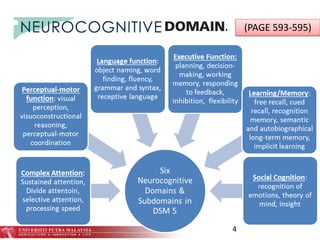
(PAGE 593-595)
5
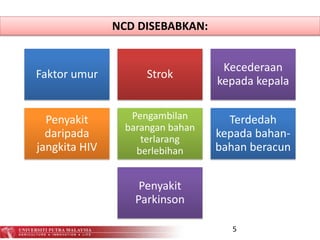
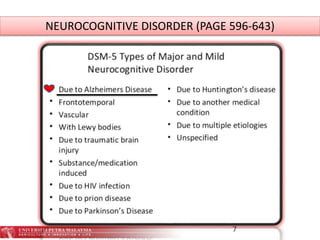
NCD DISEBABKAN:
Faktor umur Strok
Kecederaan
kepada kepala
Penyakit
daripada
jangkita HIV
Pengambilan
barangan bahan
terlarang
berlebihan
Terdedah
kepada bahan-
bahan beracun
Penyakit
Parkinson
6
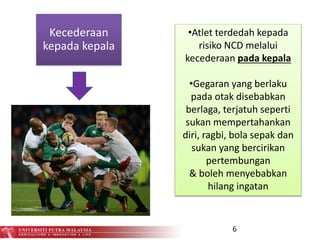
Kecederaan
kepada kepala
•Atlet terdedah kepada
risiko NCD melalui
kecederaan pada kepala
•Gegaran yang berlaku
pada otak disebabkan
berlaga, terjatuh seperti
sukan mempertahankan
diri, ragbi, bola sepak dan
sukan yang bercirikan
pertembungan
& boleh menyebabkan
hilang ingatan
7
NEUROCOGNITIVE DISORDER (PAGE 596-643)
8
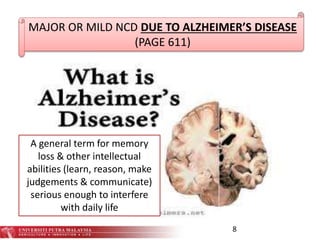
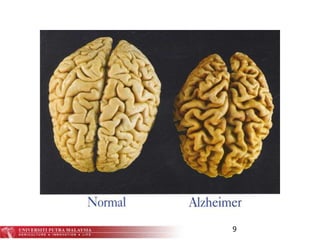
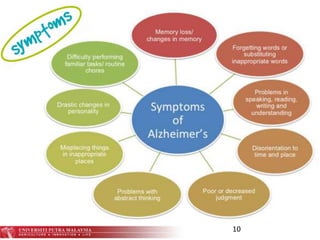
MAJOR OR MILD NCD DUE TO ALZHEIMER’S DISEASE
(PAGE 611)
A general term for memory
loss & other intellectual
abilities (learn, reason, make
judgements & communicate)
serious enough to interfere
with daily life
9
10
11
Diagnostic Criteria (page 611)
A. The criteria are met for major or mild NCD
B. There is insidious onset & gradual progression of impairment in
one or more cognitive domains (for major NCD at least 2
domains must be impaired)
C. Criteria are met for either probable or possible Alzheimer’s
disease as follows:
Major NCD: Alzheimer’s disease is diagnosed if either of the
following is present; otherwise possible Alzheimer’s disease
should be diagnosed.
12
Diagnostic Criteria (page 611)
Minor NCD:
•Probable Alzheimer’s disease is diagnosed if there is evidence of a
causative Alzheimer’s disease genetic mutation from either genetic
testing or family history.
•Possible Alzheimer’s disease is diagnosed if there is no evidence
of a causative Alzheimer’s disease genetic mutation from either
genetic testing or family history & all 3 of the following are
present:
1. Clear evidence of decline in memory & learning
2. Steadily progressive, gradual decline in cognition without
extended plateaus
13
Diagnostic Criteria (page 611)
3. No evidence of mixed etiology (i.e absence of other NCD or
cerebrovascular disease, or another neuroligical or systemic
disease or condition likely contributing to cognitive decline)
D. The disturbance is not better explained by cerebrovascular
disease, another neurodegenerative disease, the effects of a
substance, another mental, neurological or systematic disorder
14
Diagnostic Features (page 612)
1. Beyond the NCD syndrome (A)
2. Insidious onset & gradual progression of
cognitive & behavioral symptoms (B)
3. A level of diagnostic certainty must be
specified denoting Alzheimer’s disease as
the ‘probable’ or ‘possible’ etiology. (C)
4. If the etiology appears mixed, mild NCD due
to multiple etiologies should be diagnosed.
In any case for both, the clinical features
must not suggest another primary etiology
for the NCD (D)
15
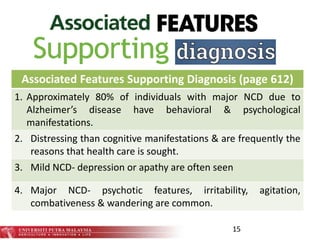
Associated Features Supporting Diagnosis (page 612)
1. Approximately 80% of individuals with major NCD due to
Alzheimer’s disease have behavioral & psychological
manifestations.
2. Distressing than cognitive manifestations & are frequently the
reasons that health care is sought.
3. Mild NCD- depression or apathy are often seen
4. Major NCD- psychotic features, irritability, agitation,
combativeness & wandering are common.
16
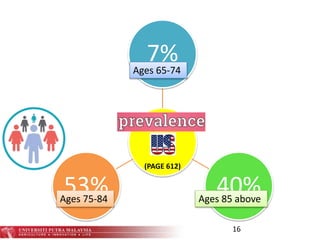
(PAGE 612)
7%
40%53%
Ages 65-74
Ages 75-84 Ages 85 above
17
18
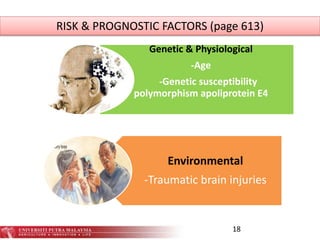
Genetic & Physiological
-Age
-Genetic susceptibility
polymorphism apoliprotein E4
Environmental
-Traumatic brain injuries
RISK & PROGNOSTIC FACTORS (page 613)
19
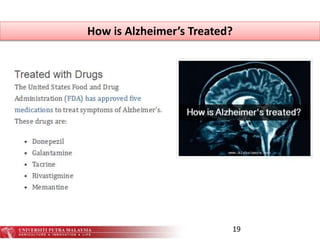
How is Alzheimer’s Treated?
20
21
22
23
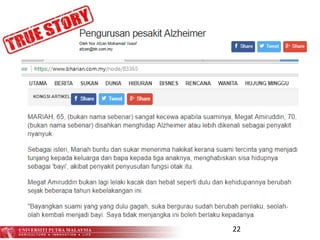
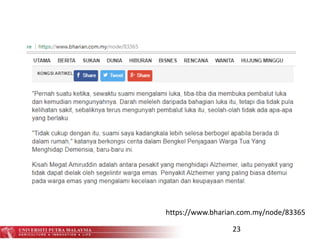
https://www.bharian.com.my/node/83365
24
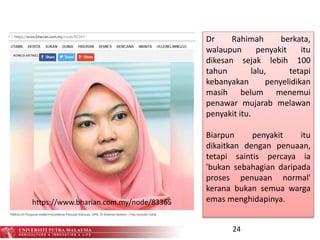
Dr Rahimah berkata,
walaupun penyakit itu
dikesan sejak lebih 100
tahun lalu, tetapi
kebanyakan penyelidikan
masih belum menemui
penawar mujarab melawan
penyakit itu.
Biarpun penyakit itu
dikaitkan dengan penuaan,
tetapi saintis percaya ia
'bukan sebahagian daripada
proses penuaan normal'
kerana bukan semua warga
emas menghidapinya.https://www.bharian.com.my/node/83365
• Ia membabitkan kehilangan 'kemerosotan neuron di
dalam otak', iaitu di lingkungan terbabit dalam daya
ingatan, bahasa, kognitif iaitu hipotalamus, frontal
dan temporal lobes di korteks cerebal. Fungsi saraf
otak kompleks dan progresif semakin menurun
memberi kesan pelupa.
• Beliau berkata, di Malaysia, istilah warga emas
digunakan dalam kalangan penduduk berumur 60
tahun ke atas
25
• Katanya, banci tahun 2010 menunjukkan Malaysia
mempunyai hampir 2.2 juta atau tujuh peratus warga
emas.
• Kumpulan umur ini dijangka akan terus meningkat
setiap tahun, malah negara ini diunjur akan menjadi
sebagai 'negara tua' menjelang tahun 2030, iaitu
apabila peratusan warga emasnya mencecah 15
peratus.
26
TINGKAH LAKU BILAZIM
(CPE3100)
NEUROCOGNITIVE DISORDER (NCD)
PENSYARAH: DR. YUSNI MOHAMAD YUSOP
NAMA: MUHAMAD AL HAFIZ BIN MD HARUN
(187457)
28
PARKINSON`S DISEASE
29
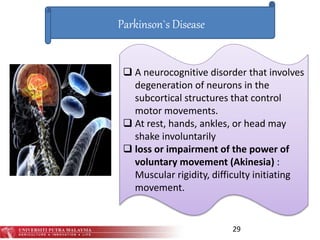
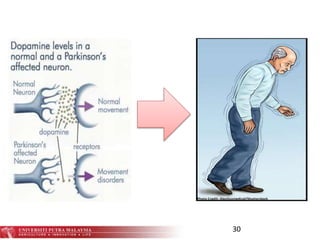
Parkinson`s Disease
 A neurocognitive disorder that involves
degeneration of neurons in the
subcortical structures that control
motor movements.
 At rest, hands, ankles, or head may
shake involuntarily
 loss or impairment of the power of
voluntary movement (Akinesia) :
Muscular rigidity, difficulty initiating
movement.
30
31
diagnostic features
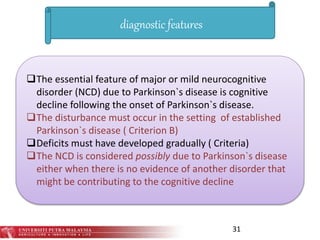
The essential feature of major or mild neurocognitive
disorder (NCD) due to Parkinson`s disease is cognitive
decline following the onset of Parkinson`s disease.
The disturbance must occur in the setting of established
Parkinson`s disease ( Criterion B)
Deficits must have developed gradually ( Criteria)
The NCD is considered possibly due to Parkinson`s disease
either when there is no evidence of another disorder that
might be contributing to the cognitive decline
32
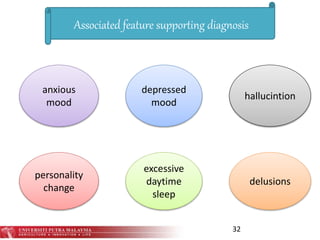
Associated feature supporting diagnosis
anxious
mood
personality
change
excessive
daytime
sleep
depressed
mood
delusions
hallucintion
33
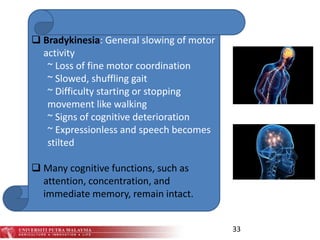
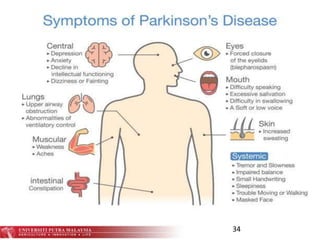
 Bradykinesia: General slowing of motor
activity
~ Loss of fine motor coordination
~ Slowed, shuffling gait
~ Difficulty starting or stopping
movement like walking
~ Signs of cognitive deterioration
~ Expressionless and speech becomes
stilted
 Many cognitive functions, such as
attention, concentration, and
immediate memory, remain intact.
34
35
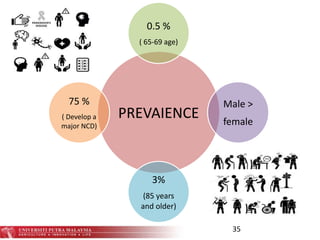
PREVAIENCE
0.5 %
( 65-69 age)
Male >
female
3%
(85 years
and older)
75 %
( Develop a
major NCD)
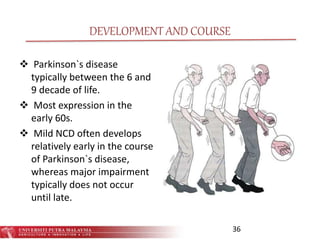
DEVELOPMENT AND COURSE
 Parkinson`s disease
typically between the 6 and
9 decade of life.
 Most expression in the
early 60s.
 Mild NCD often develops
relatively early in the course
of Parkinson`s disease,
whereas major impairment
typically does not occur
until late.
36
TREATMENT PARKINSON`S
37
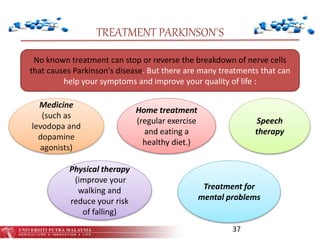
No known treatment can stop or reverse the breakdown of nerve cells
that causes Parkinson's disease. But there are many treatments that can
help your symptoms and improve your quality of life :
Medicine
(such as
levodopa and
dopamine
agonists)
Physical therapy
(improve your
walking and
reduce your risk
of falling)
Home treatment
(regular exercise
and eating a
healthy diet.)
Treatment for
mental problems
Speech
therapy
38

NEUROCOGNITIVE DISORDER (NCD)

  • 1.
    TINGKAH LAKU BILAZIM (CPE3100) NEUROCOGNITIVEDISORDER (NCD) (DSM5: PAGE 591-643) PENSYARAH: DR. YUSNI MOHAMAD YUSOP NAMA: NUR ZATUL AYUNI BINTI JAMAL (188318)
  • 2.
  • 3.
    3 NEUROCOGNITIVE DISORDER (NCD) •NCD category encompasses the group of disorder in which the primary clinical deficit is in cognitive function & that are acquired rather than developmental. • Only disorders whose core features are cognitive are included in the NCD category. • NCDs are those in which impaired cognition has not been present since birth or very early life & thus represents a decline from a previously attained level of functioning.
  • 4.
  • 5.
    5 NCD DISEBABKAN: Faktor umurStrok Kecederaan kepada kepala Penyakit daripada jangkita HIV Pengambilan barangan bahan terlarang berlebihan Terdedah kepada bahan- bahan beracun Penyakit Parkinson
  • 6.
    6 Kecederaan kepada kepala •Atlet terdedahkepada risiko NCD melalui kecederaan pada kepala •Gegaran yang berlaku pada otak disebabkan berlaga, terjatuh seperti sukan mempertahankan diri, ragbi, bola sepak dan sukan yang bercirikan pertembungan & boleh menyebabkan hilang ingatan
  • 7.
  • 8.
    8 MAJOR OR MILDNCD DUE TO ALZHEIMER’S DISEASE (PAGE 611) A general term for memory loss & other intellectual abilities (learn, reason, make judgements & communicate) serious enough to interfere with daily life
  • 9.
  • 10.
  • 11.
    11 Diagnostic Criteria (page611) A. The criteria are met for major or mild NCD B. There is insidious onset & gradual progression of impairment in one or more cognitive domains (for major NCD at least 2 domains must be impaired) C. Criteria are met for either probable or possible Alzheimer’s disease as follows: Major NCD: Alzheimer’s disease is diagnosed if either of the following is present; otherwise possible Alzheimer’s disease should be diagnosed.
  • 12.
    12 Diagnostic Criteria (page611) Minor NCD: •Probable Alzheimer’s disease is diagnosed if there is evidence of a causative Alzheimer’s disease genetic mutation from either genetic testing or family history. •Possible Alzheimer’s disease is diagnosed if there is no evidence of a causative Alzheimer’s disease genetic mutation from either genetic testing or family history & all 3 of the following are present: 1. Clear evidence of decline in memory & learning 2. Steadily progressive, gradual decline in cognition without extended plateaus
  • 13.
    13 Diagnostic Criteria (page611) 3. No evidence of mixed etiology (i.e absence of other NCD or cerebrovascular disease, or another neuroligical or systemic disease or condition likely contributing to cognitive decline) D. The disturbance is not better explained by cerebrovascular disease, another neurodegenerative disease, the effects of a substance, another mental, neurological or systematic disorder
  • 14.
    14 Diagnostic Features (page612) 1. Beyond the NCD syndrome (A) 2. Insidious onset & gradual progression of cognitive & behavioral symptoms (B) 3. A level of diagnostic certainty must be specified denoting Alzheimer’s disease as the ‘probable’ or ‘possible’ etiology. (C) 4. If the etiology appears mixed, mild NCD due to multiple etiologies should be diagnosed. In any case for both, the clinical features must not suggest another primary etiology for the NCD (D)
  • 15.
    15 Associated Features SupportingDiagnosis (page 612) 1. Approximately 80% of individuals with major NCD due to Alzheimer’s disease have behavioral & psychological manifestations. 2. Distressing than cognitive manifestations & are frequently the reasons that health care is sought. 3. Mild NCD- depression or apathy are often seen 4. Major NCD- psychotic features, irritability, agitation, combativeness & wandering are common.
  • 16.
  • 17.
  • 18.
    18 Genetic & Physiological -Age -Geneticsusceptibility polymorphism apoliprotein E4 Environmental -Traumatic brain injuries RISK & PROGNOSTIC FACTORS (page 613)
  • 19.
  • 20.
  • 21.
  • 22.
  • 23.
  • 24.
    24 Dr Rahimah berkata, walaupunpenyakit itu dikesan sejak lebih 100 tahun lalu, tetapi kebanyakan penyelidikan masih belum menemui penawar mujarab melawan penyakit itu. Biarpun penyakit itu dikaitkan dengan penuaan, tetapi saintis percaya ia 'bukan sebahagian daripada proses penuaan normal' kerana bukan semua warga emas menghidapinya.https://www.bharian.com.my/node/83365
  • 25.
    • Ia membabitkankehilangan 'kemerosotan neuron di dalam otak', iaitu di lingkungan terbabit dalam daya ingatan, bahasa, kognitif iaitu hipotalamus, frontal dan temporal lobes di korteks cerebal. Fungsi saraf otak kompleks dan progresif semakin menurun memberi kesan pelupa. • Beliau berkata, di Malaysia, istilah warga emas digunakan dalam kalangan penduduk berumur 60 tahun ke atas 25
  • 26.
    • Katanya, bancitahun 2010 menunjukkan Malaysia mempunyai hampir 2.2 juta atau tujuh peratus warga emas. • Kumpulan umur ini dijangka akan terus meningkat setiap tahun, malah negara ini diunjur akan menjadi sebagai 'negara tua' menjelang tahun 2030, iaitu apabila peratusan warga emasnya mencecah 15 peratus. 26
  • 27.
    TINGKAH LAKU BILAZIM (CPE3100) NEUROCOGNITIVEDISORDER (NCD) PENSYARAH: DR. YUSNI MOHAMAD YUSOP NAMA: MUHAMAD AL HAFIZ BIN MD HARUN (187457)
  • 28.
  • 29.
    29 Parkinson`s Disease  Aneurocognitive disorder that involves degeneration of neurons in the subcortical structures that control motor movements.  At rest, hands, ankles, or head may shake involuntarily  loss or impairment of the power of voluntary movement (Akinesia) : Muscular rigidity, difficulty initiating movement.
  • 30.
  • 31.
    31 diagnostic features The essentialfeature of major or mild neurocognitive disorder (NCD) due to Parkinson`s disease is cognitive decline following the onset of Parkinson`s disease. The disturbance must occur in the setting of established Parkinson`s disease ( Criterion B) Deficits must have developed gradually ( Criteria) The NCD is considered possibly due to Parkinson`s disease either when there is no evidence of another disorder that might be contributing to the cognitive decline
  • 32.
    32 Associated feature supportingdiagnosis anxious mood personality change excessive daytime sleep depressed mood delusions hallucintion
  • 33.
    33  Bradykinesia: Generalslowing of motor activity ~ Loss of fine motor coordination ~ Slowed, shuffling gait ~ Difficulty starting or stopping movement like walking ~ Signs of cognitive deterioration ~ Expressionless and speech becomes stilted  Many cognitive functions, such as attention, concentration, and immediate memory, remain intact.
  • 34.
  • 35.
    35 PREVAIENCE 0.5 % ( 65-69age) Male > female 3% (85 years and older) 75 % ( Develop a major NCD)
  • 36.
    DEVELOPMENT AND COURSE Parkinson`s disease typically between the 6 and 9 decade of life.  Most expression in the early 60s.  Mild NCD often develops relatively early in the course of Parkinson`s disease, whereas major impairment typically does not occur until late. 36

  • 37.
    TREATMENT PARKINSON`S 37 No knowntreatment can stop or reverse the breakdown of nerve cells that causes Parkinson's disease. But there are many treatments that can help your symptoms and improve your quality of life : Medicine (such as levodopa and dopamine agonists) Physical therapy (improve your walking and reduce your risk of falling) Home treatment (regular exercise and eating a healthy diet.) Treatment for mental problems Speech therapy
  • 38.