NEUROCOGNITIVE DISORDERS.
PERSPECTIVES ON EVERYDAY PRACTICE
Hatem Samir Shehata, M.D
Department of Neurology
Cairo University
18th CNC – Intercontinental Citystars– Cairo
FEB- 2017
OBJECTIVES
• NEW DIAGNOSTIC CRITERIA OF ALZHEIMER’S DISEASE
• EARLY AND PRODROMAL PHASES OF NCD
• THE CURRENT , MOST VALIDATED BIOMARKERS
• ATYPICAL FORMS OF DAT, ‘POSTERIOR SHIFT’
2
An Introductory Vignette
• A 68-year-old man sought medical advice because he felt that
he had some decrement in concentration ability in the last year.
He is an Emeritus Professor and living alone with his wife, who
reported unusual but infrequent familiar objects misplacement
(keys), with one or two times impairment in handling finances
(forgetting paying bills) in the last 4 months, she also reported
difficulty marketing
3
• Patient said that “it takes longer for me to concentrate well as
usual for my daily practice”. Otherwise, he and his wife have no
other complaints
• He has mild hypertension (5 mg amlodipine) and diabetic (OHD)
and non-smoker; not cardiac and no past history of any
neurological disorders
• Assessment (June / 2014): His MMSE was 29, (the drop point
was in Registration “naming of the 3 objects”)
4
CASE 1
(Cont’d)
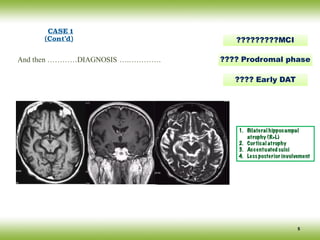
And then …………DIAGNOSIS ….………….
?????????MCI
5
???? Prodromal phase
???? Early DAT
CASE 1
(Cont’d)
1. Bilateral hippocampal
atrophy (R>L)
2. Cortical atrophy
3. Accentuated sulci
4. Less posterior involvement
6
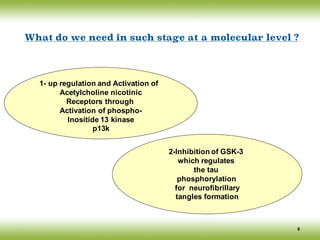
What do we need in such stage at a molecular level ?
1- up regulation and Activation of
Acetylcholine nicotinic
Receptors through
Activation of phospho-
Inositide 13 kinase
p13k
2-Inhibition of GSK-3
which regulates
the tau
phosphorylation
for neurofibrillary
tangles formation
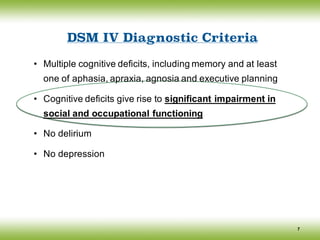
DSM IV Diagnostic Criteria
• Multiple cognitive deficits, including memory and at least
one of aphasia, apraxia, agnosia and executive planning
• Cognitive deficits give rise to significant impairment in
social and occupational functioning
• No delirium
• No depression
7
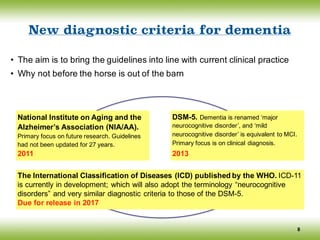
New diagnostic criteria for dementia
8
• The aim is to bring the guidelines into line with current clinical practice
• Why not before the horse is out of the barn
The International Classification of Diseases (ICD) published by the WHO. ICD-11
is currently in development; which will also adopt the terminology “neurocognitive
disorders” and very similar diagnostic criteria to those of the DSM-5.
Due for release in 2017
DSM-5. Dementia is renamed ‘major
neurocognitive disorder’, and ‘mild
neurocognitive disorder’ is equivalent to MCI.
Primary focus is on clinical diagnosis.
2013
National Institute on Aging and the
Alzheimer’s Association (NIA/AA).
Primary focus on future research. Guidelines
had not been updated for 27 years.
2011
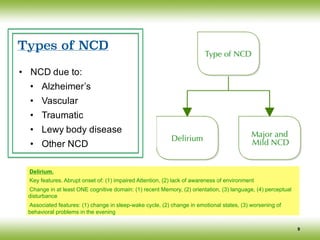
Types of NCD
• NCD due to:
• Alzheimer’s
• Vascular
• Traumatic
• Lewy body disease
• Other NCD
9
Delirium.
Key features. Abrupt onset of: (1) impaired Attention, (2) lack of awareness of environment
Change in at least ONE cognitive domain: (1) recent Memory, (2) orientation, (3) language, (4) perceptual
disturbance
Associated features: (1) change in sleep-wake cycle, (2) change in emotional states, (3) worsening of
behavioral problems in the evening
Diagnostic and statistical manual (DSM-5)
• Major NCD
• Significant cognitive decline [2 or more cognitive domains impaired]
• Interfere with independence [impaired IADLs]
• Not due to delirium
• Not due to other mental disorder
• Mild NCD
• Moderate Cognitive Decline [1 or more cognitive domains impaired]
• NOT Interfere with independence [IADLs intact]
• Not due to delirium
• Not due to other mental disorder
10
Insidious onset & gradual progression
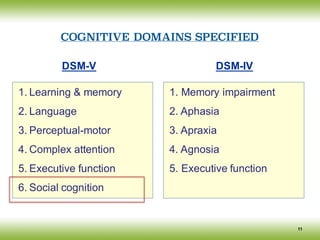
11
1. Learning & memory
2. Language
3. Perceptual-motor
4. Complex attention
5. Executive function
6. Social cognition
1. Memory impairment
2. Aphasia
3. Apraxia
4. Agnosia
5. Executive function
DSM-IVDSM-V
COGNITIVE DOMAINS SPECIFIED
Conceptual framework changes of AD
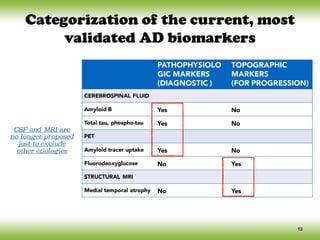
The discovery of biomarkers as surrogate markers of the underlying pathological changes,
led an international work group (IWG) to propose a new conceptual framework for AD in
2007 and [Lexicon revision in 2010] (Dubois, Feldman et al).
The main advances of the IWG/DUBOIS Criteria:
12
Consider AD as encompassing predementia and dementia stages
Which includes atypical subtypes of AD
AD is defined as a clinico- biological (rather than a clinico-pathological) entity that
can be recognized before the onset of the dementia syndrome, on the basis of:
(i) A specific clinical phenotype (amnestic syndrome of the hippocampal type), and
(ii) Supportive biomarkers evidence
Differentiate pathophysiological and topographical biomarkers
Isolate and define a prodromal stage of the disease
Define biomarker positive cognitively normal subjects as ‘asymptomatic at risk for AD’
(their risk to clinical conversion is not known)
Define monogenic mutation careers as ‘presymptomatic’
(the risk to clinical conversion is certain)
13
Categorization of the current, most
validated AD biomarkers
PATHOPHYSIOLO
GIC MARKERS
(DIAGNOSTIC )
TOPOGRAPHIC
MARKERS
(FOR PROGRESSION)
CEREBROSPINAL FLUID
Amyloid B Yes No
Total tau, phospho-tau Yes No
PET
Amyloid tracer uptake Yes No
Fluorodeoxyglucose No Yes
STRUCTURAL MRI
Medial temporal atrophy No Yes
CSF and MRI are
no longer proposed
just to exclude
other etiologies
14
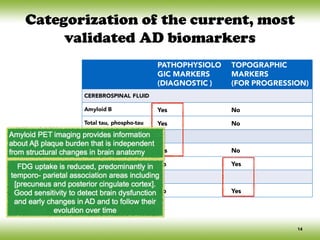
Categorization of the current, most
validated AD biomarkers
PATHOPHYSIOLO
GIC MARKERS
(DIAGNOSTIC )
TOPOGRAPHIC
MARKERS
(FOR PROGRESSION)
CEREBROSPINAL FLUID
Amyloid B Yes No
Total tau, phospho-tau Yes No
PET
Amyloid tracer uptake Yes No
Fluorodeoxyglucose No Yes
STRUCTURAL MRI
Medial temporal atrophy No Yes
CSF and MRI are
no longer proposed
just to exclude
other etiologies
2/10/17
H Shehata & M. Nasreldin 15
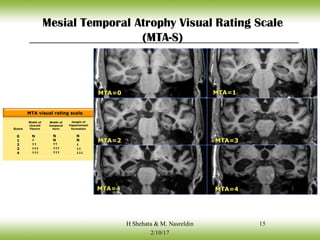
Mesial Temporal Atrophy Visual Rating Scale
(MTA-S)
Delusions
Delusion
misidentification
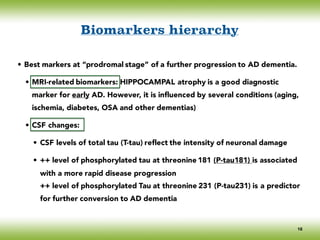
Biomarkers hierarchy
• Best markers at “prodromal stage” of a further progression to AD dementia.
• MRI-related biomarkers: HIPPOCAMPAL atrophy is a good diagnostic
marker for early AD. However, it is influenced by several conditions (aging,
ischemia, diabetes, OSA and other dementias)
• CSF changes:
• CSF levels of total tau (T-tau) reflect the intensity of neuronal damage
• ++ level of phosphorylated tau at threonine 181 (P-tau181) is associated
with a more rapid disease progression
++ level of phosphorylated Tau at threonine 231 (P-tau231) is a predictor
for further conversion to AD dementia
16
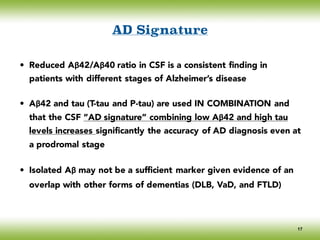
AD Signature
• Reduced Aβ42/Aβ40 ratio in CSF is a consistent finding in
patients with different stages of Alzheimer’s disease
• Aβ42 and tau (T-tau and P-tau) are used IN COMBINATION and
that the CSF “AD signature” combining low Aβ42 and high tau
levels increases significantly the accuracy of AD diagnosis even at
a prodromal stage
• Isolated Aβ may not be a sufficient marker given evidence of an
overlap with other forms of dementias (DLB, VaD, and FTLD)
17
• 70 % of subjects with MCI ------ AD within 5 years [10% - 15% per
year]
• Normal subjects develop AD at a rate of [1% - 2% per year]
• Types: Amnestic, Multiple domains, Single non-memory domain
(executive functions)
Normal
MCI
DAT
Cognitive Continuum
Mild Cognitive Impairment
18
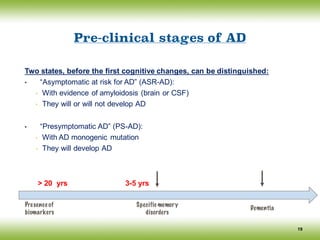
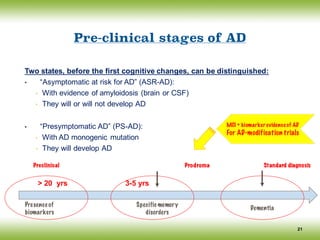
Pre-clinical stages of AD
Two states, before the first cognitive changes, can be distinguished:
• “Asymptomatic at risk for AD” (ASR-AD):
• With evidence of amyloidosis (brain or CSF)
• They will or will not develop AD
• “Presymptomatic AD” (PS-AD):
• With AD monogenic mutation
• They will develop AD
> 20 yrs 3-5 yrs
Dementia
Presence of
biomarkers
Specific memory
disorders
19
Pre-clinical stages of AD
Two states, before the first cognitive changes, can be distinguished:
• “Asymptomatic at risk for AD” (ASR-AD):
• With evidence of amyloidosis (brain or CSF)
• They will or will not develop AD
• “Presymptomatic AD” (PS-AD):
• With AD monogenic mutation
• They will develop AD
> 20 yrs 3-5 yrs
Dementia
Presence of
biomarkers
Specific memory
disorders
20
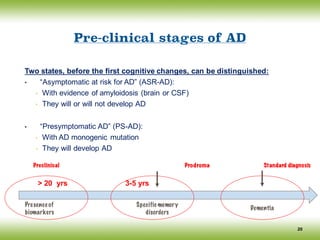
Preclinical Prodroma Standard diagnosis
Pre-clinical stages of AD
Two states, before the first cognitive changes, can be distinguished:
• “Asymptomatic at risk for AD” (ASR-AD):
• With evidence of amyloidosis (brain or CSF)
• They will or will not develop AD
• “Presymptomatic AD” (PS-AD):
• With AD monogenic mutation
• They will develop AD
> 20 yrs 3-5 yrs
Dementia
Presence of
biomarkers
Specific memory
disorders
21
Preclinical Prodroma Standard diagnosis
MCI + biomarker evidence of AD
For AD-modification trials
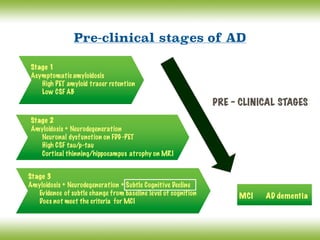
Stage 1
Asymptomatic amyloidosis
High PET amyloid tracer retention
Low CSF AB
Stage 2
Amyloidosis + Neurodegeneration
Neuronal dysfunction on FDG-PET
High CSF tau/p-tau
Cortical thinning/hippocampus atrophy on MRI
Stage 3
Amyloidosis + Neurodegeneration + Subtle Cognitive Decline
Evidence of subtle change from baseline level of cognition
Does not meet the criteria for MCI
MCI AD dementia
PRE – CLINICAL STAGES
Pre-clinical stages of AD
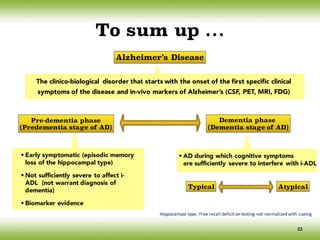
To sum up …
23
Alzheimer’s Disease
Pre-dementia phase
(Predementia stage of AD)
Dementia phase
(Dementia stage of AD)
The clinico-biological disorder that starts with the onset of the first specific clinical
symptoms of the disease and in-vivo markers of Alzheimer’s (CSF, PET, MRI, FDG)
Typical Atypical
• Early symptomatic (episodic memory
loss of the hippocampal type)
• Not sufficiently severe to affect i-
ADL (not warrant diagnosis of
dementia)
• Biomarker evidence
• AD during which cognitive symptoms
are sufficiently severe to interfere with i-ADL
Hippocampal	type.	Free	recall	deficit	on	testing	not	normalized	with	cueing
Typical Alzheimer’s disease
24
* Braak H, Braak E. Neuropathological stageing of Alzheimer-related changes. Acta Neuropathol 1991; 82: 239–59
Initial involvement of the
entorhinal cortex, and
medial temporal structures
De-afferentiation
of hippocampus
Spreads to iso &
neocortical association areas
Amnestic syndrome of the
hippocampal type
Episodic antero-grade
memory impairment
Typical initial core pattern of
cognitive changes of AD
Executive dysfunction,
Language, Praxis,
& complex visual processing
impairment
Cueing is a measure of the associative
function of the hippocampus
In-vivopositive biomarkers of
Alzheimer’s pathology
Typical regional brain pathology of AD [Braak and Braak*] revealed:
D-RELATED NEUROFIBRILLARY CHANGES 275
transentorhinal stages
I
/STAGE I // ~
region
.o,o:.o....,;ZU ,
t
X
(STAGE II II I - ..
~/~--~ •
I
limbic stages
l
STAGEIII// "~ /" ~
~ ?..°o - i ,
~..:.,, ...........,. . , .
. ....
isocortical stages
t t
FIG. 4. Summary diagram of neurofibrillarychanges seen in the hippocampal formation, entorhinal
and transentorhinal regions, and in the adjoiningtemporal isocortex. Note the development of changes
I
/STAGE I // ~
region
.o,o:.o....,;ZU ,
t
X
(STAGE II II I - ..
~/~--~ •
I
limbic stages
l
STAGEIII// "~ /" ~
~ ?..°o - i ,
~..:.,, ...........,. . , .
. ....
isocortical stages
t t
FIG. 4. Summary diagram of neurofibrillarychanges seen in the hippocampal formation, entorhinal
and transentorhinal regions, and in the adjoining temporal isocortex. Note the development of changes
from stage I to stage VI. The arrows point to leading characteristics. CAI: first sector of the Ammon's
horn, parasub: parasubiculum, presubic: presubiculum; transentorhin, region.: transentorhinal region;
entorhin.region: entorhinal region; temp. isocortex: temporal isocortex; reproduced with permission
from (12).
characteristic brain lesions, stage III or IV cases are considered
to represent incipient AD (12,14,15).
TRANSENTORHINAL STAGES 1 AND II
In the most mildly affected brains involvement only of layer
Preu is consistently displayed and this change is initially con-
fined to the transentorhinal region (Fig. le and Fig. 4). Clini-
cally, these stages do not present with any cognitive impairments
(6,18,31). As in many other neurodegenerative diseases, there
is a period of time in which NFTs and NTs slowly and gradu-
ally develop at their predilection sites. However, the brain
change remains below the ~.hreshold which produces clinical
symptoms (12,14,15).
SITUATION BEFORE THE FORMAT
OF NEUROFIBRILLARY CHANGE
Application of specific immunocytochem
offers the possibilityof going back before stag
examination of the neuronal cytoskeletal chang
actual formation of NFTs and NTs, This kin
carried out in transentorhinal region and in b
atively young individuals. Before or during s
is generally devoid of A4-amyloid deposits, neu
cular changes, or other pathologic lesions. This
tunity to study these early events in the absenc
Sensitive and specific antibodies (AT8) reactin
mally phosphorylated tau protein (36) display
appear rather abruptly in the transentorhinal
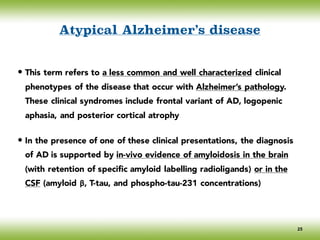
Atypical Alzheimer’s disease
• This term refers to a less common and well characterized clinical
phenotypes of the disease that occur with Alzheimer’s pathology.
These clinical syndromes include frontal variant of AD, logopenic
aphasia, and posterior cortical atrophy
• In the presence of one of these clinical presentations, the diagnosis
of AD is supported by in-vivo evidence of amyloidosis in the brain
(with retention of specific amyloid labelling radioligands) or in the
CSF (amyloid β, T-tau, and phospho-tau-231 concentrations)
25
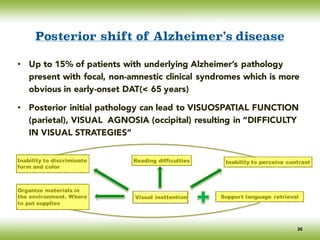
• Up to 15% of patients with underlying Alzheimer’s pathology
present with focal, non-amnestic clinical syndromes which is more
obvious in early-onset DAT(< 65 years)
• Posterior initial pathology can lead to VISUOSPATIAL FUNCTION
(parietal), VISUAL AGNOSIA (occipital) resulting in “DIFFICULTY
IN VISUAL STRATEGIES”
Posterior shift of Alzheimer’s disease
26
Support language retrievalVisual inattention
Organize materials in
the environment. Where
to put supplies
Inability to discriminate
form and color
Reading difficulties Inability to perceive contrast
• The tasks of identifying and locating objects are located in different
cortical areas
• Neuronal circuits that project from [striate cortex]
Posterior shift of Alzheimer’s neuropathology
The ventral pathway acts in the
visual recognition of objects
“STIMULUS RECOGNITION”
The dorsal pathway acts in the
recognition of space (visual
guidance of movement)
“STIMULUS LOCALIZATION “
STS
Striate	cortex
ITG
27
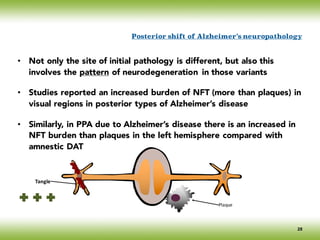
• Not only the site of initial pathology is different, but also this
involves the pattern of neurodegeneration in those variants
• Studies reported an increased burden of NFT (more than plaques) in
visual regions in posterior types of Alzheimer’s disease
• Similarly, in PPA due to Alzheimer’s disease there is an increased in
NFT burden than plaques in the left hemisphere compared with
amnestic DAT
Tangle
Plaque
Posterior shift of Alzheimer’s neuropathology
28
• Primary progressive aphasia usually occurs in the context of non-
Alzheimer dementia (FTD)
• Three clinical subtypes: (1) Agrammatic variant PPA, (2) Semantic
variant PPA and (3) Logopenic variant PPA
• Patients with pathologically verified Alzheimer's disease can
present with PPA, especially the LOGOPENIC VARIANT
• Unlike “FTD subtypes”, LvPPA does not produce behavior or
personality changes in until later stages. Patients can maintain the
ability to care for themselves and i-ADL for a few years after onset
Another Atypicality Primary Progressive Aphasia
29
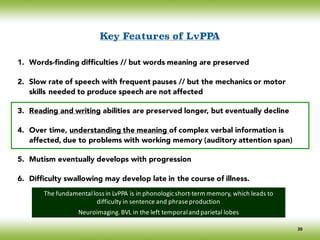
1. Words-finding difficulties // but words meaning are preserved
2. Slow rate of speech with frequent pauses // but the mechanics or motor
skills needed to produce speech are not affected
3. Reading and writing abilities are preserved longer, but eventually decline
4. Over time, understanding the meaning of complex verbal information is
affected, due to problems with working memory (auditory attention span)
5. Mutism eventually develops with progression
6. Difficulty swallowing may develop late in the course of illness.
Key Features of LvPPA
The	fundamental	loss	in	LvPPA	is	in	phonologic	short-term	memory,	which	leads	to	
difficulty	in	sentence	and	phrase	production
Neuroimaging.	BVL	in	the	left	temporal	and	parietal	lobes
30
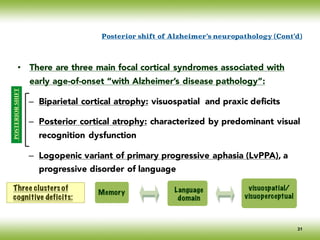
• There are three main focal cortical syndromes associated with
early age-of-onset “with Alzheimer’s disease pathology”:
– Biparietal cortical atrophy: visuospatial and praxic deficits
– Posterior cortical atrophy: characterized by predominant visual
recognition dysfunction
– Logopenic variant of primary progressive aphasia (LvPPA), a
progressive disorder of language
Posterior shift of Alzheimer’s neuropathology (Cont’d)
Memory Language
domain
visuospatial/
visuoperceptual
Three clusters of
cognitive deficits:
POSTERIORSHIFT
31
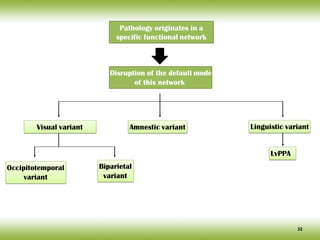
Pathology originates in a
specific functional network
Disruption of the default mode
of this network
Visual variant
Biparietal
variant
Occipitotemporal
variant
Amnestic variant Linguistic variant
LvPPA
32
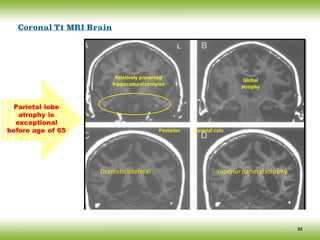
Relatively	preserved
hippocampal	complex
Global
atrophy
Posterior											parietal	cuts	
Dramatic	bilateral																																											superior	parietal	atrophy
Coronal T1 MRI Brain
Parietal lobe
atrophy is
exceptional
before age of 65
33
CASE 2. PCA
• 56 Y old Rt. handed (F) referred from ophthalmologist to assess
her “mental capabilities”
• Her husband reported that he is sure that his wife vision is
affected (my wife is almost blind and she needs help in her every-
day in-door or out-door activities), and he was negotiating the
ophthalmologists’ opinions
• She frequently walked immediately into chairs or tables despite
good lighting
• Most of the time, she knocked over objects to localize them, and
she described that when she was looking at things in space "they
seem to disappear"
CASE 2
OBJECT MISIDENTIFICATION
Eye-hand in-coordination (OPTIC ATAXIA)
OCULOMOTOR APRAXIA
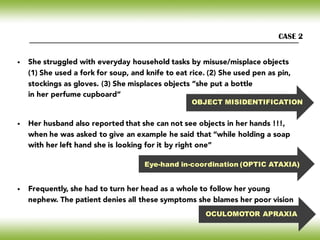
• She struggled with everyday household tasks by misuse/misplace objects
(1) She used a fork for soup, and knife to eat rice. (2) She used pen as pin,
stockings as gloves. (3) She misplaces objects “she put a bottle
in her perfume cupboard”
• Her husband also reported that she can not see objects in her hands !!!,
when he was asked to give an example he said that “while holding a soap
with her left hand she is looking for it by right one”
• Frequently, she had to turn her head as a whole to follow her young
nephew. The patient denies all these symptoms she blames her poor vision
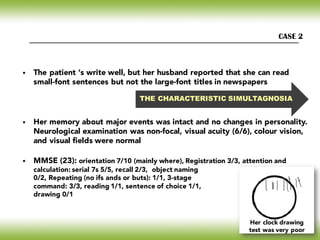
• The patient ‘s write well, but her husband reported that she can read
small-font sentences but not the large-font titles in newspapers
• Her memory about major events was intact and no changes in personality.
Neurological examination was non-focal, visual acuity (6/6), colour vision,
and visual fields were normal
• MMSE (23): orientation 7/10 (mainly where), Registration 3/3, attention and
calculation: serial 7s 5/5, recall 2/3, object naming
0/2, Repeating (no ifs ands or buts): 1/1, 3-stage
command: 3/3, reading 1/1, sentence of choice 1/1,
drawing 0/1
CASE 2
THE CHARACTERISTIC SIMULTAGNOSIA
Her clock drawing
test was very poor
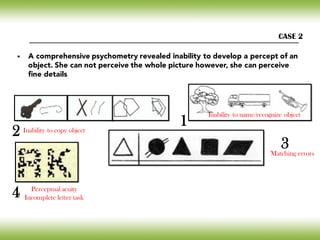
• A comprehensive psychometry revealed inability to develop a percept of an
object. She can not perceive the whole picture however, she can perceive
fine details
CASE 2
Inability to name/recognize object
Inability to copy object
Matching errors
Perceptual acuity
Incomplete letter task
1
2
3
4
• A comprehensive psychometry revealed inability to develop a percept of an
object. She can not perceive the whole picture however, she can perceive
fine details
CASE 2
Inability to name/recognize object
Inability to copy object
Matching errors
Perceptual acuity
Incomplete letter task
1
2
3
4 What is this ????
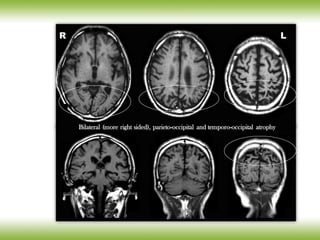
Bilateral (more right sided), parieto-occipital and temporo-occipital atrophy
R L
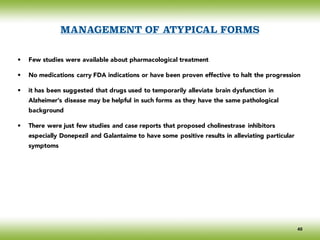
MANAGEMENT OF ATYPICAL FORMS
• Few studies were available about pharmacological treatment
• No medications carry FDA indications or have been proven effective to halt the progression
• it has been suggested that drugs used to temporarily alleviate brain dysfunction in
Alzheimer’s disease may be helpful in such forms as they have the same pathological
background
• There were just few studies and case reports that proposed cholinestrase inhibitors
especially Donepezil and Galantaime to have some positive results in alleviating particular
symptoms
40
41
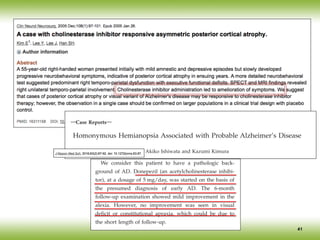
―Case Reports―
Homonymous Hemianopsia Associated with Probable Alzheimer’s Disease
Akiko Ishiwata and Kazumi Kimura
Departments of Neurological Science, Graduate School of Medicine, Nippon Medical School, Tokyo, Japan
Posterior cortical atrophy (PCA) is a rare neurodegenerative disorder that has cerebral atrophy in the
parietal, occipital, or occipitotemporal cortices and is characterized by visuospatial and visuoperceptual
impairments. The most cases are pathologically compatible with Alzheimer’s disease (AD). We describe
a case of PCA in which a combination of imaging methods, in conjunction with symptoms and neuro-
logical and neuropsychological examinations, led to its being diagnosed and to AD being identified as
its probable cause. Treatment with donepezil for 6 months mildly improved alexia symptoms, but other
symptoms remained unchanged. A 59-year-old Japanese woman with progressive alexia, visual deficit,
and mild memory loss was referred to our neurologic clinic for the evaluation of right homonymous
hemianopsia. Our neurological examination showed alexia, constructional apraxia, mild disorientation,
short-term memory loss, and right homonymous hemianopsia. These findings resulted in a score of 23
(of 30) points on the Mini-Mental State Examination. Occipital atrophy was identified, with magnetic
is also hypoperfusion in the parietal lobe and precuneus. Note: Right lateral (RT.LA
(LT.LAT), right medial (RT.MED) and left medial (LT.MED) views of brain.
this patient, DLB, CBD, and prion disease can be ex-
cluded on the basis of the clinical course and imaging
manifestations. Therefore, PCA due to AD was diagnosed
in this patient.
Our patient had findings consistent with PCA: a clini-
cal course that matched that of PCA (slow progression
and onset of visual field deficit), symptoms (alexia and
constructional apraxia present without optic ataxia, mo-
tor paralysis, or sensory disturbance), and results of ex-
aminations (predominant posterior atrophy on MRI, and
the Physical Intelligence Quotient of the Wechsler Adult
Intelligence Scale was 25 to 30 points lower than the Ver-
bal Intelligence Quotient) as proposed by Benson et al in
19881
. Therefore, PCA was diagnosed.
We consider this patient to have a pathologic back-
ground of AD. Donepezil (an acetylcholinesterase inhibi-
tor), at a dosage of 5 mg/day, was started on the basis of
the presumed diagnosis of early AD. The 6-month
follow-up examination showed mild improvement in the
alexia. However, no improvement was seen in visual
deficit or constitutional apraxia, which could be due to
the short length of follow-up.
Discu
This case was diagnosed as P
treated with an acetylcholine
nostic process, evaluations w
tailed history of symptoms
biochemical findings; hema
chiatric examination; cerebr
such as brain MRI; and funct
SPECT. As a result, we dete
of our patient and were ab
treatment.
For the treatment of PCA
been established. However, c
PCA or a visual form
cholinesterase inhibitors21,22
. I
siveness to cholinesterase in
causes of the PCA. We spec
hibitors may be effective fo
with AD.
The features of PCA propo
include cerebral atrophy inv
occipitotemporal cortices as i
mography or MRI. Howeve
In conclusion
• Neurobiological changes occurs many years before symptoms appear
• This delay in emerging clinical manifestations denotes that the
pathological process progressively erodes the “brain reserve” till the
clinical threshold is surpassed and symptoms develop
• The prospect of disease-modifying drugs that can slow or prevent
disease progression has prompted increased interest in identifying
individuals with AD earlier and more accurately
• Though stereotypical pathological pattern started with early medial
enterorhinal followed by progressive neocortical damage , yet other
pathologies should drawn out of shadows for identification and
recognition
42
43

Alzheimer Disease

  • 1.
    NEUROCOGNITIVE DISORDERS. PERSPECTIVES ONEVERYDAY PRACTICE Hatem Samir Shehata, M.D Department of Neurology Cairo University 18th CNC – Intercontinental Citystars– Cairo FEB- 2017
  • 2.
    OBJECTIVES • NEW DIAGNOSTICCRITERIA OF ALZHEIMER’S DISEASE • EARLY AND PRODROMAL PHASES OF NCD • THE CURRENT , MOST VALIDATED BIOMARKERS • ATYPICAL FORMS OF DAT, ‘POSTERIOR SHIFT’ 2
  • 3.
    An Introductory Vignette •A 68-year-old man sought medical advice because he felt that he had some decrement in concentration ability in the last year. He is an Emeritus Professor and living alone with his wife, who reported unusual but infrequent familiar objects misplacement (keys), with one or two times impairment in handling finances (forgetting paying bills) in the last 4 months, she also reported difficulty marketing 3
  • 4.
    • Patient saidthat “it takes longer for me to concentrate well as usual for my daily practice”. Otherwise, he and his wife have no other complaints • He has mild hypertension (5 mg amlodipine) and diabetic (OHD) and non-smoker; not cardiac and no past history of any neurological disorders • Assessment (June / 2014): His MMSE was 29, (the drop point was in Registration “naming of the 3 objects”) 4 CASE 1 (Cont’d)
  • 5.
    And then …………DIAGNOSIS….…………. ?????????MCI 5 ???? Prodromal phase ???? Early DAT CASE 1 (Cont’d) 1. Bilateral hippocampal atrophy (R>L) 2. Cortical atrophy 3. Accentuated sulci 4. Less posterior involvement
  • 6.
    6 What do weneed in such stage at a molecular level ? 1- up regulation and Activation of Acetylcholine nicotinic Receptors through Activation of phospho- Inositide 13 kinase p13k 2-Inhibition of GSK-3 which regulates the tau phosphorylation for neurofibrillary tangles formation
  • 7.
    DSM IV DiagnosticCriteria • Multiple cognitive deficits, including memory and at least one of aphasia, apraxia, agnosia and executive planning • Cognitive deficits give rise to significant impairment in social and occupational functioning • No delirium • No depression 7
  • 8.
    New diagnostic criteriafor dementia 8 • The aim is to bring the guidelines into line with current clinical practice • Why not before the horse is out of the barn The International Classification of Diseases (ICD) published by the WHO. ICD-11 is currently in development; which will also adopt the terminology “neurocognitive disorders” and very similar diagnostic criteria to those of the DSM-5. Due for release in 2017 DSM-5. Dementia is renamed ‘major neurocognitive disorder’, and ‘mild neurocognitive disorder’ is equivalent to MCI. Primary focus is on clinical diagnosis. 2013 National Institute on Aging and the Alzheimer’s Association (NIA/AA). Primary focus on future research. Guidelines had not been updated for 27 years. 2011
  • 9.
    Types of NCD •NCD due to: • Alzheimer’s • Vascular • Traumatic • Lewy body disease • Other NCD 9 Delirium. Key features. Abrupt onset of: (1) impaired Attention, (2) lack of awareness of environment Change in at least ONE cognitive domain: (1) recent Memory, (2) orientation, (3) language, (4) perceptual disturbance Associated features: (1) change in sleep-wake cycle, (2) change in emotional states, (3) worsening of behavioral problems in the evening
  • 10.
    Diagnostic and statisticalmanual (DSM-5) • Major NCD • Significant cognitive decline [2 or more cognitive domains impaired] • Interfere with independence [impaired IADLs] • Not due to delirium • Not due to other mental disorder • Mild NCD • Moderate Cognitive Decline [1 or more cognitive domains impaired] • NOT Interfere with independence [IADLs intact] • Not due to delirium • Not due to other mental disorder 10 Insidious onset & gradual progression
  • 11.
    11 1. Learning &memory 2. Language 3. Perceptual-motor 4. Complex attention 5. Executive function 6. Social cognition 1. Memory impairment 2. Aphasia 3. Apraxia 4. Agnosia 5. Executive function DSM-IVDSM-V COGNITIVE DOMAINS SPECIFIED
  • 12.
    Conceptual framework changesof AD The discovery of biomarkers as surrogate markers of the underlying pathological changes, led an international work group (IWG) to propose a new conceptual framework for AD in 2007 and [Lexicon revision in 2010] (Dubois, Feldman et al). The main advances of the IWG/DUBOIS Criteria: 12 Consider AD as encompassing predementia and dementia stages Which includes atypical subtypes of AD AD is defined as a clinico- biological (rather than a clinico-pathological) entity that can be recognized before the onset of the dementia syndrome, on the basis of: (i) A specific clinical phenotype (amnestic syndrome of the hippocampal type), and (ii) Supportive biomarkers evidence Differentiate pathophysiological and topographical biomarkers Isolate and define a prodromal stage of the disease Define biomarker positive cognitively normal subjects as ‘asymptomatic at risk for AD’ (their risk to clinical conversion is not known) Define monogenic mutation careers as ‘presymptomatic’ (the risk to clinical conversion is certain)
  • 13.
    13 Categorization of thecurrent, most validated AD biomarkers PATHOPHYSIOLO GIC MARKERS (DIAGNOSTIC ) TOPOGRAPHIC MARKERS (FOR PROGRESSION) CEREBROSPINAL FLUID Amyloid B Yes No Total tau, phospho-tau Yes No PET Amyloid tracer uptake Yes No Fluorodeoxyglucose No Yes STRUCTURAL MRI Medial temporal atrophy No Yes CSF and MRI are no longer proposed just to exclude other etiologies
  • 14.
    14 Categorization of thecurrent, most validated AD biomarkers PATHOPHYSIOLO GIC MARKERS (DIAGNOSTIC ) TOPOGRAPHIC MARKERS (FOR PROGRESSION) CEREBROSPINAL FLUID Amyloid B Yes No Total tau, phospho-tau Yes No PET Amyloid tracer uptake Yes No Fluorodeoxyglucose No Yes STRUCTURAL MRI Medial temporal atrophy No Yes CSF and MRI are no longer proposed just to exclude other etiologies
  • 15.
    2/10/17 H Shehata &M. Nasreldin 15 Mesial Temporal Atrophy Visual Rating Scale (MTA-S) Delusions Delusion misidentification
  • 16.
    Biomarkers hierarchy • Bestmarkers at “prodromal stage” of a further progression to AD dementia. • MRI-related biomarkers: HIPPOCAMPAL atrophy is a good diagnostic marker for early AD. However, it is influenced by several conditions (aging, ischemia, diabetes, OSA and other dementias) • CSF changes: • CSF levels of total tau (T-tau) reflect the intensity of neuronal damage • ++ level of phosphorylated tau at threonine 181 (P-tau181) is associated with a more rapid disease progression ++ level of phosphorylated Tau at threonine 231 (P-tau231) is a predictor for further conversion to AD dementia 16
  • 17.
    AD Signature • ReducedAβ42/Aβ40 ratio in CSF is a consistent finding in patients with different stages of Alzheimer’s disease • Aβ42 and tau (T-tau and P-tau) are used IN COMBINATION and that the CSF “AD signature” combining low Aβ42 and high tau levels increases significantly the accuracy of AD diagnosis even at a prodromal stage • Isolated Aβ may not be a sufficient marker given evidence of an overlap with other forms of dementias (DLB, VaD, and FTLD) 17
  • 18.
    • 70 %of subjects with MCI ------ AD within 5 years [10% - 15% per year] • Normal subjects develop AD at a rate of [1% - 2% per year] • Types: Amnestic, Multiple domains, Single non-memory domain (executive functions) Normal MCI DAT Cognitive Continuum Mild Cognitive Impairment 18
  • 19.
    Pre-clinical stages ofAD Two states, before the first cognitive changes, can be distinguished: • “Asymptomatic at risk for AD” (ASR-AD): • With evidence of amyloidosis (brain or CSF) • They will or will not develop AD • “Presymptomatic AD” (PS-AD): • With AD monogenic mutation • They will develop AD > 20 yrs 3-5 yrs Dementia Presence of biomarkers Specific memory disorders 19
  • 20.
    Pre-clinical stages ofAD Two states, before the first cognitive changes, can be distinguished: • “Asymptomatic at risk for AD” (ASR-AD): • With evidence of amyloidosis (brain or CSF) • They will or will not develop AD • “Presymptomatic AD” (PS-AD): • With AD monogenic mutation • They will develop AD > 20 yrs 3-5 yrs Dementia Presence of biomarkers Specific memory disorders 20 Preclinical Prodroma Standard diagnosis
  • 21.
    Pre-clinical stages ofAD Two states, before the first cognitive changes, can be distinguished: • “Asymptomatic at risk for AD” (ASR-AD): • With evidence of amyloidosis (brain or CSF) • They will or will not develop AD • “Presymptomatic AD” (PS-AD): • With AD monogenic mutation • They will develop AD > 20 yrs 3-5 yrs Dementia Presence of biomarkers Specific memory disorders 21 Preclinical Prodroma Standard diagnosis MCI + biomarker evidence of AD For AD-modification trials
  • 22.
    Stage 1 Asymptomatic amyloidosis HighPET amyloid tracer retention Low CSF AB Stage 2 Amyloidosis + Neurodegeneration Neuronal dysfunction on FDG-PET High CSF tau/p-tau Cortical thinning/hippocampus atrophy on MRI Stage 3 Amyloidosis + Neurodegeneration + Subtle Cognitive Decline Evidence of subtle change from baseline level of cognition Does not meet the criteria for MCI MCI AD dementia PRE – CLINICAL STAGES Pre-clinical stages of AD
  • 23.
    To sum up… 23 Alzheimer’s Disease Pre-dementia phase (Predementia stage of AD) Dementia phase (Dementia stage of AD) The clinico-biological disorder that starts with the onset of the first specific clinical symptoms of the disease and in-vivo markers of Alzheimer’s (CSF, PET, MRI, FDG) Typical Atypical • Early symptomatic (episodic memory loss of the hippocampal type) • Not sufficiently severe to affect i- ADL (not warrant diagnosis of dementia) • Biomarker evidence • AD during which cognitive symptoms are sufficiently severe to interfere with i-ADL Hippocampal type. Free recall deficit on testing not normalized with cueing
  • 24.
    Typical Alzheimer’s disease 24 *Braak H, Braak E. Neuropathological stageing of Alzheimer-related changes. Acta Neuropathol 1991; 82: 239–59 Initial involvement of the entorhinal cortex, and medial temporal structures De-afferentiation of hippocampus Spreads to iso & neocortical association areas Amnestic syndrome of the hippocampal type Episodic antero-grade memory impairment Typical initial core pattern of cognitive changes of AD Executive dysfunction, Language, Praxis, & complex visual processing impairment Cueing is a measure of the associative function of the hippocampus In-vivopositive biomarkers of Alzheimer’s pathology Typical regional brain pathology of AD [Braak and Braak*] revealed: D-RELATED NEUROFIBRILLARY CHANGES 275 transentorhinal stages I /STAGE I // ~ region .o,o:.o....,;ZU , t X (STAGE II II I - .. ~/~--~ • I limbic stages l STAGEIII// "~ /" ~ ~ ?..°o - i , ~..:.,, ...........,. . , . . .... isocortical stages t t FIG. 4. Summary diagram of neurofibrillarychanges seen in the hippocampal formation, entorhinal and transentorhinal regions, and in the adjoiningtemporal isocortex. Note the development of changes I /STAGE I // ~ region .o,o:.o....,;ZU , t X (STAGE II II I - .. ~/~--~ • I limbic stages l STAGEIII// "~ /" ~ ~ ?..°o - i , ~..:.,, ...........,. . , . . .... isocortical stages t t FIG. 4. Summary diagram of neurofibrillarychanges seen in the hippocampal formation, entorhinal and transentorhinal regions, and in the adjoining temporal isocortex. Note the development of changes from stage I to stage VI. The arrows point to leading characteristics. CAI: first sector of the Ammon's horn, parasub: parasubiculum, presubic: presubiculum; transentorhin, region.: transentorhinal region; entorhin.region: entorhinal region; temp. isocortex: temporal isocortex; reproduced with permission from (12). characteristic brain lesions, stage III or IV cases are considered to represent incipient AD (12,14,15). TRANSENTORHINAL STAGES 1 AND II In the most mildly affected brains involvement only of layer Preu is consistently displayed and this change is initially con- fined to the transentorhinal region (Fig. le and Fig. 4). Clini- cally, these stages do not present with any cognitive impairments (6,18,31). As in many other neurodegenerative diseases, there is a period of time in which NFTs and NTs slowly and gradu- ally develop at their predilection sites. However, the brain change remains below the ~.hreshold which produces clinical symptoms (12,14,15). SITUATION BEFORE THE FORMAT OF NEUROFIBRILLARY CHANGE Application of specific immunocytochem offers the possibilityof going back before stag examination of the neuronal cytoskeletal chang actual formation of NFTs and NTs, This kin carried out in transentorhinal region and in b atively young individuals. Before or during s is generally devoid of A4-amyloid deposits, neu cular changes, or other pathologic lesions. This tunity to study these early events in the absenc Sensitive and specific antibodies (AT8) reactin mally phosphorylated tau protein (36) display appear rather abruptly in the transentorhinal
  • 25.
    Atypical Alzheimer’s disease •This term refers to a less common and well characterized clinical phenotypes of the disease that occur with Alzheimer’s pathology. These clinical syndromes include frontal variant of AD, logopenic aphasia, and posterior cortical atrophy • In the presence of one of these clinical presentations, the diagnosis of AD is supported by in-vivo evidence of amyloidosis in the brain (with retention of specific amyloid labelling radioligands) or in the CSF (amyloid β, T-tau, and phospho-tau-231 concentrations) 25
  • 26.
    • Up to15% of patients with underlying Alzheimer’s pathology present with focal, non-amnestic clinical syndromes which is more obvious in early-onset DAT(< 65 years) • Posterior initial pathology can lead to VISUOSPATIAL FUNCTION (parietal), VISUAL AGNOSIA (occipital) resulting in “DIFFICULTY IN VISUAL STRATEGIES” Posterior shift of Alzheimer’s disease 26 Support language retrievalVisual inattention Organize materials in the environment. Where to put supplies Inability to discriminate form and color Reading difficulties Inability to perceive contrast
  • 27.
    • The tasksof identifying and locating objects are located in different cortical areas • Neuronal circuits that project from [striate cortex] Posterior shift of Alzheimer’s neuropathology The ventral pathway acts in the visual recognition of objects “STIMULUS RECOGNITION” The dorsal pathway acts in the recognition of space (visual guidance of movement) “STIMULUS LOCALIZATION “ STS Striate cortex ITG 27
  • 28.
    • Not onlythe site of initial pathology is different, but also this involves the pattern of neurodegeneration in those variants • Studies reported an increased burden of NFT (more than plaques) in visual regions in posterior types of Alzheimer’s disease • Similarly, in PPA due to Alzheimer’s disease there is an increased in NFT burden than plaques in the left hemisphere compared with amnestic DAT Tangle Plaque Posterior shift of Alzheimer’s neuropathology 28
  • 29.
    • Primary progressiveaphasia usually occurs in the context of non- Alzheimer dementia (FTD) • Three clinical subtypes: (1) Agrammatic variant PPA, (2) Semantic variant PPA and (3) Logopenic variant PPA • Patients with pathologically verified Alzheimer's disease can present with PPA, especially the LOGOPENIC VARIANT • Unlike “FTD subtypes”, LvPPA does not produce behavior or personality changes in until later stages. Patients can maintain the ability to care for themselves and i-ADL for a few years after onset Another Atypicality Primary Progressive Aphasia 29
  • 30.
    1. Words-finding difficulties// but words meaning are preserved 2. Slow rate of speech with frequent pauses // but the mechanics or motor skills needed to produce speech are not affected 3. Reading and writing abilities are preserved longer, but eventually decline 4. Over time, understanding the meaning of complex verbal information is affected, due to problems with working memory (auditory attention span) 5. Mutism eventually develops with progression 6. Difficulty swallowing may develop late in the course of illness. Key Features of LvPPA The fundamental loss in LvPPA is in phonologic short-term memory, which leads to difficulty in sentence and phrase production Neuroimaging. BVL in the left temporal and parietal lobes 30
  • 31.
    • There arethree main focal cortical syndromes associated with early age-of-onset “with Alzheimer’s disease pathology”: – Biparietal cortical atrophy: visuospatial and praxic deficits – Posterior cortical atrophy: characterized by predominant visual recognition dysfunction – Logopenic variant of primary progressive aphasia (LvPPA), a progressive disorder of language Posterior shift of Alzheimer’s neuropathology (Cont’d) Memory Language domain visuospatial/ visuoperceptual Three clusters of cognitive deficits: POSTERIORSHIFT 31
  • 32.
    Pathology originates ina specific functional network Disruption of the default mode of this network Visual variant Biparietal variant Occipitotemporal variant Amnestic variant Linguistic variant LvPPA 32
  • 33.
  • 34.
    CASE 2. PCA •56 Y old Rt. handed (F) referred from ophthalmologist to assess her “mental capabilities” • Her husband reported that he is sure that his wife vision is affected (my wife is almost blind and she needs help in her every- day in-door or out-door activities), and he was negotiating the ophthalmologists’ opinions • She frequently walked immediately into chairs or tables despite good lighting • Most of the time, she knocked over objects to localize them, and she described that when she was looking at things in space "they seem to disappear"
  • 35.
    CASE 2 OBJECT MISIDENTIFICATION Eye-handin-coordination (OPTIC ATAXIA) OCULOMOTOR APRAXIA • She struggled with everyday household tasks by misuse/misplace objects (1) She used a fork for soup, and knife to eat rice. (2) She used pen as pin, stockings as gloves. (3) She misplaces objects “she put a bottle in her perfume cupboard” • Her husband also reported that she can not see objects in her hands !!!, when he was asked to give an example he said that “while holding a soap with her left hand she is looking for it by right one” • Frequently, she had to turn her head as a whole to follow her young nephew. The patient denies all these symptoms she blames her poor vision
  • 36.
    • The patient‘s write well, but her husband reported that she can read small-font sentences but not the large-font titles in newspapers • Her memory about major events was intact and no changes in personality. Neurological examination was non-focal, visual acuity (6/6), colour vision, and visual fields were normal • MMSE (23): orientation 7/10 (mainly where), Registration 3/3, attention and calculation: serial 7s 5/5, recall 2/3, object naming 0/2, Repeating (no ifs ands or buts): 1/1, 3-stage command: 3/3, reading 1/1, sentence of choice 1/1, drawing 0/1 CASE 2 THE CHARACTERISTIC SIMULTAGNOSIA Her clock drawing test was very poor
  • 37.
    • A comprehensivepsychometry revealed inability to develop a percept of an object. She can not perceive the whole picture however, she can perceive fine details CASE 2 Inability to name/recognize object Inability to copy object Matching errors Perceptual acuity Incomplete letter task 1 2 3 4
  • 38.
    • A comprehensivepsychometry revealed inability to develop a percept of an object. She can not perceive the whole picture however, she can perceive fine details CASE 2 Inability to name/recognize object Inability to copy object Matching errors Perceptual acuity Incomplete letter task 1 2 3 4 What is this ????
  • 39.
    Bilateral (more rightsided), parieto-occipital and temporo-occipital atrophy R L
  • 40.
    MANAGEMENT OF ATYPICALFORMS • Few studies were available about pharmacological treatment • No medications carry FDA indications or have been proven effective to halt the progression • it has been suggested that drugs used to temporarily alleviate brain dysfunction in Alzheimer’s disease may be helpful in such forms as they have the same pathological background • There were just few studies and case reports that proposed cholinestrase inhibitors especially Donepezil and Galantaime to have some positive results in alleviating particular symptoms 40
  • 41.
    41 ―Case Reports― Homonymous HemianopsiaAssociated with Probable Alzheimer’s Disease Akiko Ishiwata and Kazumi Kimura Departments of Neurological Science, Graduate School of Medicine, Nippon Medical School, Tokyo, Japan Posterior cortical atrophy (PCA) is a rare neurodegenerative disorder that has cerebral atrophy in the parietal, occipital, or occipitotemporal cortices and is characterized by visuospatial and visuoperceptual impairments. The most cases are pathologically compatible with Alzheimer’s disease (AD). We describe a case of PCA in which a combination of imaging methods, in conjunction with symptoms and neuro- logical and neuropsychological examinations, led to its being diagnosed and to AD being identified as its probable cause. Treatment with donepezil for 6 months mildly improved alexia symptoms, but other symptoms remained unchanged. A 59-year-old Japanese woman with progressive alexia, visual deficit, and mild memory loss was referred to our neurologic clinic for the evaluation of right homonymous hemianopsia. Our neurological examination showed alexia, constructional apraxia, mild disorientation, short-term memory loss, and right homonymous hemianopsia. These findings resulted in a score of 23 (of 30) points on the Mini-Mental State Examination. Occipital atrophy was identified, with magnetic is also hypoperfusion in the parietal lobe and precuneus. Note: Right lateral (RT.LA (LT.LAT), right medial (RT.MED) and left medial (LT.MED) views of brain. this patient, DLB, CBD, and prion disease can be ex- cluded on the basis of the clinical course and imaging manifestations. Therefore, PCA due to AD was diagnosed in this patient. Our patient had findings consistent with PCA: a clini- cal course that matched that of PCA (slow progression and onset of visual field deficit), symptoms (alexia and constructional apraxia present without optic ataxia, mo- tor paralysis, or sensory disturbance), and results of ex- aminations (predominant posterior atrophy on MRI, and the Physical Intelligence Quotient of the Wechsler Adult Intelligence Scale was 25 to 30 points lower than the Ver- bal Intelligence Quotient) as proposed by Benson et al in 19881 . Therefore, PCA was diagnosed. We consider this patient to have a pathologic back- ground of AD. Donepezil (an acetylcholinesterase inhibi- tor), at a dosage of 5 mg/day, was started on the basis of the presumed diagnosis of early AD. The 6-month follow-up examination showed mild improvement in the alexia. However, no improvement was seen in visual deficit or constitutional apraxia, which could be due to the short length of follow-up. Discu This case was diagnosed as P treated with an acetylcholine nostic process, evaluations w tailed history of symptoms biochemical findings; hema chiatric examination; cerebr such as brain MRI; and funct SPECT. As a result, we dete of our patient and were ab treatment. For the treatment of PCA been established. However, c PCA or a visual form cholinesterase inhibitors21,22 . I siveness to cholinesterase in causes of the PCA. We spec hibitors may be effective fo with AD. The features of PCA propo include cerebral atrophy inv occipitotemporal cortices as i mography or MRI. Howeve
  • 42.
    In conclusion • Neurobiologicalchanges occurs many years before symptoms appear • This delay in emerging clinical manifestations denotes that the pathological process progressively erodes the “brain reserve” till the clinical threshold is surpassed and symptoms develop • The prospect of disease-modifying drugs that can slow or prevent disease progression has prompted increased interest in identifying individuals with AD earlier and more accurately • Though stereotypical pathological pattern started with early medial enterorhinal followed by progressive neocortical damage , yet other pathologies should drawn out of shadows for identification and recognition 42
  • 43.