Networking 101For the Financial IndividualPresented By The Marketing Department of Penn Mutual
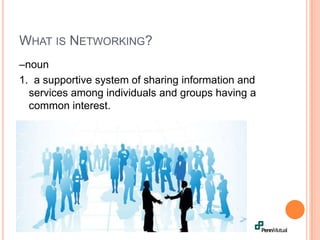
What is Networking?–noun1.  a supportive system of sharing information and services among individuals and groups having a common interest.
Networking Involves:Establishing goals.Analyzing the type of assistance you will need to achieve your goals.Developing your people skills.Building and cultivating your network.Maintaining your network through the years.
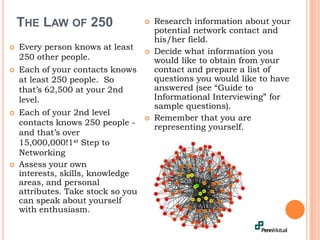
The Law of 250Research information about your potential network contact and his/her field.Decide what information you would like to obtain from your contact and prepare a list of questions you would like to have answered (see “Guide to Informational Interviewing” for sample questions).Remember that you are representing yourself.Every person knows at least 250 other people.Each of your contacts knows at least 250 people.  So that’s 62,500 at your 2nd level.Each of your 2nd level contacts knows 250 people - and that’s over 15,000,000!1st Step to NetworkingAssess your own interests, skills, knowledge areas, and personal attributes. Take stock so you can speak about yourself with enthusiasm.
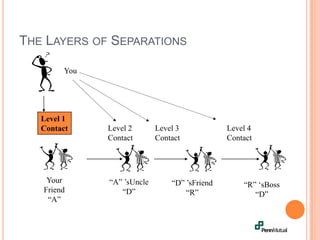
The Layers of Separations	YouLevel 1ContactLevel 2ContactLevel 3ContactLevel 4ContactYour Friend“A”“A” ’sUncle“D”“D” ’sFriend“R”“R” ‘sBoss“D”
Understanding Level 1 ContactsFamily/FriendsFriends of Family/NeighborsClassmates/AlumniContacts from Special Interest Groups (e.g., Sorority, Fraternity, Student organizations) Members of your religious congregationPeople dependant upon networking (e.g., realtors, insurance agents)Former employers/co-workersRecruiters/employers who give presentations on campus.Other job candidatesLUC Alumni Sharing Knowledge (LUC-ASK) Professional AssociationsContacts in the Career CenterFormer teachers, current professors and staff
What to Do Before Making Initial ContactKnow the purpose of your call/email/inquiryWhat do you want to know?Know yourself –What are your goals and interests?Know the person and company with whom you are speakingResearch the field to avoid asking questions you could answer on your ownDevelop an introductory script which summarizes your skills, experience and goalsPractice your script with a friend or a colleague. Remember to prepare open-ended questions.
1st Steps to Efficient NetworkingAssess your own interests, skills, knowledge areas, and personal attributes. Take stock so you can speak about yourself with enthusiasm.Research information about your potential network contact and his/her field.Decide what information you would like to obtain from your contact and prepare a list of questions you would like to have answered (see “Guide to Informational Interviewing” for sample questions).Remember that you are representing yourself and Loyola as a whole.
The Initial ContactPurpose:  Set up a meeting to discuss your needs, interests and goals.Level 1 Contacts: Call, e-mail or write a letter.Level 2, 3, etc. Contacts:  Send an “Approach” letter followed by a phone call.ATTACH YOUR RESUME AND INDICATE THAT IT’S ONLY FOR REFERENCE
Keep in Mind The same obligations and courtesies that come with traditional face-to-face networking apply to online interactions.Treat people the way you’d like to be treated, both online and offline!Career-related online networking should eventually lead to other forms of contact like phone conversations or in-person meetings.Keep an eye out for alumni and student networking receptions which are also a great way to meet with alumni.
Oh No You Didn’t!- Things Not To Do!Do not ask for a job or internship (ask for advice, information, and other contacts).Do not spam with multiple e-mails or stalk with multiple phone calls. Do not act unprofessionally or negatively.Do not ask your contact to mass distribute your resume. Do not share their contact information with others unless you have permission to do so.
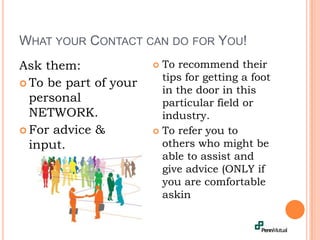
What your Contact can do for You!Ask them:To be part of your personal NETWORK.For advice & input.To recommend their tips for getting a foot in the door in this particular field or industry.To refer you to others who might be able to assist and give advice (ONLY if you are comfortable askin
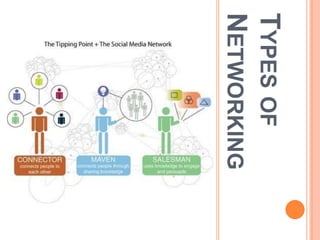
Types of Networking
Meet UpMeetup.com is the world’s largest network of self-organized clubs and community groups.It makes it easy for anyone to organize a local group or find one of the thousands already meeting up face-to-face.More than 2,000 groups get together in local communities each day, each one with the goal of improving themselves or their communities.Meetup is not about virtual relationships, but face-to-face, honest-to-goodness interaction between neighbors.
LinkedInVirtual NetworkingAn Up to date Resume & PortfolioAsk for Referrals & recommendations and reach your goal of 250 connections!
Networking by (E-mail or Letter) TechniqueYour letter should include:A brief introduction and your affiliation with LoyolaWhy you are writing to this individual; why you are interested in this field or organization A brief statement of your interests and/or experience That you would like to schedule a 15-30 minute meeting with them over the phone or in personThat you are asking for information and advice.Information about arrangements for the meeting or call with suggested dates, times and locations.Proofread all of your correspondence and be professional in your tone.  Even if this is already an “acquaintance” you should be formal and professional with them.
Telephone NetworkingTell them who you are, why you are calling & what you need. Always ask if this is a convenient time to talk.Tell them you don’t expect an immediate answer - ask if you can call them back at a later date.
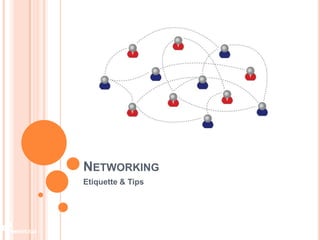
NetworkingEtiquette & Tips
Act Professionally	Be polite, respectful, and charming!Dress professionally for in-person meetings.Have 10-15 appropriate questions ready to ask for a half hour conversation, (see Networking Guidelines for examples of informational interview questions).Research the people you may meet. This always surprise them & makes you stand out from the masses. Be prepared for the person to ask you about your interests and experiences.Be respectful of the person’s time and keep the conversation short; they will let you know if they have additional time to share. Say “Thank You” at the conclusion of your conversation!
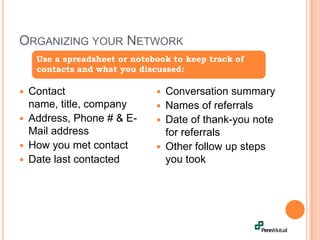
Organizing your NetworkContact name, title, company
Address, Phone # & E-Mail address
How you met contact
Date last contacted
Conversation summary

Networking2011

  • 1.
    Networking 101For theFinancial IndividualPresented By The Marketing Department of Penn Mutual
  • 2.
    What is Networking?–noun1. a supportive system of sharing information and services among individuals and groups having a common interest.
  • 3.
    Networking Involves:Establishing goals.Analyzingthe type of assistance you will need to achieve your goals.Developing your people skills.Building and cultivating your network.Maintaining your network through the years.
  • 4.
    The Law of250Research information about your potential network contact and his/her field.Decide what information you would like to obtain from your contact and prepare a list of questions you would like to have answered (see “Guide to Informational Interviewing” for sample questions).Remember that you are representing yourself.Every person knows at least 250 other people.Each of your contacts knows at least 250 people. So that’s 62,500 at your 2nd level.Each of your 2nd level contacts knows 250 people - and that’s over 15,000,000!1st Step to NetworkingAssess your own interests, skills, knowledge areas, and personal attributes. Take stock so you can speak about yourself with enthusiasm.
  • 5.
    The Layers ofSeparations YouLevel 1ContactLevel 2ContactLevel 3ContactLevel 4ContactYour Friend“A”“A” ’sUncle“D”“D” ’sFriend“R”“R” ‘sBoss“D”
  • 6.
    Understanding Level 1ContactsFamily/FriendsFriends of Family/NeighborsClassmates/AlumniContacts from Special Interest Groups (e.g., Sorority, Fraternity, Student organizations) Members of your religious congregationPeople dependant upon networking (e.g., realtors, insurance agents)Former employers/co-workersRecruiters/employers who give presentations on campus.Other job candidatesLUC Alumni Sharing Knowledge (LUC-ASK) Professional AssociationsContacts in the Career CenterFormer teachers, current professors and staff
  • 7.
    What to DoBefore Making Initial ContactKnow the purpose of your call/email/inquiryWhat do you want to know?Know yourself –What are your goals and interests?Know the person and company with whom you are speakingResearch the field to avoid asking questions you could answer on your ownDevelop an introductory script which summarizes your skills, experience and goalsPractice your script with a friend or a colleague. Remember to prepare open-ended questions.
  • 8.
    1st Steps toEfficient NetworkingAssess your own interests, skills, knowledge areas, and personal attributes. Take stock so you can speak about yourself with enthusiasm.Research information about your potential network contact and his/her field.Decide what information you would like to obtain from your contact and prepare a list of questions you would like to have answered (see “Guide to Informational Interviewing” for sample questions).Remember that you are representing yourself and Loyola as a whole.
  • 9.
    The Initial ContactPurpose: Set up a meeting to discuss your needs, interests and goals.Level 1 Contacts: Call, e-mail or write a letter.Level 2, 3, etc. Contacts: Send an “Approach” letter followed by a phone call.ATTACH YOUR RESUME AND INDICATE THAT IT’S ONLY FOR REFERENCE
  • 10.
    Keep in MindThe same obligations and courtesies that come with traditional face-to-face networking apply to online interactions.Treat people the way you’d like to be treated, both online and offline!Career-related online networking should eventually lead to other forms of contact like phone conversations or in-person meetings.Keep an eye out for alumni and student networking receptions which are also a great way to meet with alumni.
  • 11.
    Oh No YouDidn’t!- Things Not To Do!Do not ask for a job or internship (ask for advice, information, and other contacts).Do not spam with multiple e-mails or stalk with multiple phone calls. Do not act unprofessionally or negatively.Do not ask your contact to mass distribute your resume. Do not share their contact information with others unless you have permission to do so.
  • 12.
    What your Contactcan do for You!Ask them:To be part of your personal NETWORK.For advice & input.To recommend their tips for getting a foot in the door in this particular field or industry.To refer you to others who might be able to assist and give advice (ONLY if you are comfortable askin
  • 13.
  • 14.
    Meet UpMeetup.com isthe world’s largest network of self-organized clubs and community groups.It makes it easy for anyone to organize a local group or find one of the thousands already meeting up face-to-face.More than 2,000 groups get together in local communities each day, each one with the goal of improving themselves or their communities.Meetup is not about virtual relationships, but face-to-face, honest-to-goodness interaction between neighbors.
  • 15.
    LinkedInVirtual NetworkingAn Upto date Resume & PortfolioAsk for Referrals & recommendations and reach your goal of 250 connections!
  • 16.
    Networking by (E-mailor Letter) TechniqueYour letter should include:A brief introduction and your affiliation with LoyolaWhy you are writing to this individual; why you are interested in this field or organization A brief statement of your interests and/or experience That you would like to schedule a 15-30 minute meeting with them over the phone or in personThat you are asking for information and advice.Information about arrangements for the meeting or call with suggested dates, times and locations.Proofread all of your correspondence and be professional in your tone. Even if this is already an “acquaintance” you should be formal and professional with them.
  • 17.
    Telephone NetworkingTell themwho you are, why you are calling & what you need. Always ask if this is a convenient time to talk.Tell them you don’t expect an immediate answer - ask if you can call them back at a later date.
  • 18.
  • 19.
    Act Professionally Be polite,respectful, and charming!Dress professionally for in-person meetings.Have 10-15 appropriate questions ready to ask for a half hour conversation, (see Networking Guidelines for examples of informational interview questions).Research the people you may meet. This always surprise them & makes you stand out from the masses. Be prepared for the person to ask you about your interests and experiences.Be respectful of the person’s time and keep the conversation short; they will let you know if they have additional time to share. Say “Thank You” at the conclusion of your conversation!
  • 20.
    Organizing your NetworkContactname, title, company
  • 21.
    Address, Phone #& E-Mail address
  • 22.
  • 23.
  • 24.