



Networking Skills
Louise Bamford
Careers Consultant
Career Development Centre
www.westminster.ac.uk/careers
Objectives
This session will help you to:
• Understand the benefits of networking
• Develop your networking skills / strategies
• Approach contacts / employers in a
professional manner
• Re-assess your job search strategy
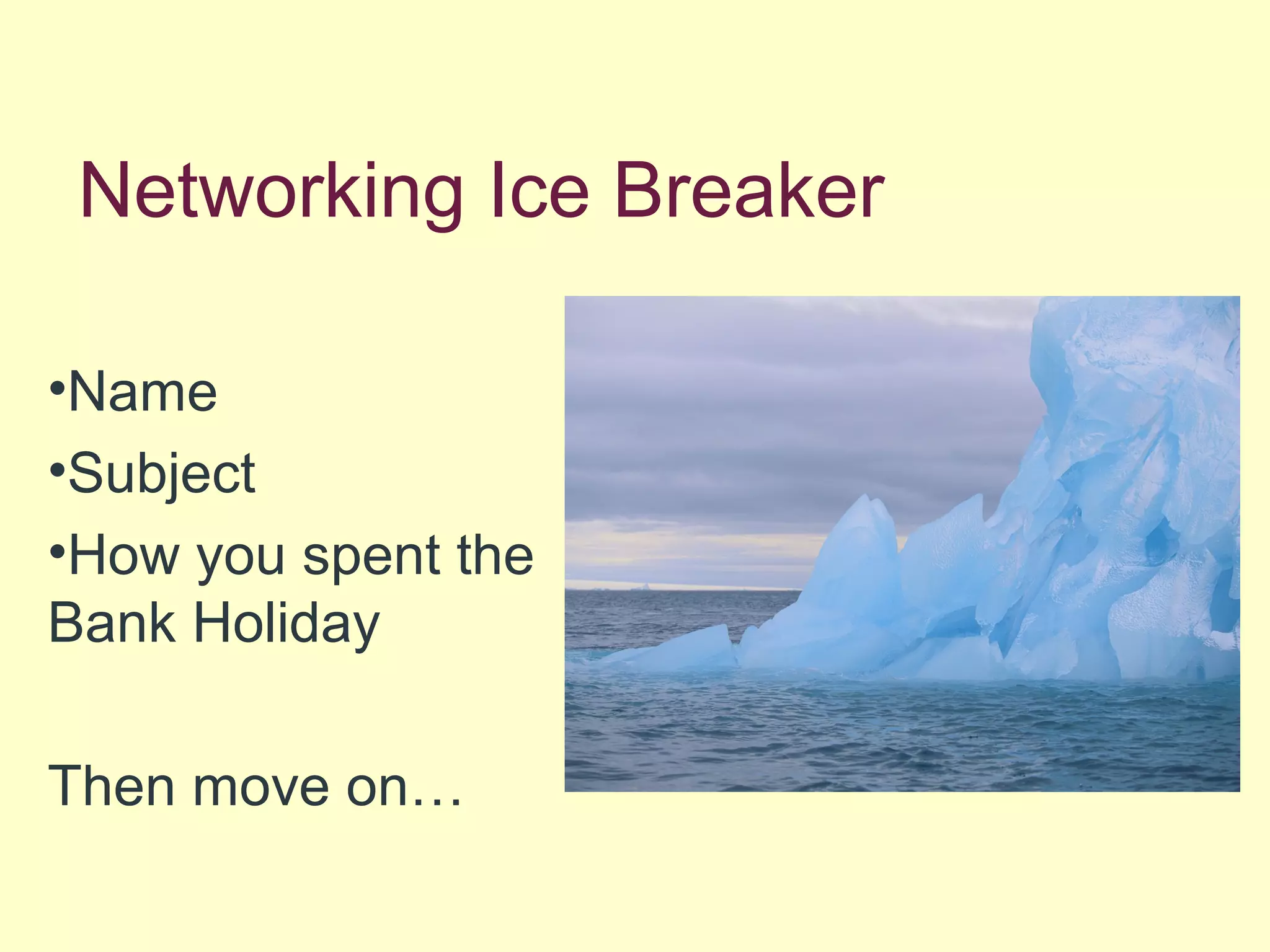
Networking Ice Breaker
•Name
•Subject
•How you spent the
Bank Holiday
Then move on…
What is networking?
…….?
What has networking ever done
for you?
…………Or how do
you hope it can
help you in the
future?
Why is networking important?
When you are starting out…
• Gain / learn about new opportunities for
shadowing, work experience or employment
• Advice on career choice / vacancy sources /
applications / interviews
• Industry trends and latest news
• Develop a motivating support network
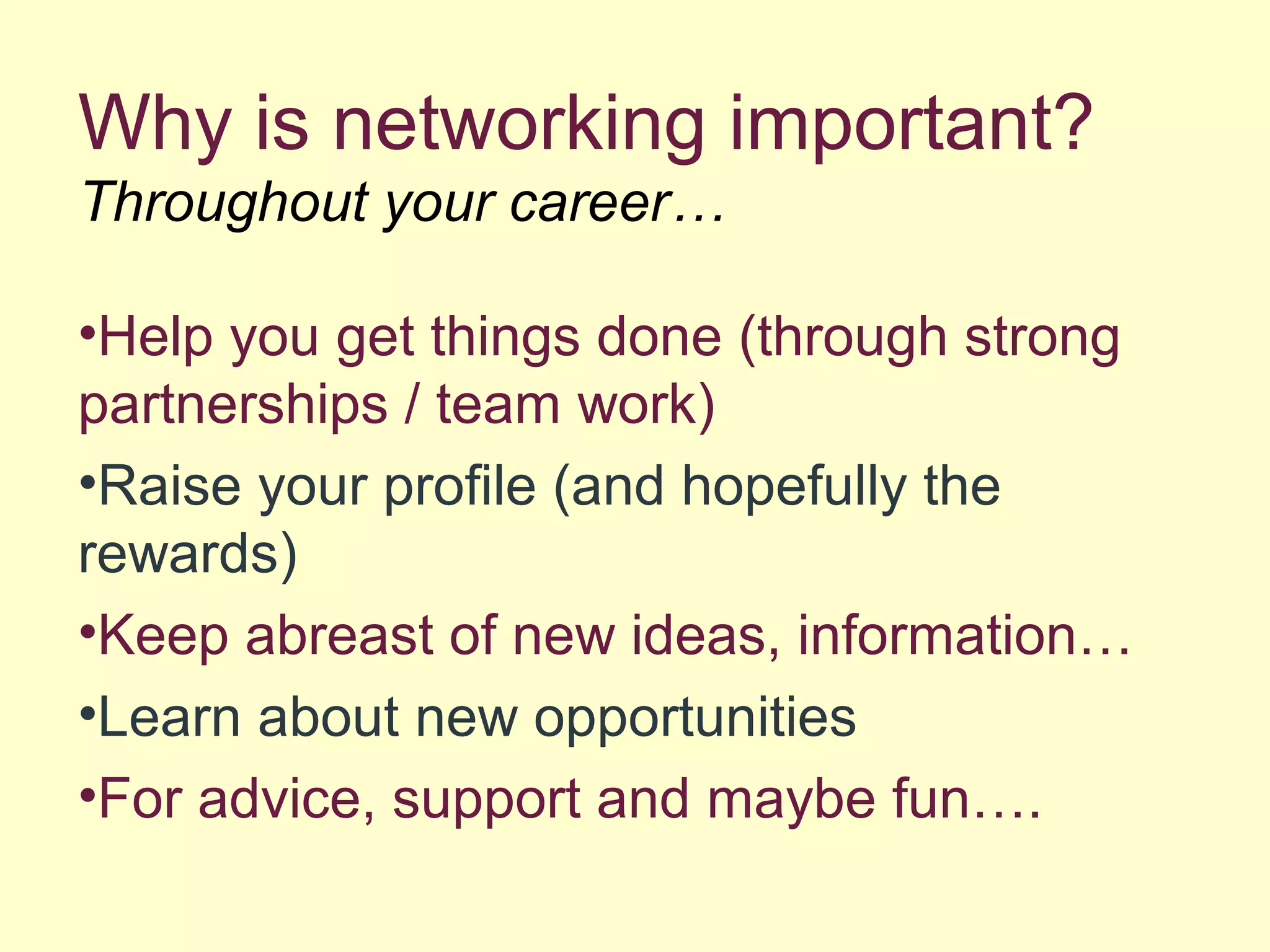
Why is networking important?
Throughout your career…
•Help you get things done (through strong
partnerships / team work)
•Raise your profile (and hopefully the
rewards)
•Keep abreast of new ideas, information…
•Learn about new opportunities
•For advice, support and maybe fun….
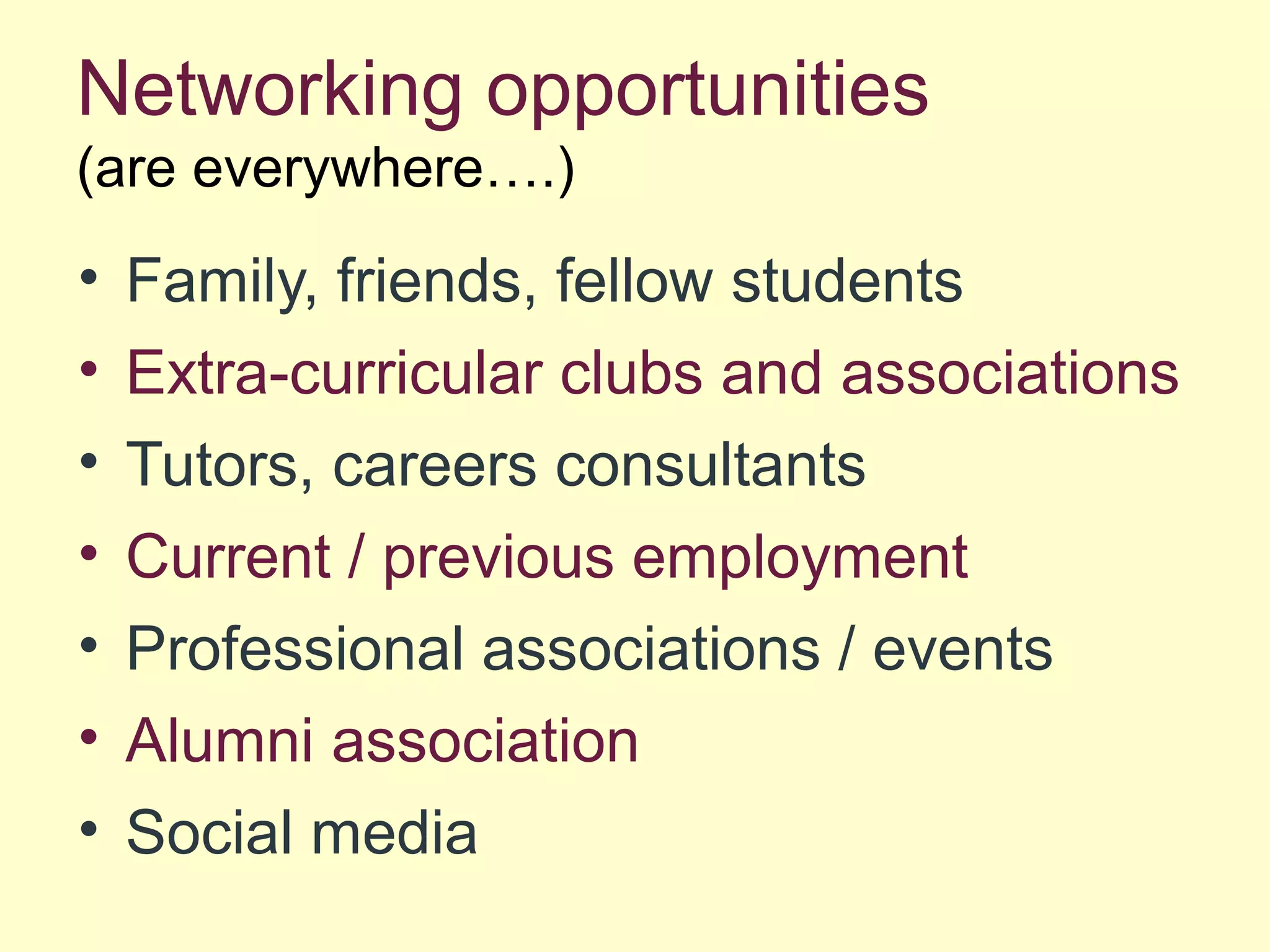
Networking opportunities
(are everywhere….)
• Family, friends, fellow students
• Extra-curricular clubs and associations
• Tutors, careers consultants
• Current / previous employment
• Professional associations / events
• Alumni association
• Social media
Six degrees of separation theory…why
you can network your way to meeting
anyone (including Kevin Bacon)
Yahoo!news – just explain it
Networking Exercise
• On the back of your action plan – write
“ME” in the middle of the page
• Pick a area you’d like to learn more about.
Who do you know who might be able to
help you with finding information about
career paths, opportunities, skills and key
advice?
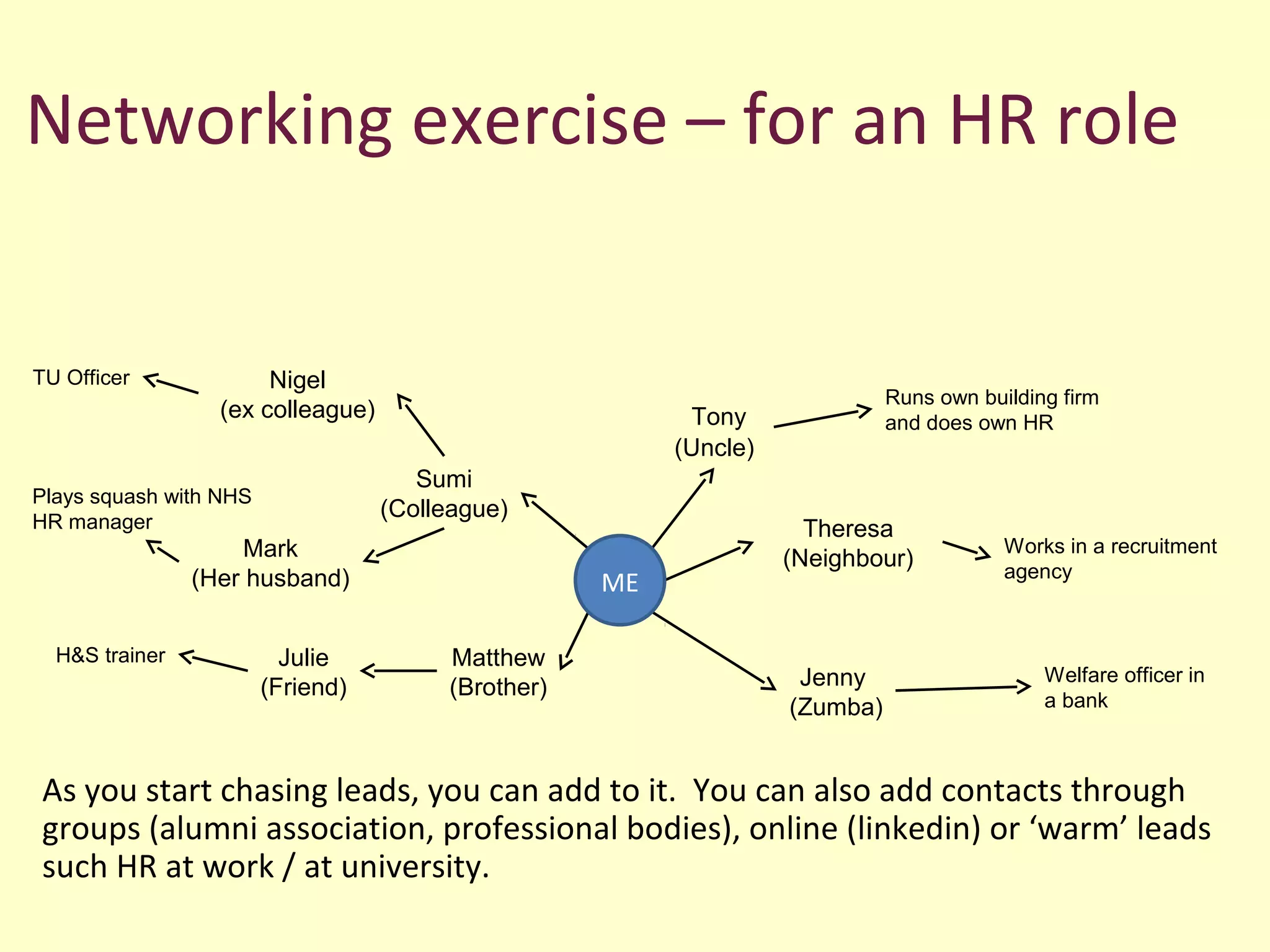
Networking exercise – for an HR role
Runs own building firm
and does own HRTony
(Uncle)
Theresa
(Neighbour)
Works in a recruitment
agency
Jenny
(Zumba)
Welfare officer in
a bank
Matthew
(Brother)
Julie
(Friend)
H&S trainer
Sumi
(Colleague)
Nigel
(ex colleague)
TU Officer
Mark
(Her husband)
Plays squash with NHS
HR manager
As you start chasing leads, you can add to it. You can also add contacts through
groups (alumni association, professional bodies), online (linkedin) or ‘warm’ leads
such HR at work / at university.
ME
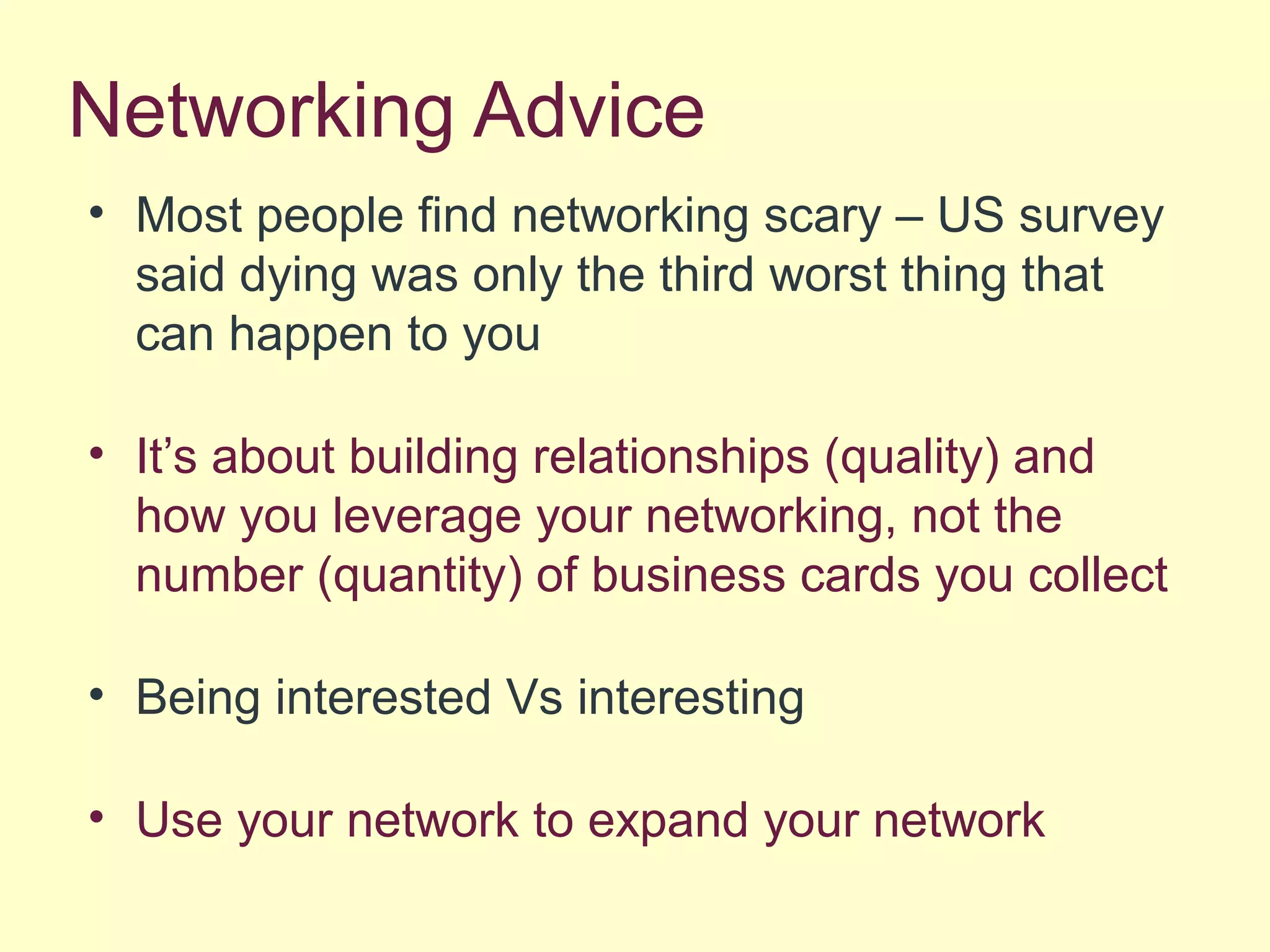
Networking Advice
• Most people find networking scary – US survey
said dying was only the third worst thing that
can happen to you
• It’s about building relationships (quality) and
how you leverage your networking, not the
number (quantity) of business cards you collect
• Being interested Vs interesting
• Use your network to expand your network
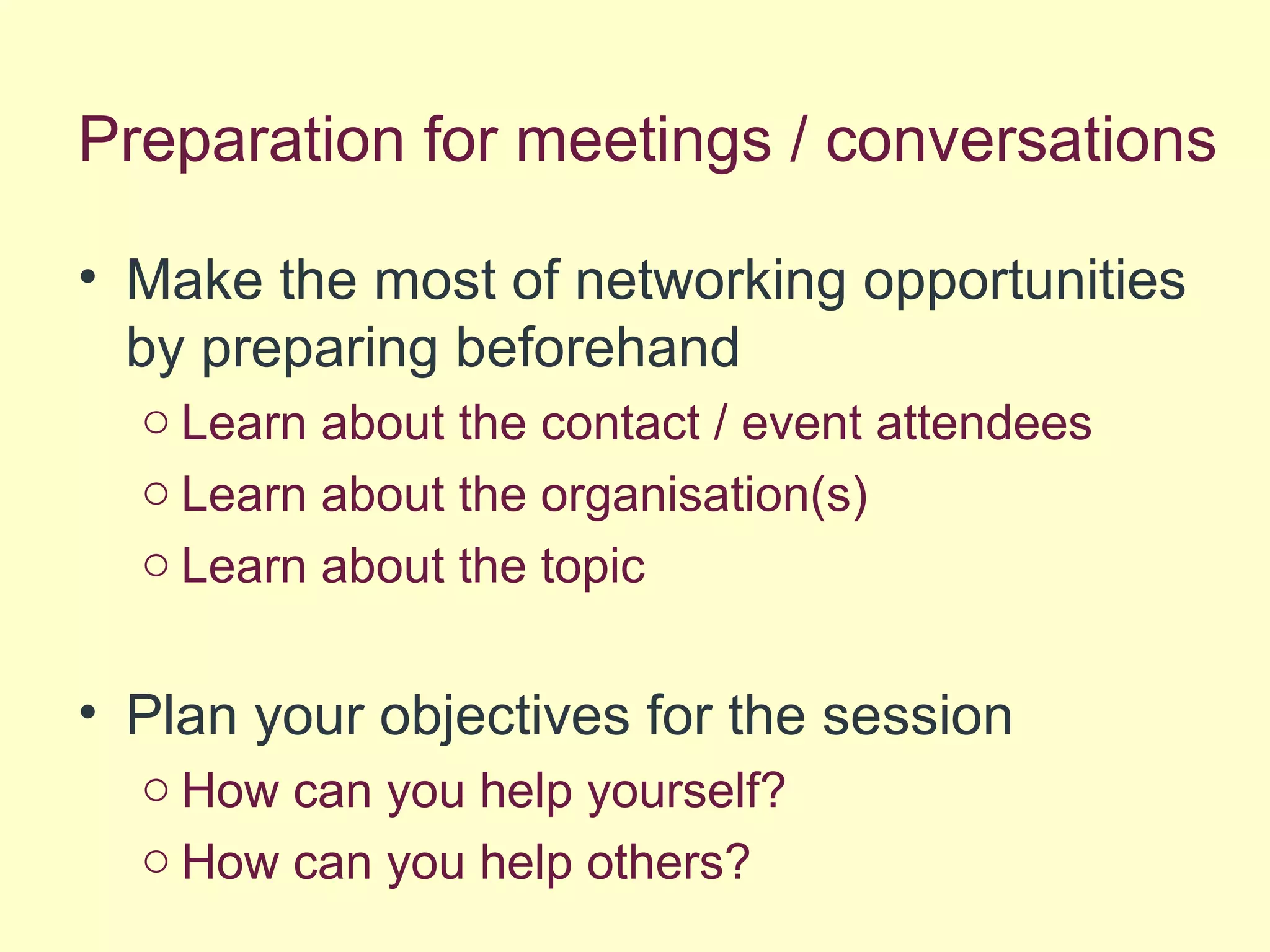
Preparation for meetings / conversations
• Make the most of networking opportunities
by preparing beforehand
o Learn about the contact / event attendees
o Learn about the organisation(s)
o Learn about the topic
• Plan your objectives for the session
o How can you help yourself?
o How can you help others?
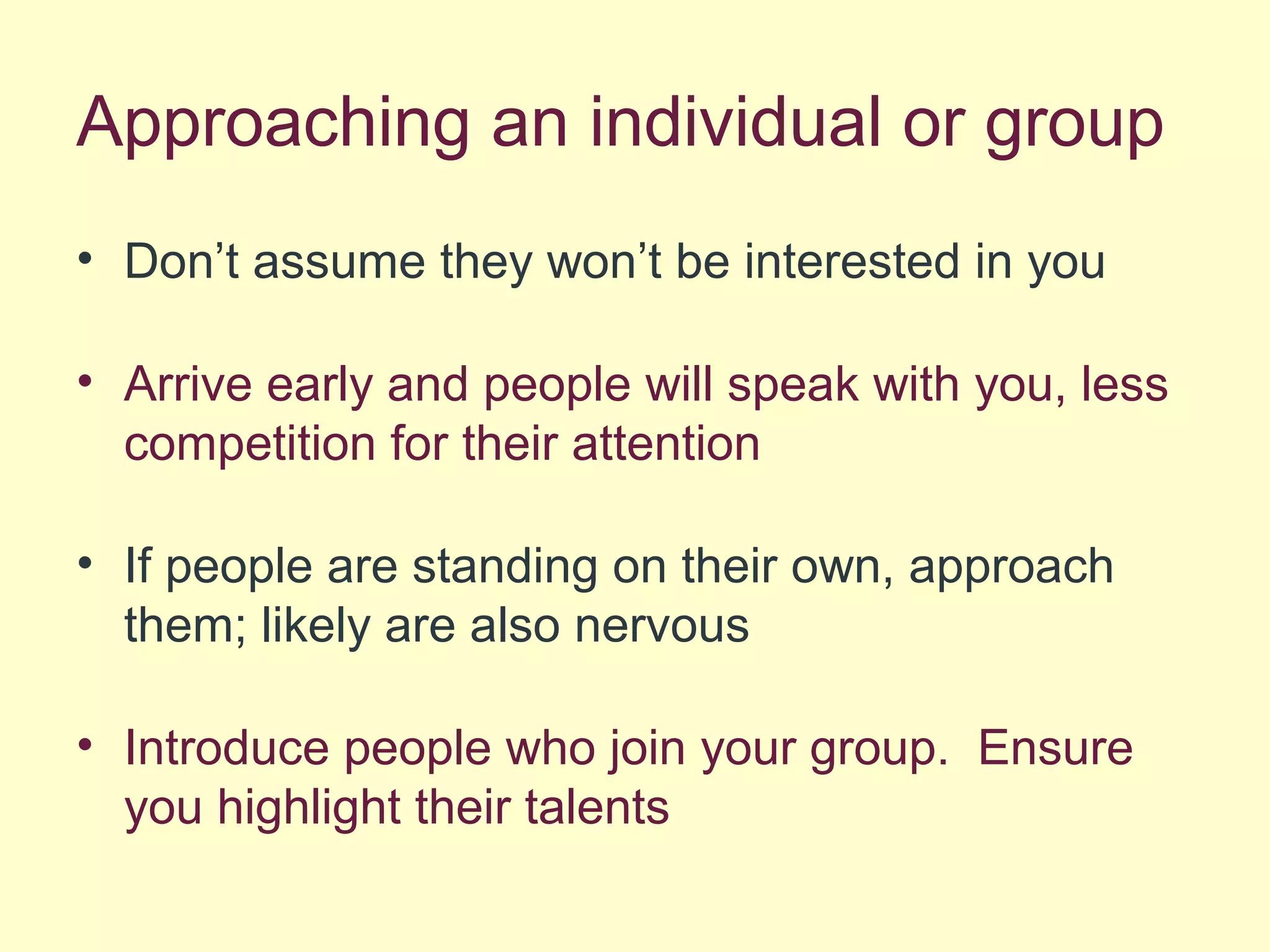
Approaching an individual or group
• Don’t assume they won’t be interested in you
• Arrive early and people will speak with you, less
competition for their attention
• If people are standing on their own, approach
them; likely are also nervous
• Introduce people who join your group. Ensure
you highlight their talents
Introducing yourself to strangers!
• Smile and offer a hand to shake
• Always offer your name first. Try to
introduce yourself in a relevant way
(interest in the event, recent achievements
etc.) rather than ‘student’
• If you think you have met before, state
your name clearly – they may not
remember
Remembering people’s names
• If you can’t remember their name be honest
…..“didn’t we meet at.... I’m desperately trying to remember your
name, please help me out”
• Listen
….Ask for it to be repeated if you didn’t catch it. Better now than
never! This will show the person you are interested in them
• Use them. It will help you (and others) to remember them.
….Imagine that you will have to introduce them to someone else in
a few minutes
• Look….you need to put a name to a face so need to remember what
they look like
• If you are given a badge wear it.
Concisely communicate your name,
skills, experience and current career
objective(s)
30 Second Elevator Pitch
Content of conversations
• Don’t know what to say? Good.
• People appreciate good listeners.
Encourage others to talk by asking
sensible, intelligent questions. And then
listen to the response (really listen – don’t
plan the next question).
Content of conversations
Offer an open question (who, what, why, how),
don’t interrogate them:
• How did you get started in your business?
• What do you enjoy most about your
profession?
• What advice would you give to someone just
starting out in the industry?
• What do you see as the coming trends in your
business?
• What’s the best thing about your work?
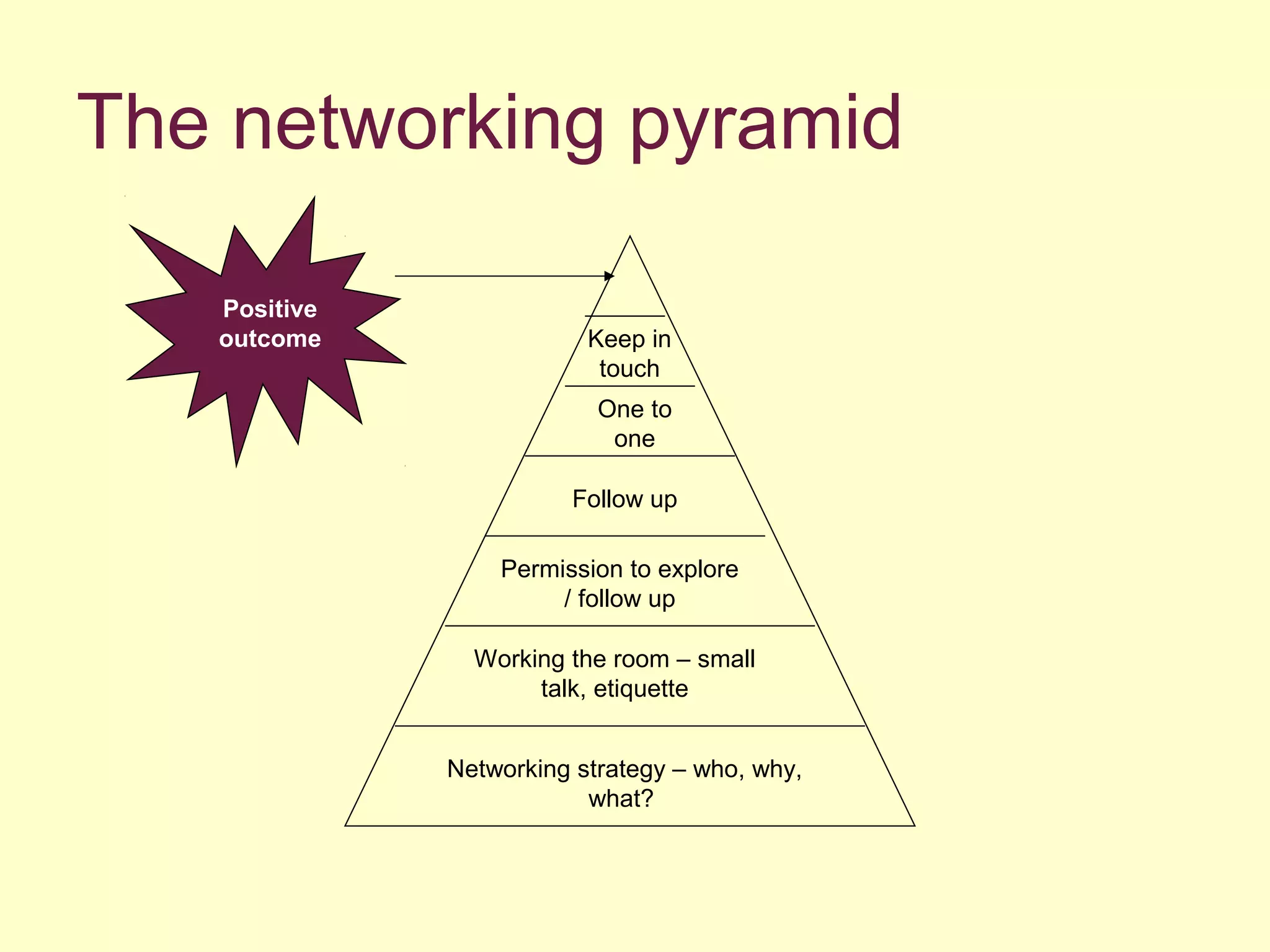
The networking pyramid
Networking strategy – who, why,
what?
Working the room – small
talk, etiquette
Permission to explore
/ follow up
Follow up
One to
one
Keep in
touch
Positive
outcome
Career Player
Tips and advice
=> Networking skills
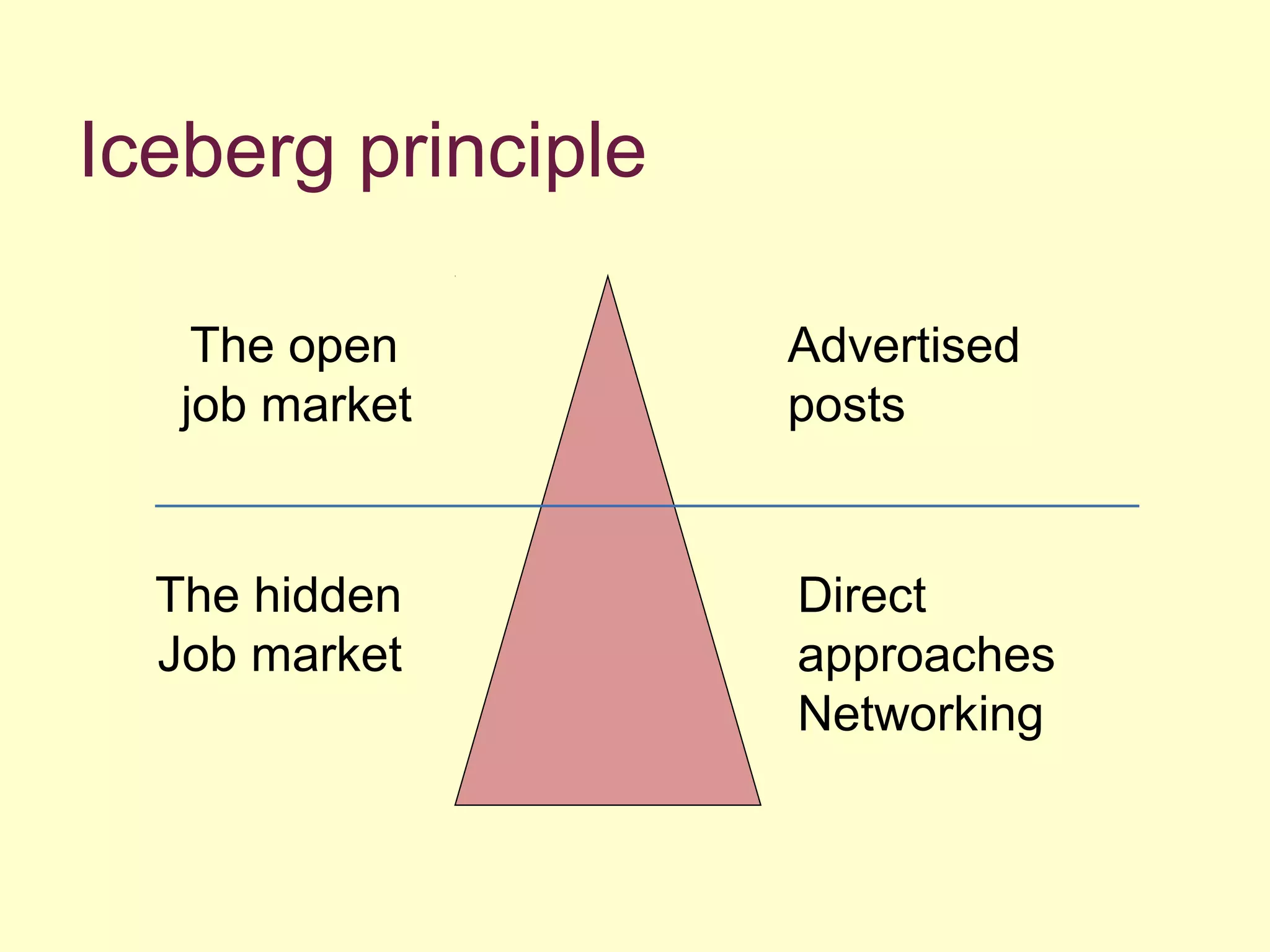
Iceberg principle
The open
job market
Advertised
posts
The hidden
Job market
Direct
approaches
Networking
Networking For A Job!
• Make it known that you are looking for work and
what it is that you can do
• Ask what they do and if they know anyone in the
industry who can help
• Use a broad spectrum of communication
methods: face-to-face, phone calls, emails, social
networking sites, online discussion forums
• By utilising your network, you are utilising
the network of everyone within that network too
Informational interviewing
• Find someone who knows about a field or
occupation
• Ask for a short interview
• This is not JOB SEARCH – it is
RESEARCH
• Helps you to find out about roles and fields
• Can reveal the hidden jobs
• Widens your network
• Who else do they know who can help?
Social Networking
Linkedin, twitter, (facebook?)
• Google yourself!
• Establish relevant online presence (also blog,
website?) – what’s your message??
• Link to your CV and portfolio
• Use to research companies and people
• Join and contribute to relevant online groups
• Establish contact with professionals you have
recently met
Aimee Bateman – Career Cake
How to connect with people you do
Before you
start…..you need
a plan!
What do you want to
achieve from
networking?
Your action plan
• What are you aiming for?
(Your career goals)
• What is your current situation?
(Job hunting activities underway, what /
who else do you need to know?)
• How can networking help you progress?
(Specific networking steps with dates)
Evaluation
– how was it for you?
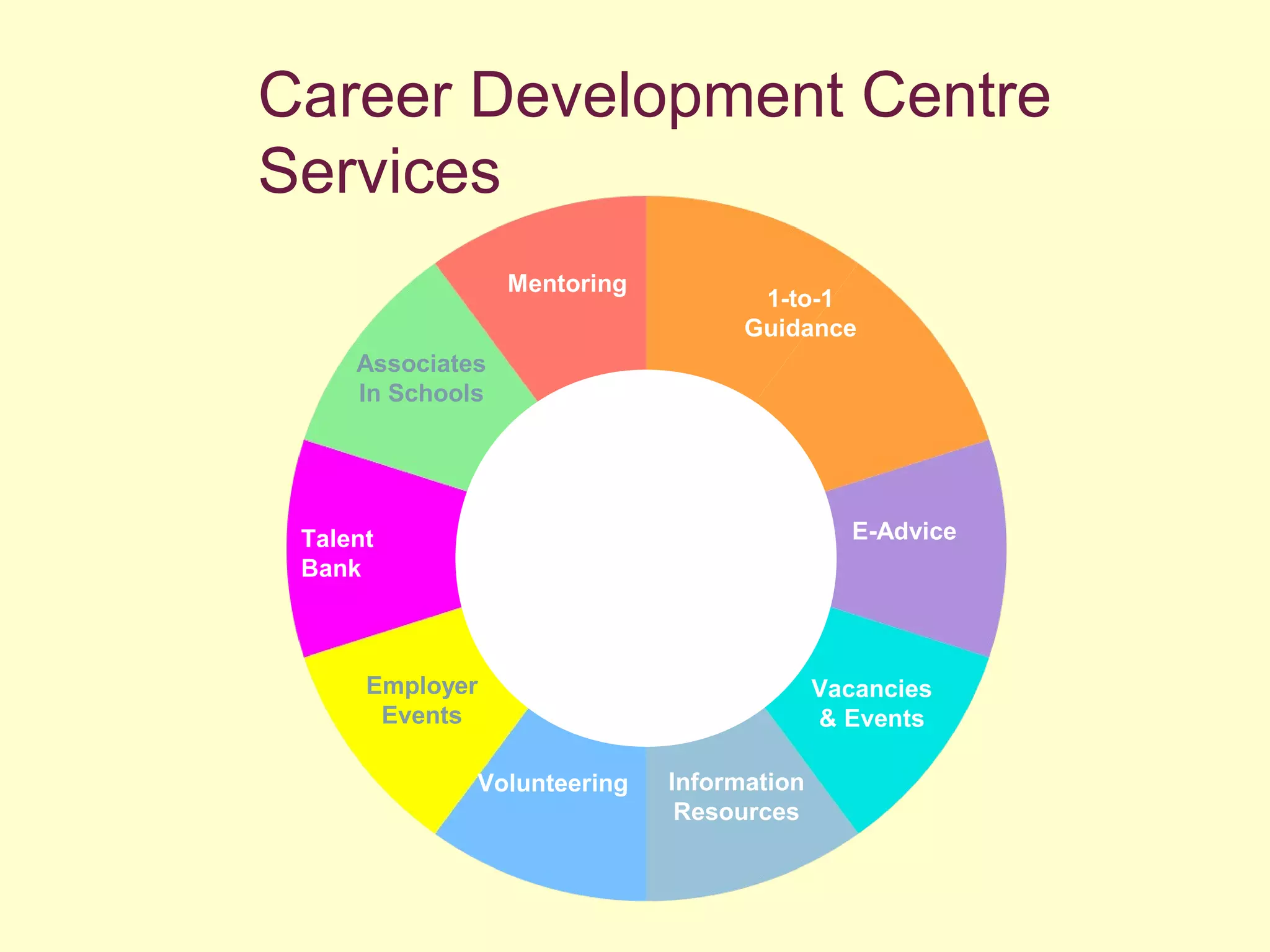
Career Development Centre
Services
1-to-1
Guidance
E-Advice
Vacancies
& Events
Information
Resources
Volunteering
Employer
Events
Talent
Bank
Associates
In Schools
Mentoring
Follow us on
facebook.com/uowcareers
twitter.com/uw_careers
blog.westminster.ac.uk/career
s
Slides are available
www.slideshare.net/cdcwestminster
Contact us
Harrow
Harrow Campus
Room EG.16
Maria Hewlett Building
Nearest tube: Northwick Park
Central London
Cavendish House
1st Floor
101 New Cavendish Street
Nearest tube: Warren St/
Goodge St/Gt Portland St
Tel: 020 7911 5184
E-mail: careers@wmin.ac.uk
www.westminster.ac.uk/careers
In summary
• Give and take……
• Know what you have to offer / you want
• Set yourself networking targets and review
regularly
• Always look for your next contact
• Step out of your comfort zone (away from
people you already know!)
• Seize all opportunities
……..and, if you need help, seek advice
and guidance

Networking Skills academy may 2014 networking

  • 1.
    Networking Skills Louise Bamford CareersConsultant Career Development Centre www.westminster.ac.uk/careers
  • 2.
    Objectives This session willhelp you to: • Understand the benefits of networking • Develop your networking skills / strategies • Approach contacts / employers in a professional manner • Re-assess your job search strategy
  • 3.
    Networking Ice Breaker •Name •Subject •Howyou spent the Bank Holiday Then move on…
  • 4.
  • 5.
    What has networkingever done for you? …………Or how do you hope it can help you in the future?
  • 6.
    Why is networkingimportant? When you are starting out… • Gain / learn about new opportunities for shadowing, work experience or employment • Advice on career choice / vacancy sources / applications / interviews • Industry trends and latest news • Develop a motivating support network
  • 7.
    Why is networkingimportant? Throughout your career… •Help you get things done (through strong partnerships / team work) •Raise your profile (and hopefully the rewards) •Keep abreast of new ideas, information… •Learn about new opportunities •For advice, support and maybe fun….
  • 8.
    Networking opportunities (are everywhere….) •Family, friends, fellow students • Extra-curricular clubs and associations • Tutors, careers consultants • Current / previous employment • Professional associations / events • Alumni association • Social media
  • 9.
    Six degrees ofseparation theory…why you can network your way to meeting anyone (including Kevin Bacon) Yahoo!news – just explain it
  • 10.
    Networking Exercise • Onthe back of your action plan – write “ME” in the middle of the page • Pick a area you’d like to learn more about. Who do you know who might be able to help you with finding information about career paths, opportunities, skills and key advice?
  • 11.
    Networking exercise –for an HR role Runs own building firm and does own HRTony (Uncle) Theresa (Neighbour) Works in a recruitment agency Jenny (Zumba) Welfare officer in a bank Matthew (Brother) Julie (Friend) H&S trainer Sumi (Colleague) Nigel (ex colleague) TU Officer Mark (Her husband) Plays squash with NHS HR manager As you start chasing leads, you can add to it. You can also add contacts through groups (alumni association, professional bodies), online (linkedin) or ‘warm’ leads such HR at work / at university. ME
  • 12.
    Networking Advice • Mostpeople find networking scary – US survey said dying was only the third worst thing that can happen to you • It’s about building relationships (quality) and how you leverage your networking, not the number (quantity) of business cards you collect • Being interested Vs interesting • Use your network to expand your network
  • 13.
    Preparation for meetings/ conversations • Make the most of networking opportunities by preparing beforehand o Learn about the contact / event attendees o Learn about the organisation(s) o Learn about the topic • Plan your objectives for the session o How can you help yourself? o How can you help others?
  • 14.
    Approaching an individualor group • Don’t assume they won’t be interested in you • Arrive early and people will speak with you, less competition for their attention • If people are standing on their own, approach them; likely are also nervous • Introduce people who join your group. Ensure you highlight their talents
  • 15.
    Introducing yourself tostrangers! • Smile and offer a hand to shake • Always offer your name first. Try to introduce yourself in a relevant way (interest in the event, recent achievements etc.) rather than ‘student’ • If you think you have met before, state your name clearly – they may not remember
  • 16.
    Remembering people’s names •If you can’t remember their name be honest …..“didn’t we meet at.... I’m desperately trying to remember your name, please help me out” • Listen ….Ask for it to be repeated if you didn’t catch it. Better now than never! This will show the person you are interested in them • Use them. It will help you (and others) to remember them. ….Imagine that you will have to introduce them to someone else in a few minutes • Look….you need to put a name to a face so need to remember what they look like • If you are given a badge wear it.
  • 17.
    Concisely communicate yourname, skills, experience and current career objective(s) 30 Second Elevator Pitch
  • 18.
    Content of conversations •Don’t know what to say? Good. • People appreciate good listeners. Encourage others to talk by asking sensible, intelligent questions. And then listen to the response (really listen – don’t plan the next question).
  • 19.
    Content of conversations Offeran open question (who, what, why, how), don’t interrogate them: • How did you get started in your business? • What do you enjoy most about your profession? • What advice would you give to someone just starting out in the industry? • What do you see as the coming trends in your business? • What’s the best thing about your work?
  • 20.
    The networking pyramid Networkingstrategy – who, why, what? Working the room – small talk, etiquette Permission to explore / follow up Follow up One to one Keep in touch Positive outcome
  • 21.
    Career Player Tips andadvice => Networking skills
  • 22.
    Iceberg principle The open jobmarket Advertised posts The hidden Job market Direct approaches Networking
  • 23.
    Networking For AJob! • Make it known that you are looking for work and what it is that you can do • Ask what they do and if they know anyone in the industry who can help • Use a broad spectrum of communication methods: face-to-face, phone calls, emails, social networking sites, online discussion forums • By utilising your network, you are utilising the network of everyone within that network too
  • 24.
    Informational interviewing • Findsomeone who knows about a field or occupation • Ask for a short interview • This is not JOB SEARCH – it is RESEARCH • Helps you to find out about roles and fields • Can reveal the hidden jobs • Widens your network • Who else do they know who can help?
  • 25.
    Social Networking Linkedin, twitter,(facebook?) • Google yourself! • Establish relevant online presence (also blog, website?) – what’s your message?? • Link to your CV and portfolio • Use to research companies and people • Join and contribute to relevant online groups • Establish contact with professionals you have recently met
  • 26.
    Aimee Bateman –Career Cake How to connect with people you do
  • 27.
    Before you start…..you need aplan! What do you want to achieve from networking?
  • 28.
    Your action plan •What are you aiming for? (Your career goals) • What is your current situation? (Job hunting activities underway, what / who else do you need to know?) • How can networking help you progress? (Specific networking steps with dates)
  • 29.
  • 30.
    Career Development Centre Services 1-to-1 Guidance E-Advice Vacancies &Events Information Resources Volunteering Employer Events Talent Bank Associates In Schools Mentoring
  • 31.
  • 32.
  • 33.
    Contact us Harrow Harrow Campus RoomEG.16 Maria Hewlett Building Nearest tube: Northwick Park Central London Cavendish House 1st Floor 101 New Cavendish Street Nearest tube: Warren St/ Goodge St/Gt Portland St Tel: 020 7911 5184 E-mail: careers@wmin.ac.uk www.westminster.ac.uk/careers
  • 34.
    In summary • Giveand take…… • Know what you have to offer / you want • Set yourself networking targets and review regularly • Always look for your next contact • Step out of your comfort zone (away from people you already know!) • Seize all opportunities ……..and, if you need help, seek advice and guidance

Editor's Notes

  • #19 Two eyes, two years, one mouth!!!! MJS Let eyes do the talking Be welcoming – be genuinely interested.