The Networking Process
and How It Works–
Essential steps for Success!
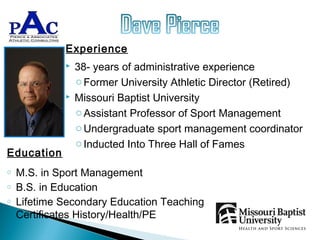
Experience
                38- years of administrative experience
                 o Former University Athletic Director (Retired)
                Missouri Baptist University
                 o Assistant Professor of Sport Management
                 o Undergraduate sport management coordinator
                 o Inducted Into Three Hall of Fames
Education
o   M.S. in Sport Management
o   B.S. in Education
o   Lifetime Secondary Education Teaching
    Certificates History/Health/PE
◦ Faster Answers to Questions
◦ Safety Net in a rapidly changing business
  world
◦ Less need to be an expert
◦ Resource for Business Deals, Alliances,
  Jobs
◦ Prepare by learning from others
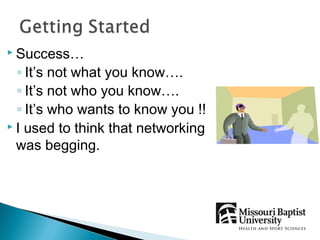
 Success…

  ◦ It’s not what you know….
  ◦ It’s not who you know….
  ◦ It’s who wants to know you !!
 I used to think that networking

  was begging.
 Then I realized that is not what people hear.
  When you network professionally, people
  respect the effort you have made, even if they
  can't help you right away,
 If you sit back and wait, opportunity will pass

  you by. You are always up against other people.
  If you want to be noticed you have to take
  action."
 If you want to be noticed, you have to make

  yourself known,
 1. a supportive system of sharing information and
  services among individuals and groups having a
  common interest. “ Networking is making links
  from people we know to people they know, in an
  organized way, for a specific purpose, while
  remaining committed to doing our part, expecting
  nothing in return.”
 2. groups of people who talk and share ideas,

  information, and resources. Networking —
  discovering connections between people.
◦ Establishing goals.
◦ Analyzing the type of assistance you will need to
  achieve your goals.
◦ Developing your people skills.
◦ Building and cultivating your network.
◦ Maintaining your network through the years.
◦ People love to give advice
◦ People like being thought of as “experts”
◦ Networking is not just asking for help, but agreeing to
  be helpful in return.
◦ 75% of people get their jobs through networking.
◦ Many positions are filled before they are even posted!
◦ People like to be “heroes”
◦ Every person knows at least 250 other people.
    ◦ Each of your contacts knows at least 250 people. So
      that’s 62,500 at your level.
    ◦ Each of your level contacts knows 250 people - and
      that’s over 15,000,000!
   Speed Networking Example
o   Crowd
o   Individual
◦ Family/Friends
◦ Friends of Family/Neighbors
◦ Classmates/Alumni
◦ Contacts from Special Interest Groups (e.g., Sorority,
  Fraternity, Student organizations)
◦ Members of your religious congregation
◦ People dependant upon networking (e.g., realtors,
  insurance agents)
◦ Former employers/co-workers
◦ Recruiters/employers who give presentations on
  campus.
◦ Other job candidates
◦ LUC Alumni Sharing Knowledge (LUC-ASK)
◦ Professional Associations
◦ Contacts in the Career Center
◦ Former teachers, current professors and staff
◦ Assess your own interests, skills, knowledge areas, and
  personal attributes. Take stock so you can speak about
  yourself with enthusiasm.
◦ Research information about your potential network
  contact and his/her field.
◦ Decide what information you would like to obtain from
  your contact and prepare a list of questions you would
  like to have answered (see “Guide to Informational
  Interviewing” for sample questions).
◦ Remember that you are representing yourself and
  Loyola as a whole.
◦ Do not ask for a job or internship (ask for advice,
  information, and other contacts).
◦ Do not spam with multiple e-mails or stalk with multiple
  phone calls.
◦ Do not act unprofessionally or negatively.
◦ Do not ask your contact to mass distribute your
  resume.
◦ Do not share their contact information with others
  unless you have permission to do so.
1 Contacts : Call, e-mail or write a letter.
    2, 3, etc. Contacts: Send an “Approach” letter followed
    by a phone call.
    ATTACH YOUR RESUME AND INDICATE THAT IT’S
    ONLY FOR REFERENCE!
   Purpose : Set up a meeting to discuss your
    needs, interests and goals
◦ Your letter should include:
   A brief introduction and your affiliation with Loyola
   Why you are writing to this individual; why you are interested in
    this field or organization
   A brief statement of your interests and/or experience
   That you would like to schedule a 15-30 minute meeting with
    them over the phone or in person
   That you are asking for information and advice.
   Information about arrangements for the meeting or call with
    suggested dates, times and locations.
◦ Proofread all of your correspondence and be professional in your
  tone. Even if this is already an “acquaintance” you should be formal
  and professional with them.
◦ Tell them who you are, why you are calling & what you need.
      Always ask if this is a convenient time to talk.
    ◦ Tell them you don’t expect an immediate answer - ask if you can
      call them back at a later date.
    Ask them:
    ◦ To be part of your personal NETWORK.
    ◦ For advice & input.
    ◦ To recommend their tips for getting a foot in the door in this
      particular field or industry.
    ◦ To refer you to others who might be able to assist and give advice
      (ONLY if you are comfortable asking).
   Tell Your Contact What You Need
◦ Be polite, respectful, and charming!
◦ Dress professionally for in-person meetings.
◦ Have 10-15 appropriate questions ready to ask for a half hour
  conversation, (see Networking Guidelines for examples of
  informational interview questions).
◦ Be prepared for the person to ask you about your interests and
  experiences.
◦ Be respectful of the person’s time and keep the conversation
  short; they will let you know if they have additional time to share.
◦ Say “Thank You” at the conclusion of your conversation!
◦ If your contact refers you to others, follow-up with
  them. Make sure to immediately mention your mutual
  contact and why they thought this new person might
  be helpful.
◦ Keep your contacts informed. If your original contact
  referred you to someone who was helpful, share that
  with her/him. Likewise, if a particular resource or
  research avenue was fruitful, let the person know.
◦ Take notes after your interactions. They may be helpful
  to refer to when reflecting on your conversation and
  conducting follow-up.
◦ Send a thank you note within 24-48 hours –either by
  email or handwritten. Include “How can I help you in
  return?”
◦ Ask yourself: What did I learn from my conversation?
  How does what I learned fit with my own interests,
  abilities, goals, and values? What additional information
  would be helpful to know?
   Develop Good People Skills

    ◦ Assert yourself positively and confidently.
    ◦ Ask good questions.
    ◦ Be a good listener.
    ◦ Be viewed as knowledgeable or skillful in a particular
      area.
    ◦ Show interest in being of assistance to others.
◦ Voicemail / Answering Machine – have a professional
  voicemail message.
◦ Social Networking websites – Keep your profile
  professional. Many people can access your
  information, even if your privacy settings are set to the
  maximum!
◦ Email address – again, keep it professional! Do not
  use something like “cutygirl89@hotmail” or
  “johnny420@yahoo”—those will not make good
  impressions.
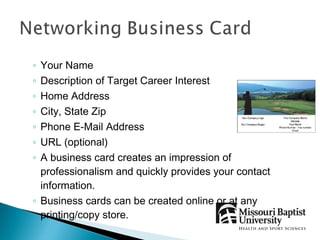
◦ Your Name
◦ Description of Target Career Interest
◦ Home Address
◦ City, State Zip
◦ Phone E-Mail Address
◦ URL (optional)
◦ A business card creates an impression of
  professionalism and quickly provides your contact
  information.
◦ Business cards can be created online or at any
  printing/copy store.
◦   Contact name, title, company
◦   Address, Phone # & E-Mail address
◦   How you met contact
◦   Date last contacted
◦   Conversation summary
◦   Names of referrals
◦   Date of thank-you note for referrals
◦   Other follow up steps you took
◦ Don’t let your “rolodex” gather dust – keep in touch
  through sending occasional emails, updates, links to
  articles, etc.
◦ Keep your contacts up-to-date on your progress.
◦ Always thank people!
◦ “ Remember, part of networking is giving to other
      people. The best networkers know that networking is
      much more than passing around resumes. It involves
      building relationships over time...”
    ◦ “Build Your Network, Now !”
   Final Thoughts…
 Thanks!

Networking

  • 1.
    The Networking Process andHow It Works– Essential steps for Success!
  • 2.
    Experience  38- years of administrative experience o Former University Athletic Director (Retired)  Missouri Baptist University o Assistant Professor of Sport Management o Undergraduate sport management coordinator o Inducted Into Three Hall of Fames Education o M.S. in Sport Management o B.S. in Education o Lifetime Secondary Education Teaching Certificates History/Health/PE
  • 3.
    ◦ Faster Answersto Questions ◦ Safety Net in a rapidly changing business world ◦ Less need to be an expert ◦ Resource for Business Deals, Alliances, Jobs ◦ Prepare by learning from others
  • 4.
     Success… ◦ It’s not what you know…. ◦ It’s not who you know…. ◦ It’s who wants to know you !!  I used to think that networking was begging.
  • 5.
     Then Irealized that is not what people hear. When you network professionally, people respect the effort you have made, even if they can't help you right away,  If you sit back and wait, opportunity will pass you by. You are always up against other people. If you want to be noticed you have to take action."  If you want to be noticed, you have to make yourself known,
  • 6.
     1. asupportive system of sharing information and services among individuals and groups having a common interest. “ Networking is making links from people we know to people they know, in an organized way, for a specific purpose, while remaining committed to doing our part, expecting nothing in return.”  2. groups of people who talk and share ideas, information, and resources. Networking — discovering connections between people.
  • 7.
    ◦ Establishing goals. ◦Analyzing the type of assistance you will need to achieve your goals. ◦ Developing your people skills. ◦ Building and cultivating your network. ◦ Maintaining your network through the years.
  • 8.
    ◦ People loveto give advice ◦ People like being thought of as “experts” ◦ Networking is not just asking for help, but agreeing to be helpful in return. ◦ 75% of people get their jobs through networking. ◦ Many positions are filled before they are even posted! ◦ People like to be “heroes”
  • 9.
    ◦ Every personknows at least 250 other people. ◦ Each of your contacts knows at least 250 people. So that’s 62,500 at your level. ◦ Each of your level contacts knows 250 people - and that’s over 15,000,000!  Speed Networking Example o Crowd o Individual
  • 10.
    ◦ Family/Friends ◦ Friendsof Family/Neighbors ◦ Classmates/Alumni ◦ Contacts from Special Interest Groups (e.g., Sorority, Fraternity, Student organizations) ◦ Members of your religious congregation ◦ People dependant upon networking (e.g., realtors, insurance agents) ◦ Former employers/co-workers
  • 11.
    ◦ Recruiters/employers whogive presentations on campus. ◦ Other job candidates ◦ LUC Alumni Sharing Knowledge (LUC-ASK) ◦ Professional Associations ◦ Contacts in the Career Center ◦ Former teachers, current professors and staff
  • 12.
    ◦ Assess yourown interests, skills, knowledge areas, and personal attributes. Take stock so you can speak about yourself with enthusiasm. ◦ Research information about your potential network contact and his/her field. ◦ Decide what information you would like to obtain from your contact and prepare a list of questions you would like to have answered (see “Guide to Informational Interviewing” for sample questions). ◦ Remember that you are representing yourself and Loyola as a whole.
  • 13.
    ◦ Do notask for a job or internship (ask for advice, information, and other contacts). ◦ Do not spam with multiple e-mails or stalk with multiple phone calls. ◦ Do not act unprofessionally or negatively. ◦ Do not ask your contact to mass distribute your resume. ◦ Do not share their contact information with others unless you have permission to do so.
  • 14.
    1 Contacts :Call, e-mail or write a letter. 2, 3, etc. Contacts: Send an “Approach” letter followed by a phone call. ATTACH YOUR RESUME AND INDICATE THAT IT’S ONLY FOR REFERENCE!  Purpose : Set up a meeting to discuss your needs, interests and goals
  • 15.
    ◦ Your lettershould include:  A brief introduction and your affiliation with Loyola  Why you are writing to this individual; why you are interested in this field or organization  A brief statement of your interests and/or experience  That you would like to schedule a 15-30 minute meeting with them over the phone or in person  That you are asking for information and advice.  Information about arrangements for the meeting or call with suggested dates, times and locations. ◦ Proofread all of your correspondence and be professional in your tone. Even if this is already an “acquaintance” you should be formal and professional with them.
  • 16.
    ◦ Tell themwho you are, why you are calling & what you need. Always ask if this is a convenient time to talk. ◦ Tell them you don’t expect an immediate answer - ask if you can call them back at a later date.   Ask them: ◦ To be part of your personal NETWORK. ◦ For advice & input. ◦ To recommend their tips for getting a foot in the door in this particular field or industry. ◦ To refer you to others who might be able to assist and give advice (ONLY if you are comfortable asking).  Tell Your Contact What You Need
  • 17.
    ◦ Be polite,respectful, and charming! ◦ Dress professionally for in-person meetings. ◦ Have 10-15 appropriate questions ready to ask for a half hour conversation, (see Networking Guidelines for examples of informational interview questions). ◦ Be prepared for the person to ask you about your interests and experiences. ◦ Be respectful of the person’s time and keep the conversation short; they will let you know if they have additional time to share. ◦ Say “Thank You” at the conclusion of your conversation!
  • 18.
    ◦ If yourcontact refers you to others, follow-up with them. Make sure to immediately mention your mutual contact and why they thought this new person might be helpful. ◦ Keep your contacts informed. If your original contact referred you to someone who was helpful, share that with her/him. Likewise, if a particular resource or research avenue was fruitful, let the person know.
  • 19.
    ◦ Take notesafter your interactions. They may be helpful to refer to when reflecting on your conversation and conducting follow-up. ◦ Send a thank you note within 24-48 hours –either by email or handwritten. Include “How can I help you in return?” ◦ Ask yourself: What did I learn from my conversation? How does what I learned fit with my own interests, abilities, goals, and values? What additional information would be helpful to know?
  • 20.
    Develop Good People Skills ◦ Assert yourself positively and confidently. ◦ Ask good questions. ◦ Be a good listener. ◦ Be viewed as knowledgeable or skillful in a particular area. ◦ Show interest in being of assistance to others.
  • 21.
    ◦ Voicemail /Answering Machine – have a professional voicemail message. ◦ Social Networking websites – Keep your profile professional. Many people can access your information, even if your privacy settings are set to the maximum! ◦ Email address – again, keep it professional! Do not use something like “cutygirl89@hotmail” or “johnny420@yahoo”—those will not make good impressions.
  • 22.
    ◦ Your Name ◦Description of Target Career Interest ◦ Home Address ◦ City, State Zip ◦ Phone E-Mail Address ◦ URL (optional) ◦ A business card creates an impression of professionalism and quickly provides your contact information. ◦ Business cards can be created online or at any printing/copy store.
  • 23.
    Contact name, title, company ◦ Address, Phone # & E-Mail address ◦ How you met contact ◦ Date last contacted ◦ Conversation summary ◦ Names of referrals ◦ Date of thank-you note for referrals ◦ Other follow up steps you took
  • 24.
    ◦ Don’t letyour “rolodex” gather dust – keep in touch through sending occasional emails, updates, links to articles, etc. ◦ Keep your contacts up-to-date on your progress. ◦ Always thank people!
  • 25.
    ◦ “ Remember,part of networking is giving to other people. The best networkers know that networking is much more than passing around resumes. It involves building relationships over time...” ◦ “Build Your Network, Now !”  Final Thoughts…
  • 26.