Successful Networking

University of Houston
College of Technology
Academic Services Center
What is Networking?
O Networking is simply building alliances
O Building relationships with intent to share

advice, information, recommendations, and
share referrals

O Networking can offer valuable contacts and

insights into career fields, companies, and
geographic
Why Is Networking
Important?
O According to the U.S. Bureau of Labor Statistics, 70

percent of jobs are found through networking.
O Networking unlocks the door to the “hidden job

market” that is jobs that are never posted for the
public.
O Employers know the best candidates are likely the

ones referred to them by word of mouth.
Types of Networking
Online

O www.linkedin.com
O www.facebook.com

Face to Face Networking
O Chamber of Commerce Functions
O Industry groups
O Alumni groups
O Toastmasters
O Seminars
O Social and Cultural Events
General Networking (Easiest Method):
O Friends and family
O Professional contacts
O Anyone
Where to Find Networking
Groups and Events
O Professional Journals – posts various group

meetings

O Organization/Association Newsletter
O Local Chamber of Commerce
O Local Newspapers or Industry Magazines
O Online
Things to Remember
O Assess yourself
O Know your goals
O Provide value
O Build Rapport
O Follow up, follow up, follow up
Assess and Prepare yourself
O Dress professionally
O Know how to explain what you do
O Prepare a “30 second commercial” – something

catchy so you stand apart from others

O The more information you have, the easier it is to

establish rapport and build relationships

O Think about what you can offer networking partners
Know Your Goals
O What are you seeking to accomplish

from networking?
O Focus on what you want to achieve
O How can you help others?
Providing Value
O How can I help someone else by connecting

with me?
O Give before you take
O Invite them to an event that would be beneficial

for them
O Introduce them to people they might benefit from
O In follow up, send an article or website information
that might be of interest
What to Say
O Be Yourself, don’t try so hard
O Structure the conversation:
O Introduce yourself
O Ask questions about the person
O “30 second commercial”
O Plan to spend, on average, 5-7 minutes
per person in order to properly cover the
room
Building Rapport
O Ask questions that will engage your

partner and create dialogue. Make
them talk about themselves and look
for a mutual interest.

O Be careful with time spent, but know

the best way to win the connection is
to win the person first.
“The first few minutes that you talk to someone, they
decide if they like you or not.
The more you talk about and ask about them, the more
they will like you.”
-Jeffrey Gitomer
(author, professional speaker, and business trainer)
Networking Tips
O
O
O
O
O
O
O

Project Confidence
Ask open-ended questions
Maintain Strong Eye Contact
Find Something in Common
Go where your customers and prospects go
Appreciate their time and Say “Thank You”
Always follow up
“Fear can only settle in when focus is inward.”
–Mary Kay
4 keys to Fearless Networking
O

Ask the right questions at the right time

O Listen for needs, issues, wants, and concerns
O Match maker
O Service above self
Networking No-No’s
O DO NOT ask for a job or internship (focus on obtaining

advice, information and other contacts)

O DO NOT spam with multiple e-mails or stalk with

multiple phone calls

O DO NOT act unprofessionally or negatively
O Do NOT talking bad about your former employer

Remember: “Neediness Repels, Caring Attracts”
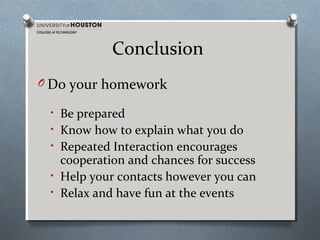
Conclusion
O Do your homework
• Be prepared
• Know how to explain what you do
• Repeated Interaction encourages

cooperation and chances for success
• Help your contacts however you can
• Relax and have fun at the events
Thank you!
Cynthia Olmedo
College of Technology- Career Counselor
300 Technology Building (T-1), #108
ceolmedo@uh.edu
(713)743-3445

Successfulnetworking workshop

  • 1.
    Successful Networking University ofHouston College of Technology Academic Services Center
  • 2.
    What is Networking? ONetworking is simply building alliances O Building relationships with intent to share advice, information, recommendations, and share referrals O Networking can offer valuable contacts and insights into career fields, companies, and geographic
  • 3.
    Why Is Networking Important? OAccording to the U.S. Bureau of Labor Statistics, 70 percent of jobs are found through networking. O Networking unlocks the door to the “hidden job market” that is jobs that are never posted for the public. O Employers know the best candidates are likely the ones referred to them by word of mouth.
  • 4.
    Types of Networking Online Owww.linkedin.com O www.facebook.com Face to Face Networking O Chamber of Commerce Functions O Industry groups O Alumni groups O Toastmasters O Seminars O Social and Cultural Events General Networking (Easiest Method): O Friends and family O Professional contacts O Anyone
  • 5.
    Where to FindNetworking Groups and Events O Professional Journals – posts various group meetings O Organization/Association Newsletter O Local Chamber of Commerce O Local Newspapers or Industry Magazines O Online
  • 6.
    Things to Remember OAssess yourself O Know your goals O Provide value O Build Rapport O Follow up, follow up, follow up
  • 7.
    Assess and Prepareyourself O Dress professionally O Know how to explain what you do O Prepare a “30 second commercial” – something catchy so you stand apart from others O The more information you have, the easier it is to establish rapport and build relationships O Think about what you can offer networking partners
  • 8.
    Know Your Goals OWhat are you seeking to accomplish from networking? O Focus on what you want to achieve O How can you help others?
  • 9.
    Providing Value O Howcan I help someone else by connecting with me? O Give before you take O Invite them to an event that would be beneficial for them O Introduce them to people they might benefit from O In follow up, send an article or website information that might be of interest
  • 10.
    What to Say OBe Yourself, don’t try so hard O Structure the conversation: O Introduce yourself O Ask questions about the person O “30 second commercial” O Plan to spend, on average, 5-7 minutes per person in order to properly cover the room
  • 11.
    Building Rapport O Askquestions that will engage your partner and create dialogue. Make them talk about themselves and look for a mutual interest. O Be careful with time spent, but know the best way to win the connection is to win the person first.
  • 12.
    “The first fewminutes that you talk to someone, they decide if they like you or not. The more you talk about and ask about them, the more they will like you.” -Jeffrey Gitomer (author, professional speaker, and business trainer)
  • 13.
    Networking Tips O O O O O O O Project Confidence Askopen-ended questions Maintain Strong Eye Contact Find Something in Common Go where your customers and prospects go Appreciate their time and Say “Thank You” Always follow up “Fear can only settle in when focus is inward.” –Mary Kay
  • 14.
    4 keys toFearless Networking O Ask the right questions at the right time O Listen for needs, issues, wants, and concerns O Match maker O Service above self
  • 15.
    Networking No-No’s O DONOT ask for a job or internship (focus on obtaining advice, information and other contacts) O DO NOT spam with multiple e-mails or stalk with multiple phone calls O DO NOT act unprofessionally or negatively O Do NOT talking bad about your former employer Remember: “Neediness Repels, Caring Attracts”
  • 16.
    Conclusion O Do yourhomework • Be prepared • Know how to explain what you do • Repeated Interaction encourages cooperation and chances for success • Help your contacts however you can • Relax and have fun at the events
  • 17.
    Thank you! Cynthia Olmedo Collegeof Technology- Career Counselor 300 Technology Building (T-1), #108 ceolmedo@uh.edu (713)743-3445