
HOW TO AVOID
BUSINESS OUTAGES
FROM MISCONFIGURED
NETWORK DEVICES
TOPICS COVERED TODAY
• Understanding the problem: misconfigured network
devices
• Typical change control processes
• The Gap between Business and IT Security
• Data center migration
2 | Confidential
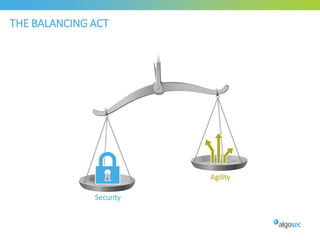
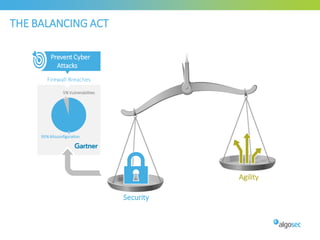
THE BALANCING ACT
3
Security
Agility
Firewall Breaches
5% Vulnerabilities
95%Misconfiguration
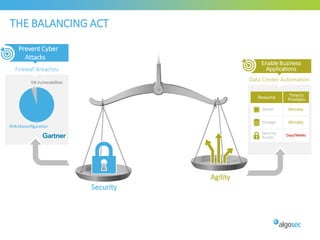
THE BALANCING ACT
Security
Agility
Prevent Cyber
Attacks
Firewall Breaches
Data Center Automation5% Vulnerabilities
95%Misconfiguration
THE BALANCING ACT
5
Security
Agility
Prevent Cyber
Attacks
Enable Business
Applications
Resource Timeto
Provision
Server Minutes
Storage Minutes
Security
Access Days/Weeks
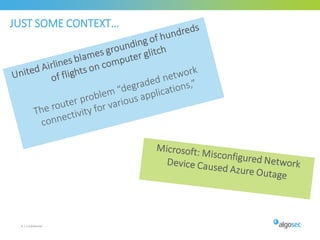
JUST SOME CONTEXT…
6 | Confidential
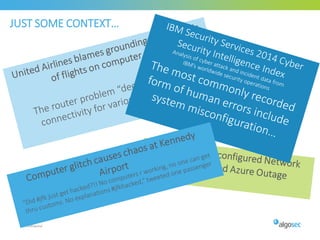
JUST SOME CONTEXT…
7 | Confidential
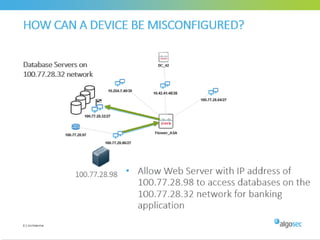
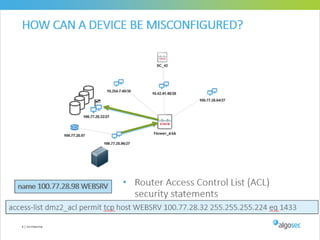
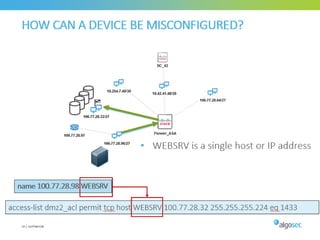
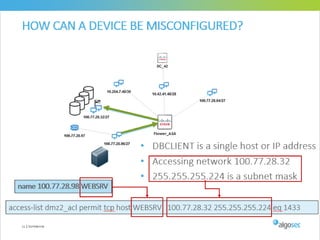
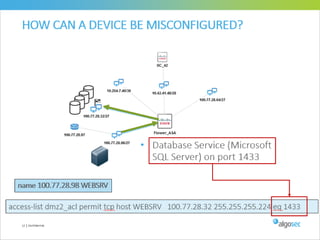
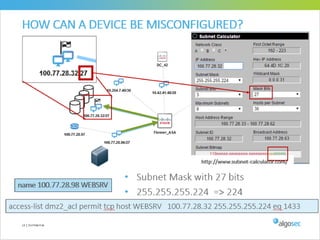
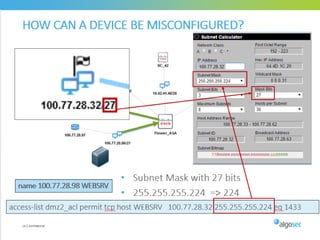
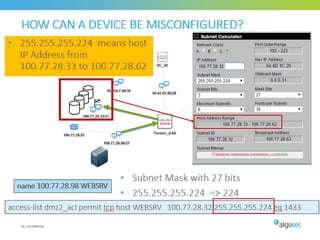
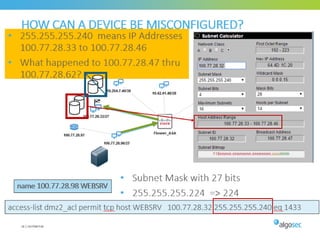
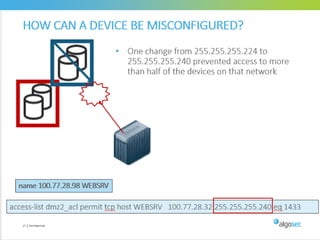
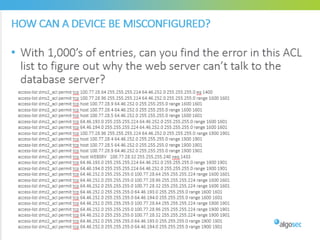
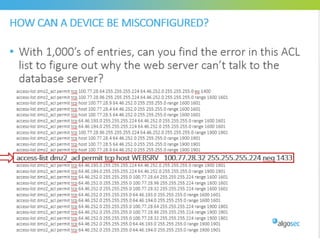
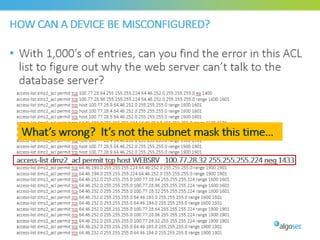
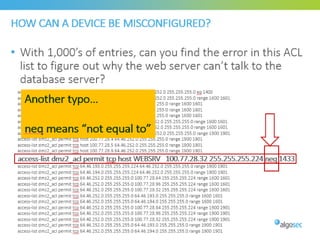
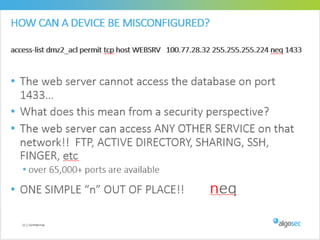
HOW CAN A DEVICE BE MISCONFIGURED?
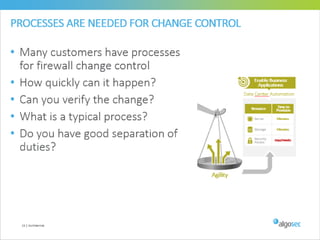
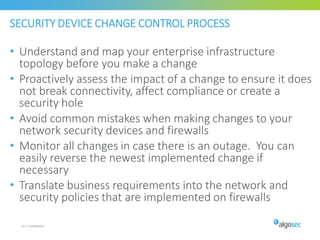
SECURITY DEVICE CHANGE CONTROL PROCESS
• Understand and map your enterprise infrastructure
topology before you make a change
• Proactively assess the impact of a change to ensure it does
not break connectivity, affect compliance or create a
security hole
• Avoid common mistakes when making changes to your
network security devices and firewalls
• Monitor all changes in case there is an outage. You can
easily reverse the newest implemented change if
necessary
• Translate business requirements into the network and
security policies that are implemented on firewalls
24 | Confidential
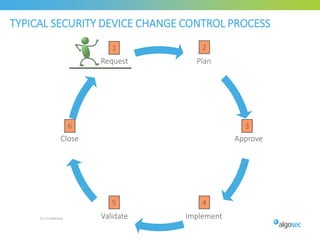
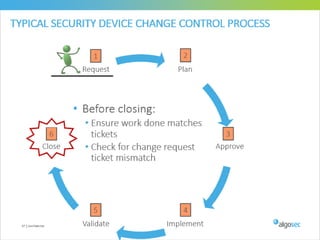
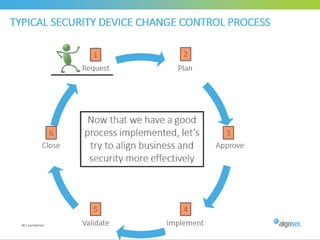
TYPICAL SECURITY DEVICE CHANGE CONTROL PROCESS
25 | Confidential
Plan
Approve
ImplementValidate
Close
Request
1 2
3
4
6
5
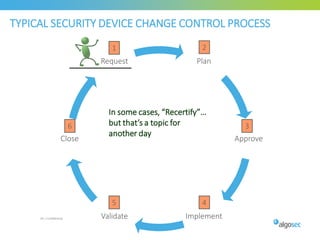
TYPICAL SECURITY DEVICE CHANGE CONTROL PROCESS
26 | Confidential
Plan
Approve
ImplementValidate
Close
Request
1 2
3
4
6
5
In some cases, “Recertify”…
but that’s a topic for
another day
TYPICAL SECURITY DEVICE CHANGE CONTROL PROCESS
27 | Confidential
Plan
Approve
ImplementValidate
Close
Request
1 2
3
4
6
5
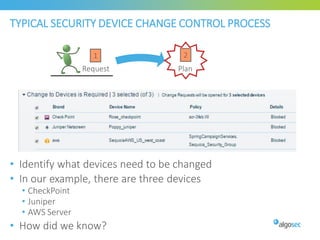
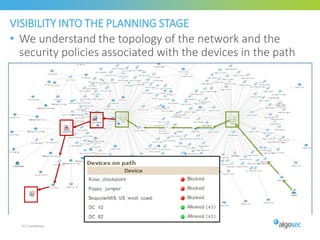
• Identify what devices need to be changed
• In our example, there are three devices
• CheckPoint
• Juniper
• AWS Server
• How did we know?
VISIBILITY INTO THE PLANNING STAGE
• We understand the topology of the network and the
security policies associated with the devices in the path
28 | Confidential
Plan
Approve
ImplementValidate
Close
Request
TYPICAL SECURITY DEVICE CHANGE CONTROL PROCESS
29 | Confidential
1 2
3
4
6
5
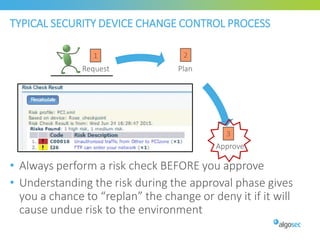
• Always perform a risk check BEFORE you approve
• Understanding the risk during the approval phase gives
you a chance to “replan” the change or deny it if it will
cause undue risk to the environment
Plan
Approve
ImplementValidate
Close
Request
TYPICAL SECURITY DEVICE CHANGE CONTROL PROCESS
30 | Confidential
1 2
3
4
6
5
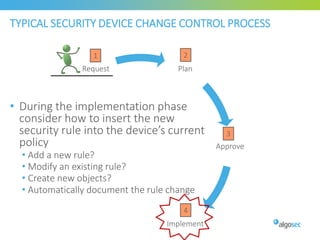
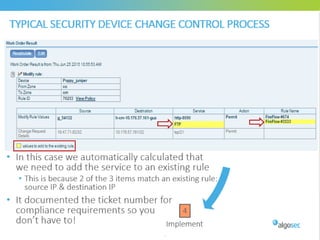
• During the implementation phase
consider how to insert the new
security rule into the device’s current
policy
• Add a new rule?
• Modify an existing rule?
• Create new objects?
• Automatically document the rule change
Plan
Approve
ImplementValidate
Close
Request
TYPICAL SECURITY DEVICE CHANGE CONTROL PROCESS
32 | Confidential
1 2
3
4
6
5
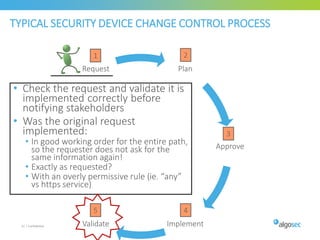
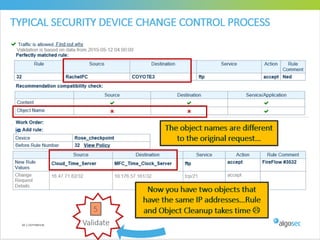
• Check the request and validate it is
implemented correctly before
notifying stakeholders
• Was the original request
implemented:
• In good working order for the entire path,
so the requester does not ask for the
same information again!
• Exactly as requested?
• With an overly permissive rule (ie. “any”
vs https service)
Plan
Approve
ImplementValidate
Close
Request
TYPICAL SECURITY DEVICE CHANGE CONTROL PROCESS
33 | Confidential
1 2
3
4
6
5
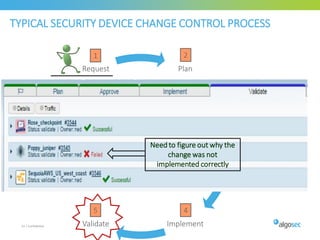
Need to figure out why the
change was not
implemented correctly
GAP BETWEEN BUSINESS AND IT SECURITY
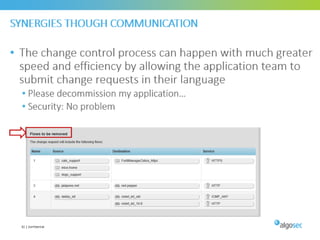
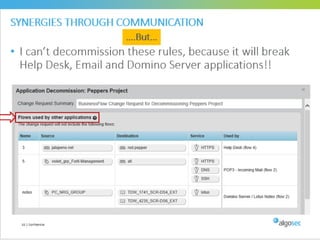
• A simplistic summary of the Business and IT relationship:
1. The business created value for customer’s and has stored this data in databases and
allowed users to access the data via applications
2. IT maintains the infrastructure to support the data (databases) and applications.
3. IT Security maintains secure access to data and applications so these assets don’t
compromise the value of the business
• Without 1, 2 & 3 above, a business would not exist
• Applications provide a vehicle to create additional value for their
customers
• Applications and “data” MUST be secure and maintainable
• Application developers and database administrators request security
infrastructure changes as business requirements adapt to new customer
and market demands
• The security change management process has to improve - just like
provisioning a web or database server….It only takes minutes now…
40 | Confidential
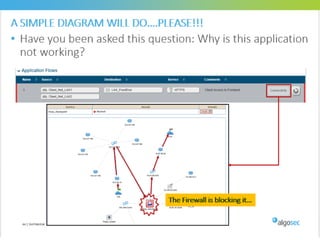
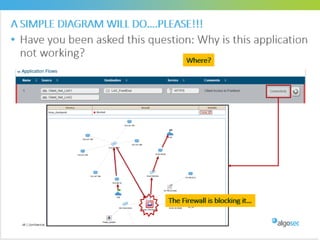
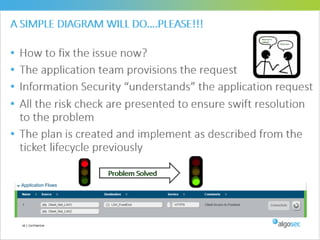
A SIMPLE DIAGRAM WILL DO….PLEASE!!!
• The current challenge is that
Information security talk a
different language than
application developers and
database administrators
(DBA’s) who are requesting application changes
• Security architects must bridge the gap between a secure
business application and operational disasters
• How many organizations can document their business
applications so the security team has a prayer in
understanding how their applications works?
41 | Confidential
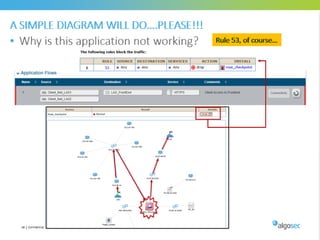
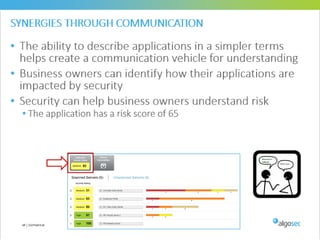
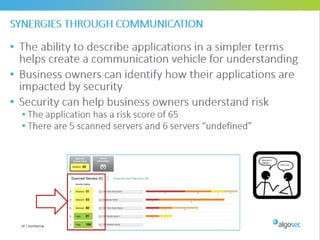
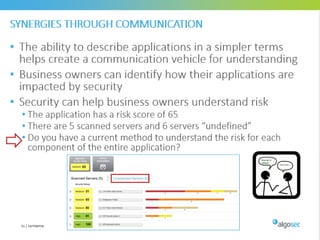
A SIMPLE DIAGRAM WILL DO….PLEASE!!!
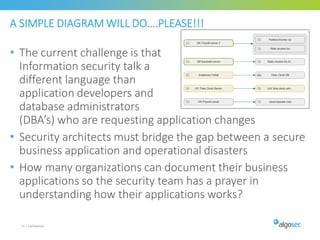
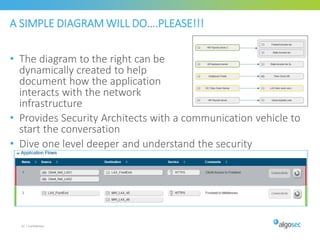
• The diagram to the right can be
dynamically created to help
document how the application
interacts with the network
infrastructure
• Provides Security Architects with a communication vehicle to
start the conversation
• Dive one level deeper and understand the security
42 | Confidential
DATACENTER AND/OR CLOUD MIGRATION MOTIVES
• Upgrade capacity
• Save money – server consolidation
• Mergers and acquisitions to combine resources
54 | Confidential
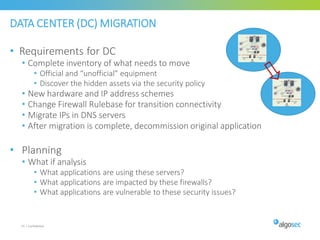
DATA CENTER (DC) MIGRATION
• Requirements for DC
• Complete inventory of what needs to move
• Official and “unofficial” equipment
• Discover the hidden assets via the security policy
• New hardware and IP address schemes
• Change Firewall Rulebase for transition connectivity
• Migrate IPs in DNS servers
• After migration is complete, decommission original application
• Planning
• What if analysis
• What applications are using these servers?
• What applications are impacted by these firewalls?
• What applications are vulnerable to these security issues?
55 | Confidential
CUSTOMER PHILOSOPHY IS CHANGING
• We currently see connectivity requests being manually
planned, assessed, designed and implemented
• This needs to change…..and quickly!
• How do you manage these 1,000 security change requests?
• Customers are moving to agile development &
deployment
• The Internet of Things is impacting service expectations
• We are required to intelligently automate as much of the
change process as possible
• The bottom line is that security needs to dramatically
improve change responsiveness with zero errors at a lower
cost!
57 | Confidential
SUMMARY
• Misconfigured devices can cause outages and security
breaches
• Use automation and validation to help reduce human
errors
• Help application developers and information security
understand each other by automatically documenting
applications and translating security policy rules into flows
that everyone can understand
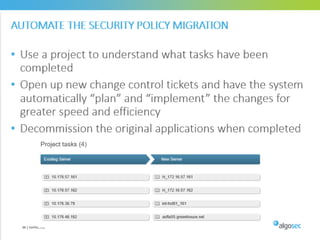
• Use “projects” to help accelerate data center migration
security policies so that it will be completed on time!
58 | Confidential
MORE RESOURCES
59 | Confidential
THANK YOU
joe.dipietro@algosec.com

Avoid outages-from-misconfigured-devices-webinar-slides

  • 1.
    HOW TO AVOID BUSINESSOUTAGES FROM MISCONFIGURED NETWORK DEVICES
  • 2.
    TOPICS COVERED TODAY •Understanding the problem: misconfigured network devices • Typical change control processes • The Gap between Business and IT Security • Data center migration 2 | Confidential
  • 3.
  • 4.
    Firewall Breaches 5% Vulnerabilities 95%Misconfiguration THEBALANCING ACT Security Agility Prevent Cyber Attacks
  • 5.
    Firewall Breaches Data CenterAutomation5% Vulnerabilities 95%Misconfiguration THE BALANCING ACT 5 Security Agility Prevent Cyber Attacks Enable Business Applications Resource Timeto Provision Server Minutes Storage Minutes Security Access Days/Weeks
  • 6.
    JUST SOME CONTEXT… 6| Confidential
  • 7.
    JUST SOME CONTEXT… 7| Confidential
  • 8.
    HOW CAN ADEVICE BE MISCONFIGURED?
  • 24.
    SECURITY DEVICE CHANGECONTROL PROCESS • Understand and map your enterprise infrastructure topology before you make a change • Proactively assess the impact of a change to ensure it does not break connectivity, affect compliance or create a security hole • Avoid common mistakes when making changes to your network security devices and firewalls • Monitor all changes in case there is an outage. You can easily reverse the newest implemented change if necessary • Translate business requirements into the network and security policies that are implemented on firewalls 24 | Confidential
  • 25.
    TYPICAL SECURITY DEVICECHANGE CONTROL PROCESS 25 | Confidential Plan Approve ImplementValidate Close Request 1 2 3 4 6 5
  • 26.
    TYPICAL SECURITY DEVICECHANGE CONTROL PROCESS 26 | Confidential Plan Approve ImplementValidate Close Request 1 2 3 4 6 5 In some cases, “Recertify”… but that’s a topic for another day
  • 27.
    TYPICAL SECURITY DEVICECHANGE CONTROL PROCESS 27 | Confidential Plan Approve ImplementValidate Close Request 1 2 3 4 6 5 • Identify what devices need to be changed • In our example, there are three devices • CheckPoint • Juniper • AWS Server • How did we know?
  • 28.
    VISIBILITY INTO THEPLANNING STAGE • We understand the topology of the network and the security policies associated with the devices in the path 28 | Confidential
  • 29.
    Plan Approve ImplementValidate Close Request TYPICAL SECURITY DEVICECHANGE CONTROL PROCESS 29 | Confidential 1 2 3 4 6 5 • Always perform a risk check BEFORE you approve • Understanding the risk during the approval phase gives you a chance to “replan” the change or deny it if it will cause undue risk to the environment
  • 30.
    Plan Approve ImplementValidate Close Request TYPICAL SECURITY DEVICECHANGE CONTROL PROCESS 30 | Confidential 1 2 3 4 6 5 • During the implementation phase consider how to insert the new security rule into the device’s current policy • Add a new rule? • Modify an existing rule? • Create new objects? • Automatically document the rule change
  • 32.
    Plan Approve ImplementValidate Close Request TYPICAL SECURITY DEVICECHANGE CONTROL PROCESS 32 | Confidential 1 2 3 4 6 5 • Check the request and validate it is implemented correctly before notifying stakeholders • Was the original request implemented: • In good working order for the entire path, so the requester does not ask for the same information again! • Exactly as requested? • With an overly permissive rule (ie. “any” vs https service)
  • 33.
    Plan Approve ImplementValidate Close Request TYPICAL SECURITY DEVICECHANGE CONTROL PROCESS 33 | Confidential 1 2 3 4 6 5 Need to figure out why the change was not implemented correctly
  • 40.
    GAP BETWEEN BUSINESSAND IT SECURITY • A simplistic summary of the Business and IT relationship: 1. The business created value for customer’s and has stored this data in databases and allowed users to access the data via applications 2. IT maintains the infrastructure to support the data (databases) and applications. 3. IT Security maintains secure access to data and applications so these assets don’t compromise the value of the business • Without 1, 2 & 3 above, a business would not exist • Applications provide a vehicle to create additional value for their customers • Applications and “data” MUST be secure and maintainable • Application developers and database administrators request security infrastructure changes as business requirements adapt to new customer and market demands • The security change management process has to improve - just like provisioning a web or database server….It only takes minutes now… 40 | Confidential
  • 41.
    A SIMPLE DIAGRAMWILL DO….PLEASE!!! • The current challenge is that Information security talk a different language than application developers and database administrators (DBA’s) who are requesting application changes • Security architects must bridge the gap between a secure business application and operational disasters • How many organizations can document their business applications so the security team has a prayer in understanding how their applications works? 41 | Confidential
  • 42.
    A SIMPLE DIAGRAMWILL DO….PLEASE!!! • The diagram to the right can be dynamically created to help document how the application interacts with the network infrastructure • Provides Security Architects with a communication vehicle to start the conversation • Dive one level deeper and understand the security 42 | Confidential
  • 54.
    DATACENTER AND/OR CLOUDMIGRATION MOTIVES • Upgrade capacity • Save money – server consolidation • Mergers and acquisitions to combine resources 54 | Confidential
  • 55.
    DATA CENTER (DC)MIGRATION • Requirements for DC • Complete inventory of what needs to move • Official and “unofficial” equipment • Discover the hidden assets via the security policy • New hardware and IP address schemes • Change Firewall Rulebase for transition connectivity • Migrate IPs in DNS servers • After migration is complete, decommission original application • Planning • What if analysis • What applications are using these servers? • What applications are impacted by these firewalls? • What applications are vulnerable to these security issues? 55 | Confidential
  • 57.
    CUSTOMER PHILOSOPHY ISCHANGING • We currently see connectivity requests being manually planned, assessed, designed and implemented • This needs to change…..and quickly! • How do you manage these 1,000 security change requests? • Customers are moving to agile development & deployment • The Internet of Things is impacting service expectations • We are required to intelligently automate as much of the change process as possible • The bottom line is that security needs to dramatically improve change responsiveness with zero errors at a lower cost! 57 | Confidential
  • 58.
    SUMMARY • Misconfigured devicescan cause outages and security breaches • Use automation and validation to help reduce human errors • Help application developers and information security understand each other by automatically documenting applications and translating security policy rules into flows that everyone can understand • Use “projects” to help accelerate data center migration security policies so that it will be completed on time! 58 | Confidential
  • 59.
    MORE RESOURCES 59 |Confidential
  • 60.