Information Security Policies
and Standards
Dr Paras Kothari
What is Security Policy?
 Security policy is a definition of what
it means to be secure for a system,
organization or other entity. For an
organization, it addresses the
constraints on behaviour of its members
as well as constraints imposed on
adversaries by mechanisms such as
doors, locks, keys and walls.
What is Information Security Policy?
 Information Security Policy /ISP/ is
a set or rules enacted by an
organization to ensure that all users or
networks of the IT structure within the
organization's domain abide by the
prescriptions regarding the security of
data stored digitally within the
boundaries the organization stretches
its authority.
The challenges
 Define security policies and standards
 Measure actual security against policy
 Report violations to policy
 Correct violations to conform with policy
 Summarize policy compliance for the
organization
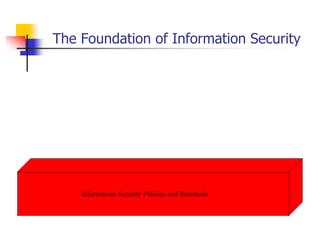
The Foundation of Information Security
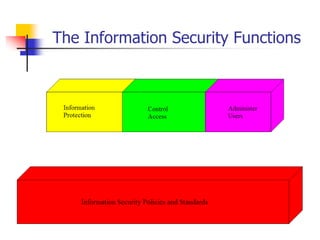
The Information Security Functions
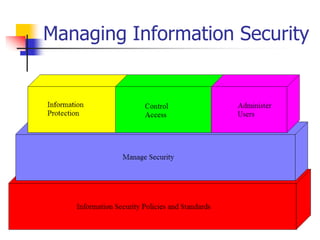
Managing Information Security
Definitions
 Policies
 High level statements that provide guidance to
workers who must make present and future
decision
 Standards
 Requirement statements that provide specific
technical specifications
 Guidelines
 Optional but recommended specifications
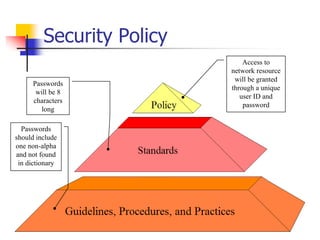
Security Policy
Access to
network resource
will be granted
through a unique
user ID and
password
Passwords
should include
one non-alpha
and not found
in dictionary
Passwords
will be 8
characters
long
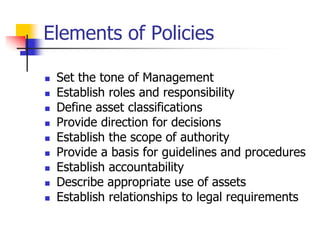
Elements of Policies
 Set the tone of Management
 Establish roles and responsibility
 Define asset classifications
 Provide direction for decisions
 Establish the scope of authority
 Provide a basis for guidelines and procedures
 Establish accountability
 Describe appropriate use of assets
 Establish relationships to legal requirements
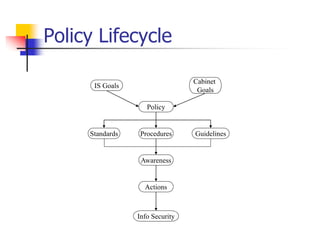
Actions
Cabinet
Goals
Policy
Standards Procedures Guidelines
Awareness
IS Goals
Info Security
Policy Lifecycle
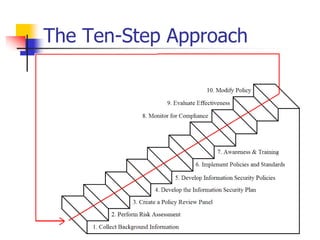
The Ten-Step Approach
Step 1 – Collect Background Information
 Obtain existing policies
 Identify what levels of control are needed
 Identify who should write the policies
Step 2 – Perform Risk Assessment
 Justify the Policies with Risk Assessment
 Identify the critical functions
 Identify the critical processes
 Identify the critical data
 Assess the vulnerabilities
Step 3 – Create a Policy Review Board
 The Policy Development Process
 Write the initial “Draft”
 Send to the Review Board for Comments
 Incorporate Comments
 Resolve Issues Face-to-Face
 Submit “Draft” Policy to Cabinet for
Approval
Step 4 – Develop the Information
Security Plan
 Establish goals
 Define roles
 Define responsibilities
 Notify the User community as to the
direction
 Establish a basis for compliance, risk
assessment, and audit of information
security
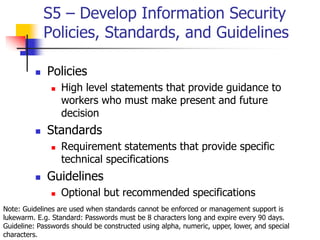
S5 – Develop Information Security
Policies, Standards, and Guidelines
 Policies
 High level statements that provide guidance to
workers who must make present and future
decision
 Standards
 Requirement statements that provide specific
technical specifications
 Guidelines
 Optional but recommended specifications
Note: Guidelines are used when standards cannot be enforced or management support is
lukewarm. E.g. Standard: Passwords must be 8 characters long and expire every 90 days.
Guideline: Passwords should be constructed using alpha, numeric, upper, lower, and special
characters.
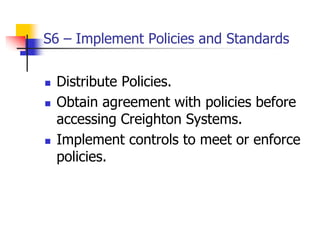
S6 – Implement Policies and Standards
 Distribute Policies.
 Obtain agreement with policies before
accessing Creighton Systems.
 Implement controls to meet or enforce
policies.
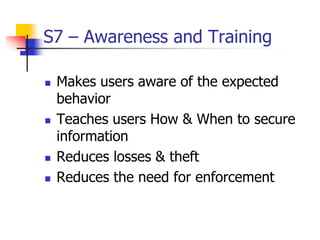
S7 – Awareness and Training
 Makes users aware of the expected
behavior
 Teaches users How & When to secure
information
 Reduces losses & theft
 Reduces the need for enforcement
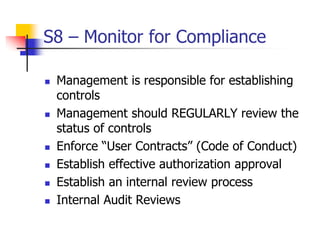
S8 – Monitor for Compliance
 Management is responsible for establishing
controls
 Management should REGULARLY review the
status of controls
 Enforce “User Contracts” (Code of Conduct)
 Establish effective authorization approval
 Establish an internal review process
 Internal Audit Reviews
S9 – Evaluate Policy Effectiveness
 Evaluate
 Document
 Report
S10 – Modify the Policy
Policies must be modified due to:
 New Technology
 New Threats
 New or changed goals
 Organizational changes
 Changes in the Law
 Ineffectiveness of the existing Policy
Query Session
Ask if Any?

Security policies

  • 1.
    Information Security Policies andStandards Dr Paras Kothari
  • 2.
    What is SecurityPolicy?  Security policy is a definition of what it means to be secure for a system, organization or other entity. For an organization, it addresses the constraints on behaviour of its members as well as constraints imposed on adversaries by mechanisms such as doors, locks, keys and walls.
  • 3.
    What is InformationSecurity Policy?  Information Security Policy /ISP/ is a set or rules enacted by an organization to ensure that all users or networks of the IT structure within the organization's domain abide by the prescriptions regarding the security of data stored digitally within the boundaries the organization stretches its authority.
  • 4.
    The challenges  Definesecurity policies and standards  Measure actual security against policy  Report violations to policy  Correct violations to conform with policy  Summarize policy compliance for the organization
  • 5.
    The Foundation ofInformation Security
  • 6.
  • 7.
  • 8.
    Definitions  Policies  Highlevel statements that provide guidance to workers who must make present and future decision  Standards  Requirement statements that provide specific technical specifications  Guidelines  Optional but recommended specifications
  • 9.
    Security Policy Access to networkresource will be granted through a unique user ID and password Passwords should include one non-alpha and not found in dictionary Passwords will be 8 characters long
  • 10.
    Elements of Policies Set the tone of Management  Establish roles and responsibility  Define asset classifications  Provide direction for decisions  Establish the scope of authority  Provide a basis for guidelines and procedures  Establish accountability  Describe appropriate use of assets  Establish relationships to legal requirements
  • 11.
  • 12.
  • 13.
    Step 1 –Collect Background Information  Obtain existing policies  Identify what levels of control are needed  Identify who should write the policies
  • 14.
    Step 2 –Perform Risk Assessment  Justify the Policies with Risk Assessment  Identify the critical functions  Identify the critical processes  Identify the critical data  Assess the vulnerabilities
  • 15.
    Step 3 –Create a Policy Review Board  The Policy Development Process  Write the initial “Draft”  Send to the Review Board for Comments  Incorporate Comments  Resolve Issues Face-to-Face  Submit “Draft” Policy to Cabinet for Approval
  • 16.
    Step 4 –Develop the Information Security Plan  Establish goals  Define roles  Define responsibilities  Notify the User community as to the direction  Establish a basis for compliance, risk assessment, and audit of information security
  • 17.
    S5 – DevelopInformation Security Policies, Standards, and Guidelines  Policies  High level statements that provide guidance to workers who must make present and future decision  Standards  Requirement statements that provide specific technical specifications  Guidelines  Optional but recommended specifications Note: Guidelines are used when standards cannot be enforced or management support is lukewarm. E.g. Standard: Passwords must be 8 characters long and expire every 90 days. Guideline: Passwords should be constructed using alpha, numeric, upper, lower, and special characters.
  • 18.
    S6 – ImplementPolicies and Standards  Distribute Policies.  Obtain agreement with policies before accessing Creighton Systems.  Implement controls to meet or enforce policies.
  • 19.
    S7 – Awarenessand Training  Makes users aware of the expected behavior  Teaches users How & When to secure information  Reduces losses & theft  Reduces the need for enforcement
  • 20.
    S8 – Monitorfor Compliance  Management is responsible for establishing controls  Management should REGULARLY review the status of controls  Enforce “User Contracts” (Code of Conduct)  Establish effective authorization approval  Establish an internal review process  Internal Audit Reviews
  • 21.
    S9 – EvaluatePolicy Effectiveness  Evaluate  Document  Report
  • 22.
    S10 – Modifythe Policy Policies must be modified due to:  New Technology  New Threats  New or changed goals  Organizational changes  Changes in the Law  Ineffectiveness of the existing Policy
  • 23.