Advanced Computer Networking
ITec5114
MSc Information Technology
Semester I
2022-23
Chapter 02
IP Routing
• IP addressing
• Forwarding and Routing
• BGP and adaptive routing
• Congestion control
Introduction:
• IP routing is a mechanism to forward packet from sender to receiver over
the different networks.
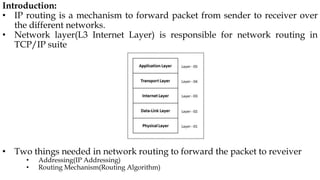
• Network layer(L3 Internet Layer) is responsible for network routing in
TCP/IP suite
• Two things needed in network routing to forward the packet to reveiver
• Addressing(IP Addressing)
• Routing Mechanism(Routing Algorithm)
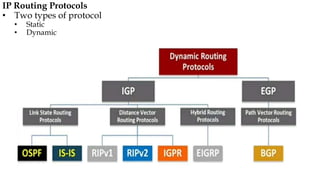
IP Routing Protocols
• Two types of protocol
• Static
• Dynamic
Interior Gateway Protocol
An interior gateway protocol (IGP) is a routing protocol that is used to exchange
routing information within an autonomous system (AS)(Ethio Tel, Safari)
• Linked State Protocol
It works basded in the cost of the path
• Open Shortest Path First(OSPF)
• Intermediate System - Intermediate System (IS-IS)
• Distance Vector Protocol
It works based on the number of hubs between the sender and receiver
• Routing Informating Prtocol V1(RIPv1)
• Routing Informating Prtocol V2(RIPv2)
• Interior Gateway Routing Protocol(IGRP)
• Hybrid Routing Protocol
It is a network routing protocol that combines Distance Vector Routing
Protocol (DVRP) and Link State Routing Protocol (LSRP) features.
• Enhanced Interior Gateway Routing Protocol (EIGRP)
Exterior Gateway Protocol (EGP)
An Exterior Gateway Protocol (EGP) is for determining network reachability between
autonomous systems(between EthioTel and Safari)
• Path Vector Routing Protocol
• Border Gateway Protocol(BGP)
Autonomous System(AS)
Its a netwrok or collection of network that are managed and supervied
by a single organiszation or administrative entity
IP Addressing
• The address should identify a network as well as a host inside a network.
• Two version of IP address; IPv4 and IPv6
IPv4
• 32bit address
• 32bit is divided into 4 chunks with each 8bit
• has to write in dotted decimal format
• This 32bit address is usded by network address and host address.
• Two types available
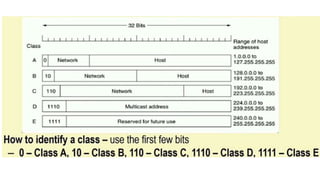
• Classful addressing (old style)
• Classless addressing
• Classful addresing is used fixed number of bits for network address and host
address.
• Classful addressing is an IPv4 addressing architecture that divides addresses into five
groups. class A, class B, class C, class D and class E
• Two special address available in every class of IP address
• Network Address - to identify the network
• all 0’s in the host address part: Ex-1(class B): 19.233.0.0 Ex-2(class A): 126.0.0.0
• Broadcast Address - send the data to all the nodes of a network
• all 1’s in the address part: Ex-1(class A): 126.255.255.255 Ex-2(class B): 189.233.255.255
Classless Addressing
• Its not using a fixed class boundary, that means not used fixed number of
bits for network and host address part.
• Subnet Mask concept is used to determine class boundary. It denote the
number of bits in nertwork address part.
Subnetting: divide a large network into multiple small networks
Supernetting: combine multiple small network into a single large network
• IP address 191.180.83.235/12
• first 12 bits are the network address part and remaining 32-12=20bits are for
the host address
• subnet mask is 255.240.0.0
Issues with IPv4 Addressing
• The address space is limited - number of devices (networking equipment)
are increasing exponentially.
• A large number of addresses are wasted or remain unutilized (Class D or
Class E).
• Solution: Make the address reusable, leveraging on the fact that not all
users or all devices will connect to the Internet at the same time.
IPv6
• Internet Protocol version 6 (IPv6) is the latest revision of the Internet Protocol (IP).
• IPv6 was developed by the Internet Engineering Task Force (IETF)
why IPv6?
• Address space is not sufficient even with CIDR
• IPv4 is not provide any direct security support
• Quality of Service is not defined well.
• It does not have a mechanism to configure a device to have globally unique IP
address
• Mobiltiy Issue
Features
• Larger Address space
• Simplified Header
• Globally unique and hierarchical address
• Auto Configuration of nework interfaces
• Faster Forwarding/Routing
• Built-in authentication and encryption
• Mobility
• Compatibility with IPv4
• Extensibility
Addressing Modes
IPv6 supports
• Unicast
• Multicast
• Anycast
Address Format
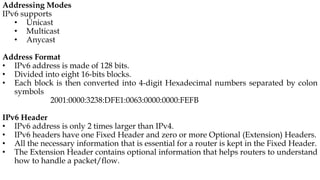
• IPv6 address is made of 128 bits.
• Divided into eight 16-bits blocks.
• Each block is then converted into 4-digit Hexadecimal numbers separated by colon
symbols
2001:0000:3238:DFE1:0063:0000:0000:FEFB
IPv6 Header
• IPv6 address is only 2 times larger than IPv4.
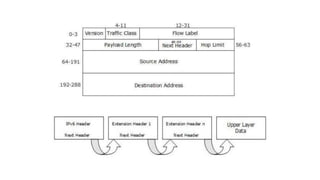
• IPv6 headers have one Fixed Header and zero or more Optional (Extension) Headers.
• All the necessary information that is essential for a router is kept in the Fixed Header.
• The Extension Header contains optional information that helps routers to understand
how to handle a packet/flow.
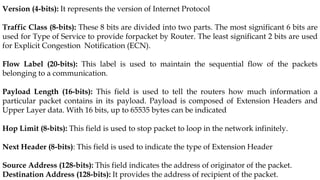
Version (4-bits): It represents the version of Internet Protocol
Traffic Class (8-bits): These 8 bits are divided into two parts. The most significant 6 bits are
used for Type of Service to provide forpacket by Router. The least significant 2 bits are used
for Explicit Congestion Notification (ECN).
Flow Label (20-bits): This label is used to maintain the sequential flow of the packets
belonging to a communication.
Payload Length (16-bits): This field is used to tell the routers how much information a
particular packet contains in its payload. Payload is composed of Extension Headers and
Upper Layer data. With 16 bits, up to 65535 bytes can be indicated
Hop Limit (8-bits): This field is used to stop packet to loop in the network infinitely.
Next Header (8-bits): This field is used to indicate the type of Extension Header
Source Address (128-bits): This field indicates the address of originator of the packet.
Destination Address (128-bits): It provides the address of recipient of the packet.
Forwarding
• Deliver the packet to the next hop(it may be final destination or intermediate)
• Forwarding of IP packets done by two different ways
• Forwarding based on Destination address (datagram Approach)
• Forwading baed on labels(Virtual Circuit Approach)
Forwarding based on Destination address
• Its a traditional and prevalent technique on today also
• When packet reaches the router, It checkes the forwarding table which created by
the routing protocol and conectionless.
• Usually routing table is called as forwading table
• Based on forwarding table router will forward the packet to next hop
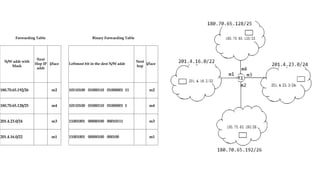
• Forwading table contains based clasless IP
• mask
• network address
• Interface number
• IP address of the next router
• Extract the destinaiton address from the packet and find mask and network
address and check with the forwarding table and forwad the packet to next hop.
Forwarding Table Binary Forwarding Table
N/W addr with
Mask
Next
Hop IP
addr
I/face Leftmost bit in the dest N/W addr
Next
hop
I/face
180.70.65.192/26 m2 10110100 01000110 01000001 11 m2
180.70.65.128/25 m4 10110100 01000110 01000001 1 m4
201.4.23.0/24 m3 11001001 00000100 00010111 m3
201.4.16.0/22 m1 11001001 00000100 000100 m1
Fowarding based on Labels
• Forwarding the packets hapPening based on the label attached with the packet
• before sending packets, connections must be estabilised, its called virtual circit.
• There is three phases: setup phase, data transfer phase and tear down phase
• In setup phase, port number and label for incoming and outgoing packets are fixed
and virtual circuit connection is estabilised
• In data transfer phase, packets are transfered based on forwarding table created in
each router and in estabished connection
• After datatransfer sucessfully, forward table data is cleared from memory
Border Gateway Protocol(BGP)
• Its a type of Exterior Gateway Protocol
• It used to connect two difference Autonomous System(AS)
• It is developed to interchange routing information and reachability information
between various autonomous systems (AS) on the Internet
• There are two types of BGP and they are as follows −
• Internal BGP
Internal BGP (IBGP) is a BGP connection between BGP speakers in the same
AS.
• External BGP
External BGP (EBGP) is a BGP connection between BGP speakers in different
AS’s.
Features of BGP
• Open Standard Protocol
• It is a Exterior Gateway Protocol used to route the information between different
Autonomous system.
• Designed for huge inter-network like Internet.
• Updates are incremental and trigger.
• Slowest Routing protocol in the world.
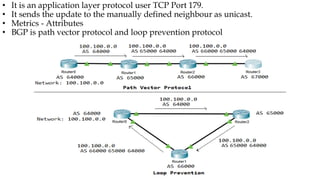
• It is an application layer protocol user TCP Port 179.
• It sends the update to the manually defined neighbour as unicast.
• Metrics - Attributes
• BGP is path vector protocol and loop prevention protocol
BGP Neighbour:
• BGP Neighbour router is also known as BGP Peer.
• As Neighbour is manually defined, unlike other routing protocol it doesn't form
neighbourship automatically.
• TCP Connection is formed with the manually defined neighbour using TCP port
179.
• TCP is used for retransmitting the lost data, to avoid duplicate data, Check
summing (accurate transmission).
BGP Tables:
Neighbour Table: Information about all the list of manually defined neighbour will
be managed in the neighbour table.
#show ip bgp neighbors
#show ip bgp summary
BGP Database table: he list of all possible network learnt by BGP will be managed
along with there attributes and path.
#Show ip bgp
Routing Table: The list of only the best path will be available in the ip routing table.
#show ip route
BGP Message Types:
Open: It is used to initiate a BGP session between 2 routers. Includes the below:
• BGP version
• Sender AS number
• Hold Time (Cisco default 180 seconds)
• BGP identifier
• optional parameter
Keepalive Message:
• This Message is used to maintain the BGP session between the BGP Peers.
• It will sent once in 1/3 of the "hold time". The default timer in cisco device is 60 seconds.
Update:
• If any new route added and existing route deleted.
• Path Attributes
Notification:
• Terminate or rejects a BGP connection.
• Can include error message (" BGP version not supported")
BGP States
BGP Attributes:
• Attributes are a piece of information attached in the BGP UPDATE message by the
BGP Router to choose the best path.
• Interior Gateway Protocols (IGP) like EIGRP, OSPF, RIP will choose the best path
based on the metrics(bandwidth, delay, load, MTU, reliability,...)
• BGP have different ways of route selection that assigns various attributes to each
path.
• This Attributes can be manipulated to control the path that is selected.
There are 4 categories of attributes:
Well-known mandatory:
• Must be recognized by all BGP routers
• Present in all BGP update messages
• Passed on to other BGP routers.
• For example: AS path, origin, and next hop.
Well-known discretionary:
• Must be recognized by all BGP routers
• Passed on to other BGP routers
• not need to be present in an update message
• For example: local preference.
Optional transitive:
• Might or might not be recognized by a BGP router
• It is passed on to other BGP routers.
• If not recognized, it is marked as partial
• For example: aggregator, community.
Optional non-transitive:
• Might or might not be recognized by a BGP router
• It is not passed on to other routers
• For example: Multi-Exit Discriminator (MED), originator ID.
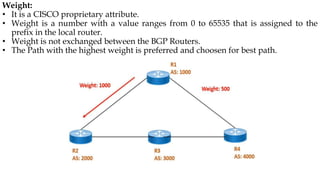
Weight:
• It is a CISCO proprietary attribute.
• Weight is a number with a value ranges from 0 to 65535 that is assigned to the
prefix in the local router.
• Weight is not exchanged between the BGP Routers.
• The Path with the highest weight is preferred and choosen for best path.
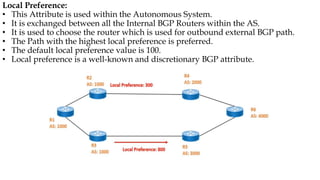
Local Preference:
• This Attribute is used within the Autonomous System.
• It is exchanged between all the Internal BGP Routers within the AS.
• It is used to choose the router which is used for outbound external BGP path.
• The Path with the highest local preference is preferred.
• The default local preference value is 100.
• Local preference is a well-known and discretionary BGP attribute.
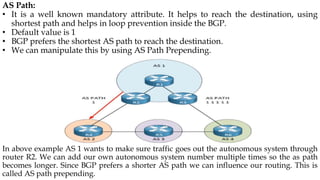
AS Path:
• It is a well known mandatory attribute. It helps to reach the destination, using
shortest path and helps in loop prevention inside the BGP.
• Default value is 1
• BGP prefers the shortest AS path to reach the destination.
• We can manipulate this by using AS Path Prepending.
In above example AS 1 wants to make sure traffic goes out the autonomous system through
router R2. We can add our own autonomous system number multiple times so the as path
becomes longer. Since BGP prefers a shorter AS path we can influence our routing. This is
called AS path prepending.
MED (Multi-Exit Discriminator):
• MED is exchanged between autonomous systems
• MED can be used to advertise to your neighbors how they should enter your AS.
• The lowest MED is the preferred path.
• MED is propagated to all routers within the neighbor AS but not passed along any
other autonomous systems.
Origin Code:
The origin is a well known mandatory attribute that defines the origin of the Prefix,
route information.
There are 3 codes listed to identify the origin of the route or prefix.
i: (IGP) routes are the routes which are originated from a IGP routing protocol, like
RIP, OSPF, EIGRP etc.
e: (EGP) routes are the routes which are originated from External Gateway Protocol
(EGP). Now the only EGP is BGP, so this is the routes originated from BGP.
?: (Incomplete) routes are the routes which are Redistributed from static, IGP etc. into
the BGP.
router-b#sho ip bgp
BGP table version is 3, local router ID is 10.0.16.10
Status codes: s suppressed, d damped, h history, valid, best,
i-internal, r RIB-failure
Origin codes: i IGP, e EGP, ? incomplete
Network Next Hop Metric LocPrf Weight Path
> 10.7.7.0/24 10.0.7.4 10 0 65500 ?
> 10.0.10.0 10.0.7.4 0 0 65500 I
Next-Hop Attribute:
• The BGP Next Hop Attribute is the next IP address that is going to be used to reach
certain destination.
• For EGBP, the next hop is always the IP address of the neighbour specified in the
neighbour command.
• For IBGP, the protocol states that the next hop advertised by EBGP should be
carried into IBGP.
Basic Configuration Syntax of BGP:
Router(config)# router bgp <Autonomous number>
Router(config-router)# network <network ID> [mask <subnet mask>]
Router(config-router)# neighbour <IP-Address> remote-as <AS number>
IP Routing.pptx
IP Routing.pptx

IP Routing.pptx

  • 1.
    Advanced Computer Networking ITec5114 MScInformation Technology Semester I 2022-23
  • 2.
    Chapter 02 IP Routing •IP addressing • Forwarding and Routing • BGP and adaptive routing • Congestion control
  • 3.
    Introduction: • IP routingis a mechanism to forward packet from sender to receiver over the different networks. • Network layer(L3 Internet Layer) is responsible for network routing in TCP/IP suite • Two things needed in network routing to forward the packet to reveiver • Addressing(IP Addressing) • Routing Mechanism(Routing Algorithm)
  • 4.
    IP Routing Protocols •Two types of protocol • Static • Dynamic
  • 5.
    Interior Gateway Protocol Aninterior gateway protocol (IGP) is a routing protocol that is used to exchange routing information within an autonomous system (AS)(Ethio Tel, Safari) • Linked State Protocol It works basded in the cost of the path • Open Shortest Path First(OSPF) • Intermediate System - Intermediate System (IS-IS) • Distance Vector Protocol It works based on the number of hubs between the sender and receiver • Routing Informating Prtocol V1(RIPv1) • Routing Informating Prtocol V2(RIPv2) • Interior Gateway Routing Protocol(IGRP) • Hybrid Routing Protocol It is a network routing protocol that combines Distance Vector Routing Protocol (DVRP) and Link State Routing Protocol (LSRP) features. • Enhanced Interior Gateway Routing Protocol (EIGRP)
  • 6.
    Exterior Gateway Protocol(EGP) An Exterior Gateway Protocol (EGP) is for determining network reachability between autonomous systems(between EthioTel and Safari) • Path Vector Routing Protocol • Border Gateway Protocol(BGP) Autonomous System(AS) Its a netwrok or collection of network that are managed and supervied by a single organiszation or administrative entity
  • 7.
    IP Addressing • Theaddress should identify a network as well as a host inside a network. • Two version of IP address; IPv4 and IPv6 IPv4 • 32bit address • 32bit is divided into 4 chunks with each 8bit • has to write in dotted decimal format • This 32bit address is usded by network address and host address. • Two types available • Classful addressing (old style) • Classless addressing • Classful addresing is used fixed number of bits for network address and host address. • Classful addressing is an IPv4 addressing architecture that divides addresses into five groups. class A, class B, class C, class D and class E • Two special address available in every class of IP address • Network Address - to identify the network • all 0’s in the host address part: Ex-1(class B): 19.233.0.0 Ex-2(class A): 126.0.0.0 • Broadcast Address - send the data to all the nodes of a network • all 1’s in the address part: Ex-1(class A): 126.255.255.255 Ex-2(class B): 189.233.255.255
  • 9.
    Classless Addressing • Itsnot using a fixed class boundary, that means not used fixed number of bits for network and host address part. • Subnet Mask concept is used to determine class boundary. It denote the number of bits in nertwork address part. Subnetting: divide a large network into multiple small networks Supernetting: combine multiple small network into a single large network • IP address 191.180.83.235/12 • first 12 bits are the network address part and remaining 32-12=20bits are for the host address • subnet mask is 255.240.0.0
  • 10.
    Issues with IPv4Addressing • The address space is limited - number of devices (networking equipment) are increasing exponentially. • A large number of addresses are wasted or remain unutilized (Class D or Class E). • Solution: Make the address reusable, leveraging on the fact that not all users or all devices will connect to the Internet at the same time.
  • 11.
    IPv6 • Internet Protocolversion 6 (IPv6) is the latest revision of the Internet Protocol (IP). • IPv6 was developed by the Internet Engineering Task Force (IETF) why IPv6? • Address space is not sufficient even with CIDR • IPv4 is not provide any direct security support • Quality of Service is not defined well. • It does not have a mechanism to configure a device to have globally unique IP address • Mobiltiy Issue Features • Larger Address space • Simplified Header • Globally unique and hierarchical address • Auto Configuration of nework interfaces • Faster Forwarding/Routing • Built-in authentication and encryption • Mobility • Compatibility with IPv4 • Extensibility
  • 12.
    Addressing Modes IPv6 supports •Unicast • Multicast • Anycast Address Format • IPv6 address is made of 128 bits. • Divided into eight 16-bits blocks. • Each block is then converted into 4-digit Hexadecimal numbers separated by colon symbols 2001:0000:3238:DFE1:0063:0000:0000:FEFB IPv6 Header • IPv6 address is only 2 times larger than IPv4. • IPv6 headers have one Fixed Header and zero or more Optional (Extension) Headers. • All the necessary information that is essential for a router is kept in the Fixed Header. • The Extension Header contains optional information that helps routers to understand how to handle a packet/flow.
  • 14.
    Version (4-bits): Itrepresents the version of Internet Protocol Traffic Class (8-bits): These 8 bits are divided into two parts. The most significant 6 bits are used for Type of Service to provide forpacket by Router. The least significant 2 bits are used for Explicit Congestion Notification (ECN). Flow Label (20-bits): This label is used to maintain the sequential flow of the packets belonging to a communication. Payload Length (16-bits): This field is used to tell the routers how much information a particular packet contains in its payload. Payload is composed of Extension Headers and Upper Layer data. With 16 bits, up to 65535 bytes can be indicated Hop Limit (8-bits): This field is used to stop packet to loop in the network infinitely. Next Header (8-bits): This field is used to indicate the type of Extension Header Source Address (128-bits): This field indicates the address of originator of the packet. Destination Address (128-bits): It provides the address of recipient of the packet.
  • 16.
    Forwarding • Deliver thepacket to the next hop(it may be final destination or intermediate) • Forwarding of IP packets done by two different ways • Forwarding based on Destination address (datagram Approach) • Forwading baed on labels(Virtual Circuit Approach) Forwarding based on Destination address • Its a traditional and prevalent technique on today also • When packet reaches the router, It checkes the forwarding table which created by the routing protocol and conectionless. • Usually routing table is called as forwading table • Based on forwarding table router will forward the packet to next hop • Forwading table contains based clasless IP • mask • network address • Interface number • IP address of the next router • Extract the destinaiton address from the packet and find mask and network address and check with the forwarding table and forwad the packet to next hop.
  • 17.
    Forwarding Table BinaryForwarding Table N/W addr with Mask Next Hop IP addr I/face Leftmost bit in the dest N/W addr Next hop I/face 180.70.65.192/26 m2 10110100 01000110 01000001 11 m2 180.70.65.128/25 m4 10110100 01000110 01000001 1 m4 201.4.23.0/24 m3 11001001 00000100 00010111 m3 201.4.16.0/22 m1 11001001 00000100 000100 m1
  • 18.
    Fowarding based onLabels • Forwarding the packets hapPening based on the label attached with the packet • before sending packets, connections must be estabilised, its called virtual circit. • There is three phases: setup phase, data transfer phase and tear down phase • In setup phase, port number and label for incoming and outgoing packets are fixed and virtual circuit connection is estabilised • In data transfer phase, packets are transfered based on forwarding table created in each router and in estabished connection • After datatransfer sucessfully, forward table data is cleared from memory
  • 19.
    Border Gateway Protocol(BGP) •Its a type of Exterior Gateway Protocol • It used to connect two difference Autonomous System(AS) • It is developed to interchange routing information and reachability information between various autonomous systems (AS) on the Internet • There are two types of BGP and they are as follows − • Internal BGP Internal BGP (IBGP) is a BGP connection between BGP speakers in the same AS. • External BGP External BGP (EBGP) is a BGP connection between BGP speakers in different AS’s. Features of BGP • Open Standard Protocol • It is a Exterior Gateway Protocol used to route the information between different Autonomous system. • Designed for huge inter-network like Internet. • Updates are incremental and trigger. • Slowest Routing protocol in the world.
  • 20.
    • It isan application layer protocol user TCP Port 179. • It sends the update to the manually defined neighbour as unicast. • Metrics - Attributes • BGP is path vector protocol and loop prevention protocol
  • 21.
    BGP Neighbour: • BGPNeighbour router is also known as BGP Peer. • As Neighbour is manually defined, unlike other routing protocol it doesn't form neighbourship automatically. • TCP Connection is formed with the manually defined neighbour using TCP port 179. • TCP is used for retransmitting the lost data, to avoid duplicate data, Check summing (accurate transmission). BGP Tables: Neighbour Table: Information about all the list of manually defined neighbour will be managed in the neighbour table. #show ip bgp neighbors #show ip bgp summary BGP Database table: he list of all possible network learnt by BGP will be managed along with there attributes and path. #Show ip bgp Routing Table: The list of only the best path will be available in the ip routing table. #show ip route
  • 22.
    BGP Message Types: Open:It is used to initiate a BGP session between 2 routers. Includes the below: • BGP version • Sender AS number • Hold Time (Cisco default 180 seconds) • BGP identifier • optional parameter Keepalive Message: • This Message is used to maintain the BGP session between the BGP Peers. • It will sent once in 1/3 of the "hold time". The default timer in cisco device is 60 seconds. Update: • If any new route added and existing route deleted. • Path Attributes Notification: • Terminate or rejects a BGP connection. • Can include error message (" BGP version not supported")
  • 23.
  • 24.
    BGP Attributes: • Attributesare a piece of information attached in the BGP UPDATE message by the BGP Router to choose the best path. • Interior Gateway Protocols (IGP) like EIGRP, OSPF, RIP will choose the best path based on the metrics(bandwidth, delay, load, MTU, reliability,...) • BGP have different ways of route selection that assigns various attributes to each path. • This Attributes can be manipulated to control the path that is selected. There are 4 categories of attributes: Well-known mandatory: • Must be recognized by all BGP routers • Present in all BGP update messages • Passed on to other BGP routers. • For example: AS path, origin, and next hop.
  • 25.
    Well-known discretionary: • Mustbe recognized by all BGP routers • Passed on to other BGP routers • not need to be present in an update message • For example: local preference. Optional transitive: • Might or might not be recognized by a BGP router • It is passed on to other BGP routers. • If not recognized, it is marked as partial • For example: aggregator, community. Optional non-transitive: • Might or might not be recognized by a BGP router • It is not passed on to other routers • For example: Multi-Exit Discriminator (MED), originator ID.
  • 26.
    Weight: • It isa CISCO proprietary attribute. • Weight is a number with a value ranges from 0 to 65535 that is assigned to the prefix in the local router. • Weight is not exchanged between the BGP Routers. • The Path with the highest weight is preferred and choosen for best path.
  • 27.
    Local Preference: • ThisAttribute is used within the Autonomous System. • It is exchanged between all the Internal BGP Routers within the AS. • It is used to choose the router which is used for outbound external BGP path. • The Path with the highest local preference is preferred. • The default local preference value is 100. • Local preference is a well-known and discretionary BGP attribute.
  • 28.
    AS Path: • Itis a well known mandatory attribute. It helps to reach the destination, using shortest path and helps in loop prevention inside the BGP. • Default value is 1 • BGP prefers the shortest AS path to reach the destination. • We can manipulate this by using AS Path Prepending. In above example AS 1 wants to make sure traffic goes out the autonomous system through router R2. We can add our own autonomous system number multiple times so the as path becomes longer. Since BGP prefers a shorter AS path we can influence our routing. This is called AS path prepending.
  • 29.
    MED (Multi-Exit Discriminator): •MED is exchanged between autonomous systems • MED can be used to advertise to your neighbors how they should enter your AS. • The lowest MED is the preferred path. • MED is propagated to all routers within the neighbor AS but not passed along any other autonomous systems.
  • 30.
    Origin Code: The originis a well known mandatory attribute that defines the origin of the Prefix, route information. There are 3 codes listed to identify the origin of the route or prefix. i: (IGP) routes are the routes which are originated from a IGP routing protocol, like RIP, OSPF, EIGRP etc. e: (EGP) routes are the routes which are originated from External Gateway Protocol (EGP). Now the only EGP is BGP, so this is the routes originated from BGP. ?: (Incomplete) routes are the routes which are Redistributed from static, IGP etc. into the BGP. router-b#sho ip bgp BGP table version is 3, local router ID is 10.0.16.10 Status codes: s suppressed, d damped, h history, valid, best, i-internal, r RIB-failure Origin codes: i IGP, e EGP, ? incomplete Network Next Hop Metric LocPrf Weight Path > 10.7.7.0/24 10.0.7.4 10 0 65500 ? > 10.0.10.0 10.0.7.4 0 0 65500 I
  • 31.
    Next-Hop Attribute: • TheBGP Next Hop Attribute is the next IP address that is going to be used to reach certain destination. • For EGBP, the next hop is always the IP address of the neighbour specified in the neighbour command. • For IBGP, the protocol states that the next hop advertised by EBGP should be carried into IBGP.
  • 32.
    Basic Configuration Syntaxof BGP: Router(config)# router bgp <Autonomous number> Router(config-router)# network <network ID> [mask <subnet mask>] Router(config-router)# neighbour <IP-Address> remote-as <AS number>