INTERNET, WWW AND E-MAIL
TOPIC1: NETWORK AND INTERNET
FUNDAMENTAL
OUTLINES
 NETWORK COMPONENTS
 WHAT IS NETWORK
 TYPES OF NETWORKS
 BENEFITS
 RISK OF NETWORK COMPUTING

 INTERNET HISTORY
 WHAT IS INTERNET
 WHAT IS INTRANET
 WHAT IS EXTRANET
NETWORK DEFINITION
 A network is a set of devices connected by

communication links.
 The connections ( Network Link) between nodes
are established using either cable media or
wireless media
 The best known computer network is the Internet
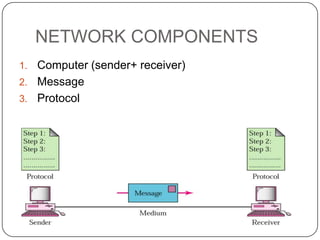
NETWORK COMPONENTS
Computer (sender+ receiver)
2. Message
3. Protocol
1.
BENEFITS OF NETWORK
 Resource sharing

–Printer, processing power, disk
space etc
–Reduces cost
 Communication
–Email, chatting, video conferencing
RISK OF NETWORKS
COMPUTING

 The risk of leakage of

authenticated data on the
network by the attack of
hackers.
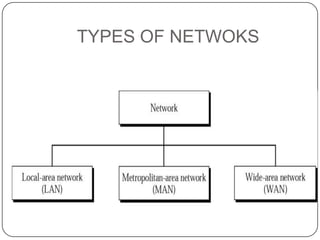
TYPES OF NETWOKS
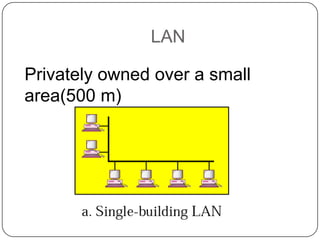
LAN

Privately owned over a small
area(500 m)
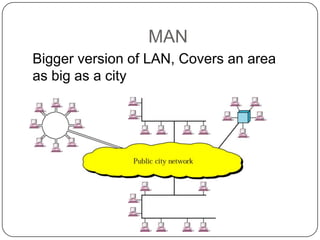
MAN
Bigger version of LAN, Covers an area
as big as a city
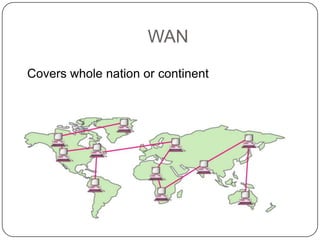
WAN
Covers whole nation or continent
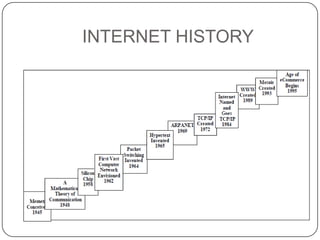
INTERNET HISTORY
INTERNET
 The largest network of networks in

the world.
 Uses TCP/IP protocols and packet
switching.
 Runs on any communications
substrate
PACKET SWITCHING
 A mode of data transmission in which

a message is broken into a number of
parts
 that are sent independently,
 over whatever route is optimum for
each packet,
 and reassembled at the destination.
WHAT IS PROTOCOL
 A protocol is the special set of

rules that end points in a
telecommunication connection.
 use when they communicate.
TCP/IP PROTOCOL
 Transmission Control

Protocol/Internet Protocol: TCP/IP
 Is the basic communication
language OR protocol of Internet.
TCP: TRANSMISSION CONTROL
PROTOCOL
 Is one of the core protocol of the internet

protocol suite.
 Specify how data should be formatted,
addressed
 When you are set up with direct access to
the internet, your computer is provided with
a copy of the TCP/IP program
 just as every other computer that you may
send message to or get information from
also has a copy of TCP/IP.
IP: INTERNET PROTOCOL
 Internet protocol
 Handles the address part of each

packet so that it gets to the right
destination.
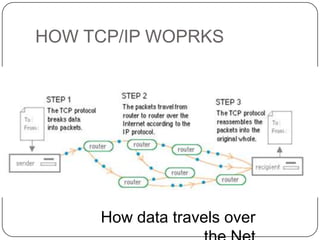
HOW TCP/IP WOPRKS

How data travels over
INTRANET
 A network based on TCP/IP protocols (an

internet) belonging to an organization,
 Is a collection of private computer networks within
an organization.
 accessible only by the organization's members,
employees, or others with authorization.
EXTRANET
 refers to an intranet that is partially accessible to





authorized outsiders.
An extranet provides various levels of
accessibility to outsiders.
You can access an extranet only if you have a
valid username and password,
and your identity determines which parts of the
extranet you can view.
Extranets are becoming a very popular means for
business partners to exchange information.
TERMENOLOGY
Memex
 the most important mechanism,
conceived by Vannevar Bush
 Brush introduced the idea for a microfilm
based machine for storing and retrieving
knowledge.
 It considered as closed to the modern
hypertext system .
TERMENOLOGY
Mathematical theory of
communication:
 is an influential 1948 .
 Article by mathematician Claude E.
Shannon.
 Claude Shannon demonstrate how to
generate “English looking” text using
Markov chains.
 www.khanacademy.org/math/applied-
TERMENOLOGY
Silicon Chip:
 was first discovered by Jack S Kilby at
Texas in 1958,
 that are imprinted onto a tiny chip of a
semiconducting material, such as Silicon .
 It’s an electronic equipment consisting of a
small crystal of silicon semiconductor
fabricated to carry out a number of
electronic function in an integrated circuit
 Example: microprocessor chip

Network and internet fundamental

  • 1.
    INTERNET, WWW ANDE-MAIL TOPIC1: NETWORK AND INTERNET FUNDAMENTAL
  • 2.
    OUTLINES  NETWORK COMPONENTS WHAT IS NETWORK  TYPES OF NETWORKS  BENEFITS  RISK OF NETWORK COMPUTING  INTERNET HISTORY  WHAT IS INTERNET  WHAT IS INTRANET  WHAT IS EXTRANET
  • 3.
    NETWORK DEFINITION  Anetwork is a set of devices connected by communication links.  The connections ( Network Link) between nodes are established using either cable media or wireless media  The best known computer network is the Internet
  • 4.
    NETWORK COMPONENTS Computer (sender+receiver) 2. Message 3. Protocol 1.
  • 5.
    BENEFITS OF NETWORK Resource sharing –Printer, processing power, disk space etc –Reduces cost  Communication –Email, chatting, video conferencing
  • 6.
    RISK OF NETWORKS COMPUTING The risk of leakage of authenticated data on the network by the attack of hackers.
  • 7.
  • 8.
    LAN Privately owned overa small area(500 m)
  • 9.
    MAN Bigger version ofLAN, Covers an area as big as a city
  • 10.
  • 11.
  • 12.
    INTERNET  The largestnetwork of networks in the world.  Uses TCP/IP protocols and packet switching.  Runs on any communications substrate
  • 13.
    PACKET SWITCHING  Amode of data transmission in which a message is broken into a number of parts  that are sent independently,  over whatever route is optimum for each packet,  and reassembled at the destination.
  • 14.
    WHAT IS PROTOCOL A protocol is the special set of rules that end points in a telecommunication connection.  use when they communicate.
  • 15.
    TCP/IP PROTOCOL  TransmissionControl Protocol/Internet Protocol: TCP/IP  Is the basic communication language OR protocol of Internet.
  • 16.
    TCP: TRANSMISSION CONTROL PROTOCOL Is one of the core protocol of the internet protocol suite.  Specify how data should be formatted, addressed  When you are set up with direct access to the internet, your computer is provided with a copy of the TCP/IP program  just as every other computer that you may send message to or get information from also has a copy of TCP/IP.
  • 17.
    IP: INTERNET PROTOCOL Internet protocol  Handles the address part of each packet so that it gets to the right destination.
  • 18.
    HOW TCP/IP WOPRKS Howdata travels over
  • 19.
    INTRANET  A networkbased on TCP/IP protocols (an internet) belonging to an organization,  Is a collection of private computer networks within an organization.  accessible only by the organization's members, employees, or others with authorization.
  • 20.
    EXTRANET  refers toan intranet that is partially accessible to     authorized outsiders. An extranet provides various levels of accessibility to outsiders. You can access an extranet only if you have a valid username and password, and your identity determines which parts of the extranet you can view. Extranets are becoming a very popular means for business partners to exchange information.
  • 21.
    TERMENOLOGY Memex  the mostimportant mechanism, conceived by Vannevar Bush  Brush introduced the idea for a microfilm based machine for storing and retrieving knowledge.  It considered as closed to the modern hypertext system .
  • 22.
    TERMENOLOGY Mathematical theory of communication: is an influential 1948 .  Article by mathematician Claude E. Shannon.  Claude Shannon demonstrate how to generate “English looking” text using Markov chains.  www.khanacademy.org/math/applied-
  • 23.
    TERMENOLOGY Silicon Chip:  wasfirst discovered by Jack S Kilby at Texas in 1958,  that are imprinted onto a tiny chip of a semiconducting material, such as Silicon .  It’s an electronic equipment consisting of a small crystal of silicon semiconductor fabricated to carry out a number of electronic function in an integrated circuit  Example: microprocessor chip