Created by Mark Anthony P. Maranga
 To learn deeper of what computer virus is
 To be immune of any computer virus attack
 To be able defend against computer virus
 What is computer virus?
 Why do people create computer virus?
 Brief History of computer virus?
 How will you know you have a computer
virus?
 Different types of computer viruses
 Ways to prevent computer virus
 List of trusted free antivirus
A computer virus
is a program
designed to harm
or cause harm on
an infected
computer.
To gain control
of or hack a
computer and
use it for
specific tasks.
 To generate money
by using such
malware as a cash
machine.
 To steal sensitive
information (credit
card number,
password, personal
details, date, etc.)
 To prove that they
are capable of
writing virus.
 Revenge against
company, cripple a
computer or
network.
 John von
Neumann
 came up with
the theory about
self-replicating
programs in 1949.
 Fred Cohen
 comes up with the
term “computer
virus”
 Core Wars
 An application not
release until 1984.
 It replicates itself
every single time
it was run in
computer
 Reaper
 Antivirus
application
specifically
designed to
destroy core wars
of an infected
computers.
 MS-DOS
 Most popular OS
when viruses
becoming thick
and fast.
 The most targeted
OS by “the brain”
virus which release
in Pakistan in
1986.
 1988 Morris Worm
for MSDOS
 Created by Robert
Morris, 23, a small
virus that infected
almost 6,000
computers
 Melissa Virus
 It managed to
infect thousands of
computers at an
alarming speed,
causing over $80
million in damages
 I Love You Virus
 It managed to
infect millions of
computers in just
under a day
 The virus sent
usernames and
passwords it found
on the infected
computer back to
the author
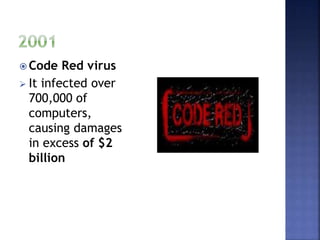
 Code Red virus
 It infected over
700,000 of
computers,
causing damages
in excess of $2
billion
 no more notable
viruses appeared
due to
sophisticated
antivirus and
firewall systems
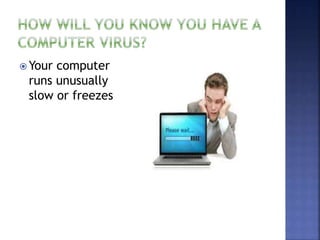
 Your computer
runs unusually
slow or freezes
 People are
receiving emails
from you which
you did not send
 You get pop-up
messages or
advertisements
 Slower than usual
network or
Internet speed
 Files mysteriously
appear or
disappear from
your computer
 Your homepage
changes and you
can not change it
back
 Your hard drive
free space keeps
shrinking
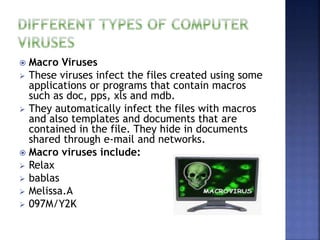
 Macro Viruses
 These viruses infect the files created using some
applications or programs that contain macros
such as doc, pps, xls and mdb.
 They automatically infect the files with macros
and also templates and documents that are
contained in the file. They hide in documents
shared through e-mail and networks.
 Macro viruses include:
 Relax
 bablas
 Melissa.A
 097M/Y2K
 Memory Resident Viruses
 They usually fix themselves inside the
computer memory. They get activated every
time the OS runs and end up infecting other
opened files. They hide in RAM.
 Memory Resident Viruses Include:
 CMJ
 meve
 randex
 mrklunky
 Overwrite Viruses
 These types of viruses delete any information
in a file they infect, leaving them partially or
completely useless once they are infected.
Once in the computer, they replaces all the
file content but the file size doesn’t change.
 Overwrite Viruses Include:
 Trj.Reboot
 way
 trivial.88.D
 Direct Action Viruses
 These viruses mainly replicate or take action
once they are executed.
 When a certain condition is met, the viruses
will act by infecting the files in the directory
or the folder specified in the AUTOEXEC.BAT.
 The viruses are generally found in the hard
disk’s root directory, but they keep on
changing location.
 Direct Action Viruses Include:
 Vienna virus
 Directory Virus
 Also known as cluster virus or file system
virus.
 They infect the computer’s directory by
changing the path indicating file location.
 They are usually located in the disk but
affect the entire directory.
 Directory Viruses Include:
 dir-2 virus
 Web Scripting Virus
 Most web pages include some complex codes
in order to create an interactive and
interesting content.
 Such a code is often exploited to cause
certain undesirable actions.
 They mostly originate from the infected web
pages or browsers.
 Web Scripting Viruses Include:
 JS.Fortnight – a virus that spreads
via malicious emails.
 Multipartite Virus
 These type of viruses spread in many
different ways.
 Their actions vary depending on the OS
installed and presence of certain files.
 They tend to hide in the computer’s memory
but do not infect the hard disk.
 FAT Viruses
 These lardy viruses attack the file allocation
table (FAT) which is the disc part used to
store every information about the available
space, location of files, unusable space etc.
 FAT Viruses Include:
 the link virus
 Companion Viruses
 These types of viruses infect files just like
the direct action and the resident types.
Once inside the computer, they ‘accompany’
other existing files.
 Companion Viruses Include:
 Asimov.1539
 stator and terrax.1069
 Polymorphic Virus
 They encode or encrypt themselves in a different
way every time they infect your computer.
 They use different encryption and algorithms.
 This makes it difficult for the antivirus software
to locate those using signature or string searches
(since they are very different in each
encryption).
 Polymorphic Viruses Include:
 Marburg
 tuareg
 Satan bug
 elkern
 Worm
 This program is very similar to a virus and
has the ability to self-replicate leading to
negative effects on your computer.
 Worm Viruses Include:
 lovgate.F
 sobig.D
 trile. C
 PSWBugbear.B
 Mapson
 Trojans
 Trojans can illegally trace important login
details of users online.
 For example E-Banking is very common
among users, therefore, vulnerability of
tracing your login details whenever your PC
is working without any strong powerful
antivirus installed.
 Email Virus
 This is a virus spread via an email.
 Such a virus will hide in an email and when
the recipient opens the mail.
 Browser Hijacker
 This virus can spread in many different ways
including a voluntary download.
 If infects certain browser functions especially
in form of re-directing the user automatically
to certain sites. A good example is
 Browser Hijackers Include:
 the cool web search
 Boot Infectors
 They include the boot sector plus master
boot record types.
 All the viral codes can be separate location;
however they infect the hard disks or the
floppy.
 Boot Infectors Include:
 the brain virus -it is the very first wild virus
to be created.
 From what we have seen, the many types of
computer viruses and their effects are very
harmful and can completely damage your
system. Always make sure your system is up
to date. Also install antivirus software. The
antivirus program protects your computer
and the personal information in it.

 Don't open unknown attachments in emails
or do a virus scan after opening them.
 (If you get an email from a person that
contains one or more viruses, the viruses
may infect files in the computer.
 The viruses might also send emails to people
from your email address book or email
folders automatically).
 Download files only from trusted sites.
 If you download a program or a
data filefrom the Internet or other shared
networks, viruses might be transferred to
your computer.
 Sometimes the free software programs on
the Internet have viruses especially if you
are downloading from sources such
as Torrent or Usenet newsgroups.
 Remember to do a virus scan for them
after peripheral devices are connected to
your computer.
 The devices such as MP3 players, USB thumb
drives, memory cards or CD drives are also
means of spreading viruses.
 AVG
 Avira
 Avast
 Microsoft Security Essentials
 Malwarebytes
 Panda Cloud AntiVirus
 Comodo Firewall + Antivirus

Computer virus

  • 1.
    Created by MarkAnthony P. Maranga
  • 2.
     To learndeeper of what computer virus is  To be immune of any computer virus attack  To be able defend against computer virus
  • 3.
     What iscomputer virus?  Why do people create computer virus?  Brief History of computer virus?  How will you know you have a computer virus?  Different types of computer viruses  Ways to prevent computer virus  List of trusted free antivirus
  • 4.
    A computer virus isa program designed to harm or cause harm on an infected computer.
  • 5.
    To gain control ofor hack a computer and use it for specific tasks.
  • 6.
     To generatemoney by using such malware as a cash machine.
  • 7.
     To stealsensitive information (credit card number, password, personal details, date, etc.)
  • 8.
     To provethat they are capable of writing virus.
  • 9.
     Revenge against company,cripple a computer or network.
  • 10.
     John von Neumann came up with the theory about self-replicating programs in 1949.
  • 11.
     Fred Cohen comes up with the term “computer virus”
  • 12.
     Core Wars An application not release until 1984.  It replicates itself every single time it was run in computer
  • 13.
     Reaper  Antivirus application specifically designedto destroy core wars of an infected computers.
  • 14.
     MS-DOS  Mostpopular OS when viruses becoming thick and fast.  The most targeted OS by “the brain” virus which release in Pakistan in 1986.
  • 15.
     1988 MorrisWorm for MSDOS  Created by Robert Morris, 23, a small virus that infected almost 6,000 computers
  • 16.
     Melissa Virus It managed to infect thousands of computers at an alarming speed, causing over $80 million in damages
  • 17.
     I LoveYou Virus  It managed to infect millions of computers in just under a day  The virus sent usernames and passwords it found on the infected computer back to the author
  • 18.
     Code Redvirus  It infected over 700,000 of computers, causing damages in excess of $2 billion
  • 19.
     no morenotable viruses appeared due to sophisticated antivirus and firewall systems
  • 20.
     Your computer runsunusually slow or freezes
  • 21.
     People are receivingemails from you which you did not send
  • 22.
     You getpop-up messages or advertisements
  • 23.
     Slower thanusual network or Internet speed
  • 24.
     Files mysteriously appearor disappear from your computer
  • 25.
     Your homepage changesand you can not change it back
  • 26.
     Your harddrive free space keeps shrinking
  • 27.
     Macro Viruses These viruses infect the files created using some applications or programs that contain macros such as doc, pps, xls and mdb.  They automatically infect the files with macros and also templates and documents that are contained in the file. They hide in documents shared through e-mail and networks.  Macro viruses include:  Relax  bablas  Melissa.A  097M/Y2K
  • 28.
     Memory ResidentViruses  They usually fix themselves inside the computer memory. They get activated every time the OS runs and end up infecting other opened files. They hide in RAM.  Memory Resident Viruses Include:  CMJ  meve  randex  mrklunky
  • 29.
     Overwrite Viruses These types of viruses delete any information in a file they infect, leaving them partially or completely useless once they are infected. Once in the computer, they replaces all the file content but the file size doesn’t change.  Overwrite Viruses Include:  Trj.Reboot  way  trivial.88.D
  • 30.
     Direct ActionViruses  These viruses mainly replicate or take action once they are executed.  When a certain condition is met, the viruses will act by infecting the files in the directory or the folder specified in the AUTOEXEC.BAT.  The viruses are generally found in the hard disk’s root directory, but they keep on changing location.  Direct Action Viruses Include:  Vienna virus
  • 31.
     Directory Virus Also known as cluster virus or file system virus.  They infect the computer’s directory by changing the path indicating file location.  They are usually located in the disk but affect the entire directory.  Directory Viruses Include:  dir-2 virus
  • 32.
     Web ScriptingVirus  Most web pages include some complex codes in order to create an interactive and interesting content.  Such a code is often exploited to cause certain undesirable actions.  They mostly originate from the infected web pages or browsers.  Web Scripting Viruses Include:  JS.Fortnight – a virus that spreads via malicious emails.
  • 33.
     Multipartite Virus These type of viruses spread in many different ways.  Their actions vary depending on the OS installed and presence of certain files.  They tend to hide in the computer’s memory but do not infect the hard disk.
  • 34.
     FAT Viruses These lardy viruses attack the file allocation table (FAT) which is the disc part used to store every information about the available space, location of files, unusable space etc.  FAT Viruses Include:  the link virus
  • 35.
     Companion Viruses These types of viruses infect files just like the direct action and the resident types. Once inside the computer, they ‘accompany’ other existing files.  Companion Viruses Include:  Asimov.1539  stator and terrax.1069
  • 36.
     Polymorphic Virus They encode or encrypt themselves in a different way every time they infect your computer.  They use different encryption and algorithms.  This makes it difficult for the antivirus software to locate those using signature or string searches (since they are very different in each encryption).  Polymorphic Viruses Include:  Marburg  tuareg  Satan bug  elkern
  • 37.
     Worm  Thisprogram is very similar to a virus and has the ability to self-replicate leading to negative effects on your computer.  Worm Viruses Include:  lovgate.F  sobig.D  trile. C  PSWBugbear.B  Mapson
  • 38.
     Trojans  Trojanscan illegally trace important login details of users online.  For example E-Banking is very common among users, therefore, vulnerability of tracing your login details whenever your PC is working without any strong powerful antivirus installed.
  • 39.
     Email Virus This is a virus spread via an email.  Such a virus will hide in an email and when the recipient opens the mail.
  • 40.
     Browser Hijacker This virus can spread in many different ways including a voluntary download.  If infects certain browser functions especially in form of re-directing the user automatically to certain sites. A good example is  Browser Hijackers Include:  the cool web search
  • 41.
     Boot Infectors They include the boot sector plus master boot record types.  All the viral codes can be separate location; however they infect the hard disks or the floppy.
  • 42.
     Boot InfectorsInclude:  the brain virus -it is the very first wild virus to be created.  From what we have seen, the many types of computer viruses and their effects are very harmful and can completely damage your system. Always make sure your system is up to date. Also install antivirus software. The antivirus program protects your computer and the personal information in it. 
  • 43.
     Don't openunknown attachments in emails or do a virus scan after opening them.  (If you get an email from a person that contains one or more viruses, the viruses may infect files in the computer.  The viruses might also send emails to people from your email address book or email folders automatically).
  • 45.
     Download filesonly from trusted sites.  If you download a program or a data filefrom the Internet or other shared networks, viruses might be transferred to your computer.  Sometimes the free software programs on the Internet have viruses especially if you are downloading from sources such as Torrent or Usenet newsgroups.
  • 47.
     Remember todo a virus scan for them after peripheral devices are connected to your computer.  The devices such as MP3 players, USB thumb drives, memory cards or CD drives are also means of spreading viruses.
  • 49.
     AVG  Avira Avast  Microsoft Security Essentials  Malwarebytes  Panda Cloud AntiVirus  Comodo Firewall + Antivirus