Computer Fundamentals
& Internet Part 1
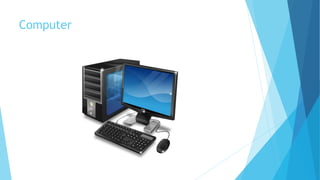
Computer
 machine that performs tasks, such as mathematical
calculations or electronic communication, under the
control of a set of instructions called a program.
 is an electronic device used to process data
Limitation of Computer
 A computer cannot generate information on its own. It must be told
what-to-do when to start, stop, compute and make the next move.
Computer is basically subject to human control.
 A computer can detect but generally cannot correct on its own in an
accurate entry. It cannot correct wrong instructions. It does not have
the “common sense” to correct the incorrect data or instructions but it
can inform you that there is an error.
 Computers need periodic maintenance support.
 A computer is subject to occasional breakdown normally due to power
failure or power fluctuations.
Data
 May be defined as the knowledge contained in the human
brain and in all electronic and written records.
 Definite knowledge acquired or supplied about something
or somebody
 The collected facts and data about a particular subject
Information
 information output by a sensing device or organ that
includes both useful and irrelevant or redundant
information and must be processed to be meaningful.
 often in the form of facts or figures obtained from
experiments or surveys, used as a basis for making
calculations or drawing conclusions.
Computer
Hardware
 refers to any part of the computer you can touch.
 Hardware consists of interconnected electronic devices
that you can use to control the computer’s operation,
input, and output.
 refers to the physical equipment of a computer
information system.
Hardware
 Processor
 Memory
 Storage Device
 Input and output Device
Processor
 The procedure that transforms raw data into useful information is called processing.
 To perform this transformation, the computer use two components: the processor and
memory.
 The processor is like the brain of the computer, the part that organizes and carries out
instructions that come from either the user or the software.
Memory
 is the computers electronic scratch pad.
 Programs are loaded into and run from memory.
 Data used by the program is also loaded into memory for fast access.
Storage Device
 Magnetic storage devices
 Optical storage devices
 Flash memory devices
 Online and Cloud
Magnetic Storage Devices
Today, magnetic storage is one of the most common types of storage used with
computers and is the technology that many computer hard drives use.
 Floppy diskette
 Hard drive
 Magnetic strip
 SuperDisk
 Tape cassette
 Zip diskette
Optical Storage Devices
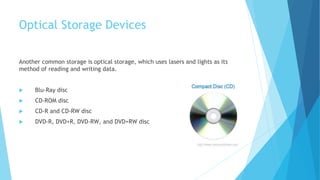
Another common storage is optical storage, which uses lasers and lights as its
method of reading and writing data.
 Blu-Ray disc
 CD-ROM disc
 CD-R and CD-RW disc
 DVD-R, DVD+R, DVD-RW, and DVD+RW disc
Flash Memory Devices
Flash memory has started to replace magnetic media as it becomes cheaper as it
is the more efficient and reliable solution.
 Jump drive or flash drive
 Memory card
 Memory stick
 SSD
Online and Cloud
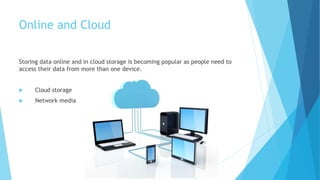
Storing data online and in cloud storage is becoming popular as people need to
access their data from more than one device.
 Cloud storage
 Network media
Input Devices
 Primary Input Devices:
 Keyboard
 Mouse
 Other Input Devices:
 Pens
 Touch Screen
 Barcode Readers
 Image Scanners and Optical Character Recognition (OCR)
Keyboard
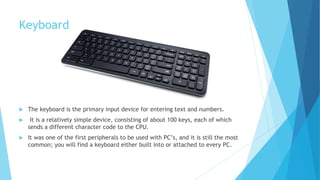
 The keyboard is the primary input device for entering text and numbers.
 It is a relatively simple device, consisting of about 100 keys, each of which
sends a different character code to the CPU.
 It was one of the first peripherals to be used with PC’s, and it is still the most
common; you will find a keyboard either built into or attached to every PC.
Mouse
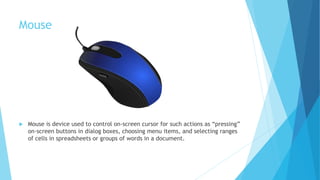
 Mouse is device used to control on-screen cursor for such actions as “pressing”
on-screen buttons in dialog boxes, choosing menu items, and selecting ranges
of cells in spreadsheets or groups of words in a document.
Pens
 Pens based system use an electronic pen as their primary input device.
 You hold the pen in your hand and write on a special pad or directly on the
screen.
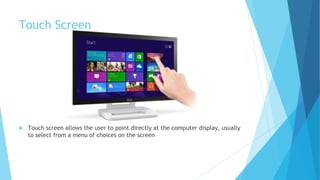
Touch Screen
 Touch screen allows the user to point directly at the computer display, usually
to select from a menu of choices on the screen
Barcode Reader
 Barcode Readers are the most widely used input device after the keyboard and
mouse.
 The most common type of barcode reader is the flatbed model, which is
commonly found in supermarkets and department stores.
Image Scanner
 Image Scanner convert any image into electronic form by shining light onto the
image and sensing the intensity of the reflection at every point.
Output Device
Monitors
Printers
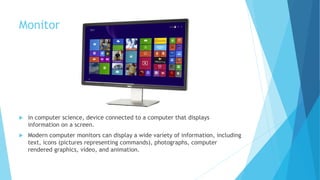
Monitor
 in computer science, device connected to a computer that displays
information on a screen.
 Modern computer monitors can display a wide variety of information, including
text, icons (pictures representing commands), photographs, computer
rendered graphics, video, and animation.
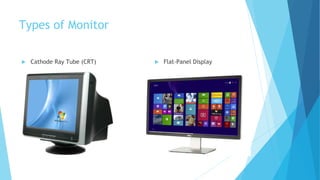
Types of Monitor
 Cathode Ray Tube (CRT)  Flat-Panel Display
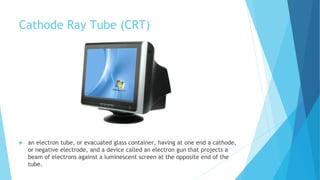
Cathode Ray Tube (CRT)
 an electron tube, or evacuated glass container, having at one end a cathode,
or negative electrode, and a device called an electron gun that projects a
beam of electrons against a luminescent screen at the opposite end of the
tube.
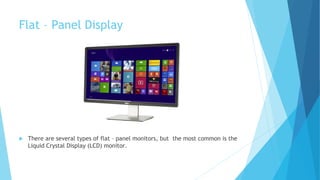
Flat – Panel Display
 There are several types of flat – panel monitors, but the most common is the
Liquid Crystal Display (LCD) monitor.
Printers
 A computer peripheral that puts text or a computer-generated image on paper
or on another medium.
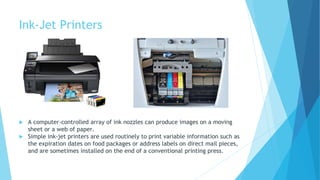
Ink-Jet Printers
 A computer-controlled array of ink nozzles can produce images on a moving
sheet or a web of paper.
 Simple ink-jet printers are used routinely to print variable information such as
the expiration dates on food packages or address labels on direct mail pieces,
and are sometimes installed on the end of a conventional printing press.
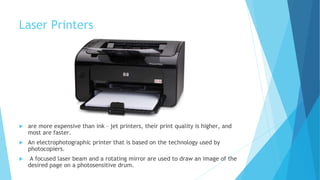
Laser Printers
 are more expensive than ink – jet printers, their print quality is higher, and
most are faster.
 An electrophotographic printer that is based on the technology used by
photocopiers.
 A focused laser beam and a rotating mirror are used to draw an image of the
desired page on a photosensitive drum.
Dot Matrix Printer
 uses a print head that moves back-and-forth, or in an up-and-down motion, on
the page and prints by impact, striking an ink-soaked cloth ribbon against the
paper, much like the print mechanism on a typewriter
Software
 The programs that help people accomplish specific tasks are referred to as
application software.
 Application software has been written to do almost every task imaginable.
 Thousands of applications are available; however, some major categories you
are likely to encounter are:
 Word processing software
 Spreadsheet
 Database management software
 Graphics, multimedia, and presentation applications
 Entertainment and education software
 Utilities
 Communication software

Computer fundamentals-internet p1

  • 1.
  • 2.
    Computer  machine thatperforms tasks, such as mathematical calculations or electronic communication, under the control of a set of instructions called a program.  is an electronic device used to process data
  • 3.
    Limitation of Computer A computer cannot generate information on its own. It must be told what-to-do when to start, stop, compute and make the next move. Computer is basically subject to human control.  A computer can detect but generally cannot correct on its own in an accurate entry. It cannot correct wrong instructions. It does not have the “common sense” to correct the incorrect data or instructions but it can inform you that there is an error.  Computers need periodic maintenance support.  A computer is subject to occasional breakdown normally due to power failure or power fluctuations.
  • 4.
    Data  May bedefined as the knowledge contained in the human brain and in all electronic and written records.  Definite knowledge acquired or supplied about something or somebody  The collected facts and data about a particular subject
  • 5.
    Information  information outputby a sensing device or organ that includes both useful and irrelevant or redundant information and must be processed to be meaningful.  often in the form of facts or figures obtained from experiments or surveys, used as a basis for making calculations or drawing conclusions.
  • 6.
  • 7.
    Hardware  refers toany part of the computer you can touch.  Hardware consists of interconnected electronic devices that you can use to control the computer’s operation, input, and output.  refers to the physical equipment of a computer information system.
  • 8.
    Hardware  Processor  Memory Storage Device  Input and output Device
  • 9.
    Processor  The procedurethat transforms raw data into useful information is called processing.  To perform this transformation, the computer use two components: the processor and memory.  The processor is like the brain of the computer, the part that organizes and carries out instructions that come from either the user or the software.
  • 10.
    Memory  is thecomputers electronic scratch pad.  Programs are loaded into and run from memory.  Data used by the program is also loaded into memory for fast access.
  • 11.
    Storage Device  Magneticstorage devices  Optical storage devices  Flash memory devices  Online and Cloud
  • 12.
    Magnetic Storage Devices Today,magnetic storage is one of the most common types of storage used with computers and is the technology that many computer hard drives use.  Floppy diskette  Hard drive  Magnetic strip  SuperDisk  Tape cassette  Zip diskette
  • 13.
    Optical Storage Devices Anothercommon storage is optical storage, which uses lasers and lights as its method of reading and writing data.  Blu-Ray disc  CD-ROM disc  CD-R and CD-RW disc  DVD-R, DVD+R, DVD-RW, and DVD+RW disc
  • 14.
    Flash Memory Devices Flashmemory has started to replace magnetic media as it becomes cheaper as it is the more efficient and reliable solution.  Jump drive or flash drive  Memory card  Memory stick  SSD
  • 15.
    Online and Cloud Storingdata online and in cloud storage is becoming popular as people need to access their data from more than one device.  Cloud storage  Network media
  • 16.
    Input Devices  PrimaryInput Devices:  Keyboard  Mouse  Other Input Devices:  Pens  Touch Screen  Barcode Readers  Image Scanners and Optical Character Recognition (OCR)
  • 17.
    Keyboard  The keyboardis the primary input device for entering text and numbers.  It is a relatively simple device, consisting of about 100 keys, each of which sends a different character code to the CPU.  It was one of the first peripherals to be used with PC’s, and it is still the most common; you will find a keyboard either built into or attached to every PC.
  • 18.
    Mouse  Mouse isdevice used to control on-screen cursor for such actions as “pressing” on-screen buttons in dialog boxes, choosing menu items, and selecting ranges of cells in spreadsheets or groups of words in a document.
  • 19.
    Pens  Pens basedsystem use an electronic pen as their primary input device.  You hold the pen in your hand and write on a special pad or directly on the screen.
  • 20.
    Touch Screen  Touchscreen allows the user to point directly at the computer display, usually to select from a menu of choices on the screen
  • 21.
    Barcode Reader  BarcodeReaders are the most widely used input device after the keyboard and mouse.  The most common type of barcode reader is the flatbed model, which is commonly found in supermarkets and department stores.
  • 22.
    Image Scanner  ImageScanner convert any image into electronic form by shining light onto the image and sensing the intensity of the reflection at every point.
  • 23.
  • 24.
    Monitor  in computerscience, device connected to a computer that displays information on a screen.  Modern computer monitors can display a wide variety of information, including text, icons (pictures representing commands), photographs, computer rendered graphics, video, and animation.
  • 25.
    Types of Monitor Cathode Ray Tube (CRT)  Flat-Panel Display
  • 26.
    Cathode Ray Tube(CRT)  an electron tube, or evacuated glass container, having at one end a cathode, or negative electrode, and a device called an electron gun that projects a beam of electrons against a luminescent screen at the opposite end of the tube.
  • 27.
    Flat – PanelDisplay  There are several types of flat – panel monitors, but the most common is the Liquid Crystal Display (LCD) monitor.
  • 28.
    Printers  A computerperipheral that puts text or a computer-generated image on paper or on another medium.
  • 29.
    Ink-Jet Printers  Acomputer-controlled array of ink nozzles can produce images on a moving sheet or a web of paper.  Simple ink-jet printers are used routinely to print variable information such as the expiration dates on food packages or address labels on direct mail pieces, and are sometimes installed on the end of a conventional printing press.
  • 30.
    Laser Printers  aremore expensive than ink – jet printers, their print quality is higher, and most are faster.  An electrophotographic printer that is based on the technology used by photocopiers.  A focused laser beam and a rotating mirror are used to draw an image of the desired page on a photosensitive drum.
  • 31.
    Dot Matrix Printer uses a print head that moves back-and-forth, or in an up-and-down motion, on the page and prints by impact, striking an ink-soaked cloth ribbon against the paper, much like the print mechanism on a typewriter
  • 32.
    Software  The programsthat help people accomplish specific tasks are referred to as application software.  Application software has been written to do almost every task imaginable.  Thousands of applications are available; however, some major categories you are likely to encounter are:  Word processing software  Spreadsheet  Database management software  Graphics, multimedia, and presentation applications  Entertainment and education software  Utilities  Communication software