Computer Networks
Lecture 01
Course Materials
 Textbooks
 Computer Networks by ATanenbaum
 Data Communications and Networking By Behrouz A. Forouzan
 Lecture slides( Will be uploaded regularly !)
What is computer network?
• A network is a set of devices (often referred to as nodes) connected by
communication links. A node can be a computer, printer, or any other device
capable of sending and/or receiving data generated by other nodes on the
network. A link can be a cable, air, optical fiber, or any medium which can
transport a signal carrying information.
Components of a data communication system
Data flow (simplex, half-duplex, and full-duplex)
Intranet & Extranet
An Intranet is a private local network which is structured within an
organization or a company. It’s a private network because no other outsider to
that organization can access the intranet. Only the users (may be employees
of the company) of the network are allowed to connect the LAN with
individual network passwords to access the company’s intranet.
Extranet An extranet is a private network that allows businesses to share
information and communicate with authorized external parties.
Intranet & Extranet
Benefit of a network
File sharing: A network makes it easy for everyone to access the same file and prevents
people from accidentally creating different versions.
Printer sharing:With a network, several computers can share the same hardware. For
example, you might need a more expensive printer to handle the added workload, it's still
cheaper to use a network printer than to connect a separate printer to every computer in your
office.
Communication and collaboration: It's hard for people to work together if no one knows
what anyone else is doing.A network allows employees to share files, view other people's
work, and exchange ideas more efficiently. In a larger office, you can use e-mail and instant
messaging tools to communicate quickly and to store messages for future reference
Shared Internet access: If you have several computers but just one phone line, a network
makes using the Internet much easier.
Network Criteria
• Performance
• Depends on Network Elements
• Measured in terms of Delay andThroughput
• Reliability
• Failure rate of network components
• Measured in terms of availability/robustness
• Security
• Data protection against corruption/loss of data due to:
• Errors
• Malicious users
How network are categorized?
• Architecture
• Transmission technology
• Scale
• Topology
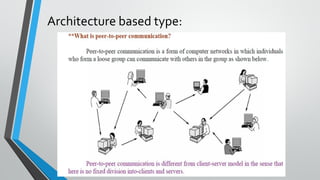
Architecture based type:
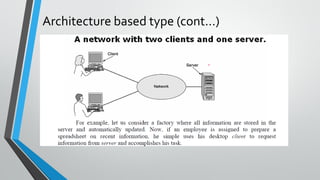
Architecture based type (cont…)
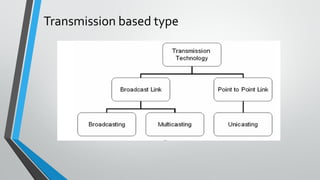
Transmission based type
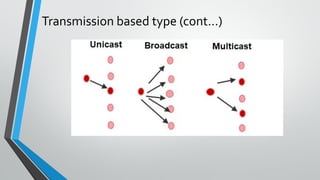
• Unicast is the term used to describe communication where a piece of
information is sent from one point to another point. In this case there is just
one sender, and one receiver.
• Broadcast is the term used to describe communication where a piece of
information is sent from one point to all other points. In this case there is
just one sender, but the information is sent to all connected receivers.
• Multicast is the term used to describe communication where a piece of
information is sent from one or more points to a set of other points. In this
case there is may be one or more senders, and the information is distributed
to a set of receivers (there may be no receivers, or any other number of
receivers).
Transmission based type (cont…)
Scale based type
Personal Area Network
A personal area network (PAN) is a
computer network for interconnecting
devices centered on an individual
person's workspace. A PAN provides
data transmission among devices such
as computers, smartphones, tablets and
personal digital assistants.
Local Area Network
A local area network (LAN) is a
computer network that interconnects
computers within a limited area such as
a residence, school, laboratory,
university campus or office building.
An isolated LAN connecting 12 computers to a hub in a
closet
Metropolitan Area Network
A metropolitan area network (MAN) is a
computer network that usually spans a
city or a large campus.A MAN usually
interconnects a number of local
area networks (LANs) using a high-
capacity backbone technology
Wide Area Network
A WAN (wide area network) is a
communications network that spans a
large geographic area such as across
cities, states, or countries.They can be
private to connect parts of a business or
they can be more public to connect
smaller networks together.
WANs: a switchedWAN and a point-to-pointWAN
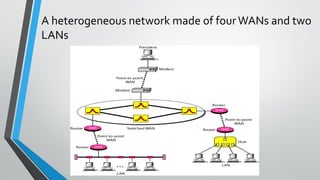
A heterogeneous network made of fourWANs and two
LANs
NetworkTopologies
• Topology the logical layout of the cables and devices that connect the nodes of
the network.
• Network designers consider several factors when deciding which topology or
combination of topologies to use:
• the type of computers and cabling in place,
• the distance between computers,
• the speed at which data must travel around the network, and
• the cost of setting up the network.
NetworkTopology: Bus
• A bus topology network uses one cable . All the nodes and peripheral devices
are connected in a series to that cable.
• This topology’s main advantage is that it uses the least amount of cabling of
any topology.
• A broken connection can bring down all or part of the network.
NetworkTopology: Star
• In a star network, all nodes are connected to a device called a hub and communicate
through it.
• In a star topology, a broken communication between a node and the hub does not
affect the rest of the network.
• If the hub is lost, however, all nodes connected to that hub are unable to
communicate.
NetworkTopology: Ring
• The ring topology connects the network' s nodes in a circular chain, with each
node connected to the next.
• The last node connects to the first, completing the ring.
• Each node examines data as it travels through the ring.
• If the ring is broken, however, the entire network is unable to communicate.
NetworkTopology: Mesh
• The mesh topology is the least-used network topology and the most
expensive to implement .
• In a mesh environment, a cable runs from every computer to every
other computer.
• If you have four computers, you must have six cables—three coming from
each computer to the other computers.
• The big advantage to this arrangement is that data can never foil to
be delivered; if one connection goes down, there arc other ways to route the
data to its destination.
THE INTERNET
The Internet has revolutionized many aspects of our daily lives. It has affected
the way we do business as well as the way we spend our leisure time.The
Internet is a communication system that has brought a wealth of information
to our fingertips and organized it for our use.
Hierarchical organization of the Internet
Protocol
Protocol: A protocol is a set of rules and standards that basically define a
language that devices can use to communicate. It determines what is
communicated, how it is communicated and when it is communicatedThere
are a great number of protocols in use extensively in networking, and they are
often implemented in different layers.The key elements of a protocol are
• Syntax,
• Semantics
• Timing
Elements of a Protocol
• Syntax
• Structure or format of the data
• Indicates how to read the bits - field delineation
• Semantics
• Interprets the meaning of the bits
• Knows which fields define what action
• Timing
• When data should be sent and what
• Speed at which data should be sent or speed at which it is being received.
Some NetworkTerminologies
 NetworkTopology
Topology of a network describes the way the computers and the nodes of the network are
interconnected.There are a number of possible topologies
▪ BusTopology
▪ StarTopology
▪ TreeTopology
▪ RingTopology
▪ MeshTopology
▪ Links
The physical connections that connects the nodes are known as links. A link may be through a pair
of wires, a coaxial cable, an optical fiber or through a satellite.
• Internetwork: It is a general term describing multiple networks connected together.The
Internet is the largest and most well-known internetwork.
• Firewall: A firewall is a program that decides whether traffic coming into a server or going
out should be allowed.A firewall usually works by creating rules for which type of traffic is
acceptable on which ports. Generally, firewalls block ports that are not used by a specific
application on a server.
BasicTerminology
• In a network, any connected device is called as host. A host can serve as
following ways:
A host can acts as a Client, when he is requesting information.
A host can acts as a Server, when he provides information.
A host can also request and provide information, is called Peer.
• VPN (Virtual Private Network): AVPN allows for information to be securely
sent across a public or unsecure network, such as the Internet. Common
uses of aVPN are to connect branch offices or remote users to a main office.
BasicTerminology (cont…)
• Packet: A packet is a unit of data sent between devices. When you load a
web page, your computer sends packets to the server requesting the web
page and the server responds with many different packets of its own, which
your computer stitches together to form the web page.The packet is the
basic unit of data that computers on a network exchange.
BasicTerminology (cont…)
“Stay hungry. Stay foolish.”
-Steve Jobs

Lecture 1 - Basic Networking and market.pdf

  • 1.
  • 2.
    Course Materials  Textbooks Computer Networks by ATanenbaum  Data Communications and Networking By Behrouz A. Forouzan  Lecture slides( Will be uploaded regularly !)
  • 3.
    What is computernetwork? • A network is a set of devices (often referred to as nodes) connected by communication links. A node can be a computer, printer, or any other device capable of sending and/or receiving data generated by other nodes on the network. A link can be a cable, air, optical fiber, or any medium which can transport a signal carrying information.
  • 4.
    Components of adata communication system
  • 5.
    Data flow (simplex,half-duplex, and full-duplex)
  • 6.
    Intranet & Extranet AnIntranet is a private local network which is structured within an organization or a company. It’s a private network because no other outsider to that organization can access the intranet. Only the users (may be employees of the company) of the network are allowed to connect the LAN with individual network passwords to access the company’s intranet. Extranet An extranet is a private network that allows businesses to share information and communicate with authorized external parties.
  • 7.
  • 8.
    Benefit of anetwork File sharing: A network makes it easy for everyone to access the same file and prevents people from accidentally creating different versions. Printer sharing:With a network, several computers can share the same hardware. For example, you might need a more expensive printer to handle the added workload, it's still cheaper to use a network printer than to connect a separate printer to every computer in your office. Communication and collaboration: It's hard for people to work together if no one knows what anyone else is doing.A network allows employees to share files, view other people's work, and exchange ideas more efficiently. In a larger office, you can use e-mail and instant messaging tools to communicate quickly and to store messages for future reference Shared Internet access: If you have several computers but just one phone line, a network makes using the Internet much easier.
  • 9.
    Network Criteria • Performance •Depends on Network Elements • Measured in terms of Delay andThroughput • Reliability • Failure rate of network components • Measured in terms of availability/robustness • Security • Data protection against corruption/loss of data due to: • Errors • Malicious users
  • 10.
    How network arecategorized? • Architecture • Transmission technology • Scale • Topology
  • 11.
  • 12.
  • 13.
  • 14.
  • 15.
  • 16.
    • Unicast isthe term used to describe communication where a piece of information is sent from one point to another point. In this case there is just one sender, and one receiver. • Broadcast is the term used to describe communication where a piece of information is sent from one point to all other points. In this case there is just one sender, but the information is sent to all connected receivers. • Multicast is the term used to describe communication where a piece of information is sent from one or more points to a set of other points. In this case there is may be one or more senders, and the information is distributed to a set of receivers (there may be no receivers, or any other number of receivers). Transmission based type (cont…)
  • 17.
  • 18.
  • 19.
    Personal Area Network Apersonal area network (PAN) is a computer network for interconnecting devices centered on an individual person's workspace. A PAN provides data transmission among devices such as computers, smartphones, tablets and personal digital assistants.
  • 20.
    Local Area Network Alocal area network (LAN) is a computer network that interconnects computers within a limited area such as a residence, school, laboratory, university campus or office building.
  • 21.
    An isolated LANconnecting 12 computers to a hub in a closet
  • 22.
    Metropolitan Area Network Ametropolitan area network (MAN) is a computer network that usually spans a city or a large campus.A MAN usually interconnects a number of local area networks (LANs) using a high- capacity backbone technology
  • 23.
    Wide Area Network AWAN (wide area network) is a communications network that spans a large geographic area such as across cities, states, or countries.They can be private to connect parts of a business or they can be more public to connect smaller networks together.
  • 24.
    WANs: a switchedWANand a point-to-pointWAN
  • 25.
    A heterogeneous networkmade of fourWANs and two LANs
  • 27.
    NetworkTopologies • Topology thelogical layout of the cables and devices that connect the nodes of the network. • Network designers consider several factors when deciding which topology or combination of topologies to use: • the type of computers and cabling in place, • the distance between computers, • the speed at which data must travel around the network, and • the cost of setting up the network.
  • 28.
    NetworkTopology: Bus • Abus topology network uses one cable . All the nodes and peripheral devices are connected in a series to that cable. • This topology’s main advantage is that it uses the least amount of cabling of any topology. • A broken connection can bring down all or part of the network.
  • 29.
    NetworkTopology: Star • Ina star network, all nodes are connected to a device called a hub and communicate through it. • In a star topology, a broken communication between a node and the hub does not affect the rest of the network. • If the hub is lost, however, all nodes connected to that hub are unable to communicate.
  • 30.
    NetworkTopology: Ring • Thering topology connects the network' s nodes in a circular chain, with each node connected to the next. • The last node connects to the first, completing the ring. • Each node examines data as it travels through the ring. • If the ring is broken, however, the entire network is unable to communicate.
  • 31.
    NetworkTopology: Mesh • Themesh topology is the least-used network topology and the most expensive to implement . • In a mesh environment, a cable runs from every computer to every other computer. • If you have four computers, you must have six cables—three coming from each computer to the other computers. • The big advantage to this arrangement is that data can never foil to be delivered; if one connection goes down, there arc other ways to route the data to its destination.
  • 34.
    THE INTERNET The Internethas revolutionized many aspects of our daily lives. It has affected the way we do business as well as the way we spend our leisure time.The Internet is a communication system that has brought a wealth of information to our fingertips and organized it for our use.
  • 35.
  • 36.
    Protocol Protocol: A protocolis a set of rules and standards that basically define a language that devices can use to communicate. It determines what is communicated, how it is communicated and when it is communicatedThere are a great number of protocols in use extensively in networking, and they are often implemented in different layers.The key elements of a protocol are • Syntax, • Semantics • Timing
  • 37.
    Elements of aProtocol • Syntax • Structure or format of the data • Indicates how to read the bits - field delineation • Semantics • Interprets the meaning of the bits • Knows which fields define what action • Timing • When data should be sent and what • Speed at which data should be sent or speed at which it is being received.
  • 38.
    Some NetworkTerminologies  NetworkTopology Topologyof a network describes the way the computers and the nodes of the network are interconnected.There are a number of possible topologies ▪ BusTopology ▪ StarTopology ▪ TreeTopology ▪ RingTopology ▪ MeshTopology ▪ Links The physical connections that connects the nodes are known as links. A link may be through a pair of wires, a coaxial cable, an optical fiber or through a satellite.
  • 39.
    • Internetwork: Itis a general term describing multiple networks connected together.The Internet is the largest and most well-known internetwork. • Firewall: A firewall is a program that decides whether traffic coming into a server or going out should be allowed.A firewall usually works by creating rules for which type of traffic is acceptable on which ports. Generally, firewalls block ports that are not used by a specific application on a server. BasicTerminology
  • 40.
    • In anetwork, any connected device is called as host. A host can serve as following ways: A host can acts as a Client, when he is requesting information. A host can acts as a Server, when he provides information. A host can also request and provide information, is called Peer. • VPN (Virtual Private Network): AVPN allows for information to be securely sent across a public or unsecure network, such as the Internet. Common uses of aVPN are to connect branch offices or remote users to a main office. BasicTerminology (cont…)
  • 41.
    • Packet: Apacket is a unit of data sent between devices. When you load a web page, your computer sends packets to the server requesting the web page and the server responds with many different packets of its own, which your computer stitches together to form the web page.The packet is the basic unit of data that computers on a network exchange. BasicTerminology (cont…)
  • 42.
    “Stay hungry. Stayfoolish.” -Steve Jobs