INTERNET
By: Praveen kr choudhary
MBA-1st semester, Section-C
Roll No. - 18152
Submitted To: Pankaj sir
Contents
• What is Internet
• Origin Of Internet
• Advantages and Disadvantages of Internet
• How Internet Works
• Internet protocol
• OSI Reference Model
WHAT IS INTERNET
The internet is a telecommunications network that uses telephone
lines, cables, satellites and wireless connections to connect
computers and other devices to the World Wide Web. All modern
computers can connect to the internet, as can many mobile phones
and some televisions, video game consoles and other devices.
ORIGIN OF INTERNET
• It all began with the development of electronic computers in the
1950's.
• The origin of the internet date back to the 1960' when research
was commisioned by the US government.
• ARPANET was funded by the US military after the cold war with
the intention of having a military command and control center the
could withstand nuclear attacks.
.ADVANTAGES AND
DISADVANTAGES OF INTERNET
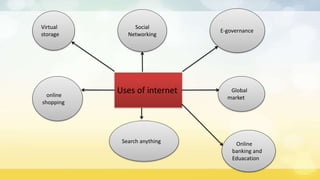
online
shopping
Global
market
Uses of internet
Virtual
storage
E-governance
Search anything
Social
Networking
Online
banking and
Eduacation
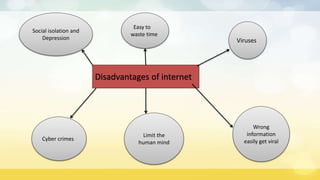
Disadvantages of internet
Viruses
Easy to
waste time
Social isolation and
Depression
Cyber crimes
Limit the
human mind
Wrong
information
easily get viral
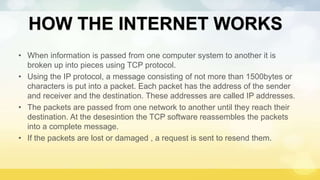
HOW THE INTERNET WORKS
• When information is passed from one computer system to another it is
broken up into pieces using TCP protocol.
• Using the IP protocol, a message consisting of not more than 1500bytes or
characters is put into a packet. Each packet has the address of the sender
and receiver and the destination. These addresses are called IP addresses.
• The packets are passed from one network to another until they reach their
destination. At the desesintion the TCP software reassembles the packets
into a complete message.
• If the packets are lost or damaged , a request is sent to resend them.
INTERNET PROTOCOL
• The Internet Protocol (IP) is the method or protocol by which data is sent
from one computer to another on the Internet. Each computer (known as a
host) on the Internet has at least one IP address that uniquely identifies it
from all other computers on the Internet.
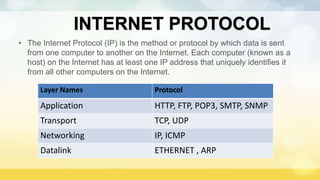
Layer Names Protocol
Application HTTP, FTP, POP3, SMTP, SNMP
Transport TCP, UDP
Networking IP, ICMP
Datalink ETHERNET , ARP
OSI REFERENCE MODEL
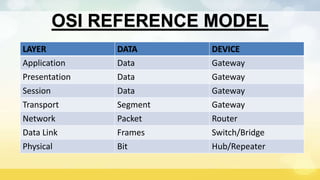
LAYER DATA DEVICE
Application Data Gateway
Presentation Data Gateway
Session Data Gateway
Transport Segment Gateway
Network Packet Router
Data Link Frames Switch/Bridge
Physical Bit Hub/Repeater
Thank you sir!

INTERNET

  • 1.
    INTERNET By: Praveen krchoudhary MBA-1st semester, Section-C Roll No. - 18152 Submitted To: Pankaj sir
  • 2.
    Contents • What isInternet • Origin Of Internet • Advantages and Disadvantages of Internet • How Internet Works • Internet protocol • OSI Reference Model
  • 3.
    WHAT IS INTERNET Theinternet is a telecommunications network that uses telephone lines, cables, satellites and wireless connections to connect computers and other devices to the World Wide Web. All modern computers can connect to the internet, as can many mobile phones and some televisions, video game consoles and other devices.
  • 5.
    ORIGIN OF INTERNET •It all began with the development of electronic computers in the 1950's. • The origin of the internet date back to the 1960' when research was commisioned by the US government. • ARPANET was funded by the US military after the cold war with the intention of having a military command and control center the could withstand nuclear attacks.
  • 6.
  • 7.
    online shopping Global market Uses of internet Virtual storage E-governance Searchanything Social Networking Online banking and Eduacation
  • 8.
    Disadvantages of internet Viruses Easyto waste time Social isolation and Depression Cyber crimes Limit the human mind Wrong information easily get viral
  • 9.
    HOW THE INTERNETWORKS • When information is passed from one computer system to another it is broken up into pieces using TCP protocol. • Using the IP protocol, a message consisting of not more than 1500bytes or characters is put into a packet. Each packet has the address of the sender and receiver and the destination. These addresses are called IP addresses. • The packets are passed from one network to another until they reach their destination. At the desesintion the TCP software reassembles the packets into a complete message. • If the packets are lost or damaged , a request is sent to resend them.
  • 10.
    INTERNET PROTOCOL • TheInternet Protocol (IP) is the method or protocol by which data is sent from one computer to another on the Internet. Each computer (known as a host) on the Internet has at least one IP address that uniquely identifies it from all other computers on the Internet. Layer Names Protocol Application HTTP, FTP, POP3, SMTP, SNMP Transport TCP, UDP Networking IP, ICMP Datalink ETHERNET , ARP
  • 11.
    OSI REFERENCE MODEL LAYERDATA DEVICE Application Data Gateway Presentation Data Gateway Session Data Gateway Transport Segment Gateway Network Packet Router Data Link Frames Switch/Bridge Physical Bit Hub/Repeater
  • 12.