1
ECS455 Chapter 2
Cellular Systems
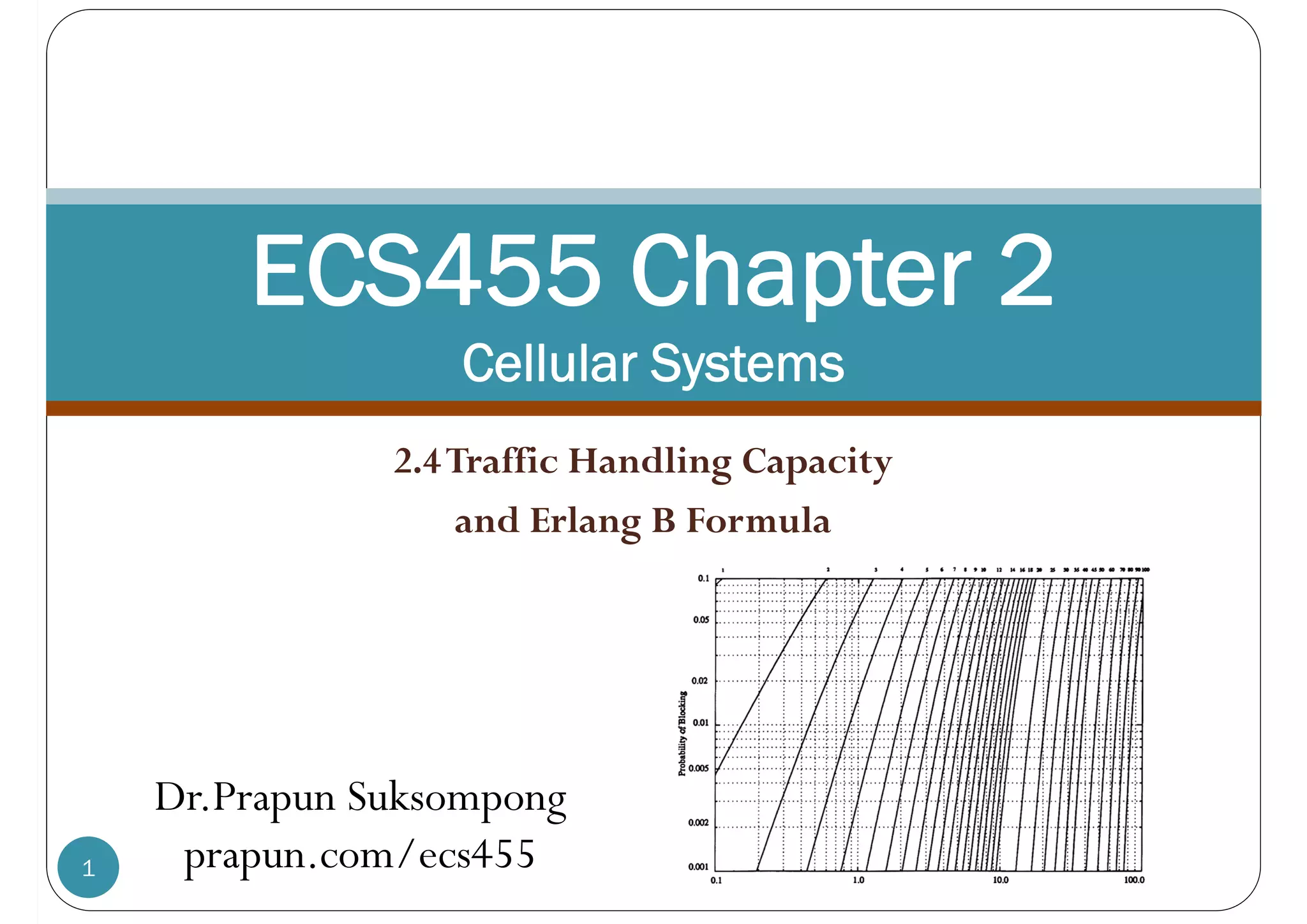
2.4Traffic Handling Capacity
and Erlang B Formula
Dr.Prapun Suksompong
prapun.com/ecs455
Capacity Concept: A Revisit
2
 Q: If I have m channels per cell, is it true that my cell can support
only m users?
 A:Yes and No
 Let’s try one example.
 How often do you make a call?
 3 calls a day, on average.
 How long is the call?
 10 mins (per call), on average.
 So, one person uses
Capacity Concept: A Revisit
3
 If we can “give” the time that “User 1” is idle to other users,
 then one channel can support users!!
 True?
New Concepts for a New Look at
Capacity
5
 We can let more than one user share a channel by using it at
different times.
 Blocked call happens if a user requests to make a call when all
the channels are occupied by other users.
 Probability of (call) blocking: Pb
 The likelihood that a call is blocked because there is no available
channel.
 1%, 2%, 5%
 In which case, the number of users that a cell can support can
exceed .
 How much larger depends strongly on the value of Pb that can be
tolerated.
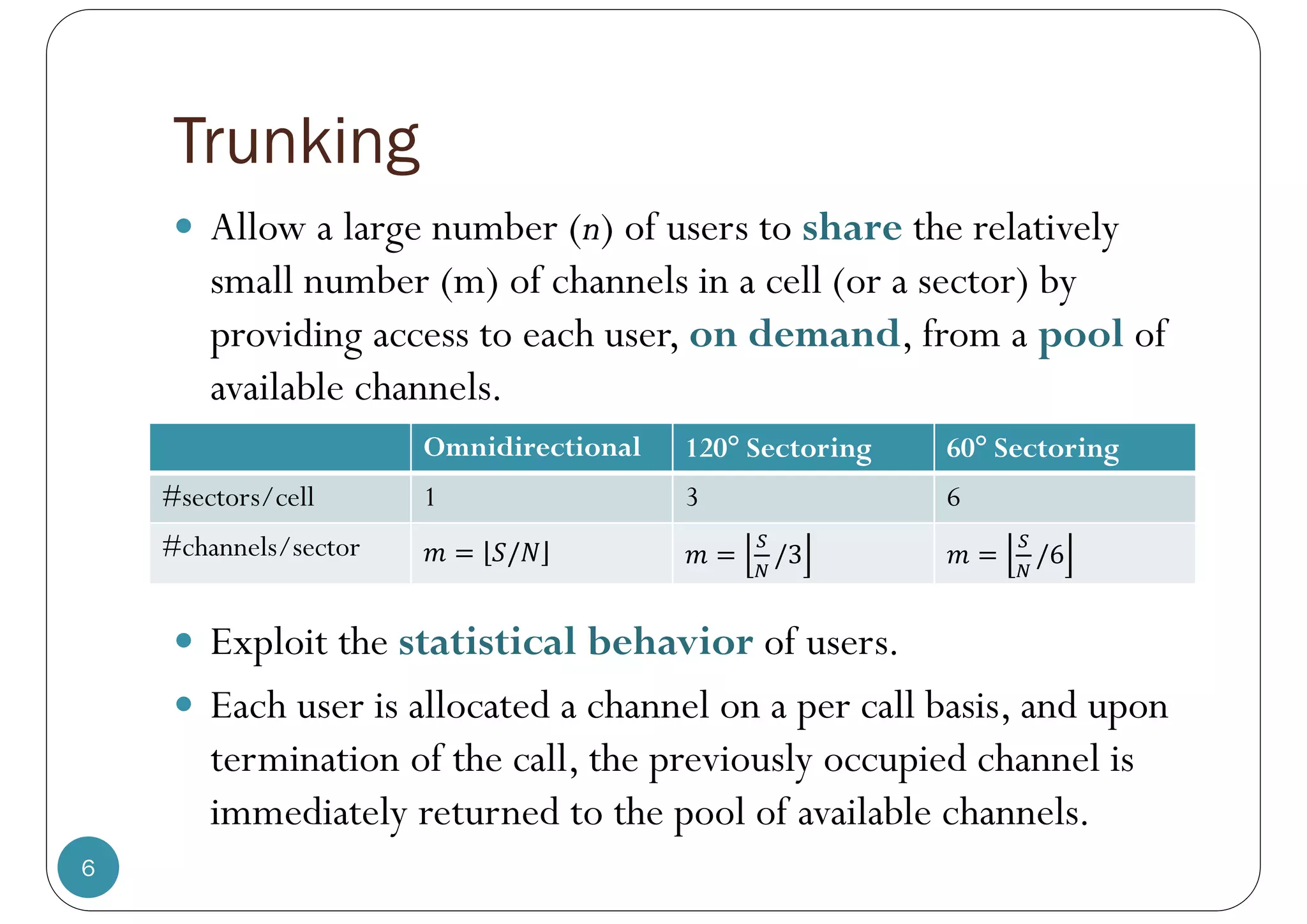
Trunking
6
 Allow a large number (n) of users to share the relatively
small number (m) of channels in a cell (or a sector) by
providing access to each user, on demand, from a pool of
available channels.
 Exploit the statistical behavior of users.
 Each user is allocated a channel on a per call basis, and upon
termination of the call, the previously occupied channel is
immediately returned to the pool of available channels.
Omnidirectional 120 Sectoring 60 Sectoring
#sectors/cell 1 3 6
#channels/sector / /3 /6
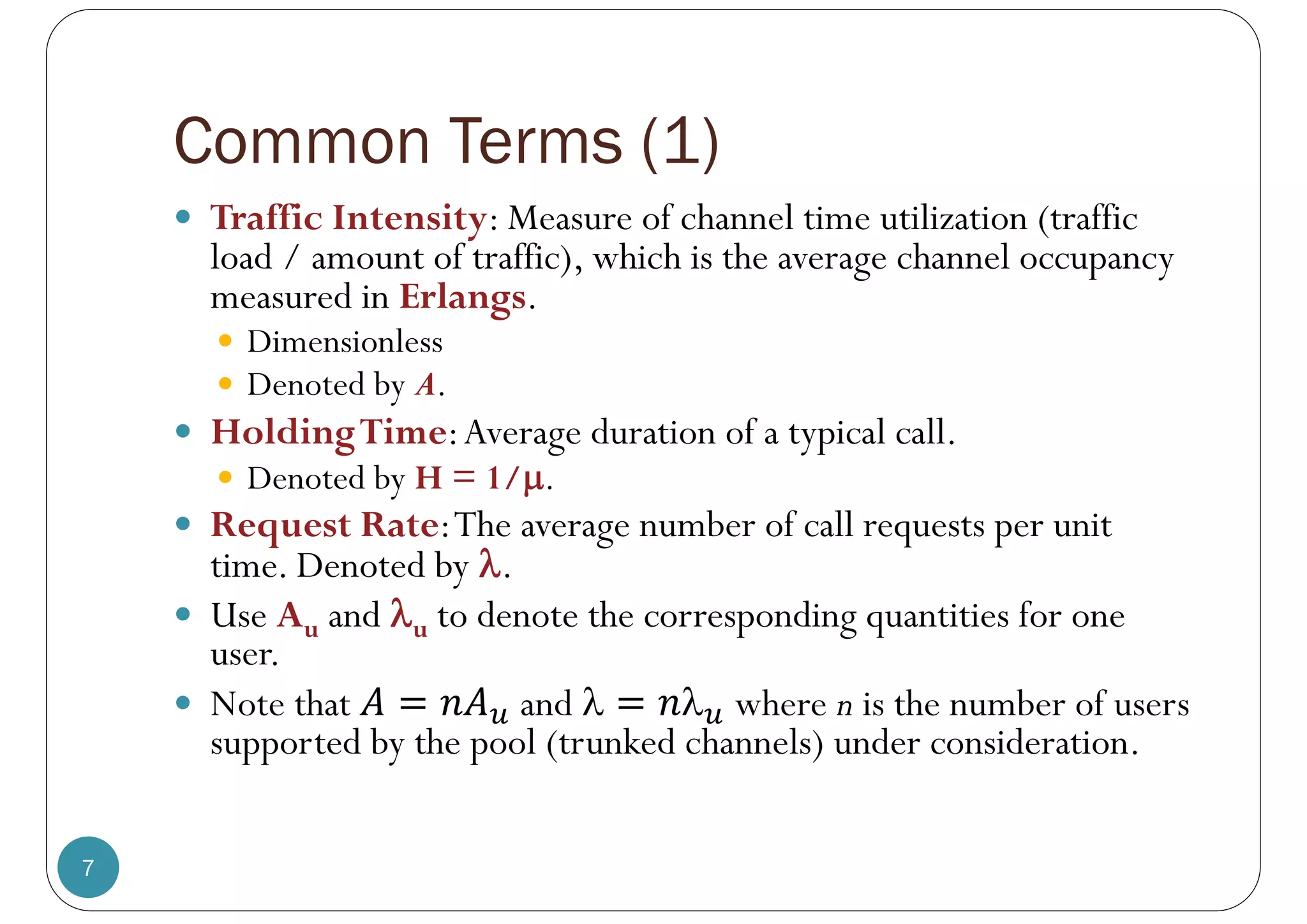
Common Terms (1)
7
 Traffic Intensity: Measure of channel time utilization (traffic
load / amount of traffic), which is the average channel occupancy
measured in Erlangs.
 Dimensionless
 Denoted by A.
 HoldingTime:Average duration of a typical call.
 Denoted by H = 1/.
 Request Rate:The average number of call requests per unit
time. Denoted by .
 Use Au and u to denote the corresponding quantities for one
user.
 Note that and   where n is the number of users
supported by the pool (trunked channels) under consideration.
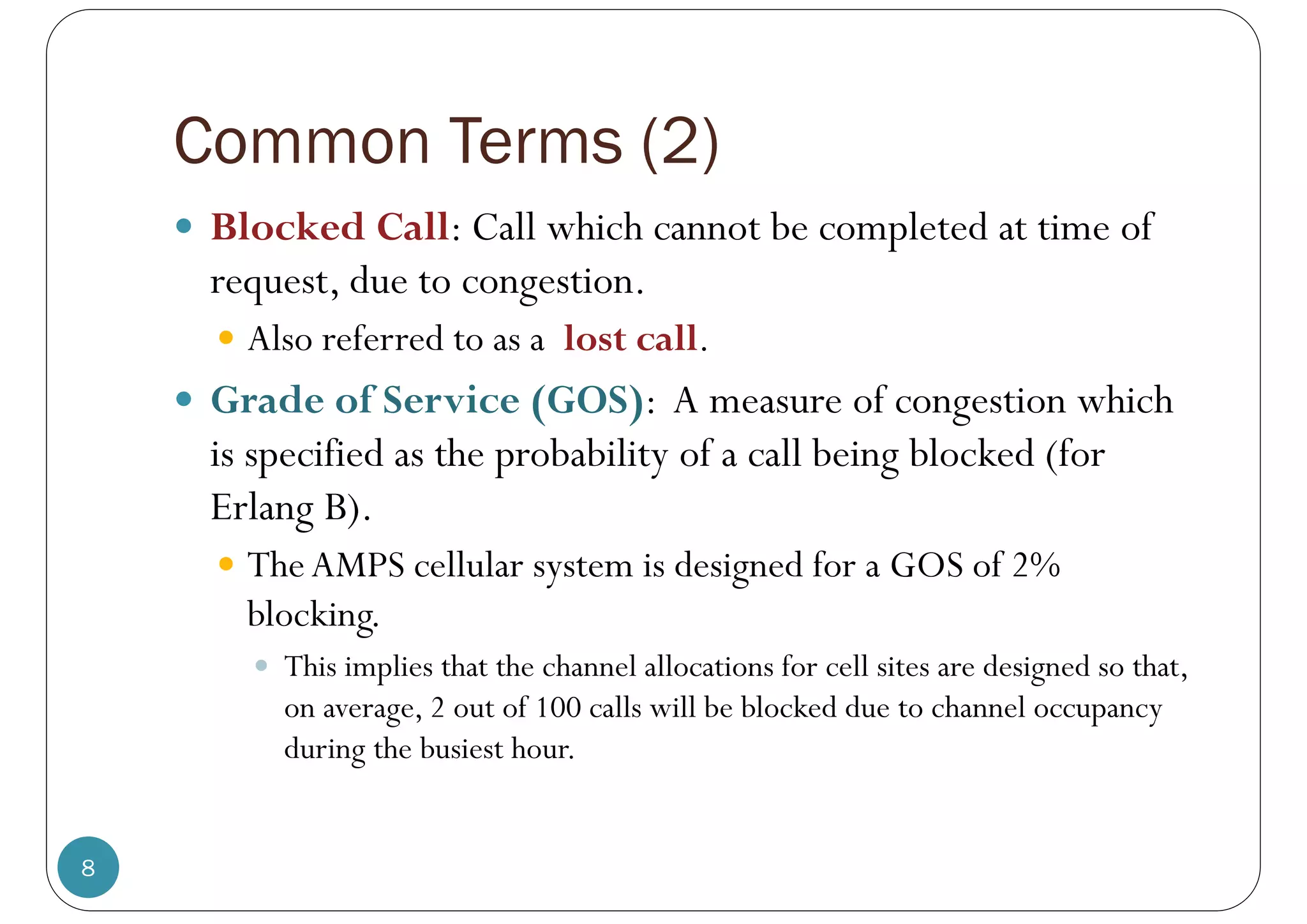
Common Terms (2)
8
 Blocked Call: Call which cannot be completed at time of
request, due to congestion.
 Also referred to as a lost call.
 Grade of Service (GOS): A measure of congestion which
is specified as the probability of a call being blocked (for
Erlang B).
 TheAMPS cellular system is designed for a GOS of 2%
blocking.
 This implies that the channel allocations for cell sites are designed so that,
on average, 2 out of 100 calls will be blocked due to channel occupancy
during the busiest hour.
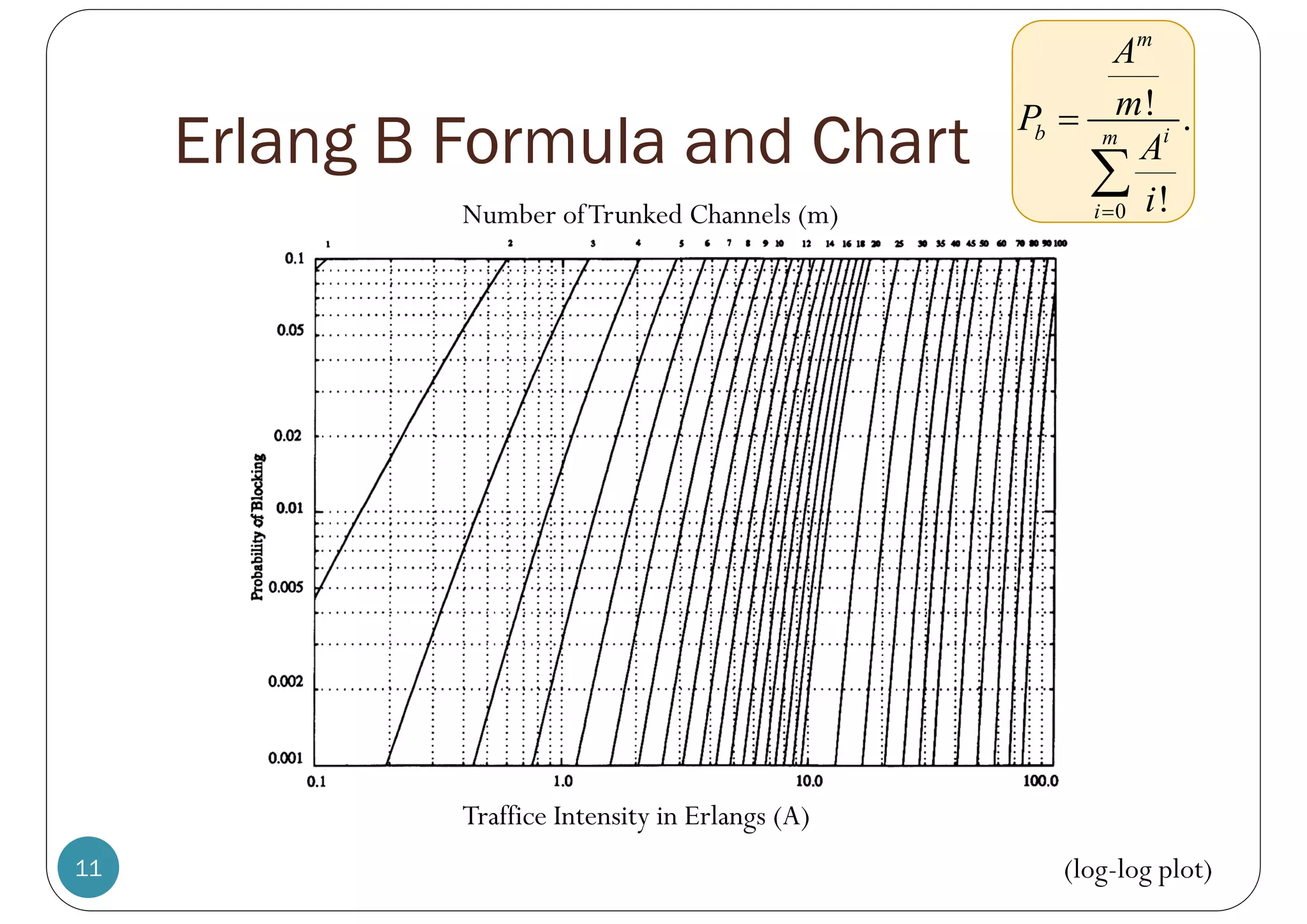
Erlang B Formula
9
0
! .
!
i
m
b
i
m
A
m
P
A
i



In MATLAB, use
erlangb(m,A)
Call blocking
probability
or l
tra oad
ffic i [Erla
ntens ngs]
ty
=
i
A



 =Average # call
attempts/requests per unit
time
m = Number of trunked channels
1
Average call length
H

 
We use the MATLAB code from http://infohost.nmt.edu/~borchers/erlang.html to evaluate the Erlang B formula.
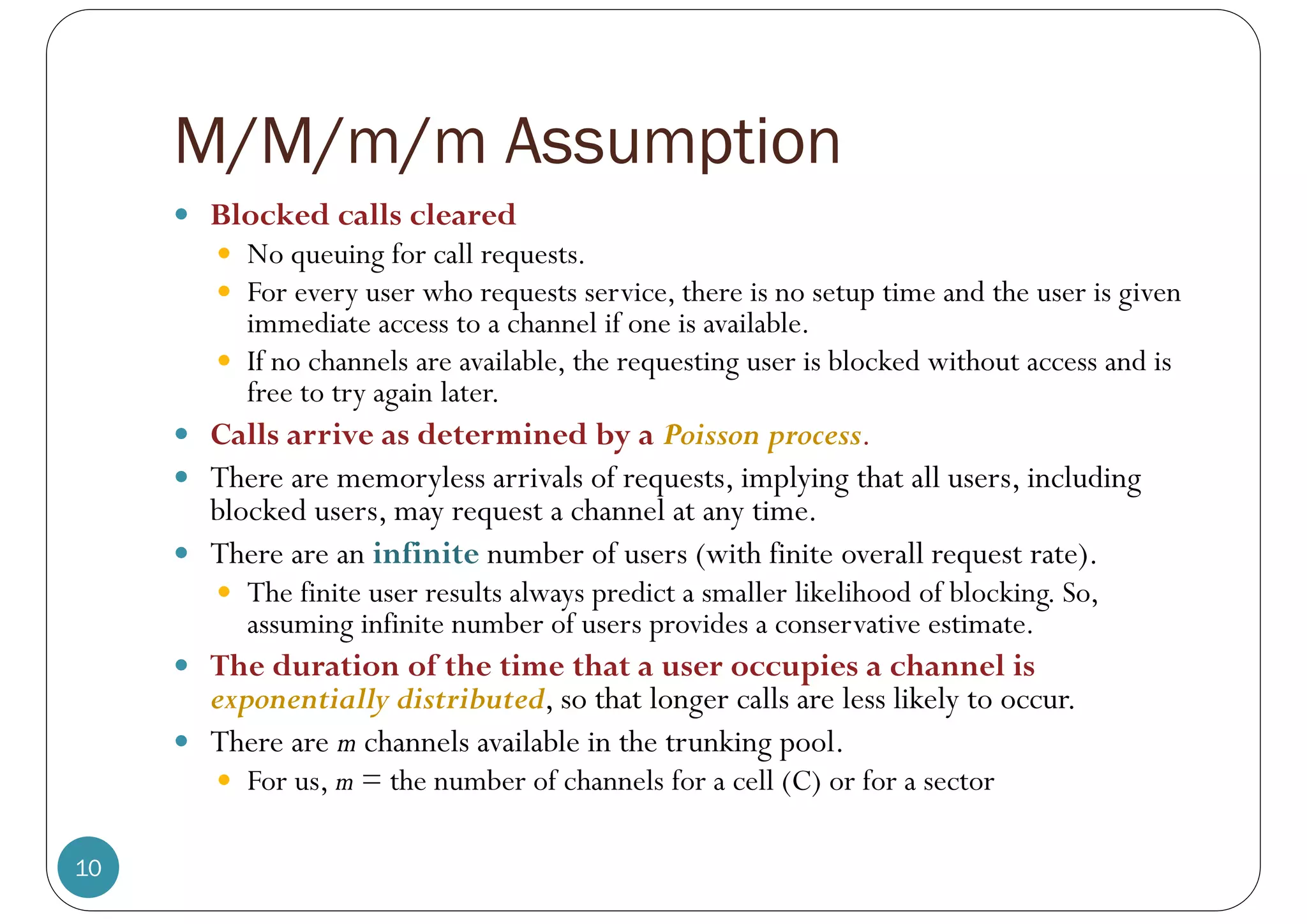
M/M/m/m Assumption
10
 Blocked calls cleared
 No queuing for call requests.
 For every user who requests service, there is no setup time and the user is given
immediate access to a channel if one is available.
 If no channels are available, the requesting user is blocked without access and is
free to try again later.
 Calls arrive as determined by a Poisson process.
 There are memoryless arrivals of requests, implying that all users, including
blocked users, may request a channel at any time.
 There are an infinite number of users (with finite overall request rate).
 The finite user results always predict a smaller likelihood of blocking. So,
assuming infinite number of users provides a conservative estimate.
 The duration of the time that a user occupies a channel is
exponentially distributed, so that longer calls are less likely to occur.
 There are m channels available in the trunking pool.
 For us, m = the number of channels for a cell (C) or for a sector
Erlang B Formula and Chart
11
Traffice Intensity in Erlangs (A)
0
! .
!
i
m
b
i
m
A
m
P
A
i



Number ofTrunked Channels (m)
(log-log plot)
Example 1
12
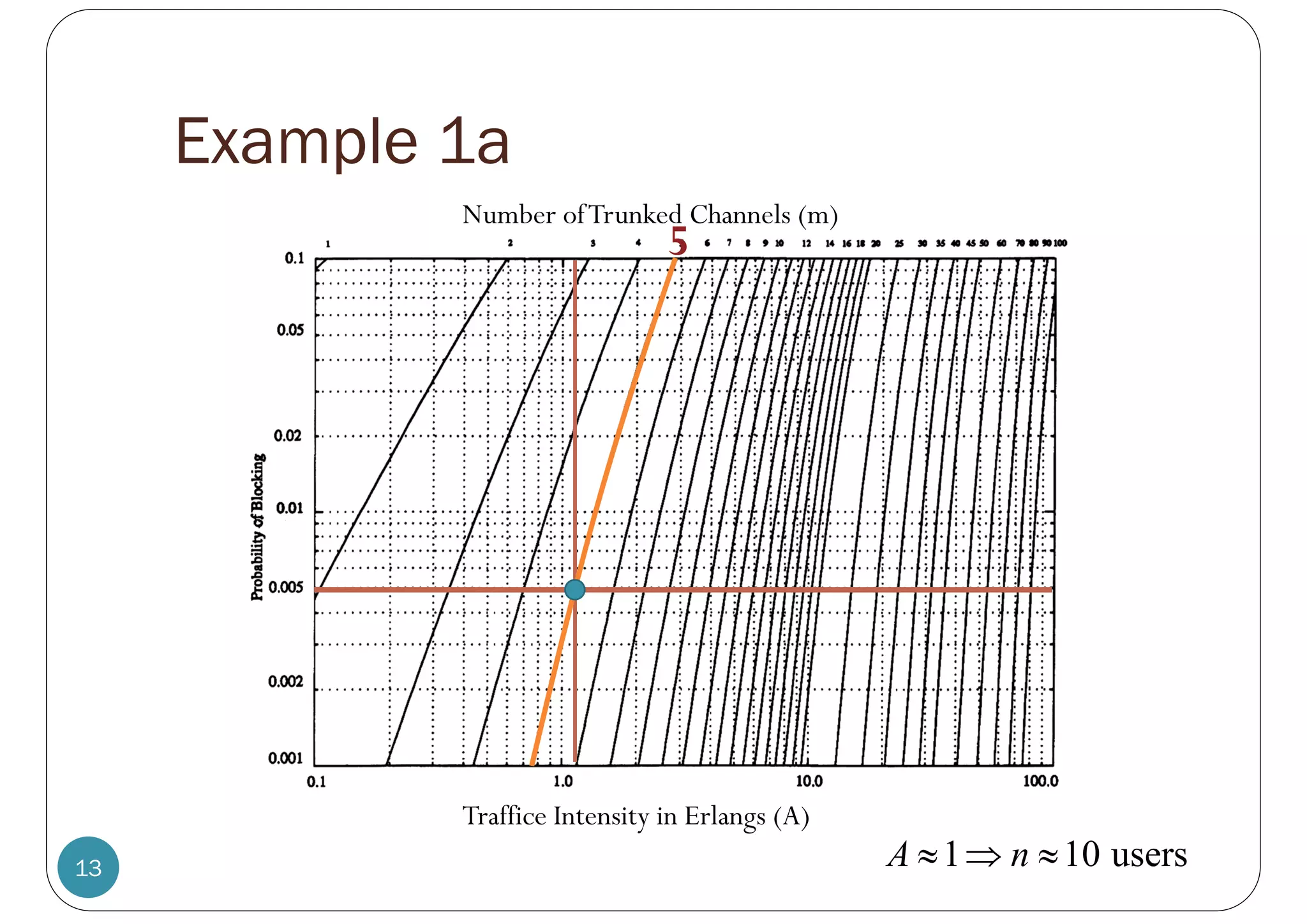
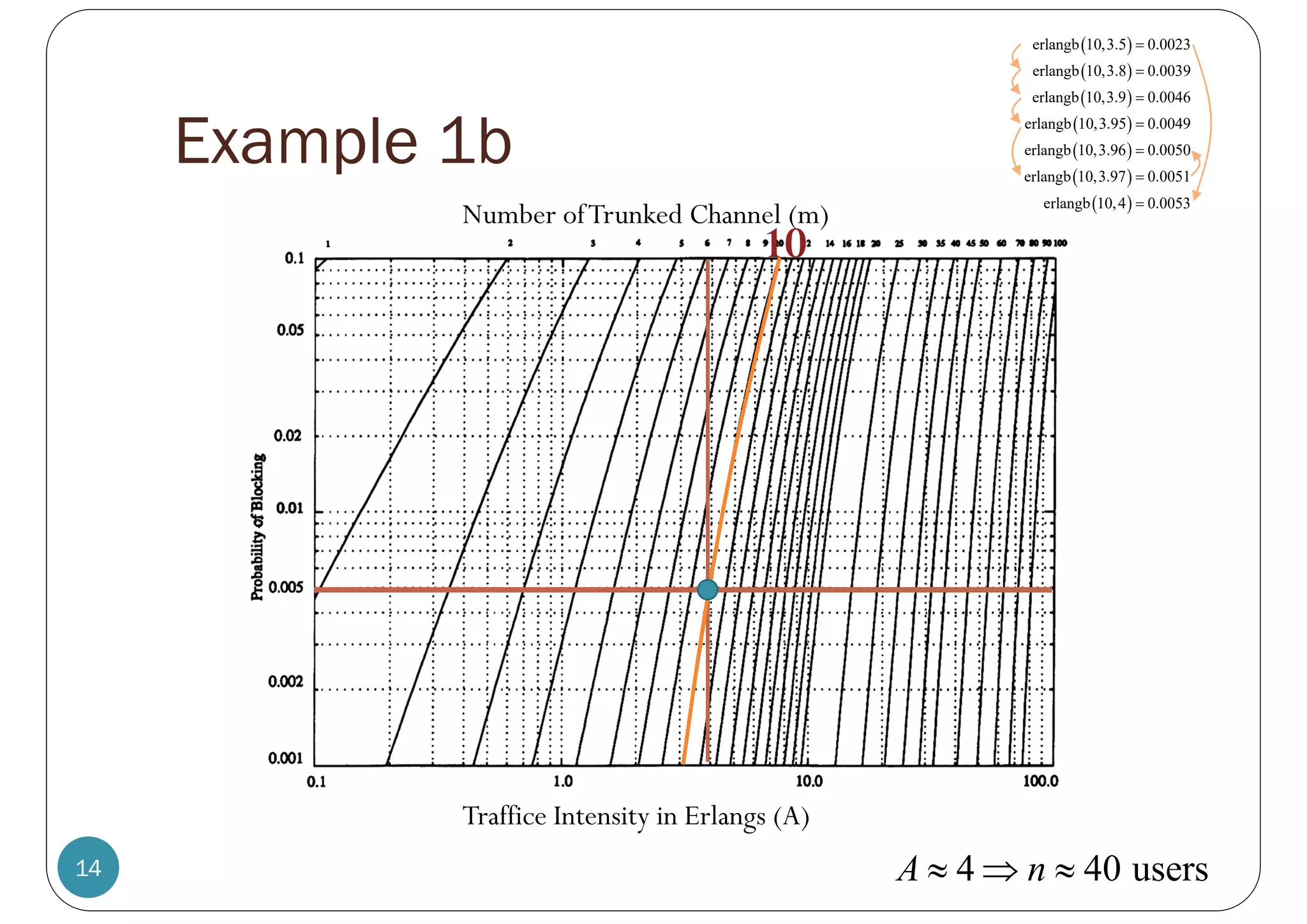
 How many users can be supported for 0.5% blocking
probability for the following number of trunked channels in a
blocked calls cleared system?
(a) 5
(b) 10
 Assume each user generates Au = 0.1 Erlangs of traffic.
Example 1a
13
Traffice Intensity in Erlangs (A)
Number ofTrunked Channels (m)
5
1 10 users
A n
  
Example 1b
14
Traffice Intensity in Erlangs (A)
Number ofTrunked Channel (m)
10
4 40 users
A n
  
 
 
 
 
 
 
 
erlangb 10,3.5 0.0023
erlangb 10,3.8 0.0039
erlangb 10,3.9 0.0046
erlangb 10,3.95 0.0049
erlangb 10,3.96 0.0050
erlangb 10,3.97 0.0051
erlangb 10,4 0.0053







Example 2.1
15
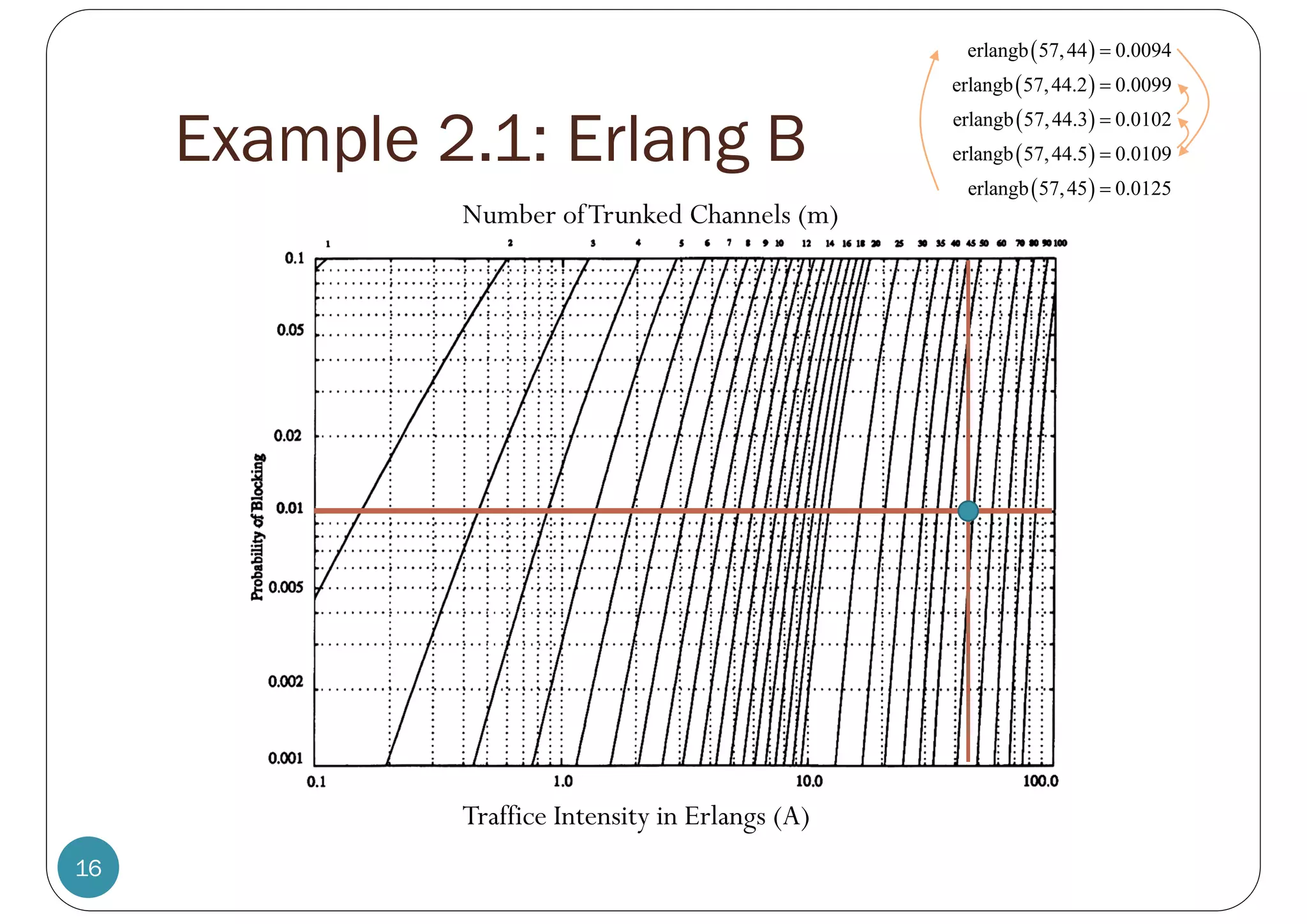
 Consider a cellular system in which
 an average call lasts two minutes
 the probability of blocking is to be no more than 1%.
 If there are a total of 399 traffic channels for a seven-cell
reuse system, there will be 57 traffic channels per cell.
 From the Erlang B formula, can handle 44.2 Erlangs or 1326
calls per hour.
[Rappaport, 2002, Ex 3.9, p 92]
Example 2.1: Erlang B
16
Traffice Intensity in Erlangs (A)
Number ofTrunked Channels (m)
 
 
 
 
 
erlangb 57,44 0.0094
erlangb 57,44.2 0.0099
erlangb 57,44.3 0.0102
erlangb 57,44.5 0.0109
erlangb 57,45 0.0125





Example 2.2
17
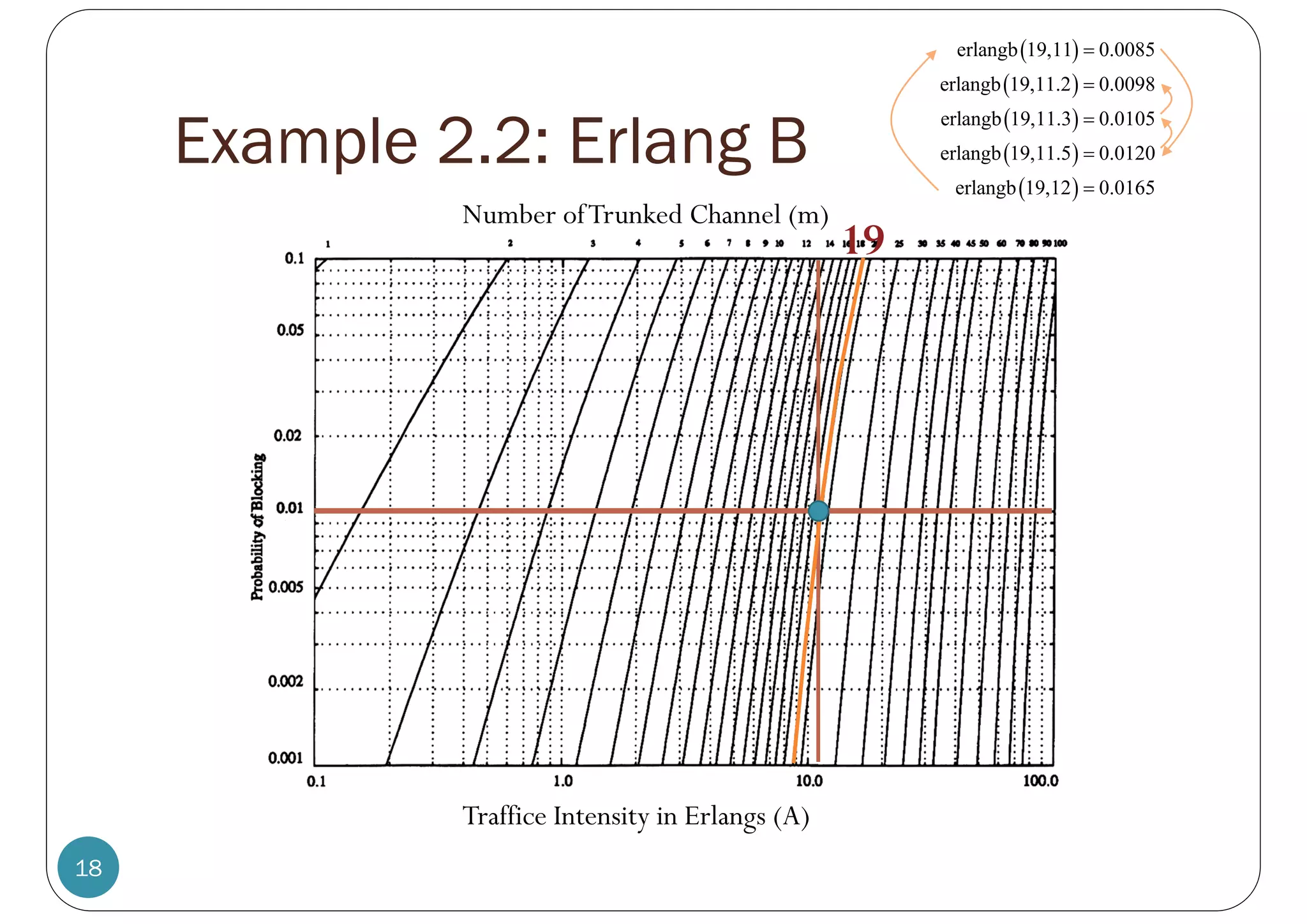
 Now employing 120° sectoring,
there are only m = 57/3 = 19 channels per sector.
 For the same probability of blocking and average call length,
each sector can handle 11.2 Erlangs or 336 calls per hour.
 Since each cell consists of three sectors, this provides a cell
capacity of 3 × 336 = 1008 calls per hour, which amounts
to a 24% decrease when compared to the unsectored case.
 Thus, sectoring decreases the trunking efficiency while
improving the SIR for each user in the system.
[Rappaport, 2002, Ex 3.9, p 92]
Example 2.2: Erlang B
18
Traffice Intensity in Erlangs (A)
Number ofTrunked Channel (m)
 
 
 
 
 
erlangb 19,11 0.0085
erlangb 19,11.2 0.0098
erlangb 19,11.3 0.0105
erlangb 19,11.5 0.0120
erlangb 19,12 0.0165





19
Erlang B Trunking Efficiency
19
[Rappaport, 2002,Table 3.4]
1% 0.1%
m
Summary of Chapter 2: Big Picture
20 0
! .
!
i
m
b
i
m
A
m
P
A
i



total
cell
A S
C
A N
 
 
 
1 1
3
S kR D
N
I K R K
K kD

 



 
  
 
  
S = total # available duplex radio channels for the system
Frequency reuse with cluster size N
Tradeoff
m = # channels allocated to
each cell.
Omni-directional: K = 6
120 Sectoring: K = 2
60 Sectoring: K = 1
“Capacity”
Trunking
Call blocking
probability
Erlang-B formula
or l
tra oad
ffic i [Erla
ntens ngs]
ty =
i
A



 =Average # call attempts/requests per unit time
1
Average call length
H

 
Path loss exponent
m = # trunked channels
Example 3: System Design (1)
21
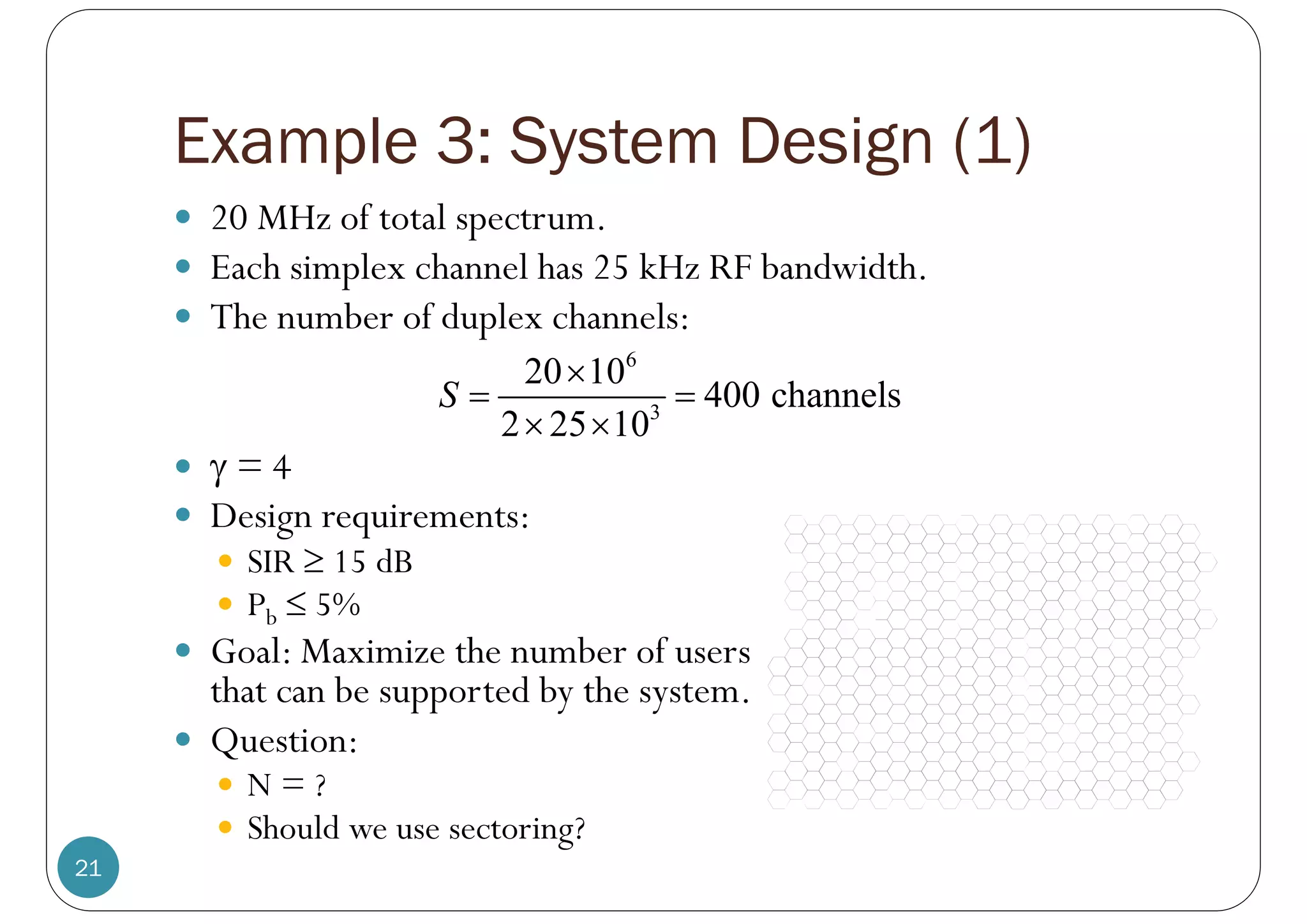
 20 MHz of total spectrum.
 Each simplex channel has 25 kHz RF bandwidth.
 The number of duplex channels:
  = 4
 Design requirements:
 SIR  15 dB
 Pb  5%
 Goal: Maximize the number of users
that can be supported by the system.
 Question:
 N = ?
 Should we use sectoring?
6
3
20 10
400 channels
2 25 10
S

 
 
Example 3 (2)
22
 SIR  15 dB
0 2 4 6 8 10 12 14 16 18 20
0
5
10
15
20
25
30
35
40
SIR
(dB)
N
K = 6  N = 7
K = 2  N = 3
K = 1  N = 3
 
1
SIR 3N
K


clear all; close all;
y = 4;
figure; grid on; hold on;
for K = [1,2,6]
N = [1, 3, 4, 7, 9, 12, 13, 16, 19];
SIR = 10*log10(1/K*((sqrt(3*N)).^y))
plot(N,SIR,'o')
N = linspace(1,20,100);
SIR = 10*log10(1/K*((sqrt(3*N)).^y));
plot(N,SIR)
end
Example 3 (3)
23
Assume that each user makes 2 calls/day and 2 min/call on average  1/360 Erlangs.
Make sure that you understand where numbers in this table come from!
Omnidirectional 120 Sectoring 60 Sectoring
K 6 2 1
N 7 3 3
SIR [dB] 18.7 16.1 19.1
#channels/cell 400/7 = 57 400/3 = 133 400/3 = 133
#sectors/cell 1 3 6
m = #channels/sector 57 /3 = 44 /6 = 22
A [Erlangs]/sector 51.55 38.56 17.13
A [Erlangs]/cell 51.55 38.563 = 115.68 17.136 = 102.78
#users/cell 18558 41645 37001
Conclusion:With  = 4, SIR  15 dB, and Pb  5%,
120 sectoring with cluster size N = 3 should be used.
Example 3 (4): Remarks
24
Omnidirectional 120 Sectoring 60 Sectoring
K 6 2 1
N 7 7 7
SIR [dB] 18.7 23.43 26.44
#channels/cell 400/7 = 57 400/7 = 57 400/7 = 57
#sectors/cell 1 3 6
m = #channels/sector 57 /3 = 19 /6 = 9
A [Erlangs]/sector 51.55 14.31 5.37
A [Erlangs]/cell 51.55 14.313 = 42.94 5.376 = 32.22
For the same N, we see that 120 sectoring and 60 sectoring give much
better SIR. However, sectoring reduces the trunking efficiency and
therefore suffer reduced value ofA.
25
Idea:The values of SIR are too high for the cases of 120 sectoring and 60 sectoring.We can
further reduce the cluster size.This increases the number of channels per cell and hence per sector.
Omnidirectional 120 Sectoring 60 Sectoring
K 6 2 1
N 7 3 3
SIR [dB] 18.7 16.1 19.1
#channels/cell 400/7 = 57 400/3 = 133 400/3 = 133
#sectors/cell 1 3 6
m = #channels/sector 57 /3 = 44 /6 = 22
A [Erlangs]/sector 51.55 38.56 17.13
A [Erlangs]/cell 51.55 38.563 = 115.68 17.136 = 102.78
Omnidirectional 120 Sectoring 60 Sectoring
K 6 2 1
N 7 7 7
SIR [dB] 18.7 23.43 26.44
#channels/cell 400/7 = 57 400/7 = 57 400/7 = 57
#sectors/cell 1 3 6
m = #channels/sector 57 /3 = 19 /6 = 9
A [Erlangs]/sector 51.55 14.31 5.37
A [Erlangs]/cell 51.55 14.313 = 42.94 5.376 = 32.22

ECS455 - 2 - 4 - Erlang B Formula.pdf

  • 1.
    1 ECS455 Chapter 2 CellularSystems 2.4Traffic Handling Capacity and Erlang B Formula Dr.Prapun Suksompong prapun.com/ecs455
  • 2.
    Capacity Concept: ARevisit 2  Q: If I have m channels per cell, is it true that my cell can support only m users?  A:Yes and No  Let’s try one example.  How often do you make a call?  3 calls a day, on average.  How long is the call?  10 mins (per call), on average.  So, one person uses
  • 3.
    Capacity Concept: ARevisit 3  If we can “give” the time that “User 1” is idle to other users,  then one channel can support users!!  True?
  • 4.
    New Concepts fora New Look at Capacity 5  We can let more than one user share a channel by using it at different times.  Blocked call happens if a user requests to make a call when all the channels are occupied by other users.  Probability of (call) blocking: Pb  The likelihood that a call is blocked because there is no available channel.  1%, 2%, 5%  In which case, the number of users that a cell can support can exceed .  How much larger depends strongly on the value of Pb that can be tolerated.
  • 5.
    Trunking 6  Allow alarge number (n) of users to share the relatively small number (m) of channels in a cell (or a sector) by providing access to each user, on demand, from a pool of available channels.  Exploit the statistical behavior of users.  Each user is allocated a channel on a per call basis, and upon termination of the call, the previously occupied channel is immediately returned to the pool of available channels. Omnidirectional 120 Sectoring 60 Sectoring #sectors/cell 1 3 6 #channels/sector / /3 /6
  • 6.
    Common Terms (1) 7 Traffic Intensity: Measure of channel time utilization (traffic load / amount of traffic), which is the average channel occupancy measured in Erlangs.  Dimensionless  Denoted by A.  HoldingTime:Average duration of a typical call.  Denoted by H = 1/.  Request Rate:The average number of call requests per unit time. Denoted by .  Use Au and u to denote the corresponding quantities for one user.  Note that and   where n is the number of users supported by the pool (trunked channels) under consideration.
  • 7.
    Common Terms (2) 8 Blocked Call: Call which cannot be completed at time of request, due to congestion.  Also referred to as a lost call.  Grade of Service (GOS): A measure of congestion which is specified as the probability of a call being blocked (for Erlang B).  TheAMPS cellular system is designed for a GOS of 2% blocking.  This implies that the channel allocations for cell sites are designed so that, on average, 2 out of 100 calls will be blocked due to channel occupancy during the busiest hour.
  • 8.
    Erlang B Formula 9 0 !. ! i m b i m A m P A i    In MATLAB, use erlangb(m,A) Call blocking probability or l tra oad ffic i [Erla ntens ngs] ty = i A     =Average # call attempts/requests per unit time m = Number of trunked channels 1 Average call length H    We use the MATLAB code from http://infohost.nmt.edu/~borchers/erlang.html to evaluate the Erlang B formula.
  • 9.
    M/M/m/m Assumption 10  Blockedcalls cleared  No queuing for call requests.  For every user who requests service, there is no setup time and the user is given immediate access to a channel if one is available.  If no channels are available, the requesting user is blocked without access and is free to try again later.  Calls arrive as determined by a Poisson process.  There are memoryless arrivals of requests, implying that all users, including blocked users, may request a channel at any time.  There are an infinite number of users (with finite overall request rate).  The finite user results always predict a smaller likelihood of blocking. So, assuming infinite number of users provides a conservative estimate.  The duration of the time that a user occupies a channel is exponentially distributed, so that longer calls are less likely to occur.  There are m channels available in the trunking pool.  For us, m = the number of channels for a cell (C) or for a sector
  • 10.
    Erlang B Formulaand Chart 11 Traffice Intensity in Erlangs (A) 0 ! . ! i m b i m A m P A i    Number ofTrunked Channels (m) (log-log plot)
  • 11.
    Example 1 12  Howmany users can be supported for 0.5% blocking probability for the following number of trunked channels in a blocked calls cleared system? (a) 5 (b) 10  Assume each user generates Au = 0.1 Erlangs of traffic.
  • 12.
    Example 1a 13 Traffice Intensityin Erlangs (A) Number ofTrunked Channels (m) 5 1 10 users A n   
  • 13.
    Example 1b 14 Traffice Intensityin Erlangs (A) Number ofTrunked Channel (m) 10 4 40 users A n                  erlangb 10,3.5 0.0023 erlangb 10,3.8 0.0039 erlangb 10,3.9 0.0046 erlangb 10,3.95 0.0049 erlangb 10,3.96 0.0050 erlangb 10,3.97 0.0051 erlangb 10,4 0.0053       
  • 14.
    Example 2.1 15  Considera cellular system in which  an average call lasts two minutes  the probability of blocking is to be no more than 1%.  If there are a total of 399 traffic channels for a seven-cell reuse system, there will be 57 traffic channels per cell.  From the Erlang B formula, can handle 44.2 Erlangs or 1326 calls per hour. [Rappaport, 2002, Ex 3.9, p 92]
  • 15.
    Example 2.1: ErlangB 16 Traffice Intensity in Erlangs (A) Number ofTrunked Channels (m)           erlangb 57,44 0.0094 erlangb 57,44.2 0.0099 erlangb 57,44.3 0.0102 erlangb 57,44.5 0.0109 erlangb 57,45 0.0125     
  • 16.
    Example 2.2 17  Nowemploying 120° sectoring, there are only m = 57/3 = 19 channels per sector.  For the same probability of blocking and average call length, each sector can handle 11.2 Erlangs or 336 calls per hour.  Since each cell consists of three sectors, this provides a cell capacity of 3 × 336 = 1008 calls per hour, which amounts to a 24% decrease when compared to the unsectored case.  Thus, sectoring decreases the trunking efficiency while improving the SIR for each user in the system. [Rappaport, 2002, Ex 3.9, p 92]
  • 17.
    Example 2.2: ErlangB 18 Traffice Intensity in Erlangs (A) Number ofTrunked Channel (m)           erlangb 19,11 0.0085 erlangb 19,11.2 0.0098 erlangb 19,11.3 0.0105 erlangb 19,11.5 0.0120 erlangb 19,12 0.0165      19
  • 18.
    Erlang B TrunkingEfficiency 19 [Rappaport, 2002,Table 3.4] 1% 0.1% m
  • 19.
    Summary of Chapter2: Big Picture 20 0 ! . ! i m b i m A m P A i    total cell A S C A N       1 1 3 S kR D N I K R K K kD                 S = total # available duplex radio channels for the system Frequency reuse with cluster size N Tradeoff m = # channels allocated to each cell. Omni-directional: K = 6 120 Sectoring: K = 2 60 Sectoring: K = 1 “Capacity” Trunking Call blocking probability Erlang-B formula or l tra oad ffic i [Erla ntens ngs] ty = i A     =Average # call attempts/requests per unit time 1 Average call length H    Path loss exponent m = # trunked channels
  • 20.
    Example 3: SystemDesign (1) 21  20 MHz of total spectrum.  Each simplex channel has 25 kHz RF bandwidth.  The number of duplex channels:   = 4  Design requirements:  SIR  15 dB  Pb  5%  Goal: Maximize the number of users that can be supported by the system.  Question:  N = ?  Should we use sectoring? 6 3 20 10 400 channels 2 25 10 S     
  • 21.
    Example 3 (2) 22 SIR  15 dB 0 2 4 6 8 10 12 14 16 18 20 0 5 10 15 20 25 30 35 40 SIR (dB) N K = 6  N = 7 K = 2  N = 3 K = 1  N = 3   1 SIR 3N K   clear all; close all; y = 4; figure; grid on; hold on; for K = [1,2,6] N = [1, 3, 4, 7, 9, 12, 13, 16, 19]; SIR = 10*log10(1/K*((sqrt(3*N)).^y)) plot(N,SIR,'o') N = linspace(1,20,100); SIR = 10*log10(1/K*((sqrt(3*N)).^y)); plot(N,SIR) end
  • 22.
    Example 3 (3) 23 Assumethat each user makes 2 calls/day and 2 min/call on average  1/360 Erlangs. Make sure that you understand where numbers in this table come from! Omnidirectional 120 Sectoring 60 Sectoring K 6 2 1 N 7 3 3 SIR [dB] 18.7 16.1 19.1 #channels/cell 400/7 = 57 400/3 = 133 400/3 = 133 #sectors/cell 1 3 6 m = #channels/sector 57 /3 = 44 /6 = 22 A [Erlangs]/sector 51.55 38.56 17.13 A [Erlangs]/cell 51.55 38.563 = 115.68 17.136 = 102.78 #users/cell 18558 41645 37001 Conclusion:With  = 4, SIR  15 dB, and Pb  5%, 120 sectoring with cluster size N = 3 should be used.
  • 23.
    Example 3 (4):Remarks 24 Omnidirectional 120 Sectoring 60 Sectoring K 6 2 1 N 7 7 7 SIR [dB] 18.7 23.43 26.44 #channels/cell 400/7 = 57 400/7 = 57 400/7 = 57 #sectors/cell 1 3 6 m = #channels/sector 57 /3 = 19 /6 = 9 A [Erlangs]/sector 51.55 14.31 5.37 A [Erlangs]/cell 51.55 14.313 = 42.94 5.376 = 32.22 For the same N, we see that 120 sectoring and 60 sectoring give much better SIR. However, sectoring reduces the trunking efficiency and therefore suffer reduced value ofA.
  • 24.
    25 Idea:The values ofSIR are too high for the cases of 120 sectoring and 60 sectoring.We can further reduce the cluster size.This increases the number of channels per cell and hence per sector. Omnidirectional 120 Sectoring 60 Sectoring K 6 2 1 N 7 3 3 SIR [dB] 18.7 16.1 19.1 #channels/cell 400/7 = 57 400/3 = 133 400/3 = 133 #sectors/cell 1 3 6 m = #channels/sector 57 /3 = 44 /6 = 22 A [Erlangs]/sector 51.55 38.56 17.13 A [Erlangs]/cell 51.55 38.563 = 115.68 17.136 = 102.78 Omnidirectional 120 Sectoring 60 Sectoring K 6 2 1 N 7 7 7 SIR [dB] 18.7 23.43 26.44 #channels/cell 400/7 = 57 400/7 = 57 400/7 = 57 #sectors/cell 1 3 6 m = #channels/sector 57 /3 = 19 /6 = 9 A [Erlangs]/sector 51.55 14.31 5.37 A [Erlangs]/cell 51.55 14.313 = 42.94 5.376 = 32.22