Structure of
Telephone System
III PHYSICS – 19.04.2022
DR.R.HEPZI PRAMILA DEVAMANI,
ASSISTANT PROFESSOR OF PHYSICS,
V.V.VANNIAPERUMAL COLLEGE FOR WOMEN,
VIRUDHUNAGAR.
Structure of Telephone
System
 The initial market was for sale of telephones, which came in
pairs.
 It was upto the customer to string a single wire between
them.
 The electrons returned through the earth.
 If a telephone owner wanted to talk to n other telephone
owners, separate wires had to be strung to all n houses.
 Within a year, the cities were covered with wires passing
over houses and trees in a wild jumble.
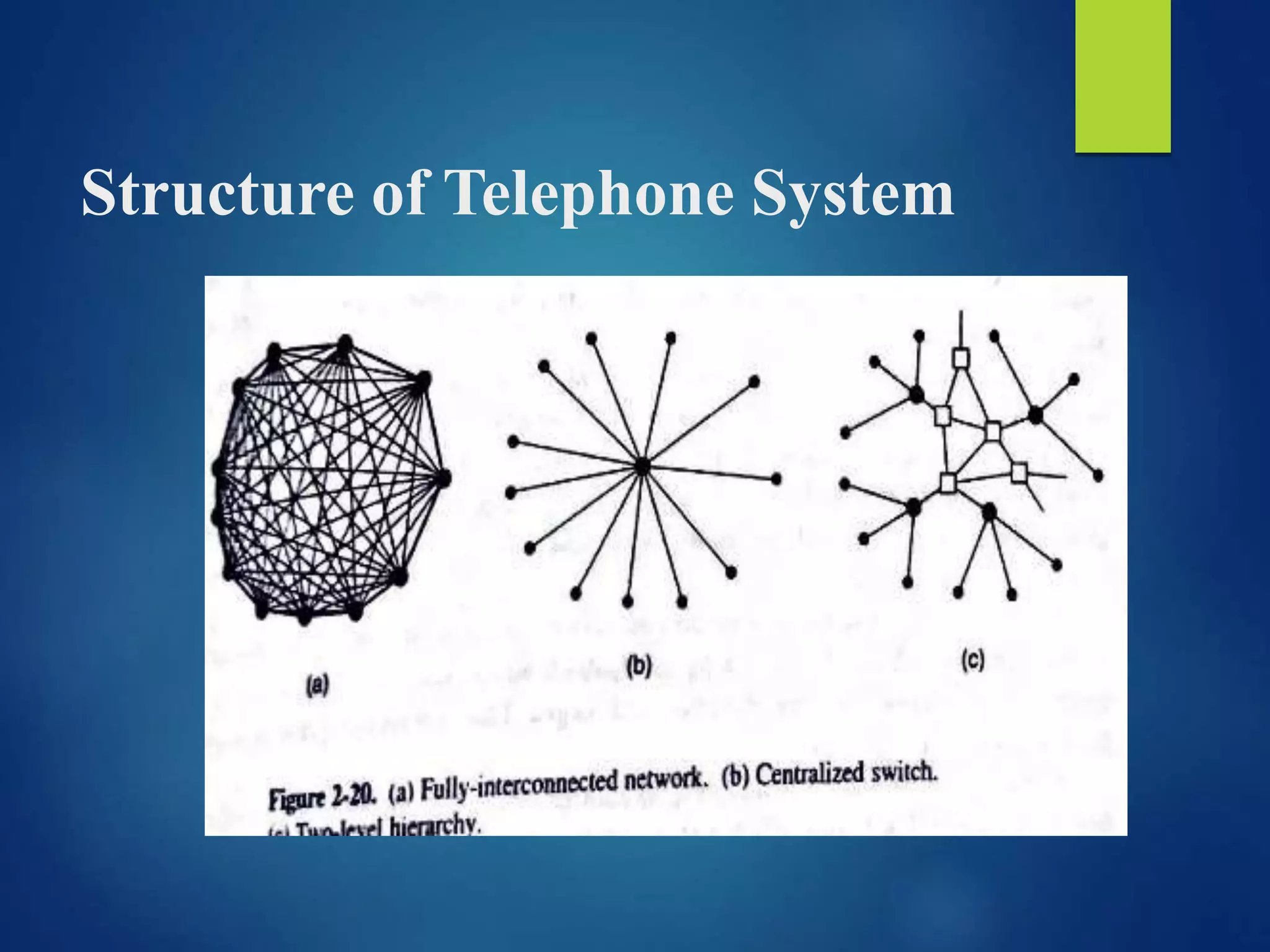
 It became immediately obvious that the model of connecting
every telephone to every other telephone as in fig(a) was not
going to work.
Structure of Telephone System
 The company ran a wire to each customer’s house or office.
 To make a call, the customer would crank the phone to make a ringing sound
in the telephone company office to attract the attention of an operator, who
would then manually connect the caller to the callee by using a jumper cable.
 The model of a single switching office is shown in fig.(b).
 People wanted to make long distance calls between cities and this needs to
connect the switching offices.
 To connect every switching office to every other switching office by means of
a wire between them quickly became unmanageable, so second level switching
offices were invented.
 After a while, multiple second level offices were needed, as in fig©.
Structure of Telephone System
 The three major parts of the telephone system were in place: the
switching offices, the wires between the customers and the
switching offices and the long distance connections between the
switching offices.
 Each telephone has two copper wires coming out of it that go
directly to the telephone company’s nearest end office also called
a local central office.
 The distance is typically 1 to 10km, being shorter in cities than in
rural areas.
 In the United states alone there are about 22000 end offices
 The two wire connections between each subscriber’ telephone nd
the end office are known in the trade as the local loop.
 If the world’s local loops were stretched out end to end, they
would extend to the moon and back 1000 times.
Structure of Telephone System
 If a subscriber attached to a given end office calls another subscriber
attached to the same end office, the switching mechanism within the
office sets up a direct electrical connection between the two local
loops. This connection remains intact for the duration of the call.
 If the called telephone is attached to another end office, a different
procedure has to be used.
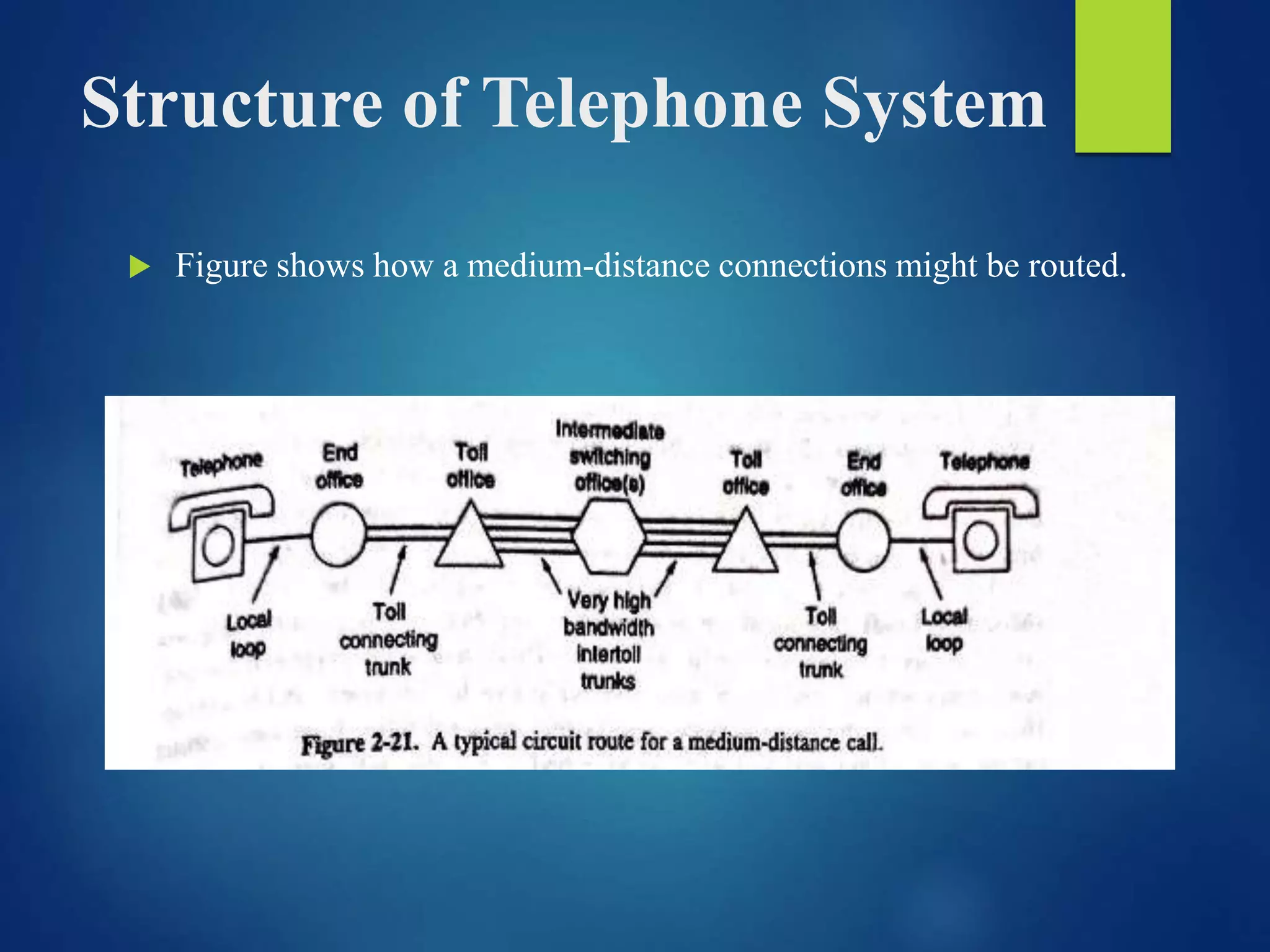
 Each end office has a number of outgoing lines to one or more nearby
switching centres called toll offices.
 These lines are called toll connection trunks.
 If both the caller’s and callee’s end offices happen to have a toll
connecting trunk to the same toll office, the connection may be
established within the toll office.
 A telephone network consisting only of telephones (small dots), end
offices (large dots) and toll offices (squares) is shown in fig ©.
Structure of Telephone System
 If the caller and callee do not have a toll office in
common, the path will have to be established
somewhere higher up in the hierarchy.
 Primary, sectional and regional offices form a network
by which the toll offices are connected.
 The toll, primary, sectional and regional exchangs
communicate with each other via high bandwidth
intertoll trunks (also called interoffice Trunks).
 The number of different kinds of switching centers and
their topology varies from country to country
depending on the country’s telephone density.
Structure of Telephone System
 Figure shows how a medium-distance connections might be routed.
Structure of Telephone System
 A variety of transmission media are used for telecommunication.
 Local loops consist of category 3 twisted pair nowadays, although in the
early days of telephony, uninsulated wires spaced 25cm apart on telephone
poles were common.
 Between switching offices, coaxial cables, microwaves and especially
fibre optics are widely used.
 In the past, transmission throughout the telephone system was analog, wih
the actual voice signal being transmitted as n electrical voltage from source
to destination.
 With the advent of fibre optics, digital electronics and computers all the
trunks and switches are now digital, leaving the local loop as the last piece
of analog technology in the system.
 Digital transmission is preferred because it is nt necessary to reproduce an
analog waveform after it has passed through many amplifiers on a long
call.
Structure of Telephone System
 Being able to distinguish a 0 from a 1 is enough.
 This property makes digital transmission more reliable than analog.
 It is also cheaper and easier to maintain.
 The telephone system consists of three major components
 Local loops (analog twisted pairs going into houses and business).
 Trunks (digital fibre optics connecting the switching offices.
 Switching offices (where calls are moved from one trunk to another).
THANK YOU

Structure of Telephone System.pptx

  • 1.
    Structure of Telephone System IIIPHYSICS – 19.04.2022 DR.R.HEPZI PRAMILA DEVAMANI, ASSISTANT PROFESSOR OF PHYSICS, V.V.VANNIAPERUMAL COLLEGE FOR WOMEN, VIRUDHUNAGAR.
  • 2.
    Structure of Telephone System The initial market was for sale of telephones, which came in pairs.  It was upto the customer to string a single wire between them.  The electrons returned through the earth.  If a telephone owner wanted to talk to n other telephone owners, separate wires had to be strung to all n houses.  Within a year, the cities were covered with wires passing over houses and trees in a wild jumble.  It became immediately obvious that the model of connecting every telephone to every other telephone as in fig(a) was not going to work.
  • 3.
  • 4.
    Structure of TelephoneSystem  The company ran a wire to each customer’s house or office.  To make a call, the customer would crank the phone to make a ringing sound in the telephone company office to attract the attention of an operator, who would then manually connect the caller to the callee by using a jumper cable.  The model of a single switching office is shown in fig.(b).  People wanted to make long distance calls between cities and this needs to connect the switching offices.  To connect every switching office to every other switching office by means of a wire between them quickly became unmanageable, so second level switching offices were invented.  After a while, multiple second level offices were needed, as in fig©.
  • 5.
    Structure of TelephoneSystem  The three major parts of the telephone system were in place: the switching offices, the wires between the customers and the switching offices and the long distance connections between the switching offices.  Each telephone has two copper wires coming out of it that go directly to the telephone company’s nearest end office also called a local central office.  The distance is typically 1 to 10km, being shorter in cities than in rural areas.  In the United states alone there are about 22000 end offices  The two wire connections between each subscriber’ telephone nd the end office are known in the trade as the local loop.  If the world’s local loops were stretched out end to end, they would extend to the moon and back 1000 times.
  • 6.
    Structure of TelephoneSystem  If a subscriber attached to a given end office calls another subscriber attached to the same end office, the switching mechanism within the office sets up a direct electrical connection between the two local loops. This connection remains intact for the duration of the call.  If the called telephone is attached to another end office, a different procedure has to be used.  Each end office has a number of outgoing lines to one or more nearby switching centres called toll offices.  These lines are called toll connection trunks.  If both the caller’s and callee’s end offices happen to have a toll connecting trunk to the same toll office, the connection may be established within the toll office.  A telephone network consisting only of telephones (small dots), end offices (large dots) and toll offices (squares) is shown in fig ©.
  • 7.
    Structure of TelephoneSystem  If the caller and callee do not have a toll office in common, the path will have to be established somewhere higher up in the hierarchy.  Primary, sectional and regional offices form a network by which the toll offices are connected.  The toll, primary, sectional and regional exchangs communicate with each other via high bandwidth intertoll trunks (also called interoffice Trunks).  The number of different kinds of switching centers and their topology varies from country to country depending on the country’s telephone density.
  • 8.
    Structure of TelephoneSystem  Figure shows how a medium-distance connections might be routed.
  • 9.
    Structure of TelephoneSystem  A variety of transmission media are used for telecommunication.  Local loops consist of category 3 twisted pair nowadays, although in the early days of telephony, uninsulated wires spaced 25cm apart on telephone poles were common.  Between switching offices, coaxial cables, microwaves and especially fibre optics are widely used.  In the past, transmission throughout the telephone system was analog, wih the actual voice signal being transmitted as n electrical voltage from source to destination.  With the advent of fibre optics, digital electronics and computers all the trunks and switches are now digital, leaving the local loop as the last piece of analog technology in the system.  Digital transmission is preferred because it is nt necessary to reproduce an analog waveform after it has passed through many amplifiers on a long call.
  • 10.
    Structure of TelephoneSystem  Being able to distinguish a 0 from a 1 is enough.  This property makes digital transmission more reliable than analog.  It is also cheaper and easier to maintain.  The telephone system consists of three major components  Local loops (analog twisted pairs going into houses and business).  Trunks (digital fibre optics connecting the switching offices.  Switching offices (where calls are moved from one trunk to another).
  • 11.