Spinal reflexes The reflex arc
The reflex arc An automatic, rapid response to an adverse stimulus. Action is involuntary the brain is not involved in the event but may be informed of it Many reflex actions are protective Some complex actions (swallowing, coughing and blinking) are coordinated by reflexes.
A simplified reflex arc stimulus
A simplified reflex arc stimulus receptor
A simplified reflex arc stimulus receptor sensory neurone
A simplified reflex arc stimulus receptor sensory neurone spinal cord of central nervous system
A simplified reflex arc stimulus receptor sensory neurone spinal cord of central nervous system relay neurone
A simplified reflex arc stimulus receptor sensory neurone spinal cord of central nervous system relay neurone motor neurone
A simplified reflex arc stimulus receptor sensory neurone spinal cord of central nervous system relay neurone motor neurone effector
A simplified reflex arc stimulus receptor sensory neurone spinal cord of central nervous system relay neurone motor neurone effector response
A withdrawal reflex
A withdrawal reflex The stimulus is the heat from the hot object
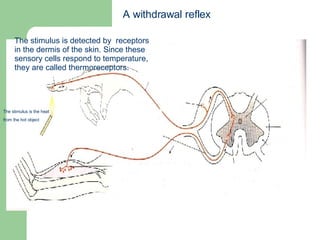
A withdrawal reflex The stimulus is the heat from the hot object   The stimulus is detected by  receptors in the dermis of the skin. Since these sensory cells respond to temperature, they are called thermoreceptors.
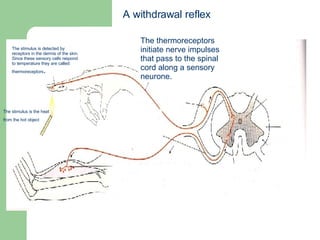
A withdrawal reflex The stimulus is the heat from the hot object   The stimulus is detected by  receptors in the dermis of the skin. Since these sensory cells respond to temperature they are called thermoreceptors . The thermoreceptors initiate nerve impulses that pass to the spinal cord along a sensory neurone.
A withdrawal reflex The stimulus is the heat from the hot object   The stimulus is detected by  receptors in the dermis of the skin. Since these sensory cells respond to temperature they are called thermoreceptors . The thermoreceptors initiate nerve impulses that pass to the spinal cord along a sensory neurone . sensory neurone cell body
A withdrawal reflex The stimulus is the heat from the hot object   The stimulus is detected by  receptors in the dermis of the skin. Since these sensory cells respond to temperature they are called thermoreceptors . The thermoreceptors initiate nerve impulses that pass to the spinal cord along a sensory neurone . sensory neurone cell body grey matter (neurone cell bodies)
A withdrawal reflex The stimulus is the heat from the hot object   The stimulus is detected by  receptors in the dermis of the skin. Since these sensory cells respond to temperature they are called thermoreceptors . The thermoreceptors initiate nerve impulses that pass to the spinal cord along a sensory neurone . sensory neurone cell body grey matter (neurone cell bodies) spinal cord
A withdrawal reflex The stimulus is the heat from the hot object   The stimulus is detected by  receptors in the dermis of the skin. Since these sensory cells respond to temperature they are called thermoreceptors . The thermoreceptors initiate nerve impulses that pass to the spinal cord along a sensory neurone . sensory neurone cell body grey matter (neurone cell bodies) spinal cord white matter (neurone axons)
A withdrawal reflex The stimulus is the heat from the hot object   The stimulus is detected by  receptors in the dermis of the skin. Since these sensory cells respond to temperature they are called thermoreceptors . The thermoreceptors initiate nerve impulses that pass to the spinal cord along a sensory neurone . sensory neurone cell body grey matter (neurone cell bodies) spinal cord white matter (neurone axons) The sensory neurone enters the spinal cord via the dorsal branch of the spinal nerve and forms a synapse with a relay neurone, inside the grey matter
A withdrawal reflex The stimulus is the heat from the hot object   The stimulus is detected by  receptors in the dermis of the skin. Since these sensory cells respond to temperature they are called thermoreceptors . The thermoreceptors initiate nerve impulses that pass to the spinal cord along a sensory neurone . sensory neurone cell body grey matter (neurone cell bodies) spinal cord white matter (neurone axons) The sensory neurone enters the spinal cord via the dorsal branch of the spinal nerve and forms a synapse with a relay neurone, inside the grey matter  The short relay neurone forms a synapse with a motor neurone  that leaves the spinal cord via the ventral root of the spinal cord.
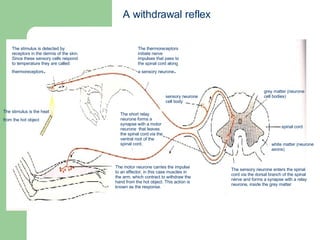
A withdrawal reflex The stimulus is the heat from the hot object   The stimulus is detected by  receptors in the dermis of the skin. Since these sensory cells respond to temperature they are called thermoreceptors . The thermoreceptors initiate nerve impulses that pass to the spinal cord along a sensory neurone . sensory neurone cell body grey matter (neurone cell bodies) spinal cord white matter (neurone axons) The sensory neurone enters the spinal cord via the dorsal branch of the spinal nerve and forms a synapse with a relay neurone, inside the grey matter  The short relay neurone forms a synapse with a motor neurone  that leaves the spinal cord via the ventral root of the spinal cord. The motor neurone carries the impulse to an effector, in this case muscles in the arm, which contract to withdraw the hand from the hot object. This action is known as the response.
A few reminders! The central  grey matter  contains the cell bodies of relay and motor neurones. The outer  white matter  contains myelinated axons, which run up and down the spinal cord to and from the brain. In the centre of the grey matter is the  spinal canal , through which the nutritive  cerebrospinal fluid  cirulates.
A few reminders! Sensory neurones enter the spinal cord through the dorsal root and the concentration of their cell bodies forms a swelling called the  dorsal root ganglion . Motor neurones leave the spinal cord via the ventral root.

Spinal Reflexes

  • 1.
  • 2.
    The reflex arcAn automatic, rapid response to an adverse stimulus. Action is involuntary the brain is not involved in the event but may be informed of it Many reflex actions are protective Some complex actions (swallowing, coughing and blinking) are coordinated by reflexes.
  • 3.
    A simplified reflexarc stimulus
  • 4.
    A simplified reflexarc stimulus receptor
  • 5.
    A simplified reflexarc stimulus receptor sensory neurone
  • 6.
    A simplified reflexarc stimulus receptor sensory neurone spinal cord of central nervous system
  • 7.
    A simplified reflexarc stimulus receptor sensory neurone spinal cord of central nervous system relay neurone
  • 8.
    A simplified reflexarc stimulus receptor sensory neurone spinal cord of central nervous system relay neurone motor neurone
  • 9.
    A simplified reflexarc stimulus receptor sensory neurone spinal cord of central nervous system relay neurone motor neurone effector
  • 10.
    A simplified reflexarc stimulus receptor sensory neurone spinal cord of central nervous system relay neurone motor neurone effector response
  • 11.
  • 12.
    A withdrawal reflexThe stimulus is the heat from the hot object
  • 13.
    A withdrawal reflexThe stimulus is the heat from the hot object The stimulus is detected by receptors in the dermis of the skin. Since these sensory cells respond to temperature, they are called thermoreceptors.
  • 14.
    A withdrawal reflexThe stimulus is the heat from the hot object The stimulus is detected by receptors in the dermis of the skin. Since these sensory cells respond to temperature they are called thermoreceptors . The thermoreceptors initiate nerve impulses that pass to the spinal cord along a sensory neurone.
  • 15.
    A withdrawal reflexThe stimulus is the heat from the hot object The stimulus is detected by receptors in the dermis of the skin. Since these sensory cells respond to temperature they are called thermoreceptors . The thermoreceptors initiate nerve impulses that pass to the spinal cord along a sensory neurone . sensory neurone cell body
  • 16.
    A withdrawal reflexThe stimulus is the heat from the hot object The stimulus is detected by receptors in the dermis of the skin. Since these sensory cells respond to temperature they are called thermoreceptors . The thermoreceptors initiate nerve impulses that pass to the spinal cord along a sensory neurone . sensory neurone cell body grey matter (neurone cell bodies)
  • 17.
    A withdrawal reflexThe stimulus is the heat from the hot object The stimulus is detected by receptors in the dermis of the skin. Since these sensory cells respond to temperature they are called thermoreceptors . The thermoreceptors initiate nerve impulses that pass to the spinal cord along a sensory neurone . sensory neurone cell body grey matter (neurone cell bodies) spinal cord
  • 18.
    A withdrawal reflexThe stimulus is the heat from the hot object The stimulus is detected by receptors in the dermis of the skin. Since these sensory cells respond to temperature they are called thermoreceptors . The thermoreceptors initiate nerve impulses that pass to the spinal cord along a sensory neurone . sensory neurone cell body grey matter (neurone cell bodies) spinal cord white matter (neurone axons)
  • 19.
    A withdrawal reflexThe stimulus is the heat from the hot object The stimulus is detected by receptors in the dermis of the skin. Since these sensory cells respond to temperature they are called thermoreceptors . The thermoreceptors initiate nerve impulses that pass to the spinal cord along a sensory neurone . sensory neurone cell body grey matter (neurone cell bodies) spinal cord white matter (neurone axons) The sensory neurone enters the spinal cord via the dorsal branch of the spinal nerve and forms a synapse with a relay neurone, inside the grey matter
  • 20.
    A withdrawal reflexThe stimulus is the heat from the hot object The stimulus is detected by receptors in the dermis of the skin. Since these sensory cells respond to temperature they are called thermoreceptors . The thermoreceptors initiate nerve impulses that pass to the spinal cord along a sensory neurone . sensory neurone cell body grey matter (neurone cell bodies) spinal cord white matter (neurone axons) The sensory neurone enters the spinal cord via the dorsal branch of the spinal nerve and forms a synapse with a relay neurone, inside the grey matter The short relay neurone forms a synapse with a motor neurone that leaves the spinal cord via the ventral root of the spinal cord.
  • 21.
    A withdrawal reflexThe stimulus is the heat from the hot object The stimulus is detected by receptors in the dermis of the skin. Since these sensory cells respond to temperature they are called thermoreceptors . The thermoreceptors initiate nerve impulses that pass to the spinal cord along a sensory neurone . sensory neurone cell body grey matter (neurone cell bodies) spinal cord white matter (neurone axons) The sensory neurone enters the spinal cord via the dorsal branch of the spinal nerve and forms a synapse with a relay neurone, inside the grey matter The short relay neurone forms a synapse with a motor neurone that leaves the spinal cord via the ventral root of the spinal cord. The motor neurone carries the impulse to an effector, in this case muscles in the arm, which contract to withdraw the hand from the hot object. This action is known as the response.
  • 22.
    A withdrawal reflexThe stimulus is the heat from the hot object The stimulus is detected by receptors in the dermis of the skin. Since these sensory cells respond to temperature they are called thermoreceptors . The thermoreceptors initiate nerve impulses that pass to the spinal cord along a sensory neurone . sensory neurone cell body grey matter (neurone cell bodies) spinal cord white matter (neurone axons) The sensory neurone enters the spinal cord via the dorsal branch of the spinal nerve and forms a synapse with a relay neurone, inside the grey matter The short relay neurone forms a synapse with a motor neurone that leaves the spinal cord via the ventral root of the spinal cord. The motor neurone carries the impulse to an effector, in this case muscles in the arm, which contract to withdraw the hand from the hot object. This action is known as the response.
  • 23.
    A few reminders!The central grey matter contains the cell bodies of relay and motor neurones. The outer white matter contains myelinated axons, which run up and down the spinal cord to and from the brain. In the centre of the grey matter is the spinal canal , through which the nutritive cerebrospinal fluid cirulates.
  • 24.
    A few reminders!Sensory neurones enter the spinal cord through the dorsal root and the concentration of their cell bodies forms a swelling called the dorsal root ganglion . Motor neurones leave the spinal cord via the ventral root.