THE NERVOUS SYYSTEM
Dr. A.O. Oyabambi,
Dept. Of Physiology, College Of Health Sciences,
University Of Ilorin, Ilorin,
Nigeria.
TOPICS
 Introduction to the Nervous System
 Division of the Nervous System
 The Central Nervous System
 The Peripheral Nervous System
 Cutaneous receptors
 Sensory or Ascending tracts
 Motor or Descending tracts
 Cerebrum
 Basal ganglia
TOPICS
 Hypothalamus
 Thalamus
 Medulla and Pons
 The Reticular Activating System (RAS)
 Control of Visceral functions
 Memory formation
STUDY OBJECTIVES
AT THE END OF THIS LECTURE STUDENTS SHOULD BE
ABLE TO:
(1) DESCRIBE THE ORGANIAZTIONAL DIVISION OF
THE NERVOUS SYSTEM
(2) LIST THE PARTS OF THE BRAIN AND THEIR
FUNCTIONS
(3) DESCRIBE THE SPINAL CORD AND FUNCTIONS.
(4) DESCRIBE THE FUNCTIONS OF THE AUTONOMIC
NERVOUS SYSTEM
(5) DESCIRBE THE DORSAL LEMNISCAL SYSTEM
(6) THE ANERLOLATERAL PATHWAY
(7) DESCRIBE CUTANEOUS RECEPTORS AND
SENSATIONS
(8) DISCUSS THE PYRAMIDAL SYSYTEM
(9) DISCUSS THE EXTRAPYMIRADAL SYSTEM
(10) DESCRIBE THE LIMBIC SYSTEM AND FUNCTIONS
(11)DISCUSS THE CONCEPT OF MEMORY FORMATION
(12). DISCUSS THE MODALITIES OF TASTE
SENSATION AND OLFACTION
(13). DESCRIBE THE AUDITORY PATHWAY
(14). DISCUSS THE VISUAL PATHWAY
(15). DISCUSS THE TASTE AND PATHWAY
RECOMMENDED TEXTS
1. Textbook of Physiology, by G.C Ezeilo, 4th ed. Oxford
University Press
2. Physiology By L.S. Costazo, 6th ed.
3. Ganong’s Review of Medical Physiology, 26th ed. By G.F
Ganong
4. Medical Physiology by Rhoades and Tanner, 4th ed.
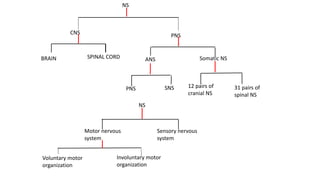
NS
CNS PNS
BRAIN SPINAL CORD Somatic NS
ANS
SNS
PNS 31 pairs of
spinal NS
12 pairs of
cranial NS
Motor nervous
system
Sensory nervous
system
Voluntary motor
organization
Involuntary motor
organization
NS
Structural Organization
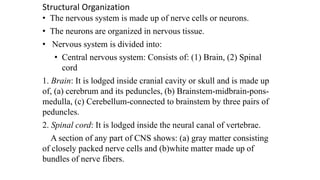
• The nervous system is made up of nerve cells or neurons.
• The neurons are organized in nervous tissue.
• Nervous system is divided into:
• Central nervous system: Consists of: (1) Brain, (2) Spinal
cord
1. Brain: It is lodged inside cranial cavity or skull and is made up
of, (a) cerebrum and its peduncles, (b) Brainstem-midbrain-pons-
medulla, (c) Cerebellum-connected to brainstem by three pairs of
peduncles.
2. Spinal cord: It is lodged inside the neural canal of vertebrae.
A section of any part of CNS shows: (a) gray matter consisting
of closely packed nerve cells and (b)white matter made up of
bundles of nerve fibers.
Structural Organization
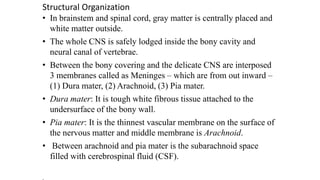
• In brainstem and spinal cord, gray matter is centrally placed and
white matter outside.
• The whole CNS is safely lodged inside the bony cavity and
neural canal of vertebrae.
• Between the bony covering and the delicate CNS are interposed
3 membranes called as Meninges – which are from out inward –
(1) Dura mater, (2) Arachnoid, (3) Pia mater.
• Dura mater: It is tough white fibrous tissue attached to the
undersurface of the bony wall.
• Pia mater: It is the thinnest vascular membrane on the surface of
the nervous matter and middle membrane is Arachnoid.
• Between arachnoid and pia mater is the subarachnoid space
filled with cerebrospinal fluid (CSF).
.
Structural Organization
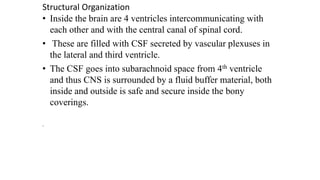
• Inside the brain are 4 ventricles intercommunicating with
each other and with the central canal of spinal cord.
• These are filled with CSF secreted by vascular plexuses in
the lateral and third ventricle.
• The CSF goes into subarachnoid space from 4th ventricle
and thus CNS is surrounded by a fluid buffer material, both
inside and outside is safe and secure inside the bony
coverings.
.
FUNCTIONAL ORGANIZATION OF CNS
Cerebral Cortex
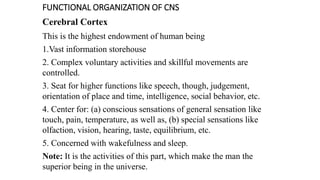
This is the highest endowment of human being
1.Vast information storehouse
2. Complex voluntary activities and skillful movements are
controlled.
3. Seat for higher functions like speech, though, judgement,
orientation of place and time, intelligence, social behavior, etc.
4. Center for: (a) conscious sensations of general sensation like
touch, pain, temperature, as well as, (b) special sensations like
olfaction, vision, hearing, taste, equilibrium, etc.
5. Concerned with wakefulness and sleep.
Note: It is the activities of this part, which make the man the
superior being in the universe.
FUNCTIONAL ORGANIZATION OF CNS
• Although, CNS functions as single unit reopening to variety of
physiological conditions:
Three components are seen if we analyze these actions:
1. Sensory function: Impulses pass from receptors to CN.
2. Motor functions: Efferent responses mediated by muscle.
3. Vegetative functions: Regulation of:
i. Visceral activities
ii. ii. Glandular activities
iii. Blood vessels, metabolism and other functions of the body
mediated by autonomic nerves.
FUNCTIONAL ORGANIZATION OF CNS
Brainstem and Subcortical Part
Information reaching this level subserve various reflexes:
1. Some subconscious activities are controlled from this level, e.g.
blood pressure, respiration, heart rate.
2. Some somatic reflexes such as righting reflexes have their
centers here.
3. Salivary reflexes and reflexes controlling secretion of digestive
juices have also their centers here.
4. Centers for emotion, feeding, sleep, pleasure, anger, pain, etc.
are located here.
.
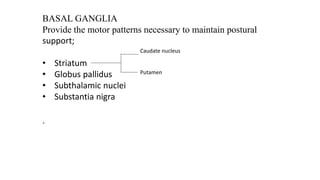
BASAL GANGLIA
Provide the motor patterns necessary to maintain postural
support;
• Striatum
• Globus pallidus
• Subthalamic nuclei
• Substantia nigra
.
Putamen
Caudate nucleus
FUNCTIONAL ORGANIZATION OF CNS
Spinal Cord
• Contains the final command pathway through which
movement is executed
 Conduit for signals from periphery to brain and vice versa
In absence of higher centers in the brain, neuronal circuits
in the cord can cause:
1. Sensory information is first passed into spinal cord through
spinal afferents.
• Some is converted to motor response at a particular
segment through a reflex.
2. Gateway for voluntary activities, as the cell bodies of
peripheral efferents are located in spinal cord.
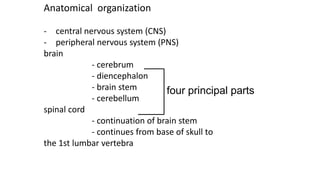
Anatomical organization
- central nervous system (CNS)
- peripheral nervous system (PNS)
brain
- cerebrum
- diencephalon
- brain stem
- cerebellum
spinal cord
- continuation of brain stem
- continues from base of skull to
the 1st lumbar vertebra
four principal parts
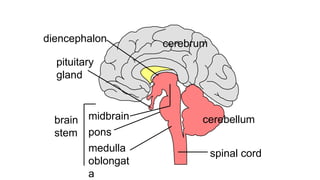
cerebrum
cerebellum
pituitary
gland
diencephalon
spinal cord
brain
stem
midbrain
pons
medulla
oblongat
a
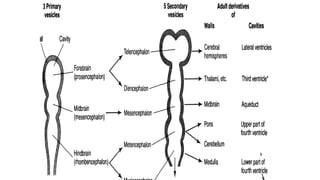
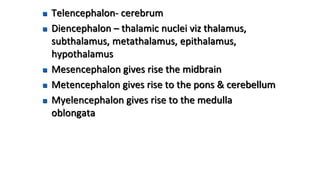
 Telencephalon- cerebrum
 Diencephalon – thalamic nuclei viz thalamus,
subthalamus, metathalamus, epithalamus,
hypothalamus
 Mesencephalon gives rise the midbrain
 Metencephalon gives rise to the pons & cerebellum
 Myelencephalon gives rise to the medulla
oblongata
Peripheral Nervous System (PNS)
• Somatic nervous system (soma = body)
- voluntary
- sensations are consciously perceived
• Autonomic nervous system (auto = self)
- involuntary/automatic
- sensations are usually not consciously perceived
• cranial nerves
- 12 pairs
- emerge from the brain
• spinal nerves
- 31 pairs
- emerge from the spinal cord

week one lecture.pptx

  • 1.
    THE NERVOUS SYYSTEM Dr.A.O. Oyabambi, Dept. Of Physiology, College Of Health Sciences, University Of Ilorin, Ilorin, Nigeria.
  • 2.
    TOPICS  Introduction tothe Nervous System  Division of the Nervous System  The Central Nervous System  The Peripheral Nervous System  Cutaneous receptors  Sensory or Ascending tracts  Motor or Descending tracts  Cerebrum  Basal ganglia
  • 3.
    TOPICS  Hypothalamus  Thalamus Medulla and Pons  The Reticular Activating System (RAS)  Control of Visceral functions  Memory formation
  • 4.
    STUDY OBJECTIVES AT THEEND OF THIS LECTURE STUDENTS SHOULD BE ABLE TO: (1) DESCRIBE THE ORGANIAZTIONAL DIVISION OF THE NERVOUS SYSTEM (2) LIST THE PARTS OF THE BRAIN AND THEIR FUNCTIONS (3) DESCRIBE THE SPINAL CORD AND FUNCTIONS. (4) DESCRIBE THE FUNCTIONS OF THE AUTONOMIC NERVOUS SYSTEM (5) DESCIRBE THE DORSAL LEMNISCAL SYSTEM (6) THE ANERLOLATERAL PATHWAY
  • 5.
    (7) DESCRIBE CUTANEOUSRECEPTORS AND SENSATIONS (8) DISCUSS THE PYRAMIDAL SYSYTEM (9) DISCUSS THE EXTRAPYMIRADAL SYSTEM (10) DESCRIBE THE LIMBIC SYSTEM AND FUNCTIONS (11)DISCUSS THE CONCEPT OF MEMORY FORMATION (12). DISCUSS THE MODALITIES OF TASTE SENSATION AND OLFACTION (13). DESCRIBE THE AUDITORY PATHWAY (14). DISCUSS THE VISUAL PATHWAY (15). DISCUSS THE TASTE AND PATHWAY
  • 6.
    RECOMMENDED TEXTS 1. Textbookof Physiology, by G.C Ezeilo, 4th ed. Oxford University Press 2. Physiology By L.S. Costazo, 6th ed. 3. Ganong’s Review of Medical Physiology, 26th ed. By G.F Ganong 4. Medical Physiology by Rhoades and Tanner, 4th ed.
  • 7.
    NS CNS PNS BRAIN SPINALCORD Somatic NS ANS SNS PNS 31 pairs of spinal NS 12 pairs of cranial NS Motor nervous system Sensory nervous system Voluntary motor organization Involuntary motor organization NS
  • 8.
    Structural Organization • Thenervous system is made up of nerve cells or neurons. • The neurons are organized in nervous tissue. • Nervous system is divided into: • Central nervous system: Consists of: (1) Brain, (2) Spinal cord 1. Brain: It is lodged inside cranial cavity or skull and is made up of, (a) cerebrum and its peduncles, (b) Brainstem-midbrain-pons- medulla, (c) Cerebellum-connected to brainstem by three pairs of peduncles. 2. Spinal cord: It is lodged inside the neural canal of vertebrae. A section of any part of CNS shows: (a) gray matter consisting of closely packed nerve cells and (b)white matter made up of bundles of nerve fibers.
  • 9.
    Structural Organization • Inbrainstem and spinal cord, gray matter is centrally placed and white matter outside. • The whole CNS is safely lodged inside the bony cavity and neural canal of vertebrae. • Between the bony covering and the delicate CNS are interposed 3 membranes called as Meninges – which are from out inward – (1) Dura mater, (2) Arachnoid, (3) Pia mater. • Dura mater: It is tough white fibrous tissue attached to the undersurface of the bony wall. • Pia mater: It is the thinnest vascular membrane on the surface of the nervous matter and middle membrane is Arachnoid. • Between arachnoid and pia mater is the subarachnoid space filled with cerebrospinal fluid (CSF). .
  • 10.
    Structural Organization • Insidethe brain are 4 ventricles intercommunicating with each other and with the central canal of spinal cord. • These are filled with CSF secreted by vascular plexuses in the lateral and third ventricle. • The CSF goes into subarachnoid space from 4th ventricle and thus CNS is surrounded by a fluid buffer material, both inside and outside is safe and secure inside the bony coverings. .
  • 11.
    FUNCTIONAL ORGANIZATION OFCNS Cerebral Cortex This is the highest endowment of human being 1.Vast information storehouse 2. Complex voluntary activities and skillful movements are controlled. 3. Seat for higher functions like speech, though, judgement, orientation of place and time, intelligence, social behavior, etc. 4. Center for: (a) conscious sensations of general sensation like touch, pain, temperature, as well as, (b) special sensations like olfaction, vision, hearing, taste, equilibrium, etc. 5. Concerned with wakefulness and sleep. Note: It is the activities of this part, which make the man the superior being in the universe.
  • 12.
    FUNCTIONAL ORGANIZATION OFCNS • Although, CNS functions as single unit reopening to variety of physiological conditions: Three components are seen if we analyze these actions: 1. Sensory function: Impulses pass from receptors to CN. 2. Motor functions: Efferent responses mediated by muscle. 3. Vegetative functions: Regulation of: i. Visceral activities ii. ii. Glandular activities iii. Blood vessels, metabolism and other functions of the body mediated by autonomic nerves.
  • 13.
    FUNCTIONAL ORGANIZATION OFCNS Brainstem and Subcortical Part Information reaching this level subserve various reflexes: 1. Some subconscious activities are controlled from this level, e.g. blood pressure, respiration, heart rate. 2. Some somatic reflexes such as righting reflexes have their centers here. 3. Salivary reflexes and reflexes controlling secretion of digestive juices have also their centers here. 4. Centers for emotion, feeding, sleep, pleasure, anger, pain, etc. are located here. .
  • 14.
    BASAL GANGLIA Provide themotor patterns necessary to maintain postural support; • Striatum • Globus pallidus • Subthalamic nuclei • Substantia nigra . Putamen Caudate nucleus
  • 15.
    FUNCTIONAL ORGANIZATION OFCNS Spinal Cord • Contains the final command pathway through which movement is executed  Conduit for signals from periphery to brain and vice versa In absence of higher centers in the brain, neuronal circuits in the cord can cause: 1. Sensory information is first passed into spinal cord through spinal afferents. • Some is converted to motor response at a particular segment through a reflex. 2. Gateway for voluntary activities, as the cell bodies of peripheral efferents are located in spinal cord.
  • 16.
    Anatomical organization - centralnervous system (CNS) - peripheral nervous system (PNS) brain - cerebrum - diencephalon - brain stem - cerebellum spinal cord - continuation of brain stem - continues from base of skull to the 1st lumbar vertebra four principal parts
  • 17.
  • 19.
     Telencephalon- cerebrum Diencephalon – thalamic nuclei viz thalamus, subthalamus, metathalamus, epithalamus, hypothalamus  Mesencephalon gives rise the midbrain  Metencephalon gives rise to the pons & cerebellum  Myelencephalon gives rise to the medulla oblongata
  • 20.
    Peripheral Nervous System(PNS) • Somatic nervous system (soma = body) - voluntary - sensations are consciously perceived • Autonomic nervous system (auto = self) - involuntary/automatic - sensations are usually not consciously perceived • cranial nerves - 12 pairs - emerge from the brain • spinal nerves - 31 pairs - emerge from the spinal cord