Chapter 9
Multicellular organism
shows complex life
processes.
 Plants shows chemical
signals.
 Phototrophs are one of
the good examples.
 Animals shows
chemical and electrical
signals.
 Reflex action is one of
the good examples.
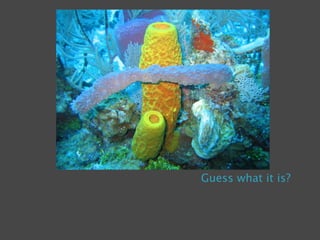
Guess what it is?
They shows only cells, no tissues.
Various cells perform different functions,
like digestion, respiration, excretion etc.
But porifera lacking nervous system.
So they shows least division of labour.
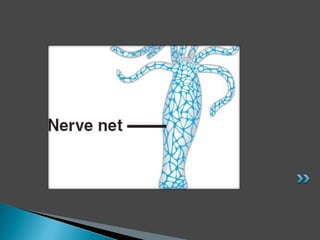
Example: Hydra.
Primitive organism which shows
nervous system. It consists of nerve
cells & sensory cells. Nerve cells forms
two nerve net.
Both the nerve net in hydra
present in mesoglea.
Neurons are not divided into sensory
neuron or motor neuron. Activation of
sensory cells can take place at any points
and impulse can be carried through out
the body in any direction.
Example: Catching of the prey during
feeding.
Phylum Ctenophora
Phylum : Platyhelminthes
The first primitive organism having central
nervous system
A pair of photosensory structure , the eyes are
located on dorsal side of the brain.
 Cephalic or Cerebral ganglia lie in
the anterior region of the body.
 From each ganglia arises nine
branches.
 From below the ganglia arise a pair
of Ventral nerve cord (VNC).
 VNC are interconnected with each
other by transfer nerve or
commissure.
 Peripheral nerve plexus arising from
VNC.
Neurons
They are structural &
functional cells of the
nervous system.
Originate from
embryonic layer
ectoderm.
Lesser in numbers as
compared to neuroglial
cells.
Example: Sensory
neuron, motor neuron,
mixed neuron.
 Neuroglial cells
 They are supporting
cells of the nervous
system.
 Originate from
embryonic layer
ectoderm.
 Greater in numbers as
compared to neurons.
 Example : Ependymal
cell, schwann cells,
microglia.
Sensory neuron
Motor neuron
Mixed neuron
Ependymal cell
Schwann cell
Microglia
 Cyton or cell bodies : consists of neurofibrils,
Nissl’s granules & other cell organelles.
 Dendrons : small conical structures arising
from cytons.
 Axon : single, long, unbranched processes,
arising from cyton.
Medullated nerves: In which nerves are
surrounded by medullary sheath and on
outside surrounded by neurilemma.
Non medullated nerves: In which nerves are
surrounded by only neurilemma.
Endoneurium:
Connective tissue
covering around the
nerve fascicule i.e.
endoneurium.
Perineurium : Few
nerve fasciculi with
endoneurium are
surrounded by
connective tissue
i.e. perineurium.
Epineurium: Some
large bundle of
nerves is covered
on outerside , i.e.
epineurium.
Conduction of impulse is faster in
medullated nerve fibres than non-
medullated nerve fibres.
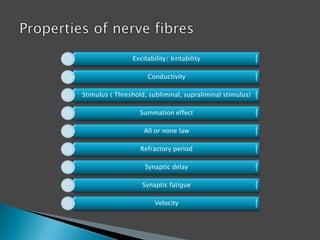
Excitability/ Irritability
Conductivity
Stimulus ( Threshold, subliminal, supraliminal stimulus)
Summation effect
All or none law
Refractory period
Synaptic delay
Synaptic fatigue
Velocity
Presynaptic neuron:
The neuron which carry
impulse to the synapse.
Postsynaptic neuron : The neuron which
receiving impulse from the synapse.
Synaptic cleft: It is a small intercellular space
lies in between two cells having a width of
about 20-30nm between them.
Synaptic transmission: The process by which the impulse from the
pre-synaptic neuron is conducted to the post-synaptic neuron.
Types of Synapse
Electrical synapse
Chemical synapse
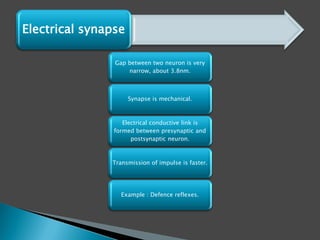
Gap between two neuron is very
narrow, about 3.8nm.
Synapse is mechanical.
Electrical conductive link is
formed between presynaptic and
postsynaptic neuron.
Transmission of impulse is faster.
Example : Defence reflexes.
Electrical synapse
Theses are specialized junctions through which one neuron send chemical signals to
the another neuron or to the non-neuronal cells , such as glands, muscles.
Gap between two adjacent neuron is 20-40 nm .
There are 3 components involved in the chemical synapse:
1. Pre synaptic neuron
2. Synaptic membrane of the postsynaptic neuron
3. Post synaptic neuron.
Chemical synapse
Synaptic
transmission
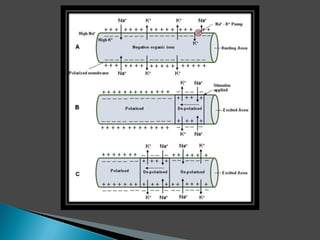
Depolarization : Any change or disturbance to the
membrane will cause Na to enter into the membrane &
lower the potential difference( lesser than -70
millivolts).
During depolarization the Na gates open but not the K
gates.
Re-polarization : Change in the polarity from
depolarized, back to the original state.
It is classified
into 3 parts
1. Central
nervous system
2. Peripheral
nervous system
3. Autonomous
nervous system
Central nervous system
It consist of
two main
parts:
1) Brain
2) Spinal
cord
There are 3
membranous layers of
meninges:
1. Dura matter:
outermost, tough,
thick, non-vascular,
fibrous layer.
2. Arachnoid matter:
middle, thin, non-
vascular layer of
connective tissue.
3. Pia matter:
innermost, delicate,
highly vascular
membrane.
Brain and Spinal cord are well protected by membranes
known as Meninges.
CSF is secreted by the pia matter, the choroid plexuses and the ependymal cells.
It is lymph like extracellular fluid.
CSF acts as a shock absorber.
Maintain constant pressure inside the brain.
Helps in exchange of nutrients and wastes between blood and brain.
Supply oxygen.
Prevent desiccation.
Cerebrospinal fluid( CSF):
The study of all
aspects of brain is
called Encephalogy.
Brain is enclosed
within the brain box
known as Cranium.
Human
brain
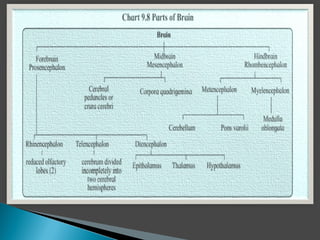
It consist of 3
parts:
Olfactory lobes
or
Rhinencephalon
Cerebrum or
Telencephalon
Diencephalon
Forebrain or Prosencephalon
Olfactory lobe
Largest part of the brain
Divided into right & left cerebral hemisphere which connected with
each other by thick band of nerve fibres known as corpus callosum.
Outer surface is cortex & inner surface is medulla.
Cortex shows gyri and sulci
Cerebrum
Each cerebral hemisphere is divieded into ;
Frontal
lobe
Parietal
lobe
Temporal
lobe
Occipital
lobe
Central sulcus separate
frontal lobe from
parietal lobe.
Parieto-occipital sulcus
separate parietal lobe
from occipital lobe.
Lateral sulcus or
sylvian sulcus separate
temporal lobe from
frontal & parietal lobe.
By three sulci
Motor area: control voluntary motor
activities or movement of muscles.
Premotor area: control
involuntary movement &
ANS.
Association area: bring
coordination between sensation
& movement.
Broca’s area/ motor speech area:
translates the thoughts into
speech.
Frontal lobes: They have 4
important areas such as,
Functional areas of cerebrum:
Parietal lobes: controls sensation of pain, pressure, temperature,
taste( gustatoreceptor).
Temporal lobes: controls centres of smell,hearing, speech and
emotions.
Occipital lobes: controls sense of vision.
In addition to all these areas there is one more area
of intelligence i.e. Wernicke’s area which helps in
the understanding of spoken and written words.
Basal nuclei or basal ganglia are grey masses present in the white
matter, help the cortex in the execution of activities at subconscious
level. Corpus striatum the largest basal nucleus.
It is the third part of the
forebrain, present below the
corpus callosum and above the
midbrain.
Encloses a cavity termed as third
ventricles or diocoel which
communicates with the two lateral
ventricles of cerebrum by foramen
of Monro.
Diencephalon
Diencephalon
Roof of
diencephalon
Dorsal wall
connected to
pineal gland
Pineal gland
produces hormone
melatonin which is
sleep inducing
hormone & related
to reproductive
behaviour
Epithalamus
Thalamus
Hypothalamus
Floor of diencephalon
Maintains homeostasis, internal equilibrium, & involuntary behaviour control.
Hypothalamic nuclei consists of neuro-secretary cells which produce hormones.
Hypothalamus is the link between nervous and endocrine system.
It regulates heart rate, respiration, B.P., body temperature, water & electrolyte balance.
It has centre for thirst, hunger, sleep, fatique, satiety centre, secretion of glands of GI.
Floor of hypothalamus shows downward projection of pituitary gland.
On inferior surface it bears the optic chiasma & pair of mammillary bodies.
A complex
neuronal
circuit called
Limbic
system.
It is formed by the hypothalamic amygdala,
epithalamus, thalamus, & hippocampus.
Mid Brain or Mesencephalon
Mid Brain
Corpora
quadrigemina
Crura cerebri
They are four rounded elevations on the dorsal surface of
the mid brain.
Upper two elevations are superior colliculi & lower two
elevations are inferior colliculi.
Superior colliculi are involved in visual reflexes.
Inferior colliculi are involved in auditory reflexes.
Corpora
quadrigemina
These are two thick fibrous
tracks on inferior side of the
mid brain.
These tracts are ascending
and descending nerve fibres.
Near the centre of mid brain ,
red nucleus is present which
is responsible for controlling
posture and muscle tone,
modifying motor activities, &
motor coordination.
Crura cerebri
It consists
of 3 parts:
Pons varolli Cerebellum
Medulla
oblongata
Hind brain or Rhombencephalon
Rounded bulge on
the underside of
the brain stem.
It consists of a
cross band of nerve
fibres connecting
cerebrum,
cerebellar lobes,
medulla oblongata,
& spinal cord.
Pons varolli
Second largest part of the brain.
Consists of two lateral hemispheres & a central vermis.
White matter intermixes with the grey matter to show a tree like pattern called Arbor vitae.
Surface of cerebellum shows gyri & sulci.
Three pairs of myelinated bundles called cerebellar peduncles, connect cerebellum to other parts of CNS.
It maintains equilibrium, posture, balancing, orientation, moderation of voluntary movement, muscle tone.
It is centre for neuromuscular activities which is responsible for controlling activities like walking, running,
speaking.
Cerebellum
Posterior most
part of the brain,
continues as the
spinal cord.
Inner grey matter
& outer white
matter.
Controls
involuntary vital
functions such
as heart beat,
respiration,
vasomotor
activities,
peristalsis.
Controls non-
vital activities
like coughing,
sneezing,
swallowing,
vomitting,
yawning.
It encloses a
cavity known as
metacoel or
fourth ventricle.
It’s roof has
posterior choroid
plexus for
secretion of CSF.
Posterior choroid
plexus has 3
opening-
•A pair of lateral
foramen of
Luschka,
•A median foramen
of Magendie.
Medulla oblongata
Second important
part of the CNS.
Lower extension
of medulla
oblongata.
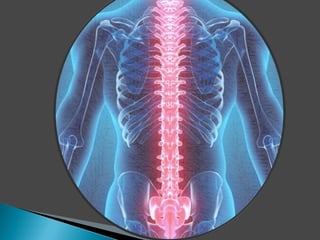
Spinal
cord
It lies within the neural canal of
the vertebral column.
It is also surrounded by three
meninges- dura matter,
arachnoid matter,& pia matter.
CSF forms a fluid cushion
around the spinal cord.
Spinal cord
It is long cylindrical rod, 42 to 45 cm long & 2.0 to 2.5 cm broad.
Broadest at anterior end & tapers posteriorly into conus medullaris &
further continues as a thread like filum terminale.
31 pairs of spinal nerves arise from lateral sides of the spinal cord.
These nerves are concentrated in the region of cervical & lumbar shows
swelling.
Bunch of nerve appear like a horse’s tail along the filum terminale,
known as Cauda equina.
Structure of the spinal cord
It is dorsoventrally
flattened due to the
presence of deep,
narrow posterior
fissure & shallow,
broad anterior fissure.
The fissures divide the
spinal cord into right
& left side.
Central canal is
present in the centre.
Grey matter is H-
shaped on the
innerside, while the
white matter is on the
outerside.
T.S. of Spinal cord
The fissures divide the grey
matter into six horns, such
as:
• Pair of dorsal horn
• Pair of lateral horn
• Pair of ventral horn
The fissures divide the white
matter into six columns or
funiculi, such as:
• Pair of dorsal funiculi
• Pair of lateral funiculi
• Pair of ventral funiculi
T.S. of Spinal cord
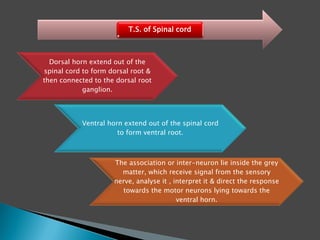
Dorsal horn extend out of the
spinal cord to form dorsal root &
then connected to the dorsal root
ganglion.
Ventral horn extend out of the spinal cord
to form ventral root.
The association or inter-neuron lie inside the grey
matter, which receive signal from the sensory
nerve, analyse it , interpret it & direct the response
towards the motor neurons lying towards the
ventral horn.
T.S. of Spinal cord
The lateral horns have neurons of ANS.
The nerves arising from these neurons, emerge out from the ventral root of
spinal nerve.
White matter consists of myelinated ascending & descending tracts.
The ascending tracts conduct sensory impulses from spinal cord to the
brain.
The descending tracts conduct motor impulses from brain to the lateral &
ventral funiculi of spinal cord.
T.S. of Spinal cord
Main centre for the
most of the reflex
actions.
It provides pathway
for conduction of
sensory and motor
impulses to and
from the brain.
It provides nervous
connection to many
parts of the body.
Functions of spinal cord
PNS connects
the CNS to
the different
parts of the
body through
receptors &
effectors.
Peripheral nervous system
It is classified into
two main types:
Cranial
nerves
Spinal
nerves
Peripheral nervous system
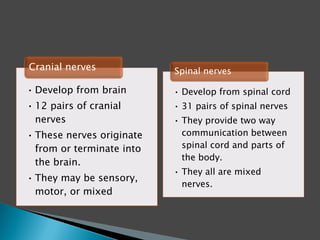
• Develop from brain
• 12 pairs of cranial
nerves
• These nerves originate
from or terminate into
the brain.
• They may be sensory,
motor, or mixed
Cranial nerves
• Develop from spinal cord
• 31 pairs of spinal nerves
• They provide two way
communication between
spinal cord and parts of
the body.
• They all are mixed
nerves.
Spinal nerves
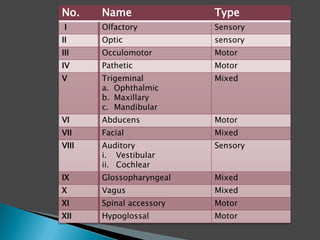
No. Name Type
I Olfactory Sensory
II Optic sensory
III Occulomotor Motor
IV Pathetic Motor
V Trigeminal
a. Ophthalmic
b. Maxillary
c. Mandibular
Mixed
VI Abducens Motor
VII Facial Mixed
VIII Auditory
i. Vestibular
ii. Cochlear
Sensory
IX Glossopharyngeal Mixed
X Vagus Mixed
XI Spinal accessory Motor
XII Hypoglossal Motor
Group No. of pairs Region of origin
Cervical 8 (C1-C8) Neck
Thoracic 12 (T1-T12) Thorax
Lumbar 5 (L1-L5) Abdomen
Sacral 5 (S1-S5) Pelvis
Coccygeal 1 (Co1) Coccyx
Spinal nerves
Each spinal nerve is formed inside the neural canal of vertebral column by the
posterior or dorsal root & the anterior or ventral root.
Dorsal root receives the sensory nerve from the dorsal root ganglion.
Ventral root gives out the motor nerve.
The dorsal sensory & ventral motor nerves together form the mixed spinal
nerve.
Spinal nerve emerges out of vertebral column through intervertebral foramen
& form three branches.
Formation of typical
spinal nerves
Ramus dorsalis: Innervate the skin
& muscles of dorsal side.
Ramus ventralis: The largest
branch, innervate the organs &
muscles on lateral & ventral side.
Ramus communicans: The smallest
branch given out from 1st thoracic
upto 3rd lumbar spinal nerve. It
joins the sympathetic ganglia.
Three branches of spinal nerve
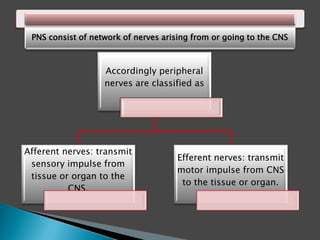
Accordingly peripheral
nerves are classified as
Afferent nerves: transmit
sensory impulse from
tissue or organ to the
CNS.
Efferent nerves: transmit
motor impulse from CNS
to the tissue or organ.
PNS consist of network of nerves arising from or going to the CNS
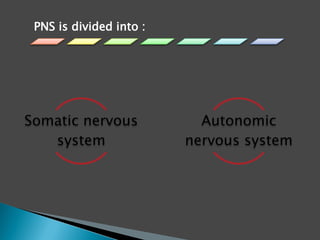
Somatic nervous
system
Autonomic
nervous system
PNS is divided into :
The somatic nervous system relays impulses
from CNS to the skeletal or voluntary muscles
of the body.
Autonomic nervous system transmits impulses from
CNS to the smooth or involuntary muscles of the body.
ANS consists of a special set of peripheral nerves that
regulate the involuntary activities of smooth muscles.
In ANS, impulses are conducted from CNS by an axon
which form synapses with an autonomic ganglion, such
neuron is called preganglionic neuron.
And the other neuron, which carry impulse from
autonomic ganglion to the effector organ, is
postganglionic neuron.
Autonomous nervous
system
Sympathetic nervous
system
•Thoraco-lumbar outflow.
•Originates in the thoracic &
lumbar region of spinal cord.
•It consists of 22 pairs of
sympathetic ganglia which lie
on a pair of sympathetic cords
on lateral sides of the spinal
cord.
Parasympathetic
nervous system
• Cranio-sacral outflow.
• Consists of branches of
cranial nerves(III,VII,IX,X) &
sacral nerves(II,III, IV).
• These ganglia are situated
very close or within the
wall of the effector
organs.
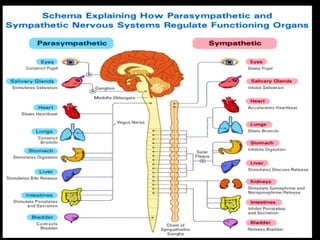
ANS consists of sympathetic & parasympathetic nervous system.
Sympathetic N S
•Pre-ganglionic nerve fibres are
short & post-ganglionic nerve
fibres are long.
•At the terminal ends of
postganglionic nerve fibres,
they produce adrenaline &
noradrenaline at effector organ.
•Hence these nerve fibres are
also called as Adrenergic fibres.
•SNS controls body activities
during emergencies.
•It has excitatory or stimulating
effect on most organs of the
body except in the digestive &
excretory organ.
Parasympathetic N S
• Pre-ganglionic nerve fibres are long
& post-ganglionic nerve fibres are
short.
• At the terminal ends of
postganglionic nerve fibres, they
produce acetylcholine at the effector
organ.
• Hence these nerve fibres are also
called as cholinergic fibres.
• PNS bring back to normal , all the
activities which are stimulated by
SNS. ( Housekeeping system)
• It has inhibitory effect on most
organs. But the activities associated
with digestion, peristalsis &
micturition, which are inhibited by
SNS are accelerated by the PNS.
Psychological disorders:
Mental disorder which affect the mood, thinking or behaviour, create distress for the
person suffering from it.
Examples: Intellectual disability, Autism spectrum, Bipolar disorder, depression,
stress related disorders, & ADHD( Attention Deficit Hyperactivity Disorder)
Parkinson’s disease:
•Degeneration of dopamine-producing neurons in the CNS.
•Symptoms are tremors, stiffness, difficulty in walking, balance,and co-
ordination.
Alzheimer’s disease:
•Common form of dementia.
•Loss of cognitive functioning such as thinking, remembering, reasoning, & behavioral abilities
•It interferes with the persons daily life and activities.
•It occurs due to loss of cholinergic & other neurons in the CNS, accumulation of amyloid proteins.
•No cure, but treatment slows down the progression of the disease.
Here nervous
coordination is over,
now let’s learn about
chemical coordination.

Neural control

  • 1.
  • 2.
  • 3.
     Plants showschemical signals.  Phototrophs are one of the good examples.  Animals shows chemical and electrical signals.  Reflex action is one of the good examples.
  • 6.
  • 7.
    They shows onlycells, no tissues. Various cells perform different functions, like digestion, respiration, excretion etc. But porifera lacking nervous system. So they shows least division of labour.
  • 8.
    Example: Hydra. Primitive organismwhich shows nervous system. It consists of nerve cells & sensory cells. Nerve cells forms two nerve net.
  • 10.
    Both the nervenet in hydra present in mesoglea.
  • 11.
    Neurons are notdivided into sensory neuron or motor neuron. Activation of sensory cells can take place at any points and impulse can be carried through out the body in any direction. Example: Catching of the prey during feeding.
  • 12.
  • 13.
  • 14.
    The first primitiveorganism having central nervous system
  • 15.
    A pair ofphotosensory structure , the eyes are located on dorsal side of the brain.  Cephalic or Cerebral ganglia lie in the anterior region of the body.  From each ganglia arises nine branches.  From below the ganglia arise a pair of Ventral nerve cord (VNC).  VNC are interconnected with each other by transfer nerve or commissure.  Peripheral nerve plexus arising from VNC.
  • 16.
    Neurons They are structural& functional cells of the nervous system. Originate from embryonic layer ectoderm. Lesser in numbers as compared to neuroglial cells. Example: Sensory neuron, motor neuron, mixed neuron.  Neuroglial cells  They are supporting cells of the nervous system.  Originate from embryonic layer ectoderm.  Greater in numbers as compared to neurons.  Example : Ependymal cell, schwann cells, microglia.
  • 17.
  • 18.
  • 20.
     Cyton orcell bodies : consists of neurofibrils, Nissl’s granules & other cell organelles.  Dendrons : small conical structures arising from cytons.  Axon : single, long, unbranched processes, arising from cyton.
  • 23.
    Medullated nerves: Inwhich nerves are surrounded by medullary sheath and on outside surrounded by neurilemma. Non medullated nerves: In which nerves are surrounded by only neurilemma.
  • 24.
    Endoneurium: Connective tissue covering aroundthe nerve fascicule i.e. endoneurium. Perineurium : Few nerve fasciculi with endoneurium are surrounded by connective tissue i.e. perineurium. Epineurium: Some large bundle of nerves is covered on outerside , i.e. epineurium. Conduction of impulse is faster in medullated nerve fibres than non- medullated nerve fibres.
  • 28.
    Excitability/ Irritability Conductivity Stimulus (Threshold, subliminal, supraliminal stimulus) Summation effect All or none law Refractory period Synaptic delay Synaptic fatigue Velocity
  • 29.
    Presynaptic neuron: The neuronwhich carry impulse to the synapse. Postsynaptic neuron : The neuron which receiving impulse from the synapse.
  • 30.
    Synaptic cleft: Itis a small intercellular space lies in between two cells having a width of about 20-30nm between them. Synaptic transmission: The process by which the impulse from the pre-synaptic neuron is conducted to the post-synaptic neuron.
  • 31.
    Types of Synapse Electricalsynapse Chemical synapse
  • 32.
    Gap between twoneuron is very narrow, about 3.8nm. Synapse is mechanical. Electrical conductive link is formed between presynaptic and postsynaptic neuron. Transmission of impulse is faster. Example : Defence reflexes. Electrical synapse
  • 33.
    Theses are specializedjunctions through which one neuron send chemical signals to the another neuron or to the non-neuronal cells , such as glands, muscles. Gap between two adjacent neuron is 20-40 nm . There are 3 components involved in the chemical synapse: 1. Pre synaptic neuron 2. Synaptic membrane of the postsynaptic neuron 3. Post synaptic neuron. Chemical synapse
  • 34.
  • 37.
    Depolarization : Anychange or disturbance to the membrane will cause Na to enter into the membrane & lower the potential difference( lesser than -70 millivolts). During depolarization the Na gates open but not the K gates. Re-polarization : Change in the polarity from depolarized, back to the original state.
  • 41.
    It is classified into3 parts 1. Central nervous system 2. Peripheral nervous system 3. Autonomous nervous system
  • 43.
    Central nervous system Itconsist of two main parts: 1) Brain 2) Spinal cord
  • 44.
    There are 3 membranouslayers of meninges: 1. Dura matter: outermost, tough, thick, non-vascular, fibrous layer. 2. Arachnoid matter: middle, thin, non- vascular layer of connective tissue. 3. Pia matter: innermost, delicate, highly vascular membrane. Brain and Spinal cord are well protected by membranes known as Meninges.
  • 45.
    CSF is secretedby the pia matter, the choroid plexuses and the ependymal cells. It is lymph like extracellular fluid. CSF acts as a shock absorber. Maintain constant pressure inside the brain. Helps in exchange of nutrients and wastes between blood and brain. Supply oxygen. Prevent desiccation. Cerebrospinal fluid( CSF):
  • 46.
    The study ofall aspects of brain is called Encephalogy. Brain is enclosed within the brain box known as Cranium. Human brain
  • 48.
    It consist of3 parts: Olfactory lobes or Rhinencephalon Cerebrum or Telencephalon Diencephalon Forebrain or Prosencephalon
  • 49.
  • 50.
    Largest part ofthe brain Divided into right & left cerebral hemisphere which connected with each other by thick band of nerve fibres known as corpus callosum. Outer surface is cortex & inner surface is medulla. Cortex shows gyri and sulci Cerebrum
  • 52.
    Each cerebral hemisphereis divieded into ; Frontal lobe Parietal lobe Temporal lobe Occipital lobe
  • 53.
    Central sulcus separate frontallobe from parietal lobe. Parieto-occipital sulcus separate parietal lobe from occipital lobe. Lateral sulcus or sylvian sulcus separate temporal lobe from frontal & parietal lobe. By three sulci
  • 55.
    Motor area: controlvoluntary motor activities or movement of muscles. Premotor area: control involuntary movement & ANS. Association area: bring coordination between sensation & movement. Broca’s area/ motor speech area: translates the thoughts into speech. Frontal lobes: They have 4 important areas such as, Functional areas of cerebrum:
  • 56.
    Parietal lobes: controlssensation of pain, pressure, temperature, taste( gustatoreceptor). Temporal lobes: controls centres of smell,hearing, speech and emotions. Occipital lobes: controls sense of vision.
  • 57.
    In addition toall these areas there is one more area of intelligence i.e. Wernicke’s area which helps in the understanding of spoken and written words. Basal nuclei or basal ganglia are grey masses present in the white matter, help the cortex in the execution of activities at subconscious level. Corpus striatum the largest basal nucleus.
  • 59.
    It is thethird part of the forebrain, present below the corpus callosum and above the midbrain. Encloses a cavity termed as third ventricles or diocoel which communicates with the two lateral ventricles of cerebrum by foramen of Monro. Diencephalon
  • 60.
  • 62.
    Roof of diencephalon Dorsal wall connectedto pineal gland Pineal gland produces hormone melatonin which is sleep inducing hormone & related to reproductive behaviour Epithalamus
  • 63.
  • 64.
    Hypothalamus Floor of diencephalon Maintainshomeostasis, internal equilibrium, & involuntary behaviour control. Hypothalamic nuclei consists of neuro-secretary cells which produce hormones. Hypothalamus is the link between nervous and endocrine system. It regulates heart rate, respiration, B.P., body temperature, water & electrolyte balance. It has centre for thirst, hunger, sleep, fatique, satiety centre, secretion of glands of GI. Floor of hypothalamus shows downward projection of pituitary gland. On inferior surface it bears the optic chiasma & pair of mammillary bodies.
  • 66.
    A complex neuronal circuit called Limbic system. Itis formed by the hypothalamic amygdala, epithalamus, thalamus, & hippocampus.
  • 69.
    Mid Brain orMesencephalon Mid Brain Corpora quadrigemina Crura cerebri
  • 70.
    They are fourrounded elevations on the dorsal surface of the mid brain. Upper two elevations are superior colliculi & lower two elevations are inferior colliculi. Superior colliculi are involved in visual reflexes. Inferior colliculi are involved in auditory reflexes. Corpora quadrigemina
  • 71.
    These are twothick fibrous tracks on inferior side of the mid brain. These tracts are ascending and descending nerve fibres. Near the centre of mid brain , red nucleus is present which is responsible for controlling posture and muscle tone, modifying motor activities, & motor coordination. Crura cerebri
  • 74.
    It consists of 3parts: Pons varolli Cerebellum Medulla oblongata Hind brain or Rhombencephalon
  • 75.
    Rounded bulge on theunderside of the brain stem. It consists of a cross band of nerve fibres connecting cerebrum, cerebellar lobes, medulla oblongata, & spinal cord. Pons varolli
  • 76.
    Second largest partof the brain. Consists of two lateral hemispheres & a central vermis. White matter intermixes with the grey matter to show a tree like pattern called Arbor vitae. Surface of cerebellum shows gyri & sulci. Three pairs of myelinated bundles called cerebellar peduncles, connect cerebellum to other parts of CNS. It maintains equilibrium, posture, balancing, orientation, moderation of voluntary movement, muscle tone. It is centre for neuromuscular activities which is responsible for controlling activities like walking, running, speaking. Cerebellum
  • 77.
    Posterior most part ofthe brain, continues as the spinal cord. Inner grey matter & outer white matter. Controls involuntary vital functions such as heart beat, respiration, vasomotor activities, peristalsis. Controls non- vital activities like coughing, sneezing, swallowing, vomitting, yawning. It encloses a cavity known as metacoel or fourth ventricle. It’s roof has posterior choroid plexus for secretion of CSF. Posterior choroid plexus has 3 opening- •A pair of lateral foramen of Luschka, •A median foramen of Magendie. Medulla oblongata
  • 79.
    Second important part ofthe CNS. Lower extension of medulla oblongata. Spinal cord
  • 82.
    It lies withinthe neural canal of the vertebral column. It is also surrounded by three meninges- dura matter, arachnoid matter,& pia matter. CSF forms a fluid cushion around the spinal cord. Spinal cord
  • 83.
    It is longcylindrical rod, 42 to 45 cm long & 2.0 to 2.5 cm broad. Broadest at anterior end & tapers posteriorly into conus medullaris & further continues as a thread like filum terminale. 31 pairs of spinal nerves arise from lateral sides of the spinal cord. These nerves are concentrated in the region of cervical & lumbar shows swelling. Bunch of nerve appear like a horse’s tail along the filum terminale, known as Cauda equina. Structure of the spinal cord
  • 84.
    It is dorsoventrally flatteneddue to the presence of deep, narrow posterior fissure & shallow, broad anterior fissure. The fissures divide the spinal cord into right & left side. Central canal is present in the centre. Grey matter is H- shaped on the innerside, while the white matter is on the outerside. T.S. of Spinal cord
  • 85.
    The fissures dividethe grey matter into six horns, such as: • Pair of dorsal horn • Pair of lateral horn • Pair of ventral horn The fissures divide the white matter into six columns or funiculi, such as: • Pair of dorsal funiculi • Pair of lateral funiculi • Pair of ventral funiculi T.S. of Spinal cord
  • 87.
    Dorsal horn extendout of the spinal cord to form dorsal root & then connected to the dorsal root ganglion. Ventral horn extend out of the spinal cord to form ventral root. The association or inter-neuron lie inside the grey matter, which receive signal from the sensory nerve, analyse it , interpret it & direct the response towards the motor neurons lying towards the ventral horn. T.S. of Spinal cord
  • 88.
    The lateral hornshave neurons of ANS. The nerves arising from these neurons, emerge out from the ventral root of spinal nerve. White matter consists of myelinated ascending & descending tracts. The ascending tracts conduct sensory impulses from spinal cord to the brain. The descending tracts conduct motor impulses from brain to the lateral & ventral funiculi of spinal cord. T.S. of Spinal cord
  • 90.
    Main centre forthe most of the reflex actions. It provides pathway for conduction of sensory and motor impulses to and from the brain. It provides nervous connection to many parts of the body. Functions of spinal cord
  • 91.
    PNS connects the CNSto the different parts of the body through receptors & effectors. Peripheral nervous system
  • 92.
    It is classifiedinto two main types: Cranial nerves Spinal nerves Peripheral nervous system
  • 93.
    • Develop frombrain • 12 pairs of cranial nerves • These nerves originate from or terminate into the brain. • They may be sensory, motor, or mixed Cranial nerves • Develop from spinal cord • 31 pairs of spinal nerves • They provide two way communication between spinal cord and parts of the body. • They all are mixed nerves. Spinal nerves
  • 94.
    No. Name Type IOlfactory Sensory II Optic sensory III Occulomotor Motor IV Pathetic Motor V Trigeminal a. Ophthalmic b. Maxillary c. Mandibular Mixed VI Abducens Motor VII Facial Mixed VIII Auditory i. Vestibular ii. Cochlear Sensory IX Glossopharyngeal Mixed X Vagus Mixed XI Spinal accessory Motor XII Hypoglossal Motor
  • 95.
    Group No. ofpairs Region of origin Cervical 8 (C1-C8) Neck Thoracic 12 (T1-T12) Thorax Lumbar 5 (L1-L5) Abdomen Sacral 5 (S1-S5) Pelvis Coccygeal 1 (Co1) Coccyx Spinal nerves
  • 96.
    Each spinal nerveis formed inside the neural canal of vertebral column by the posterior or dorsal root & the anterior or ventral root. Dorsal root receives the sensory nerve from the dorsal root ganglion. Ventral root gives out the motor nerve. The dorsal sensory & ventral motor nerves together form the mixed spinal nerve. Spinal nerve emerges out of vertebral column through intervertebral foramen & form three branches. Formation of typical spinal nerves
  • 97.
    Ramus dorsalis: Innervatethe skin & muscles of dorsal side. Ramus ventralis: The largest branch, innervate the organs & muscles on lateral & ventral side. Ramus communicans: The smallest branch given out from 1st thoracic upto 3rd lumbar spinal nerve. It joins the sympathetic ganglia. Three branches of spinal nerve
  • 99.
    Accordingly peripheral nerves areclassified as Afferent nerves: transmit sensory impulse from tissue or organ to the CNS. Efferent nerves: transmit motor impulse from CNS to the tissue or organ. PNS consist of network of nerves arising from or going to the CNS
  • 100.
  • 101.
    The somatic nervoussystem relays impulses from CNS to the skeletal or voluntary muscles of the body. Autonomic nervous system transmits impulses from CNS to the smooth or involuntary muscles of the body.
  • 102.
    ANS consists ofa special set of peripheral nerves that regulate the involuntary activities of smooth muscles. In ANS, impulses are conducted from CNS by an axon which form synapses with an autonomic ganglion, such neuron is called preganglionic neuron. And the other neuron, which carry impulse from autonomic ganglion to the effector organ, is postganglionic neuron. Autonomous nervous system
  • 103.
    Sympathetic nervous system •Thoraco-lumbar outflow. •Originatesin the thoracic & lumbar region of spinal cord. •It consists of 22 pairs of sympathetic ganglia which lie on a pair of sympathetic cords on lateral sides of the spinal cord. Parasympathetic nervous system • Cranio-sacral outflow. • Consists of branches of cranial nerves(III,VII,IX,X) & sacral nerves(II,III, IV). • These ganglia are situated very close or within the wall of the effector organs. ANS consists of sympathetic & parasympathetic nervous system.
  • 104.
    Sympathetic N S •Pre-ganglionicnerve fibres are short & post-ganglionic nerve fibres are long. •At the terminal ends of postganglionic nerve fibres, they produce adrenaline & noradrenaline at effector organ. •Hence these nerve fibres are also called as Adrenergic fibres. •SNS controls body activities during emergencies. •It has excitatory or stimulating effect on most organs of the body except in the digestive & excretory organ. Parasympathetic N S • Pre-ganglionic nerve fibres are long & post-ganglionic nerve fibres are short. • At the terminal ends of postganglionic nerve fibres, they produce acetylcholine at the effector organ. • Hence these nerve fibres are also called as cholinergic fibres. • PNS bring back to normal , all the activities which are stimulated by SNS. ( Housekeeping system) • It has inhibitory effect on most organs. But the activities associated with digestion, peristalsis & micturition, which are inhibited by SNS are accelerated by the PNS.
  • 106.
    Psychological disorders: Mental disorderwhich affect the mood, thinking or behaviour, create distress for the person suffering from it. Examples: Intellectual disability, Autism spectrum, Bipolar disorder, depression, stress related disorders, & ADHD( Attention Deficit Hyperactivity Disorder) Parkinson’s disease: •Degeneration of dopamine-producing neurons in the CNS. •Symptoms are tremors, stiffness, difficulty in walking, balance,and co- ordination. Alzheimer’s disease: •Common form of dementia. •Loss of cognitive functioning such as thinking, remembering, reasoning, & behavioral abilities •It interferes with the persons daily life and activities. •It occurs due to loss of cholinergic & other neurons in the CNS, accumulation of amyloid proteins. •No cure, but treatment slows down the progression of the disease.
  • 107.
    Here nervous coordination isover, now let’s learn about chemical coordination.