NERVES OF UPPER LIMB
Sourabh Chakraborty
Ulnar nerve
• Branch from medial cord of brachial plexus
• Conveys fibers from C8 & T1
• Receives contribution from C7 through
the median nerve for flexor carpi ulnaris
COURSE IN AXILLA
• Passes along medial side axillary
artery third part Between
axillary artery & vein
COURSE IN ARM
• Medial side of brachial artery
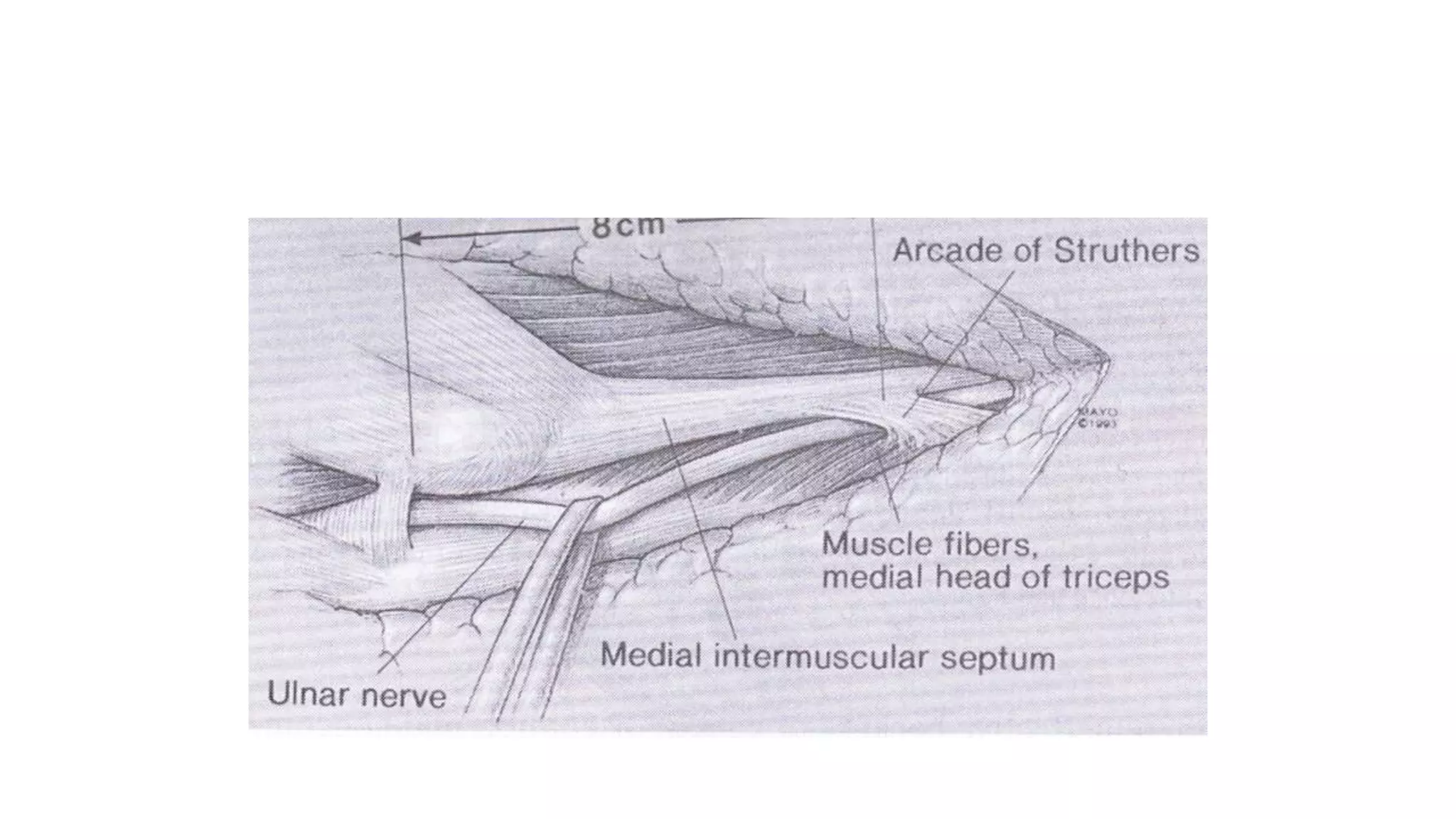
• Pierces medial IMS along
superior ulnar
collateral vs.
• Descends superficial to the
medial head of the triceps
• Appears between medial
epicondyle &
olecranon process
COURSE IN FOREARM
• Enters between two heads FCU
UPPER ONE- THIRD FOREARM
• Deeply placed
• Rests on FDP, covered by FCU
• Separated from ulnar artery
LOWER ONE- THIRD FOREARM
• Superficial
• Along lateral side FCU
• Accompanied ulnar artery
AT LEVEL OF WRIST
• Passes superficial to flexor retinaculum
• Passes beneath palmaris brevis
• Divides into superficial & deep terminal
branch
• SUPERFICIAL TERMINAL
BRANCH
• Supplies palmaris brevis
• Divides into
• a medial proper palmar digital branch
• a lateral common palmar digital branch
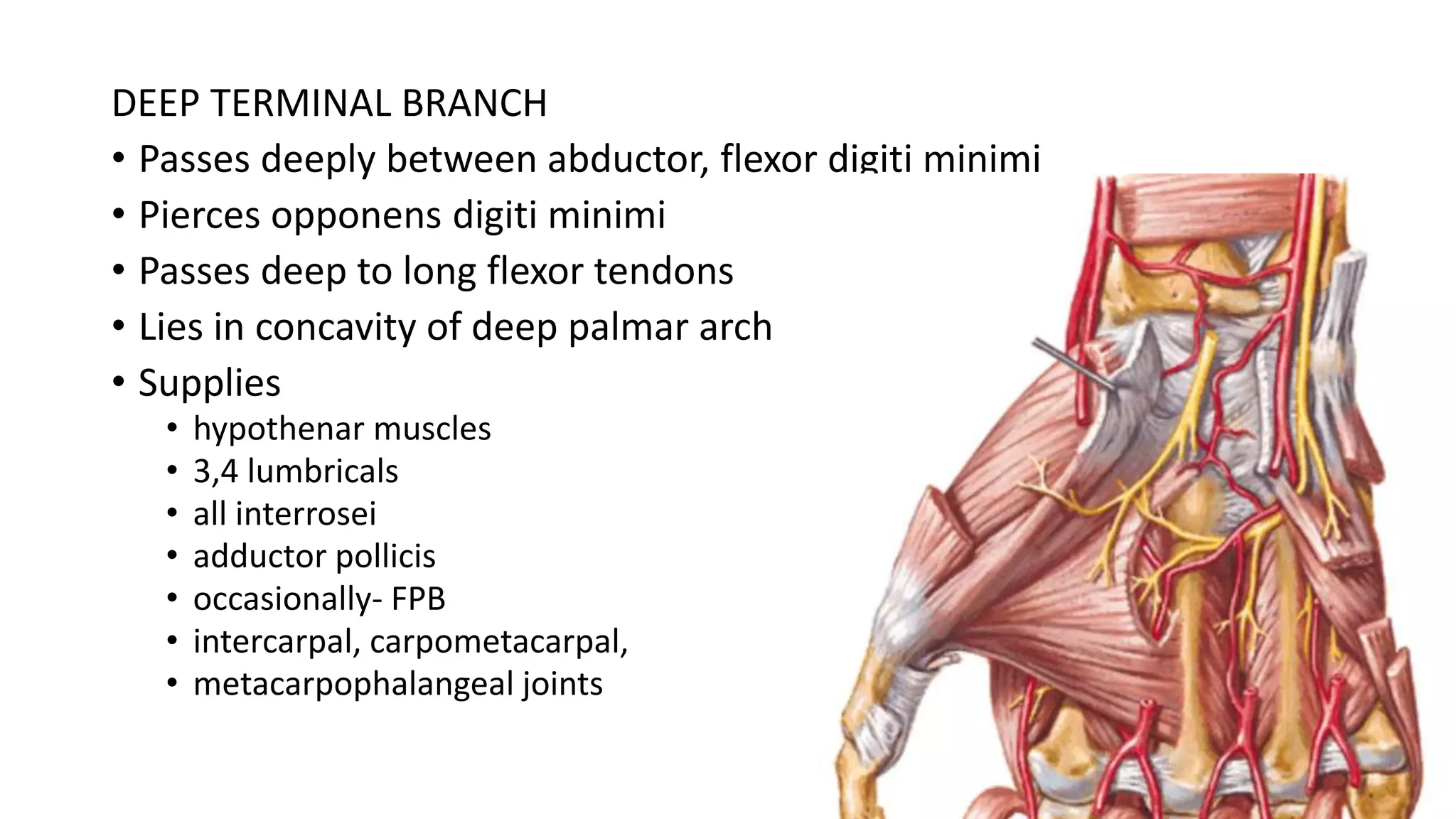
DEEP TERMINAL BRANCH
• Passes deeply between abductor, flexor digiti minimi
• Pierces opponens digiti minimi
• Passes deep to long flexor tendons
• Lies in concavity of deep palmar arch
• Supplies
• hypothenar muscles
• 3,4 lumbricals
• all interrosei
• adductor pollicis
• occasionally- FPB
• intercarpal, carpometacarpal,
• metacarpophalangeal joints
• At the midforearm, the ulnar nerve is composed of three distinct
fascicular grouP’. a dorsal sensory group, a volar sensory group. and a
motor group.
• the motor group is positioned between the ulnar dorsal sensory
group and the radial volar sensory group
• The dorsal sensOry branch separates from the motor branch and the
main sensory group8 to 10 cm proximal to the wrist .
• The motor branch remains ulnar to the sensory group until the Guyon
canal, at which time it passes dorsally to the sensOry branches of the
little and ring fingers to innervate the intrinsic muscles
Diagrammatic mappings of
the fascicular groups of the
left ulnar nerve at
representative
levels. The indicated level of
the sections is in reference
to the distance proximal to
the radial
styloid. Key: Red, motor
fascicular group; Blue,
sensory fascicular groups.
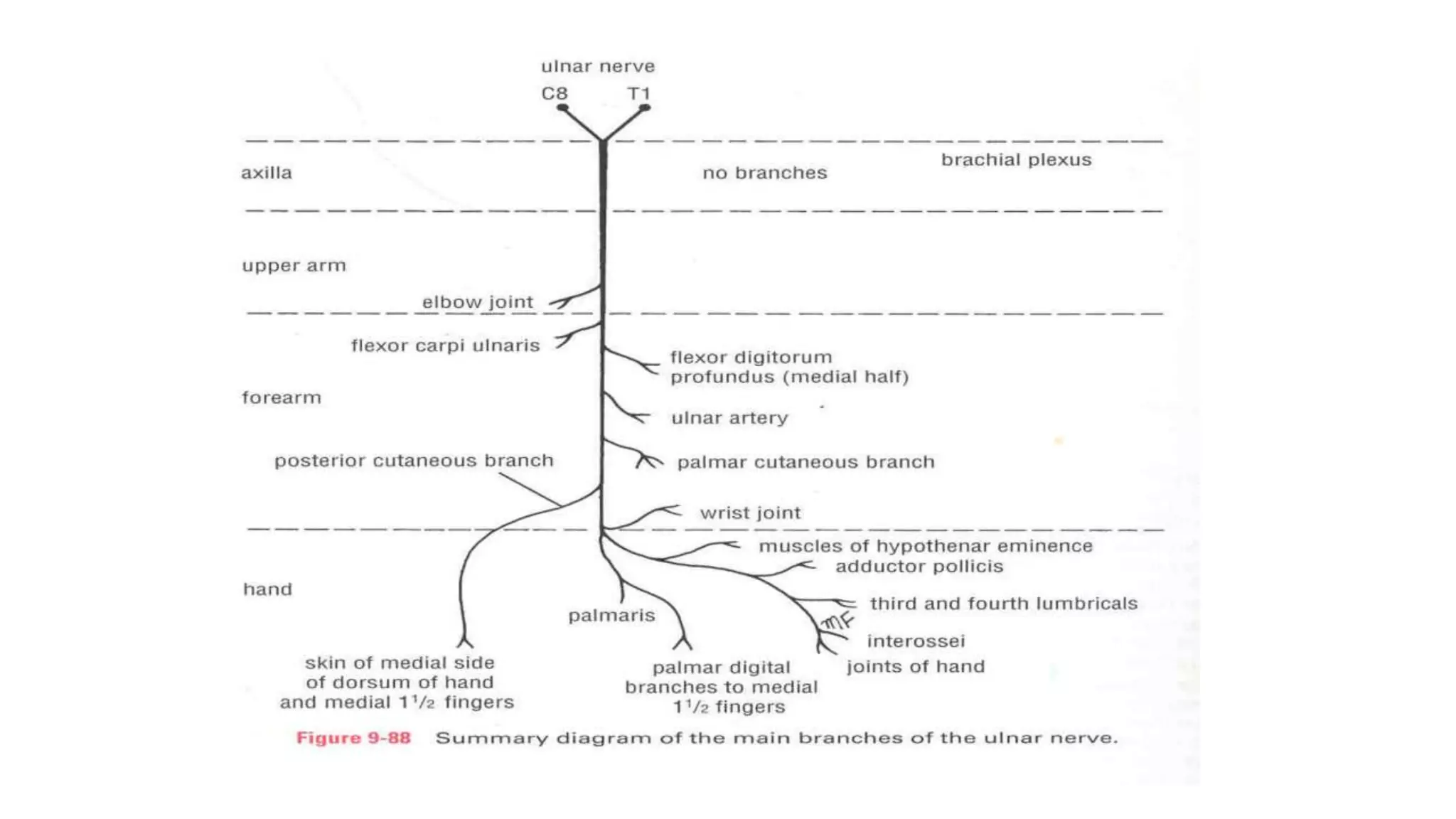
• BRANCHES OF ULNAR NERVE
Muscular branches
• forearm- FCU, medial half FDP
• hand- all intrinsic muscles except three thenar muscles, 1,2 lumbricals
Articular branches
• to elbow, intercarpal, carpometacarpal joints
Vascular branches
• axillary, brachial, ulnar, deep palmar arch
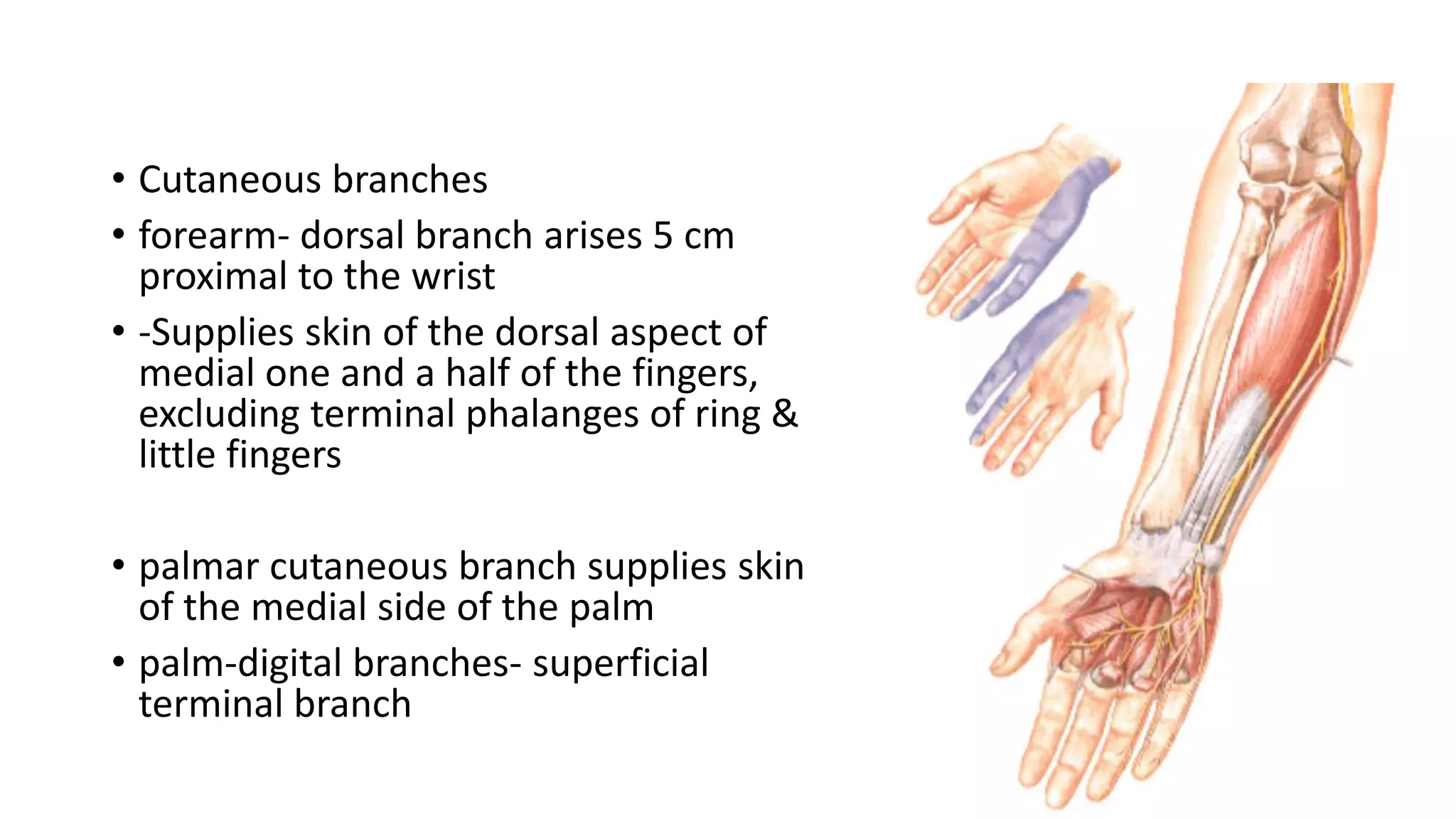
• Cutaneous branches
• forearm- dorsal branch arises 5 cm
proximal to the wrist
• -Supplies skin of the dorsal aspect of
medial one and a half of the fingers,
excluding terminal phalanges of ring &
little fingers
• palmar cutaneous branch supplies skin
of the medial side of the palm
• palm-digital branches- superficial
terminal branch
Radial nerve
• largest branch of the posterior cord of brachial plexus with a root
value of C5,6,7,8, T1
in axilla
• In axilla it passes behind the
third part of axillary artery
• Anterior to subscapularis,
latissimus dorsi & and teres
major
• Medial to it is axillary vein
• Lateral to it are axillary
nerve and coracobrachialis
• Continues behind the brachial artery
• • Then passes posterolaterally with the profunda brachii vessels
through the lower triangular space
• • Here it is anterior to teres major and passes between the long head
of triceps and humerus
After this the nerve enters
the radial groove with
the profunda vessels
In the radial groove nerve
lies between the lateral
and medial heads of
triceps in contact with
the humerus
At the lower end of the
groove, 5 cm below the
deltoid tuberosity, the
nerve pierces the lateral
intermuscular septum
and passes into anterior
compartment of arm
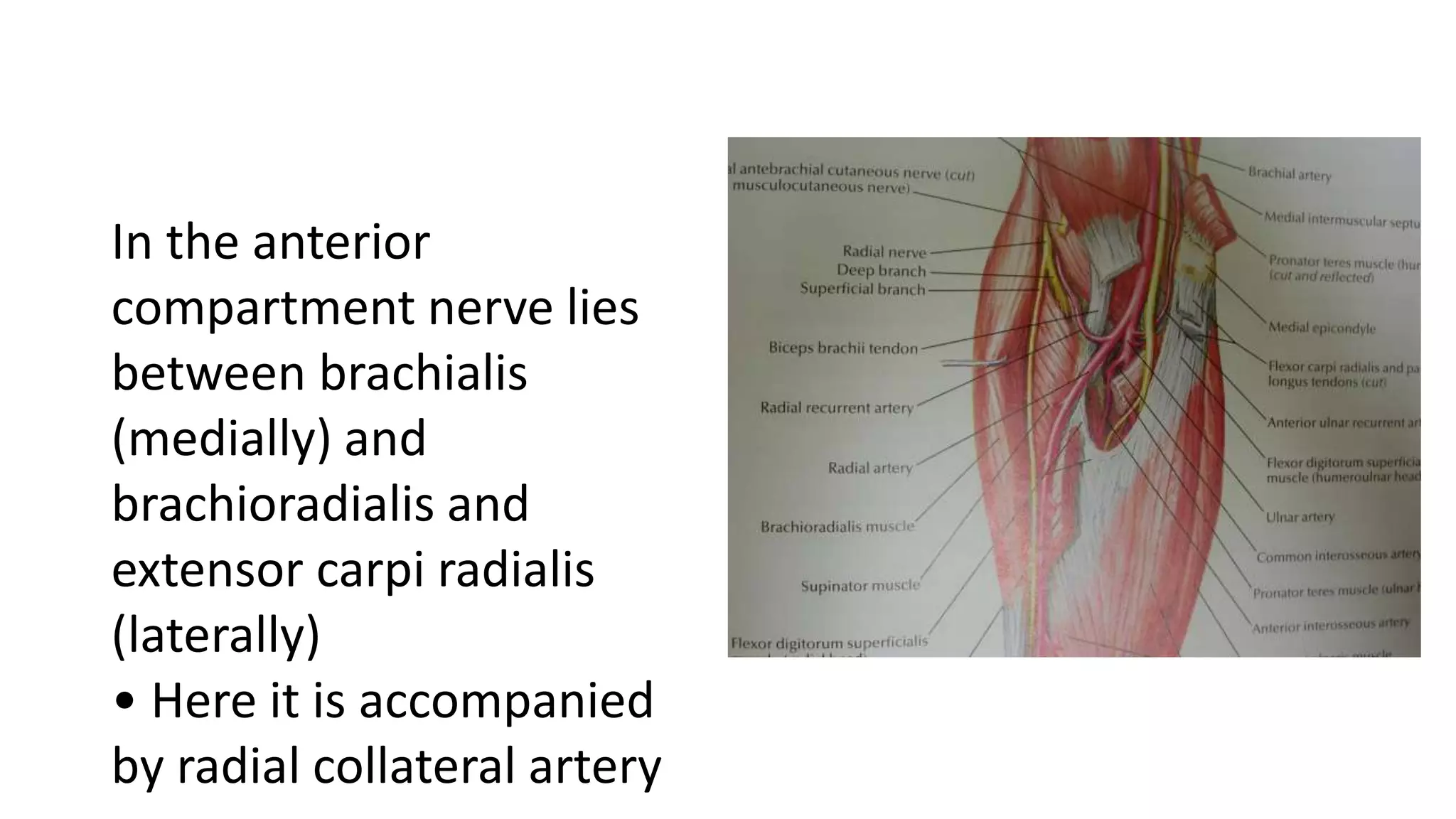
In the anterior
compartment nerve lies
between brachialis
(medially) and
brachioradialis and
extensor carpi radialis
(laterally)
• Here it is accompanied
by radial collateral artery
Branches of radial nerve
Muscular branches:
• • Before entering spiral groove- to
long and medial heads of triceps
• • In the spiral groove lateral and
medial heads of triceps and through
nerve to medial head to anconeus
• • Below the radial groove, on the
front of the arm, it supplies, the
brachialis, brachioradialis and the
extensor carpi radialis longus
Cutaneous branches:
• • Above the radial groove-
posterior cutaneous nerve of
the arm
• • In the radial groove-lower
lateral cutaneous nerve of
the arm and
• posterior cutaneous nerve of
the forearm
• Articular branches: to elbow
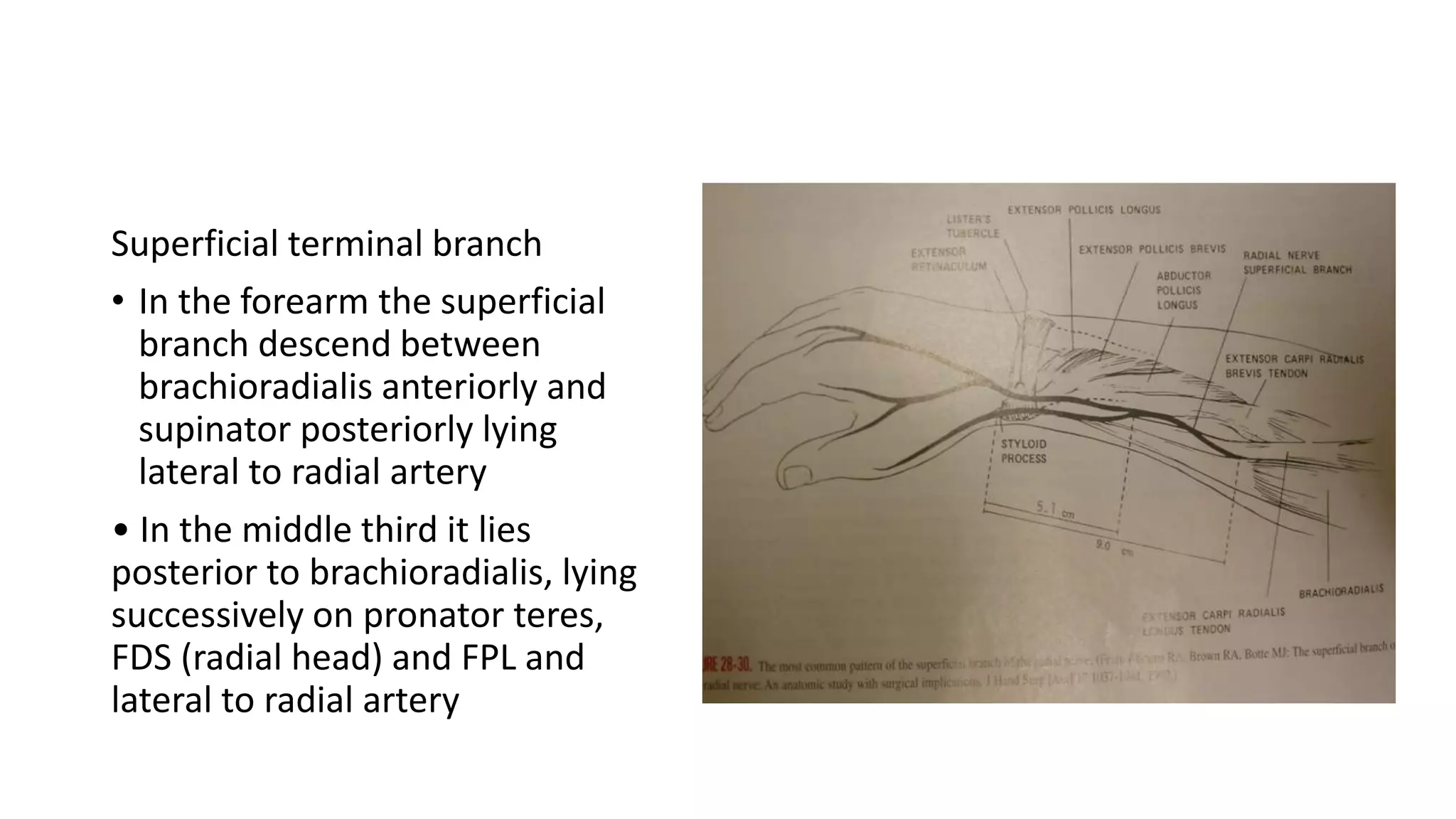
Superficial terminal branch
• In the forearm the superficial
branch descend between
brachioradialis anteriorly and
supinator posteriorly lying
lateral to radial artery
• In the middle third it lies
posterior to brachioradialis, lying
successively on pronator teres,
FDS (radial head) and FPL and
lateral to radial artery
• About 7 cm proximal to the wrist nerve leaves the artery
• • passes deep to the tendon of brachioradialis
• • Curves around the lateral side of radius
• • Pierces the deep fascia
• • Divides into 4 or 5 digital nerves on the dorsum of hand. it
communicates with posterior & lateral cutaneous nerves of forearm
• • Supplies radial half of the dorsum of the hand, proximal part of the
dorsal surface of thumb, index finger & the lateral half of the middle
finger
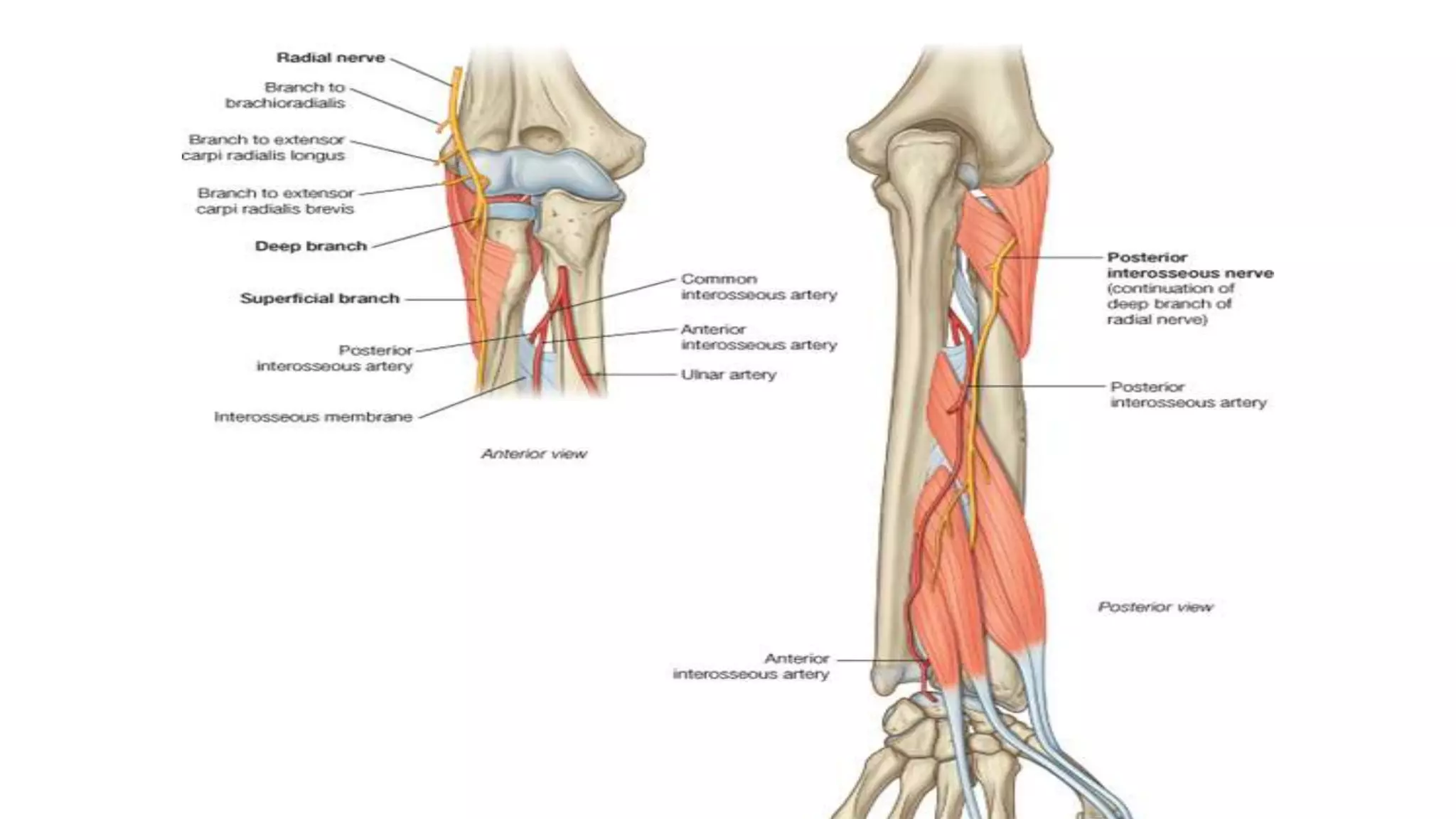
• Deep branch of radial nerve
• • Deep terminal branch reaches the back of forearm by passing
between two heads of supinator
• • supplies ECRB and supinator
Posterior interosseous nerve of
forearm
• it is deep branch of radial nerve
in forearm
• Reaches the back of forearm by
passing between the two heads of
supinator
• Descends between the
superficial &and deep group of
extensor muscles lying on the
interosseous membrane
• The upper part of nerve is accompanied by posterior interosseous
artery but the lower part is accompanied by anterior interosseous
artery
• • Terminates in to a pseudoganglion and ends by supplying the wrist
and carpal joint
Branches :
• Muscular –supinator ED,EDM &ECU -Divides into lateral & medial
branch
• lateral branch supplies APL &EPB
• Medial branch supplies EPL& EI
• • Articular branch: to wrist joint, distal radioulnar joint, some
intercarpal & intermetacarpal joint
• • Sensory branches :to interosseous membrane, radius & ulna
In the radial nerve, the motor and
sensory components are separated into
discrete fascicles. Awake stimulation can
be used to identify the motor and
&senSory components of the proximal
nerve, whereas anatomic: dissection
is used to identify them distally
Several histochemical techniques have
been described that allow motor
(acetylcholinesterase and choline
acetyltransferase) or sensory (carbonic
anhydrase) discrimination
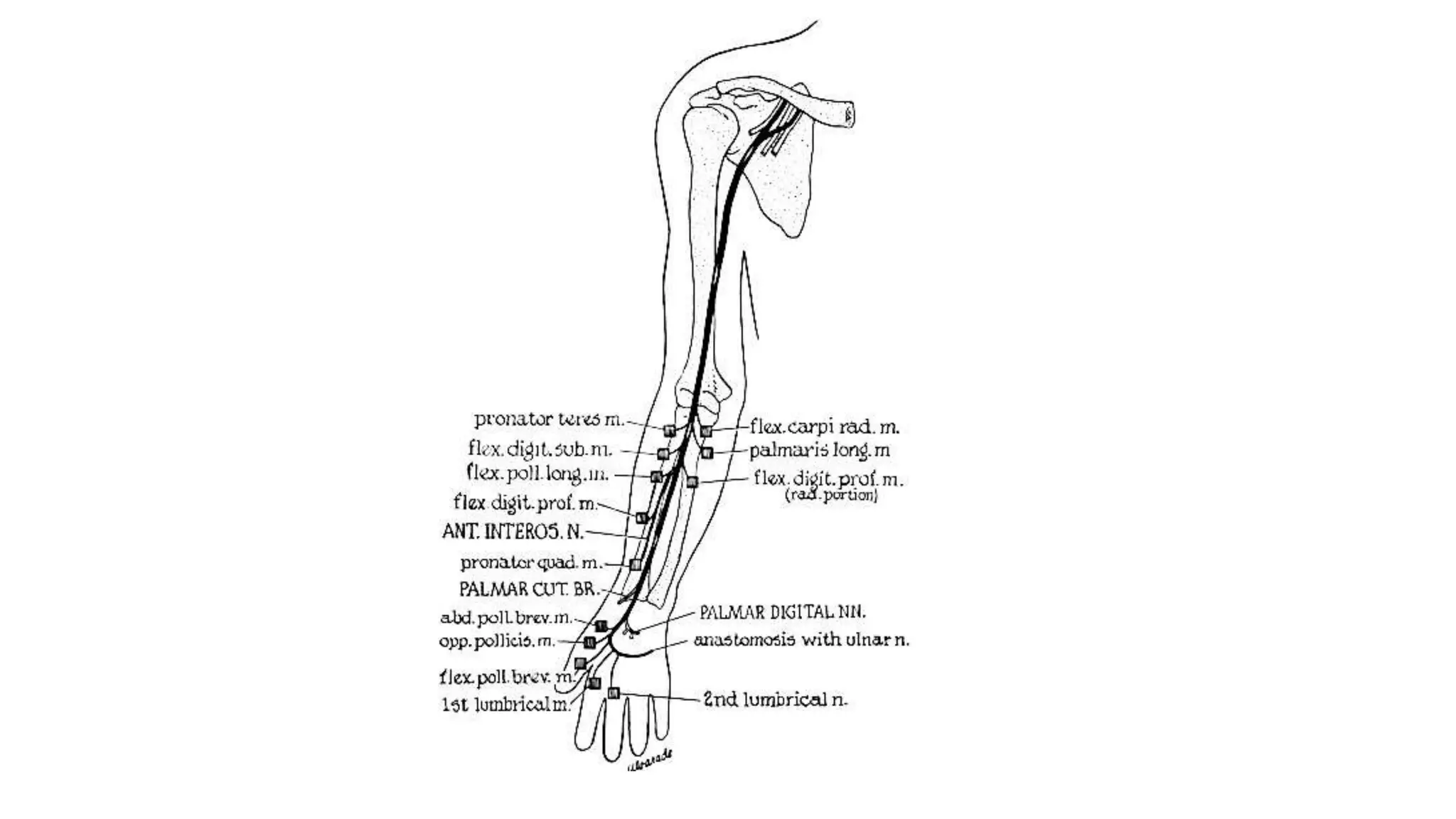
MEDIAN NERVE
• Formation: from two roots from lateral cord [C(5),6,7]& from medial
cord(C8,T1) of brachial plexus
• • These two roots embrace the third part of axillary artery uniting
anterior or lateral to it
In the arm • Closely related to the
brachial artery through out the course
in arm • In the upper part it is lateral
to artey • In the middle part it crosses
the artery from lateral to medial side •
Remains on the medial side up to
elbow
• Branches in arm
• • Branch to Pronator Teres just above elbow
• • Branch to brachial artery
• • Branch to elbow joint at or just below the
• elbow
• In the cubital fossa • Descends medial to brachial artery • Posterior to
bicipital aponeurosis • Anterior to brachialis, seperated by the muscle
from the elbow
• Leaves the cubital fossa by passing between two heads of pronator
teres
• In the forearm • Enters the forearm between the heads of pronator
teres • Crosses the lateral side of ulnar artery from which it is
seperated by the deep head of pronator teres • Gives branch to
pronator teres while passing between the two heads
• Proceeds behind a tendinous ridge between the two heads of Flexor
digitorum superficialis and anterior to Flexor digitorum profundus •
Here it is accompanied by median artery, a branch of anterior
interosseous artery
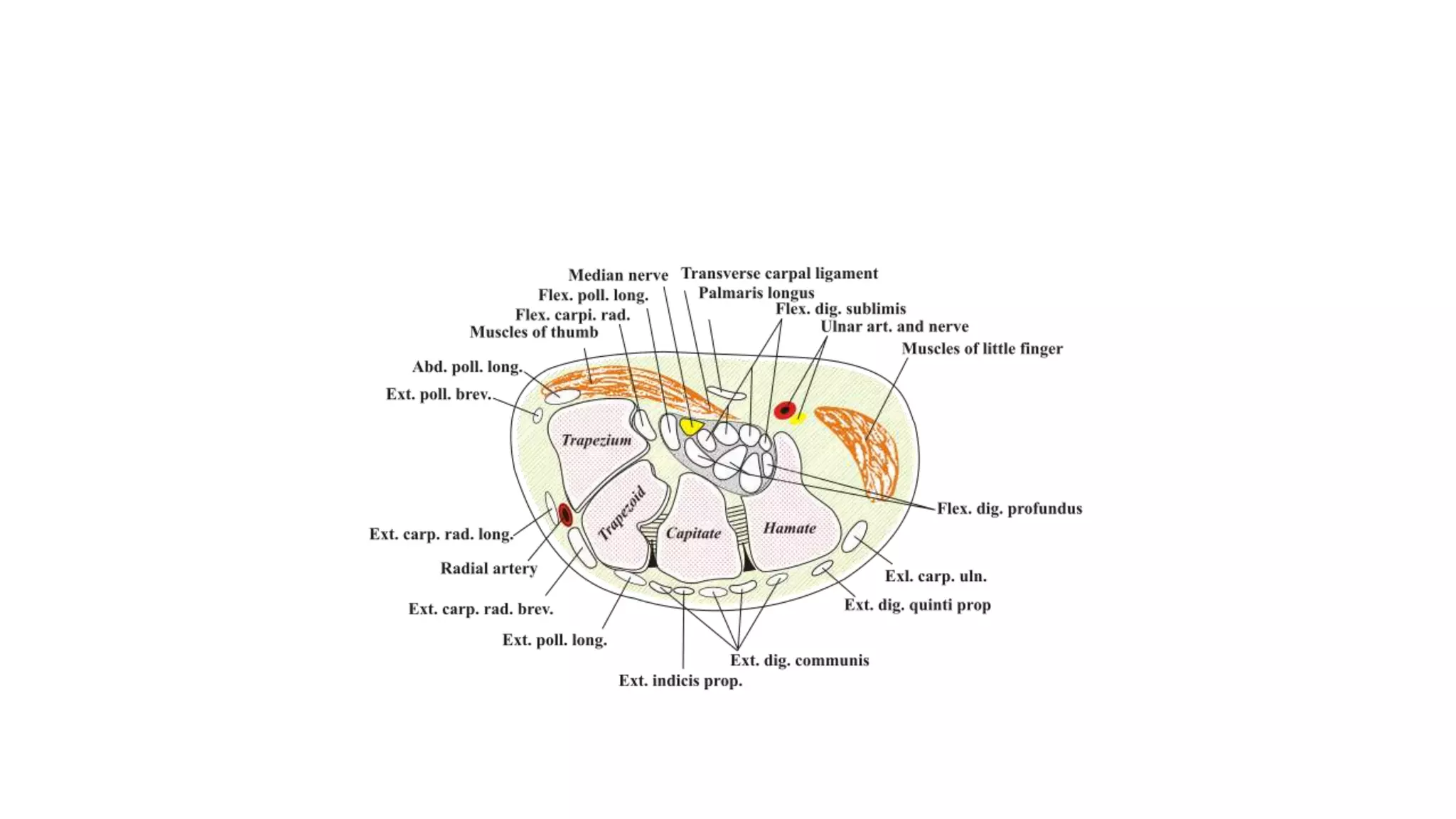
• About 5 cm proximal to flexor retinaculum it becomes superficial •
Here it lies between the tendon of palmaris longus and the flexor
carpi radialis muscle
• Leaves the forearm and enters the palm of the hand by passing
through the carpal tunnel deep to flexor retinaculum
• Branches in the forearm • Muscular branches to all the muscles in the
superficial and intermediate layer of forearm except one (FCU)
originate
• Anterior interosseous nerve: originate between two heads of
pronator teres • passes distally down the forearm with the anterior
interosseous artery. • Innervates the muscles of deep layer (FPL,
lateral half of FDP and pronator quadratus) • Terminates as articular
branch to wrist
• •Palmar cutaneous branch: starts just proximal to flexor retinaculum
•Lateral branches - thenar skin and connecting branch to the lateral
cutaneous nerve of fore arm
• •Medial branches - central palmer skin and connecting branch to the
palmar cutaneous branch of the ulnar nerve
• • Communicating branch: multiple –Arise in the proximal forearm –
Pass medialy between FDP & FDS and behind the ulnar artery to join
the ulnar nerve
• Lateral branch: gives
• Recurrent branch- short and stout, curls upwards over the distal
border of flexor retinaculum and FPL to supply three thenar
muscles APB, FPB &OP
• Three palmer digital branches- First two supply the skin of the
sides of the thumb ,its web and distal part of its dorsal surface. •
Third supplies the skin of the radial side of index finger and the
first lumbrical muscle through its superficial surface
• Medial branch: gives
• – Two common palmar digital branches- lateral and medial which
descend to the interdigital clefts between the index, middle and ring
finger
• – Each nerve divides again into two to supply adjacent sides of the
fingers
• – So in total it supplies skin of lateral three and half fingers including
the skin on the dorsal aspect of terminal phalanges
• • The lateral common palmar digital supplies the second lumbrical •
the median common palmar digital gives a communicating branch to
common palmar digital branch of ulnar nerve
• • Articular branches: to wrist ,metacarpophalangeal &
interphalangeal joint
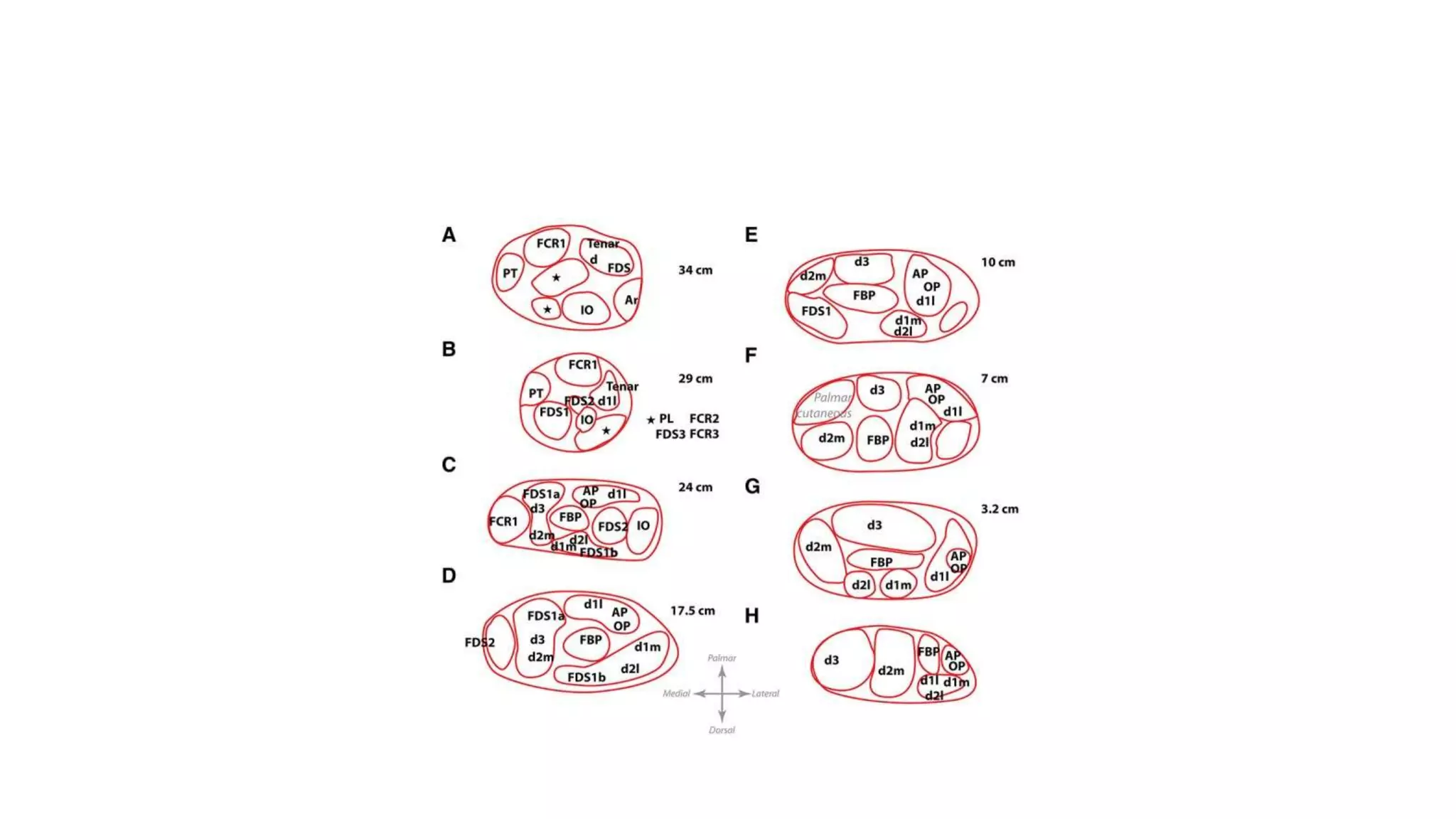
Pattern of topographic distribution of median nerve motor fascicles. The median nerve was sectioned in 2
palmar (radial and ulnar) and 2 dorsal (radial and ulnar)
quadrants each, according to black lines in the oval. The motor fascicles were assigned to the quadrants. The
size of the squares represents the frequency of the observed
fascicles’ locations and their ratios are given [%]. d, dorsal; n, sample size; p, palmar; r, radial; u, ulnar
Pattern of topographic distribution of
median nerve sensory fascicles. The median
nerve was sectioned in 2 palmar (radial and
ulnar) and 2 dorsal (radial and ulnar)
quadrants each, according to black lines in
the oval. The sensory fascicles were
assigned to the quadrants. The size of the
squares represents the frequency of the
observed
fascicles’ locations and their ratios are given
[%]. The numeric values are rounded to one
decimal with the result that the numeric
values partially vary from 100. (a) Palmar
cutaneous branch (PCB) and thumb, (b)
index finger, (c) middle finger, (d) ring finger
and communicating branch of median nerve
with ulnar nerve. d, dorsal; n, sample size;
p, palmar; r, radial; u, ulnar; asterisk, the
missing sample was supplied by the ulnar
nerve
• In the ulnar and median nerves, the fascicle count was higher in the
forearm in comparison to the upper arm whereas in the radial, the
number of fascicles decreases along forearm.
• The radial nerve near its termination in the forearm had the smallest
fascicle count of 2.
• The highest fascicle count in all nerves was found in the median
nerve with a value of 42 fascicles.
• Fascicular diameters were found to be larger in the upper arm region
than they were in the forearm region in the ulnar, median, and radial
nerves. The maximum fascicular diameters from each cross section in
the upper arm were also larger than the forearm maximum fascicular
diameters
• Fascicular diameter was not correlated with location or nerve size,
but was inversely correlated with the fascicle count. Similarly, other
groups have shown cross sectional images at the elbow in the ulnar
nerve consisting of a low fascicle count and a very large fascicle

Nerves of hand

  • 1.
    NERVES OF UPPERLIMB Sourabh Chakraborty
  • 3.
    Ulnar nerve • Branchfrom medial cord of brachial plexus • Conveys fibers from C8 & T1 • Receives contribution from C7 through the median nerve for flexor carpi ulnaris
  • 4.
    COURSE IN AXILLA •Passes along medial side axillary artery third part Between axillary artery & vein
  • 5.
    COURSE IN ARM •Medial side of brachial artery • Pierces medial IMS along superior ulnar collateral vs. • Descends superficial to the medial head of the triceps • Appears between medial epicondyle & olecranon process
  • 8.
    COURSE IN FOREARM •Enters between two heads FCU UPPER ONE- THIRD FOREARM • Deeply placed • Rests on FDP, covered by FCU • Separated from ulnar artery LOWER ONE- THIRD FOREARM • Superficial • Along lateral side FCU • Accompanied ulnar artery
  • 9.
    AT LEVEL OFWRIST • Passes superficial to flexor retinaculum • Passes beneath palmaris brevis • Divides into superficial & deep terminal branch
  • 10.
    • SUPERFICIAL TERMINAL BRANCH •Supplies palmaris brevis • Divides into • a medial proper palmar digital branch • a lateral common palmar digital branch
  • 11.
    DEEP TERMINAL BRANCH •Passes deeply between abductor, flexor digiti minimi • Pierces opponens digiti minimi • Passes deep to long flexor tendons • Lies in concavity of deep palmar arch • Supplies • hypothenar muscles • 3,4 lumbricals • all interrosei • adductor pollicis • occasionally- FPB • intercarpal, carpometacarpal, • metacarpophalangeal joints
  • 13.
    • At themidforearm, the ulnar nerve is composed of three distinct fascicular grouP’. a dorsal sensory group, a volar sensory group. and a motor group. • the motor group is positioned between the ulnar dorsal sensory group and the radial volar sensory group • The dorsal sensOry branch separates from the motor branch and the main sensory group8 to 10 cm proximal to the wrist . • The motor branch remains ulnar to the sensory group until the Guyon canal, at which time it passes dorsally to the sensOry branches of the little and ring fingers to innervate the intrinsic muscles
  • 14.
    Diagrammatic mappings of thefascicular groups of the left ulnar nerve at representative levels. The indicated level of the sections is in reference to the distance proximal to the radial styloid. Key: Red, motor fascicular group; Blue, sensory fascicular groups.
  • 15.
    • BRANCHES OFULNAR NERVE Muscular branches • forearm- FCU, medial half FDP • hand- all intrinsic muscles except three thenar muscles, 1,2 lumbricals Articular branches • to elbow, intercarpal, carpometacarpal joints Vascular branches • axillary, brachial, ulnar, deep palmar arch
  • 16.
    • Cutaneous branches •forearm- dorsal branch arises 5 cm proximal to the wrist • -Supplies skin of the dorsal aspect of medial one and a half of the fingers, excluding terminal phalanges of ring & little fingers • palmar cutaneous branch supplies skin of the medial side of the palm • palm-digital branches- superficial terminal branch
  • 18.
    Radial nerve • largestbranch of the posterior cord of brachial plexus with a root value of C5,6,7,8, T1
  • 19.
    in axilla • Inaxilla it passes behind the third part of axillary artery • Anterior to subscapularis, latissimus dorsi & and teres major • Medial to it is axillary vein • Lateral to it are axillary nerve and coracobrachialis
  • 20.
    • Continues behindthe brachial artery • • Then passes posterolaterally with the profunda brachii vessels through the lower triangular space • • Here it is anterior to teres major and passes between the long head of triceps and humerus
  • 21.
    After this thenerve enters the radial groove with the profunda vessels In the radial groove nerve lies between the lateral and medial heads of triceps in contact with the humerus At the lower end of the groove, 5 cm below the deltoid tuberosity, the nerve pierces the lateral intermuscular septum and passes into anterior compartment of arm
  • 22.
    In the anterior compartmentnerve lies between brachialis (medially) and brachioradialis and extensor carpi radialis (laterally) • Here it is accompanied by radial collateral artery
  • 23.
    Branches of radialnerve Muscular branches: • • Before entering spiral groove- to long and medial heads of triceps • • In the spiral groove lateral and medial heads of triceps and through nerve to medial head to anconeus • • Below the radial groove, on the front of the arm, it supplies, the brachialis, brachioradialis and the extensor carpi radialis longus
  • 24.
    Cutaneous branches: • •Above the radial groove- posterior cutaneous nerve of the arm • • In the radial groove-lower lateral cutaneous nerve of the arm and • posterior cutaneous nerve of the forearm • Articular branches: to elbow
  • 25.
    Superficial terminal branch •In the forearm the superficial branch descend between brachioradialis anteriorly and supinator posteriorly lying lateral to radial artery • In the middle third it lies posterior to brachioradialis, lying successively on pronator teres, FDS (radial head) and FPL and lateral to radial artery
  • 26.
    • About 7cm proximal to the wrist nerve leaves the artery • • passes deep to the tendon of brachioradialis • • Curves around the lateral side of radius • • Pierces the deep fascia • • Divides into 4 or 5 digital nerves on the dorsum of hand. it communicates with posterior & lateral cutaneous nerves of forearm • • Supplies radial half of the dorsum of the hand, proximal part of the dorsal surface of thumb, index finger & the lateral half of the middle finger
  • 28.
    • Deep branchof radial nerve • • Deep terminal branch reaches the back of forearm by passing between two heads of supinator • • supplies ECRB and supinator
  • 29.
    Posterior interosseous nerveof forearm • it is deep branch of radial nerve in forearm • Reaches the back of forearm by passing between the two heads of supinator • Descends between the superficial &and deep group of extensor muscles lying on the interosseous membrane
  • 30.
    • The upperpart of nerve is accompanied by posterior interosseous artery but the lower part is accompanied by anterior interosseous artery • • Terminates in to a pseudoganglion and ends by supplying the wrist and carpal joint Branches : • Muscular –supinator ED,EDM &ECU -Divides into lateral & medial branch
  • 31.
    • lateral branchsupplies APL &EPB • Medial branch supplies EPL& EI • • Articular branch: to wrist joint, distal radioulnar joint, some intercarpal & intermetacarpal joint • • Sensory branches :to interosseous membrane, radius & ulna
  • 32.
    In the radialnerve, the motor and sensory components are separated into discrete fascicles. Awake stimulation can be used to identify the motor and &senSory components of the proximal nerve, whereas anatomic: dissection is used to identify them distally Several histochemical techniques have been described that allow motor (acetylcholinesterase and choline acetyltransferase) or sensory (carbonic anhydrase) discrimination
  • 33.
    MEDIAN NERVE • Formation:from two roots from lateral cord [C(5),6,7]& from medial cord(C8,T1) of brachial plexus • • These two roots embrace the third part of axillary artery uniting anterior or lateral to it
  • 34.
    In the arm• Closely related to the brachial artery through out the course in arm • In the upper part it is lateral to artey • In the middle part it crosses the artery from lateral to medial side • Remains on the medial side up to elbow
  • 35.
    • Branches inarm • • Branch to Pronator Teres just above elbow • • Branch to brachial artery • • Branch to elbow joint at or just below the • elbow
  • 36.
    • In thecubital fossa • Descends medial to brachial artery • Posterior to bicipital aponeurosis • Anterior to brachialis, seperated by the muscle from the elbow • Leaves the cubital fossa by passing between two heads of pronator teres
  • 37.
    • In theforearm • Enters the forearm between the heads of pronator teres • Crosses the lateral side of ulnar artery from which it is seperated by the deep head of pronator teres • Gives branch to pronator teres while passing between the two heads • Proceeds behind a tendinous ridge between the two heads of Flexor digitorum superficialis and anterior to Flexor digitorum profundus • Here it is accompanied by median artery, a branch of anterior interosseous artery
  • 38.
    • About 5cm proximal to flexor retinaculum it becomes superficial • Here it lies between the tendon of palmaris longus and the flexor carpi radialis muscle • Leaves the forearm and enters the palm of the hand by passing through the carpal tunnel deep to flexor retinaculum
  • 40.
    • Branches inthe forearm • Muscular branches to all the muscles in the superficial and intermediate layer of forearm except one (FCU) originate • Anterior interosseous nerve: originate between two heads of pronator teres • passes distally down the forearm with the anterior interosseous artery. • Innervates the muscles of deep layer (FPL, lateral half of FDP and pronator quadratus) • Terminates as articular branch to wrist
  • 42.
    • •Palmar cutaneousbranch: starts just proximal to flexor retinaculum •Lateral branches - thenar skin and connecting branch to the lateral cutaneous nerve of fore arm • •Medial branches - central palmer skin and connecting branch to the palmar cutaneous branch of the ulnar nerve • • Communicating branch: multiple –Arise in the proximal forearm – Pass medialy between FDP & FDS and behind the ulnar artery to join the ulnar nerve
  • 44.
    • Lateral branch:gives • Recurrent branch- short and stout, curls upwards over the distal border of flexor retinaculum and FPL to supply three thenar muscles APB, FPB &OP • Three palmer digital branches- First two supply the skin of the sides of the thumb ,its web and distal part of its dorsal surface. • Third supplies the skin of the radial side of index finger and the first lumbrical muscle through its superficial surface
  • 45.
    • Medial branch:gives • – Two common palmar digital branches- lateral and medial which descend to the interdigital clefts between the index, middle and ring finger • – Each nerve divides again into two to supply adjacent sides of the fingers • – So in total it supplies skin of lateral three and half fingers including the skin on the dorsal aspect of terminal phalanges
  • 46.
    • • Thelateral common palmar digital supplies the second lumbrical • the median common palmar digital gives a communicating branch to common palmar digital branch of ulnar nerve • • Articular branches: to wrist ,metacarpophalangeal & interphalangeal joint
  • 49.
    Pattern of topographicdistribution of median nerve motor fascicles. The median nerve was sectioned in 2 palmar (radial and ulnar) and 2 dorsal (radial and ulnar) quadrants each, according to black lines in the oval. The motor fascicles were assigned to the quadrants. The size of the squares represents the frequency of the observed fascicles’ locations and their ratios are given [%]. d, dorsal; n, sample size; p, palmar; r, radial; u, ulnar
  • 50.
    Pattern of topographicdistribution of median nerve sensory fascicles. The median nerve was sectioned in 2 palmar (radial and ulnar) and 2 dorsal (radial and ulnar) quadrants each, according to black lines in the oval. The sensory fascicles were assigned to the quadrants. The size of the squares represents the frequency of the observed fascicles’ locations and their ratios are given [%]. The numeric values are rounded to one decimal with the result that the numeric values partially vary from 100. (a) Palmar cutaneous branch (PCB) and thumb, (b) index finger, (c) middle finger, (d) ring finger and communicating branch of median nerve with ulnar nerve. d, dorsal; n, sample size; p, palmar; r, radial; u, ulnar; asterisk, the missing sample was supplied by the ulnar nerve
  • 51.
    • In theulnar and median nerves, the fascicle count was higher in the forearm in comparison to the upper arm whereas in the radial, the number of fascicles decreases along forearm. • The radial nerve near its termination in the forearm had the smallest fascicle count of 2. • The highest fascicle count in all nerves was found in the median nerve with a value of 42 fascicles.
  • 52.
    • Fascicular diameterswere found to be larger in the upper arm region than they were in the forearm region in the ulnar, median, and radial nerves. The maximum fascicular diameters from each cross section in the upper arm were also larger than the forearm maximum fascicular diameters • Fascicular diameter was not correlated with location or nerve size, but was inversely correlated with the fascicle count. Similarly, other groups have shown cross sectional images at the elbow in the ulnar nerve consisting of a low fascicle count and a very large fascicle