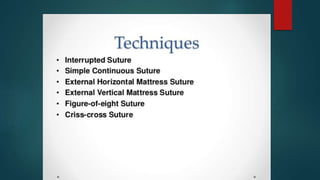
Suture techniques
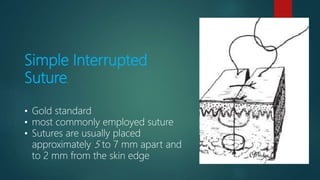
Simple Interrupted
Suture.
• Gold standard
• most commonly employed suture
• Sutures are usually placed
approximately 5 to 7 mm apart and
to 2 mm from the skin edge
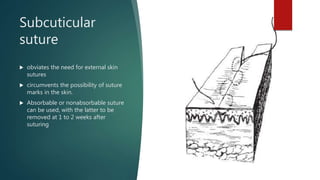
Subcuticular
suture
 obviates the need for external skin
sutures
 circumvents the possibility of suture
marks in the skin.
 Absorbable or nonabsorbable suture
can be used, with the latter to be
removed at 1 to 2 weeks after
suturing
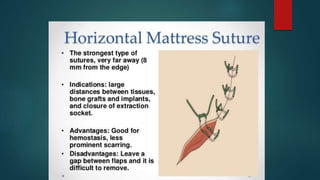
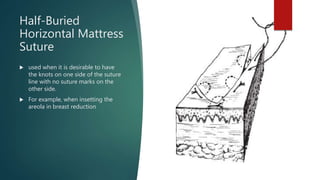
Half-Buried
Horizontal Mattress
Suture
 used when it is desirable to have
the knots on one side of the suture
line with no suture marks on the
other side.
 For example, when insetting the
areola in breast reduction
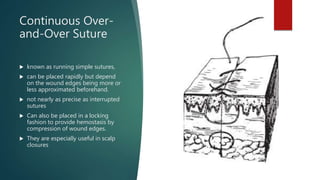
Continuous Over-
and-Over Suture
 known as running simple sutures,
 can be placed rapidly but depend
on the wound edges being more or
less approximated beforehand.
 not nearly as precise as interrupted
sutures
 Can also be placed in a locking
fashion to provide hemostasis by
compression of wound edges.
 They are especially useful in scalp
closures
Skin Staples
 useful as a timesaver
 Grasping the wound edges with
forceps to evert the tissue is helpful
when placing the staples to prevent
inverted skin edges.
 Staples must be removed early to
prevent skin marks and are ideal for
the hair-bearing scalp
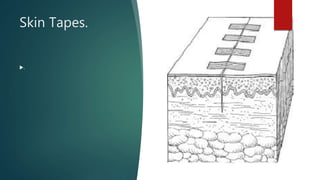
Skin Tapes.
.
Skin Adhesives
in areas where there is no tension
on the closure, or where strength
of closure has been provided by
a layer of buried dermal sutures.
Adhesives, by themselves,
however, do not evert the wound
edges.
Eversion must be provided by
deeper sutures.
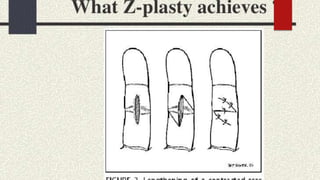
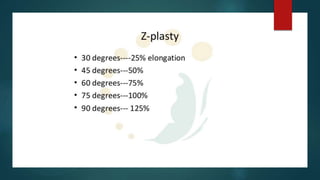
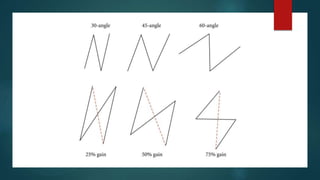
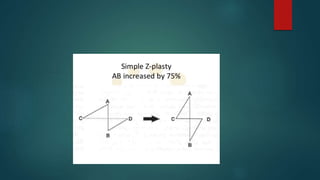
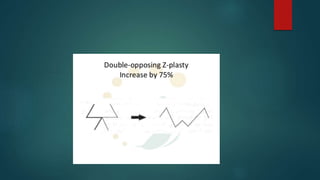
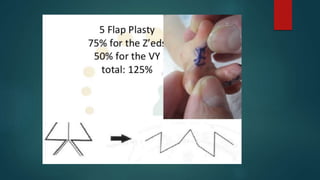
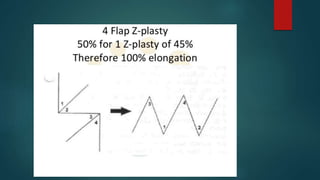
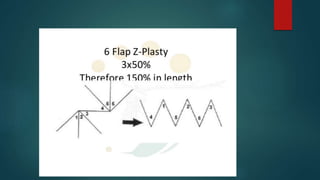
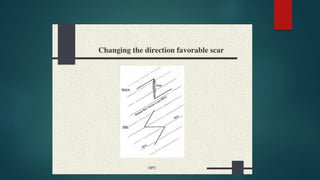
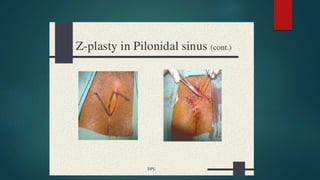
Z-PLASTY
 1856, Denonvilliers first described the Z-plasty technique as a surgical
treatment for lower lid ectropion.
 The first reference to this technique in American literature was in 1913, by
McCurdy, as treatment for contracture at the oral commissure.
 Limberg, in 1929, provided a more detailed geometric description
indications
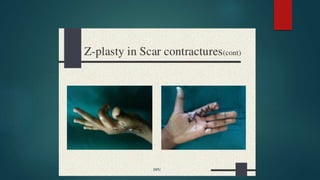
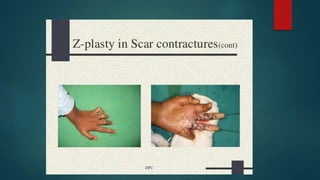
 Limiting/preventing contracture of linear scars, especially when they cross
the border of a facial aesthetic unit (eg, vermillion border) or when scars
cross a concave surface (eg, the medial canthus)
 Changing scar length (eg, scar contracture of lip, eyelid, or neck)
 Changing scar vector (eg, repositioning a scar across the nasolabial fold)
 Repositioning malposed tissues (useful for "trapdoor" or "pin-cushion"
defects)
 Effacing web/release contracture (similar to first listed use)
 Closing cutaneous defects (eg, large oval defects, pharyngocutaneous
fistulae)
 Correcting stenosis (eg, tracheostoma, nares, external auditory canal) using
single or multiple Z-plasties [3]
 Transposing healthy tissue to close a fistula (eg, tracheostoma closure after
irradiation)
contraindications
 health risks that affect vascular supply to the skin (eg, atherosclerotic heart
disease, diabetes, smoking, collagen vascular disease, prior irradiation,
anticoagulation).
 A history of poor wound healing, hypertrophic scarring, or keloid
formation is a relative contraindication to Z-plasty
complications
 Hematoma
 Dehiscence
 Trap door
 Flap necrosis
 infection
Reconstructive
ladder
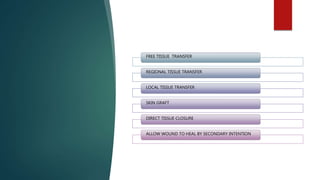
FREE TISSUE TRANSFER
REGIONAL TISSUE TRANSFER
LOCAL TISSUE TRANSFER
SKIN GRAFT
DIRECT TISSUE CLOSURE
ALLOW WOUND TO HEAL BY SECONDARY INTENTION

Suture techniques, Z-plasty

  • 1.
  • 3.
    Simple Interrupted Suture. • Goldstandard • most commonly employed suture • Sutures are usually placed approximately 5 to 7 mm apart and to 2 mm from the skin edge
  • 6.
    Subcuticular suture  obviates theneed for external skin sutures  circumvents the possibility of suture marks in the skin.  Absorbable or nonabsorbable suture can be used, with the latter to be removed at 1 to 2 weeks after suturing
  • 7.
    Half-Buried Horizontal Mattress Suture  usedwhen it is desirable to have the knots on one side of the suture line with no suture marks on the other side.  For example, when insetting the areola in breast reduction
  • 8.
    Continuous Over- and-Over Suture known as running simple sutures,  can be placed rapidly but depend on the wound edges being more or less approximated beforehand.  not nearly as precise as interrupted sutures  Can also be placed in a locking fashion to provide hemostasis by compression of wound edges.  They are especially useful in scalp closures
  • 9.
    Skin Staples  usefulas a timesaver  Grasping the wound edges with forceps to evert the tissue is helpful when placing the staples to prevent inverted skin edges.  Staples must be removed early to prevent skin marks and are ideal for the hair-bearing scalp
  • 10.
  • 11.
    Skin Adhesives in areaswhere there is no tension on the closure, or where strength of closure has been provided by a layer of buried dermal sutures. Adhesives, by themselves, however, do not evert the wound edges. Eversion must be provided by deeper sutures.
  • 12.
  • 13.
     1856, Denonvilliersfirst described the Z-plasty technique as a surgical treatment for lower lid ectropion.  The first reference to this technique in American literature was in 1913, by McCurdy, as treatment for contracture at the oral commissure.  Limberg, in 1929, provided a more detailed geometric description
  • 14.
    indications  Limiting/preventing contractureof linear scars, especially when they cross the border of a facial aesthetic unit (eg, vermillion border) or when scars cross a concave surface (eg, the medial canthus)  Changing scar length (eg, scar contracture of lip, eyelid, or neck)  Changing scar vector (eg, repositioning a scar across the nasolabial fold)  Repositioning malposed tissues (useful for "trapdoor" or "pin-cushion" defects)
  • 15.
     Effacing web/releasecontracture (similar to first listed use)  Closing cutaneous defects (eg, large oval defects, pharyngocutaneous fistulae)  Correcting stenosis (eg, tracheostoma, nares, external auditory canal) using single or multiple Z-plasties [3]  Transposing healthy tissue to close a fistula (eg, tracheostoma closure after irradiation)
  • 16.
    contraindications  health risksthat affect vascular supply to the skin (eg, atherosclerotic heart disease, diabetes, smoking, collagen vascular disease, prior irradiation, anticoagulation).  A history of poor wound healing, hypertrophic scarring, or keloid formation is a relative contraindication to Z-plasty
  • 30.
    complications  Hematoma  Dehiscence Trap door  Flap necrosis  infection
  • 31.
  • 32.
    FREE TISSUE TRANSFER REGIONALTISSUE TRANSFER LOCAL TISSUE TRANSFER SKIN GRAFT DIRECT TISSUE CLOSURE ALLOW WOUND TO HEAL BY SECONDARY INTENTION