Liposuction
Liposuction:
• surgical aspiration of fat from subcutaneous
plane leaving a more desirable body contour
and a smooth transition between suctioned
and nonsuctioned areas
• Originally introduced by Illouz in 1982
• Pierre Fournier, and Francis Otteni
• American Society of Plastic Surgery and
American Society for Aesthetic Plastic Surgery,
ranks top procedures performed in plastic
surgery for the last 10 years
• standard suction-assisted liposuction (SAL)
• Ultrasound assisted liposuction (UAL)
• power-assisted liposuction (PAL)
• vaser-assisted liposuction
• laser-assisted liposuction (LAL)
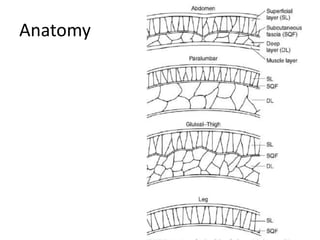
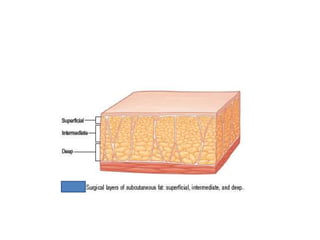
Anatomy
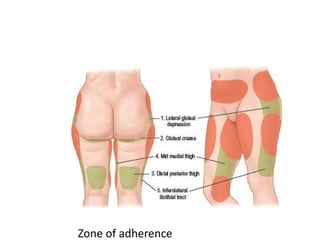
Zone of adherence
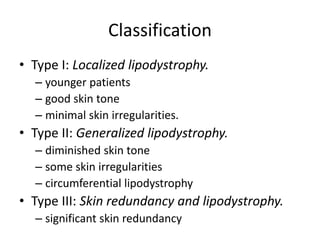
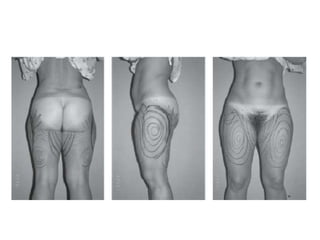
Classification
• Type I: Localized lipodystrophy.
– younger patients
– good skin tone
– minimal skin irregularities.
• Type II: Generalized lipodystrophy.
– diminished skin tone
– some skin irregularities
– circumferential lipodystrophy
• Type III: Skin redundancy and lipodystrophy.
– significant skin redundancy
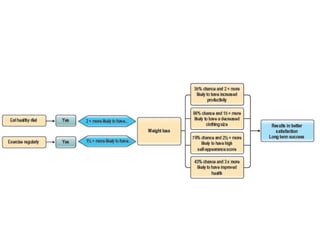
Patient selection
four key elements to achieve and maintain
optimal results:
1. Lifestyle change
2. Regular exercise
3. Well-balanced diet
4. Body contouring.
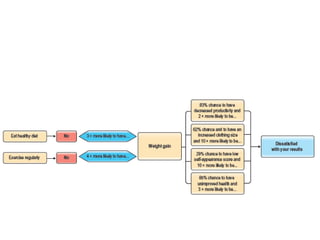
Poor candidates:
• perfectionists with imperceptible deformities,
• those with underlying mental illness that
prohibits realistic expectations (body
dysmorphic disorder, or active eating
disorders)
• significantly overweight patients who are
incapable of weight reduction and/or weight
maintenance after liposuction
Initial evaluation
• goals of surgery
• patient has realistic expectations
• prioritize the body regions
• medications, allergies, and tobacco use
• diabetes, massive weight loss, previous
surgery, previous liposuction
• nutrition, hemoglobin, iron, B12
• Avoiding aspirin, NSAIDs, and hormonal
therapy 3 weeks prior to surgery
• oral contraceptives and estrogen 1 month
prior
Physical exam
• prior scars
• Hernias
• venous insufficiency
• pre-existing asymmetry or contour irregularity
• BMI
Key elements to be documented:
1. Evaluation of areas of lipodystrophy and
contour deformities
2. Skin tone and quality
3. Asymmetries
4. Dimpling and cellulite
5. Myofascial support
6. Zones of adherence
Patient education and informed consent:
• procedure
• postoperative course
• long-term results
• alternative treatments
• financial obligations
• complications
• risks.
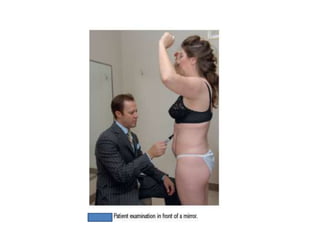
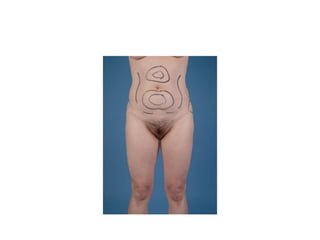
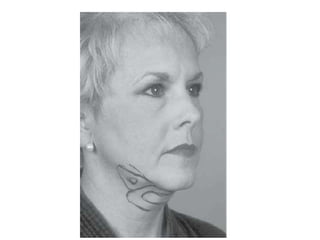
Preoperative marking
• In front of a mirror
• Circle- Areas to be suctioned
• Hash marks- zones of adherence and areas to
avoid
• prevent access incision in or adjacent to zones
of adherence
• no longer than 3–4 mm
Anesthesia technique/location of
operation
• small-volume liposuction- LA
• avoid epidural and spinal anesthesia in office-
based settings
• Complex, large-volume liposuction and
combined cases- GA
Patient positioning
• Prone/supine
• Turnaround time should be <10 min
• prep the patient circumferentially while
standing
• arm is abducted at 90°, hips and knees flexed
at 30° with a pillow
• Lateral decubitus- rarely
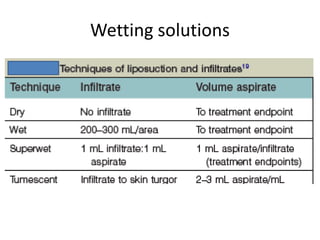
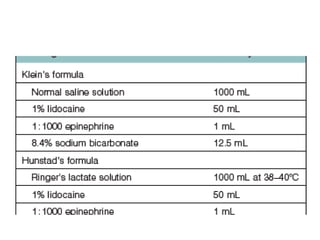
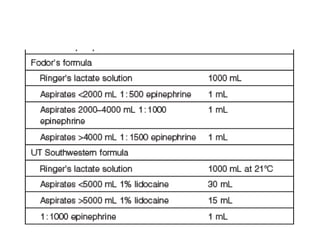
Wetting solutions
• Infiltrate should be allowed to set for 7 min
and no longer than 30 min prior to suctioning
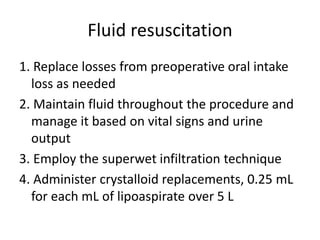
Fluid resuscitation
1. Replace losses from preoperative oral intake
loss as needed
2. Maintain fluid throughout the procedure and
manage it based on vital signs and urine
output
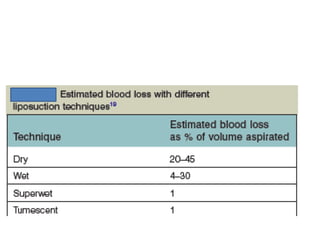
3. Employ the superwet infiltration technique
4. Administer crystalloid replacements, 0.25 mL
for each mL of lipoaspirate over 5 L
Treatment options
Suction-assisted lipoplasty:
• two-stage technique
• incisions 3–4 mm
• ease of use, malleable cannulas, a wide
variety of cannulas, and decades of experience
and results
• difficult to use in fibrous areas
Power-assisted liposuction:
• externally powered cannula, which is variable
in size and flex, and oscillates in 2–3-mm
reciprocating motion at rates of 4000–6000
cycles/min.
• for large volumes, fibrous areas, and revision
liposuction
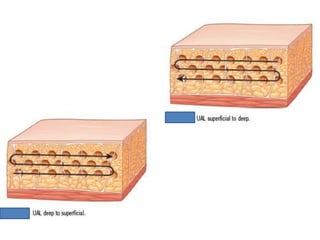
Ultrasound-assisted liposuction:
• Ultrasonic energy
• three stages: (1) infiltration, (2) emulsification,
and (3) evacuation and contouring
• Skin protection from thermal injury.
– Limiting application of energy and bathing the
access site with saline
• Begun at a depth of approximately 1–2 cm,
depending on body area.
• Standard cannulas for final contouring
• Advantages:
– Less surgeon fatigue
– improved results in fibrous areas and in secondary
procedures.
• Disadvantage:
– increased equipment cost,
– slightly larger incisions,
– longer operative times,
– thermal injury.
– requires a superwet environment
– continuous movement to prevent excessive
exposure of the tissues to heat
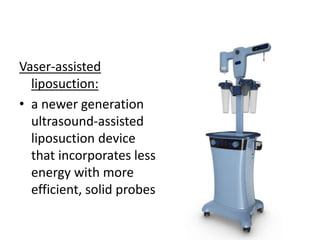
Vaser-assisted
liposuction:
• a newer generation
ultrasound-assisted
liposuction device
that incorporates less
energy with more
efficient, solid probes
Laser-assisted liposuction:
• laser fiber via a small skin incision
• 924/975 nm, 1064 nm, 1319/1320, and 1450
nm
• four-stage technique:
– Infiltration
– application of energy to subcutaneous tissues
– Evacuation
– subdermal skin stimulation
• disrupt fat cell membranes and emulsify fat
• smaller regions (such as the neck)
• skin-tightening effects
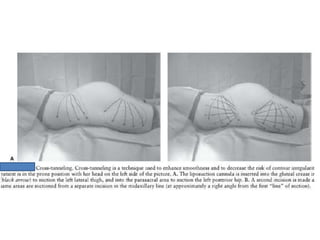
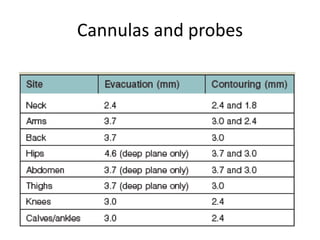
Cannulas and probes
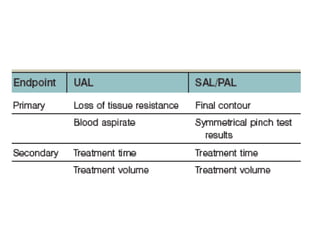
Surgical endpoints
Longstanding endpoints:
1. skin pinch,
2. final contour
3. volume of Aspirate
4. treatment time
5. blood in aspirate
Postoperative care
• compression garment customized- 24 hrs a
day for 2 weeks
• compression foam- the first week
• ambulate the day of the surgery
• Sequential compression devices till discharge
• postoperative visits- 5–7 days
• return to activity/work: 3–4 days or at 2 weeks
• Edema tends to peak from 3 to 5 days
• Postoperative lymphatic massage
• Bruising dissipate by 7–10 days
• final aesthetic result: 3–6 months
Complications
1. perioperative period (0–48 h)
2. early postoperative period (days 1–7)
3. late postoperative period (1 week to 3
months)
Perioperative
• anesthesia and cardiac complications
• cannula trauma to skin and/or internal organs
• Cannula injury to blood vessels, bowel and
other solid intra-abdominal organs
• volume loss/overload from bleeding or excess
fluid administration.
• Hypothermia (<36.4°C)
– Warming of wetting solutions
– increase of the ambient room temperature,
– use of preoperative and intraoperative warming
devices (Bair Hugger®, Arizant, Eden Prairie, MN).
– Prewarming the patient with forced air for 1 h
early postoperative:
• venous thromboembolism (1%)
– Homan’s signs, shortness of breath, chest pain,
and/or tachycardia
• Infection (necrotizing fasciitis)
– 1st gen cephalosporins
• Skin necrosis
Late complications:
• delayed seroma
– loose closure of cannula sites, postoperative
compression garments, and expressing residual fluid
over liposuction areas at the end of procedure
• Edema
• Paresthesias
– up to 10 weeks to recover
• Ecchymosis & Hyperpigmentation
• contour irregularities
Emerging technology
1. Mesotherapy or lipolysis:
– injection of phosphatidylcholine, deoxycholate,
and/or other agents which are purported to
dissolve fat in mesoderm
2. Lipodissolve
3. Low level laser therapy
4. LipoSonix: high-intensity focused ultrasound
5. Cryolipolysis

Liposuction- techniques and indications

  • 1.
  • 2.
    Liposuction: • surgical aspirationof fat from subcutaneous plane leaving a more desirable body contour and a smooth transition between suctioned and nonsuctioned areas • Originally introduced by Illouz in 1982 • Pierre Fournier, and Francis Otteni
  • 3.
    • American Societyof Plastic Surgery and American Society for Aesthetic Plastic Surgery, ranks top procedures performed in plastic surgery for the last 10 years
  • 4.
    • standard suction-assistedliposuction (SAL) • Ultrasound assisted liposuction (UAL) • power-assisted liposuction (PAL) • vaser-assisted liposuction • laser-assisted liposuction (LAL)
  • 5.
  • 7.
  • 8.
    Classification • Type I:Localized lipodystrophy. – younger patients – good skin tone – minimal skin irregularities. • Type II: Generalized lipodystrophy. – diminished skin tone – some skin irregularities – circumferential lipodystrophy • Type III: Skin redundancy and lipodystrophy. – significant skin redundancy
  • 9.
    Patient selection four keyelements to achieve and maintain optimal results: 1. Lifestyle change 2. Regular exercise 3. Well-balanced diet 4. Body contouring.
  • 12.
    Poor candidates: • perfectionistswith imperceptible deformities, • those with underlying mental illness that prohibits realistic expectations (body dysmorphic disorder, or active eating disorders) • significantly overweight patients who are incapable of weight reduction and/or weight maintenance after liposuction
  • 13.
    Initial evaluation • goalsof surgery • patient has realistic expectations • prioritize the body regions • medications, allergies, and tobacco use • diabetes, massive weight loss, previous surgery, previous liposuction • nutrition, hemoglobin, iron, B12
  • 14.
    • Avoiding aspirin,NSAIDs, and hormonal therapy 3 weeks prior to surgery • oral contraceptives and estrogen 1 month prior
  • 15.
    Physical exam • priorscars • Hernias • venous insufficiency • pre-existing asymmetry or contour irregularity • BMI
  • 16.
    Key elements tobe documented: 1. Evaluation of areas of lipodystrophy and contour deformities 2. Skin tone and quality 3. Asymmetries 4. Dimpling and cellulite 5. Myofascial support 6. Zones of adherence
  • 18.
    Patient education andinformed consent: • procedure • postoperative course • long-term results • alternative treatments • financial obligations • complications • risks.
  • 19.
    Preoperative marking • Infront of a mirror • Circle- Areas to be suctioned • Hash marks- zones of adherence and areas to avoid • prevent access incision in or adjacent to zones of adherence • no longer than 3–4 mm
  • 24.
    Anesthesia technique/location of operation •small-volume liposuction- LA • avoid epidural and spinal anesthesia in office- based settings • Complex, large-volume liposuction and combined cases- GA
  • 25.
    Patient positioning • Prone/supine •Turnaround time should be <10 min • prep the patient circumferentially while standing • arm is abducted at 90°, hips and knees flexed at 30° with a pillow • Lateral decubitus- rarely
  • 26.
  • 27.
    • Infiltrate shouldbe allowed to set for 7 min and no longer than 30 min prior to suctioning
  • 32.
    Fluid resuscitation 1. Replacelosses from preoperative oral intake loss as needed 2. Maintain fluid throughout the procedure and manage it based on vital signs and urine output 3. Employ the superwet infiltration technique 4. Administer crystalloid replacements, 0.25 mL for each mL of lipoaspirate over 5 L
  • 33.
    Treatment options Suction-assisted lipoplasty: •two-stage technique • incisions 3–4 mm • ease of use, malleable cannulas, a wide variety of cannulas, and decades of experience and results • difficult to use in fibrous areas
  • 34.
    Power-assisted liposuction: • externallypowered cannula, which is variable in size and flex, and oscillates in 2–3-mm reciprocating motion at rates of 4000–6000 cycles/min. • for large volumes, fibrous areas, and revision liposuction
  • 35.
    Ultrasound-assisted liposuction: • Ultrasonicenergy • three stages: (1) infiltration, (2) emulsification, and (3) evacuation and contouring • Skin protection from thermal injury. – Limiting application of energy and bathing the access site with saline
  • 36.
    • Begun ata depth of approximately 1–2 cm, depending on body area. • Standard cannulas for final contouring • Advantages: – Less surgeon fatigue – improved results in fibrous areas and in secondary procedures.
  • 37.
    • Disadvantage: – increasedequipment cost, – slightly larger incisions, – longer operative times, – thermal injury. – requires a superwet environment – continuous movement to prevent excessive exposure of the tissues to heat
  • 39.
    Vaser-assisted liposuction: • a newergeneration ultrasound-assisted liposuction device that incorporates less energy with more efficient, solid probes
  • 40.
    Laser-assisted liposuction: • laserfiber via a small skin incision • 924/975 nm, 1064 nm, 1319/1320, and 1450 nm • four-stage technique: – Infiltration – application of energy to subcutaneous tissues – Evacuation – subdermal skin stimulation
  • 41.
    • disrupt fatcell membranes and emulsify fat • smaller regions (such as the neck) • skin-tightening effects
  • 42.
  • 43.
    Surgical endpoints Longstanding endpoints: 1.skin pinch, 2. final contour 3. volume of Aspirate 4. treatment time 5. blood in aspirate
  • 45.
    Postoperative care • compressiongarment customized- 24 hrs a day for 2 weeks • compression foam- the first week • ambulate the day of the surgery • Sequential compression devices till discharge • postoperative visits- 5–7 days • return to activity/work: 3–4 days or at 2 weeks
  • 46.
    • Edema tendsto peak from 3 to 5 days • Postoperative lymphatic massage • Bruising dissipate by 7–10 days • final aesthetic result: 3–6 months
  • 47.
    Complications 1. perioperative period(0–48 h) 2. early postoperative period (days 1–7) 3. late postoperative period (1 week to 3 months)
  • 48.
    Perioperative • anesthesia andcardiac complications • cannula trauma to skin and/or internal organs • Cannula injury to blood vessels, bowel and other solid intra-abdominal organs • volume loss/overload from bleeding or excess fluid administration.
  • 49.
    • Hypothermia (<36.4°C) –Warming of wetting solutions – increase of the ambient room temperature, – use of preoperative and intraoperative warming devices (Bair Hugger®, Arizant, Eden Prairie, MN). – Prewarming the patient with forced air for 1 h
  • 50.
    early postoperative: • venousthromboembolism (1%) – Homan’s signs, shortness of breath, chest pain, and/or tachycardia • Infection (necrotizing fasciitis) – 1st gen cephalosporins • Skin necrosis
  • 51.
    Late complications: • delayedseroma – loose closure of cannula sites, postoperative compression garments, and expressing residual fluid over liposuction areas at the end of procedure • Edema • Paresthesias – up to 10 weeks to recover • Ecchymosis & Hyperpigmentation • contour irregularities
  • 52.
    Emerging technology 1. Mesotherapyor lipolysis: – injection of phosphatidylcholine, deoxycholate, and/or other agents which are purported to dissolve fat in mesoderm 2. Lipodissolve 3. Low level laser therapy 4. LipoSonix: high-intensity focused ultrasound 5. Cryolipolysis