Peripheral nerve injuries
BY: Dr. Mahum Rauf
DPT
Definition
• Partial or complete interruption of normal physiology of the
nerve. NERVE CONDUCTION IS AFFECTED.
• Peripheral nerve damage is based on the extent of
damage to both the nerve and the
surrounding connective tissue since the nervous
system is characterized by dependence of neurons on
their supporting ganglia.
• Unlike in the central nervous system, regeneration in
the peripheral nervous system is possible.
Key points
• Nerve injury can range from minor and transient
alteration in sensation to severe and permanent
interruption of sensory and motor function.
• Timing of nerve injury repair depends on the
mechanism of injury, the presence of recovery, and the
anatomical location of the injury.
• Nerve grafting techniques and augmentation strategies
promise to improve rates of functional recovery in the
future.
Type of injuries
1. Neurapraxia:
The lowest degree of nerve injury in which the nerve
remains intact but signaling ability is damaged.
2. Axonotmesis
The second degree in which the axon is damaged but the
surrounding connecting tissue remains intact.
3. Neurotmesis :The last degree in which both the axon
and connective tissue are damaged.
Causes of nerve Injuries
1. Laceration
2. Focal contusion (gunshot wound)
3. Stretch traction injury
4. Compression
5. Drug injection injury
6. Electric injury
7. Motor vehicle Accident (MVA)
8. Tumor
9. Fracture
Signs & symptoms
• Pain
• Loss of sensation
• Loss of motion
• Loss of power
• Loss of reflexes
• Muscle weakness and wasting
• Trophic changes (skin,sc,neurovascular,bones,muscles)
• Contractures
Diagnosis
• X-RAY
• Electromyography (EMG)
• Nerve conduction studies (NCS)
• Magnetic resonance imaging (MRI)
Clinical examples
• BRACHIAL PLEXUS INJURY
• ERB’ PALSY
• CARPAL TUNNEL SYNDROME(MEDIAN NV)
• RADIAL NERVE INJURY
• ULNAR NERVE INJURY
• SCIATIC NERVE INJURY
• FEMORAL NERVE INJURY
• PERONEAL NERVE INJURY
Brachial plexus injuries
• The clinical manifestations of brachial plexus injuries are particularly
dependent on the specific elements of the plexus that have been injured.
• The plexus originates from the roots of C5 through T1. For the most part,
• C5 root generally gives rise to deltoid function,
• C6 root to biceps function,
• C7 root to triceps function,
• C8 root to the deep flexors of the hand and forearm
• T1 root to the intrinsic muscle function of the hand.
• Using these motor functions as a guideline, along with the appropriate
sensory distributions, the extent of injury can often be determined by
clinical examination.
• Example : ERB’s Palsy
ERB’s Palsy
• Birth Injury (Difficult Labour)
• Traction On Nerve Roots C5-6
• Stretch-rupture-avulsion
• Upper Limb In Extension
• Also known as Waiter’s tip hand and Policeman hand
CARPAL TUNNEL SYNDROME
(MEDIAN NV)
Median nerve entrapment in flexor Retinaculum
• Sign and symptoms :
1. loss of pinch and grip strength denervation of the flexor
pollicis longus muscle and the intrinsic muscles of the
thenar eminence
2. pain
3. Numbness
4. atrophy of forearm muscle mass
5. sensation deficit of both the volar and palmar aspects of
the lateral 3.5 digits
RADIAL NERVE INJURY
• Mechanism of injury : The radial nerve originates in the
distal axilla and is susceptible at that site to compression
injuries or fracture of mid humerus.
• Radial nerve injury causes “Saturday night palsy” or Wrist
Drop
• S/S :
1. Sensory deficit on dorsum of hand
2. Patient is unable to extend the forearm secondary to loss
of triceps innervation
ULNAR NERVE INJURY
Dr Saleh WaslAllah Alharby
www.ksu.edu.sa/DrSalehAlharby
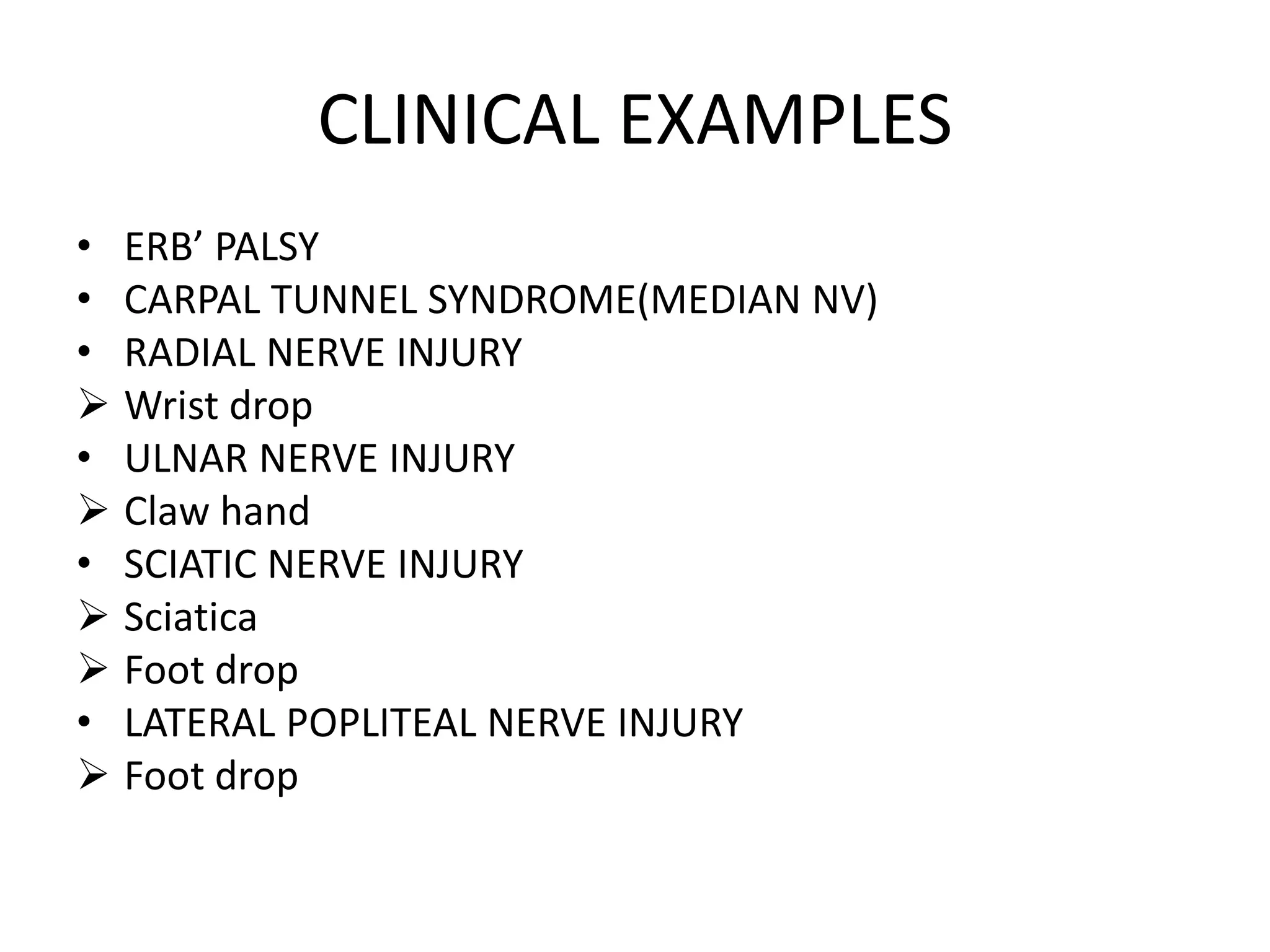
CLINICAL EXAMPLES
• ERB’ PALSY
• CARPAL TUNNEL SYNDROME(MEDIAN NV)
• RADIAL NERVE INJURY
 Wrist drop
• ULNAR NERVE INJURY
 Claw hand
• SCIATIC NERVE INJURY
 Sciatica
 Foot drop
• LATERAL POPLITEAL NERVE INJURY
 Foot drop
Dr Saleh WaslAllah Alharby
www.ksu.edu.sa/DrSalehAlharby
SCIATIC NERVE INJURY
Dr Saleh WaslAllah Alharby
www.ksu.edu.sa/DrSalehAlharby
PERONEAL NERVE INJURY (LPN)
• FOOT DROP
• TIGHT POP
• SKELETAL TRACTION
• DIRECT INJURY (RARE)
Dr Saleh WaslAllah Alharby
www.ksu.edu.sa/DrSalehAlharby

peripheral nerve injuries.physiology.pptx

  • 1.
  • 2.
    Definition • Partial orcomplete interruption of normal physiology of the nerve. NERVE CONDUCTION IS AFFECTED. • Peripheral nerve damage is based on the extent of damage to both the nerve and the surrounding connective tissue since the nervous system is characterized by dependence of neurons on their supporting ganglia. • Unlike in the central nervous system, regeneration in the peripheral nervous system is possible.
  • 4.
    Key points • Nerveinjury can range from minor and transient alteration in sensation to severe and permanent interruption of sensory and motor function. • Timing of nerve injury repair depends on the mechanism of injury, the presence of recovery, and the anatomical location of the injury. • Nerve grafting techniques and augmentation strategies promise to improve rates of functional recovery in the future.
  • 5.
    Type of injuries 1.Neurapraxia: The lowest degree of nerve injury in which the nerve remains intact but signaling ability is damaged. 2. Axonotmesis The second degree in which the axon is damaged but the surrounding connecting tissue remains intact. 3. Neurotmesis :The last degree in which both the axon and connective tissue are damaged.
  • 6.
    Causes of nerveInjuries 1. Laceration 2. Focal contusion (gunshot wound) 3. Stretch traction injury 4. Compression 5. Drug injection injury 6. Electric injury 7. Motor vehicle Accident (MVA) 8. Tumor 9. Fracture
  • 7.
    Signs & symptoms •Pain • Loss of sensation • Loss of motion • Loss of power • Loss of reflexes • Muscle weakness and wasting • Trophic changes (skin,sc,neurovascular,bones,muscles) • Contractures
  • 8.
    Diagnosis • X-RAY • Electromyography(EMG) • Nerve conduction studies (NCS) • Magnetic resonance imaging (MRI)
  • 9.
    Clinical examples • BRACHIALPLEXUS INJURY • ERB’ PALSY • CARPAL TUNNEL SYNDROME(MEDIAN NV) • RADIAL NERVE INJURY • ULNAR NERVE INJURY • SCIATIC NERVE INJURY • FEMORAL NERVE INJURY • PERONEAL NERVE INJURY
  • 10.
    Brachial plexus injuries •The clinical manifestations of brachial plexus injuries are particularly dependent on the specific elements of the plexus that have been injured. • The plexus originates from the roots of C5 through T1. For the most part, • C5 root generally gives rise to deltoid function, • C6 root to biceps function, • C7 root to triceps function, • C8 root to the deep flexors of the hand and forearm • T1 root to the intrinsic muscle function of the hand. • Using these motor functions as a guideline, along with the appropriate sensory distributions, the extent of injury can often be determined by clinical examination. • Example : ERB’s Palsy
  • 11.
    ERB’s Palsy • BirthInjury (Difficult Labour) • Traction On Nerve Roots C5-6 • Stretch-rupture-avulsion • Upper Limb In Extension • Also known as Waiter’s tip hand and Policeman hand
  • 13.
    CARPAL TUNNEL SYNDROME (MEDIANNV) Median nerve entrapment in flexor Retinaculum • Sign and symptoms : 1. loss of pinch and grip strength denervation of the flexor pollicis longus muscle and the intrinsic muscles of the thenar eminence 2. pain 3. Numbness 4. atrophy of forearm muscle mass 5. sensation deficit of both the volar and palmar aspects of the lateral 3.5 digits
  • 14.
    RADIAL NERVE INJURY •Mechanism of injury : The radial nerve originates in the distal axilla and is susceptible at that site to compression injuries or fracture of mid humerus. • Radial nerve injury causes “Saturday night palsy” or Wrist Drop • S/S : 1. Sensory deficit on dorsum of hand 2. Patient is unable to extend the forearm secondary to loss of triceps innervation
  • 16.
    ULNAR NERVE INJURY DrSaleh WaslAllah Alharby www.ksu.edu.sa/DrSalehAlharby
  • 17.
    CLINICAL EXAMPLES • ERB’PALSY • CARPAL TUNNEL SYNDROME(MEDIAN NV) • RADIAL NERVE INJURY  Wrist drop • ULNAR NERVE INJURY  Claw hand • SCIATIC NERVE INJURY  Sciatica  Foot drop • LATERAL POPLITEAL NERVE INJURY  Foot drop Dr Saleh WaslAllah Alharby www.ksu.edu.sa/DrSalehAlharby
  • 18.
    SCIATIC NERVE INJURY DrSaleh WaslAllah Alharby www.ksu.edu.sa/DrSalehAlharby
  • 19.
    PERONEAL NERVE INJURY(LPN) • FOOT DROP • TIGHT POP • SKELETAL TRACTION • DIRECT INJURY (RARE) Dr Saleh WaslAllah Alharby www.ksu.edu.sa/DrSalehAlharby