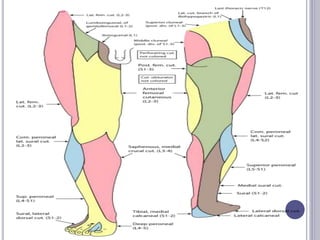
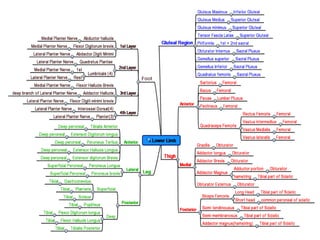
NCV OF THE LOWER LIMBS 
BY- DR SAUMYA MITTAL 
18th NOVEMBER 2014
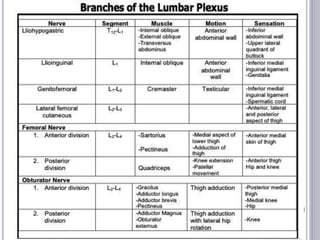
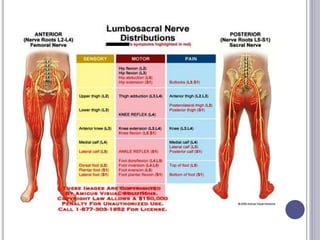
LUMBAR PLEXUS 
L1-L4
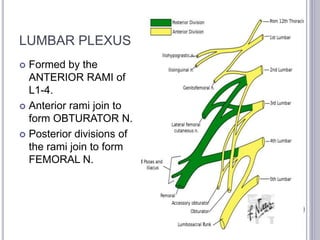
LUMBAR PLEXUS 
 Formed by the 
ANTERIOR RAMI of 
L1-4. 
 Anterior rami join to 
form OBTURATOR N. 
 Posterior divisions of 
the rami join to form 
FEMORAL N.
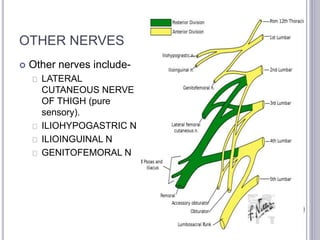
OTHER NERVES 
 Other nerves include- 
LATERAL 
CUTANEOUS NERVE 
OF THIGH (pure 
sensory). 
ILIOHYPOGASTRIC N 
ILIOINGUINAL N 
GENITOFEMORAL N
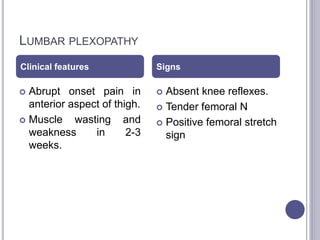
LUMBAR PLEXOPATHY 
Clinical features Signs 
 Abrupt onset pain in 
anterior aspect of thigh. 
 Muscle wasting and 
weakness in 2-3 
weeks. 
 Absent knee reflexes. 
 Tender femoral N 
 Positive femoral stretch 
sign
 Sensory symptoms are partial and seen in 1/3rd 
patients. 
 NCV shows normal nerves- femoral, peroneal, sural 
and saphenous N. 
 May show reduced amplitude. 
 EMG may show changes of denervation and 
renervation. 
 Recovery may be spontaneous over months-years.
Normal femoral conduction velocity – 70.0 ± 5.5 m/S 
FEMORAL N 
From dorsal portion of anterior rami of L2-L4 
Mixed Nerve
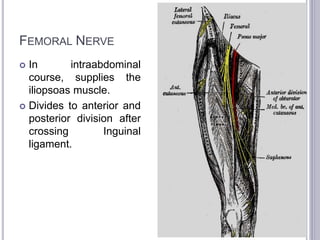
FEMORAL NERVE 
 In intraabdominal 
course, supplies the 
iliopsoas muscle. 
 Divides to anterior and 
posterior division after 
crossing Inguinal 
ligament.
FEMORAL NERVE 
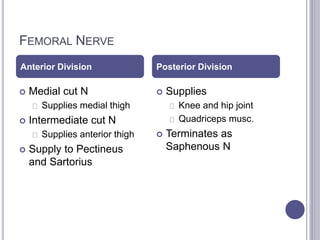
Anterior Division Posterior Division 
 Medial cut N 
Supplies medial thigh 
 Intermediate cut N 
Supplies anterior thigh 
 Supply to Pectineus 
and Sartorius 
 Supplies 
Knee and hip joint 
Quadriceps musc. 
 Terminates as 
Saphenous N
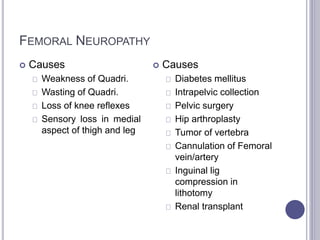
FEMORAL NEUROPATHY 
 Causes 
Weakness of Quadri. 
Wasting of Quadri. 
Loss of knee reflexes 
Sensory loss in medial 
aspect of thigh and leg 
 Causes 
Diabetes mellitus 
Intrapelvic collection 
Pelvic surgery 
Hip arthroplasty 
Tumor of vertebra 
Cannulation of Femoral 
vein/artery 
Inguinal lig 
compression in 
lithotomy 
Renal transplant
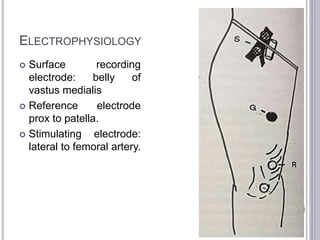
ELECTROPHYSIOLOGY 
 Surface recording 
electrode: belly of 
vastus medialis 
 Reference electrode 
prox to patella. 
 Stimulating electrode: 
lateral to femoral artery.
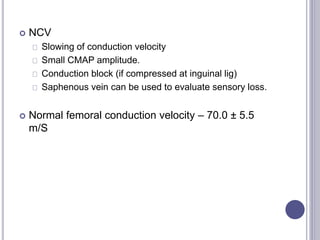
 NCV 
Slowing of conduction velocity 
Small CMAP amplitude. 
Conduction block (if compressed at inguinal lig) 
Saphenous vein can be used to evaluate sensory loss. 
 Normal femoral conduction velocity – 70.0 ± 5.5 
m/S
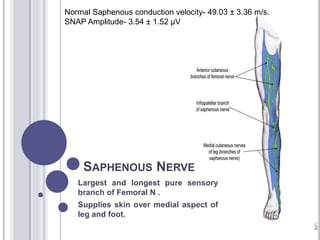
Normal Saphenous conduction velocity- 49.03 ± 3.36 m/s. 
SNAP Amplitude- 3.54 ± 1.52 μV 
SAPHENOUS NERVE 
Largest and longest pure sensory 
branch of Femoral N . 
Supplies skin over medial aspect of 
leg and foot.
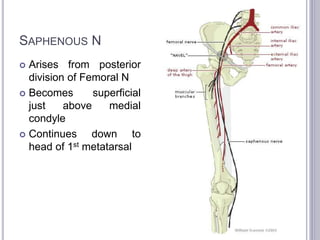
SAPHENOUS N 
 Arises from posterior 
division of Femoral N 
 Becomes superficial 
just above medial 
condyle 
 Continues down to 
head of 1st metatarsal
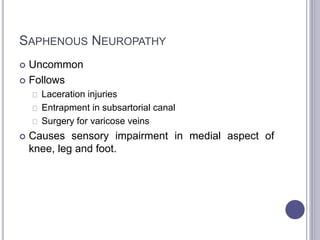
SAPHENOUS NEUROPATHY 
 Uncommon 
 Follows 
Laceration injuries 
Entrapment in subsartorial canal 
Surgery for varicose veins 
 Causes sensory impairment in medial aspect of 
knee, leg and foot.
SAPHENOUS NERVE CONDUCTION 
 Stimulate 1 cm above 
inferior border of 
patella between gracilis 
and sartorius. 
 Recording electrode- 
15 cm distal on medial 
border of tibia.
 Stimulate between 
medial head of 
gastrocnemius and 
tibia, 12- 14 cm 
proximal to med 
malleolus 
 Recording electrode is 
placed anterior to 
medial malleolus 
Normal Saphenous conduction velocity- 49.03 ± 3.36 m/s. 
SNAP Amplitude- 3.54 ± 1.52 μV
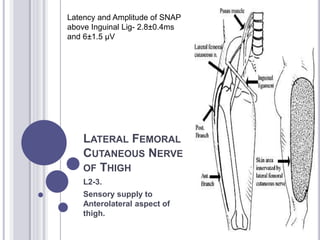
Latency and Amplitude of SNAP 
above Inguinal Lig- 2.8±0.4ms 
and 6±1.5 μV 
LATERAL FEMORAL 
CUTANEOUS NERVE 
OF THIGH 
L2-3. 
Sensory supply to 
Anterolateral aspect of 
thigh.
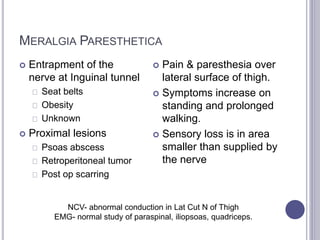
MERALGIA PARESTHETICA 
 Entrapment of the 
nerve at Inguinal tunnel 
Seat belts 
Obesity 
Unknown 
 Proximal lesions 
Psoas abscess 
Retroperitoneal tumor 
Post op scarring 
 Pain & paresthesia over 
lateral surface of thigh. 
 Symptoms increase on 
standing and prolonged 
walking. 
 Sensory loss is in area 
smaller than supplied by 
the nerve 
NCV- abnormal conduction in Lat Cut N of Thigh 
EMG- normal study of paraspinal, iliopsoas, quadriceps.
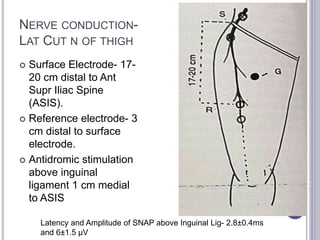
NERVE CONDUCTION-LAT 
CUT N OF THIGH 
 Surface Electrode- 17- 
20 cm distal to Ant 
Supr Iliac Spine 
(ASIS). 
 Reference electrode- 3 
cm distal to surface 
electrode. 
 Antidromic stimulation 
above inguinal 
ligament 1 cm medial 
to ASIS 
Latency and Amplitude of SNAP above Inguinal Lig- 2.8±0.4ms 
and 6±1.5 μV
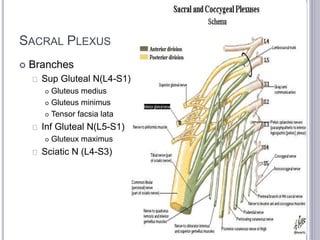
SACRAL PLEXUS 
L4-S3 roots
SACRAL PLEXUS 
 Branches 
Sup Gluteal N(L4-S1) 
 Gluteus medius 
 Gluteus minimus 
 Tensor facsia lata 
Inf Gluteal N(L5-S1) 
 Gluteux maximus 
Sciatic N (L4-S3)
SACRAL PLEXOPATHY 
 Abrupt onset pain in 
posteror aspect of the 
thigh and buttocks. 
 Weakness of knee 
flexor 
 Absent reflexes. 
 Sciatic N tenderness 
 Positive SLR test.
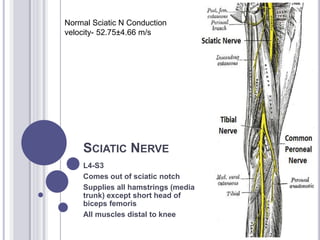
Normal Sciatic N Conduction 
velocity- 52.75±4.66 m/s 
SCIATIC NERVE 
L4-S3 
Comes out of sciatic notch 
Supplies all hamstrings (medial 
trunk) except short head of 
biceps femoris 
All muscles distal to knee
SCIATIC NEUROPATHY 
 Causes include- 
Trauma 
Fracture/disloc of hip 
joint 
Injection 
Puncture wound 
Muscle scarring 
Vasculitis 
Compression 
 Anesthesia 
 Coma 
 Lymphoma & tumours 
 Symptoms 
Involvement of 
hamstrings 
Involvement of muscles 
below knee 
Variable sensory loss. 
 Needs motor 
conduction studies of 
Peroneal N 
Post Tibial N 
Sural N 
Sup Peroneal N 
EMG
SCIATIC N CONDUCTION 
NCV 
 Difficult d/t deep location. 
 Surface Electrode on 
distal peroneal 
innervated muscle eg 
abd hallucius 
 Stimulation- 
Just below gluteal fold 
Medial trunk- apex of 
popliteal fossa 
Lateral trunk- head of 
fibula
 EMG 
 Helps differentiate the condition and levels 
Denervation in paraspinal muscle + normal sural snap 
s/o L5/S1 radiculopathy 
Involvement of gluteal muscles- involvement prior to 
sciatic notch 
Peroneal neuropathy v/s sciatic neuropathy- 
Lat trunk- short head of biceps 
Med trunk- hamstrings and other tibial supp muscles 
Normal Sciatic N Conduction velocity- 52.75±4.66 m/s
COMMON PERONEAL NERVE 
Lateral trunk of Sciatic N descends as Common 
Peroneal N
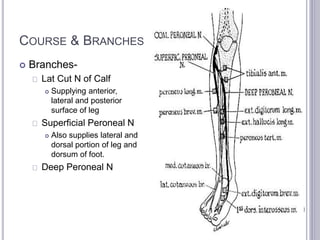
COURSE & BRANCHES 
 Branches- 
Lat Cut N of Calf 
 Supplying anterior, 
lateral and posterior 
surface of leg 
Superficial Peroneal N 
 Also supplies lateral and 
dorsal portion of leg and 
dorsum of foot. 
Deep Peroneal N
COMMON PERONEAL NEUROPATHY 
 Occurs due to 
compression around 
head of fibula. 
In sleep/coma 
Anesthesia 
Plaster/tight bandage 
Cross legging 
Fracture of fibula 
Callus/cyst/lipoma 
Vasculitis 
Leprosy 
 Weakness of 
Dorsiflexion of foot and 
toes 
Eversion of foot 
Cause foot drop and 
slapping gait 
 Sensory loss 
In distribution of 
superficial peroneal N 
or lat cut N of calf, 
depending on level of 
lesion
ELECTROPHYSIOLOGY 
 Evaluation by conduction study of 
Different segments of common peroneal nerve 
Superficial peroneal nerve 
EMG of peroneal nerve innervated muscles. 
 Sural conduction and EMG of short head of biceps 
differentiate from sciatic neuropathy
PERONEAL NERVE 
CONDUCTION 
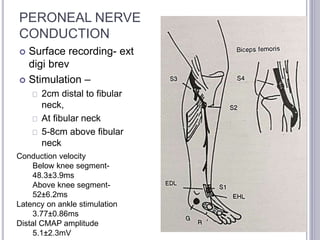
 Surface recording- ext 
digi brev 
 Stimulation – 
2cm distal to fibular 
neck, 
At fibular neck 
5-8cm above fibular 
neck 
Conduction velocity 
Below knee segment- 
48.3±3.9ms 
Above knee segment- 
52±6.2ms 
Latency on ankle stimulation 
3.77±0.86ms 
Distal CMAP amplitude 
5.1±2.3mV
SUPERFICIAL PERONEAL 
NERVE CONDUCTION 
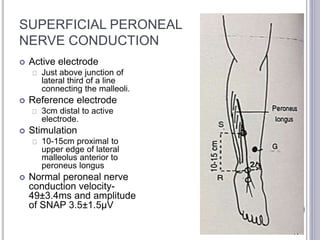
 Active electrode 
Just above junction of 
lateral third of a line 
connecting the malleoli. 
 Reference electrode 
3cm distal to active 
electrode. 
 Stimulation 
10-15cm proximal to 
upper edge of lateral 
malleolus anterior to 
peroneus longus 
 Normal peroneal nerve 
conduction velocity- 
49±3.4ms and amplitude 
of SNAP 3.5±1.5μV
 In peroneal neuropathy conduction block and 
reduction in motor nerve conduction velocity >10ms 
across head of fibula localizes the lesion at this site. 
 In common peroneal neuropathy muscles supplied 
by the deep branch are frequently/severely 
affected. 
 Common peroneal nerve and lateral trunk of sciatic 
nerve- EMG of short head of biceps are useful
Sural N conduction velocity- 50.9±5.4 m/s, amplitude of SNAP 18±10.5μV 
SURAL NERVE 
S1 and S2 
Medial derived from Tibial N 
Lateral derived from Peroneal N 
Pure sensory N
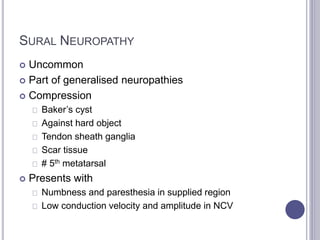
SURAL NEUROPATHY 
 Uncommon 
 Part of generalised neuropathies 
 Compression 
Baker’s cyst 
Against hard object 
Tendon sheath ganglia 
Scar tissue 
# 5th metatarsal 
 Presents with 
Numbness and paresthesia in supplied region 
Low conduction velocity and amplitude in NCV
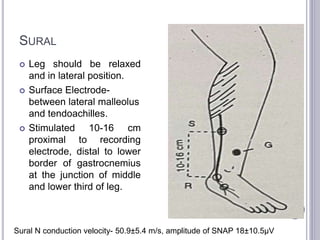
SURAL 
 Leg should be relaxed 
and in lateral position. 
 Surface Electrode-between 
lateral malleolus 
and tendoachilles. 
 Stimulated 10-16 cm 
proximal to recording 
electrode, distal to lower 
border of gastrocnemius 
at the junction of middle 
and lower third of leg. 
Sural N conduction velocity- 50.9±5.4 m/s, amplitude of SNAP 18±10.5μV
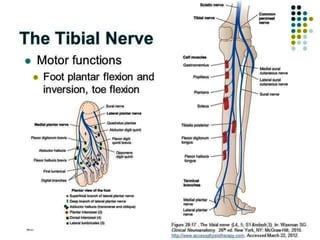
TIBIAL NERVE 
Continuation of medial trunk of sciatic nerve
TIBIAL NEUROPATHY 
 Damage at popliteal 
fossa uncommon. 
 Causes- 
Baker’s cyst 
Nerve sheath ganglia 
Popliteal A Aneurysm 
Leprosy 
 Weakness of 
plantar flexors 
Invertors 
Intrinsic foot muscles 
 Sensory loss in sole
TARSAL TUNNEL SYNDROME 
 Rare picture 
 Pain and paresthesia 
of sole 
 Weakness of intrinsic 
foot muscles (rare) 
 Causes 
Ill-fitting footwear 
Tight plaster cast 
Post traumatic fibrosis 
Tenosynovitis 
RA 
Hypothyroidism 
Idiopathic
ELECTROPHYSIOLOGY 
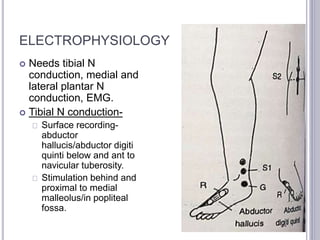
 Needs tibial N 
conduction, medial and 
lateral plantar N 
conduction, EMG. 
 Tibial N conduction- 
Surface recording-abductor 
hallucis/abductor digiti 
quinti below and ant to 
navicular tuberosity. 
Stimulation behind and 
proximal to medial 
malleolus/in popliteal 
fossa.
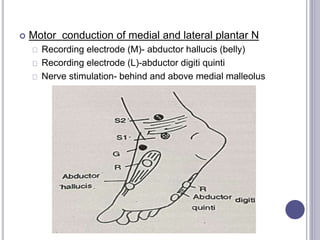
 Motor conduction of medial and lateral plantar N 
Recording electrode (M)- abductor hallucis (belly) 
Recording electrode (L)-abductor digiti quinti 
Nerve stimulation- behind and above medial malleolus
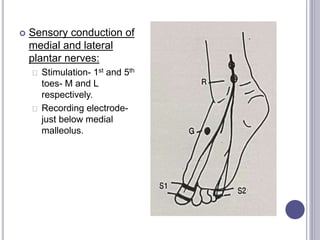
 Sensory conduction of 
medial and lateral 
plantar nerves: 
Stimulation- 1st and 5th 
toes- M and L 
respectively. 
Recording electrode-just 
below medial 
malleolus.
 In Tarsal Tunnel Syndrome 
Conduction block and latency prolongation across tarsal 
tunnel 
Accurate localisation by inching technique (1cm)-abrupt 
prolongation in latency. 
 Normal conduction velocity of Tibial N-48.3±4.5ms 
 Motor conduction 
Latency for medial plantar nerve-3.8±0.5ms 
Latency for lateral plantar nerve-3.9±0.5ms 
 Sensory conduction for 
Latency for medial plantar nerve-2.4±0.2ms, 3.2±0.3ms, 
4±0.2ms (10,14 and 18 cm segment). 
Latency for lateral plantar nerve-3.2±0.3ms,4±0.3ms (14 
and 18 cm segment).
THANK YOU
Nerve Conduction Studies- Lower Leg

Nerve Conduction Studies- Lower Leg

  • 1.
    NCV OF THELOWER LIMBS BY- DR SAUMYA MITTAL 18th NOVEMBER 2014
  • 2.
  • 3.
    LUMBAR PLEXUS Formed by the ANTERIOR RAMI of L1-4.  Anterior rami join to form OBTURATOR N.  Posterior divisions of the rami join to form FEMORAL N.
  • 4.
    OTHER NERVES Other nerves include- LATERAL CUTANEOUS NERVE OF THIGH (pure sensory). ILIOHYPOGASTRIC N ILIOINGUINAL N GENITOFEMORAL N
  • 6.
    LUMBAR PLEXOPATHY Clinicalfeatures Signs  Abrupt onset pain in anterior aspect of thigh.  Muscle wasting and weakness in 2-3 weeks.  Absent knee reflexes.  Tender femoral N  Positive femoral stretch sign
  • 7.
     Sensory symptomsare partial and seen in 1/3rd patients.  NCV shows normal nerves- femoral, peroneal, sural and saphenous N.  May show reduced amplitude.  EMG may show changes of denervation and renervation.  Recovery may be spontaneous over months-years.
  • 8.
    Normal femoral conductionvelocity – 70.0 ± 5.5 m/S FEMORAL N From dorsal portion of anterior rami of L2-L4 Mixed Nerve
  • 9.
    FEMORAL NERVE In intraabdominal course, supplies the iliopsoas muscle.  Divides to anterior and posterior division after crossing Inguinal ligament.
  • 10.
    FEMORAL NERVE AnteriorDivision Posterior Division  Medial cut N Supplies medial thigh  Intermediate cut N Supplies anterior thigh  Supply to Pectineus and Sartorius  Supplies Knee and hip joint Quadriceps musc.  Terminates as Saphenous N
  • 11.
    FEMORAL NEUROPATHY Causes Weakness of Quadri. Wasting of Quadri. Loss of knee reflexes Sensory loss in medial aspect of thigh and leg  Causes Diabetes mellitus Intrapelvic collection Pelvic surgery Hip arthroplasty Tumor of vertebra Cannulation of Femoral vein/artery Inguinal lig compression in lithotomy Renal transplant
  • 12.
    ELECTROPHYSIOLOGY  Surfacerecording electrode: belly of vastus medialis  Reference electrode prox to patella.  Stimulating electrode: lateral to femoral artery.
  • 13.
     NCV Slowingof conduction velocity Small CMAP amplitude. Conduction block (if compressed at inguinal lig) Saphenous vein can be used to evaluate sensory loss.  Normal femoral conduction velocity – 70.0 ± 5.5 m/S
  • 14.
    Normal Saphenous conductionvelocity- 49.03 ± 3.36 m/s. SNAP Amplitude- 3.54 ± 1.52 μV SAPHENOUS NERVE Largest and longest pure sensory branch of Femoral N . Supplies skin over medial aspect of leg and foot.
  • 15.
    SAPHENOUS N Arises from posterior division of Femoral N  Becomes superficial just above medial condyle  Continues down to head of 1st metatarsal
  • 16.
    SAPHENOUS NEUROPATHY Uncommon  Follows Laceration injuries Entrapment in subsartorial canal Surgery for varicose veins  Causes sensory impairment in medial aspect of knee, leg and foot.
  • 17.
    SAPHENOUS NERVE CONDUCTION  Stimulate 1 cm above inferior border of patella between gracilis and sartorius.  Recording electrode- 15 cm distal on medial border of tibia.
  • 18.
     Stimulate between medial head of gastrocnemius and tibia, 12- 14 cm proximal to med malleolus  Recording electrode is placed anterior to medial malleolus Normal Saphenous conduction velocity- 49.03 ± 3.36 m/s. SNAP Amplitude- 3.54 ± 1.52 μV
  • 19.
    Latency and Amplitudeof SNAP above Inguinal Lig- 2.8±0.4ms and 6±1.5 μV LATERAL FEMORAL CUTANEOUS NERVE OF THIGH L2-3. Sensory supply to Anterolateral aspect of thigh.
  • 20.
    MERALGIA PARESTHETICA Entrapment of the nerve at Inguinal tunnel Seat belts Obesity Unknown  Proximal lesions Psoas abscess Retroperitoneal tumor Post op scarring  Pain & paresthesia over lateral surface of thigh.  Symptoms increase on standing and prolonged walking.  Sensory loss is in area smaller than supplied by the nerve NCV- abnormal conduction in Lat Cut N of Thigh EMG- normal study of paraspinal, iliopsoas, quadriceps.
  • 21.
    NERVE CONDUCTION-LAT CUTN OF THIGH  Surface Electrode- 17- 20 cm distal to Ant Supr Iliac Spine (ASIS).  Reference electrode- 3 cm distal to surface electrode.  Antidromic stimulation above inguinal ligament 1 cm medial to ASIS Latency and Amplitude of SNAP above Inguinal Lig- 2.8±0.4ms and 6±1.5 μV
  • 23.
  • 24.
    SACRAL PLEXUS Branches Sup Gluteal N(L4-S1)  Gluteus medius  Gluteus minimus  Tensor facsia lata Inf Gluteal N(L5-S1)  Gluteux maximus Sciatic N (L4-S3)
  • 25.
    SACRAL PLEXOPATHY Abrupt onset pain in posteror aspect of the thigh and buttocks.  Weakness of knee flexor  Absent reflexes.  Sciatic N tenderness  Positive SLR test.
  • 26.
    Normal Sciatic NConduction velocity- 52.75±4.66 m/s SCIATIC NERVE L4-S3 Comes out of sciatic notch Supplies all hamstrings (medial trunk) except short head of biceps femoris All muscles distal to knee
  • 27.
    SCIATIC NEUROPATHY Causes include- Trauma Fracture/disloc of hip joint Injection Puncture wound Muscle scarring Vasculitis Compression  Anesthesia  Coma  Lymphoma & tumours  Symptoms Involvement of hamstrings Involvement of muscles below knee Variable sensory loss.  Needs motor conduction studies of Peroneal N Post Tibial N Sural N Sup Peroneal N EMG
  • 28.
    SCIATIC N CONDUCTION NCV  Difficult d/t deep location.  Surface Electrode on distal peroneal innervated muscle eg abd hallucius  Stimulation- Just below gluteal fold Medial trunk- apex of popliteal fossa Lateral trunk- head of fibula
  • 29.
     EMG Helps differentiate the condition and levels Denervation in paraspinal muscle + normal sural snap s/o L5/S1 radiculopathy Involvement of gluteal muscles- involvement prior to sciatic notch Peroneal neuropathy v/s sciatic neuropathy- Lat trunk- short head of biceps Med trunk- hamstrings and other tibial supp muscles Normal Sciatic N Conduction velocity- 52.75±4.66 m/s
  • 30.
    COMMON PERONEAL NERVE Lateral trunk of Sciatic N descends as Common Peroneal N
  • 31.
    COURSE & BRANCHES  Branches- Lat Cut N of Calf  Supplying anterior, lateral and posterior surface of leg Superficial Peroneal N  Also supplies lateral and dorsal portion of leg and dorsum of foot. Deep Peroneal N
  • 32.
    COMMON PERONEAL NEUROPATHY  Occurs due to compression around head of fibula. In sleep/coma Anesthesia Plaster/tight bandage Cross legging Fracture of fibula Callus/cyst/lipoma Vasculitis Leprosy  Weakness of Dorsiflexion of foot and toes Eversion of foot Cause foot drop and slapping gait  Sensory loss In distribution of superficial peroneal N or lat cut N of calf, depending on level of lesion
  • 33.
    ELECTROPHYSIOLOGY  Evaluationby conduction study of Different segments of common peroneal nerve Superficial peroneal nerve EMG of peroneal nerve innervated muscles.  Sural conduction and EMG of short head of biceps differentiate from sciatic neuropathy
  • 34.
    PERONEAL NERVE CONDUCTION  Surface recording- ext digi brev  Stimulation – 2cm distal to fibular neck, At fibular neck 5-8cm above fibular neck Conduction velocity Below knee segment- 48.3±3.9ms Above knee segment- 52±6.2ms Latency on ankle stimulation 3.77±0.86ms Distal CMAP amplitude 5.1±2.3mV
  • 35.
    SUPERFICIAL PERONEAL NERVECONDUCTION  Active electrode Just above junction of lateral third of a line connecting the malleoli.  Reference electrode 3cm distal to active electrode.  Stimulation 10-15cm proximal to upper edge of lateral malleolus anterior to peroneus longus  Normal peroneal nerve conduction velocity- 49±3.4ms and amplitude of SNAP 3.5±1.5μV
  • 36.
     In peronealneuropathy conduction block and reduction in motor nerve conduction velocity >10ms across head of fibula localizes the lesion at this site.  In common peroneal neuropathy muscles supplied by the deep branch are frequently/severely affected.  Common peroneal nerve and lateral trunk of sciatic nerve- EMG of short head of biceps are useful
  • 37.
    Sural N conductionvelocity- 50.9±5.4 m/s, amplitude of SNAP 18±10.5μV SURAL NERVE S1 and S2 Medial derived from Tibial N Lateral derived from Peroneal N Pure sensory N
  • 38.
    SURAL NEUROPATHY Uncommon  Part of generalised neuropathies  Compression Baker’s cyst Against hard object Tendon sheath ganglia Scar tissue # 5th metatarsal  Presents with Numbness and paresthesia in supplied region Low conduction velocity and amplitude in NCV
  • 39.
    SURAL  Legshould be relaxed and in lateral position.  Surface Electrode-between lateral malleolus and tendoachilles.  Stimulated 10-16 cm proximal to recording electrode, distal to lower border of gastrocnemius at the junction of middle and lower third of leg. Sural N conduction velocity- 50.9±5.4 m/s, amplitude of SNAP 18±10.5μV
  • 40.
    TIBIAL NERVE Continuationof medial trunk of sciatic nerve
  • 42.
    TIBIAL NEUROPATHY Damage at popliteal fossa uncommon.  Causes- Baker’s cyst Nerve sheath ganglia Popliteal A Aneurysm Leprosy  Weakness of plantar flexors Invertors Intrinsic foot muscles  Sensory loss in sole
  • 43.
    TARSAL TUNNEL SYNDROME  Rare picture  Pain and paresthesia of sole  Weakness of intrinsic foot muscles (rare)  Causes Ill-fitting footwear Tight plaster cast Post traumatic fibrosis Tenosynovitis RA Hypothyroidism Idiopathic
  • 44.
    ELECTROPHYSIOLOGY  Needstibial N conduction, medial and lateral plantar N conduction, EMG.  Tibial N conduction- Surface recording-abductor hallucis/abductor digiti quinti below and ant to navicular tuberosity. Stimulation behind and proximal to medial malleolus/in popliteal fossa.
  • 45.
     Motor conductionof medial and lateral plantar N Recording electrode (M)- abductor hallucis (belly) Recording electrode (L)-abductor digiti quinti Nerve stimulation- behind and above medial malleolus
  • 46.
     Sensory conductionof medial and lateral plantar nerves: Stimulation- 1st and 5th toes- M and L respectively. Recording electrode-just below medial malleolus.
  • 47.
     In TarsalTunnel Syndrome Conduction block and latency prolongation across tarsal tunnel Accurate localisation by inching technique (1cm)-abrupt prolongation in latency.  Normal conduction velocity of Tibial N-48.3±4.5ms  Motor conduction Latency for medial plantar nerve-3.8±0.5ms Latency for lateral plantar nerve-3.9±0.5ms  Sensory conduction for Latency for medial plantar nerve-2.4±0.2ms, 3.2±0.3ms, 4±0.2ms (10,14 and 18 cm segment). Latency for lateral plantar nerve-3.2±0.3ms,4±0.3ms (14 and 18 cm segment).
  • 48.

Editor's Notes

  • #18 Normal Saphenous conduction velocity- 49.03 ± 3.36 m/s. SNAP Amplitude- 3.54 ± 1.52 µV