Case Review:
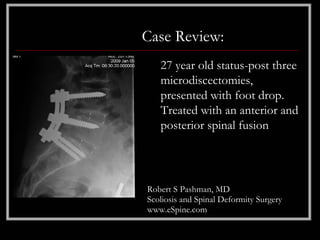
   27 year old status-post three
   microdiscectomies,
   presented with foot drop.
   Treated with an anterior and
   posterior spinal fusion


Robert S Pashman, MD
Scoliosis and Spinal Deformity Surgery
www.eSpine.com
Patient History
• 27 year old female from Washington
• Disk herniations at both L4-5 and L5-S1. The patient decided
  that despite some weakness, she wanted to have a child in
  advance of any spine surgery. Ultimately, her symptoms resolved.
• She become re-symptomatic subsequently and had two
  microdiscectomies.
• The second disk herniation resulted in severe weakness and foot
  drop in both the L5 and S1 distributions of the left leg. It was
  associated with severe pain. Microdiscectomy Surgery was
  performed on an emergent basis in Washington.
• The weakness did not resolve after the third microdiscetomy.
Patient History – cont.
• The patient, at this point, has significant low back pain and also
  has plantar flexion and extensor hallicis longus and tibialis
  anterior weakness of the left leg. She has associated calf atrophy
  also on the left hand side and walks with a discernible limp that
  actually accentuates her foot drop with increased cadence. She
  had negative straight leg raising and a well-healed incision
  posteriorly.
• A combination of MRIs and CT myelogram show that the
  patient has evidence of microdiskectomy at L4-5, L5- S1 and still
  has some blunting of the myelographic stripe at L5-S1 and L4-5
  in the lateral recess.
Pre-op X-rays
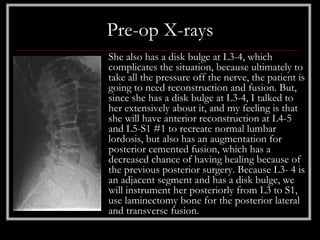
She also has a disk bulge at L3-4, which
complicates the situation, because ultimately to
take all the pressure off the nerve, the patient is
going to need reconstruction and fusion. But,
since she has a disk bulge at L3-4, I talked to
her extensively about it, and my feeling is that
she will have anterior reconstruction at L4-5
and L5-S1 #1 to recreate normal lumbar
lordosis, but also has an augmentation for
posterior cemented fusion, which has a
decreased chance of having healing because of
the previous posterior surgery. Because L3- 4 is
an adjacent segment and has a disk bulge, we
will instrument her posteriorly from L3 to S1,
use laminectomy bone for the posterior lateral
and transverse fusion.
Indications for Surgery
• Status post microdiskectomy, L4-5, L5-S1 x3.
• Severe motor sensory deficits, left leg, due to residual
  compression lumbar spine.
• Lumbar kyphosis.
• Degenerative disk disease, L4-5, L5-S1.
• Failed conservative therapy.
Surgical Strategy – Stage 1
• Abdominal retroperitoneal approach to the lumbosacral spine.
• Radical diskectomy, L5-S1, L4-5.
• Anterior interbody fusion with PEEK device, L4-5, L5-S1,
  measuring 8 and 8 mm, respectively.
• Anterior interbody fusion bone graft with RH bone
  morphogenic protein in the central PEEK spacer, L4-5, L5-S1.
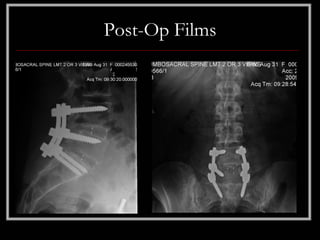
• Segmental spinal instrumentation L4-S1 using 5.5 stainless steel
  rod construct.
• Posterolateral intertransverse fusion L4 to S1 using locally
  harvested laminectomy bone.
Surgical Strategy – Stage 2
• Re-exploration decompression under the microscope with
  complete laminectomy, L5, and subtotal laminectomy L4.
• Intralaminar laminectomy and facetectomy re-exploration
  decompression, lateral recess decompression and
  neuroforaminotomy L4-L5, L5-S1 bilaterally.
• Intralaminar laminectomy, facetectomy, lateral recess release L3-
  L4 for lateral recess stenosis.
• Intraoperative SSEP's.
• Intraoperative fluoroscopy.
Post-Op Films
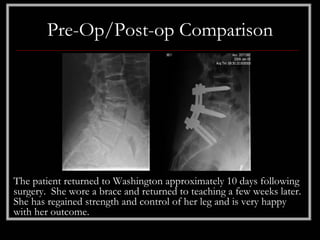
Pre-Op/Post-op Comparison


The patient returned to Washington approximately 10 days following
surgery. She wore a brace and returned to teaching a few weeks later.
She has regained strength and control of her leg and is very happy
with her outcome.
2 year follow-up
A year after surgery, the patient got pregnant. She sent us a
birth announcement with a note stating that she had no back
pain during her pregnancy or delivery.

Case Review #1: 27 year old female presents with foot drop after 3rd lumbar surgeries

  • 1.
    Case Review: 27 year old status-post three microdiscectomies, presented with foot drop. Treated with an anterior and posterior spinal fusion Robert S Pashman, MD Scoliosis and Spinal Deformity Surgery www.eSpine.com
  • 2.
    Patient History • 27year old female from Washington • Disk herniations at both L4-5 and L5-S1. The patient decided that despite some weakness, she wanted to have a child in advance of any spine surgery. Ultimately, her symptoms resolved. • She become re-symptomatic subsequently and had two microdiscectomies. • The second disk herniation resulted in severe weakness and foot drop in both the L5 and S1 distributions of the left leg. It was associated with severe pain. Microdiscectomy Surgery was performed on an emergent basis in Washington. • The weakness did not resolve after the third microdiscetomy.
  • 3.
    Patient History –cont. • The patient, at this point, has significant low back pain and also has plantar flexion and extensor hallicis longus and tibialis anterior weakness of the left leg. She has associated calf atrophy also on the left hand side and walks with a discernible limp that actually accentuates her foot drop with increased cadence. She had negative straight leg raising and a well-healed incision posteriorly. • A combination of MRIs and CT myelogram show that the patient has evidence of microdiskectomy at L4-5, L5- S1 and still has some blunting of the myelographic stripe at L5-S1 and L4-5 in the lateral recess.
  • 4.
    Pre-op X-rays She alsohas a disk bulge at L3-4, which complicates the situation, because ultimately to take all the pressure off the nerve, the patient is going to need reconstruction and fusion. But, since she has a disk bulge at L3-4, I talked to her extensively about it, and my feeling is that she will have anterior reconstruction at L4-5 and L5-S1 #1 to recreate normal lumbar lordosis, but also has an augmentation for posterior cemented fusion, which has a decreased chance of having healing because of the previous posterior surgery. Because L3- 4 is an adjacent segment and has a disk bulge, we will instrument her posteriorly from L3 to S1, use laminectomy bone for the posterior lateral and transverse fusion.
  • 5.
    Indications for Surgery •Status post microdiskectomy, L4-5, L5-S1 x3. • Severe motor sensory deficits, left leg, due to residual compression lumbar spine. • Lumbar kyphosis. • Degenerative disk disease, L4-5, L5-S1. • Failed conservative therapy.
  • 6.
    Surgical Strategy –Stage 1 • Abdominal retroperitoneal approach to the lumbosacral spine. • Radical diskectomy, L5-S1, L4-5. • Anterior interbody fusion with PEEK device, L4-5, L5-S1, measuring 8 and 8 mm, respectively. • Anterior interbody fusion bone graft with RH bone morphogenic protein in the central PEEK spacer, L4-5, L5-S1. • Segmental spinal instrumentation L4-S1 using 5.5 stainless steel rod construct. • Posterolateral intertransverse fusion L4 to S1 using locally harvested laminectomy bone.
  • 7.
    Surgical Strategy –Stage 2 • Re-exploration decompression under the microscope with complete laminectomy, L5, and subtotal laminectomy L4. • Intralaminar laminectomy and facetectomy re-exploration decompression, lateral recess decompression and neuroforaminotomy L4-L5, L5-S1 bilaterally. • Intralaminar laminectomy, facetectomy, lateral recess release L3- L4 for lateral recess stenosis. • Intraoperative SSEP's. • Intraoperative fluoroscopy.
  • 8.
  • 9.
    Pre-Op/Post-op Comparison The patientreturned to Washington approximately 10 days following surgery. She wore a brace and returned to teaching a few weeks later. She has regained strength and control of her leg and is very happy with her outcome.
  • 10.
    2 year follow-up Ayear after surgery, the patient got pregnant. She sent us a birth announcement with a note stating that she had no back pain during her pregnancy or delivery.