SCIATIC NERVE
OBJECTIVES
OBJECTIVES
 By the end of the lecture, the students
should be able to:
 Describe the anatomy (origin, course &
distribution) of the sciatic nerve.
 List the branches of the sciatic nerve.
 Describe briefly the main motor and
sensory manifestations in case of injury
of the sciatic nerve or its main branches.
Origin
From Sacral the
Plexus:
 (L4,5, S1,
2,3and4).
It is the largest
branch of the
plexus
 It is the largest
nerve of the
body.
Sacral Plexus
Sacral Plexus
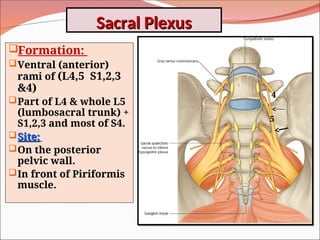
Formation:
Ventral (anterior)
rami of (L4,5 S1,2,3
&4)
Part of L4 & whole L5
(lumbosacral trunk) +
S1,2,3 and most of S4.
Site:
Site:
On the posterior
pelvic wall.
In front of Piriformis
muscle.
4
5
Course & Distribution
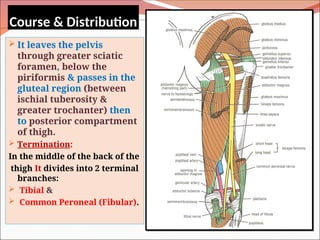
 It leaves the pelvis
through greater sciatic
foramen, below the
piriformis & passes in the
gluteal region (between
ischial tuberosity &
greater trochanter) then
to posterior compartment
of thigh.
 Termination:
In the middle of the back of the
thigh It divides into 2 terminal
branches:
 Tibial &
 Common Peroneal (Fibular).
Branches of Sciatic Nerve
1. Cutaneous:
 To all leg & foot
EXCEPT:
Areas supplied by
the saphenous
nerve (branch of
femoral nerve).
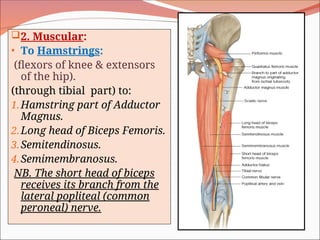
2. Muscular:
• To Hamstrings:
(flexors of knee & extensors
of the hip).
(through tibial part) to:
1.Hamstring part of Adductor
Magnus.
2.Long head of Biceps Femoris.
3.Semitendinosus.
4.Semimembranosus.
NB. The short head of biceps
receives its branch from the
lateral popliteal (common
peroneal) nerve.
Tibial Nerve
Tibial Nerve
Course:
 Descends through
popliteal fossa to
posterior compartment
of leg, accompanied
with posterior tibial
vessels.
 Passes deep to flexor
retinaculum (through
the tarsal tunnel
tarsal tunnel,
behind medial
behind medial
malleolus
malleolus) to reach the
sole of foot where it
divides into 2 terminal
branches (Medial &
Lateral planter nerves.
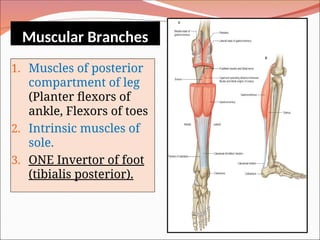
Muscular Branches
1. Muscles of posterior
compartment of leg
(Planter flexors of
ankle, Flexors of toes
2. Intrinsic muscles of
sole.
3. ONE Invertor of foot
(tibialis posterior).
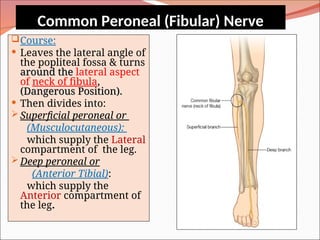
Common Peroneal (Fibular) Nerve
Course:
 Leaves the lateral angle of
the popliteal fossa & turns
around the
around the lateral aspect
of neck of fibula,
,
(Dangerous Position).
 Then divides into:
 Superficial peroneal or
(Musculocutaneous):
which supply the Lateral
compartment of the leg.
 Deep peroneal or
(Anterior Tibial):
which supply the
Anterior compartment of
the leg.
Muscular Branches
To muscles of anterior &
lateral compartments
of leg:
1. Dorsi flexors of ankle,
2. Extensors of toes,
3. Evertors of foot).
 The sciatic nerve is most
most
frequently injured
frequently injured by…?
I-
I- Badly placed
intramuscular injections
in the gluteal region.
 To avoid this,
injections should be done
into the gluteus maximus
or medius (into the upper
upper
outer quadrant of
outer quadrant of
buttock
buttock
 Most nerve lesions are
Most nerve lesions are
incomplete,
incomplete, and in 90% of
and in 90% of
injuries, the common
peroneal nerve is the
mostly affected.
mostly affected. Why?
- The common peroneal
nerve fibers lie superficial
superficial
in the sciatic nerve.
CAUSES OF SCIATIC
CAUSES OF SCIATIC
NERVE INJURY
NERVE INJURY
II-Posterior
dislocation of
the hip joint
SCIATIC NERVE INJURY
MOTOR EFFECT:
MOTOR EFFECT:
• Marked wasting of the
muscles below the knee.
• Weak flexion of the knee
(sartorius & gracilis are
intact).
• Weak extension of hip
(gluteus maximus is
intact).
 All the muscles below the
knee are paralyzed, and the
weight of the foot causes it
to assume the plantar-flexed
plantar-flexed
position,
position, or Foot Drop.
Foot Drop.
 (
(Stamping gait
Stamping gait).
).
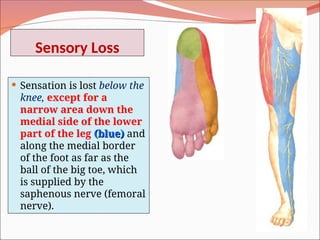
Sensory Loss
 Sensation is lost below the
knee, except for a
narrow area down the
medial side of the lower
part of the leg (blue)
(blue) and
along the medial border
of the foot as far as the
ball of the big toe, which
is supplied by the
saphenous nerve (femoral
nerve).
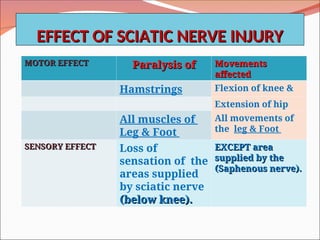
EFFECT OF SCIATIC NERVE INJURY
MOTOR EFFECT
MOTOR EFFECT Paralysis of
Paralysis of Movements
Movements
affected
affected
Hamstrings Flexion of knee &
Extension of hip
All muscles of
Leg & Foot
All movements of
the leg & Foot
SENSORY EFFECT
SENSORY EFFECT Loss of
sensation of the
areas supplied
by sciatic nerve
(below knee).
(below knee).
EXCEPT area
EXCEPT area
supplied by the
supplied by the
(Saphenous nerve).
(Saphenous nerve).
SCIATICA
 Sciatica describes
the condition in
which patients have
pain along the
sensory
distribution of the
sciatic nerve.
 Thus the pain is
experienced in the
posterior aspect of
the thigh, the
posterior and
lateral sides of the
leg, and the lateral
part of the foot.
Causes of Sciatica :
 Prolapse of an intervertebral disc, with
pressure on one or roots of the lower lumbar
and sacral spinal nerves,
 Pressure on the sacral plexus or sciatic nerve
by an intrpelvic tumor,
 Inflammation of the sciatic nerve or its
terminal branches.
Common Peroneal Nerve
Injury
The common peroneal nerve
common peroneal nerve
is in an exposed position
exposed position as it
leaves the popliteal fossa it
winds around neck of the
fibula to enter peroneus longus
muscle, (Dangerous
Position)!!!!!!!!!!!!!
The common peroneal nerve is commonly injured
In Fractures of the neck of the fibula and
By pressure from casts or splints.
 The following clinical
features are present:
Motor:
Motor:
 The muscles of the anterior
The muscles of the anterior
and lateral compartments of
the leg are paralyzed,
 As a result, the opposing
muscles, the plantar flexors
of the ankle joint and the
invertors of the subtalar
joints, cause the foot to be
cause the foot to be
Plantar Flexed (Foot
Drop) and Inverted,
Drop) and Inverted, an
attitude referred to as
Talipes Equinovarus
Equinovarus.
.
Manifestations of
Common Peroneal Nerve
Injury
Common Peroneal Nerve
Injury
Sensory
Sensation is lost between
the first and second toes.
Dorsum of the foot and toes.
Medial side of the big toe.
Lateral side of the leg.
Superficial
peroneal
Tibial Nerve Injury
 Because of its deep and
protected position, the tibial
nerve is rarely injured.
rarely injured.
 Complete division results in
the following clinical features:
 Motor:
 All the muscles in the back of
All the muscles in the back of
the leg and the sole of the
foot are paralyzed.
foot are paralyzed.
 The opposing muscles Dorsiflex
Dorsiflex
the foot at the ankle joint and
and
Evert the foot
Evert the foot at the subtalar
joint, an attitude referred to as
Taleps Calcaneovalgus.
Calcaneovalgus.
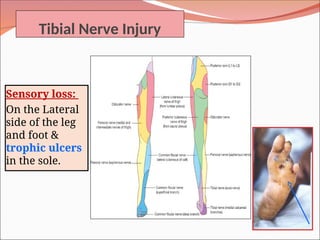
Tibial Nerve Injury
Sensory loss:
On the Lateral
side of the leg
and foot &
trophic ulcers
in the sole.
THANK YOU

SCIATIC NERVE SCIATIC NERVE SCIATIC NERV

  • 1.
  • 2.
    OBJECTIVES OBJECTIVES  By theend of the lecture, the students should be able to:  Describe the anatomy (origin, course & distribution) of the sciatic nerve.  List the branches of the sciatic nerve.  Describe briefly the main motor and sensory manifestations in case of injury of the sciatic nerve or its main branches.
  • 4.
    Origin From Sacral the Plexus: (L4,5, S1, 2,3and4). It is the largest branch of the plexus  It is the largest nerve of the body.
  • 5.
    Sacral Plexus Sacral Plexus Formation: Ventral(anterior) rami of (L4,5 S1,2,3 &4) Part of L4 & whole L5 (lumbosacral trunk) + S1,2,3 and most of S4. Site: Site: On the posterior pelvic wall. In front of Piriformis muscle. 4 5
  • 6.
    Course & Distribution It leaves the pelvis through greater sciatic foramen, below the piriformis & passes in the gluteal region (between ischial tuberosity & greater trochanter) then to posterior compartment of thigh.  Termination: In the middle of the back of the thigh It divides into 2 terminal branches:  Tibial &  Common Peroneal (Fibular).
  • 7.
    Branches of SciaticNerve Branches of Sciatic Nerve 1. Cutaneous:  To all leg & foot EXCEPT: Areas supplied by the saphenous nerve (branch of femoral nerve).
  • 8.
    2. Muscular: • ToHamstrings: (flexors of knee & extensors of the hip). (through tibial part) to: 1.Hamstring part of Adductor Magnus. 2.Long head of Biceps Femoris. 3.Semitendinosus. 4.Semimembranosus. NB. The short head of biceps receives its branch from the lateral popliteal (common peroneal) nerve.
  • 9.
    Tibial Nerve Tibial Nerve Course: Descends through popliteal fossa to posterior compartment of leg, accompanied with posterior tibial vessels.  Passes deep to flexor retinaculum (through the tarsal tunnel tarsal tunnel, behind medial behind medial malleolus malleolus) to reach the sole of foot where it divides into 2 terminal branches (Medial & Lateral planter nerves.
  • 10.
    Muscular Branches 1. Musclesof posterior compartment of leg (Planter flexors of ankle, Flexors of toes 2. Intrinsic muscles of sole. 3. ONE Invertor of foot (tibialis posterior).
  • 11.
    Common Peroneal (Fibular)Nerve Common Peroneal (Fibular) Nerve Course:  Leaves the lateral angle of the popliteal fossa & turns around the around the lateral aspect of neck of fibula, , (Dangerous Position). (Dangerous Position).  Then divides into:  Superficial peroneal or (Musculocutaneous): which supply the Lateral compartment of the leg.  Deep peroneal or (Anterior Tibial): which supply the Anterior compartment of the leg.
  • 12.
    Muscular Branches To musclesof anterior & lateral compartments of leg: 1. Dorsi flexors of ankle, 2. Extensors of toes, 3. Evertors of foot).
  • 13.
     The sciaticnerve is most most frequently injured frequently injured by…? I- I- Badly placed intramuscular injections in the gluteal region.  To avoid this, injections should be done into the gluteus maximus or medius (into the upper upper outer quadrant of outer quadrant of buttock buttock  Most nerve lesions are Most nerve lesions are incomplete, incomplete, and in 90% of and in 90% of injuries, the common injuries, the common peroneal nerve is the peroneal nerve is the mostly affected. mostly affected. Why? - The common peroneal nerve fibers lie superficial superficial in the sciatic nerve. CAUSES OF SCIATIC CAUSES OF SCIATIC NERVE INJURY NERVE INJURY II-Posterior dislocation of the hip joint
  • 14.
    SCIATIC NERVE INJURY SCIATICNERVE INJURY MOTOR EFFECT: MOTOR EFFECT: • Marked wasting of the muscles below the knee. • Weak flexion of the knee (sartorius & gracilis are intact). • Weak extension of hip (gluteus maximus is intact).  All the muscles below the knee are paralyzed, and the weight of the foot causes it to assume the plantar-flexed plantar-flexed position, position, or Foot Drop. Foot Drop.  ( (Stamping gait Stamping gait). ).
  • 15.
    Sensory Loss  Sensationis lost below the knee, except for a narrow area down the medial side of the lower part of the leg (blue) (blue) and along the medial border of the foot as far as the ball of the big toe, which is supplied by the saphenous nerve (femoral nerve).
  • 16.
    EFFECT OF SCIATICNERVE INJURY EFFECT OF SCIATIC NERVE INJURY MOTOR EFFECT MOTOR EFFECT Paralysis of Paralysis of Movements Movements affected affected Hamstrings Flexion of knee & Extension of hip All muscles of Leg & Foot All movements of the leg & Foot SENSORY EFFECT SENSORY EFFECT Loss of sensation of the areas supplied by sciatic nerve (below knee). (below knee). EXCEPT area EXCEPT area supplied by the supplied by the (Saphenous nerve). (Saphenous nerve).
  • 17.
    SCIATICA  Sciatica describes thecondition in which patients have pain along the sensory distribution of the sciatic nerve.  Thus the pain is experienced in the posterior aspect of the thigh, the posterior and lateral sides of the leg, and the lateral part of the foot.
  • 18.
    Causes of Sciatica:  Prolapse of an intervertebral disc, with pressure on one or roots of the lower lumbar and sacral spinal nerves,  Pressure on the sacral plexus or sciatic nerve by an intrpelvic tumor,  Inflammation of the sciatic nerve or its terminal branches.
  • 19.
    Common Peroneal Nerve Injury Thecommon peroneal nerve common peroneal nerve is in an exposed position exposed position as it leaves the popliteal fossa it winds around neck of the fibula to enter peroneus longus muscle, (Dangerous Position)!!!!!!!!!!!!! The common peroneal nerve is commonly injured In Fractures of the neck of the fibula and By pressure from casts or splints.
  • 20.
     The followingclinical features are present: Motor: Motor:  The muscles of the anterior The muscles of the anterior and lateral compartments of and lateral compartments of the leg are paralyzed, the leg are paralyzed,  As a result, the opposing muscles, the plantar flexors of the ankle joint and the invertors of the subtalar joints, cause the foot to be cause the foot to be Plantar Flexed (Foot Plantar Flexed (Foot Drop) and Inverted, Drop) and Inverted, an attitude referred to as Talipes Equinovarus Equinovarus. . Manifestations of Common Peroneal Nerve Injury
  • 21.
    Common Peroneal Nerve Injury Sensory Sensationis lost between the first and second toes. Dorsum of the foot and toes. Medial side of the big toe. Lateral side of the leg. Superficial peroneal
  • 22.
    Tibial Nerve Injury Because of its deep and protected position, the tibial nerve is rarely injured. rarely injured.  Complete division results in the following clinical features:  Motor:  All the muscles in the back of All the muscles in the back of the leg and the sole of the the leg and the sole of the foot are paralyzed. foot are paralyzed.  The opposing muscles Dorsiflex Dorsiflex the foot at the ankle joint and and Evert the foot Evert the foot at the subtalar joint, an attitude referred to as Taleps Calcaneovalgus. Calcaneovalgus.
  • 23.
    Tibial Nerve Injury Sensoryloss: On the Lateral side of the leg and foot & trophic ulcers in the sole.
  • 24.