PERIPHERAL NERVES
OF LOWER LIMB
DR.MOHINISH . S
DM PED NEURO RESIDENT
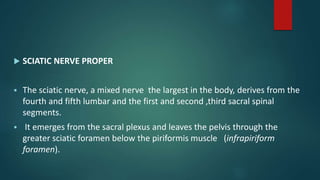
 SCIATIC NERVE PROPER
 The sciatic nerve, a mixed nerve the largest in the body, derives from the
fourth and fifth lumbar and the first and second ,third sacral spinal
segments.
 It emerges from the sacral plexus and leaves the pelvis through the
greater sciatic foramen below the piriformis muscle (infrapiriform
foramen).
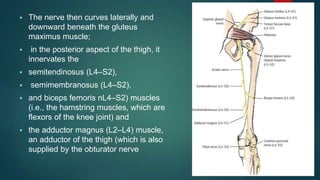
 The nerve then curves laterally and
downward beneath the gluteus
maximus muscle;
 in the posterior aspect of the thigh, it
innervates the
 semitendinosus (L4–S2),
 semimembranosus (L4–S2),
 and biceps femoris nL4–S2) muscles
(i.e., the hamstring muscles, which are
flexors of the knee joint) and
 the adductor magnus (L2–L4) muscle,
an adductor of the thigh (which is also
supplied by the obturator nerve
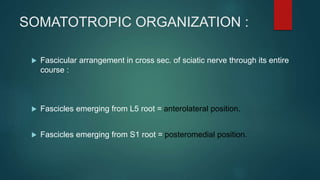
SOMATOTROPIC ORGANIZATION :
 Fascicular arrangement in cross sec. of sciatic nerve through its entire
course :
 Fascicles emerging from L5 root = anterolateral position.
 Fascicles emerging from S1 root = posteromedial position.
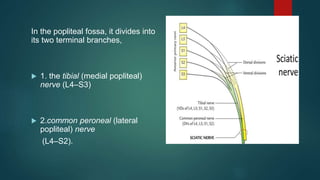
In the popliteal fossa, it divides into
its two terminal branches,
 1. the tibial (medial popliteal)
nerve (L4–S3)
 2.common peroneal (lateral
popliteal) nerve
(L4–S2).
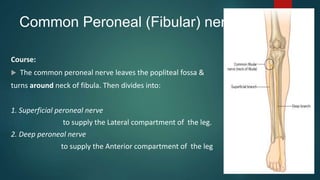
Common Peroneal (Fibular) nerve.
Course:
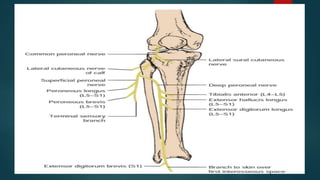
 The common peroneal nerve leaves the popliteal fossa &
turns around neck of fibula. Then divides into:
1. Superficial peroneal nerve
to supply the Lateral compartment of the leg.
2. Deep peroneal nerve
to supply the Anterior compartment of the leg
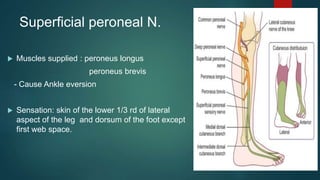
Superficial peroneal N.
 Muscles supplied : peroneus longus
peroneus brevis
- Cause Ankle eversion
 Sensation: skin of the lower 1/3 rd of lateral
aspect of the leg and dorsum of the foot except
first web space.
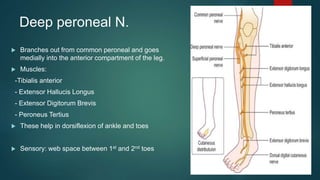
Deep peroneal N.
 Branches out from common peroneal and goes
medially into the anterior compartment of the leg.
 Muscles:
-Tibialis anterior
- Extensor Hallucis Longus
- Extensor Digitorum Brevis
- Peroneus Tertius
 These help in dorsiflexion of ankle and toes
 Sensory: web space between 1st and 2nd toes
Lesions of the Sciatic Nerve Proper
 The sciatic nerve is frequently damaged in the sacral plexus, the pelvis, the
gluteal region, or at the sciatic notch.
 Nerve injury may occur with
 fracture dislocation of the hip with apophyseal avulsion fracture
 after penetrating injury
 after pelvic cancer or hip joint surgery
 with infections (e.g., herpes simplex or zoster),
 after radiation therapy , with gluteal hemorrhage,
 or after intramuscular injection
 As the sciatic nerve is composed of two nerve trunks, medial and lateral, which
become the tibial and peroneal nerves, respectively,
 partial sciatic lesions may differentially involve these trunks and thereby cause
misleading localization deficits.
 Sciatic neuropathies can therefore be mistaken clinically for more distal
neuropathies, especially common peroneal neuropathies or, less often, tibial
neuropathies
 In general, sciatic lesions tend to affect the peroneal division more than the tibial
division in about 75% of cases
Named sciatic neuropathies
 The piriformis syndrome is an entrapment syndrome - greater sciatic notch include pressure by
a wallet (credit-card–wallet sciatica)
 by coins in a back pocket (car toll neuropathy)
 The sciatic nerve may also be compressed in the thigh as a consequence of yoga (lotus foot
drop)
 injured by compression against an underlying prominent lesser trochanter or even damaged
because of toilet seat entrapment (toilet seat sciatic neuropathy)
 A woman with profound bilateral lower extremity weakness and sensory abnormality after
falling asleep
 in the head-to-knees yoga position (also called Paschi mottanasana) has also been
described (another form of yoga neuropathy)
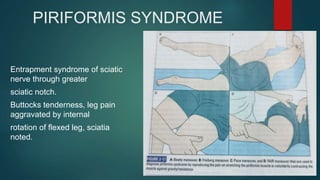
PIRIFORMIS SYNDROME
Entrapment syndrome of sciatic
nerve through greater
sciatic notch.
Buttocks tenderness, leg pain
aggravated by internal
rotation of flexed leg, sciatia
noted.
Lesions of the Common Peroneal Nerve
 1. Lesions at the fibular head
 Motor-With common peroneal neuropathies,, there is paresis or paralysis of toe
and foot dorsiflexion and of foot eversion.
 Sensory -A variable sensory disturbance affects the entire dorsum of the foot
and toes and the lateral distal portion of the lower leg.
 2. The anterior tibial (deep peroneal) nerve syndrome.
 This nerve may be injured in isolation at the fibular head or more distally in the leg.
 motor deficit (paresis or paralysis of toe and foot dorsiflexion);
 sensory deficit is limited to the web of skin located between the first and second toes
 3.The superficial peroneal nerve syndrome.
 The superficial peroneal nerve may be affected in isolation by
lesions at the fibular head or by lesions more distally in the leg.
 motor Paresis and atrophy of the peronei (foot eversion)
 sensory disturbance affecting the skin of the lateral distal portion
of the lower leg and dorsum of the foot are present
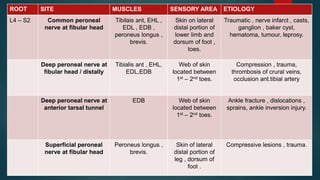
ROOT SITE MUSCLES SENSORY AREA ETIOLOGY
L4 – S2 Common peroneal
nerve at fibular head
Tibilais ant, EHL ,
EDL , EDB ,
peroneus longus ,
brevis.
Skin on lateral
distal portion of
lower limb and
dorsum of foot ,
toes.
Traumatic , nerve infarct , casts,
ganglion , baker cyst,
hematoma, tumour, leprosy.
Deep peroneal nerve at
fibular head / distally
Tibialis ant , EHL,
EDL,EDB
Web of skin
located between
1st – 2nd toes.
Compression , trauma,
thrombosis of crural veins,
occlusion ant.tibial artery
Deep peroneal nerve at
anterior tarsal tunnel
EDB Web of skin
located between
1st – 2nd toes.
Ankle fracture , dislocations ,
sprains, ankle inversion injury.
Superficial peroneal
nerve at fibular head
Peroneus longus ,
brevis.
Skin of lateral
distal portion of
leg , dorsum of
foot .
Compressive lesions , trauma.
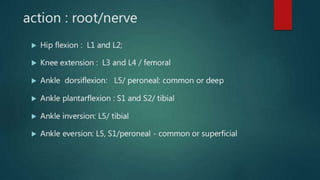
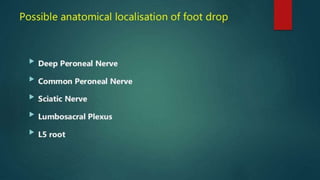
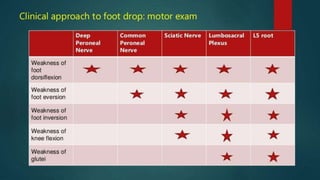
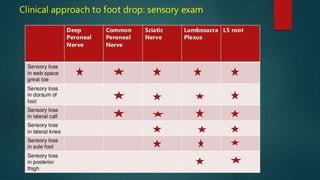
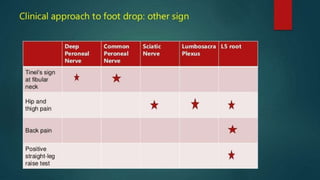
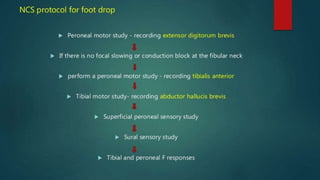
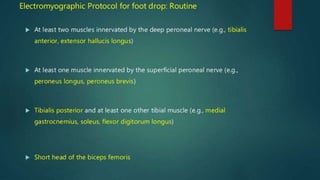
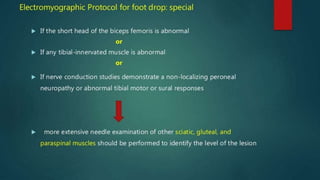
FOOT DROP LOCALISATION
THANK YOU

PERIPHERAL NERVE LL_105612.pptx

  • 1.
    PERIPHERAL NERVES OF LOWERLIMB DR.MOHINISH . S DM PED NEURO RESIDENT
  • 2.
     SCIATIC NERVEPROPER  The sciatic nerve, a mixed nerve the largest in the body, derives from the fourth and fifth lumbar and the first and second ,third sacral spinal segments.  It emerges from the sacral plexus and leaves the pelvis through the greater sciatic foramen below the piriformis muscle (infrapiriform foramen).
  • 3.
     The nervethen curves laterally and downward beneath the gluteus maximus muscle;  in the posterior aspect of the thigh, it innervates the  semitendinosus (L4–S2),  semimembranosus (L4–S2),  and biceps femoris nL4–S2) muscles (i.e., the hamstring muscles, which are flexors of the knee joint) and  the adductor magnus (L2–L4) muscle, an adductor of the thigh (which is also supplied by the obturator nerve
  • 4.
    SOMATOTROPIC ORGANIZATION : Fascicular arrangement in cross sec. of sciatic nerve through its entire course :  Fascicles emerging from L5 root = anterolateral position.  Fascicles emerging from S1 root = posteromedial position.
  • 5.
    In the poplitealfossa, it divides into its two terminal branches,  1. the tibial (medial popliteal) nerve (L4–S3)  2.common peroneal (lateral popliteal) nerve (L4–S2).
  • 6.
    Common Peroneal (Fibular)nerve. Course:  The common peroneal nerve leaves the popliteal fossa & turns around neck of fibula. Then divides into: 1. Superficial peroneal nerve to supply the Lateral compartment of the leg. 2. Deep peroneal nerve to supply the Anterior compartment of the leg
  • 8.
    Superficial peroneal N. Muscles supplied : peroneus longus peroneus brevis - Cause Ankle eversion  Sensation: skin of the lower 1/3 rd of lateral aspect of the leg and dorsum of the foot except first web space.
  • 9.
    Deep peroneal N. Branches out from common peroneal and goes medially into the anterior compartment of the leg.  Muscles: -Tibialis anterior - Extensor Hallucis Longus - Extensor Digitorum Brevis - Peroneus Tertius  These help in dorsiflexion of ankle and toes  Sensory: web space between 1st and 2nd toes
  • 10.
    Lesions of theSciatic Nerve Proper  The sciatic nerve is frequently damaged in the sacral plexus, the pelvis, the gluteal region, or at the sciatic notch.  Nerve injury may occur with  fracture dislocation of the hip with apophyseal avulsion fracture  after penetrating injury  after pelvic cancer or hip joint surgery  with infections (e.g., herpes simplex or zoster),  after radiation therapy , with gluteal hemorrhage,  or after intramuscular injection
  • 11.
     As thesciatic nerve is composed of two nerve trunks, medial and lateral, which become the tibial and peroneal nerves, respectively,  partial sciatic lesions may differentially involve these trunks and thereby cause misleading localization deficits.  Sciatic neuropathies can therefore be mistaken clinically for more distal neuropathies, especially common peroneal neuropathies or, less often, tibial neuropathies  In general, sciatic lesions tend to affect the peroneal division more than the tibial division in about 75% of cases
  • 12.
    Named sciatic neuropathies The piriformis syndrome is an entrapment syndrome - greater sciatic notch include pressure by a wallet (credit-card–wallet sciatica)  by coins in a back pocket (car toll neuropathy)  The sciatic nerve may also be compressed in the thigh as a consequence of yoga (lotus foot drop)  injured by compression against an underlying prominent lesser trochanter or even damaged because of toilet seat entrapment (toilet seat sciatic neuropathy)  A woman with profound bilateral lower extremity weakness and sensory abnormality after falling asleep  in the head-to-knees yoga position (also called Paschi mottanasana) has also been described (another form of yoga neuropathy)
  • 13.
    PIRIFORMIS SYNDROME Entrapment syndromeof sciatic nerve through greater sciatic notch. Buttocks tenderness, leg pain aggravated by internal rotation of flexed leg, sciatia noted.
  • 14.
    Lesions of theCommon Peroneal Nerve  1. Lesions at the fibular head  Motor-With common peroneal neuropathies,, there is paresis or paralysis of toe and foot dorsiflexion and of foot eversion.  Sensory -A variable sensory disturbance affects the entire dorsum of the foot and toes and the lateral distal portion of the lower leg.  2. The anterior tibial (deep peroneal) nerve syndrome.  This nerve may be injured in isolation at the fibular head or more distally in the leg.  motor deficit (paresis or paralysis of toe and foot dorsiflexion);  sensory deficit is limited to the web of skin located between the first and second toes
  • 15.
     3.The superficialperoneal nerve syndrome.  The superficial peroneal nerve may be affected in isolation by lesions at the fibular head or by lesions more distally in the leg.  motor Paresis and atrophy of the peronei (foot eversion)  sensory disturbance affecting the skin of the lateral distal portion of the lower leg and dorsum of the foot are present
  • 16.
    ROOT SITE MUSCLESSENSORY AREA ETIOLOGY L4 – S2 Common peroneal nerve at fibular head Tibilais ant, EHL , EDL , EDB , peroneus longus , brevis. Skin on lateral distal portion of lower limb and dorsum of foot , toes. Traumatic , nerve infarct , casts, ganglion , baker cyst, hematoma, tumour, leprosy. Deep peroneal nerve at fibular head / distally Tibialis ant , EHL, EDL,EDB Web of skin located between 1st – 2nd toes. Compression , trauma, thrombosis of crural veins, occlusion ant.tibial artery Deep peroneal nerve at anterior tarsal tunnel EDB Web of skin located between 1st – 2nd toes. Ankle fracture , dislocations , sprains, ankle inversion injury. Superficial peroneal nerve at fibular head Peroneus longus , brevis. Skin of lateral distal portion of leg , dorsum of foot . Compressive lesions , trauma.
  • 17.
  • 26.