Neonatal resuscitation
Lecture by Andriy Berbets
Asphyxia – it’s a syndrome characterized by
absence of breathing movements but with
presence of heartbeat of fetus
Classification:
1. Central (suppression of breathing centre)
2. Peripheric
3. May be caused by trauma, immaturity of fetus
nervous system, pharmacological depression
etc.
4. May be cased by lungs, heart dysfunction or
anemia
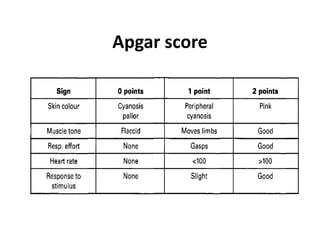
Apgar score
3 degrees of asphyxia
Mild, moderate, severe
Apgar score 6-7 (1st min) – mild
Apgar score 5-4 (1st and 5th min) – moderate
Apgar less 3 – severe

Three stages of reanimation of the newborn
1 ABC-reanimation
2 Intensive therapy
3 Reabilitation

АВС-steps
А- airways
В- breathing
С-circulation
1.
2.
3.
1.
2.
•
•
1.
2.
3.

А-step
To put the newborn in the correct position
Free the nose, mouth and trachea (if needed)
Intubation (if needed)
В-step
Tactile stimulation to cause breathing
Artificial breathing (if needed)
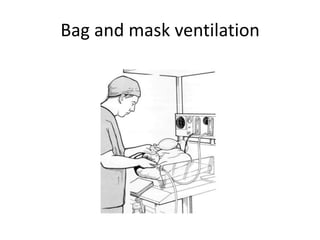
Bag and mask ventilation
Trachea intubation (if needed)
C-step
To support blood circulation
Indirect heart massage
Treatment by medication

Don’t forget about “heating chain”!
General methodfology
The necessity of further aid to the newborn
during resuscitation is based on the
simultaneous estimation of three clinical
signs:
• presence and adequacy of independent
breathing;
• frequency of heartbeat;
• color of the skin and mucous membranes.
Every 30 seconds of resuscitation of
newborn it is required:
– to estimate vital signs mentioned above;
– using general algorithm of resuscitation to decide
what to do further,
– to perform a corresponding action;
– to estimate 3 important vital signs again; to
decide, what interference is required in this
moment, and to perform it;
– to continue the cycle "estimation-decisionaction" until resuscitation is completed.
Presence and adequacy of
independent breathing
• The estimation of presence and adequacy of
independent breathing is conducted:
• right after the birth of a baby – for taking the
decision about beginning of resuscitation;
• at the end of the 1st and the 5th min (and further,
in case of necessity) – for estimation by APGAR
scale;
• during resuscitation actions;
• during staying of a newborn in the delivery room
(regardless whether the primary resuscitation
was conducted).
Signs of adequate breathing of a
newborn
• The scream and/or satisfactory excursions of
the thorax:
• The frequency and depth of respiratory movements
must grow in a few seconds after birth (for instance,
after the tactile stimulation);
• The normal frequency of breathing of a newborn is 3060 movements per 1 minute.
• Besides of frequency and depth of breathing it is
necessary to estimate symmetry of the respiratory
movements, and also presence of other respiratory
disorders: convulsive breathing, grunting breathing,
considerable retractions.
Signs of inadequate breathing of a
newborn
• Absence of breathing movements
• Convulsive respiratory movements ("gasping"
type of breathing), or bradypnea < 30 breathings
per 1 minute are ineffective.
• The appearance of expiratory grunting or other
respiratory disorders – baby needs further postresuscitational aid.
• If artificial respiration is conducted for baby, it has
to be stopped approximately for 6 seconds to
estimate presence and adequacy of independent
breathing of the newborn.
Estimation of the heartbeat of a
newborn
• Normal heartbeat frequency of a newborn is >
100 per 1 minute.
• Bradycardia < 100 heartbeats per 1 minute in
newborn is always indication for initialing
artificial respiration.
Methods of determination of
heartbeat frequency of a newborn:
– Listening the palpitation using stethoscope on the left
side of the thorax is the most reliable method.
– Palpation of pulsation on the basis of umbilical cord
directly in the area of its connection to the frontal
abdominal wall is useful to exclude bradycardia.
– Heartbeat frequency of a newborn is counted during 6
seconds. The result is multiplied on 10.
– While counting heartbeat frequency of a newborn
artificial respiration and indirect cardiac massage have
to be stopped.
Estimation of the color of the mucous
membranes and skin
• Presence and changes of central cyanosis should be
observed. It is determined as a dark blue color of mucous
membranes, lips and skin of trunk of a newborn.
• Acrocyanosis (blue color of palms and feet of a newborn)
without central cyanosis usually is not indicative of a low
oxygen level in the blood of a newborn. However, it can
testify to the presence of cold-provoked stress
(hypothermia) of a newborn.
• Paleness or presence of a marble pattern of the newborn’s
skin can be non-specific signs of decreased heartbeat
volume, severe anaemia (including hemolytic),
hypovolemia, hypothermia or acidosis of a newborn.
Maintenance of passability of the
respiratory tract in case of clean
amniotic fluid
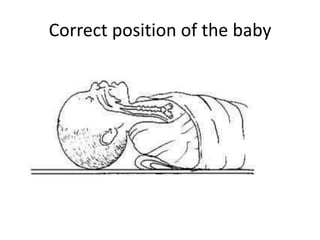
To put the child in supine position (on the back) or lying on its side. The
head should be slightly extended, a bolster should be placed under
the shoulders. Conduct aspiration (sucking-out) procedure at first
from the mouth, then – from the nose. General rules:
• to use a disposable rubber bulb for aspiration of secretion and
mucus; in case of absence of disposable rubber bulbs sterile
disposable catheters can be used;
• during aspiration do not insert a catheter or bulb too vigorously or
too deeply (not deeper than 3 cm from the level of lips for a fullterm newborn and 2 cm for a premature baby);
• to perform aspiration briefly and carefully. The bulb or catheter
should be removed slowly. The duration of aspiration should not
not exceed 5 seconds.
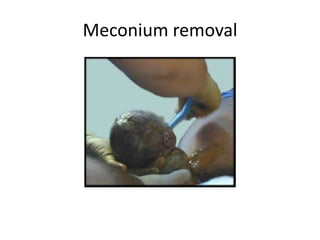
Meconium removal
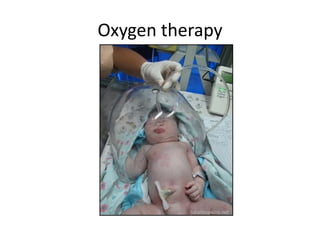
Oxygen therapy
• Presence of central cyanosis in a baby is the
indication to supply free stream of oxygen,
regardless of adequate independent breathing
and heartbeat frequency > 100 per minute.
• A newborn who gets an additional oxygen in
delivery room (or in the operating-room) must
be under the permanent supervision of
medical personnel.
Oxygen therapy
• Give a free oxygen stream in the direction to
the nose of a baby. Speed of free oxygen
stream should not exceed 5 liters per minute,
to prevent supercooling of a baby.
• Equipment for the oxygen therapy:
- oxygenation tube;
- breathing sack filled with oxygen stream, and
resuscitation mask;
- oxygenation “tent”
Oxygen therapy
Artificial ventilation of lungs by sack
and mask
Indications for artificial respiration by sack and mask:
• Absent or inadequate independent breathing after initial steps
of resuscitation, conducted during 30 seconds after the child
birth.
• The heartbeat frequency of a newborn < 100 per 1 minute
regardless of presence and adequacy of independent
breathing after initial steps of aid, conducted during 30
seconds after the child birth.
• Stable central cyanosis, in spite of presence of adequate
independent breathing, heartbeat frequency of a newborn >
100 per 1 minute and supplement of free stream of 100 %
oxygen during at least 5 minutes.
Bag and mask ventilation
Indications for artificial respiration by
100% oxygen
• Critical condition of a newborn: absence of
independent breathing, muscle tonus, reaction to
irritations, paleness of the skin in case of
presence of heartbeating.
• Absence of positive changes of the state of a
newborn within 90 seconds after delivery, in spite
of effective lung ventilation by air:
• heartbeat frequency of a newborn < 100 per 1
minute after 30 seconds of ventilation;
• presence of indications for indirect cardiac
massage.
Correct position of the baby
Assessment of efficacy of reanimation
Breath evaluation
• If spontaneous breathing is present, we can
access the ECG
• If no spontaneous breath movements are
present, we start artificial breathing with
90-100 % of oxygen
Heartbeat evaluation
Heartbeat (HB) is more then 100 per min:
1. If there is spontaneous breathing, and HB is more then 100/min,
we stop artificial breathing (AB) and evaluate cyanosis of the
skin
2. If there is no spontaneous breathing, we continue AB
3. If there is less then 100 HB per min, AB has to be continued:
•
Heartbeat is 60-100 beats – continue AB
•
Heartbeat is less then 60 min – indirect heart massage
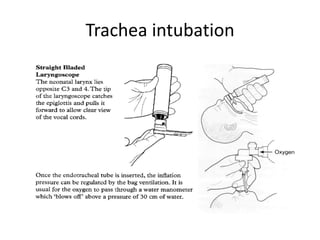
Indications for intubation:
•
•
•
•

Long-time AB
Aspiration by meconium
Diaphragmal hernia
No effect from bag/mask artificial breathing

Medication for C-step
•
•
•
•

Adrenalin
Infusive solutions
Solution of soda (NaHCO3) for acidosis correction
Antagonists of narcotic drugs (naloxon 0.1 mg/kg)
i.v. or per os
Trachea intubation
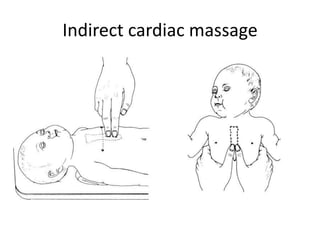
Indirect cardiac massage
Frequency of pressure on the thorax is 90 for 1 minute.
It is important to coordinate indirect massage of the
heart with artificial respiration, avoiding simultaneous
implementation of both procedures:
• after each three pressures on the breastbone make a
pause for realization of artificial ventilation of the
lungs. After this the pressures are repeated;
• during every two seconds of resuscitation it is needed
to press on the breastbone 3 times (90 presses per 1
min) and to conduct 1 ventilation action (30 actions
per 1 min), altogether - 120 actions per 1 minute have
to be performed.
Indirect cardiac massage
Criteria of efficiency of indirect cardiac
massage
• the increase of frequency of the heartbeat of a
newborn,
• the possibility to define pulsation on the humeral
artery.
Stop indirect cardiac massage, if the heartbeat
frequency of a newborn is more than 60 beats
per minute.
After each 30 seconds of indirect cardiac massage
repeatedly estimate the heartbeat and breathing
of a newborn to decide what to do further.
Indications for adrenaline
(epinephrine)
• HB < 60/min after 30 sec of AB 100% O2
• Absence of heartbeat
Solution 1:10000

Infusion therapy
Ringer’s solution (5-10 ml/kg) in umbilical vein
Blood plasma (indications only!)
0,9% NaCl
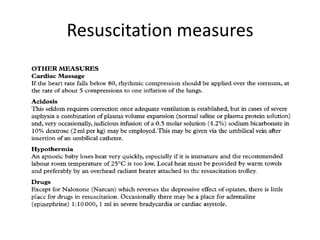
Resuscitation measures
Thank you!

Neonatal resuscitation

  • 1.
  • 2.
    Asphyxia – it’sa syndrome characterized by absence of breathing movements but with presence of heartbeat of fetus Classification: 1. Central (suppression of breathing centre) 2. Peripheric 3. May be caused by trauma, immaturity of fetus nervous system, pharmacological depression etc. 4. May be cased by lungs, heart dysfunction or anemia
  • 3.
  • 4.
    3 degrees ofasphyxia Mild, moderate, severe Apgar score 6-7 (1st min) – mild Apgar score 5-4 (1st and 5th min) – moderate Apgar less 3 – severe Three stages of reanimation of the newborn 1 ABC-reanimation 2 Intensive therapy 3 Reabilitation АВС-steps А- airways В- breathing С-circulation
  • 5.
    1. 2. 3. 1. 2. • • 1. 2. 3. А-step To put thenewborn in the correct position Free the nose, mouth and trachea (if needed) Intubation (if needed) В-step Tactile stimulation to cause breathing Artificial breathing (if needed) Bag and mask ventilation Trachea intubation (if needed) C-step To support blood circulation Indirect heart massage Treatment by medication Don’t forget about “heating chain”!
  • 6.
    General methodfology The necessityof further aid to the newborn during resuscitation is based on the simultaneous estimation of three clinical signs: • presence and adequacy of independent breathing; • frequency of heartbeat; • color of the skin and mucous membranes.
  • 7.
    Every 30 secondsof resuscitation of newborn it is required: – to estimate vital signs mentioned above; – using general algorithm of resuscitation to decide what to do further, – to perform a corresponding action; – to estimate 3 important vital signs again; to decide, what interference is required in this moment, and to perform it; – to continue the cycle "estimation-decisionaction" until resuscitation is completed.
  • 8.
    Presence and adequacyof independent breathing • The estimation of presence and adequacy of independent breathing is conducted: • right after the birth of a baby – for taking the decision about beginning of resuscitation; • at the end of the 1st and the 5th min (and further, in case of necessity) – for estimation by APGAR scale; • during resuscitation actions; • during staying of a newborn in the delivery room (regardless whether the primary resuscitation was conducted).
  • 9.
    Signs of adequatebreathing of a newborn • The scream and/or satisfactory excursions of the thorax: • The frequency and depth of respiratory movements must grow in a few seconds after birth (for instance, after the tactile stimulation); • The normal frequency of breathing of a newborn is 3060 movements per 1 minute. • Besides of frequency and depth of breathing it is necessary to estimate symmetry of the respiratory movements, and also presence of other respiratory disorders: convulsive breathing, grunting breathing, considerable retractions.
  • 10.
    Signs of inadequatebreathing of a newborn • Absence of breathing movements • Convulsive respiratory movements ("gasping" type of breathing), or bradypnea < 30 breathings per 1 minute are ineffective. • The appearance of expiratory grunting or other respiratory disorders – baby needs further postresuscitational aid. • If artificial respiration is conducted for baby, it has to be stopped approximately for 6 seconds to estimate presence and adequacy of independent breathing of the newborn.
  • 11.
    Estimation of theheartbeat of a newborn • Normal heartbeat frequency of a newborn is > 100 per 1 minute. • Bradycardia < 100 heartbeats per 1 minute in newborn is always indication for initialing artificial respiration.
  • 12.
    Methods of determinationof heartbeat frequency of a newborn: – Listening the palpitation using stethoscope on the left side of the thorax is the most reliable method. – Palpation of pulsation on the basis of umbilical cord directly in the area of its connection to the frontal abdominal wall is useful to exclude bradycardia. – Heartbeat frequency of a newborn is counted during 6 seconds. The result is multiplied on 10. – While counting heartbeat frequency of a newborn artificial respiration and indirect cardiac massage have to be stopped.
  • 13.
    Estimation of thecolor of the mucous membranes and skin • Presence and changes of central cyanosis should be observed. It is determined as a dark blue color of mucous membranes, lips and skin of trunk of a newborn. • Acrocyanosis (blue color of palms and feet of a newborn) without central cyanosis usually is not indicative of a low oxygen level in the blood of a newborn. However, it can testify to the presence of cold-provoked stress (hypothermia) of a newborn. • Paleness or presence of a marble pattern of the newborn’s skin can be non-specific signs of decreased heartbeat volume, severe anaemia (including hemolytic), hypovolemia, hypothermia or acidosis of a newborn.
  • 14.
    Maintenance of passabilityof the respiratory tract in case of clean amniotic fluid To put the child in supine position (on the back) or lying on its side. The head should be slightly extended, a bolster should be placed under the shoulders. Conduct aspiration (sucking-out) procedure at first from the mouth, then – from the nose. General rules: • to use a disposable rubber bulb for aspiration of secretion and mucus; in case of absence of disposable rubber bulbs sterile disposable catheters can be used; • during aspiration do not insert a catheter or bulb too vigorously or too deeply (not deeper than 3 cm from the level of lips for a fullterm newborn and 2 cm for a premature baby); • to perform aspiration briefly and carefully. The bulb or catheter should be removed slowly. The duration of aspiration should not not exceed 5 seconds.
  • 15.
  • 16.
    Oxygen therapy • Presenceof central cyanosis in a baby is the indication to supply free stream of oxygen, regardless of adequate independent breathing and heartbeat frequency > 100 per minute. • A newborn who gets an additional oxygen in delivery room (or in the operating-room) must be under the permanent supervision of medical personnel.
  • 17.
    Oxygen therapy • Givea free oxygen stream in the direction to the nose of a baby. Speed of free oxygen stream should not exceed 5 liters per minute, to prevent supercooling of a baby. • Equipment for the oxygen therapy: - oxygenation tube; - breathing sack filled with oxygen stream, and resuscitation mask; - oxygenation “tent”
  • 18.
  • 19.
    Artificial ventilation oflungs by sack and mask Indications for artificial respiration by sack and mask: • Absent or inadequate independent breathing after initial steps of resuscitation, conducted during 30 seconds after the child birth. • The heartbeat frequency of a newborn < 100 per 1 minute regardless of presence and adequacy of independent breathing after initial steps of aid, conducted during 30 seconds after the child birth. • Stable central cyanosis, in spite of presence of adequate independent breathing, heartbeat frequency of a newborn > 100 per 1 minute and supplement of free stream of 100 % oxygen during at least 5 minutes.
  • 20.
    Bag and maskventilation
  • 21.
    Indications for artificialrespiration by 100% oxygen • Critical condition of a newborn: absence of independent breathing, muscle tonus, reaction to irritations, paleness of the skin in case of presence of heartbeating. • Absence of positive changes of the state of a newborn within 90 seconds after delivery, in spite of effective lung ventilation by air: • heartbeat frequency of a newborn < 100 per 1 minute after 30 seconds of ventilation; • presence of indications for indirect cardiac massage.
  • 22.
  • 23.
    Assessment of efficacyof reanimation Breath evaluation • If spontaneous breathing is present, we can access the ECG • If no spontaneous breath movements are present, we start artificial breathing with 90-100 % of oxygen
  • 24.
    Heartbeat evaluation Heartbeat (HB)is more then 100 per min: 1. If there is spontaneous breathing, and HB is more then 100/min, we stop artificial breathing (AB) and evaluate cyanosis of the skin 2. If there is no spontaneous breathing, we continue AB 3. If there is less then 100 HB per min, AB has to be continued: • Heartbeat is 60-100 beats – continue AB • Heartbeat is less then 60 min – indirect heart massage
  • 25.
    Indications for intubation: • • • • Long-timeAB Aspiration by meconium Diaphragmal hernia No effect from bag/mask artificial breathing Medication for C-step • • • • Adrenalin Infusive solutions Solution of soda (NaHCO3) for acidosis correction Antagonists of narcotic drugs (naloxon 0.1 mg/kg) i.v. or per os
  • 26.
  • 27.
    Indirect cardiac massage Frequencyof pressure on the thorax is 90 for 1 minute. It is important to coordinate indirect massage of the heart with artificial respiration, avoiding simultaneous implementation of both procedures: • after each three pressures on the breastbone make a pause for realization of artificial ventilation of the lungs. After this the pressures are repeated; • during every two seconds of resuscitation it is needed to press on the breastbone 3 times (90 presses per 1 min) and to conduct 1 ventilation action (30 actions per 1 min), altogether - 120 actions per 1 minute have to be performed.
  • 28.
  • 29.
    Criteria of efficiencyof indirect cardiac massage • the increase of frequency of the heartbeat of a newborn, • the possibility to define pulsation on the humeral artery. Stop indirect cardiac massage, if the heartbeat frequency of a newborn is more than 60 beats per minute. After each 30 seconds of indirect cardiac massage repeatedly estimate the heartbeat and breathing of a newborn to decide what to do further.
  • 30.
    Indications for adrenaline (epinephrine) •HB < 60/min after 30 sec of AB 100% O2 • Absence of heartbeat Solution 1:10000 Infusion therapy Ringer’s solution (5-10 ml/kg) in umbilical vein Blood plasma (indications only!) 0,9% NaCl
  • 31.
  • 32.