Neonatal Resuscitation
Submitted by :- Submitted to:-
Vishwamitra Pandey Dr. N. Sujatha
Roll no-91 Dr. Priyanka Wadhwa
Dr. Payal Thakur
Dr. Bharat Sethi
Dr. Ritu Jyani
Contents
INTRODUCTION
NEONATAL RESUSCITATION
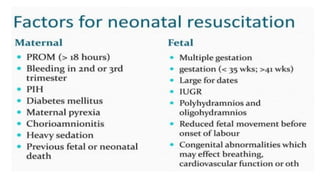
FACTORS FOR NEONATAL RESUSCITATION
APGAR SCORE
STEPS IN NEONATAL RESUSCITATION
Neonatal Resuscitation
Globally, about ¼ of all newborn deaths are caused by
asphyxia at birth, which can be prevented by effective and
rapid resuscitation.
Series of actions, used to assist newborns with difficulty
making the physiological ‘transition’ to extra-uterine life
They are emergency procedures to support newborns that are
not breathing, are gasping or have a weak heartbeat at birth.
• About 10% will require some assistance at birth to begin
breathing
Facilities/Equipments for Neonatal
Resuscitation
• The first 60 seconds after delivery is critical
• The need for resuscitation is often unexpected, therefore, one need
to have:
• A warm labor room with good light sources to assess the baby
• Equipment
• Resuscitation bed, over head warmer (infrared heater), towel,
stethoscope, pulse oximeter
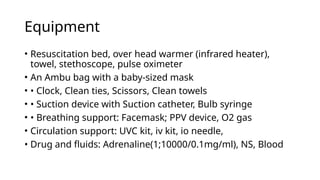
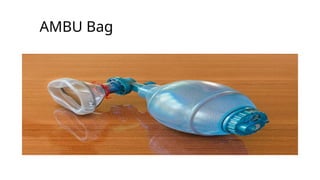
• An Ambu bag with a baby-sized mask
Clock, Clean ties, Scissors, Clean towels
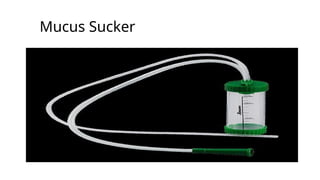
Suction device with Suction catheter, Bulb syringe
Equipment
• Resuscitation bed, over head warmer (infrared heater),
towel, stethoscope, pulse oximeter
• An Ambu bag with a baby-sized mask
• • Clock, Clean ties, Scissors, Clean towels
• • Suction device with Suction catheter, Bulb syringe
• • Breathing support: Facemask; PPV device, O2 gas
• Circulation support: UVC kit, iv kit, io needle,
• Drug and fluids: Adrenaline(1;10000/0.1mg/ml), NS, Blood
AMBU Bag
Mucus Sucker
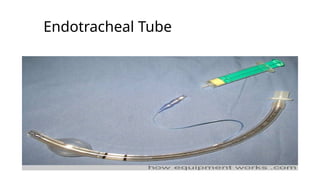
Endotracheal Tube
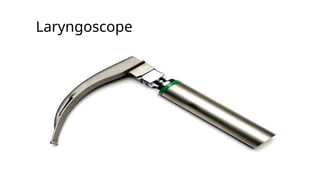
Laryngoscope
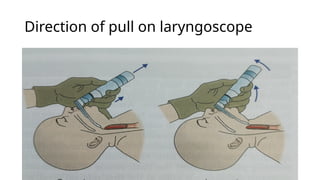
Direction of pull on laryngoscope
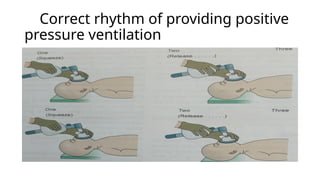
Correct rhythm of providing positive
pressure ventilation
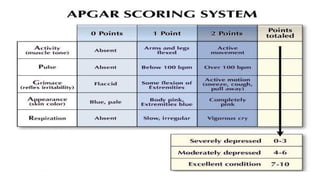
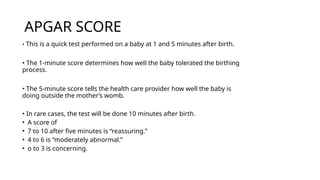
APGAR SCORE
• This is a quick test performed on a baby at 1 and 5 minutes after birth.
• The 1-minute score determines how well the baby tolerated the birthing
process.
• The 5-minute score tells the health care provider how well the baby is
doing outside the mother’s womb.
• In rare cases, the test will be done 10 minutes after birth.
• A score of
• 7 to 10 after five minutes is “reassuring.”
• 4 to 6 is “moderately abnormal.”
• o to 3 is concerning.
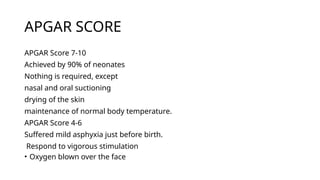
APGAR SCORE
APGAR Score 7-10
Achieved by 90% of neonates
Nothing is required, except
nasal and oral suctioning
drying of the skin
maintenance of normal body temperature.
APGAR Score 4-6
Suffered mild asphyxia just before birth.
Respond to vigorous stimulation
• Oxygen blown over the face
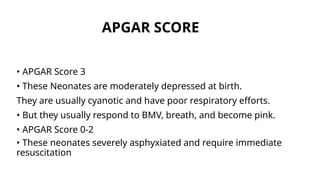
APGAR SCORE
• APGAR Score 3
• These Neonates are moderately depressed at birth.
They are usually cyanotic and have poor respiratory efforts.
• But they usually respond to BMV, breath, and become pink.
• APGAR Score 0-2
• These neonates severely asphyxiated and require immediate
resuscitation
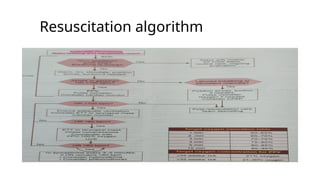
Resuscitation algorithm
Anticipation of Resuscitation Need
Anticipation, adequate preparation, accurate evaluation, and
prompt initiation of support are critical for successful
neonatal resuscitation.
At every delivery at least 1 person required whose primary
responsibility is the newly born.
• This person must be capable of initiating resuscitation,
including administration of PPV and chest compressions.
“the Golden Minute”
≈60 sec for initial steps, reevaluating, and beginning
ventilation if required.
The decision to progress beyond initial steps is determined by
simultaneous assessment of:
Respirations (apnea, gasping, or labored or unlabored
breathing)
• HR (whether < 100/min or > 100/min)
Steps in Resuscitation
ceive one or more of the following action in sequence:
tabilization
ons
Administration of epinephrine and/or volume expansion
Initial Steps
To provide warmth by placing the baby under a radiant heat
source,
Positioning the head in a “sniffing” position to open the
airway,
Clearing the airway if necessary with a bulb syringe or suction
catheter,
Drying the baby, and
• Stimulating respiration.
Keeping the baby warm
Immediately after birth, the baby is wrapped in a dry, warm
towel and rubbed gently, to stimulate breathing.
The baby’s back and soles of feet is rubbed gently also for five
seconds to stimulate breathing.
• The baby is dried with warmed towels or blankets to avoid
lowering of body heat.
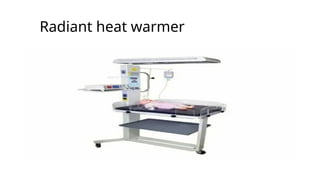
Radiant heat warmer
Additional warming techniques
Pre-warming the delivery room to 26°C,
Covering the baby in plastic wrapping (food or medical grade,
heat-resistant plastic)
Placing the baby on an exothermic mattress,
• Placing the baby under radiant heat.
Clearing the airway
-Suctioning
Clear the airway by sucking mouth secretions with a bulb
syringe quickly within five seconds.
Suctioning immediately after birth should be reserved for
babies who have obvious obstruction to spontaneous
breathing.
When Amniotic Fluid Is Clear,
Deep Suctioning is avoided
nasopharynx bradycardia during resuscitation.
→
• Remove thick meconium (if present) using a wide port tube.
Clearing the airway
-Suctioning contradictions
When Meconium is Present,
Suctioning, Chest physical therapy, and postural drainage
done every 30 min for 2 hrs and hourly thereafter for the next
6 hrs help remove residual meconium from the lung.
All neonates born after meconium aspiration should be
observed for 24 hrs
• because they can develop Persistent Fetal Circulation
syndrome.
Clamping and cutting the cord
If the baby is breathing adequately, then the doctor will
Keep the baby at the same height as the placenta or below
the placenta until the cord is clamped to enhance blood
transfusion.
Clamp the cord approximately one to three minutes after
birth to minimize anemia (low red blood cells in the blood).
• Return the baby to the mother for skin-to-skin contact to
keep the baby warm.
Opening the airway for breathing
If the baby is still not breathing, to open the airways
They will be kept on a flat surface on their back.
Their head will be kept in a neutral position (parallel to the
surface).
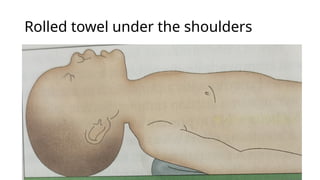
• A two to three centimeter thick folded towel will be placed
beneath their shoulders.
Rolled towel under the shoulders
Keeping the baby breathing
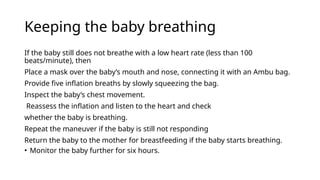
If the baby still does not breathe with a low heart rate (less than 100
beats/minute), then
Place a mask over the baby’s mouth and nose, connecting it with an Ambu bag.
Provide five inflation breaths by slowly squeezing the bag.
Inspect the baby’s chest movement.
Reassess the inflation and listen to the heart and check
whether the baby is breathing.
Repeat the maneuver if the baby is still not responding
Return the baby to the mother for breastfeeding if the baby starts breathing.
• Monitor the baby further for six hours.
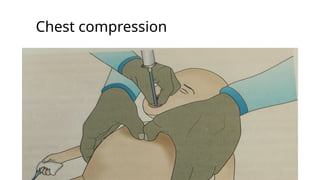
Chest compression
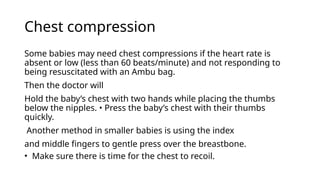
Some babies may need chest compressions if the heart rate is
absent or low (less than 60 beats/minute) and not responding to
being resuscitated with an Ambu bag.
Then the doctor will
Hold the baby’s chest with two hands while placing the thumbs
below the nipples. • Press the baby’s chest with their thumbs
quickly.
Another method in smaller babies is using the index
and middle fingers to gentle press over the breastbone.
• Make sure there is time for the chest to recoil.
Chest compression
Chest compression contradictions
Provide three chest compressions to one breath with the help of an
attendant.
A 3:1 compression to ventilation ratio is used where ventilation
compromise is the primary cause, but rescuers should consider
using higher ratios if the arrest is believed to be of cardiac origin.
Continue chest compression until the baby’s heart rate gets to
normal.
• Check for responses by listening to the baby’s heart rate every 30
seconds to one minute and see chest movements with each
breath, after each intervention.
Chest compression contradictions
Compressions should be delivered on the lower third of the
sternum to a depth of =1/3rd
of the AP diameter of the chest.
indicated when HR < 60/min despite adequate PPV with O2 for 30
seconds.
Rescuers should ensure that assisted ventilation is
being delivered optimally before starting chest compressions
because
ventilation is the most effective action and
• chest compressions are likely to compete with effective
ventilation,
RESUSCITATION DRUGS
• If the HR remains < 60/min despite adequate ventilation and chest
compressions with100% O2,
adrenaline or volume expansion or both are indicated
• IV is the preferred route: UVC is preferable to intraosseous
• Recommended IV dose is 0.01-0.03 mg/kg/dose; rapid bolus followed
by 1ml of 0.9% NS flush
• Intratracheal dose is higher(0.05 to 0.1 mg/kg); 1:10,000 (0.1 mg/mL);
• Can be repeated every 5 minutes, if HR remains < 60/min.
Treatment of Hypovolemia
Best be done with blood and crystalloids
If hypovolemia is suspected at birth, Rhnegative type O
PRBCs should be available in delivery room before neonate is
born.
Crystalloid and blood should be titrated in 10 mL/kg and
given slowly over 10 minutes.
• In most cases, <10-20 mL/kg of volume restores mean
arterial pressure to normal.
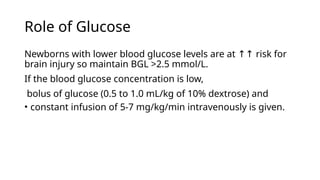
Role of Glucose
Newborns with lower blood glucose levels are at risk for
↑↑
brain injury so maintain BGL >2.5 mmol/L.
If the blood glucose concentration is low,
bolus of glucose (0.5 to 1.0 mL/kg of 10% dextrose) and
• constant infusion of 5-7 mg/kg/min intravenously is given.
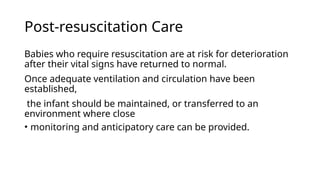
Post-resuscitation Care
Babies who require resuscitation are at risk for deterioration
after their vital signs have returned to normal.
Once adequate ventilation and circulation have been
established,
the infant should be maintained, or transferred to an
environment where close
• monitoring and anticipatory care can be provided.
Monitoring required may include:
Oxygen saturation (SpO2)
Heart rate and ECG
Respiratory rate and pattern
Blood glucose measurement
Blood gas analysis
Fluid balance and nutrition
Blood pressure
Temperature
• Neurological
Discontinuing Resuscitative Efforts
In a newly born baby with no detectable HR, resuscitation are
discontinued if the HR remains
undetectable for 10 min. • Resuscitation efforts beyond 10
min with no HR should be considered if presumed etiology of
the
• arrest, gestation of the baby, and the parental desire.
When should a doctor stop
resuscitation?
In the majority of cases, the above steps are enough to save a baby.
Even after this if there is no improvement, infants may require
tracheal intubation
if endotracheal (ET) administration of medications is desired,
congenital diaphragmatic hernia is suspected or
there is a prolonged need for assisted ventilation.
Such measures are only done in a neonatal intensive care unit
(NICU) supervised by an experienced doctor.
• Each country’s guidelines vary as to when a doctor should stop
resuscitation attempts (from 10 to 20 minutes after birth).
References
1 . Suraj gupte
2. O.P ghai
3. Wikipedia
4. Google Scholars
Thank you

Neonatal Resuscitation 3.pptxhhgghjhgfgh

  • 1.
    Neonatal Resuscitation Submitted by:- Submitted to:- Vishwamitra Pandey Dr. N. Sujatha Roll no-91 Dr. Priyanka Wadhwa Dr. Payal Thakur Dr. Bharat Sethi Dr. Ritu Jyani
  • 2.
    Contents INTRODUCTION NEONATAL RESUSCITATION FACTORS FORNEONATAL RESUSCITATION APGAR SCORE STEPS IN NEONATAL RESUSCITATION
  • 3.
    Neonatal Resuscitation Globally, about¼ of all newborn deaths are caused by asphyxia at birth, which can be prevented by effective and rapid resuscitation. Series of actions, used to assist newborns with difficulty making the physiological ‘transition’ to extra-uterine life They are emergency procedures to support newborns that are not breathing, are gasping or have a weak heartbeat at birth. • About 10% will require some assistance at birth to begin breathing
  • 4.
    Facilities/Equipments for Neonatal Resuscitation •The first 60 seconds after delivery is critical • The need for resuscitation is often unexpected, therefore, one need to have: • A warm labor room with good light sources to assess the baby • Equipment • Resuscitation bed, over head warmer (infrared heater), towel, stethoscope, pulse oximeter • An Ambu bag with a baby-sized mask Clock, Clean ties, Scissors, Clean towels Suction device with Suction catheter, Bulb syringe
  • 5.
    Equipment • Resuscitation bed,over head warmer (infrared heater), towel, stethoscope, pulse oximeter • An Ambu bag with a baby-sized mask • • Clock, Clean ties, Scissors, Clean towels • • Suction device with Suction catheter, Bulb syringe • • Breathing support: Facemask; PPV device, O2 gas • Circulation support: UVC kit, iv kit, io needle, • Drug and fluids: Adrenaline(1;10000/0.1mg/ml), NS, Blood
  • 6.
  • 7.
  • 8.
  • 9.
  • 10.
    Direction of pullon laryngoscope
  • 11.
    Correct rhythm ofproviding positive pressure ventilation
  • 14.
    APGAR SCORE • Thisis a quick test performed on a baby at 1 and 5 minutes after birth. • The 1-minute score determines how well the baby tolerated the birthing process. • The 5-minute score tells the health care provider how well the baby is doing outside the mother’s womb. • In rare cases, the test will be done 10 minutes after birth. • A score of • 7 to 10 after five minutes is “reassuring.” • 4 to 6 is “moderately abnormal.” • o to 3 is concerning.
  • 15.
    APGAR SCORE APGAR Score7-10 Achieved by 90% of neonates Nothing is required, except nasal and oral suctioning drying of the skin maintenance of normal body temperature. APGAR Score 4-6 Suffered mild asphyxia just before birth. Respond to vigorous stimulation • Oxygen blown over the face
  • 16.
    APGAR SCORE • APGARScore 3 • These Neonates are moderately depressed at birth. They are usually cyanotic and have poor respiratory efforts. • But they usually respond to BMV, breath, and become pink. • APGAR Score 0-2 • These neonates severely asphyxiated and require immediate resuscitation
  • 17.
  • 18.
    Anticipation of ResuscitationNeed Anticipation, adequate preparation, accurate evaluation, and prompt initiation of support are critical for successful neonatal resuscitation. At every delivery at least 1 person required whose primary responsibility is the newly born. • This person must be capable of initiating resuscitation, including administration of PPV and chest compressions.
  • 19.
    “the Golden Minute” ≈60sec for initial steps, reevaluating, and beginning ventilation if required. The decision to progress beyond initial steps is determined by simultaneous assessment of: Respirations (apnea, gasping, or labored or unlabored breathing) • HR (whether < 100/min or > 100/min)
  • 20.
    Steps in Resuscitation ceiveone or more of the following action in sequence: tabilization ons Administration of epinephrine and/or volume expansion
  • 21.
    Initial Steps To providewarmth by placing the baby under a radiant heat source, Positioning the head in a “sniffing” position to open the airway, Clearing the airway if necessary with a bulb syringe or suction catheter, Drying the baby, and • Stimulating respiration.
  • 22.
    Keeping the babywarm Immediately after birth, the baby is wrapped in a dry, warm towel and rubbed gently, to stimulate breathing. The baby’s back and soles of feet is rubbed gently also for five seconds to stimulate breathing. • The baby is dried with warmed towels or blankets to avoid lowering of body heat.
  • 23.
  • 24.
    Additional warming techniques Pre-warmingthe delivery room to 26°C, Covering the baby in plastic wrapping (food or medical grade, heat-resistant plastic) Placing the baby on an exothermic mattress, • Placing the baby under radiant heat.
  • 25.
    Clearing the airway -Suctioning Clearthe airway by sucking mouth secretions with a bulb syringe quickly within five seconds. Suctioning immediately after birth should be reserved for babies who have obvious obstruction to spontaneous breathing. When Amniotic Fluid Is Clear, Deep Suctioning is avoided nasopharynx bradycardia during resuscitation. → • Remove thick meconium (if present) using a wide port tube.
  • 26.
    Clearing the airway -Suctioningcontradictions When Meconium is Present, Suctioning, Chest physical therapy, and postural drainage done every 30 min for 2 hrs and hourly thereafter for the next 6 hrs help remove residual meconium from the lung. All neonates born after meconium aspiration should be observed for 24 hrs • because they can develop Persistent Fetal Circulation syndrome.
  • 27.
    Clamping and cuttingthe cord If the baby is breathing adequately, then the doctor will Keep the baby at the same height as the placenta or below the placenta until the cord is clamped to enhance blood transfusion. Clamp the cord approximately one to three minutes after birth to minimize anemia (low red blood cells in the blood). • Return the baby to the mother for skin-to-skin contact to keep the baby warm.
  • 28.
    Opening the airwayfor breathing If the baby is still not breathing, to open the airways They will be kept on a flat surface on their back. Their head will be kept in a neutral position (parallel to the surface). • A two to three centimeter thick folded towel will be placed beneath their shoulders.
  • 29.
    Rolled towel underthe shoulders
  • 30.
    Keeping the babybreathing If the baby still does not breathe with a low heart rate (less than 100 beats/minute), then Place a mask over the baby’s mouth and nose, connecting it with an Ambu bag. Provide five inflation breaths by slowly squeezing the bag. Inspect the baby’s chest movement. Reassess the inflation and listen to the heart and check whether the baby is breathing. Repeat the maneuver if the baby is still not responding Return the baby to the mother for breastfeeding if the baby starts breathing. • Monitor the baby further for six hours.
  • 31.
    Chest compression Some babiesmay need chest compressions if the heart rate is absent or low (less than 60 beats/minute) and not responding to being resuscitated with an Ambu bag. Then the doctor will Hold the baby’s chest with two hands while placing the thumbs below the nipples. • Press the baby’s chest with their thumbs quickly. Another method in smaller babies is using the index and middle fingers to gentle press over the breastbone. • Make sure there is time for the chest to recoil.
  • 32.
  • 33.
    Chest compression contradictions Providethree chest compressions to one breath with the help of an attendant. A 3:1 compression to ventilation ratio is used where ventilation compromise is the primary cause, but rescuers should consider using higher ratios if the arrest is believed to be of cardiac origin. Continue chest compression until the baby’s heart rate gets to normal. • Check for responses by listening to the baby’s heart rate every 30 seconds to one minute and see chest movements with each breath, after each intervention.
  • 34.
    Chest compression contradictions Compressionsshould be delivered on the lower third of the sternum to a depth of =1/3rd of the AP diameter of the chest. indicated when HR < 60/min despite adequate PPV with O2 for 30 seconds. Rescuers should ensure that assisted ventilation is being delivered optimally before starting chest compressions because ventilation is the most effective action and • chest compressions are likely to compete with effective ventilation,
  • 35.
    RESUSCITATION DRUGS • Ifthe HR remains < 60/min despite adequate ventilation and chest compressions with100% O2, adrenaline or volume expansion or both are indicated • IV is the preferred route: UVC is preferable to intraosseous • Recommended IV dose is 0.01-0.03 mg/kg/dose; rapid bolus followed by 1ml of 0.9% NS flush • Intratracheal dose is higher(0.05 to 0.1 mg/kg); 1:10,000 (0.1 mg/mL); • Can be repeated every 5 minutes, if HR remains < 60/min.
  • 36.
    Treatment of Hypovolemia Bestbe done with blood and crystalloids If hypovolemia is suspected at birth, Rhnegative type O PRBCs should be available in delivery room before neonate is born. Crystalloid and blood should be titrated in 10 mL/kg and given slowly over 10 minutes. • In most cases, <10-20 mL/kg of volume restores mean arterial pressure to normal.
  • 37.
    Role of Glucose Newbornswith lower blood glucose levels are at risk for ↑↑ brain injury so maintain BGL >2.5 mmol/L. If the blood glucose concentration is low, bolus of glucose (0.5 to 1.0 mL/kg of 10% dextrose) and • constant infusion of 5-7 mg/kg/min intravenously is given.
  • 38.
    Post-resuscitation Care Babies whorequire resuscitation are at risk for deterioration after their vital signs have returned to normal. Once adequate ventilation and circulation have been established, the infant should be maintained, or transferred to an environment where close • monitoring and anticipatory care can be provided.
  • 39.
    Monitoring required mayinclude: Oxygen saturation (SpO2) Heart rate and ECG Respiratory rate and pattern Blood glucose measurement Blood gas analysis Fluid balance and nutrition Blood pressure Temperature • Neurological
  • 40.
    Discontinuing Resuscitative Efforts Ina newly born baby with no detectable HR, resuscitation are discontinued if the HR remains undetectable for 10 min. • Resuscitation efforts beyond 10 min with no HR should be considered if presumed etiology of the • arrest, gestation of the baby, and the parental desire.
  • 41.
    When should adoctor stop resuscitation? In the majority of cases, the above steps are enough to save a baby. Even after this if there is no improvement, infants may require tracheal intubation if endotracheal (ET) administration of medications is desired, congenital diaphragmatic hernia is suspected or there is a prolonged need for assisted ventilation. Such measures are only done in a neonatal intensive care unit (NICU) supervised by an experienced doctor. • Each country’s guidelines vary as to when a doctor should stop resuscitation attempts (from 10 to 20 minutes after birth).
  • 42.
    References 1 . Surajgupte 2. O.P ghai 3. Wikipedia 4. Google Scholars
  • 43.