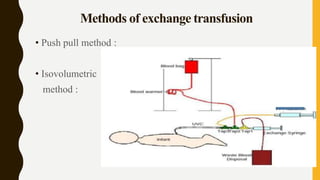
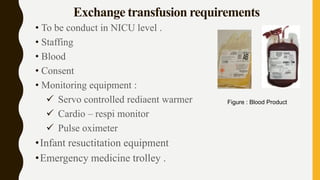
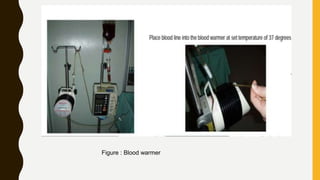
An exchange transfusion involves slowly removing a patient's blood and replacing it with donor blood in order to remove abnormal components and toxins while maintaining blood volume. It is indicated for hyperbilirubinemia, Rhesus/ABO incompatibility, severe anemia, and other conditions. The procedure requires specialized equipment and staffing in a NICU. Blood is warmed and infused using either a push-pull or isovolumetric method while carefully monitoring the infant. Potential complications include blood clots, changes in blood chemistry, heart/lung problems, and low risk of infection.

Introduction
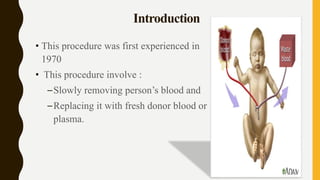
• This procedurewas first experienced in
1970
• This procedure involve :
–Slowly removing person’s blood and
–Replacing it with fresh donor blood or
plasma.
3.
Definition
• An exchangetransfusion involves removing aliquots of patient
blood and replacing with donor blood in order to remove abnormal
blood components and circulating toxins while maintaining
adequate circulating blood volume.
4.
Indication
• Hyperbilirubinea :
Serumbilirubin 5mg /dl at birth
Serum bilirubin is equal or more than 20 mg / dl ( term ) , 15
mg / dl ( preterm) at anytime in first week of life.
• Rhesus / ABO incompability
• Severe anemia
• Hydrops fetalis
• Other :
Hyperkalemia
DCI
Neonatal polycythemia
Drugs toxicity
Contd…
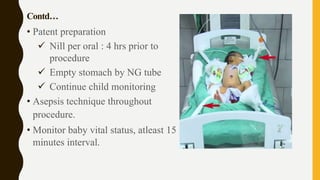
• Patent preparation
Nill per oral : 4 hrs prior to
procedure
Empty stomach by NG tube
Continue child monitoring
• Asepsis technique throughout
procedure.
• Monitor baby vital status, atleast 15
minutes interval.
10.
Complications
• Blood clots
•Changes in blood chemistry (high or low potassium, low
calcium, low glucose, change in acid-base balance in the blood)
• Heart and lung problems
• Infection (very low risk due to careful screening of blood)