“Necrosis is the morphological changes that follow cell
death in a living tissue or organ,
 Resulting from the progressive degenerative action of
enzymes on the lethally injured cell.”
So,
Necrosis begins with an impairment of the cell’s ability
to maintain homeostasis, leading
to an influx of water and extracellular ions
Anoxia
Ischemia
Physical agents
Chemical agents
Biological agents
Hypersenstivity
Necrotic changes in tissues are caused By
Digestion of cell by enzymes
Denaturation of proteins
Digestion of cell by enzymes
This digestion is of two types
 Autolysis: Digestion of cell by enzymes derived
from their own lyosomes
 Heterolysis: Digestion of cell by enzymes derived
from lysosmes of leukocytes.
Denaturation of proteins caused by intracellular
acidosis
and due to this result is that:
Injury to the cell membrane
Severe impairment of phosphorylation of cell
Increase permeability of the cell
Influx of Na+ and Ca+ in the cell
Decreased intracellular activity of the cell
 Changes inside the cell
 Changes in mitochondria
 Changes in Nucleus
 Changes in cytoplasm
Endoplasmic reticulum is disorganized
There is rupture of membrane
Ribosomes are shed off
Disorganization of polysomes & their structures
Mitochondria become swallon
Loss of interamitochondrial granules
Loss of cristae & change their shape
Rupture of outer membrane of Mitochondria
Nucleus becomes smaller
Chromatin loses & become clumped
 Nucleus shows following changes
Pyknosis
Karyorrhexis
Karyolysis
PYKNOSIS
“When the dna is broken down by endonucleases
fragments are formed & the nucleus becomes acid
and stains basophillic”
KARYORRHEXIS
“The pyknotic nucleus may break up into fragments
and disappear. This process is called karyorrhexis”
KARYOLYSIS
“The pyknotic nucleus may undergo lysis by the
enzyme DNAse”
 Cytoplasm becomes more eosinophilic:
Due to loss of Rna & denaturation of cytoplasmic proteins
 Cytoplasm becomes opaque.
Basic types
Coagulative necrosis
Liquefactive necrosis
Caseous necrosis
In special sites
Fat necrosis
Fibrinoid necrosis
Gangrenous necrosis
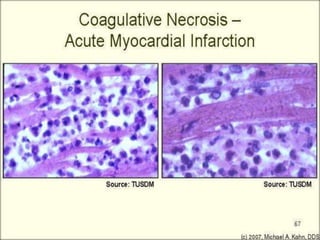
“In this type of necrosis, the necrotic cell retains
its
cellular outline for several days”
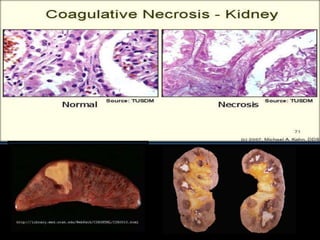
Coagulative necrosis typically occurs in solid
organs such as kidney, heart and adrenal gland
usually as a result of deficient blood supply
and anoxia.
Examples
Denaturation of protein is the basic mechanism of
coagulative necrosis
The injury and the subsequent increasing acidosis
denatures not only the structural proteins but also
the enzymic proteins, thus blocking the cellular
proteolysis.
Morphology
Preservation of basic structural outline of the
coagulated cells
Appears as a mass of coagulated, pink staining
homogenous cytoplasm
It is the type of necrosis that occurs due to autolytic
and
heterolytic actions of enzymes that convert the
proteins
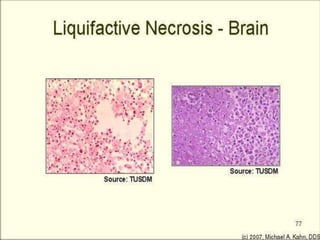
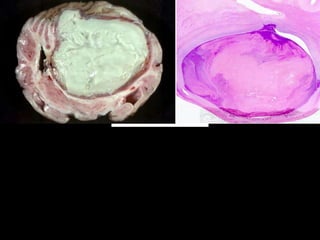
of cells into liquid.
 It is characterized by softening and liquifaction of
tissue.
Examples
Ischemic necrosis of brain
Suppurative inflammation.
Enzymatic degradation of proteins is the basic
mechanism of liquefactive necrosis
Morphology
o Complete loss of cellular detail
o Cellular outline is also destroyed
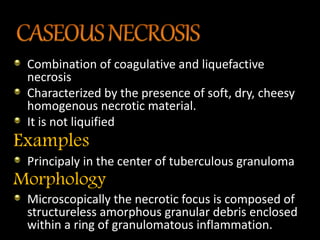
Combination of coagulative and liquefactive
necrosis
Characterized by the presence of soft, dry, cheesy
homogenous necrotic material.
It is not liquified
Examples
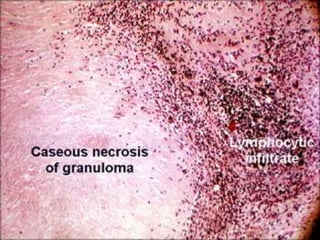
Principaly in the center of tuberculous granuloma
Morphology
Microscopically the necrotic focus is composed of
structureless amorphous granular debris enclosed
within a ring of granulomatous inflammation.
It occurs in two forms:
Enzymatic fat necrosis
Traumatic fat necrosis
 Most commonly seen in acute pancreatitis.
“Refers to the necrosis in adipose tissue, induced
by the action of pancreatic enzymes which are
lead due to trauma to the pancreas”
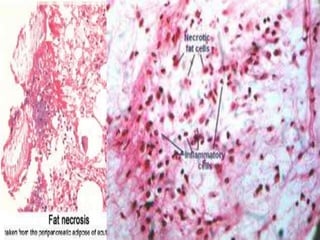
Morphology
Chalky white opaque spots surrounded by
inflammatory margins are seen
Necrotic area shows acute inflammatory
changes with dissolved fat cells
It occur following severe injury to the tissues with
high fat content such as the breast,
subcutaneous tissue and abdomen.
Morphology
Foam cells and giant cells are seen.
 necrotic foci contain a lot of phagocytes
containing fat known as foam cells
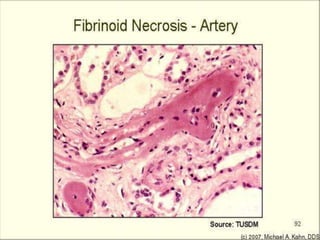
Type of connective tissue necrosis especially
affecting arterial walls.
 Mostly seen in two conditions
Auto immune diseases e.g
Rheumaic fever
Malignant hypertension
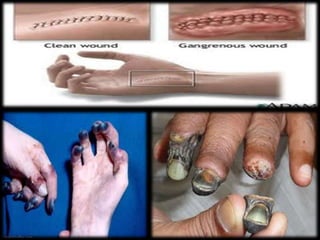
Gangrene is the necrosis of tissue with superadded
putrefaction (enzymatic decomposition).
It is the clinical condition in which extensive tissue
necrosis is complicated to a variable degree by
secondary bacterial infection.
Gangrene= Necrosis + infection + putrefaction
 Arterial obstructon due to:
Thrombosis of atherosclerotic artery
Embolus
Diabetes:- atherosclerotic artery , loss of sensation
results repeated trauma & increase chances of
infection
 Infection
Gas gangrene
Gangrene of scrotum
 Trauma
Crush injuries
 Physical agents
Burns
Chemicals
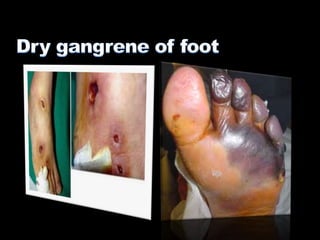
Dry gangrene
Wet gangrene
Gas gangrene
It is usually secondary to slow occlusive vascular
disease
Etiology
Gradual loss of arterial supply to an organ or tissue as
happens in
Arteriosclerosis
Trauma
Ergot poisoning
Common sites
 limbs; especially foot
It is a traditional term used to describe the
infarction of the limbs.
It is not true gangrene because the infection in
necrotic tissue is insignificant and putrefaction
is absent or minimal.
The necrotic area becomes black due to
breakdown of hemoglobin and formation of
iron sulfide
It is a type of gangrene in which tissue appears moist.
It results from severe bacterial infection superimposed on
necrosis
Pathogenesis
It is a true gangrene because it shows the severe infection
and putrefaction of tissue with edema and foul smell.
Arterial obstruction present.
blackening of the tissue is due to formation of iron sulphide
It is not clearly demarcated from adjacent healthy tissues.
Common sites
 Intestine
 Appendix
 Limbs
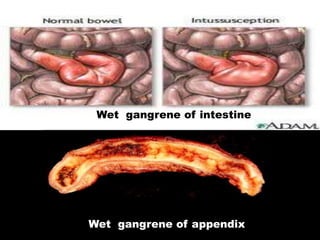
Wet gangrene of intestine
Wet gangrene of appendix
“In this type of gangrene bacterial infection causes necrosis
and then gangrene with abundant gas formation in the tissue”
Gas gangrene=wet gangrene + gas formation
Predisposing factors
Foreign bodies in wound cause tissue ischemia
Foreign bodies favour infection
Contamination of wound by soil is dangerous because its
ionisable calcium salts and silicic acid may lead to tissue
necrosis.
Infection by aerobic organisms at the same time serve to
produce anaerobic environment that is favorable for
anaerobic clostridia.
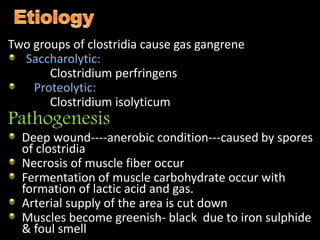
Two groups of clostridia cause gas gangrene
Saccharolytic:
Clostridium perfringens
Proteolytic:
Clostridium isolyticum
Pathogenesis
Deep wound----anerobic condition---caused by spores
of clostridia
Necrosis of muscle fiber occur
Fermentation of muscle carbohydrate occur with
formation of lactic acid and gas.
Arterial supply of the area is cut down
Muscles become greenish- black due to iron sulphide
& foul smell
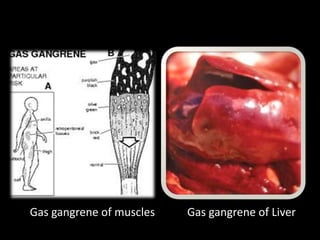
Muscles
Liver
Complicatons
Rapidly spreading gangrene
Shock and hemolytic anemia
Treatment of gangrene
Treatment of predisposing factor:
Amputation:
Surgical removal of gangrene tissue to prevent
spreading of
the infection to the healthy tissue.
Gas gangrene of muscles Gas gangrene of Liver
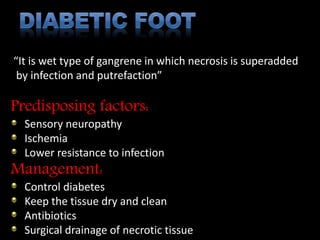
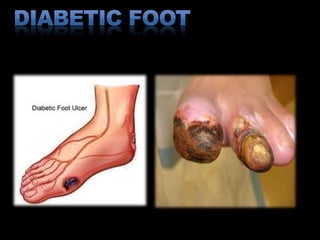
“It is wet type of gangrene in which necrosis is superadded
by infection and putrefaction”
Predisposing factors:
Sensory neuropathy
Ischemia
Lower resistance to infection
Management:
Control diabetes
Keep the tissue dry and clean
Antibiotics
Surgical drainage of necrotic tissue
Necrosis class

Necrosis class

  • 1.
    “Necrosis is themorphological changes that follow cell death in a living tissue or organ,  Resulting from the progressive degenerative action of enzymes on the lethally injured cell.” So, Necrosis begins with an impairment of the cell’s ability to maintain homeostasis, leading to an influx of water and extracellular ions
  • 2.
  • 3.
    Necrotic changes intissues are caused By Digestion of cell by enzymes Denaturation of proteins Digestion of cell by enzymes This digestion is of two types  Autolysis: Digestion of cell by enzymes derived from their own lyosomes  Heterolysis: Digestion of cell by enzymes derived from lysosmes of leukocytes.
  • 4.
    Denaturation of proteinscaused by intracellular acidosis and due to this result is that: Injury to the cell membrane Severe impairment of phosphorylation of cell Increase permeability of the cell Influx of Na+ and Ca+ in the cell Decreased intracellular activity of the cell
  • 5.
     Changes insidethe cell  Changes in mitochondria  Changes in Nucleus  Changes in cytoplasm
  • 6.
    Endoplasmic reticulum isdisorganized There is rupture of membrane Ribosomes are shed off Disorganization of polysomes & their structures Mitochondria become swallon Loss of interamitochondrial granules Loss of cristae & change their shape Rupture of outer membrane of Mitochondria
  • 7.
    Nucleus becomes smaller Chromatinloses & become clumped  Nucleus shows following changes Pyknosis Karyorrhexis Karyolysis
  • 8.
    PYKNOSIS “When the dnais broken down by endonucleases fragments are formed & the nucleus becomes acid and stains basophillic” KARYORRHEXIS “The pyknotic nucleus may break up into fragments and disappear. This process is called karyorrhexis” KARYOLYSIS “The pyknotic nucleus may undergo lysis by the enzyme DNAse”
  • 9.
     Cytoplasm becomesmore eosinophilic: Due to loss of Rna & denaturation of cytoplasmic proteins  Cytoplasm becomes opaque.
  • 10.
    Basic types Coagulative necrosis Liquefactivenecrosis Caseous necrosis In special sites Fat necrosis Fibrinoid necrosis Gangrenous necrosis
  • 11.
    “In this typeof necrosis, the necrotic cell retains its cellular outline for several days” Coagulative necrosis typically occurs in solid organs such as kidney, heart and adrenal gland usually as a result of deficient blood supply and anoxia. Examples
  • 12.
    Denaturation of proteinis the basic mechanism of coagulative necrosis The injury and the subsequent increasing acidosis denatures not only the structural proteins but also the enzymic proteins, thus blocking the cellular proteolysis. Morphology Preservation of basic structural outline of the coagulated cells Appears as a mass of coagulated, pink staining homogenous cytoplasm
  • 15.
    It is thetype of necrosis that occurs due to autolytic and heterolytic actions of enzymes that convert the proteins of cells into liquid.  It is characterized by softening and liquifaction of tissue. Examples Ischemic necrosis of brain Suppurative inflammation.
  • 16.
    Enzymatic degradation ofproteins is the basic mechanism of liquefactive necrosis Morphology o Complete loss of cellular detail o Cellular outline is also destroyed
  • 19.
    Combination of coagulativeand liquefactive necrosis Characterized by the presence of soft, dry, cheesy homogenous necrotic material. It is not liquified Examples Principaly in the center of tuberculous granuloma Morphology Microscopically the necrotic focus is composed of structureless amorphous granular debris enclosed within a ring of granulomatous inflammation.
  • 21.
    It occurs intwo forms: Enzymatic fat necrosis Traumatic fat necrosis
  • 22.
     Most commonlyseen in acute pancreatitis. “Refers to the necrosis in adipose tissue, induced by the action of pancreatic enzymes which are lead due to trauma to the pancreas” Morphology Chalky white opaque spots surrounded by inflammatory margins are seen Necrotic area shows acute inflammatory changes with dissolved fat cells
  • 23.
    It occur followingsevere injury to the tissues with high fat content such as the breast, subcutaneous tissue and abdomen. Morphology Foam cells and giant cells are seen.  necrotic foci contain a lot of phagocytes containing fat known as foam cells
  • 25.
    Type of connectivetissue necrosis especially affecting arterial walls.  Mostly seen in two conditions Auto immune diseases e.g Rheumaic fever Malignant hypertension
  • 27.
    Gangrene is thenecrosis of tissue with superadded putrefaction (enzymatic decomposition). It is the clinical condition in which extensive tissue necrosis is complicated to a variable degree by secondary bacterial infection. Gangrene= Necrosis + infection + putrefaction
  • 29.
     Arterial obstructondue to: Thrombosis of atherosclerotic artery Embolus Diabetes:- atherosclerotic artery , loss of sensation results repeated trauma & increase chances of infection  Infection Gas gangrene Gangrene of scrotum  Trauma Crush injuries  Physical agents Burns Chemicals
  • 30.
  • 31.
    It is usuallysecondary to slow occlusive vascular disease Etiology Gradual loss of arterial supply to an organ or tissue as happens in Arteriosclerosis Trauma Ergot poisoning Common sites  limbs; especially foot
  • 32.
    It is atraditional term used to describe the infarction of the limbs. It is not true gangrene because the infection in necrotic tissue is insignificant and putrefaction is absent or minimal. The necrotic area becomes black due to breakdown of hemoglobin and formation of iron sulfide
  • 34.
    It is atype of gangrene in which tissue appears moist. It results from severe bacterial infection superimposed on necrosis Pathogenesis It is a true gangrene because it shows the severe infection and putrefaction of tissue with edema and foul smell. Arterial obstruction present. blackening of the tissue is due to formation of iron sulphide It is not clearly demarcated from adjacent healthy tissues. Common sites  Intestine  Appendix  Limbs
  • 35.
    Wet gangrene ofintestine Wet gangrene of appendix
  • 36.
    “In this typeof gangrene bacterial infection causes necrosis and then gangrene with abundant gas formation in the tissue” Gas gangrene=wet gangrene + gas formation Predisposing factors Foreign bodies in wound cause tissue ischemia Foreign bodies favour infection Contamination of wound by soil is dangerous because its ionisable calcium salts and silicic acid may lead to tissue necrosis. Infection by aerobic organisms at the same time serve to produce anaerobic environment that is favorable for anaerobic clostridia.
  • 37.
    Two groups ofclostridia cause gas gangrene Saccharolytic: Clostridium perfringens Proteolytic: Clostridium isolyticum Pathogenesis Deep wound----anerobic condition---caused by spores of clostridia Necrosis of muscle fiber occur Fermentation of muscle carbohydrate occur with formation of lactic acid and gas. Arterial supply of the area is cut down Muscles become greenish- black due to iron sulphide & foul smell
  • 38.
    Muscles Liver Complicatons Rapidly spreading gangrene Shockand hemolytic anemia Treatment of gangrene Treatment of predisposing factor: Amputation: Surgical removal of gangrene tissue to prevent spreading of the infection to the healthy tissue.
  • 39.
    Gas gangrene ofmuscles Gas gangrene of Liver
  • 40.
    “It is wettype of gangrene in which necrosis is superadded by infection and putrefaction” Predisposing factors: Sensory neuropathy Ischemia Lower resistance to infection Management: Control diabetes Keep the tissue dry and clean Antibiotics Surgical drainage of necrotic tissue