PREVENTION AND TREATMENT
DISTINCTION BETWEEN
 ACCIDENTS - events that occur during surgery
 COMPLICATIONS – all the conditions that appear

postoperatively
~early stage complications appear in the immediate
postoperative period & interfere with healing
~late stage: during the process of osseointegration.
EARLY STAGE COMPLICATIONS
INVOLVE : maxillary sinus or mandibular bone

soft tissues & nerve trunks adjacent
to the implant site.
•CAUSES - excessively traumatic surgical
approach
-bone overheating during osteotomy
-bacterial contamination of the host
site.
DURING FIRST FEW POST-OPERATIVE DAYS
-edema, exudate & pain.
CAUSES: bacterial contamination during surgery
~directly or indirectly.
PREVENTION- of the infection mainly depends on asepsis
-sterile working area
-disinfection of perioral skin with povidone
iodine & alcohol
-disinfection of oral mucosa with 0.2% Chx
(studies have shown reduction in infections 4.1% test group
8.7% control group by Chx use)
EDEMA
 ACCUMULATION OF EXCESS PLASMA FLUID

(transudate) in the interstitial spaces (at least 10%
increase)
 Edema is related to extent of surgical trauma & duration of
surgery .
 Negatively affects healing, and causes discomfort during
food intake & oral hygiene maintenance.
 Prevention - atraumatic surgical technique
- minimal tissue damage
- ice packs & administration of corticosteroids
ECCHYMOSES & HAEMATOMAS
 NOT COMMON
 CAUSES - long & complex procedures

- lack of patient compliance with the
instructions given for the postoperative period
-vessel fragility(esp. in elderly pt.)
-failure to discontinue anti-platelet
therapy before surgery
• MANAGEMENT- topical skin application of heparin
containing medications.
EMPHYSEMA
 Rare complication; from a sudden rise of the intra-oral

pressure. ie when the pt. sneezes
 CLINICALLY - swelling of half of face; extending
at times to neck & thorax
- crackling sound heard upon palpation
• MANAGEMENT-massages & compression with
ice packs .
• PREVENTION- avoid use of high velocity instruments to
prepare the bone bed or irrigation of the wound with
hydrogen peroxide.
BLEEDING
 Causes - failure to stabilize flap

-tearing of soft tissues
-masticatory trauma
-early temporization and inappropriately
modified temporary prosthesis.
• MANAGEMENT- compression & tamponade
with
surgical gauzes soaked in tranexamic acid.
- if bleeding persists, re-elevate flap, remove
clotted blood & place new sutures to immobilize the
soft tissue and promote clot formn. And stabilization.
FLAP DEHISCENCE
 Is the opening of the surgical wound edges exposing

implant head &/or surrounding bone tissue.

 Causes - thin mucosa

- failure to ensure passive re-approximation &
closure of flap margins (thus unable to counter
intramural mechanical stress- due to muscle and
bone interaction)
- insufficient or extensive tension on the
suture(leads to soft tissue necrosis)
- functional movements, mastication,
phonation or deglutition.
Causes contd..
- Previous radiation therapy which affects flap
vascularity
- Incomplete tightening of the cover screw (due to
presence of blood residues)
- Bone debris trapped under the periosteum
- Cigarette smoking & local effects of nicotine
(cytotoxic & vasoactive substances) & systemic
(altered granulocytes & T-cells), impaired production
of antibodies & vasomotor substances.
Treatment - based on extent of exposure
If small

If large

 no surgical correction, as

 removing the sutures &

the granulation tissue
which forms would
promote healing .
 granulation tissue
formation process lasting
>2 wks may require
refreshing the epithelial
wound margins

re-suturing.
Prevention of Dehiscence :
Careful preoperative assessment of the soft tissues, to
measure the amount of keratinized mucosa present &
planning of augmentation procedures as appropriate.
1.Minimally invasive flap elevation & reflection with
careful removal of any bone debris
2.Proper suturing
3.Sensible temporization with appropriate modifications;
rebasing & relining
4.Delaying the use of removable dentures until 2 wks after
surgery
SENSORY DISORDERS
 Results from injuries to the nerve trunk
 May lead to hyperesthesia, hypoesthesia or

anesthesia.
 SYMPTOMS- numbness, tingling, hot & cold, pain,
swelling, hardening, burning, loss of saliva, prickling,
tickle, electrical shock sensation, itch.
 lower jaw more affected - lower lip 54-64%, chin 4658%, gum tissues 32-45%, tongue 11-16%
Nature of damage
Reversible

 Compression by edema

or hematomas
 Excessive stretching
(>8% elastic limit) of
the mental nerve
during flap reflection

Permanent

 Injuries to inferior

alveolar nerve or
mental nerve during
osteotomy leads to
permanent sensory
alteration along with
hyperalgesia.
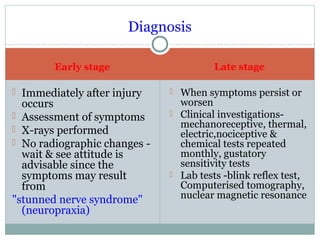
Diagnosis
Early stage
 Immediately after injury

occurs
 Assessment of symptoms
 X-rays performed
 No radiographic changes wait & see attitude is
advisable since the
symptoms may result
from
"stunned nerve syndrome"
(neuropraxia)

Late stage
 When symptoms persist or

worsen
 Clinical investigationsmechanoreceptive, thermal,
electric,nociceptive &
chemical tests repeated
monthly, gustatory
sensitivity tests
 Lab tests -blink reflex test,
Computerised tomography,
nuclear magnetic resonance
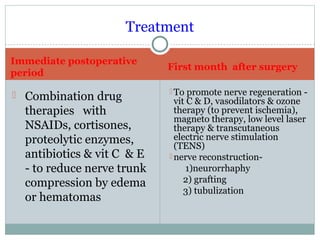
Treatment
Immediate postoperative
period

 Combination drug

therapies with
NSAIDs, cortisones,
proteolytic enzymes,
antibiotics & vit C & E
- to reduce nerve trunk
compression by edema
or hematomas

First month after surgery
 To promote nerve regeneration -

vit C & D, vasodilators & ozone
therapy (to prevent ischemia),
magneto therapy, low level laser
therapy & transcutaneous
electric nerve stimulation
(TENS)
 nerve reconstruction1)neurorrhaphy
2) grafting
3) tubulization
Late: MAXILLARY SINUSITIS
 As a result of bacterial contamination during surgery

or healing for wound dehiscence or implant
placement into sinus
 ACUTE CASES : pain, edema , swelling, reddened
soft tissues
 CHRONIC CASES: massive proliferation of mucosa,
thickening of membrane, polypoid masses filling the
sinus,decrease air in sinus and antral content become
radiopaque
Treatment
 Systemic therapy- antibiotics, Chx mouthwashes,

saline irrigation through nasal orifice & use of nasal
decongestants
 If infection worsens or a dislodged implant in sinus radical revision surgery of sinus & the antral mucosa
completely removed.
 Prevention - screening patients prior to surgery for
sinustis or predisposing factors
- prophylactic antibiotic therapy
-asepsis
MANDIBULAR FRACTURES
 Rare - occur during osseointegration, after restoration or

as a result of trauma.
 Cause unknown; but fracture lines consistently pass
through implant sites , as stresses converge & loss of bone
density occurs .
 Clinical signs : pain, swelling, impaired function & fistulae
in fracture area
 Diagnosis - clinical evaluation: movement of fractured
segment, crackling sounds, signs of infection
-radiograph: radiolucent area through implant site
Treatment
 Aligned fractures : antibiotic therapy +soft diet
 Mal-alinged fractures : reduction & immobilization

Prevention
• Bone should be 7mm in height & 6mm in width ,
•
•
•
•

if not ridge expansion or augmentation
Avoid preparation of multiple bone beds
5mm of hard tissue left between two sites
Avoid overscrewing of implant
Keep mandible at rest during healing
FAILED OSSEOINTEGRATION
 Diagnosed at phase II surgery or restoration
 Results in loss of implant
 Causes: reduced healing, occlusal loading during

osseointegration, bone overheating(>47°C for 1min;
radiographically visible after 2-4 wks)
 Diagnosis: loosened implant & muffled sound upon
percussion
 Radiographically, radiolucent margin around implant
 Treatment : removal of implant & debridement of the
area
BONE DEFECTS
Can be horizontal or vertical
CAUSES: 1. Direct trauma to bone or insult to

periosteum (reduced vascularity)
2. Decreased bone density
3. Implant placement into fresh extraction site
4. Wrong inclination of the implant
5. Excessive torque during insertion
6. Thin alveolar crest
7. Wound dehiscence during healing
8. Perforation of mucoperiosteum
9. Postoperative infection
Diagnosis
 Patients are asymptomatic, thus radiographic examination

of crestal bone-implant interface.

Treatment:
• vertical defect

a) <2mm -horizontal osteotomy
b) >2mm- autologous bone graft ; if bone loss
>25% grafting + membrane
uncovering of implant postponed by 2- 4months
Treatment contd..
 Horizontal defect

a) small- apical repositioning of soft tissues
b) large - autologous graft + membrane
uncovering of implants postponed by 3-4mnths
prevention
• Plan treatment according to quality & quantity of bone
present
PERIAPICAL IMPLANT LESION
Is a pathological area of osteolysis at the apex of an
osseo-integrated implant
Cause: 1) accidental sectioning of the neurovascular
bundle
2) pre-existing bone infection
3) foreign bodies or root fragments
4) sinus infections
5) contamination of implant
6) compression of bone debris , causing
ischemia-necrosis & bone sequestration.
Infection
MAIN CAUSES:
CONTAMINATION OF RECENTLY INSERTED IMPLANTS BY PATHOGENIC
MICROFLORA. IT MAY BE FAVORED BY PRESENCE OF NECROTIC ANT
TRAUMATIZED BONY TISSUE AND/OR IMPAIRED HOST MECHANISM.

C/F – EDEMA , SWELLING , PURULENT EXUDATE, PAIN ON PALPATION OR
FISTULAE.
RADIOGRAPHIC FEATURE- MARKED BONE RESORPTION.
TREATMENT: IF BONE IS NOT INVOLVED, A FLAP IS ELEVATED TO DRAIN
THE ABSCESS AND REMOVE GRANULATION TISSUE.
FOLLOWED BY SALINE IRRI.& ADM-LOCAL ANTIBIOTICS
IF BONE RESORPTION+, A GUIDED BONE REGENERATION PROTOCOL WILL
BE FOLLOWED.
POSTOP- ANTIBIOTIC THERAPY: IN BOTH THE ABOVE CASES
AMOX+ CLAVULANIC ACID- 2G+METRON- 750MG & .12% CHX FOR ORAL
HYGIENE.
Conclusions:
 Local complications arising during the implant

surgery are the main determinants of the outcome of
the entire rehabilitation program.
 Hence, the prevention of the complications sh be our
main objective.
 Therefore, careful clinical and radiographic
examination, accurate treatment planning, proper
planning of procedures, use of proper surgical
techniques, appropriate instruments and correct
management of healing and osseointegration are all
the important aspects in preventing the
complications.

Local Complications in Dental Implants Surgery

  • 1.
  • 2.
    DISTINCTION BETWEEN  ACCIDENTS- events that occur during surgery  COMPLICATIONS – all the conditions that appear postoperatively ~early stage complications appear in the immediate postoperative period & interfere with healing ~late stage: during the process of osseointegration.
  • 3.
    EARLY STAGE COMPLICATIONS INVOLVE: maxillary sinus or mandibular bone soft tissues & nerve trunks adjacent to the implant site. •CAUSES - excessively traumatic surgical approach -bone overheating during osteotomy -bacterial contamination of the host site.
  • 4.
    DURING FIRST FEWPOST-OPERATIVE DAYS -edema, exudate & pain. CAUSES: bacterial contamination during surgery ~directly or indirectly. PREVENTION- of the infection mainly depends on asepsis -sterile working area -disinfection of perioral skin with povidone iodine & alcohol -disinfection of oral mucosa with 0.2% Chx (studies have shown reduction in infections 4.1% test group 8.7% control group by Chx use)
  • 5.
    EDEMA  ACCUMULATION OFEXCESS PLASMA FLUID (transudate) in the interstitial spaces (at least 10% increase)  Edema is related to extent of surgical trauma & duration of surgery .  Negatively affects healing, and causes discomfort during food intake & oral hygiene maintenance.  Prevention - atraumatic surgical technique - minimal tissue damage - ice packs & administration of corticosteroids
  • 6.
    ECCHYMOSES & HAEMATOMAS NOT COMMON  CAUSES - long & complex procedures - lack of patient compliance with the instructions given for the postoperative period -vessel fragility(esp. in elderly pt.) -failure to discontinue anti-platelet therapy before surgery • MANAGEMENT- topical skin application of heparin containing medications.
  • 7.
    EMPHYSEMA  Rare complication;from a sudden rise of the intra-oral pressure. ie when the pt. sneezes  CLINICALLY - swelling of half of face; extending at times to neck & thorax - crackling sound heard upon palpation • MANAGEMENT-massages & compression with ice packs . • PREVENTION- avoid use of high velocity instruments to prepare the bone bed or irrigation of the wound with hydrogen peroxide.
  • 8.
    BLEEDING  Causes -failure to stabilize flap -tearing of soft tissues -masticatory trauma -early temporization and inappropriately modified temporary prosthesis. • MANAGEMENT- compression & tamponade with surgical gauzes soaked in tranexamic acid. - if bleeding persists, re-elevate flap, remove clotted blood & place new sutures to immobilize the soft tissue and promote clot formn. And stabilization.
  • 9.
    FLAP DEHISCENCE  Isthe opening of the surgical wound edges exposing implant head &/or surrounding bone tissue.  Causes - thin mucosa - failure to ensure passive re-approximation & closure of flap margins (thus unable to counter intramural mechanical stress- due to muscle and bone interaction) - insufficient or extensive tension on the suture(leads to soft tissue necrosis) - functional movements, mastication, phonation or deglutition.
  • 10.
    Causes contd.. - Previousradiation therapy which affects flap vascularity - Incomplete tightening of the cover screw (due to presence of blood residues) - Bone debris trapped under the periosteum - Cigarette smoking & local effects of nicotine (cytotoxic & vasoactive substances) & systemic (altered granulocytes & T-cells), impaired production of antibodies & vasomotor substances.
  • 11.
    Treatment - basedon extent of exposure If small If large  no surgical correction, as  removing the sutures & the granulation tissue which forms would promote healing .  granulation tissue formation process lasting >2 wks may require refreshing the epithelial wound margins re-suturing.
  • 12.
    Prevention of Dehiscence: Careful preoperative assessment of the soft tissues, to measure the amount of keratinized mucosa present & planning of augmentation procedures as appropriate. 1.Minimally invasive flap elevation & reflection with careful removal of any bone debris 2.Proper suturing 3.Sensible temporization with appropriate modifications; rebasing & relining 4.Delaying the use of removable dentures until 2 wks after surgery
  • 13.
    SENSORY DISORDERS  Resultsfrom injuries to the nerve trunk  May lead to hyperesthesia, hypoesthesia or anesthesia.  SYMPTOMS- numbness, tingling, hot & cold, pain, swelling, hardening, burning, loss of saliva, prickling, tickle, electrical shock sensation, itch.  lower jaw more affected - lower lip 54-64%, chin 4658%, gum tissues 32-45%, tongue 11-16%
  • 14.
    Nature of damage Reversible Compression by edema or hematomas  Excessive stretching (>8% elastic limit) of the mental nerve during flap reflection Permanent  Injuries to inferior alveolar nerve or mental nerve during osteotomy leads to permanent sensory alteration along with hyperalgesia.
  • 15.
    Diagnosis Early stage  Immediatelyafter injury occurs  Assessment of symptoms  X-rays performed  No radiographic changes wait & see attitude is advisable since the symptoms may result from "stunned nerve syndrome" (neuropraxia) Late stage  When symptoms persist or worsen  Clinical investigationsmechanoreceptive, thermal, electric,nociceptive & chemical tests repeated monthly, gustatory sensitivity tests  Lab tests -blink reflex test, Computerised tomography, nuclear magnetic resonance
  • 16.
    Treatment Immediate postoperative period  Combinationdrug therapies with NSAIDs, cortisones, proteolytic enzymes, antibiotics & vit C & E - to reduce nerve trunk compression by edema or hematomas First month after surgery  To promote nerve regeneration - vit C & D, vasodilators & ozone therapy (to prevent ischemia), magneto therapy, low level laser therapy & transcutaneous electric nerve stimulation (TENS)  nerve reconstruction1)neurorrhaphy 2) grafting 3) tubulization
  • 17.
    Late: MAXILLARY SINUSITIS As a result of bacterial contamination during surgery or healing for wound dehiscence or implant placement into sinus  ACUTE CASES : pain, edema , swelling, reddened soft tissues  CHRONIC CASES: massive proliferation of mucosa, thickening of membrane, polypoid masses filling the sinus,decrease air in sinus and antral content become radiopaque
  • 18.
    Treatment  Systemic therapy-antibiotics, Chx mouthwashes, saline irrigation through nasal orifice & use of nasal decongestants  If infection worsens or a dislodged implant in sinus radical revision surgery of sinus & the antral mucosa completely removed.  Prevention - screening patients prior to surgery for sinustis or predisposing factors - prophylactic antibiotic therapy -asepsis
  • 19.
    MANDIBULAR FRACTURES  Rare- occur during osseointegration, after restoration or as a result of trauma.  Cause unknown; but fracture lines consistently pass through implant sites , as stresses converge & loss of bone density occurs .  Clinical signs : pain, swelling, impaired function & fistulae in fracture area  Diagnosis - clinical evaluation: movement of fractured segment, crackling sounds, signs of infection -radiograph: radiolucent area through implant site
  • 20.
    Treatment  Aligned fractures: antibiotic therapy +soft diet  Mal-alinged fractures : reduction & immobilization Prevention • Bone should be 7mm in height & 6mm in width , • • • • if not ridge expansion or augmentation Avoid preparation of multiple bone beds 5mm of hard tissue left between two sites Avoid overscrewing of implant Keep mandible at rest during healing
  • 21.
    FAILED OSSEOINTEGRATION  Diagnosedat phase II surgery or restoration  Results in loss of implant  Causes: reduced healing, occlusal loading during osseointegration, bone overheating(>47°C for 1min; radiographically visible after 2-4 wks)  Diagnosis: loosened implant & muffled sound upon percussion  Radiographically, radiolucent margin around implant  Treatment : removal of implant & debridement of the area
  • 22.
    BONE DEFECTS Can behorizontal or vertical CAUSES: 1. Direct trauma to bone or insult to periosteum (reduced vascularity) 2. Decreased bone density 3. Implant placement into fresh extraction site 4. Wrong inclination of the implant 5. Excessive torque during insertion 6. Thin alveolar crest 7. Wound dehiscence during healing 8. Perforation of mucoperiosteum 9. Postoperative infection
  • 23.
    Diagnosis  Patients areasymptomatic, thus radiographic examination of crestal bone-implant interface. Treatment: • vertical defect a) <2mm -horizontal osteotomy b) >2mm- autologous bone graft ; if bone loss >25% grafting + membrane uncovering of implant postponed by 2- 4months
  • 24.
    Treatment contd..  Horizontaldefect a) small- apical repositioning of soft tissues b) large - autologous graft + membrane uncovering of implants postponed by 3-4mnths prevention • Plan treatment according to quality & quantity of bone present
  • 25.
    PERIAPICAL IMPLANT LESION Isa pathological area of osteolysis at the apex of an osseo-integrated implant Cause: 1) accidental sectioning of the neurovascular bundle 2) pre-existing bone infection 3) foreign bodies or root fragments 4) sinus infections 5) contamination of implant 6) compression of bone debris , causing ischemia-necrosis & bone sequestration.
  • 26.
    Infection MAIN CAUSES: CONTAMINATION OFRECENTLY INSERTED IMPLANTS BY PATHOGENIC MICROFLORA. IT MAY BE FAVORED BY PRESENCE OF NECROTIC ANT TRAUMATIZED BONY TISSUE AND/OR IMPAIRED HOST MECHANISM. C/F – EDEMA , SWELLING , PURULENT EXUDATE, PAIN ON PALPATION OR FISTULAE. RADIOGRAPHIC FEATURE- MARKED BONE RESORPTION. TREATMENT: IF BONE IS NOT INVOLVED, A FLAP IS ELEVATED TO DRAIN THE ABSCESS AND REMOVE GRANULATION TISSUE. FOLLOWED BY SALINE IRRI.& ADM-LOCAL ANTIBIOTICS IF BONE RESORPTION+, A GUIDED BONE REGENERATION PROTOCOL WILL BE FOLLOWED. POSTOP- ANTIBIOTIC THERAPY: IN BOTH THE ABOVE CASES AMOX+ CLAVULANIC ACID- 2G+METRON- 750MG & .12% CHX FOR ORAL HYGIENE.
  • 27.
    Conclusions:  Local complicationsarising during the implant surgery are the main determinants of the outcome of the entire rehabilitation program.  Hence, the prevention of the complications sh be our main objective.  Therefore, careful clinical and radiographic examination, accurate treatment planning, proper planning of procedures, use of proper surgical techniques, appropriate instruments and correct management of healing and osseointegration are all the important aspects in preventing the complications.