Maxillofacial surgery
Anesthetic Issues
HOSSAM M ATEF;MD
Department of Anesthesia
SUEZ CANAL UNIVERSITY
Maxillofacial surgery
• Diseases, injuries and defects in the head, neck, face, jaws and the
hard and soft tissues of the oral and Cranio-maxillofacial region
• Indications
Correction of congenital deformities
Acquired injuries
Neoplasms
Cosmetic (dental malocclusions)
ANESTHETIC IMPLICATIONS
PRE-OPERATIVE PROBLEMS
• Neonate, Elderly, Chronically Debilitated Patients
• Malnourished, under weight
• COPD ,chest infection, aspiration
• Alcoholism
• Co-existing disease such as HTN,D.M, IHD, etc.
PRE-OPERATIVE
MANAGEMENT
Adequate pre-operative work-up of Cardiac Status & Pulmonary
Functions should be carried out using various diagnostic modalities with
the objective of optimizing patient’s condition
RECONSTRUCTIVE MAXILLOFACIAL SURGERY
Problems:
 Major problem: Airway Management
 Extensive, long operation
 Significant blood loss
 Poor nutritional status
 Micro-vascular surgery
• Caution with Vasoconstrictors
• Caution with Transfusion
• Caution with Diurresis
• Blood Rheology (Hct:25-27)
INTRA-OPERATIVE MANAGEMENT
SPECIAL CONSIDERATIONS
• Two large bore canulae
• Invasive blood pressure monitoring
• Central venous pressure monitoring
• Use of muscle relaxants
• Induced hypotension
• Blood loss & transfusion
• Haemodynamic changes
• Venous air embolism
INTRA-OPERATIVE MANAGEMENT
Invasive Blood Pressure Monitoring
• is indicated due to following reasons :
• Blood loss may be rapid secondary to
• Neck dissection
• Pre operative radiotherapy
• Surgery close to big vessels of neck
• Frequent fluctuations in the blood pressure due to manipulation in the area of
carotid body and sinus.
INTRA-OPERATIVE MANAGEMENT
Central Venous Pressure Monitoring
• Risk of venous air embolism during neck dissection
• As a guide to the management of fluid therapy
• The site of insertion is either:
• Antecubital vein
• Femoral vein
INTRAOPERATIVE MANAGEMENT
Use of Muscle Relaxants
During surgery IPPV is carried out without muscle relaxant as
surgeons need to identify the nerves during surgery
Issues
• Associated defects/injuries
• Shared airway
• Anticipated/Unanticipated Difficult intubation
• Bleeding & Induced hypotension
• Emergence/Extubation
• Post-operative complications & PONV
hossam
Issues
• Associated defects/injuries
• Shared airway
• Difficult intubation
• Bleeding & Induced hypotension
• Emergence/Extubation
• PONV
Associated Injuries/Complications
• Airway compromise
• Cervical spine injury/fracture ribs
• Head trauma/Pneumocephalus /hemopneumothorax
• Subcutaneous emphysema and pneumomediastinum
• Trismus
• Hemorrhage
Issues
• Associated defects/injuries
• Shared airway
• Difficult intubation
• Bleeding & Induced hypotension
• Emergence/Extubation
• PONV
Airway sharing
• Common site of Work
• Pre-op discussion & planning helpful
• Intraop assesssment of facial symmetry, mouth opening & teeth
occlusion
• Extra vigilance for tube dislodgement,kinking
Issues
• Associated defects/injuries
• Shared airway
• Difficult intubation
• Bleeding & Induced hypotension
• Emergence/Extubation
• PONV
 Documented History of Difficulties with general anesthesia or,
more specifically, mask ventilation or endotracheal intubation
 Congenital Syndromes Associated With Difficult Endotracheal
Intubation
 Pathologic States That Influence Airway Management
Congenital Syndromes Associated With Difficult Endotracheal Intubation
• SYNDROME
• Down
• Large tongue, small mouth ; small subglottic diameter possible Laryngospasm frequent
• Goldenhar
• Mandibular hypoplasia and cervical spine abnormality
• Klippel-Feil
• Neck rigidity because of cervical vertebral fusion
• Pierre Robin
• Small mouth, large tongue, mandibular anomaly; awake intubation essential in neonate
• Treacher Collins (mandibulofacial dysostosis) Laryngoscopy difficult
• Turner
• High likelihood of difficult intubation
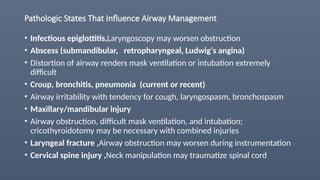
Pathologic States That Influence Airway Management
• Infectious epiglottitis,Laryngoscopy may worsen obstruction
• Abscess (submandibular, retropharyngeal, Ludwig‘s angina)
• Distortion of airway renders mask ventilation or intubation extremely
difficult
• Croup, bronchitis, pneumonia (current or recent)
• Airway irritability with tendency for cough, laryngospasm, bronchospasm
• Maxillary/mandibular injury
• Airway obstruction, difficult mask ventilation, and intubation;
cricothyroidotomy may be necessary with combined injuries
• Laryngeal fracture ,Airway obstruction may worsen during instrumentation
• Cervical spine injury ,Neck manipulation may traumatize spinal cord
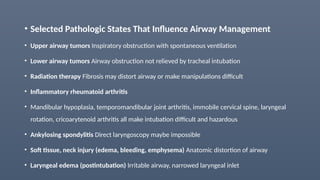
• Selected Pathologic States That Influence Airway Management
• Upper airway tumors Inspiratory obstruction with spontaneous ventilation
• Lower airway tumors Airway obstruction not relieved by tracheal intubation
• Radiation therapy Fibrosis may distort airway or make manipulations difficult
• Inflammatory rheumatoid arthritis
• Mandibular hypoplasia, temporomandibular joint arthritis, immobile cervical spine, laryngeal
rotation, cricoarytenoid arthritis all make intubation difficult and hazardous
• Ankylosing spondylitis Direct laryngoscopy maybe impossible
• Soft tissue, neck injury (edema, bleeding, emphysema) Anatomic distortion of airway
• Laryngeal edema (postintubation) Irritable airway, narrowed laryngeal inlet
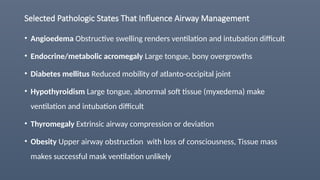
Selected Pathologic States That Influence Airway Management
• Angioedema Obstructive swelling renders ventilation and intubation difficult
• Endocrine/metabolic acromegaly Large tongue, bony overgrowths
• Diabetes mellitus Reduced mobility of atlanto-occipital joint
• Hypothyroidism Large tongue, abnormal soft tissue (myxedema) make
ventilation and intubation difficult
• Thyromegaly Extrinsic airway compression or deviation
• Obesity Upper airway obstruction with loss of consciousness, Tissue mass
makes successful mask ventilation unlikely
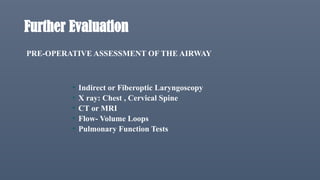
Further Evaluation
PRE-OPERATIVE ASSESSMENT OF THE AIRWAY
• Indirect or Fiberoptic Laryngoscopy
• X ray: Chest , Cervical Spine
• CT or MRI
• Flow- Volume Loops
• Pulmonary Function Tests
Difficult Airway
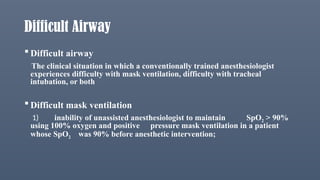
 Difficult airway
The clinical situation in which a conventionally trained anesthesiologist
experiences difficulty with mask ventilation, difficulty with tracheal
intubation, or both
 Difficult mask ventilation
1) inability of unassisted anesthesiologist to maintain SpO2 > 90%
using 100% oxygen and positive pressure mask ventilation in a patient
whose SpO2 was 90% before anesthetic intervention;
Difficult Airway
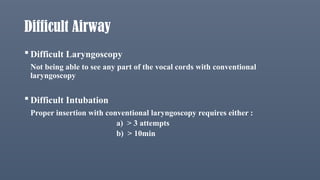
 Difficult Laryngoscopy
Not being able to see any part of the vocal cords with conventional
laryngoscopy
 Difficult Intubation
Proper insertion with conventional laryngoscopy requires either :
a) > 3 attempts
b) > 10min
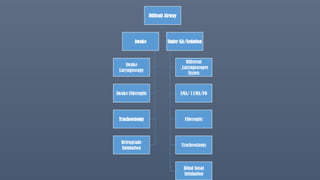
Difficult Airway
Awake
Awake
Laryngoscopy
Awake Fiberoptic
Tracheostomy
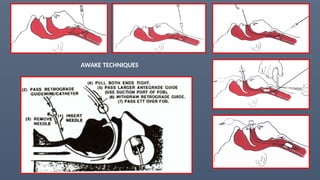
Retrograde
Intubation
Under GA/Sedation
Different
Laryngoscopes
,
Stylets
LMA/ I LMA/FO
Fiberoptic
Tracheostomy
Blind Nasal
Intubation
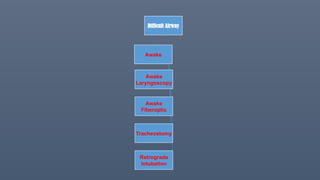
Difficult Airway
Awake
Awake
Laryngoscopy
Awake
Fiberoptic
Tracheostomy
Retrograde
Intubation
AWAKE TECHNIQUES
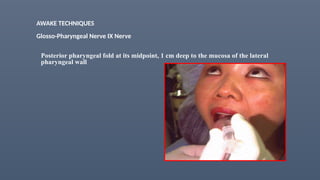
Glosso-Pharyngeal Nerve IX Nerve
Posterior pharyngeal fold at its midpoint, 1 cm deep to the mucosa of the lateral
pharyngeal wall
AWAKE TECHNIQUES
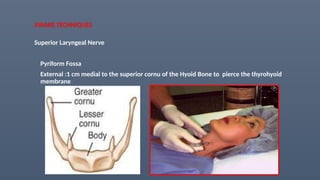
Superior Laryngeal Nerve
Pyriform Fossa
External :1 cm medial to the superior cornu of the Hyoid Bone to pierce the thyrohyoid
membrane
AWAKE TECHNIQUES
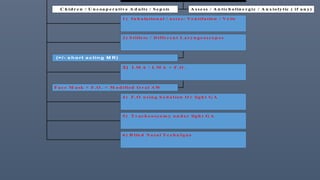
C h id r e n / U n c oa p e ra tiv e A d u lts / S e p sis A sse ss / A n tic h o lin e r g ic / A n x io ly tic ( if a n y)
1 ) In h a la tio n a l / a sse s: Ve n tila tio n / V e iw
(=/- short a cting M R)
2 ) S tille te / D iffe r en t L a ry n g e osc o p es
F a c e M a sk + F. O . + M o d ified O r a l A W
3) L M A / L M A + F .O .
4 ) F. O u sin g S e d a tion O r lig h t G A
5 ) T r ac h e o syo m y u n d e r lig h t G A
6 ) B lin d N a sa l T e c h n iq u e
Anticipated problems
• 1.Anticipated difficult airway
• 2.Restricted ability to open the mouth
• 3.Possibility of cervical spine fracture
• 4.Possibility of concurrent base skull fracture
• 5. Full stomach (emergency cases)
Methods available
• Awake vs Anesthetized patient
• Orotracheal vs nasotracheal intubation
• Fiberoptic laryngoscopy/intubation
• Anterograde vs retrograde
• Cricothyroidotomy, tracheostomy
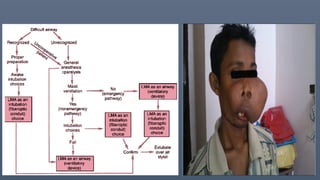
DIFFICULT AIRWAY
ALGORITHM
Intubation
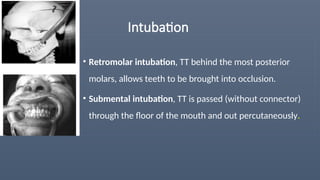
• Retromolar intubation, TT behind the most posterior
molars, allows teeth to be brought into occlusion.
• Submental intubation, TT is passed (without connector)
through the floor of the mouth and out percutaneously.
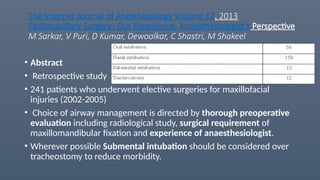
The Internet Journal of Anesthesiology Volume 12. 2013
Faciomaxillary Surgery- Our Experience: Anaesthesiologist's Perspective
M Sarkar, V Puri, D Kumar, Dewoolkar, C Shastri, M Shakeel
• Abstract
• Retrospective study
• 241 patients who underwent elective surgeries for maxillofacial
injuries (2002-2005)
• Choice of airway management is directed by thorough preoperative
evaluation including radiological study, surgical requirement of
maxillomandibular fixation and experience of anaesthesiologist.
• Wherever possible Submental intubation should be considered over
tracheostomy to reduce morbidity.
Induction of anesthesia
• Regular induction vs Rapid Sequence Induction
• Opioids
IV inducing agents
+/- Muscle relaxants
Maintenance of anesthesia
• Volatile agents or total i.v. anesthesia (TIVA).
• analgesia may be provided with Morphine or shorter acting opioids
such as Fentanyl or Alfentanil.
• Remifentanil becoming popular, rapidly titratable, accelerated Wake
up and recovery
• Mandibular and maxillary nerve blocks performed by surgeons can aid
intra/post-op analgesia
Issues
• Associated defects/injuries
• Shared airway
• Difficult intubation
• Bleeding & Induced hypotension
• Emergence/Extubation
• PONV
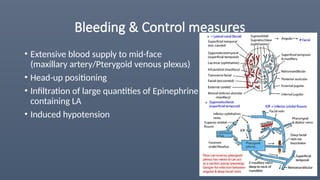
Bleeding & Control measures
• Extensive blood supply to mid-face
(maxillary artery/Pterygoid venous plexus)
• Head-up positioning
• Infiltration of large quantities of Epinephrine
containing LA
• Induced hypotension
Induced hypotension
• Induced-hypotension can reduce blood loss, transfusion rate, and
operating time. Not without risks !!
• No more than 30% reduction with an absolute lower limit of 55 mm
Hg (in ASA I patients)*
• Caution in CAD,uncontrolled HTN,CVD,hepatic/renal impairment
• Clonidine/Magnesium may contribute to postoperative analgesia.
• Mg should be titrated and caution exercised, may prolong
neuromuscular blockade
INTRAOPERATIVE MANAGEMENT
Induced Hypotension
Mild degree of hypotension is required during surgery to reduce the
blood loss. This can be achieved by following:
• 15-30 degree head up tilt
• Increasing the conc. of volatile anesthetics
• Use of peripheral vasodilators
• Use of beta blockers
INTRAOPERATIVE MANAGEMENT
Blood Transfusion
Before the decision of blood transfusion the following points should be
considered
• Patient’s underlying medical condition
• Possibility of risks of transfusion hazards
• Increased risk of post-transfusion cancer recurrence as a result of immune suppression
INTRAOPERATIVE MANAGEMENT
Haemodynamic Changes
During radical neck dissection, the traction or pressure on the carotid
sinus and / or stellate ganglion can cause following:-
• Brady-dysrhythmias
• Sinus arrest leading to asystole
• Wide swings in blood pressure
• Prolonged QT Interval
INTRAOPERATIVE MANAGEMENT
Haemodynamic Changes “Treatment”
• Immediate cessation of the stimulus
• Blockage of the sinus with local anesthetic by the surgeon
• Vagolysis by atropine
INTRAOPERATIVE MANAGEMENT
Venous Air Embolism
• When CVP is low
• Veins are open to atmosphere, air is sucked in causing air embolism.
• Diagnosis
• Early Detection
• Hypoxia
• Hypotension
• Hypocarbia
Venous Air Embolism
Treatment
• Compression of neck veins
• Positive pressure ventilation
• Left lateral position
• Aspiration of air through the central venous catheter
• Ionotropes
INTRAOPERATIVE MANAGEMENT
POST-OPERATIVE CARE
ROUTINE CARE
SPECIAL CONSIDRATIONS
• ICU care & Possible mechanical Ventilation
• Hemodynamic Instability
• Analgesia
• Tracheostomy
POST-OPERATIVE CARE
ICU Care & Possible Mechanical Ventilation
• Patient should be kept in the intensive care unit for 24-48 hours
• Prolonged Surgery
• Airway Oedema
• Co-existing diseases
• Risk of bleeding and/or neck hematoma
POST-OPERATIVE CARE
Haemodynamic Instability
• Bilateral neck dissection may result in
• Post-operative hypertension and hypoxic drive
• Denervation of the carotid sinus and carotid body
POST-OPERATIVE CARE
Analgesia
• Non Steroidal Anti-inflammatory Agents as opioids cause respiratory
depression in spontaneously breathing patients
• When patient is on ventilator opioid analgesia can be given
POST-OPERATIVE CARE
Tracheostomy Care
• Humidified Oxygen
• Intermittent Suction
• Sterile Precautions
• Adjustment of cuff pressure to15-20 mmHg
• Complications
Hypotensive Anesthesia versus Normotensive Anesthesia during Major Maxillofacial
Surgery: A Review of the Literature The Scientific World Journal August: 2014
Michal Barak MD 1 Leiser Yoav DMD, PhD2, Imad Abu el-Naaj DDS 3
1Department of Anesthesiology, Rambam Health Care Campus, and the Bruce Rappaport Faculty of Medicine,
Technion-Israel Institute of Technology, Haifa, Israel
• Conclusions
• Patients who undergo major maxillofacial surgery are at risk of
considerable intra-operative bleeding, and the outcome of the
surgical procedure depends on the quality of the surgical field
conditions. Since hypotensive anesthesia can reduce the extent of
intraoperative bleeding and can potentially improve the quality of the
surgical field conditions, hypotensive anesthesia is considered to be
beneficial during these procedures.
• However, hypotension carries the risk of hypoperfusion in vital organs
and is unsafe in certain patients.
• Thus, the magnitude of the blood pressure reduction should be
adjusted to the patient's general condition, age, and existing diseases.
• Normotensive or modified hypotensive anesthesia should be used for
patients with ischemic heart disease, carotid artery stenosis, a
disseminated vascular disease, kidney dysfunction, or severe
hypertension who are scheduled to undergo a major maxillofacial
operation.
• Appropriate patient selection, careful monitoring, and adequate
intraoperative volume replacement are mandatory in hypotensive
anesthesia for its safe implementation in patients who are scheduled
to undergo a major
Issues
• Associated defects/injuries
• Shared airway
• Difficult intubation
• Bleeding & Induced hypotension
• Emergence/Extubation
• PONV
Emergence and Extubation
• Discontinue Induced hypotension
• ?Airway cleared with suction
• Ensure hemostasis before jaw wiring is carried out (esp if
intermaxillary fixation)
• Deep smooth Vs Safer Awake extubation
• Pharyngeal Pack removed
Issues
• Associated defects/injuries
• Shared airway
• Difficult intubation
• Bleeding & Induced hypotension
• Emergence/Extubation
• Post-operative complications
Postoperative complications
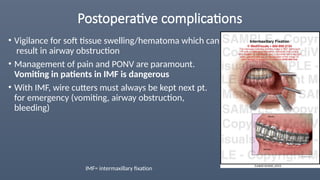
• Vigilance for soft tissue swelling/hematoma which can
result in airway obstruction
• Management of pain and PONV are paramount.
Vomiting in patients in IMF is dangerous
• With IMF, wire cutters must always be kept next pt.
for emergency (vomiting, airway obstruction,
bleeding)
IMF= intermaxillary fixation
PONV
• Orthognathic surgery associated with a high incidence of PONV 7-40%
• Intra-operative steroids (usu dexamethasone) administered also
efficacious anti-emetics and contribute to analgesia.
• The use of additional anti-emetics should be considered
Post op Analgesia
• Postoperative pain after orthognathic surgery often not severe,
probable contribution by intra-op use of LA
• Usu managed by Opioids with PCM and NSAIDs
Conclusion
• Close communication & detailed understanding of the surgical plan to
be followed
• Specific considerations
airway management
techniques to assist surgical hemostasis and reduce blood loss
effective anti-emesis and
vigilance for postoperative airway complications
MAXILLOFASCIAL SURGERY ANESTHESIA  CONSIDERATION

MAXILLOFASCIAL SURGERY ANESTHESIA CONSIDERATION

  • 1.
    Maxillofacial surgery Anesthetic Issues HOSSAMM ATEF;MD Department of Anesthesia SUEZ CANAL UNIVERSITY
  • 2.
    Maxillofacial surgery • Diseases,injuries and defects in the head, neck, face, jaws and the hard and soft tissues of the oral and Cranio-maxillofacial region • Indications Correction of congenital deformities Acquired injuries Neoplasms Cosmetic (dental malocclusions)
  • 3.
  • 4.
    PRE-OPERATIVE PROBLEMS • Neonate,Elderly, Chronically Debilitated Patients • Malnourished, under weight • COPD ,chest infection, aspiration • Alcoholism • Co-existing disease such as HTN,D.M, IHD, etc.
  • 5.
    PRE-OPERATIVE MANAGEMENT Adequate pre-operative work-upof Cardiac Status & Pulmonary Functions should be carried out using various diagnostic modalities with the objective of optimizing patient’s condition
  • 6.
    RECONSTRUCTIVE MAXILLOFACIAL SURGERY Problems: Major problem: Airway Management  Extensive, long operation  Significant blood loss  Poor nutritional status  Micro-vascular surgery • Caution with Vasoconstrictors • Caution with Transfusion • Caution with Diurresis • Blood Rheology (Hct:25-27)
  • 7.
    INTRA-OPERATIVE MANAGEMENT SPECIAL CONSIDERATIONS •Two large bore canulae • Invasive blood pressure monitoring • Central venous pressure monitoring • Use of muscle relaxants • Induced hypotension • Blood loss & transfusion • Haemodynamic changes • Venous air embolism
  • 8.
    INTRA-OPERATIVE MANAGEMENT Invasive BloodPressure Monitoring • is indicated due to following reasons : • Blood loss may be rapid secondary to • Neck dissection • Pre operative radiotherapy • Surgery close to big vessels of neck • Frequent fluctuations in the blood pressure due to manipulation in the area of carotid body and sinus.
  • 9.
    INTRA-OPERATIVE MANAGEMENT Central VenousPressure Monitoring • Risk of venous air embolism during neck dissection • As a guide to the management of fluid therapy • The site of insertion is either: • Antecubital vein • Femoral vein
  • 10.
    INTRAOPERATIVE MANAGEMENT Use ofMuscle Relaxants During surgery IPPV is carried out without muscle relaxant as surgeons need to identify the nerves during surgery
  • 11.
    Issues • Associated defects/injuries •Shared airway • Anticipated/Unanticipated Difficult intubation • Bleeding & Induced hypotension • Emergence/Extubation • Post-operative complications & PONV hossam
  • 12.
    Issues • Associated defects/injuries •Shared airway • Difficult intubation • Bleeding & Induced hypotension • Emergence/Extubation • PONV
  • 13.
    Associated Injuries/Complications • Airwaycompromise • Cervical spine injury/fracture ribs • Head trauma/Pneumocephalus /hemopneumothorax • Subcutaneous emphysema and pneumomediastinum • Trismus • Hemorrhage
  • 14.
    Issues • Associated defects/injuries •Shared airway • Difficult intubation • Bleeding & Induced hypotension • Emergence/Extubation • PONV
  • 15.
    Airway sharing • Commonsite of Work • Pre-op discussion & planning helpful • Intraop assesssment of facial symmetry, mouth opening & teeth occlusion • Extra vigilance for tube dislodgement,kinking
  • 16.
    Issues • Associated defects/injuries •Shared airway • Difficult intubation • Bleeding & Induced hypotension • Emergence/Extubation • PONV
  • 17.
     Documented Historyof Difficulties with general anesthesia or, more specifically, mask ventilation or endotracheal intubation  Congenital Syndromes Associated With Difficult Endotracheal Intubation  Pathologic States That Influence Airway Management
  • 18.
    Congenital Syndromes AssociatedWith Difficult Endotracheal Intubation • SYNDROME • Down • Large tongue, small mouth ; small subglottic diameter possible Laryngospasm frequent • Goldenhar • Mandibular hypoplasia and cervical spine abnormality • Klippel-Feil • Neck rigidity because of cervical vertebral fusion • Pierre Robin • Small mouth, large tongue, mandibular anomaly; awake intubation essential in neonate • Treacher Collins (mandibulofacial dysostosis) Laryngoscopy difficult • Turner • High likelihood of difficult intubation
  • 19.
    Pathologic States ThatInfluence Airway Management • Infectious epiglottitis,Laryngoscopy may worsen obstruction • Abscess (submandibular, retropharyngeal, Ludwig‘s angina) • Distortion of airway renders mask ventilation or intubation extremely difficult • Croup, bronchitis, pneumonia (current or recent) • Airway irritability with tendency for cough, laryngospasm, bronchospasm • Maxillary/mandibular injury • Airway obstruction, difficult mask ventilation, and intubation; cricothyroidotomy may be necessary with combined injuries • Laryngeal fracture ,Airway obstruction may worsen during instrumentation • Cervical spine injury ,Neck manipulation may traumatize spinal cord
  • 20.
    • Selected PathologicStates That Influence Airway Management • Upper airway tumors Inspiratory obstruction with spontaneous ventilation • Lower airway tumors Airway obstruction not relieved by tracheal intubation • Radiation therapy Fibrosis may distort airway or make manipulations difficult • Inflammatory rheumatoid arthritis • Mandibular hypoplasia, temporomandibular joint arthritis, immobile cervical spine, laryngeal rotation, cricoarytenoid arthritis all make intubation difficult and hazardous • Ankylosing spondylitis Direct laryngoscopy maybe impossible • Soft tissue, neck injury (edema, bleeding, emphysema) Anatomic distortion of airway • Laryngeal edema (postintubation) Irritable airway, narrowed laryngeal inlet
  • 21.
    Selected Pathologic StatesThat Influence Airway Management • Angioedema Obstructive swelling renders ventilation and intubation difficult • Endocrine/metabolic acromegaly Large tongue, bony overgrowths • Diabetes mellitus Reduced mobility of atlanto-occipital joint • Hypothyroidism Large tongue, abnormal soft tissue (myxedema) make ventilation and intubation difficult • Thyromegaly Extrinsic airway compression or deviation • Obesity Upper airway obstruction with loss of consciousness, Tissue mass makes successful mask ventilation unlikely
  • 22.
    Further Evaluation PRE-OPERATIVE ASSESSMENTOF THE AIRWAY • Indirect or Fiberoptic Laryngoscopy • X ray: Chest , Cervical Spine • CT or MRI • Flow- Volume Loops • Pulmonary Function Tests
  • 23.
    Difficult Airway  Difficultairway The clinical situation in which a conventionally trained anesthesiologist experiences difficulty with mask ventilation, difficulty with tracheal intubation, or both  Difficult mask ventilation 1) inability of unassisted anesthesiologist to maintain SpO2 > 90% using 100% oxygen and positive pressure mask ventilation in a patient whose SpO2 was 90% before anesthetic intervention;
  • 24.
    Difficult Airway  DifficultLaryngoscopy Not being able to see any part of the vocal cords with conventional laryngoscopy  Difficult Intubation Proper insertion with conventional laryngoscopy requires either : a) > 3 attempts b) > 10min
  • 25.
    Difficult Airway Awake Awake Laryngoscopy Awake Fiberoptic Tracheostomy Retrograde Intubation UnderGA/Sedation Different Laryngoscopes , Stylets LMA/ I LMA/FO Fiberoptic Tracheostomy Blind Nasal Intubation
  • 26.
  • 27.
    AWAKE TECHNIQUES Glosso-Pharyngeal NerveIX Nerve Posterior pharyngeal fold at its midpoint, 1 cm deep to the mucosa of the lateral pharyngeal wall
  • 28.
    AWAKE TECHNIQUES Superior LaryngealNerve Pyriform Fossa External :1 cm medial to the superior cornu of the Hyoid Bone to pierce the thyrohyoid membrane
  • 29.
  • 30.
    C h idr e n / U n c oa p e ra tiv e A d u lts / S e p sis A sse ss / A n tic h o lin e r g ic / A n x io ly tic ( if a n y) 1 ) In h a la tio n a l / a sse s: Ve n tila tio n / V e iw (=/- short a cting M R) 2 ) S tille te / D iffe r en t L a ry n g e osc o p es F a c e M a sk + F. O . + M o d ified O r a l A W 3) L M A / L M A + F .O . 4 ) F. O u sin g S e d a tion O r lig h t G A 5 ) T r ac h e o syo m y u n d e r lig h t G A 6 ) B lin d N a sa l T e c h n iq u e
  • 31.
    Anticipated problems • 1.Anticipateddifficult airway • 2.Restricted ability to open the mouth • 3.Possibility of cervical spine fracture • 4.Possibility of concurrent base skull fracture • 5. Full stomach (emergency cases)
  • 32.
    Methods available • Awakevs Anesthetized patient • Orotracheal vs nasotracheal intubation • Fiberoptic laryngoscopy/intubation • Anterograde vs retrograde • Cricothyroidotomy, tracheostomy
  • 33.
  • 34.
    Intubation • Retromolar intubation,TT behind the most posterior molars, allows teeth to be brought into occlusion. • Submental intubation, TT is passed (without connector) through the floor of the mouth and out percutaneously.
  • 35.
    The Internet Journalof Anesthesiology Volume 12. 2013 Faciomaxillary Surgery- Our Experience: Anaesthesiologist's Perspective M Sarkar, V Puri, D Kumar, Dewoolkar, C Shastri, M Shakeel • Abstract • Retrospective study • 241 patients who underwent elective surgeries for maxillofacial injuries (2002-2005) • Choice of airway management is directed by thorough preoperative evaluation including radiological study, surgical requirement of maxillomandibular fixation and experience of anaesthesiologist. • Wherever possible Submental intubation should be considered over tracheostomy to reduce morbidity.
  • 36.
    Induction of anesthesia •Regular induction vs Rapid Sequence Induction • Opioids IV inducing agents +/- Muscle relaxants
  • 37.
    Maintenance of anesthesia •Volatile agents or total i.v. anesthesia (TIVA). • analgesia may be provided with Morphine or shorter acting opioids such as Fentanyl or Alfentanil. • Remifentanil becoming popular, rapidly titratable, accelerated Wake up and recovery • Mandibular and maxillary nerve blocks performed by surgeons can aid intra/post-op analgesia
  • 38.
    Issues • Associated defects/injuries •Shared airway • Difficult intubation • Bleeding & Induced hypotension • Emergence/Extubation • PONV
  • 39.
    Bleeding & Controlmeasures • Extensive blood supply to mid-face (maxillary artery/Pterygoid venous plexus) • Head-up positioning • Infiltration of large quantities of Epinephrine containing LA • Induced hypotension
  • 40.
    Induced hypotension • Induced-hypotensioncan reduce blood loss, transfusion rate, and operating time. Not without risks !! • No more than 30% reduction with an absolute lower limit of 55 mm Hg (in ASA I patients)* • Caution in CAD,uncontrolled HTN,CVD,hepatic/renal impairment • Clonidine/Magnesium may contribute to postoperative analgesia. • Mg should be titrated and caution exercised, may prolong neuromuscular blockade
  • 41.
    INTRAOPERATIVE MANAGEMENT Induced Hypotension Milddegree of hypotension is required during surgery to reduce the blood loss. This can be achieved by following: • 15-30 degree head up tilt • Increasing the conc. of volatile anesthetics • Use of peripheral vasodilators • Use of beta blockers
  • 42.
    INTRAOPERATIVE MANAGEMENT Blood Transfusion Beforethe decision of blood transfusion the following points should be considered • Patient’s underlying medical condition • Possibility of risks of transfusion hazards • Increased risk of post-transfusion cancer recurrence as a result of immune suppression
  • 43.
    INTRAOPERATIVE MANAGEMENT Haemodynamic Changes Duringradical neck dissection, the traction or pressure on the carotid sinus and / or stellate ganglion can cause following:- • Brady-dysrhythmias • Sinus arrest leading to asystole • Wide swings in blood pressure • Prolonged QT Interval
  • 44.
    INTRAOPERATIVE MANAGEMENT Haemodynamic Changes“Treatment” • Immediate cessation of the stimulus • Blockage of the sinus with local anesthetic by the surgeon • Vagolysis by atropine
  • 45.
    INTRAOPERATIVE MANAGEMENT Venous AirEmbolism • When CVP is low • Veins are open to atmosphere, air is sucked in causing air embolism. • Diagnosis • Early Detection • Hypoxia • Hypotension • Hypocarbia
  • 46.
    Venous Air Embolism Treatment •Compression of neck veins • Positive pressure ventilation • Left lateral position • Aspiration of air through the central venous catheter • Ionotropes INTRAOPERATIVE MANAGEMENT
  • 47.
    POST-OPERATIVE CARE ROUTINE CARE SPECIALCONSIDRATIONS • ICU care & Possible mechanical Ventilation • Hemodynamic Instability • Analgesia • Tracheostomy
  • 48.
    POST-OPERATIVE CARE ICU Care& Possible Mechanical Ventilation • Patient should be kept in the intensive care unit for 24-48 hours • Prolonged Surgery • Airway Oedema • Co-existing diseases • Risk of bleeding and/or neck hematoma
  • 49.
    POST-OPERATIVE CARE Haemodynamic Instability •Bilateral neck dissection may result in • Post-operative hypertension and hypoxic drive • Denervation of the carotid sinus and carotid body
  • 50.
    POST-OPERATIVE CARE Analgesia • NonSteroidal Anti-inflammatory Agents as opioids cause respiratory depression in spontaneously breathing patients • When patient is on ventilator opioid analgesia can be given
  • 51.
    POST-OPERATIVE CARE Tracheostomy Care •Humidified Oxygen • Intermittent Suction • Sterile Precautions • Adjustment of cuff pressure to15-20 mmHg • Complications
  • 52.
    Hypotensive Anesthesia versusNormotensive Anesthesia during Major Maxillofacial Surgery: A Review of the Literature The Scientific World Journal August: 2014 Michal Barak MD 1 Leiser Yoav DMD, PhD2, Imad Abu el-Naaj DDS 3 1Department of Anesthesiology, Rambam Health Care Campus, and the Bruce Rappaport Faculty of Medicine, Technion-Israel Institute of Technology, Haifa, Israel • Conclusions • Patients who undergo major maxillofacial surgery are at risk of considerable intra-operative bleeding, and the outcome of the surgical procedure depends on the quality of the surgical field conditions. Since hypotensive anesthesia can reduce the extent of intraoperative bleeding and can potentially improve the quality of the surgical field conditions, hypotensive anesthesia is considered to be beneficial during these procedures.
  • 53.
    • However, hypotensioncarries the risk of hypoperfusion in vital organs and is unsafe in certain patients. • Thus, the magnitude of the blood pressure reduction should be adjusted to the patient's general condition, age, and existing diseases. • Normotensive or modified hypotensive anesthesia should be used for patients with ischemic heart disease, carotid artery stenosis, a disseminated vascular disease, kidney dysfunction, or severe hypertension who are scheduled to undergo a major maxillofacial operation.
  • 54.
    • Appropriate patientselection, careful monitoring, and adequate intraoperative volume replacement are mandatory in hypotensive anesthesia for its safe implementation in patients who are scheduled to undergo a major
  • 55.
    Issues • Associated defects/injuries •Shared airway • Difficult intubation • Bleeding & Induced hypotension • Emergence/Extubation • PONV
  • 56.
    Emergence and Extubation •Discontinue Induced hypotension • ?Airway cleared with suction • Ensure hemostasis before jaw wiring is carried out (esp if intermaxillary fixation) • Deep smooth Vs Safer Awake extubation • Pharyngeal Pack removed
  • 57.
    Issues • Associated defects/injuries •Shared airway • Difficult intubation • Bleeding & Induced hypotension • Emergence/Extubation • Post-operative complications
  • 58.
    Postoperative complications • Vigilancefor soft tissue swelling/hematoma which can result in airway obstruction • Management of pain and PONV are paramount. Vomiting in patients in IMF is dangerous • With IMF, wire cutters must always be kept next pt. for emergency (vomiting, airway obstruction, bleeding) IMF= intermaxillary fixation
  • 59.
    PONV • Orthognathic surgeryassociated with a high incidence of PONV 7-40% • Intra-operative steroids (usu dexamethasone) administered also efficacious anti-emetics and contribute to analgesia. • The use of additional anti-emetics should be considered
  • 60.
    Post op Analgesia •Postoperative pain after orthognathic surgery often not severe, probable contribution by intra-op use of LA • Usu managed by Opioids with PCM and NSAIDs
  • 61.
    Conclusion • Close communication& detailed understanding of the surgical plan to be followed • Specific considerations airway management techniques to assist surgical hemostasis and reduce blood loss effective anti-emesis and vigilance for postoperative airway complications

Editor's Notes

  • #2 Orthognathic surgery, (Greek: orthos ‘straight’, gnathos ‘jaw’) involving osteotomy and repositioning of the mandible, maxilla, or both is performed to treat skeletal disproportion of the lower face
  • #12 Associated cardiovascular effects with cleft palate/lip
  • #15 Not only is the airway shared, as with any oral surgery, but orthognathic surgery also requires that the patient's mouth is free for the occlusion of the teeth to be checked intra-operatively with and without the wafers As the correction of facial symmetry and profile is a fundamental goal of the surgery it is also necessary for the surgeons to periodically undrape the face to assess the relationship between lips and central facial structures, and so anesthetic equipment should not unnecessarily distort these tissues
  • #32 nasotracheal intubation is contraindicated in the presence of fracture of nasal skeleton, skull base fracture and CSF rhinorrhoea
  • #34  Retromolar intubation, an attempt is made to pass a reinforced oral TT (inserted conventionally) behind the most posterior molars, thus still allowing the teeth to be brought into occlusion. Submental intubation, the end of the conventionally inserted oral TT is passed (minus its connector) through the floor of the mouth and out percutaneously. Neither of these is ideal from the surgical perspective and the risk of accidental TT dislodgement is high.  Tracheostomy
  • #35 The Internet Journal of Anesthesiology Volume 12 Number 1 Original Article
  • #37 analgesia may be provided with morphine or with shorter acting opioids such as fentanyl or alfentanil. With either volatile agents or TIVA, the use of remifentanil is becoming popular, its rapidly titratable nature allowing for smooth anesthesia during intermittently highly stimulating surgery. Wake up and recovery may also be accelerated
  • #39 Minimizing blood loss intra-operatively can be difficult, especially during maxillary surgery. The bony mid-face receives an extensive blood supply and the posterior maxilla is also in close proximity to a rich venous plexus. Bleeding can therefore be heavy from both soft tissue and bone. Bleeding can occur from branches of the third part of the maxillary artery and on occasions from the pterygoid venous plexus which can lead to major blood loss. T
  • #40 number of contraindications to induced hypotension including ischemic heart disease, uncontrolled hypertension, diabetes, severe anaemia, haemoglobinopathies (such as Sickle cell anaemia), cerebrovascular disease, and hepatic and renal impairment. Some of these are relative and induced hypotension may still be used, but with caution and closer monitoring.
  • #58 Management of pain and PONV are paramount. Vomiting in patients in IMF is dangerous and if jaws are wired there must be wire cutters immediately available which accompany the patient from theatre, to the PACU, and also to the ward
  • #59  Intra-operative steroids, usually dexamethasone, are administered primarily to minimize postoperative swelling but are also efficacious anti-emetics and contribute to analgesia. Orthognathic surgery is nevertheless associated with a high incidence of postoperative nausea and vomiting (PONV) of 7–40% even with peri-operative steroids the occurrence of which is undesirable in these patients, particularly if jaw fixation is to be used after operation in some form (see below). The use of additional anti-emetics should be considered
  • #60 As with many types of head and neck surgery, postoperative pain after orthognathic surgery is often not severe, and this is contributed to by the generous intra-operative use of local anesthesia
  • #61 Good anaesthesia for orthognathic and TMJ surgery requires close communication with the surgical team and a detailed understanding of the surgical plan to be followed both intra-operatively and after operation. Specific considerations include airway management, techniques to assist surgical haemostasis and reduce blood loss, effective anti-emesis and vigilance for postoperative airway complications. Induced-hypotension is of benefit to patient outcome and safe when undertaken in an appropriate manner.